ACCT602 Case Study Analysis: NZ IAS 38 and Intangible Assets

Verified

Added on  2023/06/04

|6
|1566
|88
Case Study
AI Summary
This case study analyzes the financial accounting treatment of intangible assets under NZ IAS 38, using Tourism Holdings Limited (THL) as an example. The analysis evaluates the recognition, measurement, and disclosure of THL's intangible assets, including brands, goodwill, trademarks, leases, licenses, and other intangibles. The study examines whether THL's accounting practices align with NZ IAS 38, particularly regarding the use of fair value and historical cost. The document also explores the separate recognition and disclosure of goodwill, examining the reasons behind this practice and referencing relevant accounting literature. The case study highlights the importance of understanding and applying accounting standards for intangible assets in financial reporting.
Document Page
Running head: FINANCIAL ACCOUNTING FOR COMPANIES
Financial Accounting for Companies
Name of the Student
Name of the University
Author’s Note
tabler-icon-diamond-filled.svg

Paraphrase This Document

Need a fresh take? Get an instant paraphrase of this document with our AI Paraphraser
Document Page
1FINANCIAL ACCOUNTING FOR COMPANIES
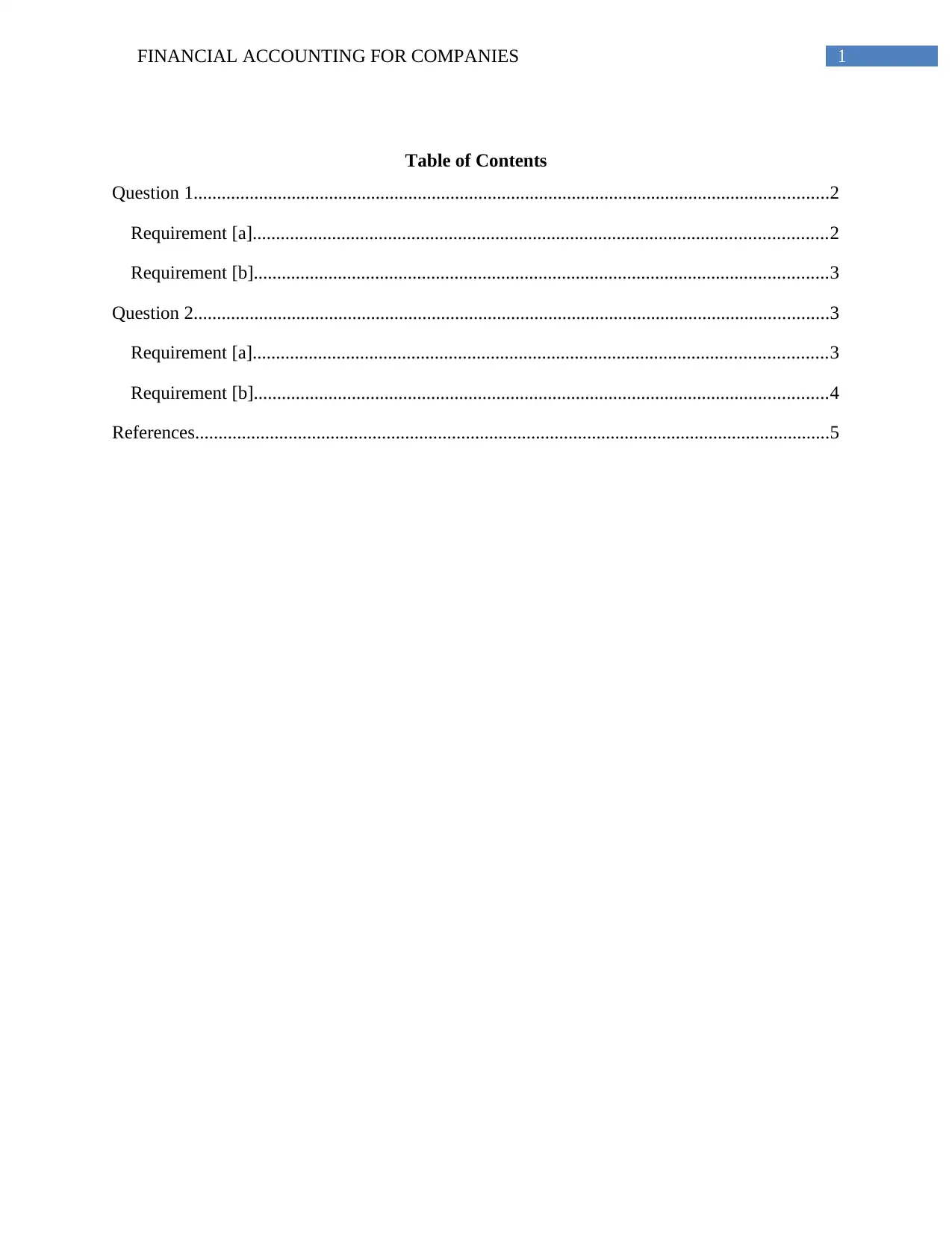
Table of Contents
Question 1........................................................................................................................................2
Requirement [a]...........................................................................................................................2
Requirement [b]...........................................................................................................................3
Question 2........................................................................................................................................3
Requirement [a]...........................................................................................................................3
Requirement [b]...........................................................................................................................4
References........................................................................................................................................5
Document Page
2FINANCIAL ACCOUNTING FOR COMPANIES
Question 1
Requirement [a]
It can be seen from the 2017 Annual Financial Statement of THL Company (THL) that
the company has provided the information about their intangible assets of their business.
According to the 2017 Annual Financial Statement of THL, the company has recognized some
specific intangible assets. They are Brands; Goodwill; Trademarks, Leases and Licenses; and
Other Intangibles (thlonline.com, 2018).
The accounting standards setting body of New Zealand has provided the business entities
of the country with the required guidelines at the time of the recognition of the business
intangible assets; and these guiding principles can be found in NZ IAS 38: Intangible Assets.
According to NZ IAS 38, the business organizations of the country are needed to fulfill two
conditions at the time to recognize the intangible assets (Kabir & Laswad, 2014). According to
the first condition, companies are needed to recognize the intangible assets in the presence of the
probability that the future economic benefits related with the intangible asset will flow to the
entity; and the companies need to be able to reliably measure the cost of those intangible assets
(Vetoshkina & Tukhvatullin, 2014).
According to the 2017 Annual Financial Report of THL, the company has recognized
Brands at the fair value at the date of acquisition; and the value of this asset is included in the
cash generating unit (thlonline.com, 2018). In case of Goodwill, THL has recognized them in fair
value at the date of acquisition and it is added in the cash generating unit. After that, the
company has recognized the intangible assets of trademark, leases and license at the historical
cost less amortization at the date of acquisition. Lastly, other intangible assets like the computer
software are recognized on the basis of cost at the date of acquisition as the company considers
them as assets and they are subject to amortization (Baboukardos & Rimmel, 2014).
Thus, it can be seen from the above discussion that the company has been able in the
measurement of the cost of all of these intangible assets ether in fair value basis or on the basis
of historical cost. In addition, the value of these assets are added to cash generating unit and the
Document Page
3FINANCIAL ACCOUNTING FOR COMPANIES
company has considered them as assets and the company will gain the future economic benefits
of these assets. Hence, the basis of recognition is constant with NZ IAS 38.
Requirement [b]
The above discussion indicates that THL uses fair value measurement basis for the
recognition of majority portion of their intangible assets and the company gets major benefits
from this. The adoption of fair value measurement helps the company in capturing the recent
changes in the value of these intangible assets and thus, they become able in the reliable
measurement of the cost of these intangible assets. In addition, THL’s measurement process of
intangible assets as per NZ IAS 38 makes the details about intangible assets more acceptable in
the presence of major compliance with the relevant regulations. All these aspects indicate
towards the appropriateness of the measurement basis of THL for the intangible assets (Castilla-
Polo & Gallardo-Vázquez, 2016).
Question 2
Requirement [a]
In the process of financial reporting of the companies, there are many instances where the
business entities have recognized and disclosed some part of their intangible assets separately;
and it has been done in the presence of some specific reasons (thlonline.com, 2018). The same
aspect can be seen in the financial reporting of THL. It can be observed from the 2017 Annual
Financial Statements of THL that the company has recognized and disclosed some specific part
of their goodwill separately. THL involves in the annual testing of impairment for the separately
recognized goodwill and this disclosure is done at cost value less accumulated impairment
losses. In this context, it needs to be mentioned that the separately recognized goodwill of THL
is related to the acquisition of El Monte Rents Inc (André, Dionysiou & Tsalavoutas, 2018).
There are certain reasons for which the company has recognized this part of the goodwill
separately. It is considered as an intangible asset as it is probable that the company will receive
future economic benefit from this asset. After that, as per NZ IAS 38: Intangible Assets, THL
has been able in the reliable measurement of the cost of the separately acquired intangible assets
as the company has acquired El Monte Rents Inc at a price of $91 million that comprises cash of
$79 million and 3,384,266 shares of THL. Apart from this, it can be seen that the cost of
tabler-icon-diamond-filled.svg

Paraphrase This Document

Need a fresh take? Get an instant paraphrase of this document with our AI Paraphraser
Document Page
4FINANCIAL ACCOUNTING FOR COMPANIES
separately acquired intangible asset of THL includes some major aspects like the purchase price
including non-refundable purchase taxes, import duties, rebates and after deducting trade
discount along with some direct costs related to the acquisition of the intangible asset (Lueg,
Punda & Burkert, 2014). Apart from this, the company has recognized this intangible asset
differently as there are some expenditures that are not the part of the acquisition of this intangible
asset; some of them are cost related to the introduction of new product, cost o conduct business
in new location and others. In the presence of all these reasons, THL has separately recognized
and disclosed this intangible asset (Lueg, Punda & Burkert, 2014).
Requirement [b]
There are different articles that have discussed about the process to separately recognize
and disclose some of the intangible assets. One of them is Accounting for intangible assets:
current requirements, key players and future directions” by Stephen Powell and this article
discusses about the present accounting requirement of the intangible assets (Powell, 2003).
According to this article, it is needed for the business entities to involve in the separate
recognition of an intangible asset in case it arises from the contractual or legal rights (Powell,
2003). Related to the acquisition of business, the article indicates towards the fact that the
acquirer is needed to separately recognize and disclosed the goodwill from the acquisition in the
financial statements of the acquirer. However, at the same time, the author has also mentioned
the fact that it is a difficult process for the acquirer companies to separately recognize and
disclose a specific part of the intangible assets (Powell, 2003).
Document Page
5FINANCIAL ACCOUNTING FOR COMPANIES
References
Powell, S. (2003). Accounting for intangible assets: current requirements, key players and future
directions. European accounting review, 12(4), 797-811.
Vetoshkina, E. Y., & Tukhvatullin, R. S. (2014). The problem of accounting for the costs
incurred after the initial recognition of an intangible asset. Mediterranean Journal of
Social Sciences, 5(24), 52.
Castilla-Polo, F., & Gallardo-Vázquez, D. (2016). The main topics of research on disclosures of
intangible assets: a critical review. Accounting, Auditing & Accountability Journal, 29(2),
323-356.
Kabir, M. H., & Laswad, F. (2014). The behaviour of earnings, accruals and impairment losses
of failed New Zealand finance companies. Australian Accounting Review, 24(3), 262-
275.
André, P., Dionysiou, D., & Tsalavoutas, I. (2018). Mandated disclosures under IAS 36
Impairment of Assets and IAS 38 Intangible Assets: value relevance and impact on
analysts’ forecasts. Applied Economics, 50(7), 707-725.
Lueg, R., Punda, P., & Burkert, M. (2014). Does transition to IFRS substantially affect key
financial ratios in shareholder-oriented common law regimes? Evidence from the
UK. Advances in accounting, 30(1), 241-250.
Baboukardos, D., & Rimmel, G. (2014, March). Goodwill under IFRS: Relevance and
disclosures in an unfavorable environment. In Accounting Forum (Vol. 38, No. 1, pp. 1-
17). Elsevier.
THL. (2018). Annual Financial Statements. Retrieved 23 September 2018, from
http://www.thlonline.com/FinancialInvestorInformation/Documents/ShareholderDocs201
7/thl-Annual-Financial-Statements-FY17.pdf
chevron_up_icon
1 out of 6
circle_padding
hide_on_mobile
zoom_out_icon
[object Object]