Financial Accounting: A Comparison of Ethics Codes and Practices
VerifiedAdded on 2022/11/13
|13
|3491
|450
Essay
AI Summary
This essay undertakes a comparative analysis of two pivotal codes of ethics within the Australian financial sector: the Banking Code of Practice and the Code of Ethics for Professional Accountants. It begins with an introduction to the codes and their significance in upholding professional standards and ethical conduct. The essay delves into the similarities and differences between the two codes, examining their scope, application, purpose, and the individuals to whom they apply. It explores the fundamental principles that guide each code, such as transparency, accountability, integrity, and objectivity. The essay then investigates the need for these codes, highlighting how they address issues within the banking and accounting sectors, such as the imbalance of power between banks and customers and the need for structured self-regulation. Furthermore, the essay assesses the effectiveness of these codes, considering their role in enhancing consumer protection and promoting professional ethical standards, while also addressing criticisms and potential improvements. The analysis draws on peer-reviewed journals, articles, and books to support its arguments, providing a comprehensive understanding of the impact and importance of these codes in the financial industry.
Running head: Financial Accounting 1
FINANCIAL ACCOUNTING
STUDENT’S NAME
STUDENT NUMBER
COURSE NAME
COURSE NUMBER
DATE OF SUBMISSION
NUMBER OF WORDS
FINANCIAL ACCOUNTING
STUDENT’S NAME
STUDENT NUMBER
COURSE NAME
COURSE NUMBER
DATE OF SUBMISSION
NUMBER OF WORDS

Paraphrase This Document
Need a fresh take? Get an instant paraphrase of this document with our AI Paraphraser
Financial Accounting 2
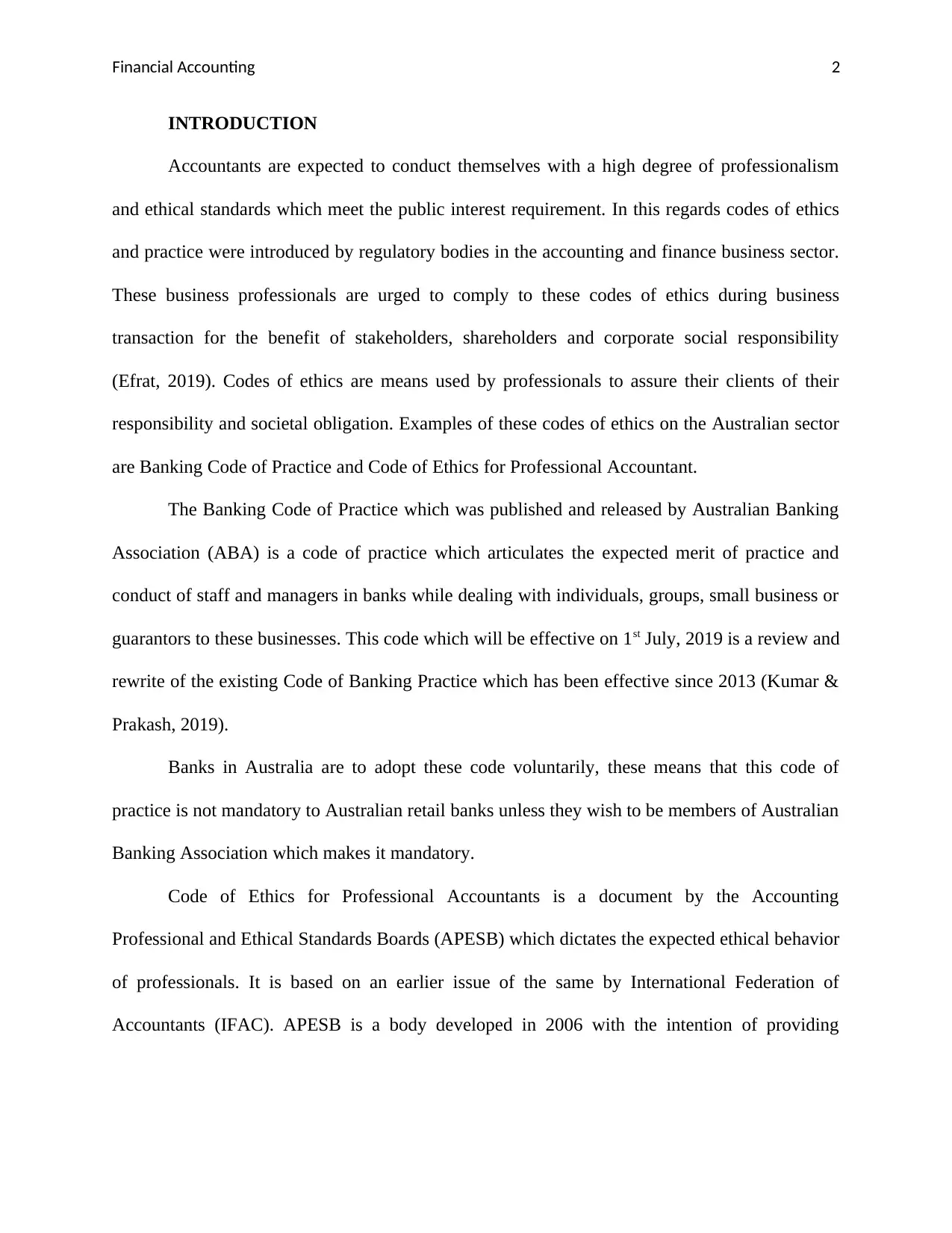
INTRODUCTION
Accountants are expected to conduct themselves with a high degree of professionalism
and ethical standards which meet the public interest requirement. In this regards codes of ethics
and practice were introduced by regulatory bodies in the accounting and finance business sector.
These business professionals are urged to comply to these codes of ethics during business
transaction for the benefit of stakeholders, shareholders and corporate social responsibility
(Efrat, 2019). Codes of ethics are means used by professionals to assure their clients of their
responsibility and societal obligation. Examples of these codes of ethics on the Australian sector
are Banking Code of Practice and Code of Ethics for Professional Accountant.
The Banking Code of Practice which was published and released by Australian Banking
Association (ABA) is a code of practice which articulates the expected merit of practice and
conduct of staff and managers in banks while dealing with individuals, groups, small business or
guarantors to these businesses. This code which will be effective on 1st July, 2019 is a review and
rewrite of the existing Code of Banking Practice which has been effective since 2013 (Kumar &
Prakash, 2019).
Banks in Australia are to adopt these code voluntarily, these means that this code of
practice is not mandatory to Australian retail banks unless they wish to be members of Australian
Banking Association which makes it mandatory.
Code of Ethics for Professional Accountants is a document by the Accounting
Professional and Ethical Standards Boards (APESB) which dictates the expected ethical behavior
of professionals. It is based on an earlier issue of the same by International Federation of
Accountants (IFAC). APESB is a body developed in 2006 with the intention of providing
INTRODUCTION
Accountants are expected to conduct themselves with a high degree of professionalism
and ethical standards which meet the public interest requirement. In this regards codes of ethics
and practice were introduced by regulatory bodies in the accounting and finance business sector.
These business professionals are urged to comply to these codes of ethics during business
transaction for the benefit of stakeholders, shareholders and corporate social responsibility
(Efrat, 2019). Codes of ethics are means used by professionals to assure their clients of their
responsibility and societal obligation. Examples of these codes of ethics on the Australian sector
are Banking Code of Practice and Code of Ethics for Professional Accountant.
The Banking Code of Practice which was published and released by Australian Banking
Association (ABA) is a code of practice which articulates the expected merit of practice and
conduct of staff and managers in banks while dealing with individuals, groups, small business or
guarantors to these businesses. This code which will be effective on 1st July, 2019 is a review and
rewrite of the existing Code of Banking Practice which has been effective since 2013 (Kumar &
Prakash, 2019).
Banks in Australia are to adopt these code voluntarily, these means that this code of
practice is not mandatory to Australian retail banks unless they wish to be members of Australian
Banking Association which makes it mandatory.
Code of Ethics for Professional Accountants is a document by the Accounting
Professional and Ethical Standards Boards (APESB) which dictates the expected ethical behavior
of professionals. It is based on an earlier issue of the same by International Federation of
Accountants (IFAC). APESB is a body developed in 2006 with the intention of providing
Financial Accounting 3
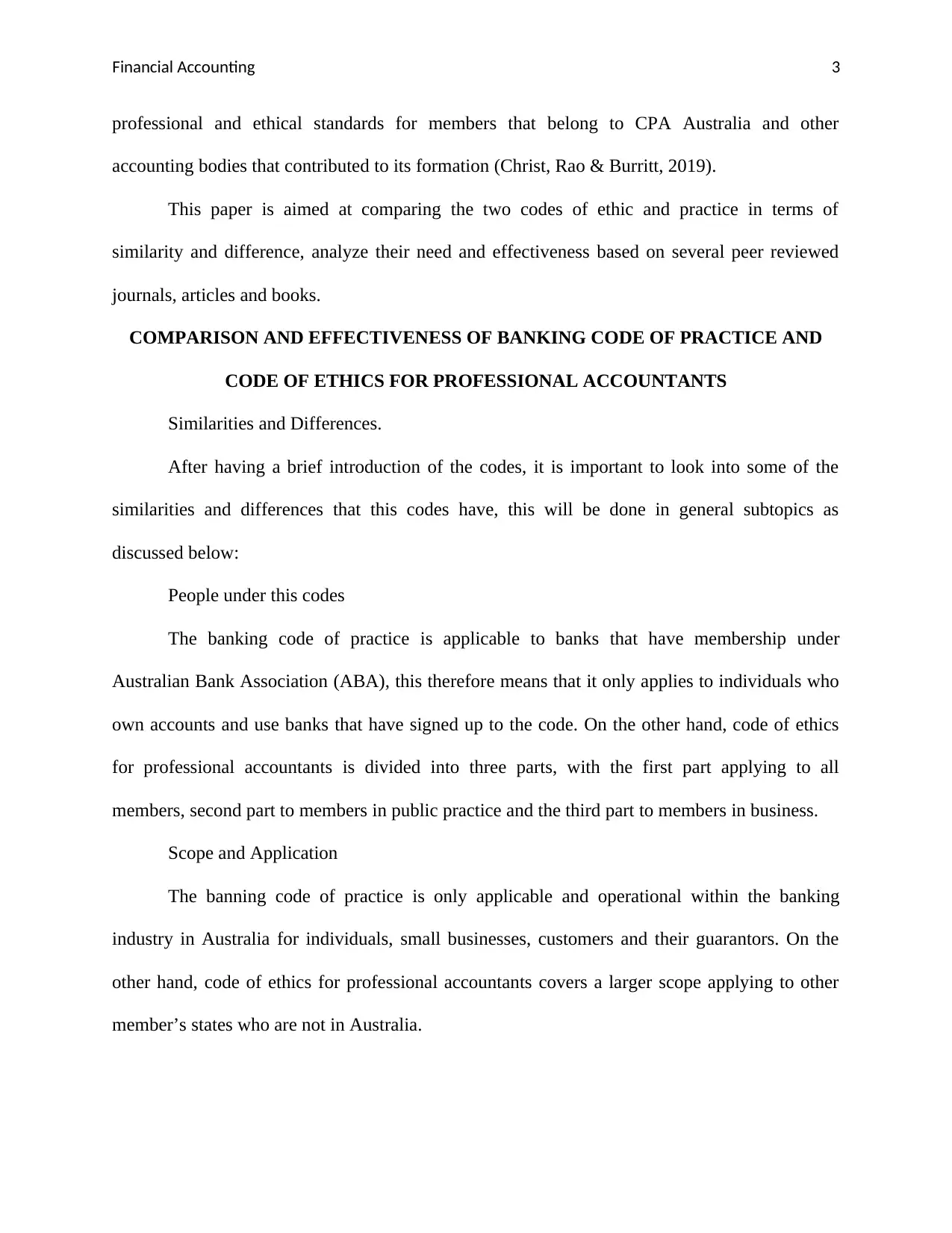
professional and ethical standards for members that belong to CPA Australia and other
accounting bodies that contributed to its formation (Christ, Rao & Burritt, 2019).
This paper is aimed at comparing the two codes of ethic and practice in terms of
similarity and difference, analyze their need and effectiveness based on several peer reviewed
journals, articles and books.
COMPARISON AND EFFECTIVENESS OF BANKING CODE OF PRACTICE AND
CODE OF ETHICS FOR PROFESSIONAL ACCOUNTANTS
Similarities and Differences.
After having a brief introduction of the codes, it is important to look into some of the
similarities and differences that this codes have, this will be done in general subtopics as
discussed below:
People under this codes
The banking code of practice is applicable to banks that have membership under
Australian Bank Association (ABA), this therefore means that it only applies to individuals who
own accounts and use banks that have signed up to the code. On the other hand, code of ethics
for professional accountants is divided into three parts, with the first part applying to all
members, second part to members in public practice and the third part to members in business.
Scope and Application
The banning code of practice is only applicable and operational within the banking
industry in Australia for individuals, small businesses, customers and their guarantors. On the
other hand, code of ethics for professional accountants covers a larger scope applying to other
member’s states who are not in Australia.
professional and ethical standards for members that belong to CPA Australia and other
accounting bodies that contributed to its formation (Christ, Rao & Burritt, 2019).
This paper is aimed at comparing the two codes of ethic and practice in terms of
similarity and difference, analyze their need and effectiveness based on several peer reviewed
journals, articles and books.
COMPARISON AND EFFECTIVENESS OF BANKING CODE OF PRACTICE AND
CODE OF ETHICS FOR PROFESSIONAL ACCOUNTANTS
Similarities and Differences.
After having a brief introduction of the codes, it is important to look into some of the
similarities and differences that this codes have, this will be done in general subtopics as
discussed below:
People under this codes
The banking code of practice is applicable to banks that have membership under
Australian Bank Association (ABA), this therefore means that it only applies to individuals who
own accounts and use banks that have signed up to the code. On the other hand, code of ethics
for professional accountants is divided into three parts, with the first part applying to all
members, second part to members in public practice and the third part to members in business.
Scope and Application
The banning code of practice is only applicable and operational within the banking
industry in Australia for individuals, small businesses, customers and their guarantors. On the
other hand, code of ethics for professional accountants covers a larger scope applying to other
member’s states who are not in Australia.
⊘ This is a preview!⊘
Do you want full access?
Subscribe today to unlock all pages.

Trusted by 1+ million students worldwide
Financial Accounting 4
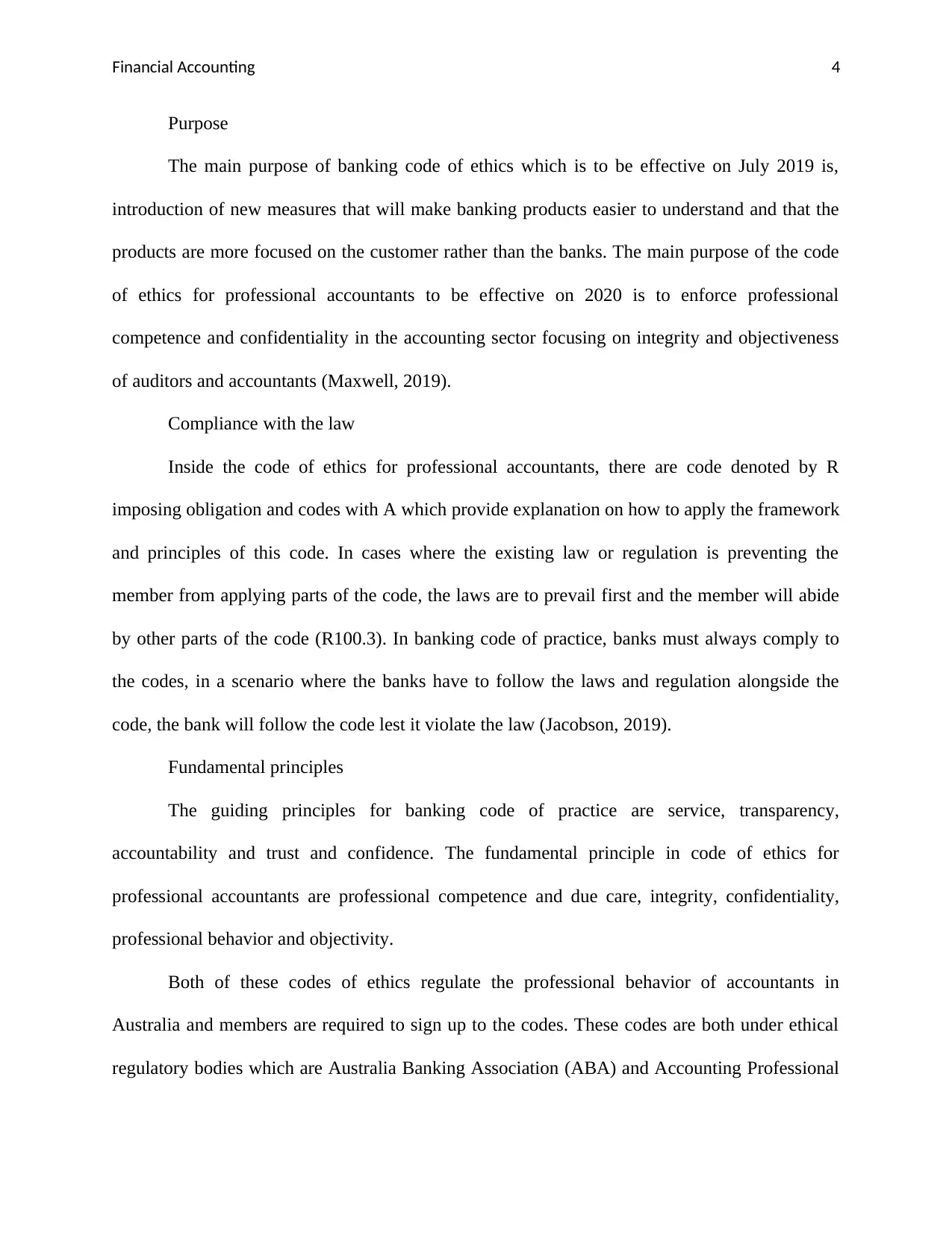
Purpose
The main purpose of banking code of ethics which is to be effective on July 2019 is,
introduction of new measures that will make banking products easier to understand and that the
products are more focused on the customer rather than the banks. The main purpose of the code
of ethics for professional accountants to be effective on 2020 is to enforce professional
competence and confidentiality in the accounting sector focusing on integrity and objectiveness
of auditors and accountants (Maxwell, 2019).
Compliance with the law
Inside the code of ethics for professional accountants, there are code denoted by R
imposing obligation and codes with A which provide explanation on how to apply the framework
and principles of this code. In cases where the existing law or regulation is preventing the
member from applying parts of the code, the laws are to prevail first and the member will abide
by other parts of the code (R100.3). In banking code of practice, banks must always comply to
the codes, in a scenario where the banks have to follow the laws and regulation alongside the
code, the bank will follow the code lest it violate the law (Jacobson, 2019).
Fundamental principles
The guiding principles for banking code of practice are service, transparency,
accountability and trust and confidence. The fundamental principle in code of ethics for
professional accountants are professional competence and due care, integrity, confidentiality,
professional behavior and objectivity.
Both of these codes of ethics regulate the professional behavior of accountants in
Australia and members are required to sign up to the codes. These codes are both under ethical
regulatory bodies which are Australia Banking Association (ABA) and Accounting Professional
Purpose
The main purpose of banking code of ethics which is to be effective on July 2019 is,
introduction of new measures that will make banking products easier to understand and that the
products are more focused on the customer rather than the banks. The main purpose of the code
of ethics for professional accountants to be effective on 2020 is to enforce professional
competence and confidentiality in the accounting sector focusing on integrity and objectiveness
of auditors and accountants (Maxwell, 2019).
Compliance with the law
Inside the code of ethics for professional accountants, there are code denoted by R
imposing obligation and codes with A which provide explanation on how to apply the framework
and principles of this code. In cases where the existing law or regulation is preventing the
member from applying parts of the code, the laws are to prevail first and the member will abide
by other parts of the code (R100.3). In banking code of practice, banks must always comply to
the codes, in a scenario where the banks have to follow the laws and regulation alongside the
code, the bank will follow the code lest it violate the law (Jacobson, 2019).
Fundamental principles
The guiding principles for banking code of practice are service, transparency,
accountability and trust and confidence. The fundamental principle in code of ethics for
professional accountants are professional competence and due care, integrity, confidentiality,
professional behavior and objectivity.
Both of these codes of ethics regulate the professional behavior of accountants in
Australia and members are required to sign up to the codes. These codes are both under ethical
regulatory bodies which are Australia Banking Association (ABA) and Accounting Professional
Paraphrase This Document
Need a fresh take? Get an instant paraphrase of this document with our AI Paraphraser
Financial Accounting 5
and Ethical Standards Board (APESB). They are aimed at ensuring that banks value their
customers and act professionally in terms of ethics (Mah, 2018).
Need
The banking coed of practice and code of ethics for professional accountants have
provided solutions to various issues that existed in the Australian financial and banking public
and private sector. Their need was prompted by various reasons as discussed below.
Before the implementation of these codes, all the activities of the Australian banks
including their relationship to the customers was dictated by the federal government. This control
by the government through its regulation was not ideal for it was limited. This led to an
imbalance between the highly resourced banks and customers (Babenko, Nakisko & Mykolenko,
2018).
Banks were more focused on increasing their influence and powers other than the ability
to protect and safeguard the interests of the public. There were no regulations on some aspects of
the relationship between the bank and the public which prompted the need for codes of ethics.
In 1991, in a report generated by Martins committee, it was established that banks needed
a formal structured self-regulating system that incorporated the government’s policies yet it
would still be of more benefit to the public. It also indicated that there was high amount of
money that was spent in solving the issues that arose from customers and banks in the court of
law (Dunn & Sainty, 2019). Therefore, the report emphasized on the need for an effective way to
solve this disputes that would cost less ensuring that customer issues are equally resolved. This
could be seen as a prompt for complain resolution procedure.
and Ethical Standards Board (APESB). They are aimed at ensuring that banks value their
customers and act professionally in terms of ethics (Mah, 2018).
Need
The banking coed of practice and code of ethics for professional accountants have
provided solutions to various issues that existed in the Australian financial and banking public
and private sector. Their need was prompted by various reasons as discussed below.
Before the implementation of these codes, all the activities of the Australian banks
including their relationship to the customers was dictated by the federal government. This control
by the government through its regulation was not ideal for it was limited. This led to an
imbalance between the highly resourced banks and customers (Babenko, Nakisko & Mykolenko,
2018).
Banks were more focused on increasing their influence and powers other than the ability
to protect and safeguard the interests of the public. There were no regulations on some aspects of
the relationship between the bank and the public which prompted the need for codes of ethics.
In 1991, in a report generated by Martins committee, it was established that banks needed
a formal structured self-regulating system that incorporated the government’s policies yet it
would still be of more benefit to the public. It also indicated that there was high amount of
money that was spent in solving the issues that arose from customers and banks in the court of
law (Dunn & Sainty, 2019). Therefore, the report emphasized on the need for an effective way to
solve this disputes that would cost less ensuring that customer issues are equally resolved. This
could be seen as a prompt for complain resolution procedure.
Financial Accounting 6
Banks engaged in competitions that largely affected the public, who were their major
customers, as they searched for more profit. When the banks convinced the legislator to give
them the permissions to come up with regulations, they were given the chance and their
regulation did not look into finding resolutions in case of conflicts with the banks.
A report on Banking Code by ABA in the year 2003, conclude that the codes were selfish
and aimed at furthering individuals interest, it went further ahead to provide 250 clauses and sub
clauses which it tagged ‘meaningless’ (Martinov & Mladenovic, 2015).
These policies have also been introduced as a result of their publishers, Accounting
Professional and Ethical Standards Boards (APESB) and Australian Banking Association (ABA)
review the previous code of ethics in accordance with professional skepticism and professional
judgments. Professional skepticism entails professionals seeking further information, critiquing,
seeking more clarification and adding knowledge to the existing codes of ethics in order to make
them more effective.
The development of these codes of ethics majorly was in order to enhance consumer
protection standards in the banking sector while increasing the services that were offered in the
financial sector. Earlier version of other codes had failed in tackling issues such as actions in
cases where legislation could not solve the disputes amongst banks, specific areas in dealing with
vulnerable persons, account combination rights and infliction of aspirational standards to banks
(Caratti, Pinto, Scully & Perrin, 2018).
These factors discussed above prompted the need for these codes of ethics as their
publisher seemed to enhance customer protection by covering areas that were disadvantages to
the public as dictated by their research and professionals in the banking and finance sector.
Banks engaged in competitions that largely affected the public, who were their major
customers, as they searched for more profit. When the banks convinced the legislator to give
them the permissions to come up with regulations, they were given the chance and their
regulation did not look into finding resolutions in case of conflicts with the banks.
A report on Banking Code by ABA in the year 2003, conclude that the codes were selfish
and aimed at furthering individuals interest, it went further ahead to provide 250 clauses and sub
clauses which it tagged ‘meaningless’ (Martinov & Mladenovic, 2015).
These policies have also been introduced as a result of their publishers, Accounting
Professional and Ethical Standards Boards (APESB) and Australian Banking Association (ABA)
review the previous code of ethics in accordance with professional skepticism and professional
judgments. Professional skepticism entails professionals seeking further information, critiquing,
seeking more clarification and adding knowledge to the existing codes of ethics in order to make
them more effective.
The development of these codes of ethics majorly was in order to enhance consumer
protection standards in the banking sector while increasing the services that were offered in the
financial sector. Earlier version of other codes had failed in tackling issues such as actions in
cases where legislation could not solve the disputes amongst banks, specific areas in dealing with
vulnerable persons, account combination rights and infliction of aspirational standards to banks
(Caratti, Pinto, Scully & Perrin, 2018).
These factors discussed above prompted the need for these codes of ethics as their
publisher seemed to enhance customer protection by covering areas that were disadvantages to
the public as dictated by their research and professionals in the banking and finance sector.
⊘ This is a preview!⊘
Do you want full access?
Subscribe today to unlock all pages.
Trusted by 1+ million students worldwide
Financial Accounting 7
Effectiveness and Justification
Professional accountants are faced with ethical choices and moral dilemmas frequently in
their professional activities. A recent study in the Australian business sector looked into some of
this ethical dilemmas and how they affected the public sector especially stakeholders and
shareholders to banking industries that face such kind of challenges. A group of researchers
supported by CPA Australia’s Global Research Perspective Program undertook a survey to the
Australian accountants in determining, the ethical dilemmas that they face, how they respond to
the dilemmas, what resources they used in responding to these situations and how their response
could be improved.
Some of the ethical issues that they raised were misleading reports, practice of fraud and
tax evasion, bribery from the public, favoritism based on ethnicity, poor use of funds, insider
trading, accounting errors cover up, lack of transparency in accounting and overcharging or over
servicing on their clients. Some of the causes of this ethical issues included pressure from their
customers and employers and conflict in interests amongst other reasons (Malsch, Tremblay &
Cohen, 2018).
Some common code of ethics that the kept on mentioning as resources that has helped
them in responding to this ethical issues include the code of banking practice and code of ethics
for professional accountants. In looking at the effectiveness of these codes it is important to look
into how they have been able to further the interest of the public in promoting professional
ethical standards amongst accountants.
Australian Banking Association (ABA) recent release of the updated Banking Code of
Practice which will be effective in 1st of July 2019 has encountered criticism on its effectiveness.
I however, expect this banking code of practice to be effective due to the following reasons.
Effectiveness and Justification
Professional accountants are faced with ethical choices and moral dilemmas frequently in
their professional activities. A recent study in the Australian business sector looked into some of
this ethical dilemmas and how they affected the public sector especially stakeholders and
shareholders to banking industries that face such kind of challenges. A group of researchers
supported by CPA Australia’s Global Research Perspective Program undertook a survey to the
Australian accountants in determining, the ethical dilemmas that they face, how they respond to
the dilemmas, what resources they used in responding to these situations and how their response
could be improved.
Some of the ethical issues that they raised were misleading reports, practice of fraud and
tax evasion, bribery from the public, favoritism based on ethnicity, poor use of funds, insider
trading, accounting errors cover up, lack of transparency in accounting and overcharging or over
servicing on their clients. Some of the causes of this ethical issues included pressure from their
customers and employers and conflict in interests amongst other reasons (Malsch, Tremblay &
Cohen, 2018).
Some common code of ethics that the kept on mentioning as resources that has helped
them in responding to this ethical issues include the code of banking practice and code of ethics
for professional accountants. In looking at the effectiveness of these codes it is important to look
into how they have been able to further the interest of the public in promoting professional
ethical standards amongst accountants.
Australian Banking Association (ABA) recent release of the updated Banking Code of
Practice which will be effective in 1st of July 2019 has encountered criticism on its effectiveness.
I however, expect this banking code of practice to be effective due to the following reasons.
Paraphrase This Document
Need a fresh take? Get an instant paraphrase of this document with our AI Paraphraser
Financial Accounting 8
This updates seeks to further improvement in the provision of banking services by
making the rights and responsibilities of banks clearer thereby preserving the mutual and legal
relionship that exists between banks and customers. It also focuses more on how to help the
customer in case a conflict or disagreements occur.
Australian Banker’s Association Chief Executive Officer Anna Bligh in a press release
termed the new banking code as “a huge step in the industry” which has led to the introduction of
codes that are more focused on the customer. The new banking code introduces new and simpler
language which is easier to read and relate with. This will enable the community to understand
the expectations of ethical professionals in the accounting sector and their role in it (Cavell,
2019).
The new code that is broken into ten parts, introduces four sections on availing banking
services more to the customers and small business and the other six sections being improvements
to the existing banking code of practice (Gilligan, 2019). These improvements are focused on
transparency of the services and products offered by banks and commitment by professional
accountants to more and better ethical behavior. When implemented this new code of banking
will be able to ensure further commitment to ethical behavior and professionalism.
The new banking code of practice will be effective because it is aimed at improving the
customer expectations towards the banks by making the banking processes easier, providing
banking customers with more information such as notifications on the expiry of their credit cards
and the new code has provided better standards in the provision of services to the customer
(Schmulow, Fairweather & Tarrant, 2019).
The effectiveness of banking code can also be analyzed in terms of the initiatives it has
for individuals, small businesses and guarantors. For individuals the banks will provide better
This updates seeks to further improvement in the provision of banking services by
making the rights and responsibilities of banks clearer thereby preserving the mutual and legal
relionship that exists between banks and customers. It also focuses more on how to help the
customer in case a conflict or disagreements occur.
Australian Banker’s Association Chief Executive Officer Anna Bligh in a press release
termed the new banking code as “a huge step in the industry” which has led to the introduction of
codes that are more focused on the customer. The new banking code introduces new and simpler
language which is easier to read and relate with. This will enable the community to understand
the expectations of ethical professionals in the accounting sector and their role in it (Cavell,
2019).
The new code that is broken into ten parts, introduces four sections on availing banking
services more to the customers and small business and the other six sections being improvements
to the existing banking code of practice (Gilligan, 2019). These improvements are focused on
transparency of the services and products offered by banks and commitment by professional
accountants to more and better ethical behavior. When implemented this new code of banking
will be able to ensure further commitment to ethical behavior and professionalism.
The new banking code of practice will be effective because it is aimed at improving the
customer expectations towards the banks by making the banking processes easier, providing
banking customers with more information such as notifications on the expiry of their credit cards
and the new code has provided better standards in the provision of services to the customer
(Schmulow, Fairweather & Tarrant, 2019).
The effectiveness of banking code can also be analyzed in terms of the initiatives it has
for individuals, small businesses and guarantors. For individuals the banks will provide better
Financial Accounting 9
reporting of credits, loans interests and default payments with an improvement in the disclosure
of charges on customer transactions. For small business there is an improvement on the
communication in matters such as loans and the conditions and content of contracts. There is a
lot an improvement in transparency of property values and insolvent practitioners. For guarantors
there is improvement on decision making period regarding guarantor documents and
notifications regarding changes to the borrower and their responsibilities as guarantors (Payne,
Corey, Raiborn, & Zingoni, 2019). All the above changes and improvements indicate why I
strongly believe that the new banking code of practice will be effective within the Australian
banking sector.
The Code of Ethics for Professional Accountants which is to be effective on 1st of
January 2020 has also raised criticism on its effectiveness by several scholars. While conducting
research in this regard I came to the conclusion that this new code of ethics will be effective for
the following reasons below.
This new code of ethics for professional accountants has increased the independency of
auditors, by doing so auditors are able to identify freely areas within banking institutions that
require changes without any restrictions as it was before. It has gone ahead to provide new
sections for professional business accountants such as chief financial officers (Jaber & Fadda
2016).
Nicola Roxon the current Chief Executive Officer of Accounting Professional and Ethical
Standards Board (APESB) in a press release mentioned some of the benefits of this new code to
be, better provisions in regards to requirements and guidelines related to professional ethics and
the independency of the auditor.
reporting of credits, loans interests and default payments with an improvement in the disclosure
of charges on customer transactions. For small business there is an improvement on the
communication in matters such as loans and the conditions and content of contracts. There is a
lot an improvement in transparency of property values and insolvent practitioners. For guarantors
there is improvement on decision making period regarding guarantor documents and
notifications regarding changes to the borrower and their responsibilities as guarantors (Payne,
Corey, Raiborn, & Zingoni, 2019). All the above changes and improvements indicate why I
strongly believe that the new banking code of practice will be effective within the Australian
banking sector.
The Code of Ethics for Professional Accountants which is to be effective on 1st of
January 2020 has also raised criticism on its effectiveness by several scholars. While conducting
research in this regard I came to the conclusion that this new code of ethics will be effective for
the following reasons below.
This new code of ethics for professional accountants has increased the independency of
auditors, by doing so auditors are able to identify freely areas within banking institutions that
require changes without any restrictions as it was before. It has gone ahead to provide new
sections for professional business accountants such as chief financial officers (Jaber & Fadda
2016).
Nicola Roxon the current Chief Executive Officer of Accounting Professional and Ethical
Standards Board (APESB) in a press release mentioned some of the benefits of this new code to
be, better provisions in regards to requirements and guidelines related to professional ethics and
the independency of the auditor.
⊘ This is a preview!⊘
Do you want full access?
Subscribe today to unlock all pages.
Trusted by 1+ million students worldwide
Financial Accounting 10
The new code will be effective since it has a better structure and simpler language for
both the community to use in going through it and the accountants who will understand their
roles better, thus it will be easier to comply with this laws that they understand. In reduces the
pressure on accountants by providing the m with room for assisting each other when they feel
pressured to violate principles in this code, this requirement is documented in revised part C
(Mladenovic, Martinov & Bell, 2019).
The effectiveness of this new code to be effective in 2020 is tagged on the fact that its
focus has been in, enforcing integrity in the accounting sector, confidentiality in business
practice, professional competence, independence and objectivity of auditors and chief financial
officers and lastly in promoting professional ethical behavior which directly affect the public
sector.
CONCLUSION
The final report which was tabled in parliament on 4th of February 2019 pointed out to
key issues regarding poor conduct in the banking sector, superannuation and financial services
industry (Turnbull, 2019). While some of these issues have been raised before in the banking
industry, there were new issues that equally required attentions form boards of professional
ethics in Australia.
The new code of ethics for professional accountant and banking code of practice which
will be effective in January 2020 and July 2019 respectively will assist in tackling these issues
since they are updated to address these new issues that were identified. Although these two codes
have some similarities, there are areas that each of them specifically address thus prompting for
the need of each of them.
The new code will be effective since it has a better structure and simpler language for
both the community to use in going through it and the accountants who will understand their
roles better, thus it will be easier to comply with this laws that they understand. In reduces the
pressure on accountants by providing the m with room for assisting each other when they feel
pressured to violate principles in this code, this requirement is documented in revised part C
(Mladenovic, Martinov & Bell, 2019).
The effectiveness of this new code to be effective in 2020 is tagged on the fact that its
focus has been in, enforcing integrity in the accounting sector, confidentiality in business
practice, professional competence, independence and objectivity of auditors and chief financial
officers and lastly in promoting professional ethical behavior which directly affect the public
sector.
CONCLUSION
The final report which was tabled in parliament on 4th of February 2019 pointed out to
key issues regarding poor conduct in the banking sector, superannuation and financial services
industry (Turnbull, 2019). While some of these issues have been raised before in the banking
industry, there were new issues that equally required attentions form boards of professional
ethics in Australia.
The new code of ethics for professional accountant and banking code of practice which
will be effective in January 2020 and July 2019 respectively will assist in tackling these issues
since they are updated to address these new issues that were identified. Although these two codes
have some similarities, there are areas that each of them specifically address thus prompting for
the need of each of them.
Paraphrase This Document
Need a fresh take? Get an instant paraphrase of this document with our AI Paraphraser
Financial Accounting 11
Based on the fact that they are both voluntary, they will help in capturing the banking
industry as a whole since different bans may be members to different bodies of ethics. These
codes will therefore be effective in their primary goal of promoting professionalism in
accountancy while securing public interest.
REFERENCE
Babenko, V., Nakisko, O., & Mykolenko, I. (2018). Investigation of aspects of the risk
management process modeling of the project for the implementation of the information
support system. Journal of Business Ethics, 169(1), 130-450.
Caratti, S., Pinto, D., Scully, G., & Perrin, B. (2018). An analysis of the Tax Practitioners Board
outsourcing exposure draft. Tax Specialist, 21(3), 106.
Cavell, L. (2019). Banking and corporate law: Tougher laws and more resources signal a new
era in ASIC enforcement. LSJ: Law Society of NSW Journal, (55), 84.
Christ, K. L., Rao, K. K., & Burritt, R. L. (2019). Accounting for modern slavery: an analysis of
Australian listed company disclosures. Accounting, Auditing & Accountability Journal.
Dunn, P., & Sainty, B. (2019). Professionalism in accounting: a five-factor model of ethical
decision-making. Social Responsibility Journal.
Efrat, Z. (2019). The big questions: Where to from here? Company Director, 35(2), 32.
Based on the fact that they are both voluntary, they will help in capturing the banking
industry as a whole since different bans may be members to different bodies of ethics. These
codes will therefore be effective in their primary goal of promoting professionalism in
accountancy while securing public interest.
REFERENCE
Babenko, V., Nakisko, O., & Mykolenko, I. (2018). Investigation of aspects of the risk
management process modeling of the project for the implementation of the information
support system. Journal of Business Ethics, 169(1), 130-450.
Caratti, S., Pinto, D., Scully, G., & Perrin, B. (2018). An analysis of the Tax Practitioners Board
outsourcing exposure draft. Tax Specialist, 21(3), 106.
Cavell, L. (2019). Banking and corporate law: Tougher laws and more resources signal a new
era in ASIC enforcement. LSJ: Law Society of NSW Journal, (55), 84.
Christ, K. L., Rao, K. K., & Burritt, R. L. (2019). Accounting for modern slavery: an analysis of
Australian listed company disclosures. Accounting, Auditing & Accountability Journal.
Dunn, P., & Sainty, B. (2019). Professionalism in accounting: a five-factor model of ethical
decision-making. Social Responsibility Journal.
Efrat, Z. (2019). The big questions: Where to from here? Company Director, 35(2), 32.
Financial Accounting 12
Gilligan, G. (2019). The Hayne Royal Commission–just another piece of official discourse? Law
and Financial Markets Review, 1-10.
Jaber, R. J., & Fadda, M. M. A. (2016). Awareness Level of Professional Independence
Requirements, through Assimilation of Fundamental Principles of Professional Ethics,
by Jordanian CPA Auditors, in Auditing Process: Field Study. International Journal of
Economics and Finance, 8(9), 11-25.
Jacobson, D. (2019). Vulnerable customers. Agent, The, 52(1), 16.
Kumar, K., & Prakash, A. (2019). Examination of sustainability reporting practices in Indian
banking sector. Asian Journal of Sustainability and Social Responsibility, 4(1), 2.
Mah, S. (2018). Understanding the public and private interest roles of professional accounting
bodies’ disciplinary processes: a review of the Australian experience. Journal of Business
Ethics, 155(3), 270-289.
Malsch, B., Tremblay, M. S., & Cohen, J. (2018). WHEN DO ACCOUNTING FIRMS
PRODUCE PUBLIC OUTCOMES? (RE) POSITIONING THE PUBLIC INTEREST IN
AUDITING. Journal of Business Ethics, 157(2), 260-300.
Martinov-Bennie, N., & Mladenovic, R. (2015). Investigation of the impact of an ethical
framework and an integrated ethics education on accounting students’ ethical sensitivity
and judgment. Journal of Business Ethics, 127(1), 189-203.
Maxwell, C. (2019). Acting for you, March 2019. Governance Directions, 71(2), 115.
Gilligan, G. (2019). The Hayne Royal Commission–just another piece of official discourse? Law
and Financial Markets Review, 1-10.
Jaber, R. J., & Fadda, M. M. A. (2016). Awareness Level of Professional Independence
Requirements, through Assimilation of Fundamental Principles of Professional Ethics,
by Jordanian CPA Auditors, in Auditing Process: Field Study. International Journal of
Economics and Finance, 8(9), 11-25.
Jacobson, D. (2019). Vulnerable customers. Agent, The, 52(1), 16.
Kumar, K., & Prakash, A. (2019). Examination of sustainability reporting practices in Indian
banking sector. Asian Journal of Sustainability and Social Responsibility, 4(1), 2.
Mah, S. (2018). Understanding the public and private interest roles of professional accounting
bodies’ disciplinary processes: a review of the Australian experience. Journal of Business
Ethics, 155(3), 270-289.
Malsch, B., Tremblay, M. S., & Cohen, J. (2018). WHEN DO ACCOUNTING FIRMS
PRODUCE PUBLIC OUTCOMES? (RE) POSITIONING THE PUBLIC INTEREST IN
AUDITING. Journal of Business Ethics, 157(2), 260-300.
Martinov-Bennie, N., & Mladenovic, R. (2015). Investigation of the impact of an ethical
framework and an integrated ethics education on accounting students’ ethical sensitivity
and judgment. Journal of Business Ethics, 127(1), 189-203.
Maxwell, C. (2019). Acting for you, March 2019. Governance Directions, 71(2), 115.
⊘ This is a preview!⊘
Do you want full access?
Subscribe today to unlock all pages.
Trusted by 1+ million students worldwide

1 out of 13


Related Documents


Your All-in-One AI-Powered Toolkit for Academic Success.
+13062052269
info@desklib.com
Available 24*7 on WhatsApp / Email
![[object Object]](/_next/static/media/star-bottom.7253800d.svg)
Unlock your academic potential
Copyright © 2020–2026 A2Z Services. All Rights Reserved. Developed and managed by ZUCOL.