Financial Accounting: IFRS Standards and Financial Crisis Impact
VerifiedAdded on 2023/06/08
|8
|2095
|247
Essay
AI Summary
This essay examines the complex relationship between financial crises and IFRS accounting standards, drawing upon the work of Laux and Leuz (2009). The paper begins by defining financial crises, highlighting situations where asset values decline rapidly, often triggered by economic instability and market fluctuations. It then delves into the role of IFRS, particularly fair value accounting, in contributing to these crises. The essay explores the arguments for and against fair value accounting, including its impact on asset valuation and transparency. The analysis includes a discussion of the impact of fair value accounting in the financial crisis. The essay concludes by summarizing the key findings and offering insights into how financial reporting frameworks can be strengthened to mitigate the negative impacts of future financial crises.
Finanical Crises
Financial Strategy
Accounting and finance
[Type the author name]
University Name-
Financial Strategy
Accounting and finance
[Type the author name]
University Name-

Paraphrase This Document
Need a fresh take? Get an instant paraphrase of this document with our AI Paraphraser
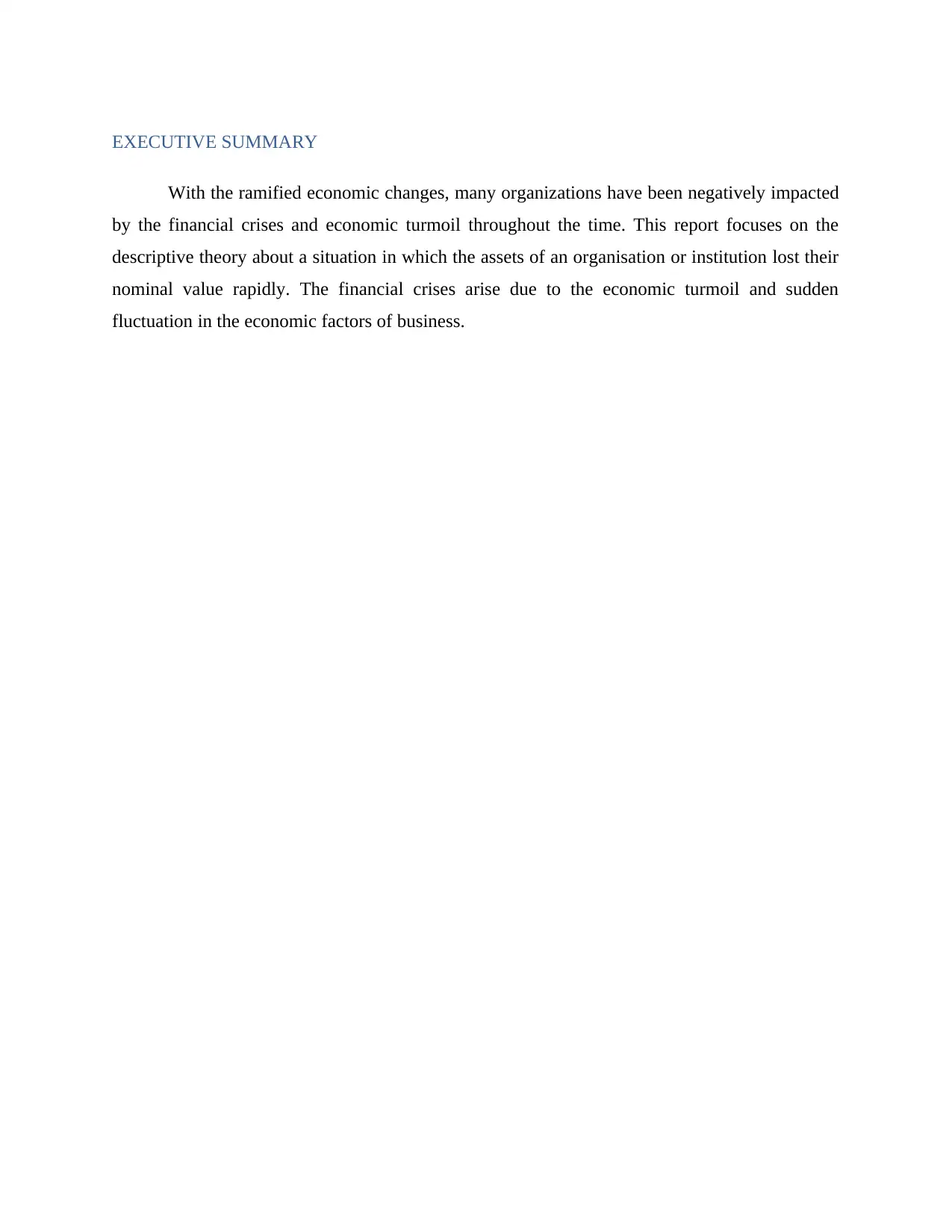
EXECUTIVE SUMMARY
With the ramified economic changes, many organizations have been negatively impacted
by the financial crises and economic turmoil throughout the time. This report focuses on the
descriptive theory about a situation in which the assets of an organisation or institution lost their
nominal value rapidly. The financial crises arise due to the economic turmoil and sudden
fluctuation in the economic factors of business.
With the ramified economic changes, many organizations have been negatively impacted
by the financial crises and economic turmoil throughout the time. This report focuses on the
descriptive theory about a situation in which the assets of an organisation or institution lost their
nominal value rapidly. The financial crises arise due to the economic turmoil and sudden
fluctuation in the economic factors of business.
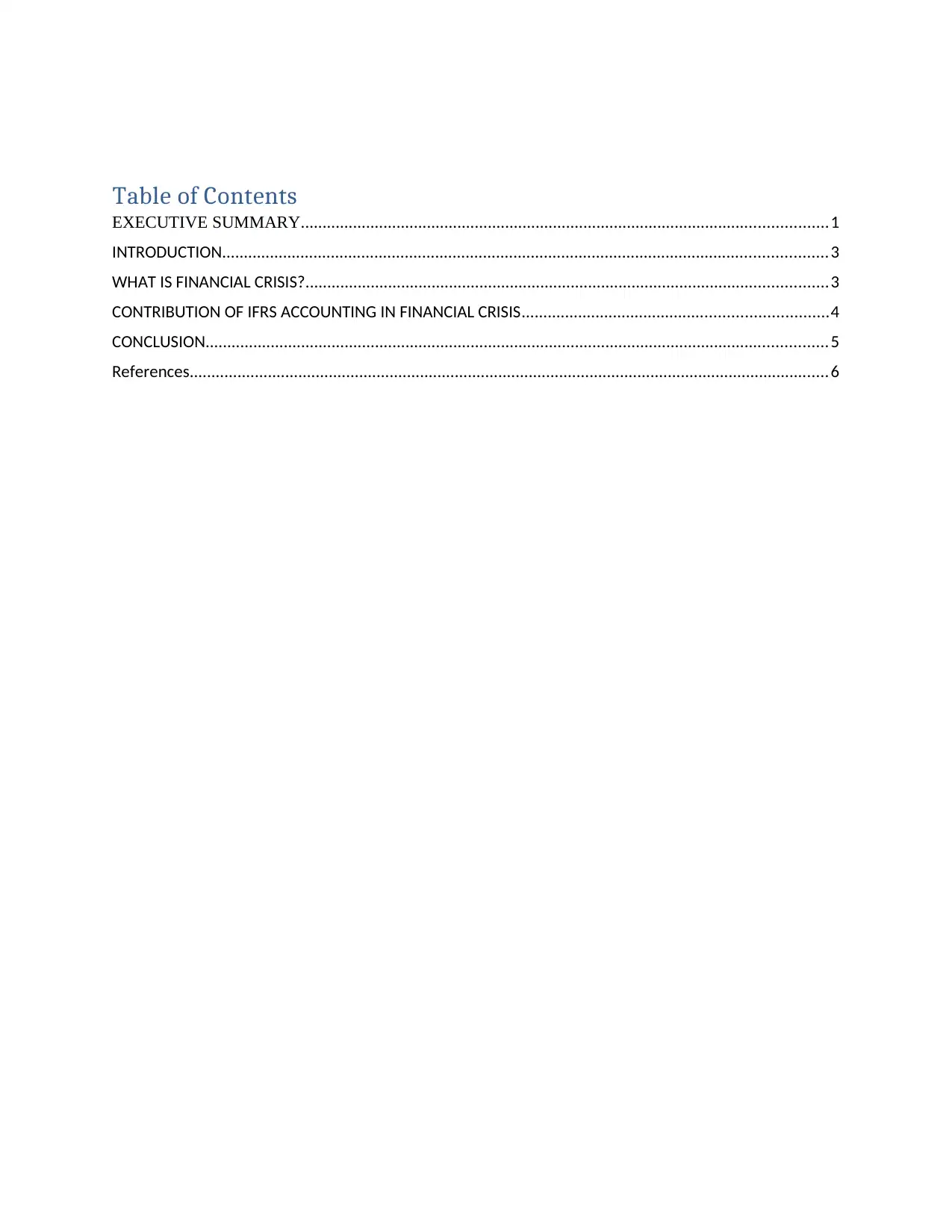
Table of Contents
EXECUTIVE SUMMARY.........................................................................................................................1
INTRODUCTION...........................................................................................................................................3
WHAT IS FINANCIAL CRISIS?........................................................................................................................3
CONTRIBUTION OF IFRS ACCOUNTING IN FINANCIAL CRISIS......................................................................4
CONCLUSION...............................................................................................................................................5
References...................................................................................................................................................6
EXECUTIVE SUMMARY.........................................................................................................................1
INTRODUCTION...........................................................................................................................................3
WHAT IS FINANCIAL CRISIS?........................................................................................................................3
CONTRIBUTION OF IFRS ACCOUNTING IN FINANCIAL CRISIS......................................................................4
CONCLUSION...............................................................................................................................................5
References...................................................................................................................................................6
⊘ This is a preview!⊘
Do you want full access?
Subscribe today to unlock all pages.

Trusted by 1+ million students worldwide
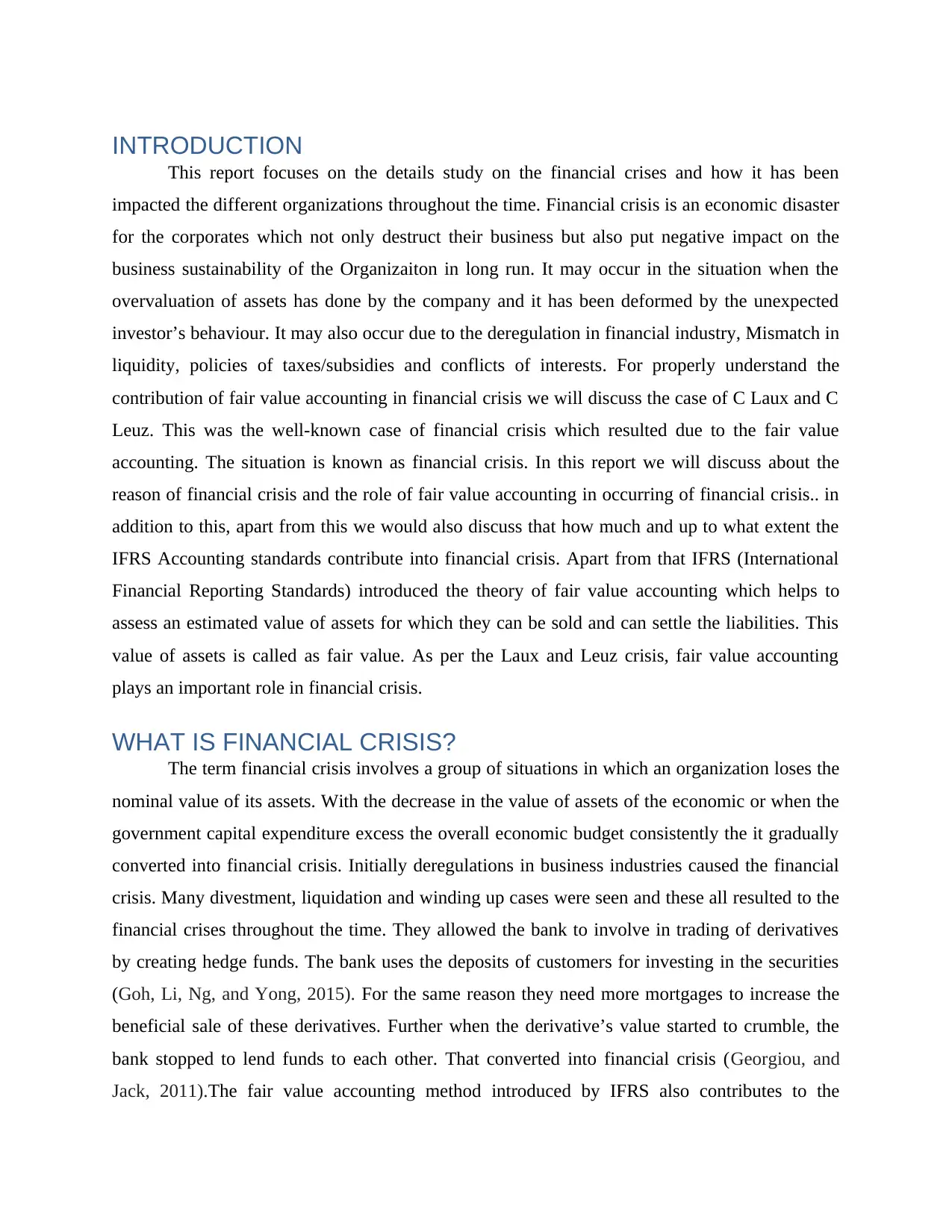
INTRODUCTION
This report focuses on the details study on the financial crises and how it has been
impacted the different organizations throughout the time. Financial crisis is an economic disaster
for the corporates which not only destruct their business but also put negative impact on the
business sustainability of the Organizaiton in long run. It may occur in the situation when the
overvaluation of assets has done by the company and it has been deformed by the unexpected
investor’s behaviour. It may also occur due to the deregulation in financial industry, Mismatch in
liquidity, policies of taxes/subsidies and conflicts of interests. For properly understand the
contribution of fair value accounting in financial crisis we will discuss the case of C Laux and C
Leuz. This was the well-known case of financial crisis which resulted due to the fair value
accounting. The situation is known as financial crisis. In this report we will discuss about the
reason of financial crisis and the role of fair value accounting in occurring of financial crisis.. in
addition to this, apart from this we would also discuss that how much and up to what extent the
IFRS Accounting standards contribute into financial crisis. Apart from that IFRS (International
Financial Reporting Standards) introduced the theory of fair value accounting which helps to
assess an estimated value of assets for which they can be sold and can settle the liabilities. This
value of assets is called as fair value. As per the Laux and Leuz crisis, fair value accounting
plays an important role in financial crisis.
WHAT IS FINANCIAL CRISIS?
The term financial crisis involves a group of situations in which an organization loses the
nominal value of its assets. With the decrease in the value of assets of the economic or when the
government capital expenditure excess the overall economic budget consistently the it gradually
converted into financial crisis. Initially deregulations in business industries caused the financial
crisis. Many divestment, liquidation and winding up cases were seen and these all resulted to the
financial crises throughout the time. They allowed the bank to involve in trading of derivatives
by creating hedge funds. The bank uses the deposits of customers for investing in the securities
(Goh, Li, Ng, and Yong, 2015). For the same reason they need more mortgages to increase the
beneficial sale of these derivatives. Further when the derivative’s value started to crumble, the
bank stopped to lend funds to each other. That converted into financial crisis (Georgiou, and
Jack, 2011).The fair value accounting method introduced by IFRS also contributes to the
This report focuses on the details study on the financial crises and how it has been
impacted the different organizations throughout the time. Financial crisis is an economic disaster
for the corporates which not only destruct their business but also put negative impact on the
business sustainability of the Organizaiton in long run. It may occur in the situation when the
overvaluation of assets has done by the company and it has been deformed by the unexpected
investor’s behaviour. It may also occur due to the deregulation in financial industry, Mismatch in
liquidity, policies of taxes/subsidies and conflicts of interests. For properly understand the
contribution of fair value accounting in financial crisis we will discuss the case of C Laux and C
Leuz. This was the well-known case of financial crisis which resulted due to the fair value
accounting. The situation is known as financial crisis. In this report we will discuss about the
reason of financial crisis and the role of fair value accounting in occurring of financial crisis.. in
addition to this, apart from this we would also discuss that how much and up to what extent the
IFRS Accounting standards contribute into financial crisis. Apart from that IFRS (International
Financial Reporting Standards) introduced the theory of fair value accounting which helps to
assess an estimated value of assets for which they can be sold and can settle the liabilities. This
value of assets is called as fair value. As per the Laux and Leuz crisis, fair value accounting
plays an important role in financial crisis.
WHAT IS FINANCIAL CRISIS?
The term financial crisis involves a group of situations in which an organization loses the
nominal value of its assets. With the decrease in the value of assets of the economic or when the
government capital expenditure excess the overall economic budget consistently the it gradually
converted into financial crisis. Initially deregulations in business industries caused the financial
crisis. Many divestment, liquidation and winding up cases were seen and these all resulted to the
financial crises throughout the time. They allowed the bank to involve in trading of derivatives
by creating hedge funds. The bank uses the deposits of customers for investing in the securities
(Goh, Li, Ng, and Yong, 2015). For the same reason they need more mortgages to increase the
beneficial sale of these derivatives. Further when the derivative’s value started to crumble, the
bank stopped to lend funds to each other. That converted into financial crisis (Georgiou, and
Jack, 2011).The fair value accounting method introduced by IFRS also contributes to the
Paraphrase This Document
Need a fresh take? Get an instant paraphrase of this document with our AI Paraphraser
financial crisis. It is concerned with the valuation of assets and their inaccurate valuation results
into financial crisis. The changing policies of valuation and imposition of taxes also affects the
finance of an entity, which attracts the situation of financial crisis (Arnold, 2009). With the
changes in economic policies and international business downfalls, financial crises cases have
increased the impacted the various domestic and international organization. If company fails to
keep its business transparent then it might deviate the investment decisions of the investors and
may also result to destruction of the invested value of the investors (Humphrey, Loft, and
Woods, 2009). There are several companies such as HIH insurance, One Tel Company and other
big listed companies which have faced liquidation due to the non-effective accounting
compliance. These companies went into liquidation as it failed to align its business interest with
the society. In the world where scarcity of the resources is there, this liquidation and winding up
become the biggest turmoil and reasons for the financial crises. It is analyzed that if company
fails to manage its busienss by arranging the proper profitability, financial leverage then it might
result to destruction of the busienss. IFRS rules and standards strengthen the reporting
framework of organization and it has established with the purpose to remove the inherent
problems of the financial reporting but against to the expectations. If company wants to mitigate
the negative impact of the financial crises then it will have to focus on establishing the
harmonization in its domestic and international reporting frameworks (Power, 2010).
CONTRIBUTION OF IFRS ACCOUNTING IN FINANCIAL CRISIS
The international Accounting Standard Board issued International Financial Reporting
Standards, introduced the method of fair value accounting. It is also known as the mark-to-
market method. It is analyzed that with the ramified economic changes, IASB has been taking
the required measures to improve the reporting standards in the contemplation of financial crisis
The fair value accounting method has been used by the companies to assess the current market
condition of assets and liabilities. It also reflects the true and fair view of the assets and liabilities
of company which strengthen the overall outcomes and business efficiency in long run. Hence it
increases the transparency and provides timely information. In contrast, the opponent says that
the FAV leads to undesirable actions on the part of companies. Furthermore, they claim that it is
not an accurate method as it cannot define the value of assets held for a long term period (Laux,
and Leuz, 2009). Every company needs to revaluate the assets and liabilities in its books of
accounts to strengthen the overall outcomes and business efficiency in long run. As per the
into financial crisis. The changing policies of valuation and imposition of taxes also affects the
finance of an entity, which attracts the situation of financial crisis (Arnold, 2009). With the
changes in economic policies and international business downfalls, financial crises cases have
increased the impacted the various domestic and international organization. If company fails to
keep its business transparent then it might deviate the investment decisions of the investors and
may also result to destruction of the invested value of the investors (Humphrey, Loft, and
Woods, 2009). There are several companies such as HIH insurance, One Tel Company and other
big listed companies which have faced liquidation due to the non-effective accounting
compliance. These companies went into liquidation as it failed to align its business interest with
the society. In the world where scarcity of the resources is there, this liquidation and winding up
become the biggest turmoil and reasons for the financial crises. It is analyzed that if company
fails to manage its busienss by arranging the proper profitability, financial leverage then it might
result to destruction of the busienss. IFRS rules and standards strengthen the reporting
framework of organization and it has established with the purpose to remove the inherent
problems of the financial reporting but against to the expectations. If company wants to mitigate
the negative impact of the financial crises then it will have to focus on establishing the
harmonization in its domestic and international reporting frameworks (Power, 2010).
CONTRIBUTION OF IFRS ACCOUNTING IN FINANCIAL CRISIS
The international Accounting Standard Board issued International Financial Reporting
Standards, introduced the method of fair value accounting. It is also known as the mark-to-
market method. It is analyzed that with the ramified economic changes, IASB has been taking
the required measures to improve the reporting standards in the contemplation of financial crisis
The fair value accounting method has been used by the companies to assess the current market
condition of assets and liabilities. It also reflects the true and fair view of the assets and liabilities
of company which strengthen the overall outcomes and business efficiency in long run. Hence it
increases the transparency and provides timely information. In contrast, the opponent says that
the FAV leads to undesirable actions on the part of companies. Furthermore, they claim that it is
not an accurate method as it cannot define the value of assets held for a long term period (Laux,
and Leuz, 2009). Every company needs to revaluate the assets and liabilities in its books of
accounts to strengthen the overall outcomes and business efficiency in long run. As per the
international financial reporting frameworks, each and every organization needs to implement
proper impairment test in its business process to evaluate true and fair view of the assets and
liabilities. It will allow company to make the business more transparent to its stakeholders. The
prices can be crumbled due to the irrational investors, market inefficiency and liquidity issues.
Conclusively, they did not found the fair value accounting method reliable. Also it contributes to
the financial crisis (Mala, and Chand, 2012). In Laux and Leuz case, the crisis has led due to fair
value accounting method. The crisis has led to a cogent issue about the merits and demerits of
fair value accounting. The study says that the accounting standards i.e. IRFS enables the
management of company to measure the item at their market value, which may not be acceptable
in low liquidity market. Hence, the method does not reveal the real value of assets or institution.
In such situation, the managers can discrete the values of assets in their favour to receive good
results for making incentives (Laux, and Leuz, 2010). It is analyzed that when organization fails
to establish harmonization in its domestic and international reporting frameworks then it results
to failure of the business and downfall in the economic business environment (Dechow, Myers,
and Shakespeare, 2010). In addition to this, failure to adopt the IFRS rules and accounting
standards, company might face accounting issues which may negatively impact the business
sustainability and long term success of organization. Therefore, it could be inferred that if
company does not reflect the true and fair view of the assets then it might destruct the business
outcomes and also deviate investors in creating the value on the invested capital (Power, 2010).
The failure to comply with the accounting policies and standards has negatively impacted
business growth and outcomes which have resulted to their liquidation and winding up. These
business failures also negatively impact the economy and resulted to financial crises in long run.
Many of the companies such as Dick Smith, ABC learning and One Tel Company have faced
issue of the liquidation and winding up due to its failure to comply with the IFRS rules and
accounting standards. These companies failed to manage the transparency in its busienss and
manipulated its accounting and books of accounts which resulted to ethical and legal compliance
misconduct. These all companies went into liquidation and had to distribute all of its assets to its
stakeholders.
CONCLUSION
In the end, the conclusion of the report says that financial crisis results due to various
causes. It may be the policies of taxes/subsidies, conflicts of interests, deregulation in financial
proper impairment test in its business process to evaluate true and fair view of the assets and
liabilities. It will allow company to make the business more transparent to its stakeholders. The
prices can be crumbled due to the irrational investors, market inefficiency and liquidity issues.
Conclusively, they did not found the fair value accounting method reliable. Also it contributes to
the financial crisis (Mala, and Chand, 2012). In Laux and Leuz case, the crisis has led due to fair
value accounting method. The crisis has led to a cogent issue about the merits and demerits of
fair value accounting. The study says that the accounting standards i.e. IRFS enables the
management of company to measure the item at their market value, which may not be acceptable
in low liquidity market. Hence, the method does not reveal the real value of assets or institution.
In such situation, the managers can discrete the values of assets in their favour to receive good
results for making incentives (Laux, and Leuz, 2010). It is analyzed that when organization fails
to establish harmonization in its domestic and international reporting frameworks then it results
to failure of the business and downfall in the economic business environment (Dechow, Myers,
and Shakespeare, 2010). In addition to this, failure to adopt the IFRS rules and accounting
standards, company might face accounting issues which may negatively impact the business
sustainability and long term success of organization. Therefore, it could be inferred that if
company does not reflect the true and fair view of the assets then it might destruct the business
outcomes and also deviate investors in creating the value on the invested capital (Power, 2010).
The failure to comply with the accounting policies and standards has negatively impacted
business growth and outcomes which have resulted to their liquidation and winding up. These
business failures also negatively impact the economy and resulted to financial crises in long run.
Many of the companies such as Dick Smith, ABC learning and One Tel Company have faced
issue of the liquidation and winding up due to its failure to comply with the IFRS rules and
accounting standards. These companies failed to manage the transparency in its busienss and
manipulated its accounting and books of accounts which resulted to ethical and legal compliance
misconduct. These all companies went into liquidation and had to distribute all of its assets to its
stakeholders.
CONCLUSION
In the end, the conclusion of the report says that financial crisis results due to various
causes. It may be the policies of taxes/subsidies, conflicts of interests, deregulation in financial
⊘ This is a preview!⊘
Do you want full access?
Subscribe today to unlock all pages.
Trusted by 1+ million students worldwide
industry, Mismatch in liquidity, and fair value accounting method. Fair Value Accounting is
beating the convergence of accounting exercise across the world. It has been considered as an
important factor contributed to the recent financial crisis. Use of financial value accounting
raises the doubts on suitability of IFRS for financial reporting around the world. International
Financial Reporting Standards established with the purpose to remove the inherent problems of
the financial reporting but against to the expectations it increases the case of financial crisis more
than before. Many financial institutions are forcing the International Accounting Standard Board
to reform the rules of fair value accounting. Also the IASB has been taking the required
measures to improve the reporting standards in the contemplation of financial crisis. Now in the
end, it could be inferred that if any economic wants to put a cap on the financial crises cases then
it will first have to strengthen the financial reporting framework and transparency. It will
eventually lower down the busienss failure and collapse.
beating the convergence of accounting exercise across the world. It has been considered as an
important factor contributed to the recent financial crisis. Use of financial value accounting
raises the doubts on suitability of IFRS for financial reporting around the world. International
Financial Reporting Standards established with the purpose to remove the inherent problems of
the financial reporting but against to the expectations it increases the case of financial crisis more
than before. Many financial institutions are forcing the International Accounting Standard Board
to reform the rules of fair value accounting. Also the IASB has been taking the required
measures to improve the reporting standards in the contemplation of financial crisis. Now in the
end, it could be inferred that if any economic wants to put a cap on the financial crises cases then
it will first have to strengthen the financial reporting framework and transparency. It will
eventually lower down the busienss failure and collapse.
Paraphrase This Document
Need a fresh take? Get an instant paraphrase of this document with our AI Paraphraser
References
Arnold, P.J., (2009). Global financial crisis: The challenge to accounting research. Accounting,
organizations and society, 34(6-7), pp.803-809.
Dechow, P.M., Myers, L.A. and Shakespeare, C., 2010. Fair value accounting and gains from
asset securitizations: A convenient earnings management tool with compensation side-
benefits. Journal of accounting and economics, 49(1-2), pp.2-25.
Georgiou, O. and Jack, L., 2011. In pursuit of legitimacy: A history behind fair value
accounting. The British Accounting Review, 43(4), pp.311-323.
Goh, B. W., Li, D., Ng, J., and Yong, K. O. (2015). Market pricing of banks’ fair value assets
reported under SFAS 157 since the 2008 financial crisis. Journal of Accounting and Public
Policy, 34(2), 129-145.
Humphrey, C., Loft, A. and Woods, M., 2009. The global audit profession and the international
financial architecture: Understanding regulatory relationships at a time of financial
crisis. Accounting, organizations and society, 34(6-7), pp.810-825.
Laux, C. and Leuz, C., (2009). The crisis of fair-value accounting: Making sense of the recent
debate. Accounting, organizations and society, 34(6-7), pp.826-834.
Laux, C., and Leuz, C. (2010). Did fair-value accounting contribute to the financial
crisis?. Journal of economic perspectives, 24(1), 93-118.
Mala, R. and Chand, P., 2012. Effect of the global financial crisis on accounting
convergence. Accounting & Finance, 52(1), pp.21-46.
Power, M. (2010). Fair value accounting, financial economics and the transformation of
reliability. Accounting and Business Research, 40(3), 197-210.
Arnold, P.J., (2009). Global financial crisis: The challenge to accounting research. Accounting,
organizations and society, 34(6-7), pp.803-809.
Dechow, P.M., Myers, L.A. and Shakespeare, C., 2010. Fair value accounting and gains from
asset securitizations: A convenient earnings management tool with compensation side-
benefits. Journal of accounting and economics, 49(1-2), pp.2-25.
Georgiou, O. and Jack, L., 2011. In pursuit of legitimacy: A history behind fair value
accounting. The British Accounting Review, 43(4), pp.311-323.
Goh, B. W., Li, D., Ng, J., and Yong, K. O. (2015). Market pricing of banks’ fair value assets
reported under SFAS 157 since the 2008 financial crisis. Journal of Accounting and Public
Policy, 34(2), 129-145.
Humphrey, C., Loft, A. and Woods, M., 2009. The global audit profession and the international
financial architecture: Understanding regulatory relationships at a time of financial
crisis. Accounting, organizations and society, 34(6-7), pp.810-825.
Laux, C. and Leuz, C., (2009). The crisis of fair-value accounting: Making sense of the recent
debate. Accounting, organizations and society, 34(6-7), pp.826-834.
Laux, C., and Leuz, C. (2010). Did fair-value accounting contribute to the financial
crisis?. Journal of economic perspectives, 24(1), 93-118.
Mala, R. and Chand, P., 2012. Effect of the global financial crisis on accounting
convergence. Accounting & Finance, 52(1), pp.21-46.
Power, M. (2010). Fair value accounting, financial economics and the transformation of
reliability. Accounting and Business Research, 40(3), 197-210.

1 out of 8


Related Documents


Your All-in-One AI-Powered Toolkit for Academic Success.
+13062052269
info@desklib.com
Available 24*7 on WhatsApp / Email
![[object Object]](/_next/static/media/star-bottom.7253800d.svg)
Unlock your academic potential
Copyright © 2020–2026 A2Z Services. All Rights Reserved. Developed and managed by ZUCOL.