Financial Accounting Principles: Stakeholders, Clients, and Analysis
VerifiedAdded on 2020/10/23
|26
|5321
|460
Report
AI Summary
This report delves into the core principles of financial accounting, encompassing the recording, summarization, and reporting of financial transactions. It explores the purpose of financial accounting and its importance in providing a framework for decision-making. The report identifies and analyzes both internal and external stakeholders, highlighting their interests in an organization's financial information. It presents journal entries, trial balances, profit and loss statements, and balance sheets for various clients. Furthermore, it explains crucial accounting concepts such as depreciation, bank reconciliation, and the imprest system in petty cash. The report also compares financial statements of sole traders and limited companies, and discusses the use of control and suspense accounts. The report also includes example journal entries. Overall, the report offers a detailed analysis of financial accounting practices, providing valuable insights for students.
FINANCIAL ACCOUNTING
PRINCIPLES
PRINCIPLES

Paraphrase This Document
Need a fresh take? Get an instant paraphrase of this document with our AI Paraphraser

TABLE OF CONTENTS
INTRODUCTION...........................................................................................................................4
1. Defining financial accounting and its purpose...................................................................4
2. Internal and External stakeholders of an organization and why they are interested in
organization's financial information.......................................................................................6
CLIENT 1........................................................................................................................................8
Journal entry in the books of Alexandra study.......................................................................8
Trial balance:........................................................................................................................18
CLIENT 2......................................................................................................................................18
A.) Preparation of profit and loss statement of Munteanu Ltd. For the year ended 31st
december 2018......................................................................................................................18
B.) Statement of financial position of Munteanu Ltd as on 31st December 2018................18
C.) Explanation on following concepts................................................................................19
D.) Describing purpose of depreciation with its two methods.............................................20
E.) Critically evaluating the difference between the financial statements prepared by sole
trader and the limited companies..........................................................................................20
CLIENT 3......................................................................................................................................21
A.) Explaining the purpose of preparing the bank reconciliation statement and reason of this
preparation on monthly basis................................................................................................21
B.) Explaining areas which may cause record vary from the bank records.........................22
C.) Explaining the term imprest which is used in petty cash system...................................22
D.) Cash book and bank reconciliation statements..............................................................22
CLIENT 4......................................................................................................................................24
A.) preparation of balances...................................................................................................24
B.) Explaining the term Control account..............................................................................25
CLIENT 5......................................................................................................................................25
a.) Explaining the term suspense account with its main features.........................................25
b) Trial balance.....................................................................................................................26
c.) Journal entries and correction..........................................................................................26
CONCLUSION..............................................................................................................................27
INTRODUCTION...........................................................................................................................4
1. Defining financial accounting and its purpose...................................................................4
2. Internal and External stakeholders of an organization and why they are interested in
organization's financial information.......................................................................................6
CLIENT 1........................................................................................................................................8
Journal entry in the books of Alexandra study.......................................................................8
Trial balance:........................................................................................................................18
CLIENT 2......................................................................................................................................18
A.) Preparation of profit and loss statement of Munteanu Ltd. For the year ended 31st
december 2018......................................................................................................................18
B.) Statement of financial position of Munteanu Ltd as on 31st December 2018................18
C.) Explanation on following concepts................................................................................19
D.) Describing purpose of depreciation with its two methods.............................................20
E.) Critically evaluating the difference between the financial statements prepared by sole
trader and the limited companies..........................................................................................20
CLIENT 3......................................................................................................................................21
A.) Explaining the purpose of preparing the bank reconciliation statement and reason of this
preparation on monthly basis................................................................................................21
B.) Explaining areas which may cause record vary from the bank records.........................22
C.) Explaining the term imprest which is used in petty cash system...................................22
D.) Cash book and bank reconciliation statements..............................................................22
CLIENT 4......................................................................................................................................24
A.) preparation of balances...................................................................................................24
B.) Explaining the term Control account..............................................................................25
CLIENT 5......................................................................................................................................25
a.) Explaining the term suspense account with its main features.........................................25
b) Trial balance.....................................................................................................................26
c.) Journal entries and correction..........................................................................................26
CONCLUSION..............................................................................................................................27

REFERENCE...................................................................................................................................1
⊘ This is a preview!⊘
Do you want full access?
Subscribe today to unlock all pages.

Trusted by 1+ million students worldwide

INTRODUCTION
Financial accounting is the process of recording, summarizing and reporting the financial
transactions of a company. Field of financial accounting is highly significant which in turn
provides stakeholders with suitable framework for decision making. Thus, the assessment will
create for developing better understanding of financial accounting and its purpose. Further, in
this report two internal stakeholders and four external stakeholders for large businesses will
evaluate in order to identify their interest in financial information of the organization. Small
accountancy firm which is selected in this report is Berley Chartered accountant which deals in
giving financial services to clients. Moreover, in this report calculation related to clients will also
be provided.
1. Defining financial accounting and its purpose
Financial accounting:
The financial accounting can be described as that branch of accounting that deals with
tracking the financial transaction of the company. The transactions are recorded in the books of
account as per the guidelines, standards to summaries the same and present the information in
financial reports or statement which includes profits and loss account, balance sheet, cash flow
statement etc. This is a process of recording, summarizing and reporting the myriad of
transaction which are a result from the operations and activities of a business over a period of
time (Financial accounting, 2018). The presentation of financing information of business
activities as per the standardized guidelines in various forms of statements record the operating
performance of company for a specific period. This utilize pre determined accounting principles
to decide the treatments of a particulate transaction as per the established principles.
The financial accounting may be performed using either of two methods accuracy and
cash method or a both. In general practice accrual method is followed as this record the dual
effect of a transaction giving the exact accounting treatments of each financial transaction of the
organization. The transactions are recorded in accordance with Generally accepted Accounting
principles (GAAP).
Purpose served by financial accounting:
The purpose of financial accounting is to make sure that all the certified accounting
standards are aided with in summarizing and recording of the financial transaction of the firm.
The purpose served by the financial accounting are not limited but its main aims is to assists in
Financial accounting is the process of recording, summarizing and reporting the financial
transactions of a company. Field of financial accounting is highly significant which in turn
provides stakeholders with suitable framework for decision making. Thus, the assessment will
create for developing better understanding of financial accounting and its purpose. Further, in
this report two internal stakeholders and four external stakeholders for large businesses will
evaluate in order to identify their interest in financial information of the organization. Small
accountancy firm which is selected in this report is Berley Chartered accountant which deals in
giving financial services to clients. Moreover, in this report calculation related to clients will also
be provided.
1. Defining financial accounting and its purpose
Financial accounting:
The financial accounting can be described as that branch of accounting that deals with
tracking the financial transaction of the company. The transactions are recorded in the books of
account as per the guidelines, standards to summaries the same and present the information in
financial reports or statement which includes profits and loss account, balance sheet, cash flow
statement etc. This is a process of recording, summarizing and reporting the myriad of
transaction which are a result from the operations and activities of a business over a period of
time (Financial accounting, 2018). The presentation of financing information of business
activities as per the standardized guidelines in various forms of statements record the operating
performance of company for a specific period. This utilize pre determined accounting principles
to decide the treatments of a particulate transaction as per the established principles.
The financial accounting may be performed using either of two methods accuracy and
cash method or a both. In general practice accrual method is followed as this record the dual
effect of a transaction giving the exact accounting treatments of each financial transaction of the
organization. The transactions are recorded in accordance with Generally accepted Accounting
principles (GAAP).
Purpose served by financial accounting:
The purpose of financial accounting is to make sure that all the certified accounting
standards are aided with in summarizing and recording of the financial transaction of the firm.
The purpose served by the financial accounting are not limited but its main aims is to assists in
Paraphrase This Document
Need a fresh take? Get an instant paraphrase of this document with our AI Paraphraser

harmonized recording, decision making etc. Some of the main purpose served by it are recouped
below:
Recording of the financial transaction:
The most important aspect of financial accounting is to record the financial and monetary
data and information of a business. To be carried out in such a manner that gives the final
extract about the performance of company as well as assist in decision making process.
Harmonized way record the transaction:
The main purpose served by financial accounting is summarizing and recording of the
monetary transaction related to a business pertaining to a particular period. This allow the
business to follow a uniform method in recording of the transaction with uniformity giving a
scope of comparison regarding own financial performance & position and competitors as well.
Assist in decision making process:
The main purpose served by financial accounting is to accumulate reports on the financial
information regarding the performance, financial position and cash flow of the business (The
importance of financial accounting, 2018). The information is used by the management in
decision making process on how to manage the business, invests and lend money etc.
Adherence with prescribed standard and guidelines:
This accounting emphasizes on abiding with regulatory guidelines and standards for
recording financial transaction associated with business. The transaction must be recorded as per
guidelines of GAAP, FASB, IFRS etc. which fulfills the legal obligation of the business
organization.
Relevance:
Purpose of financial accounting is to help its reader in making decision by analyzing
financial capability of company. Thus, financial accounting has the purpose to for providing
useful information which must be relevant. For satisfying these objective, entity report result on
quarterly and annual basis (Freedman, 2019).
Reliability-
It is the purpose financial accounting to provide information which must be reliable. It
reliable financial statements are not produce by company then investors are not able to gain the
information by which they will able to develop economic decision.
Comparability-
below:
Recording of the financial transaction:
The most important aspect of financial accounting is to record the financial and monetary
data and information of a business. To be carried out in such a manner that gives the final
extract about the performance of company as well as assist in decision making process.
Harmonized way record the transaction:
The main purpose served by financial accounting is summarizing and recording of the
monetary transaction related to a business pertaining to a particular period. This allow the
business to follow a uniform method in recording of the transaction with uniformity giving a
scope of comparison regarding own financial performance & position and competitors as well.
Assist in decision making process:
The main purpose served by financial accounting is to accumulate reports on the financial
information regarding the performance, financial position and cash flow of the business (The
importance of financial accounting, 2018). The information is used by the management in
decision making process on how to manage the business, invests and lend money etc.
Adherence with prescribed standard and guidelines:
This accounting emphasizes on abiding with regulatory guidelines and standards for
recording financial transaction associated with business. The transaction must be recorded as per
guidelines of GAAP, FASB, IFRS etc. which fulfills the legal obligation of the business
organization.
Relevance:
Purpose of financial accounting is to help its reader in making decision by analyzing
financial capability of company. Thus, financial accounting has the purpose to for providing
useful information which must be relevant. For satisfying these objective, entity report result on
quarterly and annual basis (Freedman, 2019).
Reliability-
It is the purpose financial accounting to provide information which must be reliable. It
reliable financial statements are not produce by company then investors are not able to gain the
information by which they will able to develop economic decision.
Comparability-
Another purpose of financial accounting is to provide information which is comparable.
System of recording and reporting accounting information is developed in order to provide
information which is more comparable.
Consistency-
It is the secondary quality of information which must be comparable where users will
able to relay and develop their decision regarding investment in company.
2. Internal and External stakeholders of an organization and why they are interested in
organization's financial information
Stakeholders can be defined as an independent body or institutions such as organizations,
individuals, groups that are concerned with the operations of a company and are interested in the
financial results of a business concern. Such stakeholders can be internal and external that are
briefly discussed below:
Internal stakeholders:
Internal stakeholders can be referred as those groups or individual that are present within
in the business organisation. Examples of such internal stakeholders are:
Employees- these are the group of stakeholders which have direct interest for business
operations of the entity. Reason which states their interest is that they are one which plays
main role in developing effective business functions. They analyse their involvement by
analysing the nature of business in which they will earn of themselves. For example:
transportation, mining, construction are the business where employees develop interest by
analysing health and safety policies. Management- these are also a group of internal stakeholder which has the direct interest
in business operations of the entity. They generally want to earn high wages and also
wants to retain their jobs for long term perspective. Thus, they have huge interest in
financial capability and growth of business.
External stakeholders
External stakeholders are such individuals and groups that are not within the business
organisation but are affected by the operations of the company (Bredmar, 2016). Examples of
such groups or individuals are :
Customers- These are the main group of stakeholder for every organisation because it is
said that the business only exists to serve their customers. That is why it is been said that
System of recording and reporting accounting information is developed in order to provide
information which is more comparable.
Consistency-
It is the secondary quality of information which must be comparable where users will
able to relay and develop their decision regarding investment in company.
2. Internal and External stakeholders of an organization and why they are interested in
organization's financial information
Stakeholders can be defined as an independent body or institutions such as organizations,
individuals, groups that are concerned with the operations of a company and are interested in the
financial results of a business concern. Such stakeholders can be internal and external that are
briefly discussed below:
Internal stakeholders:
Internal stakeholders can be referred as those groups or individual that are present within
in the business organisation. Examples of such internal stakeholders are:
Employees- these are the group of stakeholders which have direct interest for business
operations of the entity. Reason which states their interest is that they are one which plays
main role in developing effective business functions. They analyse their involvement by
analysing the nature of business in which they will earn of themselves. For example:
transportation, mining, construction are the business where employees develop interest by
analysing health and safety policies. Management- these are also a group of internal stakeholder which has the direct interest
in business operations of the entity. They generally want to earn high wages and also
wants to retain their jobs for long term perspective. Thus, they have huge interest in
financial capability and growth of business.
External stakeholders
External stakeholders are such individuals and groups that are not within the business
organisation but are affected by the operations of the company (Bredmar, 2016). Examples of
such groups or individuals are :
Customers- These are the main group of stakeholder for every organisation because it is
said that the business only exists to serve their customers. That is why it is been said that
⊘ This is a preview!⊘
Do you want full access?
Subscribe today to unlock all pages.
Trusted by 1+ million students worldwide

the consumers are the actual stakeholder of the business which mainly impacted by value
and quality of service which entity provides.
Investors- these are the form of stakeholders which include both shareholders and debt
holders. They generally invest capital in business with the expectation of getting of
earning a certain rate of return. They are mainly concerned with concept of shareholder
value.
Government Authorities- these are also a major stakeholder group in business because
they collect taxes from the entity as well as from people which are employed in the
company. They get benefited from the overall gross domestic product which is also
contributed by companies. Suppliers/Creditors- these are the group of stakeholders which sells goods and services
to the business and will only relay upon the revenue generation with the business
operations conduct on daily basis. It is also true that these are the group which directly
involved in the functions which operated by company because of which their interest
generated with health and safety too.
The different stakeholders are interested in company's financial reasons because of the
various reasons that are briefly discussed below:
Employees: The employees of a company are concerned with the profitability and
stability. This is because of profitability of the company helps employees to assess the ability of
firm to pay their salaries on time. Profits are the basis on which employees' benefits are decided.
Through company's stability, employees are assured of their jobs in the future. This satisfies their
need of job security. Further, personnel evaluate organisation's financial performance with the
motive to assess or identify probabilities of organisation in relation to expansion of operations in
different markets (Osadchy and et.al., 2018). Moreover, such expansion possibilities provides a
gateway for the career development and growth opportunities to the existing workforce of the
company.
Management: In big and large organisations, management are the professionals
appointed by the Board of Directors, who are also elected by the shareholders of company to run
the business in the most effective manner. This group of the entity is given with the
responsibility of conducting day to day activities of business on the behalf of owners. The
financial performance of the company helps the managers in assessing the level of effectiveness
and quality of service which entity provides.
Investors- these are the form of stakeholders which include both shareholders and debt
holders. They generally invest capital in business with the expectation of getting of
earning a certain rate of return. They are mainly concerned with concept of shareholder
value.
Government Authorities- these are also a major stakeholder group in business because
they collect taxes from the entity as well as from people which are employed in the
company. They get benefited from the overall gross domestic product which is also
contributed by companies. Suppliers/Creditors- these are the group of stakeholders which sells goods and services
to the business and will only relay upon the revenue generation with the business
operations conduct on daily basis. It is also true that these are the group which directly
involved in the functions which operated by company because of which their interest
generated with health and safety too.
The different stakeholders are interested in company's financial reasons because of the
various reasons that are briefly discussed below:
Employees: The employees of a company are concerned with the profitability and
stability. This is because of profitability of the company helps employees to assess the ability of
firm to pay their salaries on time. Profits are the basis on which employees' benefits are decided.
Through company's stability, employees are assured of their jobs in the future. This satisfies their
need of job security. Further, personnel evaluate organisation's financial performance with the
motive to assess or identify probabilities of organisation in relation to expansion of operations in
different markets (Osadchy and et.al., 2018). Moreover, such expansion possibilities provides a
gateway for the career development and growth opportunities to the existing workforce of the
company.
Management: In big and large organisations, management are the professionals
appointed by the Board of Directors, who are also elected by the shareholders of company to run
the business in the most effective manner. This group of the entity is given with the
responsibility of conducting day to day activities of business on the behalf of owners. The
financial performance of the company helps the managers in assessing the level of effectiveness
Paraphrase This Document
Need a fresh take? Get an instant paraphrase of this document with our AI Paraphraser

of firm's policies and strategies regarding every aspect of enterprise. The current financial
position of the company helps the management in deciding the future plans in terms of expansion
of operations. For example, finance manager is concerned with profits made by the company
during a particular period. This in turn helps management team in assessing the funds available
within company. Meanwhile, financial statement analysis helps management in identifying
opportunities in relation to taking new projects (Harrison and van der Laan Smith, 2015).
The management analyses the financial position of the organisation for determining the
long term and short term solvency, profitability, liquidity and return from the investments made
by the business. In other words, by evaluating financial statement management team can assess
whether goals pertaining to sales and profit are met or not. Hence, by undertaking such
information management team of business unit can develop strategic framework for upcoming
time period.
CLIENT 1
Journal entry in the books of Alexandra study
Journal entries in the books of Alexandra for January are as follows
Date particulars Debit Credit
1st jan 2019 Storage expense A/c Dr 450
To bank A/c
2nd jan 2019 Purchase A/c Dr 6080
To S. hood A/c 1450
To D main A/c 2060
To W Tone A/c 960
To R foot A/c 1610
3rd jan 2019 J Wilson A/c Dr 1200
T . Cole A/c dr 1650
position of the company helps the management in deciding the future plans in terms of expansion
of operations. For example, finance manager is concerned with profits made by the company
during a particular period. This in turn helps management team in assessing the funds available
within company. Meanwhile, financial statement analysis helps management in identifying
opportunities in relation to taking new projects (Harrison and van der Laan Smith, 2015).
The management analyses the financial position of the organisation for determining the
long term and short term solvency, profitability, liquidity and return from the investments made
by the business. In other words, by evaluating financial statement management team can assess
whether goals pertaining to sales and profit are met or not. Hence, by undertaking such
information management team of business unit can develop strategic framework for upcoming
time period.
CLIENT 1
Journal entry in the books of Alexandra study
Journal entries in the books of Alexandra for January are as follows
Date particulars Debit Credit
1st jan 2019 Storage expense A/c Dr 450
To bank A/c
2nd jan 2019 Purchase A/c Dr 6080
To S. hood A/c 1450
To D main A/c 2060
To W Tone A/c 960
To R foot A/c 1610
3rd jan 2019 J Wilson A/c Dr 1200
T . Cole A/c dr 1650
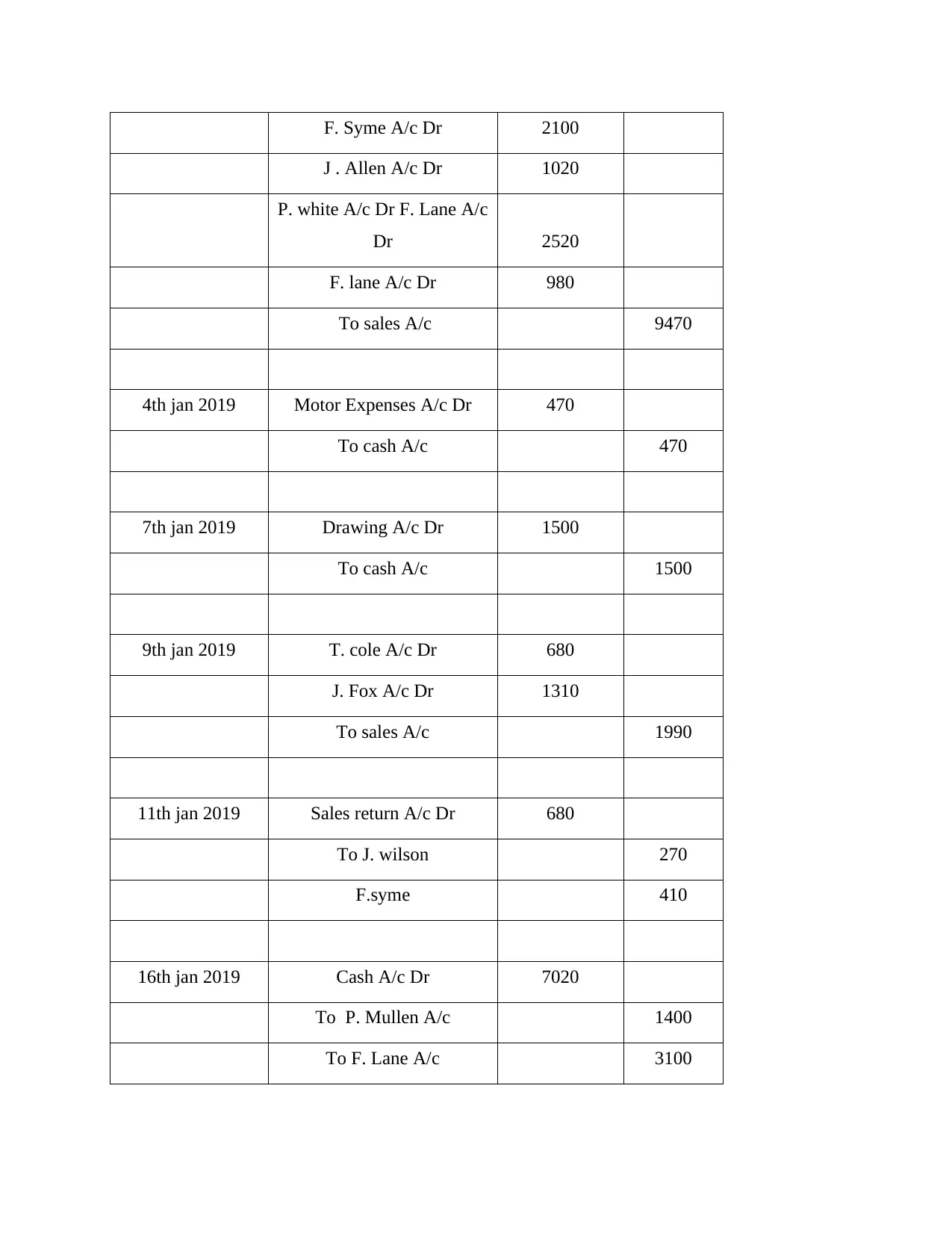
F. Syme A/c Dr 2100
J . Allen A/c Dr 1020
P. white A/c Dr F. Lane A/c
Dr 2520
F. lane A/c Dr 980
To sales A/c 9470
4th jan 2019 Motor Expenses A/c Dr 470
To cash A/c 470
7th jan 2019 Drawing A/c Dr 1500
To cash A/c 1500
9th jan 2019 T. cole A/c Dr 680
J. Fox A/c Dr 1310
To sales A/c 1990
11th jan 2019 Sales return A/c Dr 680
To J. wilson 270
F.syme 410
16th jan 2019 Cash A/c Dr 7020
To P. Mullen A/c 1400
To F. Lane A/c 3100
J . Allen A/c Dr 1020
P. white A/c Dr F. Lane A/c
Dr 2520
F. lane A/c Dr 980
To sales A/c 9470
4th jan 2019 Motor Expenses A/c Dr 470
To cash A/c 470
7th jan 2019 Drawing A/c Dr 1500
To cash A/c 1500
9th jan 2019 T. cole A/c Dr 680
J. Fox A/c Dr 1310
To sales A/c 1990
11th jan 2019 Sales return A/c Dr 680
To J. wilson 270
F.syme 410
16th jan 2019 Cash A/c Dr 7020
To P. Mullen A/c 1400
To F. Lane A/c 3100
⊘ This is a preview!⊘
Do you want full access?
Subscribe today to unlock all pages.
Trusted by 1+ million students worldwide
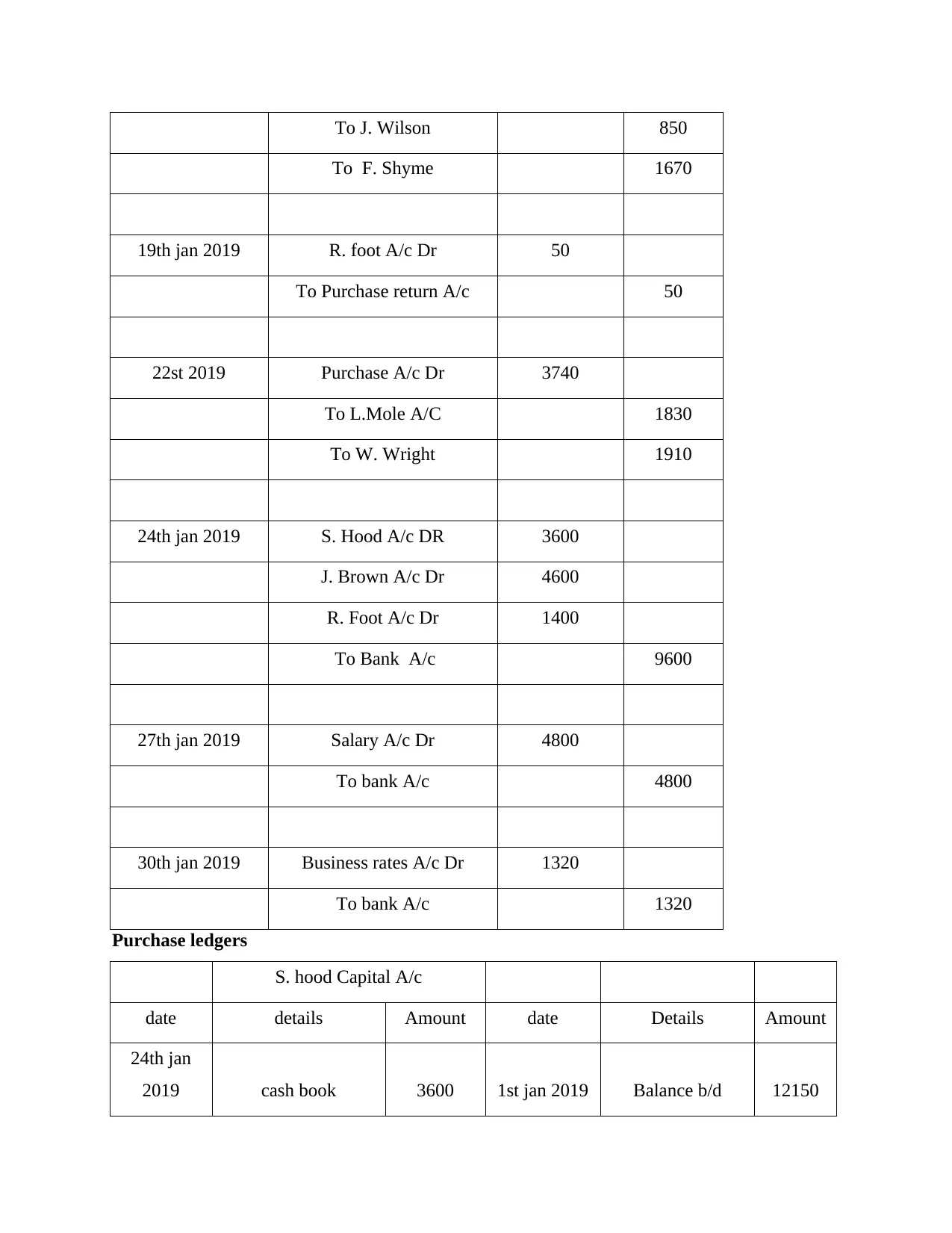
To J. Wilson 850
To F. Shyme 1670
19th jan 2019 R. foot A/c Dr 50
To Purchase return A/c 50
22st 2019 Purchase A/c Dr 3740
To L.Mole A/C 1830
To W. Wright 1910
24th jan 2019 S. Hood A/c DR 3600
J. Brown A/c Dr 4600
R. Foot A/c Dr 1400
To Bank A/c 9600
27th jan 2019 Salary A/c Dr 4800
To bank A/c 4800
30th jan 2019 Business rates A/c Dr 1320
To bank A/c 1320
Purchase ledgers
S. hood Capital A/c
date details Amount date Details Amount
24th jan
2019 cash book 3600 1st jan 2019 Balance b/d 12150
To F. Shyme 1670
19th jan 2019 R. foot A/c Dr 50
To Purchase return A/c 50
22st 2019 Purchase A/c Dr 3740
To L.Mole A/C 1830
To W. Wright 1910
24th jan 2019 S. Hood A/c DR 3600
J. Brown A/c Dr 4600
R. Foot A/c Dr 1400
To Bank A/c 9600
27th jan 2019 Salary A/c Dr 4800
To bank A/c 4800
30th jan 2019 Business rates A/c Dr 1320
To bank A/c 1320
Purchase ledgers
S. hood Capital A/c
date details Amount date Details Amount
24th jan
2019 cash book 3600 1st jan 2019 Balance b/d 12150
Paraphrase This Document
Need a fresh take? Get an instant paraphrase of this document with our AI Paraphraser
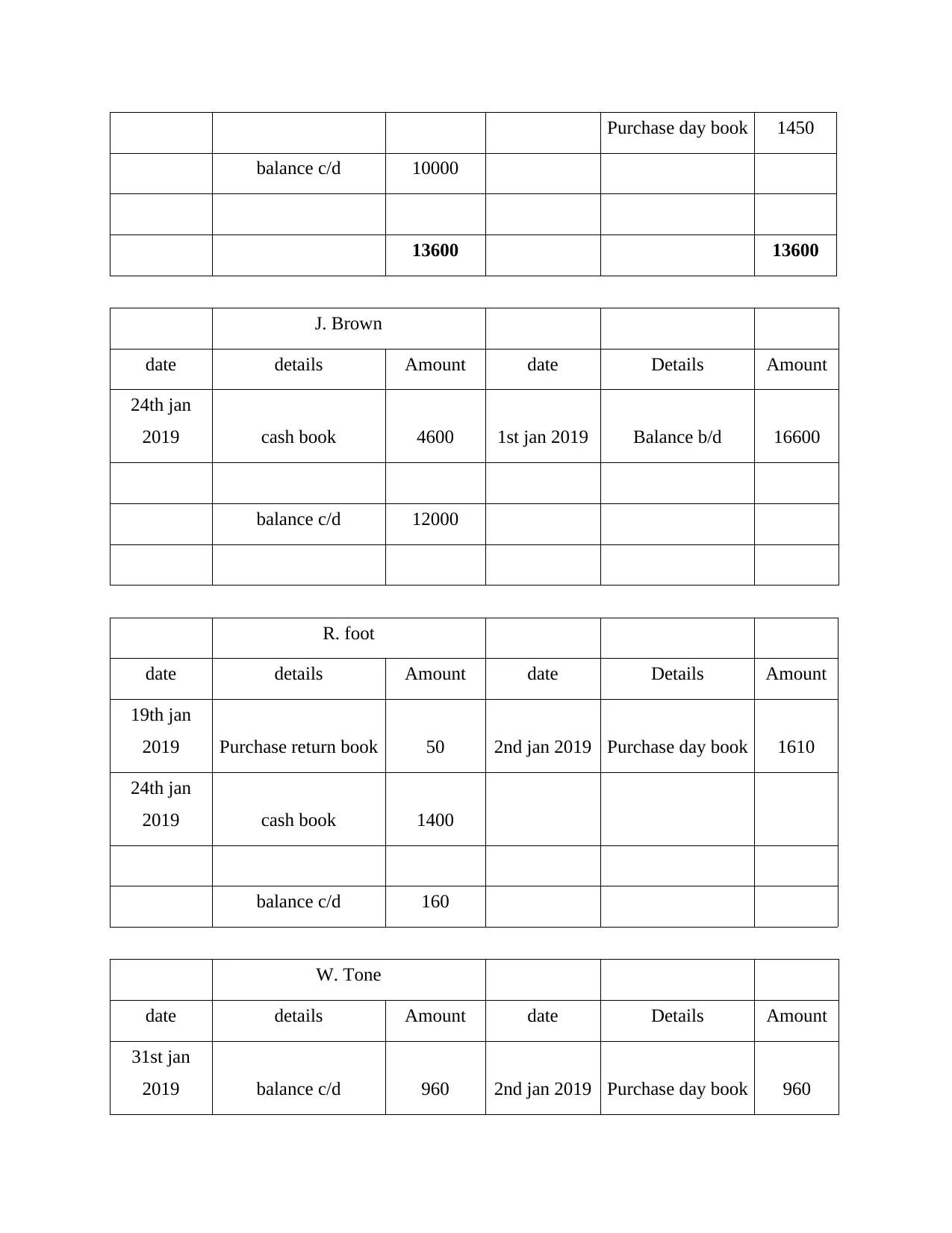
Purchase day book 1450
balance c/d 10000
13600 13600
J. Brown
date details Amount date Details Amount
24th jan
2019 cash book 4600 1st jan 2019 Balance b/d 16600
balance c/d 12000
R. foot
date details Amount date Details Amount
19th jan
2019 Purchase return book 50 2nd jan 2019 Purchase day book 1610
24th jan
2019 cash book 1400
balance c/d 160
W. Tone
date details Amount date Details Amount
31st jan
2019 balance c/d 960 2nd jan 2019 Purchase day book 960
balance c/d 10000
13600 13600
J. Brown
date details Amount date Details Amount
24th jan
2019 cash book 4600 1st jan 2019 Balance b/d 16600
balance c/d 12000
R. foot
date details Amount date Details Amount
19th jan
2019 Purchase return book 50 2nd jan 2019 Purchase day book 1610
24th jan
2019 cash book 1400
balance c/d 160
W. Tone
date details Amount date Details Amount
31st jan
2019 balance c/d 960 2nd jan 2019 Purchase day book 960
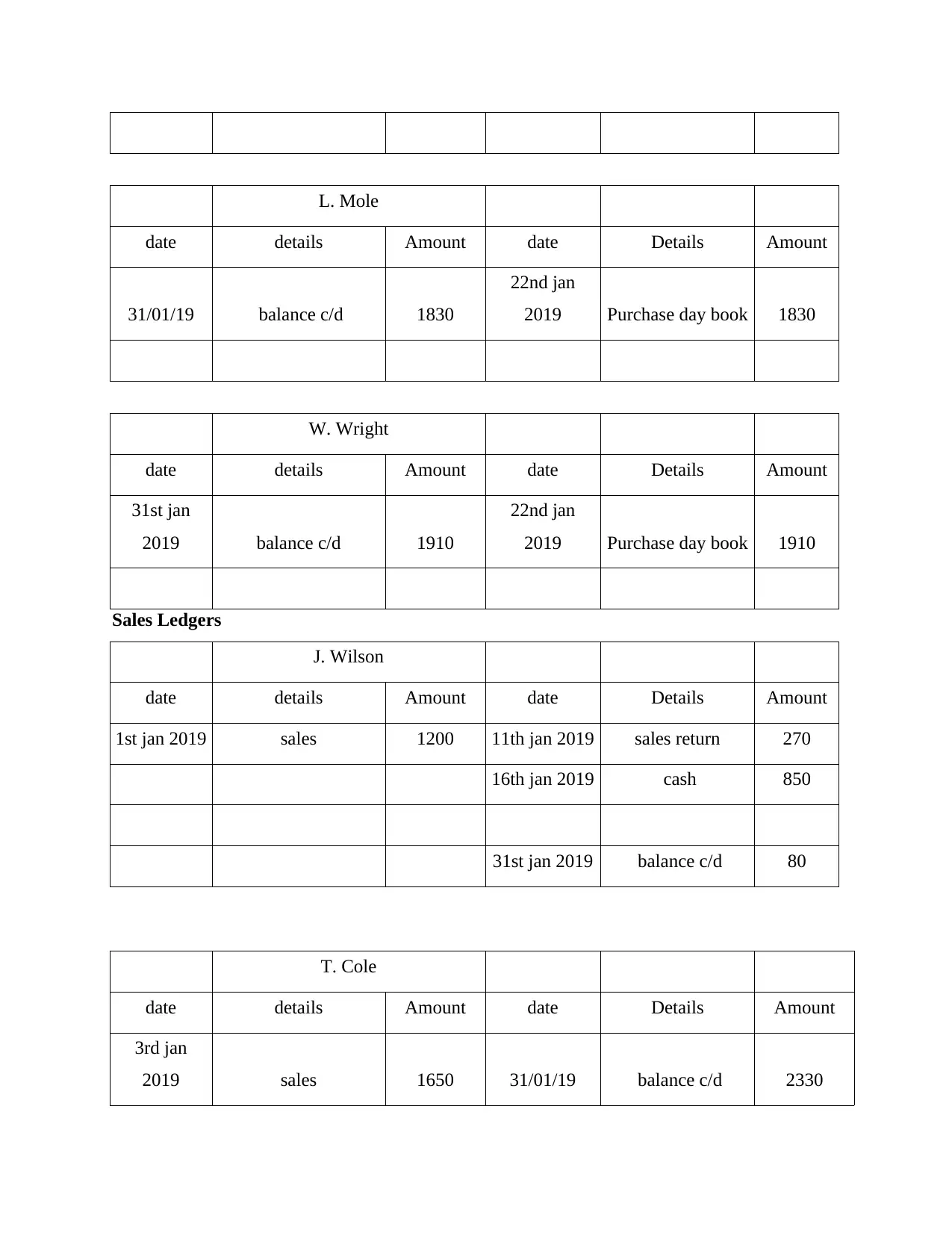
L. Mole
date details Amount date Details Amount
31/01/19 balance c/d 1830
22nd jan
2019 Purchase day book 1830
W. Wright
date details Amount date Details Amount
31st jan
2019 balance c/d 1910
22nd jan
2019 Purchase day book 1910
Sales Ledgers
J. Wilson
date details Amount date Details Amount
1st jan 2019 sales 1200 11th jan 2019 sales return 270
16th jan 2019 cash 850
31st jan 2019 balance c/d 80
T. Cole
date details Amount date Details Amount
3rd jan
2019 sales 1650 31/01/19 balance c/d 2330
date details Amount date Details Amount
31/01/19 balance c/d 1830
22nd jan
2019 Purchase day book 1830
W. Wright
date details Amount date Details Amount
31st jan
2019 balance c/d 1910
22nd jan
2019 Purchase day book 1910
Sales Ledgers
J. Wilson
date details Amount date Details Amount
1st jan 2019 sales 1200 11th jan 2019 sales return 270
16th jan 2019 cash 850
31st jan 2019 balance c/d 80
T. Cole
date details Amount date Details Amount
3rd jan
2019 sales 1650 31/01/19 balance c/d 2330
⊘ This is a preview!⊘
Do you want full access?
Subscribe today to unlock all pages.
Trusted by 1+ million students worldwide

1 out of 26


Related Documents


Your All-in-One AI-Powered Toolkit for Academic Success.
+13062052269
info@desklib.com
Available 24*7 on WhatsApp / Email
![[object Object]](/_next/static/media/star-bottom.7253800d.svg)
Unlock your academic potential
Copyright © 2020–2026 A2Z Services. All Rights Reserved. Developed and managed by ZUCOL.