Financial Accounting Report: Revenue, Consolidation and Reporting
VerifiedAdded on 2022/12/27
|14
|2916
|416
Report
AI Summary
This financial accounting report, prepared by a student, addresses several key concepts in financial reporting. It begins with revenue recognition, discussing the criteria for recognizing income and the application of IAS 11 Construction Contracts. The report then moves on to consolidated financial statements, explaining their purpose, the concept of non-controlling interest, and the principles governing their preparation. It provides detailed working notes and a consolidated statement of financial position, along with a consolidated statement of profit or loss. The report further explores foreign currency translation, differentiating between local, functional, and presentation currencies and outlining various translation methods. Finally, it touches upon approaches to corporate reporting, including the integrated reporting framework, emphasizing its role in presenting financial information effectively. The report incorporates practical examples and references relevant accounting standards to illustrate the discussed concepts.
Running head: FINANCIAL ACCOUNTING
Financial Accounting
Name of the Student:
Name of the University:
Author’s Note
Financial Accounting
Name of the Student:
Name of the University:
Author’s Note

Paraphrase This Document
Need a fresh take? Get an instant paraphrase of this document with our AI Paraphraser
1
FINANCIAL ACCOUNTING
Table of Contents
Answer to Question 1................................................................................................................2
Answer to Question 2................................................................................................................2
Working Notes.......................................................................................................................2
Consolidated Financial Statement of P CO...........................................................................3
Answer to Question 3................................................................................................................4
Purpose of Preparing Consolidated Financial Statements.....................................................4
Non-Controlling Interest.......................................................................................................4
Principles of Consolidated Financial Statements..................................................................5
Consolidated Financial Statement.........................................................................................6
Answer to Question 4................................................................................................................6
Translation of Foreign Currency...........................................................................................7
Answer to Question 5................................................................................................................8
Approaches for Corporate Reporting....................................................................................8
Integrated Reporting Framework..........................................................................................9
Analysis of the Article.........................................................................................................10
Reference.................................................................................................................................12
FINANCIAL ACCOUNTING
Table of Contents
Answer to Question 1................................................................................................................2
Answer to Question 2................................................................................................................2
Working Notes.......................................................................................................................2
Consolidated Financial Statement of P CO...........................................................................3
Answer to Question 3................................................................................................................4
Purpose of Preparing Consolidated Financial Statements.....................................................4
Non-Controlling Interest.......................................................................................................4
Principles of Consolidated Financial Statements..................................................................5
Consolidated Financial Statement.........................................................................................6
Answer to Question 4................................................................................................................6
Translation of Foreign Currency...........................................................................................7
Answer to Question 5................................................................................................................8
Approaches for Corporate Reporting....................................................................................8
Integrated Reporting Framework..........................................................................................9
Analysis of the Article.........................................................................................................10
Reference.................................................................................................................................12
2
FINANCIAL ACCOUNTING
Answer to Question 1
As per the situation which is provided, the company which is being considered is
engaged in the construction business and therefore the business has option of recognition the
revenue which is generated by the business either during the period of operation of the contract
or can be recognized as per the proportion of completion of the contract. As per the provisions
which is stated in IAS 11 Construction Contracts, the revenue which is generated by a business
should be identified at the time when the contract is actually completed and it is also to be noted
that the costs should be directly associated with the operations of the business and cost that are
attributable to the contractor's general contracting activity which is related to the contract. The
provisions of IAS 11 also state that in case the construction contracts results can be reliably
estimated, income and expenses should be considered in the proportion of the stage of the
contract and the same needs to be recorded accordingly. This would lead to a better presentation
of the financial information of the business.
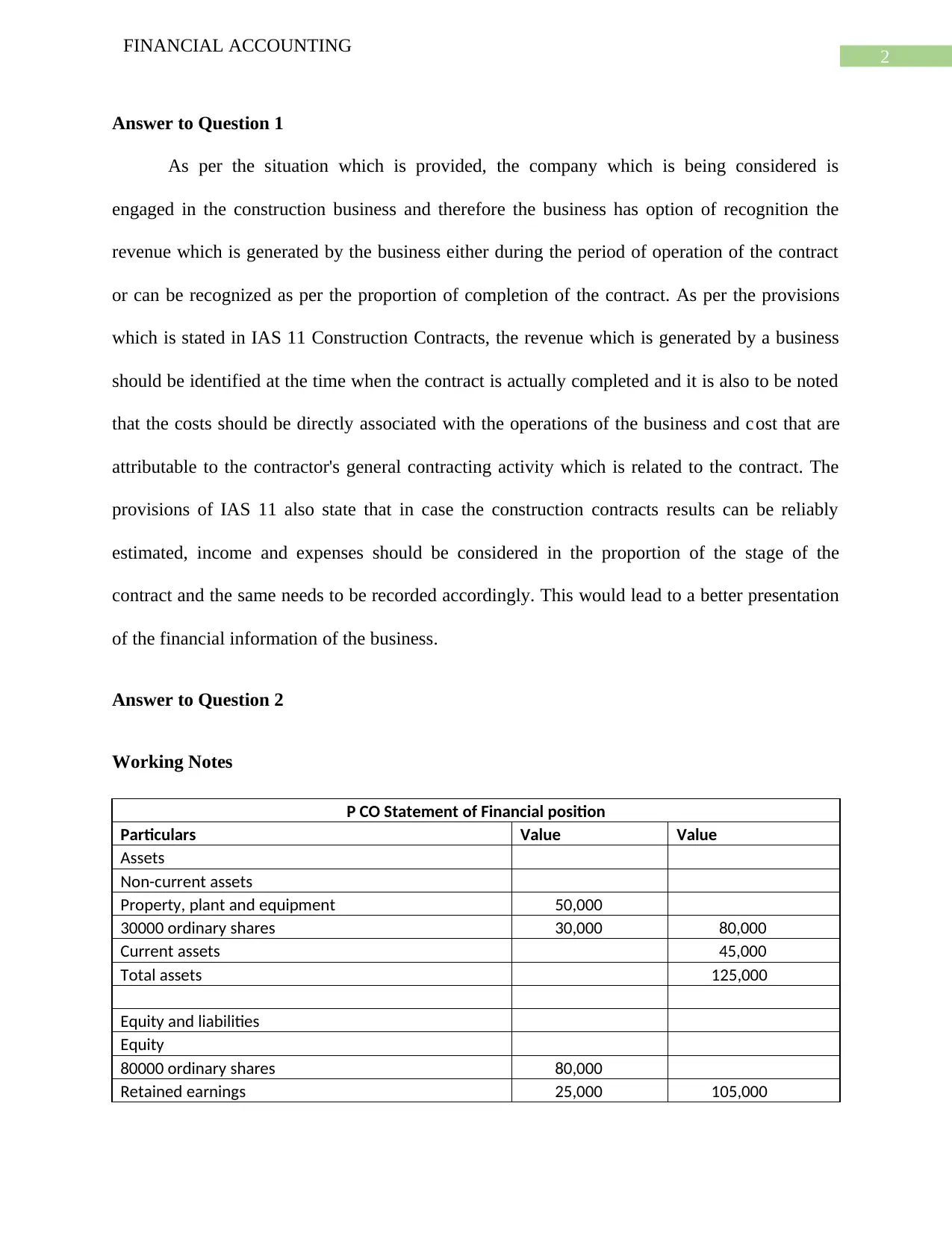
Answer to Question 2
Working Notes
P CO Statement of Financial position
Particulars Value Value
Assets
Non-current assets
Property, plant and equipment 50,000
30000 ordinary shares 30,000 80,000
Current assets 45,000
Total assets 125,000
Equity and liabilities
Equity
80000 ordinary shares 80,000
Retained earnings 25,000 105,000
FINANCIAL ACCOUNTING
Answer to Question 1
As per the situation which is provided, the company which is being considered is
engaged in the construction business and therefore the business has option of recognition the
revenue which is generated by the business either during the period of operation of the contract
or can be recognized as per the proportion of completion of the contract. As per the provisions
which is stated in IAS 11 Construction Contracts, the revenue which is generated by a business
should be identified at the time when the contract is actually completed and it is also to be noted
that the costs should be directly associated with the operations of the business and cost that are
attributable to the contractor's general contracting activity which is related to the contract. The
provisions of IAS 11 also state that in case the construction contracts results can be reliably
estimated, income and expenses should be considered in the proportion of the stage of the
contract and the same needs to be recorded accordingly. This would lead to a better presentation
of the financial information of the business.
Answer to Question 2
Working Notes
P CO Statement of Financial position
Particulars Value Value
Assets
Non-current assets
Property, plant and equipment 50,000
30000 ordinary shares 30,000 80,000
Current assets 45,000
Total assets 125,000
Equity and liabilities
Equity
80000 ordinary shares 80,000
Retained earnings 25,000 105,000
⊘ This is a preview!⊘
Do you want full access?
Subscribe today to unlock all pages.

Trusted by 1+ million students worldwide
3
FINANCIAL ACCOUNTING
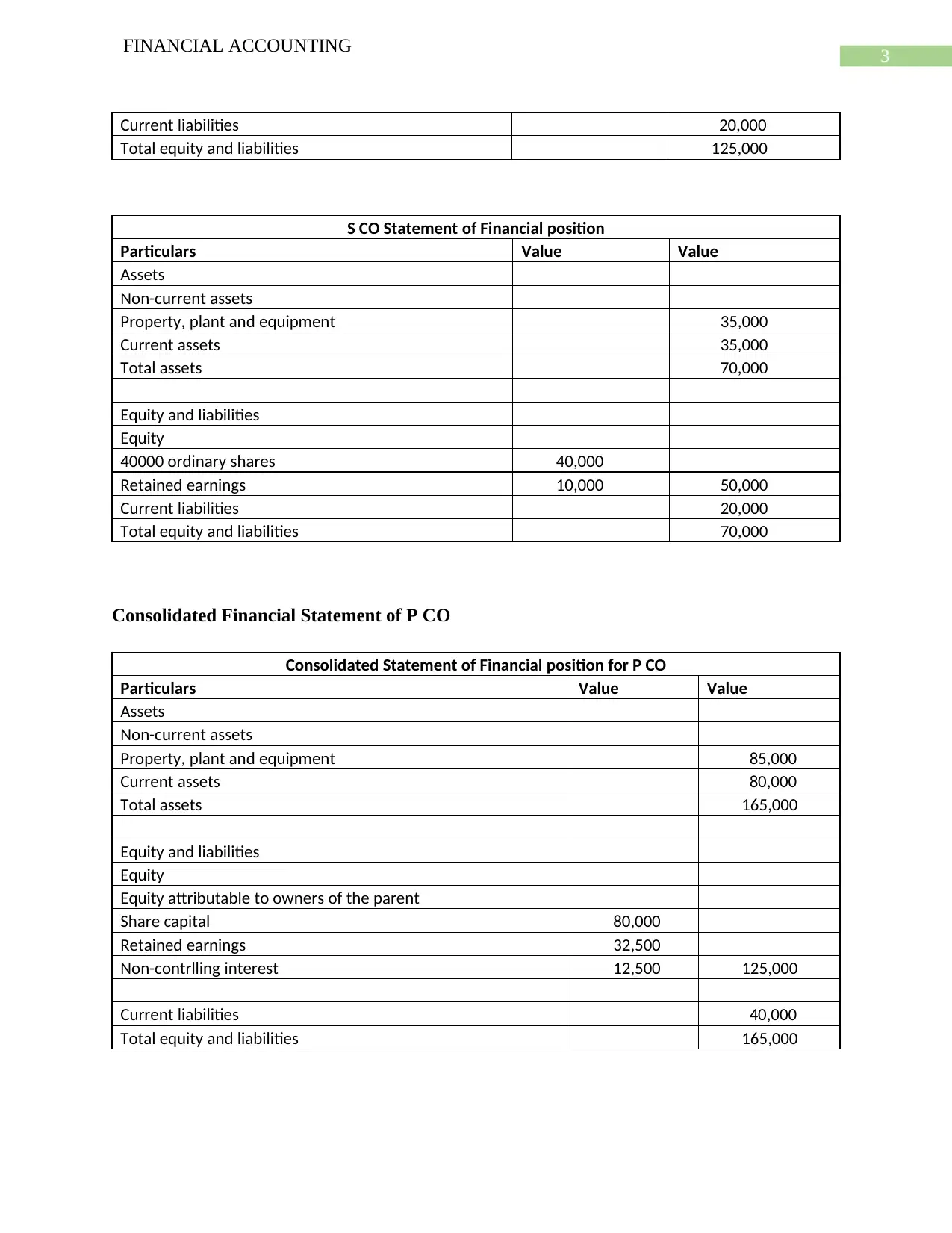
Current liabilities 20,000
Total equity and liabilities 125,000
S CO Statement of Financial position
Particulars Value Value
Assets
Non-current assets
Property, plant and equipment 35,000
Current assets 35,000
Total assets 70,000
Equity and liabilities
Equity
40000 ordinary shares 40,000
Retained earnings 10,000 50,000
Current liabilities 20,000
Total equity and liabilities 70,000
Consolidated Financial Statement of P CO
Consolidated Statement of Financial position for P CO
Particulars Value Value
Assets
Non-current assets
Property, plant and equipment 85,000
Current assets 80,000
Total assets 165,000
Equity and liabilities
Equity
Equity attributable to owners of the parent
Share capital 80,000
Retained earnings 32,500
Non-contrlling interest 12,500 125,000
Current liabilities 40,000
Total equity and liabilities 165,000
FINANCIAL ACCOUNTING
Current liabilities 20,000
Total equity and liabilities 125,000
S CO Statement of Financial position
Particulars Value Value
Assets
Non-current assets
Property, plant and equipment 35,000
Current assets 35,000
Total assets 70,000
Equity and liabilities
Equity
40000 ordinary shares 40,000
Retained earnings 10,000 50,000
Current liabilities 20,000
Total equity and liabilities 70,000
Consolidated Financial Statement of P CO
Consolidated Statement of Financial position for P CO
Particulars Value Value
Assets
Non-current assets
Property, plant and equipment 85,000
Current assets 80,000
Total assets 165,000
Equity and liabilities
Equity
Equity attributable to owners of the parent
Share capital 80,000
Retained earnings 32,500
Non-contrlling interest 12,500 125,000
Current liabilities 40,000
Total equity and liabilities 165,000
Paraphrase This Document
Need a fresh take? Get an instant paraphrase of this document with our AI Paraphraser
4
FINANCIAL ACCOUNTING
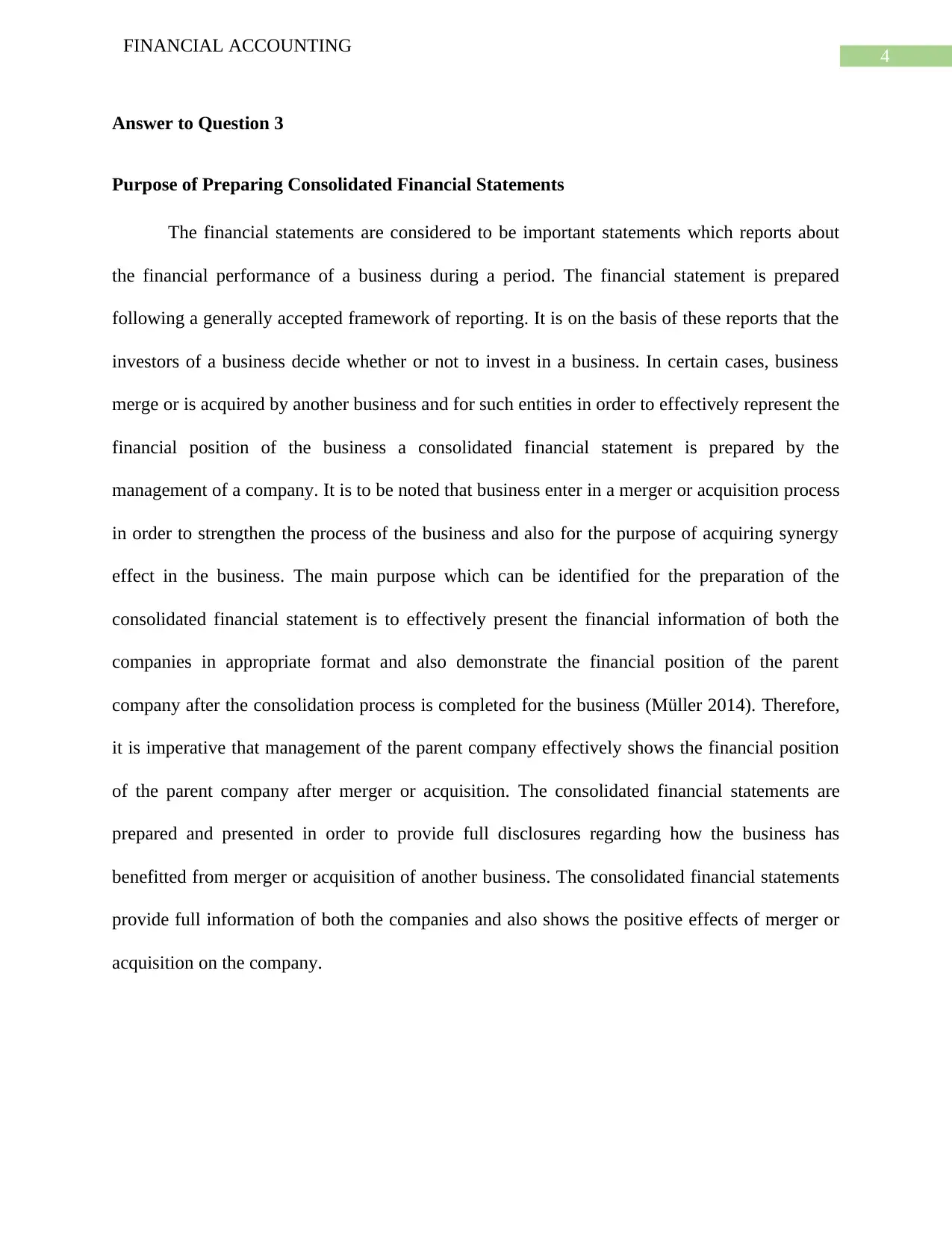
Answer to Question 3
Purpose of Preparing Consolidated Financial Statements
The financial statements are considered to be important statements which reports about
the financial performance of a business during a period. The financial statement is prepared
following a generally accepted framework of reporting. It is on the basis of these reports that the
investors of a business decide whether or not to invest in a business. In certain cases, business
merge or is acquired by another business and for such entities in order to effectively represent the
financial position of the business a consolidated financial statement is prepared by the
management of a company. It is to be noted that business enter in a merger or acquisition process
in order to strengthen the process of the business and also for the purpose of acquiring synergy
effect in the business. The main purpose which can be identified for the preparation of the
consolidated financial statement is to effectively present the financial information of both the
companies in appropriate format and also demonstrate the financial position of the parent
company after the consolidation process is completed for the business (Müller 2014). Therefore,
it is imperative that management of the parent company effectively shows the financial position
of the parent company after merger or acquisition. The consolidated financial statements are
prepared and presented in order to provide full disclosures regarding how the business has
benefitted from merger or acquisition of another business. The consolidated financial statements
provide full information of both the companies and also shows the positive effects of merger or
acquisition on the company.
FINANCIAL ACCOUNTING
Answer to Question 3
Purpose of Preparing Consolidated Financial Statements
The financial statements are considered to be important statements which reports about
the financial performance of a business during a period. The financial statement is prepared
following a generally accepted framework of reporting. It is on the basis of these reports that the
investors of a business decide whether or not to invest in a business. In certain cases, business
merge or is acquired by another business and for such entities in order to effectively represent the
financial position of the business a consolidated financial statement is prepared by the
management of a company. It is to be noted that business enter in a merger or acquisition process
in order to strengthen the process of the business and also for the purpose of acquiring synergy
effect in the business. The main purpose which can be identified for the preparation of the
consolidated financial statement is to effectively present the financial information of both the
companies in appropriate format and also demonstrate the financial position of the parent
company after the consolidation process is completed for the business (Müller 2014). Therefore,
it is imperative that management of the parent company effectively shows the financial position
of the parent company after merger or acquisition. The consolidated financial statements are
prepared and presented in order to provide full disclosures regarding how the business has
benefitted from merger or acquisition of another business. The consolidated financial statements
provide full information of both the companies and also shows the positive effects of merger or
acquisition on the company.
5
FINANCIAL ACCOUNTING
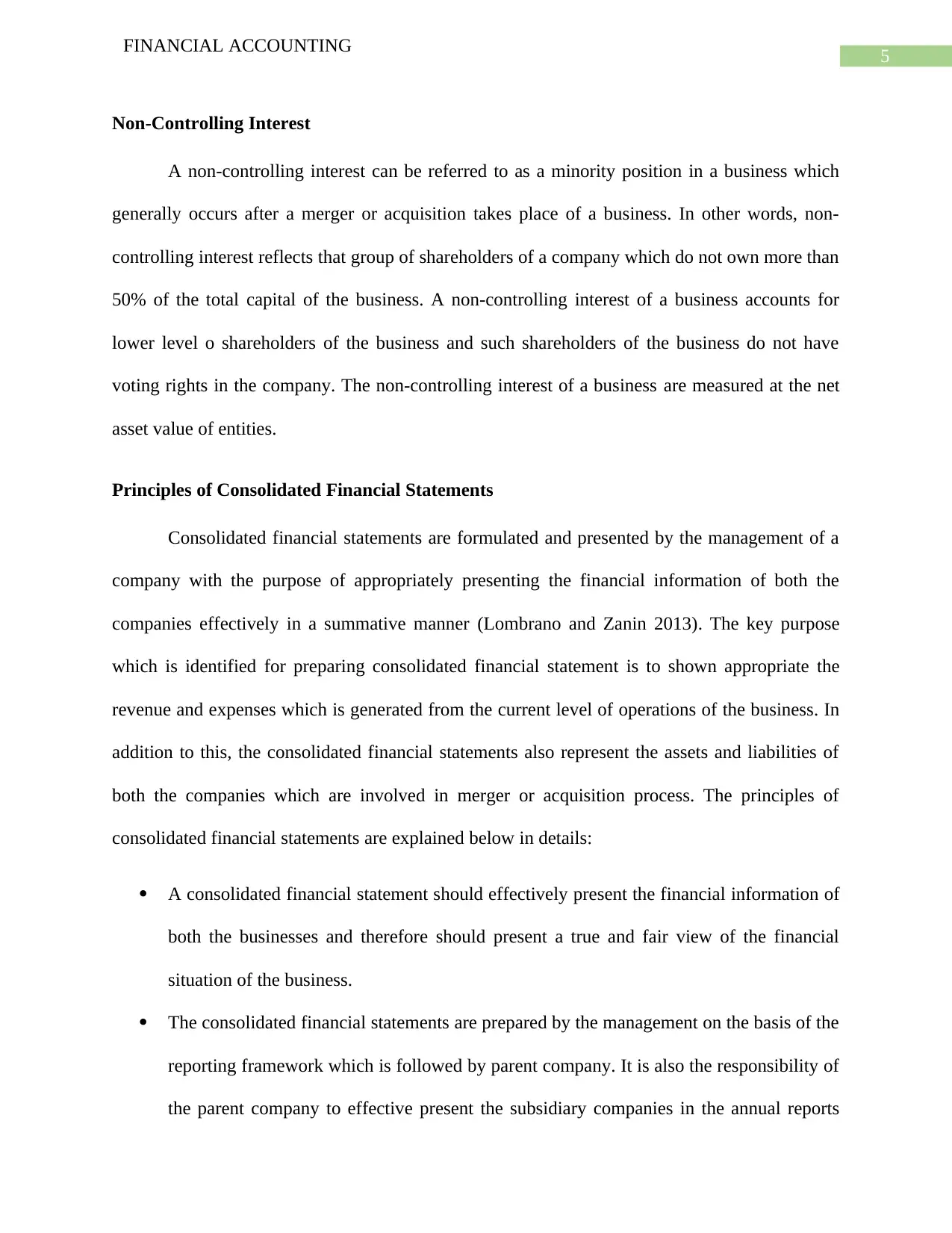
Non-Controlling Interest
A non-controlling interest can be referred to as a minority position in a business which
generally occurs after a merger or acquisition takes place of a business. In other words, non-
controlling interest reflects that group of shareholders of a company which do not own more than
50% of the total capital of the business. A non-controlling interest of a business accounts for
lower level o shareholders of the business and such shareholders of the business do not have
voting rights in the company. The non-controlling interest of a business are measured at the net
asset value of entities.
Principles of Consolidated Financial Statements
Consolidated financial statements are formulated and presented by the management of a
company with the purpose of appropriately presenting the financial information of both the
companies effectively in a summative manner (Lombrano and Zanin 2013). The key purpose
which is identified for preparing consolidated financial statement is to shown appropriate the
revenue and expenses which is generated from the current level of operations of the business. In
addition to this, the consolidated financial statements also represent the assets and liabilities of
both the companies which are involved in merger or acquisition process. The principles of
consolidated financial statements are explained below in details:
A consolidated financial statement should effectively present the financial information of
both the businesses and therefore should present a true and fair view of the financial
situation of the business.
The consolidated financial statements are prepared by the management on the basis of the
reporting framework which is followed by parent company. It is also the responsibility of
the parent company to effective present the subsidiary companies in the annual reports
FINANCIAL ACCOUNTING
Non-Controlling Interest
A non-controlling interest can be referred to as a minority position in a business which
generally occurs after a merger or acquisition takes place of a business. In other words, non-
controlling interest reflects that group of shareholders of a company which do not own more than
50% of the total capital of the business. A non-controlling interest of a business accounts for
lower level o shareholders of the business and such shareholders of the business do not have
voting rights in the company. The non-controlling interest of a business are measured at the net
asset value of entities.
Principles of Consolidated Financial Statements
Consolidated financial statements are formulated and presented by the management of a
company with the purpose of appropriately presenting the financial information of both the
companies effectively in a summative manner (Lombrano and Zanin 2013). The key purpose
which is identified for preparing consolidated financial statement is to shown appropriate the
revenue and expenses which is generated from the current level of operations of the business. In
addition to this, the consolidated financial statements also represent the assets and liabilities of
both the companies which are involved in merger or acquisition process. The principles of
consolidated financial statements are explained below in details:
A consolidated financial statement should effectively present the financial information of
both the businesses and therefore should present a true and fair view of the financial
situation of the business.
The consolidated financial statements are prepared by the management on the basis of the
reporting framework which is followed by parent company. It is also the responsibility of
the parent company to effective present the subsidiary companies in the annual reports
⊘ This is a preview!⊘
Do you want full access?
Subscribe today to unlock all pages.
Trusted by 1+ million students worldwide
6
FINANCIAL ACCOUNTING
which needs to be prepared according to the principles of GAAP and showing
appropriate disclosures for the same (Aletkin 2014).
A consolidated financial statement provides a clear picture regarding the financial
position of the business and it should provide information which do not affect the
judgement of the users of the financial statements.
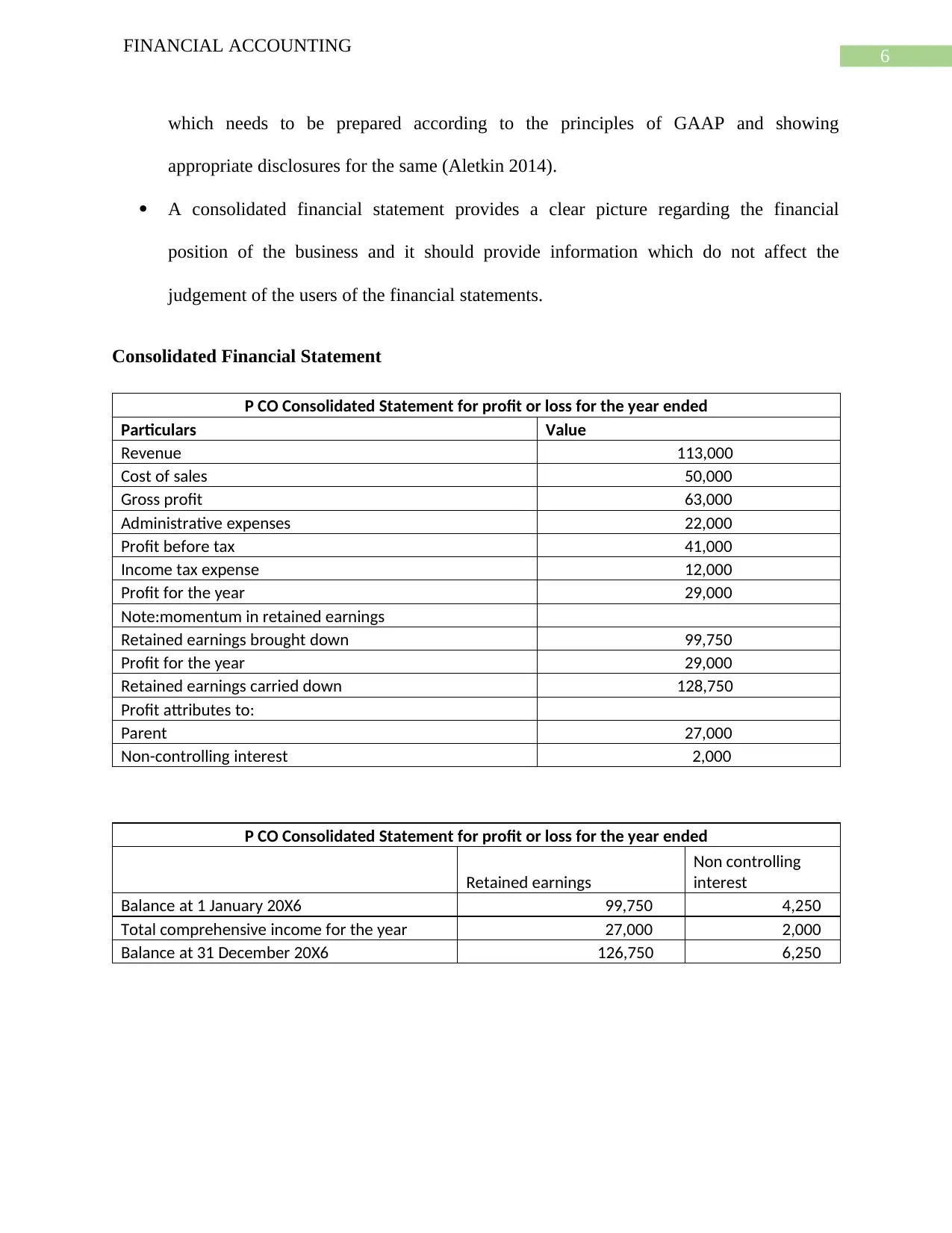
Consolidated Financial Statement
P CO Consolidated Statement for profit or loss for the year ended
Particulars Value
Revenue 113,000
Cost of sales 50,000
Gross profit 63,000
Administrative expenses 22,000
Profit before tax 41,000
Income tax expense 12,000
Profit for the year 29,000
Note:momentum in retained earnings
Retained earnings brought down 99,750
Profit for the year 29,000
Retained earnings carried down 128,750
Profit attributes to:
Parent 27,000
Non-controlling interest 2,000
P CO Consolidated Statement for profit or loss for the year ended
Retained earnings
Non controlling
interest
Balance at 1 January 20X6 99,750 4,250
Total comprehensive income for the year 27,000 2,000
Balance at 31 December 20X6 126,750 6,250
FINANCIAL ACCOUNTING
which needs to be prepared according to the principles of GAAP and showing
appropriate disclosures for the same (Aletkin 2014).
A consolidated financial statement provides a clear picture regarding the financial
position of the business and it should provide information which do not affect the
judgement of the users of the financial statements.
Consolidated Financial Statement
P CO Consolidated Statement for profit or loss for the year ended
Particulars Value
Revenue 113,000
Cost of sales 50,000
Gross profit 63,000
Administrative expenses 22,000
Profit before tax 41,000
Income tax expense 12,000
Profit for the year 29,000
Note:momentum in retained earnings
Retained earnings brought down 99,750
Profit for the year 29,000
Retained earnings carried down 128,750
Profit attributes to:
Parent 27,000
Non-controlling interest 2,000
P CO Consolidated Statement for profit or loss for the year ended
Retained earnings
Non controlling
interest
Balance at 1 January 20X6 99,750 4,250
Total comprehensive income for the year 27,000 2,000
Balance at 31 December 20X6 126,750 6,250
Paraphrase This Document
Need a fresh take? Get an instant paraphrase of this document with our AI Paraphraser
7
FINANCIAL ACCOUNTING
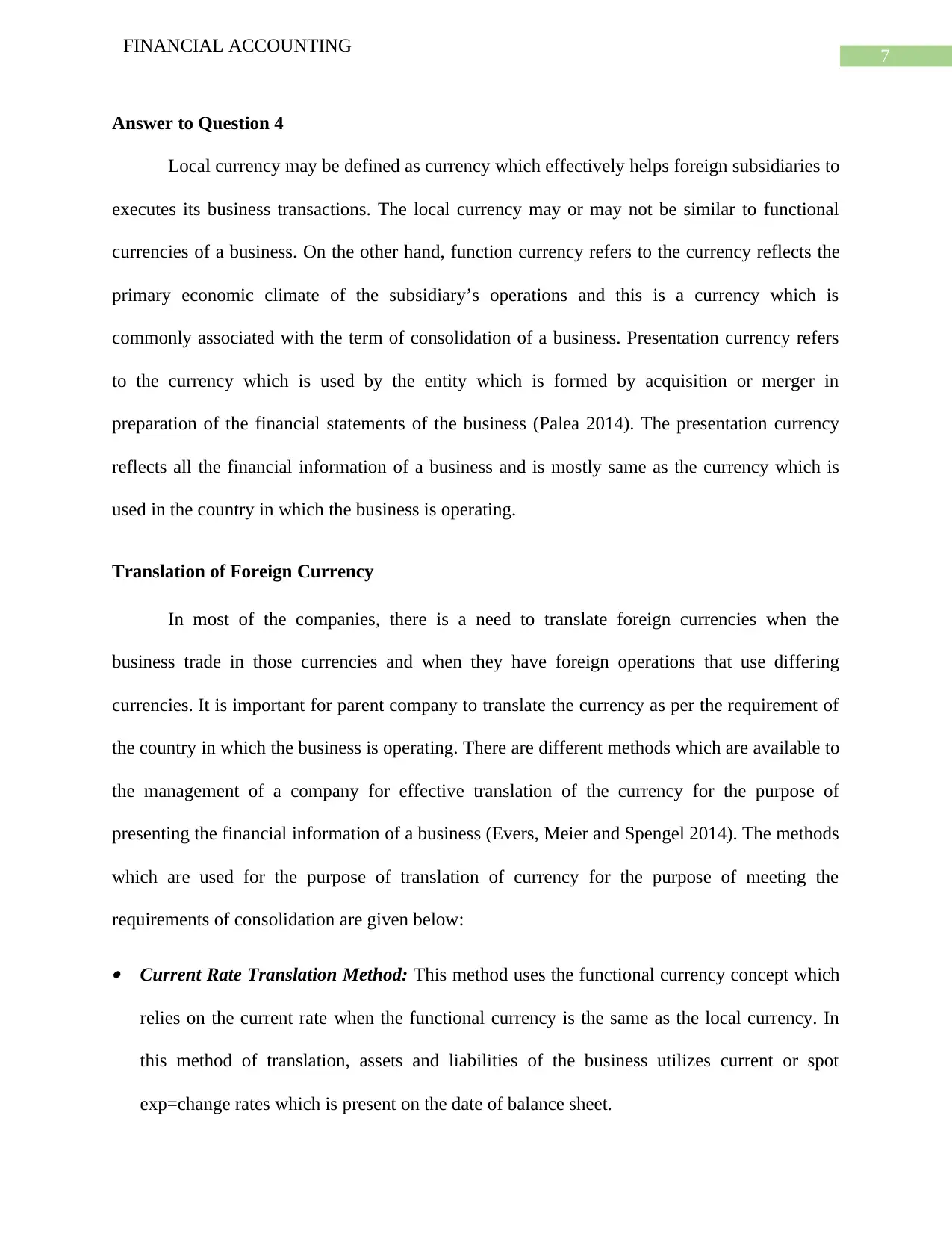
Answer to Question 4
Local currency may be defined as currency which effectively helps foreign subsidiaries to
executes its business transactions. The local currency may or may not be similar to functional
currencies of a business. On the other hand, function currency refers to the currency reflects the
primary economic climate of the subsidiary’s operations and this is a currency which is
commonly associated with the term of consolidation of a business. Presentation currency refers
to the currency which is used by the entity which is formed by acquisition or merger in
preparation of the financial statements of the business (Palea 2014). The presentation currency
reflects all the financial information of a business and is mostly same as the currency which is
used in the country in which the business is operating.
Translation of Foreign Currency
In most of the companies, there is a need to translate foreign currencies when the
business trade in those currencies and when they have foreign operations that use differing
currencies. It is important for parent company to translate the currency as per the requirement of
the country in which the business is operating. There are different methods which are available to
the management of a company for effective translation of the currency for the purpose of
presenting the financial information of a business (Evers, Meier and Spengel 2014). The methods
which are used for the purpose of translation of currency for the purpose of meeting the
requirements of consolidation are given below:
Current Rate Translation Method: This method uses the functional currency concept which
relies on the current rate when the functional currency is the same as the local currency. In
this method of translation, assets and liabilities of the business utilizes current or spot
exp=change rates which is present on the date of balance sheet.
FINANCIAL ACCOUNTING
Answer to Question 4
Local currency may be defined as currency which effectively helps foreign subsidiaries to
executes its business transactions. The local currency may or may not be similar to functional
currencies of a business. On the other hand, function currency refers to the currency reflects the
primary economic climate of the subsidiary’s operations and this is a currency which is
commonly associated with the term of consolidation of a business. Presentation currency refers
to the currency which is used by the entity which is formed by acquisition or merger in
preparation of the financial statements of the business (Palea 2014). The presentation currency
reflects all the financial information of a business and is mostly same as the currency which is
used in the country in which the business is operating.
Translation of Foreign Currency
In most of the companies, there is a need to translate foreign currencies when the
business trade in those currencies and when they have foreign operations that use differing
currencies. It is important for parent company to translate the currency as per the requirement of
the country in which the business is operating. There are different methods which are available to
the management of a company for effective translation of the currency for the purpose of
presenting the financial information of a business (Evers, Meier and Spengel 2014). The methods
which are used for the purpose of translation of currency for the purpose of meeting the
requirements of consolidation are given below:
Current Rate Translation Method: This method uses the functional currency concept which
relies on the current rate when the functional currency is the same as the local currency. In
this method of translation, assets and liabilities of the business utilizes current or spot
exp=change rates which is present on the date of balance sheet.
8
FINANCIAL ACCOUNTING
Temporal Rate Translation Method: This method requires the translation process to use
temporal or historical rate method for translation and it is also to be noted that the local
currency differs from that of functional currency (De Vlaminck and Sarens 2015). Income
generating assets can be adjusted when temporal rate is used for the purpose of translation.
Monetary-Nonmonetary Translation Method: This method of translation is utilized by a
business when a foreign business operation is highly integrated with a parent company which
operates in domestic country. This method is also used by businesses when the operations of
two businesses are related to each other in a manner.
Answer to Question 5
Approaches for Corporate Reporting
The purpose of corporate reporting is to effectively present the financial information of a
business so that the same can be used by the users of financial reports to take major decision.
The four-step model which is applied for the purpose of corporate reporting of a business
involves the following steps which are explained below in details:
Principle Based approach: This is a concept which is closely followed with integrated reporting
framework of a business and requires the management of a company to follow effectively all the
principles of accounting which needs to be followed while preparing the financial statements if a
business. The reporting framework of integrated reporting has significant advantage and is
developing rapidly in businesses (Weil, Schipper and Francis 2013). The integrated reporting
framework also ensures that the financial reports which is prepared by the management of the
company effectively presents the financial information of the business by using both qualitative
and quantitative approaches. In qualitative approaches more, theoretical information is provided
FINANCIAL ACCOUNTING
Temporal Rate Translation Method: This method requires the translation process to use
temporal or historical rate method for translation and it is also to be noted that the local
currency differs from that of functional currency (De Vlaminck and Sarens 2015). Income
generating assets can be adjusted when temporal rate is used for the purpose of translation.
Monetary-Nonmonetary Translation Method: This method of translation is utilized by a
business when a foreign business operation is highly integrated with a parent company which
operates in domestic country. This method is also used by businesses when the operations of
two businesses are related to each other in a manner.
Answer to Question 5
Approaches for Corporate Reporting
The purpose of corporate reporting is to effectively present the financial information of a
business so that the same can be used by the users of financial reports to take major decision.
The four-step model which is applied for the purpose of corporate reporting of a business
involves the following steps which are explained below in details:
Principle Based approach: This is a concept which is closely followed with integrated reporting
framework of a business and requires the management of a company to follow effectively all the
principles of accounting which needs to be followed while preparing the financial statements if a
business. The reporting framework of integrated reporting has significant advantage and is
developing rapidly in businesses (Weil, Schipper and Francis 2013). The integrated reporting
framework also ensures that the financial reports which is prepared by the management of the
company effectively presents the financial information of the business by using both qualitative
and quantitative approaches. In qualitative approaches more, theoretical information is provided
⊘ This is a preview!⊘
Do you want full access?
Subscribe today to unlock all pages.
Trusted by 1+ million students worldwide
9
FINANCIAL ACCOUNTING
by the business along with representation of the management of the company. The quantitative
approaches require the management of the company to present more of numerical information in
the financial statements which is prepared by the business (Robinson et al. 2015). The
quantitative approach of presenting more information requires better presentation of and use of
forecasting techniques for making comparisons.
Integrated Reporting Framework
Integrated reporting framework is used by the management of a company for effectively
presenting financial information in a concise manner which effectively represents the strategies
of the of the business along with performance and prospect of the business. The reporting
framework is consistent with the long term, medium term and long-term strategies of the
business. The management of a company must prepare an integrated report on the basis of this
framework (Nobes 2013). The method of integrated reporting framework is utilizing principle-
based approaches for maintaining appropriate balances between flexibility and prescription that
is related to wide variations in reporting framework of the business.
The integrated reporting framework has become excessively popular over the last few years
as it effectively presents the information of the business. In addition to this, a certain level of
quality can also be maintained by following integrated reporting framework. The objectives of
integrated reporting framework which can be identified are listed below in details:
The main purpose of integrated reporting framework is to ensure that the financial
statements are prepared by the management of the company following guiding principles
and content elements that governs the overall information which is presented in the
FINANCIAL ACCOUNTING
by the business along with representation of the management of the company. The quantitative
approaches require the management of the company to present more of numerical information in
the financial statements which is prepared by the business (Robinson et al. 2015). The
quantitative approach of presenting more information requires better presentation of and use of
forecasting techniques for making comparisons.
Integrated Reporting Framework
Integrated reporting framework is used by the management of a company for effectively
presenting financial information in a concise manner which effectively represents the strategies
of the of the business along with performance and prospect of the business. The reporting
framework is consistent with the long term, medium term and long-term strategies of the
business. The management of a company must prepare an integrated report on the basis of this
framework (Nobes 2013). The method of integrated reporting framework is utilizing principle-
based approaches for maintaining appropriate balances between flexibility and prescription that
is related to wide variations in reporting framework of the business.
The integrated reporting framework has become excessively popular over the last few years
as it effectively presents the information of the business. In addition to this, a certain level of
quality can also be maintained by following integrated reporting framework. The objectives of
integrated reporting framework which can be identified are listed below in details:
The main purpose of integrated reporting framework is to ensure that the financial
statements are prepared by the management of the company following guiding principles
and content elements that governs the overall information which is presented in the
Paraphrase This Document
Need a fresh take? Get an instant paraphrase of this document with our AI Paraphraser
10
FINANCIAL ACCOUNTING
integrated reports of the business. It is also aimed at properly explaining the fundamental
concepts which are used for presenting the financial information of the business.
The framework is basically used by the management of the company for identifying areas
where the management of the company can create values for the business and it also
reflects the ability of the business for creating value in the operations of the business.
The integrated reporting framework which is used by businesses for complying with the
expectation of the shareholders of the business. This also reflect the ability of the
business to create value in a business and the stakeholders of the business includes
employees, customers and business partners and others.
Analysis of the Article
The analysis of the article effectively shows that business of Uniqlo which is engaged in
the business of retailing business and is considered to be quite successful in the market. The
management of the company needs to follow social accountability standards 8000 so that proper
social consideration is adopted in the business (Flower 2015). The business of retailing has
suffered significantly from ethical consideration and therefore the management of the company
needs to adopt appropriate strategies so that proper management of business can be implemented.
The management of the company needs to consider the safety issues in the business along with
proper working environment is available to the workers and proper shift time is maintained for
the workers operating in the business. The management of the company also needs to ensure that
no discrimination practices takes place in the business and every employee should be treated in
an equal manner. These policies would not only improve the business structure but also improve
the profit generation ability of the business. In addition to this, this will also improve the
confidence of the public in the business.
FINANCIAL ACCOUNTING
integrated reports of the business. It is also aimed at properly explaining the fundamental
concepts which are used for presenting the financial information of the business.
The framework is basically used by the management of the company for identifying areas
where the management of the company can create values for the business and it also
reflects the ability of the business for creating value in the operations of the business.
The integrated reporting framework which is used by businesses for complying with the
expectation of the shareholders of the business. This also reflect the ability of the
business to create value in a business and the stakeholders of the business includes
employees, customers and business partners and others.
Analysis of the Article
The analysis of the article effectively shows that business of Uniqlo which is engaged in
the business of retailing business and is considered to be quite successful in the market. The
management of the company needs to follow social accountability standards 8000 so that proper
social consideration is adopted in the business (Flower 2015). The business of retailing has
suffered significantly from ethical consideration and therefore the management of the company
needs to adopt appropriate strategies so that proper management of business can be implemented.
The management of the company needs to consider the safety issues in the business along with
proper working environment is available to the workers and proper shift time is maintained for
the workers operating in the business. The management of the company also needs to ensure that
no discrimination practices takes place in the business and every employee should be treated in
an equal manner. These policies would not only improve the business structure but also improve
the profit generation ability of the business. In addition to this, this will also improve the
confidence of the public in the business.
11
FINANCIAL ACCOUNTING
As per legitimacy theory, the management of a company is bound by social
considerations and therefore the management of company must take appropriate steps for making
improvements in social contributions of the business. The management of Uniqlo needs to
consider the well beings of the employees of the business and therefore introduce rewards
systems and processes so that the employees of the business are motivated towards achieving the
long term and short term objectives of the business.
FINANCIAL ACCOUNTING
As per legitimacy theory, the management of a company is bound by social
considerations and therefore the management of company must take appropriate steps for making
improvements in social contributions of the business. The management of Uniqlo needs to
consider the well beings of the employees of the business and therefore introduce rewards
systems and processes so that the employees of the business are motivated towards achieving the
long term and short term objectives of the business.
⊘ This is a preview!⊘
Do you want full access?
Subscribe today to unlock all pages.
Trusted by 1+ million students worldwide

1 out of 14


Related Documents


Your All-in-One AI-Powered Toolkit for Academic Success.
+13062052269
info@desklib.com
Available 24*7 on WhatsApp / Email
![[object Object]](/_next/static/media/star-bottom.7253800d.svg)
Unlock your academic potential
Copyright © 2020–2026 A2Z Services. All Rights Reserved. Developed and managed by ZUCOL.