Financial and Management Accounting: Concepts and Differences Report
VerifiedAdded on 2023/01/12
|16
|3396
|88
Report
AI Summary
This report provides a comprehensive overview of financial and management accounting, comparing their concepts and methods. Section A focuses on financial accounting, detailing journal entries, ledger accounts, trial balance, and financial statements (income statement, statement of owner's equity, and balance sheet). It also highlights the differences between financial and management accounting, emphasizing the characteristics of high-quality financial information. Section B delves into management accounting, including cost analysis, overhead absorption, and profit calculations under absorption and marginal costing. The report concludes by summarizing the key takeaways and differences between these two vital accounting methods, providing valuable insights for decision-making and understanding financial performance. The report covers topics such as journal entries, ledger accounts, income statements, balance sheets, and cost accounting methods. The assignment also includes a detailed comparison of financial accounting vs. management accounting.
FINANCIAL ACCOUNTING

Paraphrase This Document
Need a fresh take? Get an instant paraphrase of this document with our AI Paraphraser
ABSTRACT
Present report is based over the concepts and methods used in financial and management
accounting by the organisation. Both the accounting method provides relevant information for
decision making. Present report will enhance the understanding of the management accounting
and financial accounting and its importance. Report will stated the difference between the two
accounting methods and the characteristics of quality information.
Present report is based over the concepts and methods used in financial and management
accounting by the organisation. Both the accounting method provides relevant information for
decision making. Present report will enhance the understanding of the management accounting
and financial accounting and its importance. Report will stated the difference between the two
accounting methods and the characteristics of quality information.
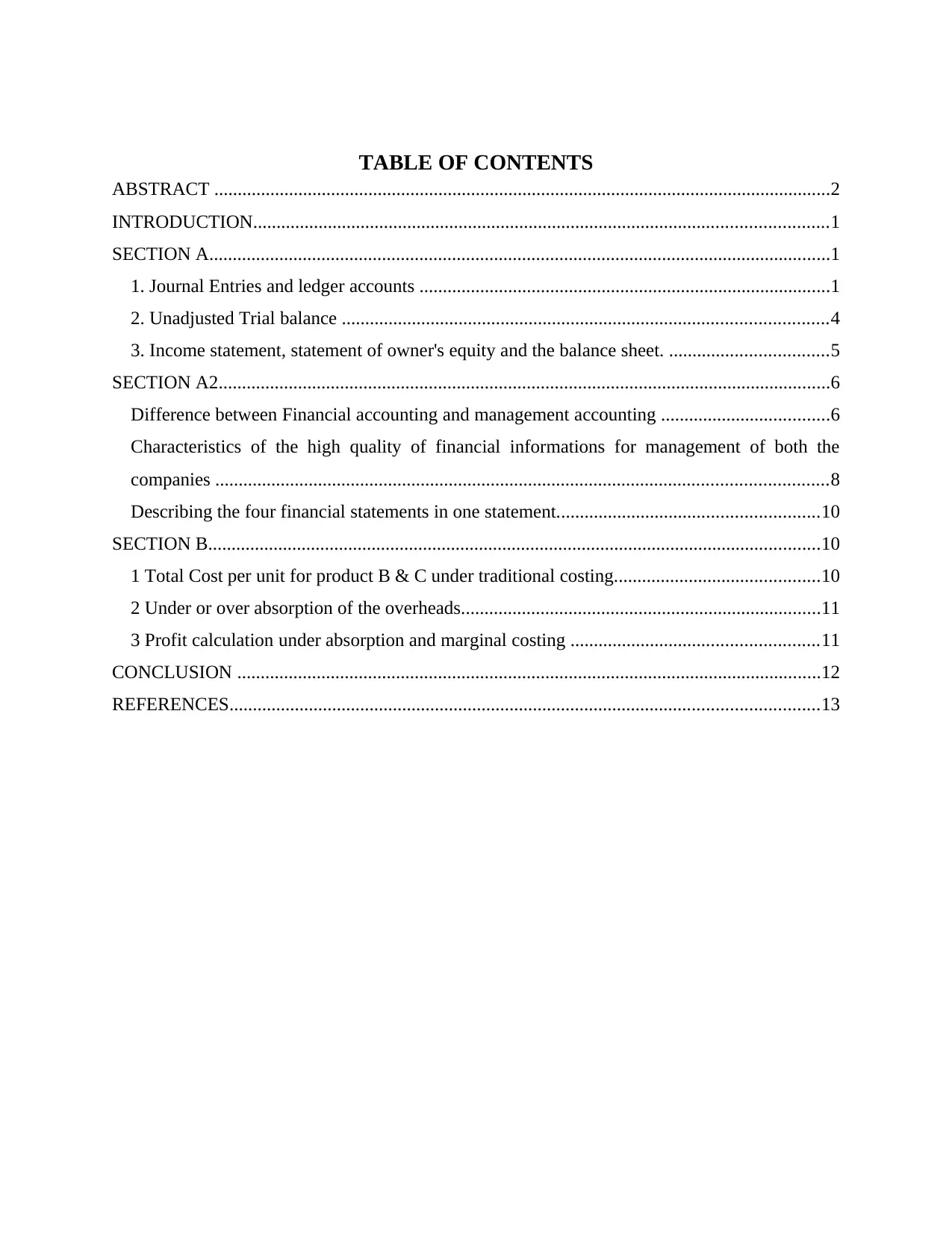
TABLE OF CONTENTS
ABSTRACT ....................................................................................................................................2
INTRODUCTION...........................................................................................................................1
SECTION A.....................................................................................................................................1
1. Journal Entries and ledger accounts ........................................................................................1
2. Unadjusted Trial balance ........................................................................................................4
3. Income statement, statement of owner's equity and the balance sheet. ..................................5
SECTION A2...................................................................................................................................6
Difference between Financial accounting and management accounting ....................................6
Characteristics of the high quality of financial informations for management of both the
companies ...................................................................................................................................8
Describing the four financial statements in one statement........................................................10
SECTION B...................................................................................................................................10
1 Total Cost per unit for product B & C under traditional costing............................................10
2 Under or over absorption of the overheads.............................................................................11
3 Profit calculation under absorption and marginal costing .....................................................11
CONCLUSION .............................................................................................................................12
REFERENCES..............................................................................................................................13
ABSTRACT ....................................................................................................................................2
INTRODUCTION...........................................................................................................................1
SECTION A.....................................................................................................................................1
1. Journal Entries and ledger accounts ........................................................................................1
2. Unadjusted Trial balance ........................................................................................................4
3. Income statement, statement of owner's equity and the balance sheet. ..................................5
SECTION A2...................................................................................................................................6
Difference between Financial accounting and management accounting ....................................6
Characteristics of the high quality of financial informations for management of both the
companies ...................................................................................................................................8
Describing the four financial statements in one statement........................................................10
SECTION B...................................................................................................................................10
1 Total Cost per unit for product B & C under traditional costing............................................10
2 Under or over absorption of the overheads.............................................................................11
3 Profit calculation under absorption and marginal costing .....................................................11
CONCLUSION .............................................................................................................................12
REFERENCES..............................................................................................................................13
⊘ This is a preview!⊘
Do you want full access?
Subscribe today to unlock all pages.

Trusted by 1+ million students worldwide
INTRODUCTION
Financial accounting is concerned with reporting the operating profits and value of
business to the stakeholders. MA is used for describing accounting systems, methods and
techniques that with the special ability and knowledge assists the management in the objective to
maximise profits and reducing costs and wastages (Otley, 2016). Present report is based over the
concepts of financial accounting and management accounting. Section A of the report covers
concepts of financial accounting and section B covers the concepts of management accounting.
SECTION A
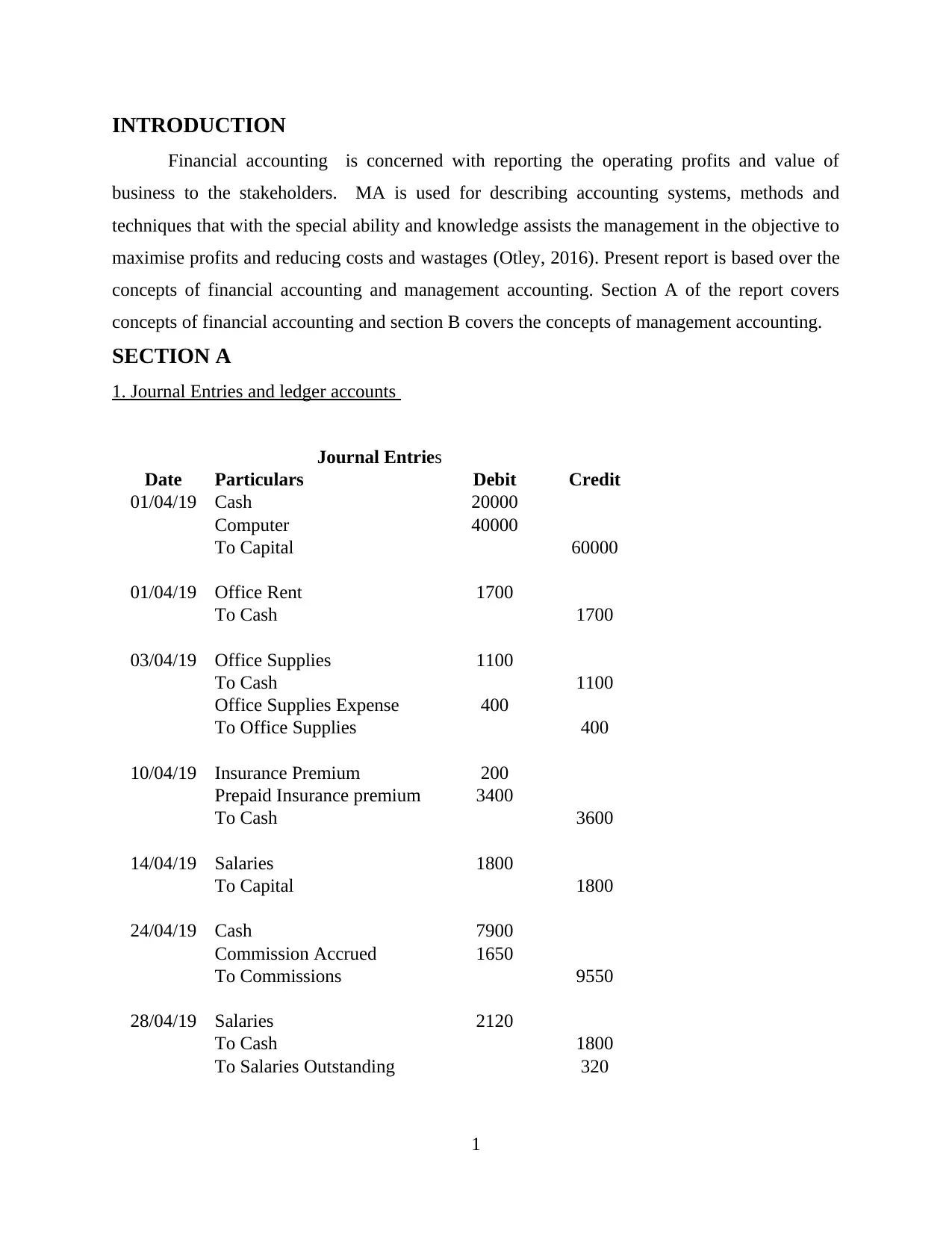
1. Journal Entries and ledger accounts
Journal Entries
Date Particulars Debit Credit
01/04/19 Cash 20000
Computer 40000
To Capital 60000
01/04/19 Office Rent 1700
To Cash 1700
03/04/19 Office Supplies 1100
To Cash 1100
Office Supplies Expense 400
To Office Supplies 400
10/04/19 Insurance Premium 200
Prepaid Insurance premium 3400
To Cash 3600
14/04/19 Salaries 1800
To Capital 1800
24/04/19 Cash 7900
Commission Accrued 1650
To Commissions 9550
28/04/19 Salaries 2120
To Cash 1800
To Salaries Outstanding 320
1
Financial accounting is concerned with reporting the operating profits and value of
business to the stakeholders. MA is used for describing accounting systems, methods and
techniques that with the special ability and knowledge assists the management in the objective to
maximise profits and reducing costs and wastages (Otley, 2016). Present report is based over the
concepts of financial accounting and management accounting. Section A of the report covers
concepts of financial accounting and section B covers the concepts of management accounting.
SECTION A
1. Journal Entries and ledger accounts
Journal Entries
Date Particulars Debit Credit
01/04/19 Cash 20000
Computer 40000
To Capital 60000
01/04/19 Office Rent 1700
To Cash 1700
03/04/19 Office Supplies 1100
To Cash 1100
Office Supplies Expense 400
To Office Supplies 400
10/04/19 Insurance Premium 200
Prepaid Insurance premium 3400
To Cash 3600
14/04/19 Salaries 1800
To Capital 1800
24/04/19 Cash 7900
Commission Accrued 1650
To Commissions 9550
28/04/19 Salaries 2120
To Cash 1800
To Salaries Outstanding 320
1
Paraphrase This Document
Need a fresh take? Get an instant paraphrase of this document with our AI Paraphraser
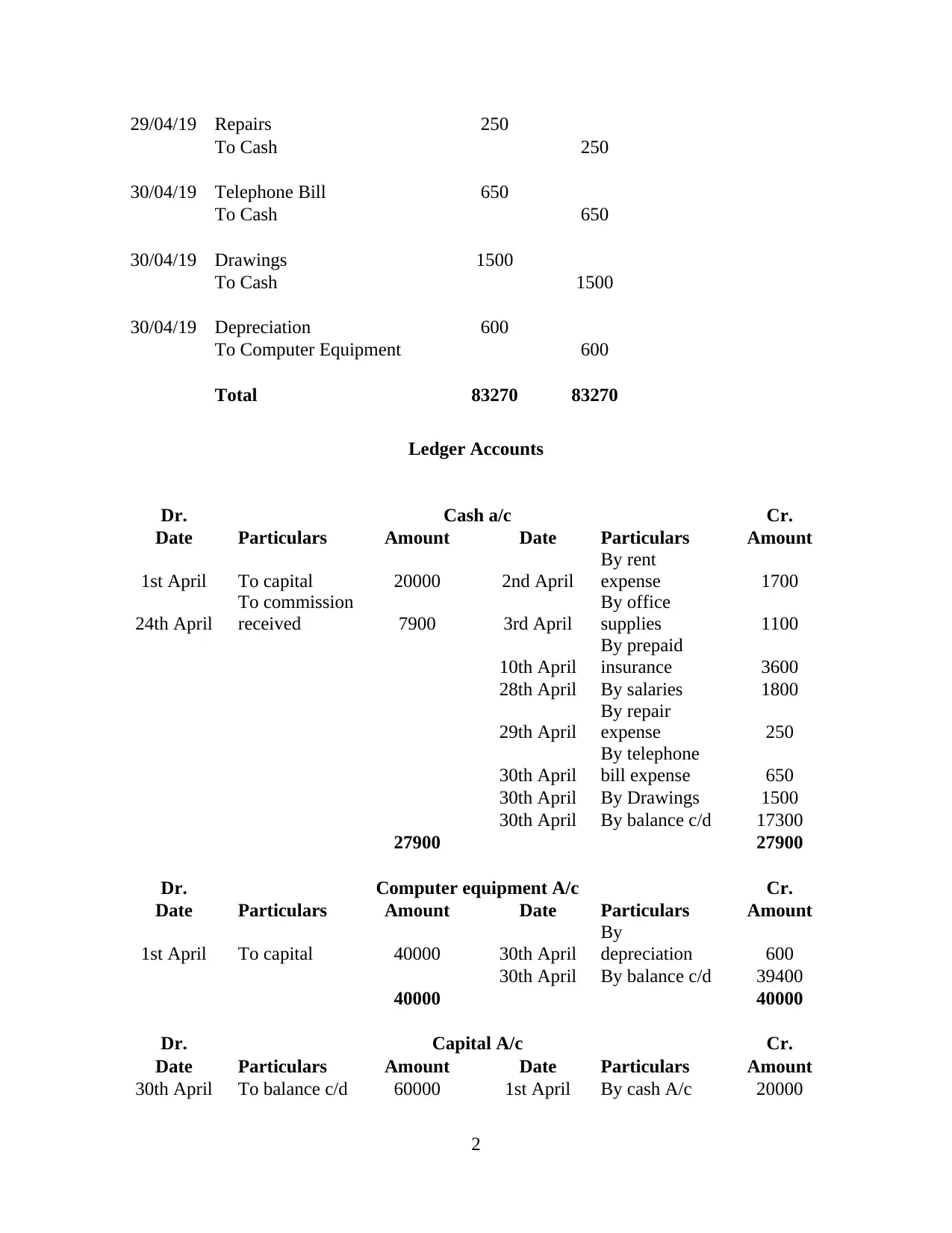
29/04/19 Repairs 250
To Cash 250
30/04/19 Telephone Bill 650
To Cash 650
30/04/19 Drawings 1500
To Cash 1500
30/04/19 Depreciation 600
To Computer Equipment 600
Total 83270 83270
Ledger Accounts
Dr. Cash a/c Cr.
Date Particulars Amount Date Particulars Amount
1st April To capital 20000 2nd April
By rent
expense 1700
24th April
To commission
received 7900 3rd April
By office
supplies 1100
10th April
By prepaid
insurance 3600
28th April By salaries 1800
29th April
By repair
expense 250
30th April
By telephone
bill expense 650
30th April By Drawings 1500
30th April By balance c/d 17300
27900 27900
Dr. Computer equipment A/c Cr.
Date Particulars Amount Date Particulars Amount
1st April To capital 40000 30th April
By
depreciation 600
30th April By balance c/d 39400
40000 40000
Dr. Capital A/c Cr.
Date Particulars Amount Date Particulars Amount
30th April To balance c/d 60000 1st April By cash A/c 20000
2
To Cash 250
30/04/19 Telephone Bill 650
To Cash 650
30/04/19 Drawings 1500
To Cash 1500
30/04/19 Depreciation 600
To Computer Equipment 600
Total 83270 83270
Ledger Accounts
Dr. Cash a/c Cr.
Date Particulars Amount Date Particulars Amount
1st April To capital 20000 2nd April
By rent
expense 1700
24th April
To commission
received 7900 3rd April
By office
supplies 1100
10th April
By prepaid
insurance 3600
28th April By salaries 1800
29th April
By repair
expense 250
30th April
By telephone
bill expense 650
30th April By Drawings 1500
30th April By balance c/d 17300
27900 27900
Dr. Computer equipment A/c Cr.
Date Particulars Amount Date Particulars Amount
1st April To capital 40000 30th April
By
depreciation 600
30th April By balance c/d 39400
40000 40000
Dr. Capital A/c Cr.
Date Particulars Amount Date Particulars Amount
30th April To balance c/d 60000 1st April By cash A/c 20000
2
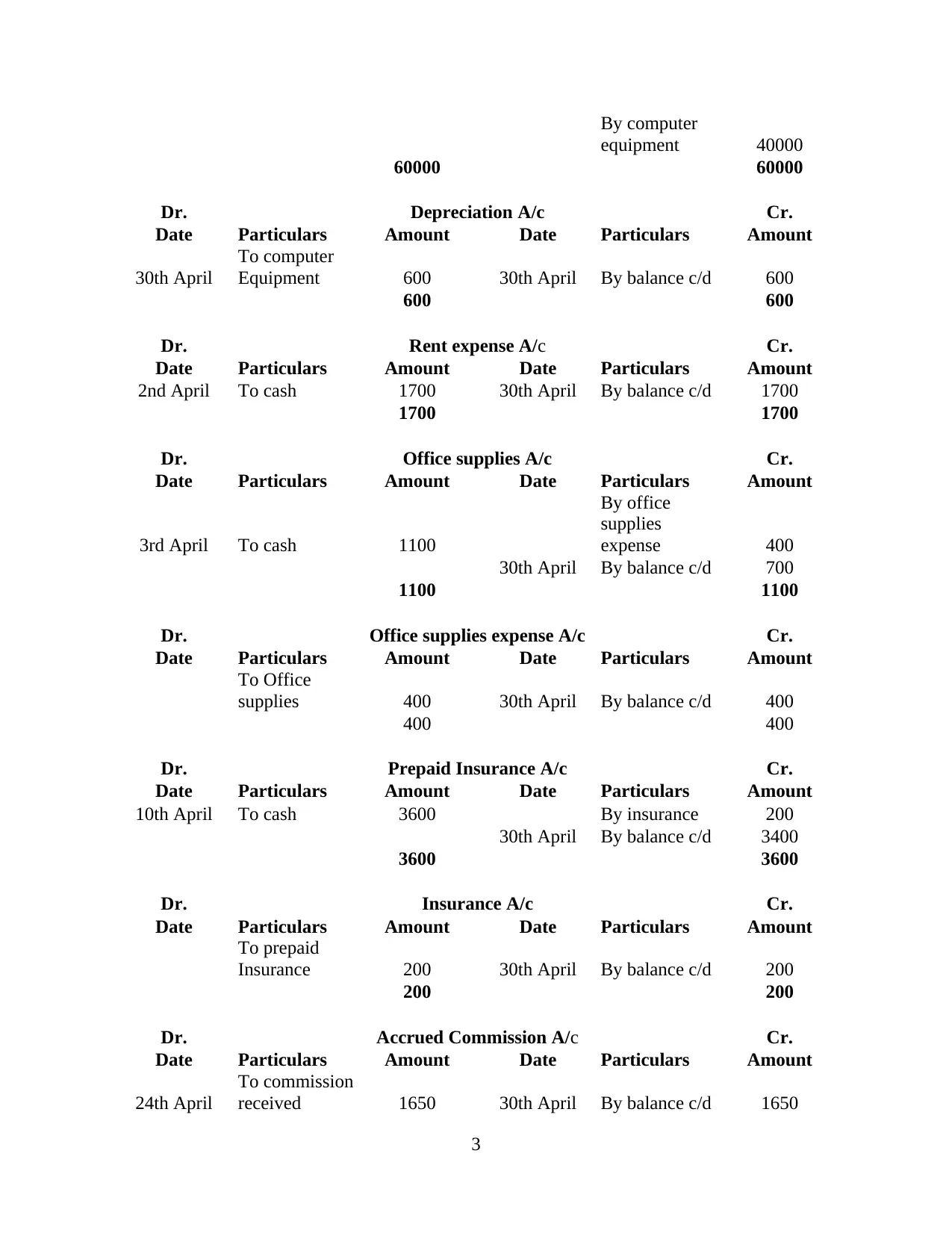
By computer
equipment 40000
60000 60000
Dr. Depreciation A/c Cr.
Date Particulars Amount Date Particulars Amount
30th April
To computer
Equipment 600 30th April By balance c/d 600
600 600
Dr. Rent expense A/c Cr.
Date Particulars Amount Date Particulars Amount
2nd April To cash 1700 30th April By balance c/d 1700
1700 1700
Dr. Office supplies A/c Cr.
Date Particulars Amount Date Particulars Amount
3rd April To cash 1100
By office
supplies
expense 400
30th April By balance c/d 700
1100 1100
Dr. Office supplies expense A/c Cr.
Date Particulars Amount Date Particulars Amount
To Office
supplies 400 30th April By balance c/d 400
400 400
Dr. Prepaid Insurance A/c Cr.
Date Particulars Amount Date Particulars Amount
10th April To cash 3600 By insurance 200
30th April By balance c/d 3400
3600 3600
Dr. Insurance A/c Cr.
Date Particulars Amount Date Particulars Amount
To prepaid
Insurance 200 30th April By balance c/d 200
200 200
Dr. Accrued Commission A/c Cr.
Date Particulars Amount Date Particulars Amount
24th April
To commission
received 1650 30th April By balance c/d 1650
3
equipment 40000
60000 60000
Dr. Depreciation A/c Cr.
Date Particulars Amount Date Particulars Amount
30th April
To computer
Equipment 600 30th April By balance c/d 600
600 600
Dr. Rent expense A/c Cr.
Date Particulars Amount Date Particulars Amount
2nd April To cash 1700 30th April By balance c/d 1700
1700 1700
Dr. Office supplies A/c Cr.
Date Particulars Amount Date Particulars Amount
3rd April To cash 1100
By office
supplies
expense 400
30th April By balance c/d 700
1100 1100
Dr. Office supplies expense A/c Cr.
Date Particulars Amount Date Particulars Amount
To Office
supplies 400 30th April By balance c/d 400
400 400
Dr. Prepaid Insurance A/c Cr.
Date Particulars Amount Date Particulars Amount
10th April To cash 3600 By insurance 200
30th April By balance c/d 3400
3600 3600
Dr. Insurance A/c Cr.
Date Particulars Amount Date Particulars Amount
To prepaid
Insurance 200 30th April By balance c/d 200
200 200
Dr. Accrued Commission A/c Cr.
Date Particulars Amount Date Particulars Amount
24th April
To commission
received 1650 30th April By balance c/d 1650
3
⊘ This is a preview!⊘
Do you want full access?
Subscribe today to unlock all pages.
Trusted by 1+ million students worldwide
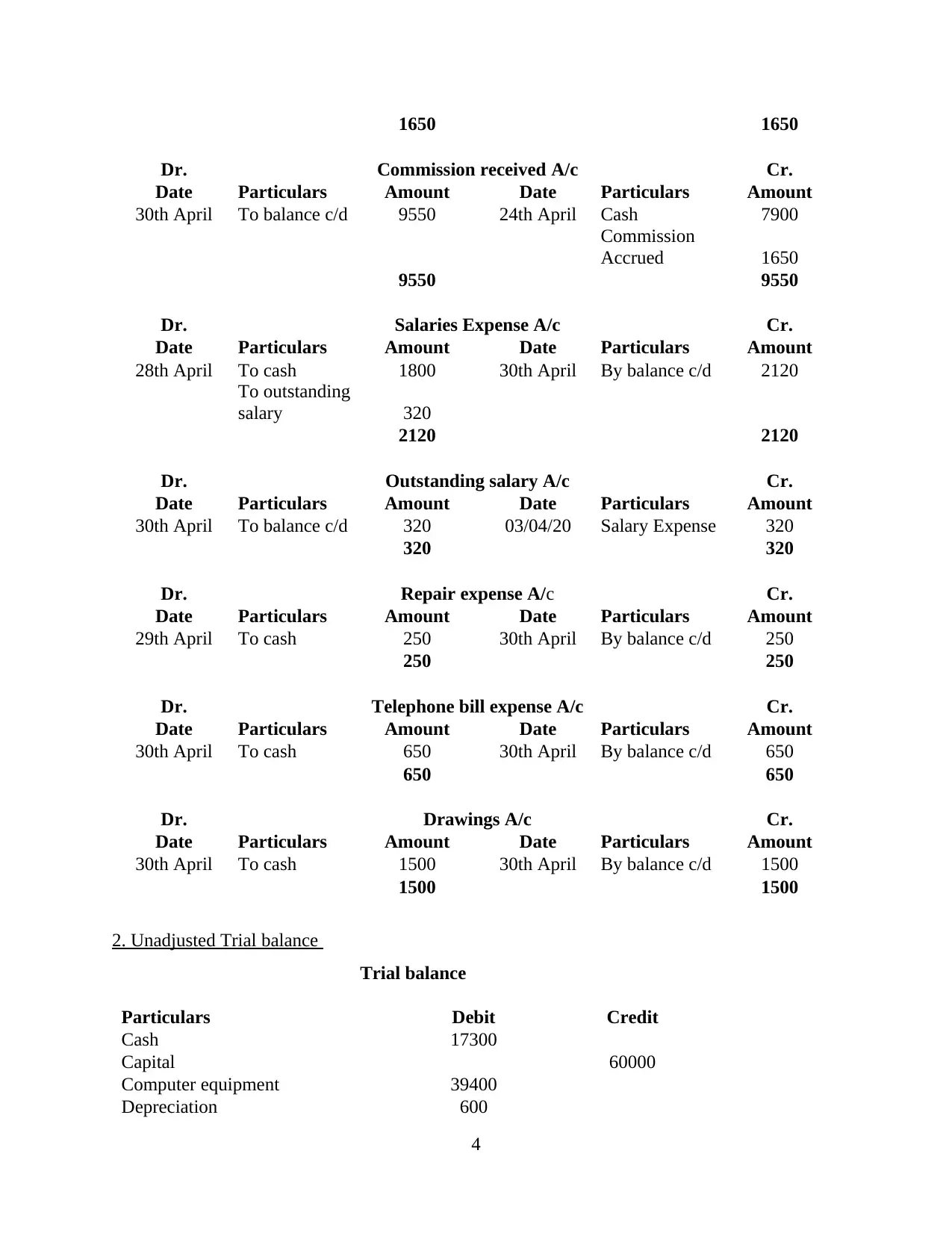
1650 1650
Dr. Commission received A/c Cr.
Date Particulars Amount Date Particulars Amount
30th April To balance c/d 9550 24th April Cash 7900
Commission
Accrued 1650
9550 9550
Dr. Salaries Expense A/c Cr.
Date Particulars Amount Date Particulars Amount
28th April To cash 1800 30th April By balance c/d 2120
To outstanding
salary 320
2120 2120
Dr. Outstanding salary A/c Cr.
Date Particulars Amount Date Particulars Amount
30th April To balance c/d 320 03/04/20 Salary Expense 320
320 320
Dr. Repair expense A/c Cr.
Date Particulars Amount Date Particulars Amount
29th April To cash 250 30th April By balance c/d 250
250 250
Dr. Telephone bill expense A/c Cr.
Date Particulars Amount Date Particulars Amount
30th April To cash 650 30th April By balance c/d 650
650 650
Dr. Drawings A/c Cr.
Date Particulars Amount Date Particulars Amount
30th April To cash 1500 30th April By balance c/d 1500
1500 1500
2. Unadjusted Trial balance
Trial balance
Particulars Debit Credit
Cash 17300
Capital 60000
Computer equipment 39400
Depreciation 600
4
Dr. Commission received A/c Cr.
Date Particulars Amount Date Particulars Amount
30th April To balance c/d 9550 24th April Cash 7900
Commission
Accrued 1650
9550 9550
Dr. Salaries Expense A/c Cr.
Date Particulars Amount Date Particulars Amount
28th April To cash 1800 30th April By balance c/d 2120
To outstanding
salary 320
2120 2120
Dr. Outstanding salary A/c Cr.
Date Particulars Amount Date Particulars Amount
30th April To balance c/d 320 03/04/20 Salary Expense 320
320 320
Dr. Repair expense A/c Cr.
Date Particulars Amount Date Particulars Amount
29th April To cash 250 30th April By balance c/d 250
250 250
Dr. Telephone bill expense A/c Cr.
Date Particulars Amount Date Particulars Amount
30th April To cash 650 30th April By balance c/d 650
650 650
Dr. Drawings A/c Cr.
Date Particulars Amount Date Particulars Amount
30th April To cash 1500 30th April By balance c/d 1500
1500 1500
2. Unadjusted Trial balance
Trial balance
Particulars Debit Credit
Cash 17300
Capital 60000
Computer equipment 39400
Depreciation 600
4
Paraphrase This Document
Need a fresh take? Get an instant paraphrase of this document with our AI Paraphraser
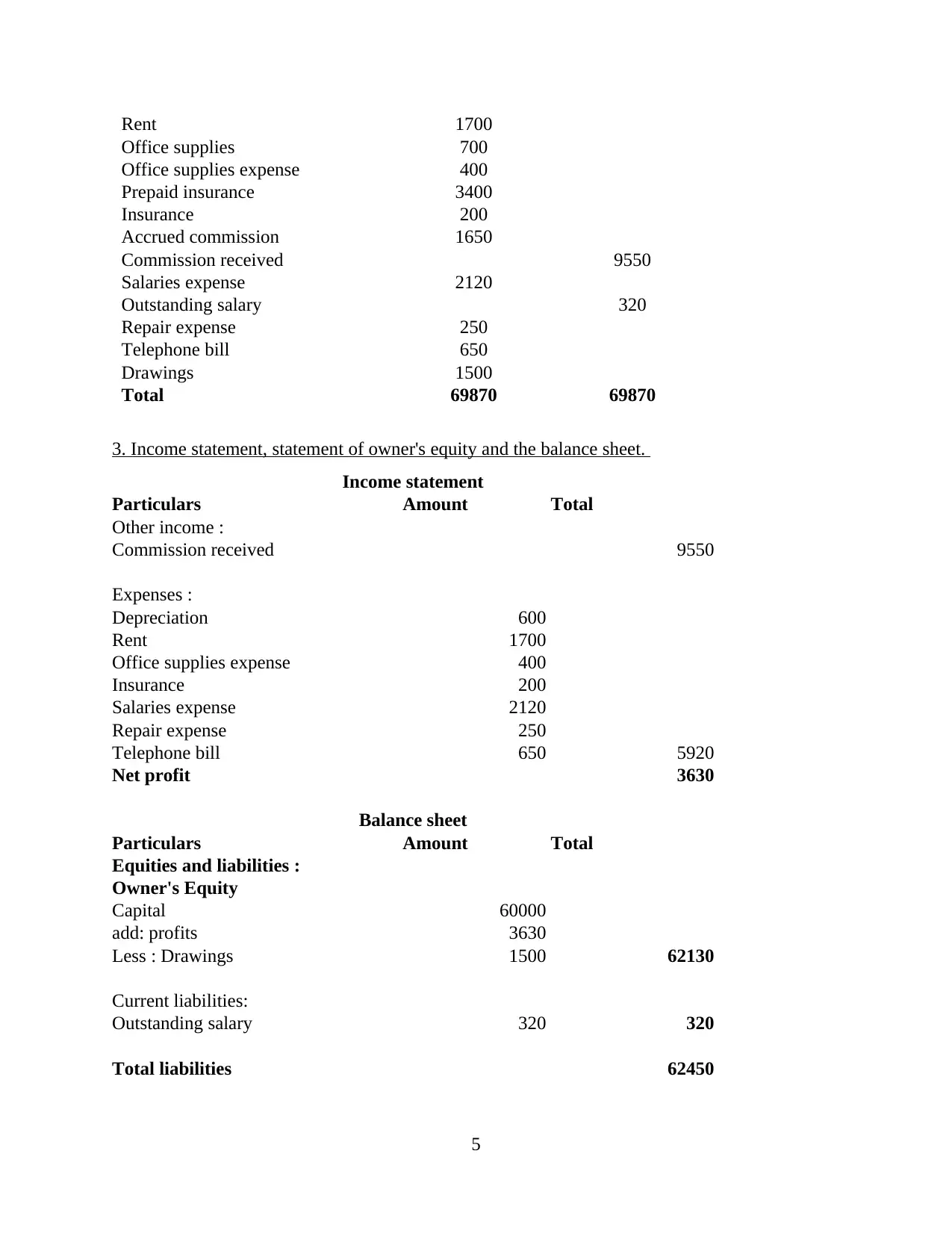
Rent 1700
Office supplies 700
Office supplies expense 400
Prepaid insurance 3400
Insurance 200
Accrued commission 1650
Commission received 9550
Salaries expense 2120
Outstanding salary 320
Repair expense 250
Telephone bill 650
Drawings 1500
Total 69870 69870
3. Income statement, statement of owner's equity and the balance sheet.
Income statement
Particulars Amount Total
Other income :
Commission received 9550
Expenses :
Depreciation 600
Rent 1700
Office supplies expense 400
Insurance 200
Salaries expense 2120
Repair expense 250
Telephone bill 650 5920
Net profit 3630
Balance sheet
Particulars Amount Total
Equities and liabilities :
Owner's Equity
Capital 60000
add: profits 3630
Less : Drawings 1500 62130
Current liabilities:
Outstanding salary 320 320
Total liabilities 62450
5
Office supplies 700
Office supplies expense 400
Prepaid insurance 3400
Insurance 200
Accrued commission 1650
Commission received 9550
Salaries expense 2120
Outstanding salary 320
Repair expense 250
Telephone bill 650
Drawings 1500
Total 69870 69870
3. Income statement, statement of owner's equity and the balance sheet.
Income statement
Particulars Amount Total
Other income :
Commission received 9550
Expenses :
Depreciation 600
Rent 1700
Office supplies expense 400
Insurance 200
Salaries expense 2120
Repair expense 250
Telephone bill 650 5920
Net profit 3630
Balance sheet
Particulars Amount Total
Equities and liabilities :
Owner's Equity
Capital 60000
add: profits 3630
Less : Drawings 1500 62130
Current liabilities:
Outstanding salary 320 320
Total liabilities 62450
5
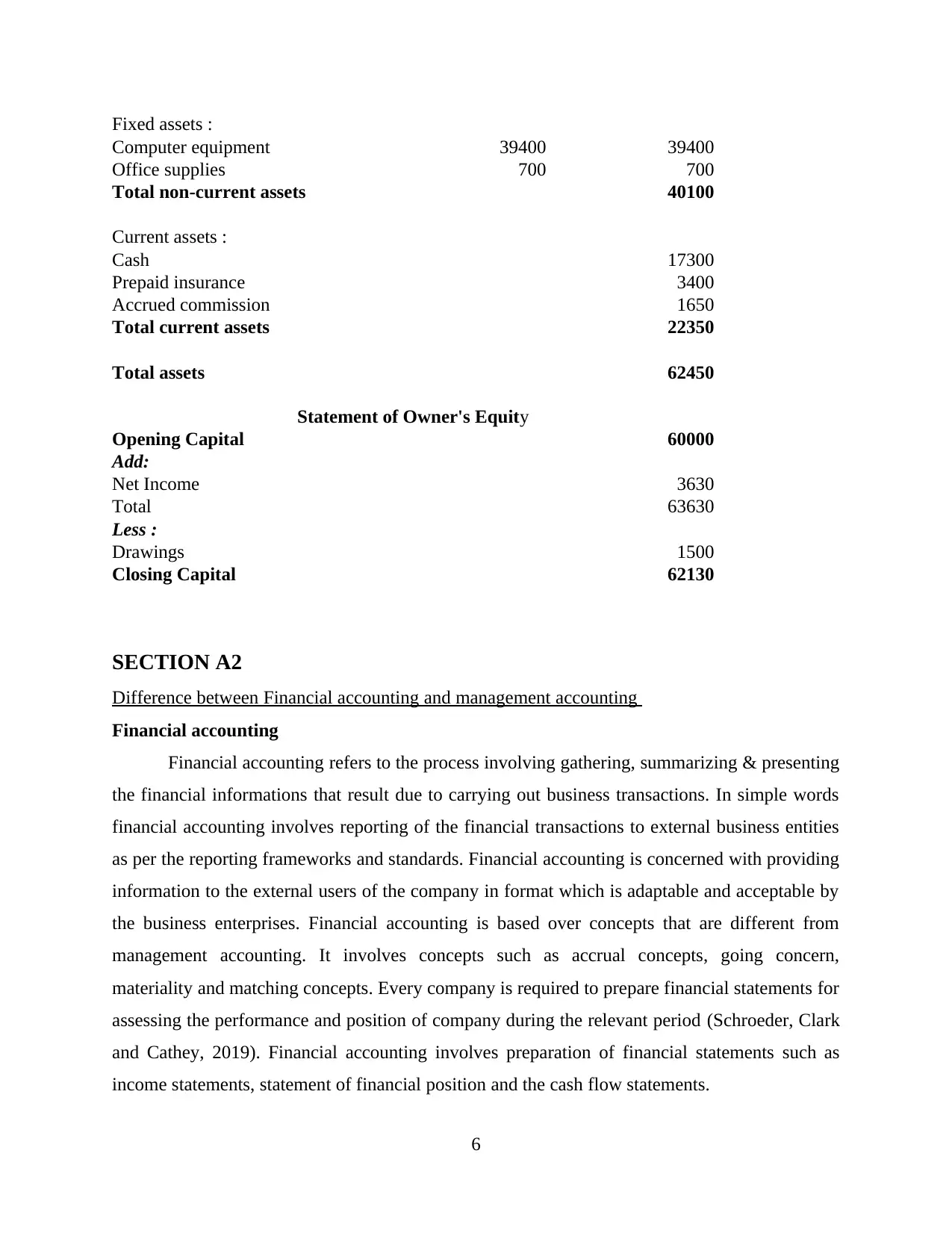
Fixed assets :
Computer equipment 39400 39400
Office supplies 700 700
Total non-current assets 40100
Current assets :
Cash 17300
Prepaid insurance 3400
Accrued commission 1650
Total current assets 22350
Total assets 62450
Statement of Owner's Equity
Opening Capital 60000
Add:
Net Income 3630
Total 63630
Less :
Drawings 1500
Closing Capital 62130
SECTION A2
Difference between Financial accounting and management accounting
Financial accounting
Financial accounting refers to the process involving gathering, summarizing & presenting
the financial informations that result due to carrying out business transactions. In simple words
financial accounting involves reporting of the financial transactions to external business entities
as per the reporting frameworks and standards. Financial accounting is concerned with providing
information to the external users of the company in format which is adaptable and acceptable by
the business enterprises. Financial accounting is based over concepts that are different from
management accounting. It involves concepts such as accrual concepts, going concern,
materiality and matching concepts. Every company is required to prepare financial statements for
assessing the performance and position of company during the relevant period (Schroeder, Clark
and Cathey, 2019). Financial accounting involves preparation of financial statements such as
income statements, statement of financial position and the cash flow statements.
6
Computer equipment 39400 39400
Office supplies 700 700
Total non-current assets 40100
Current assets :
Cash 17300
Prepaid insurance 3400
Accrued commission 1650
Total current assets 22350
Total assets 62450
Statement of Owner's Equity
Opening Capital 60000
Add:
Net Income 3630
Total 63630
Less :
Drawings 1500
Closing Capital 62130
SECTION A2
Difference between Financial accounting and management accounting
Financial accounting
Financial accounting refers to the process involving gathering, summarizing & presenting
the financial informations that result due to carrying out business transactions. In simple words
financial accounting involves reporting of the financial transactions to external business entities
as per the reporting frameworks and standards. Financial accounting is concerned with providing
information to the external users of the company in format which is adaptable and acceptable by
the business enterprises. Financial accounting is based over concepts that are different from
management accounting. It involves concepts such as accrual concepts, going concern,
materiality and matching concepts. Every company is required to prepare financial statements for
assessing the performance and position of company during the relevant period (Schroeder, Clark
and Cathey, 2019). Financial accounting involves preparation of financial statements such as
income statements, statement of financial position and the cash flow statements.
6
⊘ This is a preview!⊘
Do you want full access?
Subscribe today to unlock all pages.
Trusted by 1+ million students worldwide
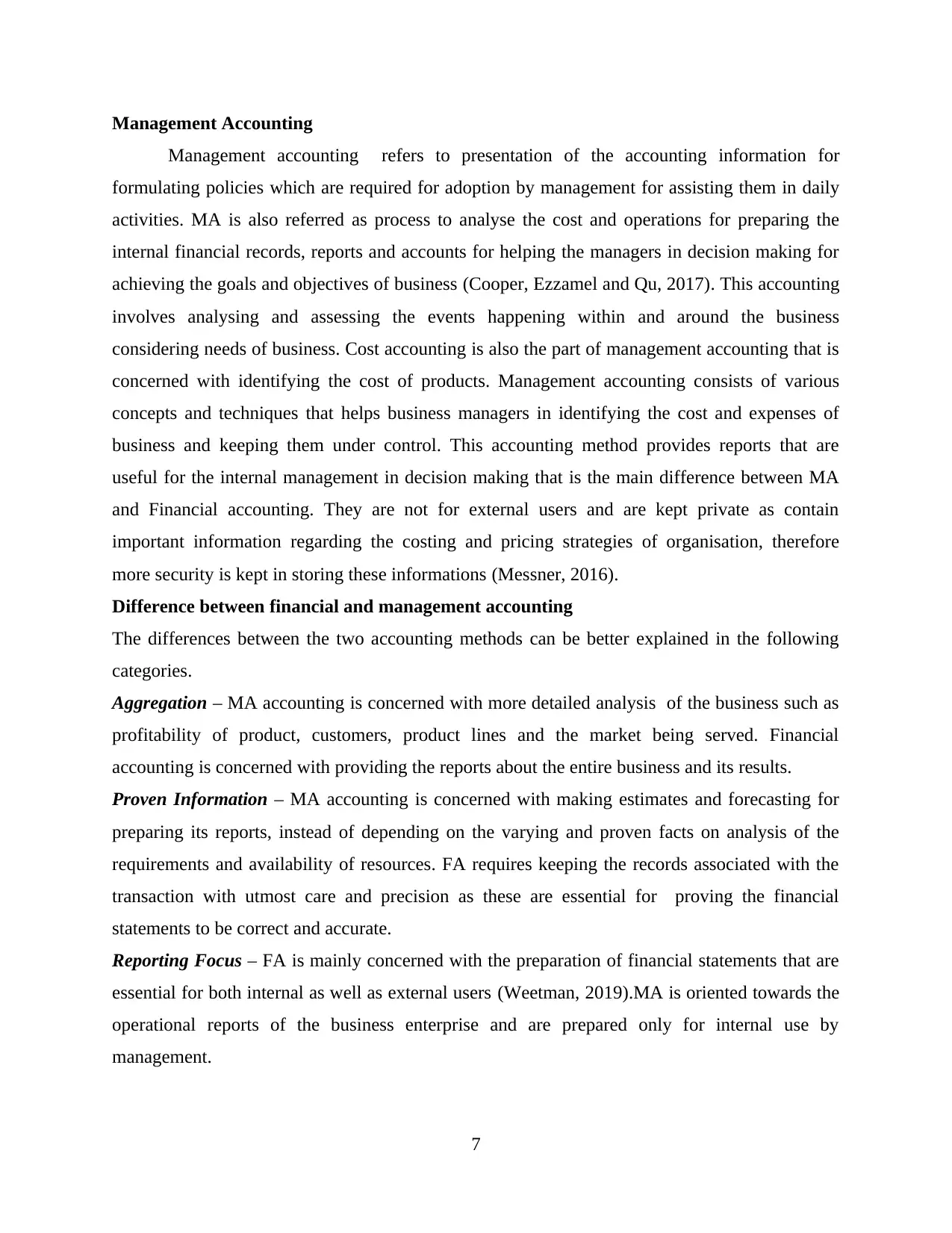
Management Accounting
Management accounting refers to presentation of the accounting information for
formulating policies which are required for adoption by management for assisting them in daily
activities. MA is also referred as process to analyse the cost and operations for preparing the
internal financial records, reports and accounts for helping the managers in decision making for
achieving the goals and objectives of business (Cooper, Ezzamel and Qu, 2017). This accounting
involves analysing and assessing the events happening within and around the business
considering needs of business. Cost accounting is also the part of management accounting that is
concerned with identifying the cost of products. Management accounting consists of various
concepts and techniques that helps business managers in identifying the cost and expenses of
business and keeping them under control. This accounting method provides reports that are
useful for the internal management in decision making that is the main difference between MA
and Financial accounting. They are not for external users and are kept private as contain
important information regarding the costing and pricing strategies of organisation, therefore
more security is kept in storing these informations (Messner, 2016).
Difference between financial and management accounting
The differences between the two accounting methods can be better explained in the following
categories.
Aggregation – MA accounting is concerned with more detailed analysis of the business such as
profitability of product, customers, product lines and the market being served. Financial
accounting is concerned with providing the reports about the entire business and its results.
Proven Information – MA accounting is concerned with making estimates and forecasting for
preparing its reports, instead of depending on the varying and proven facts on analysis of the
requirements and availability of resources. FA requires keeping the records associated with the
transaction with utmost care and precision as these are essential for proving the financial
statements to be correct and accurate.
Reporting Focus – FA is mainly concerned with the preparation of financial statements that are
essential for both internal as well as external users (Weetman, 2019).MA is oriented towards the
operational reports of the business enterprise and are prepared only for internal use by
management.
7
Management accounting refers to presentation of the accounting information for
formulating policies which are required for adoption by management for assisting them in daily
activities. MA is also referred as process to analyse the cost and operations for preparing the
internal financial records, reports and accounts for helping the managers in decision making for
achieving the goals and objectives of business (Cooper, Ezzamel and Qu, 2017). This accounting
involves analysing and assessing the events happening within and around the business
considering needs of business. Cost accounting is also the part of management accounting that is
concerned with identifying the cost of products. Management accounting consists of various
concepts and techniques that helps business managers in identifying the cost and expenses of
business and keeping them under control. This accounting method provides reports that are
useful for the internal management in decision making that is the main difference between MA
and Financial accounting. They are not for external users and are kept private as contain
important information regarding the costing and pricing strategies of organisation, therefore
more security is kept in storing these informations (Messner, 2016).
Difference between financial and management accounting
The differences between the two accounting methods can be better explained in the following
categories.
Aggregation – MA accounting is concerned with more detailed analysis of the business such as
profitability of product, customers, product lines and the market being served. Financial
accounting is concerned with providing the reports about the entire business and its results.
Proven Information – MA accounting is concerned with making estimates and forecasting for
preparing its reports, instead of depending on the varying and proven facts on analysis of the
requirements and availability of resources. FA requires keeping the records associated with the
transaction with utmost care and precision as these are essential for proving the financial
statements to be correct and accurate.
Reporting Focus – FA is mainly concerned with the preparation of financial statements that are
essential for both internal as well as external users (Weetman, 2019).MA is oriented towards the
operational reports of the business enterprise and are prepared only for internal use by
management.
7
Paraphrase This Document
Need a fresh take? Get an instant paraphrase of this document with our AI Paraphraser
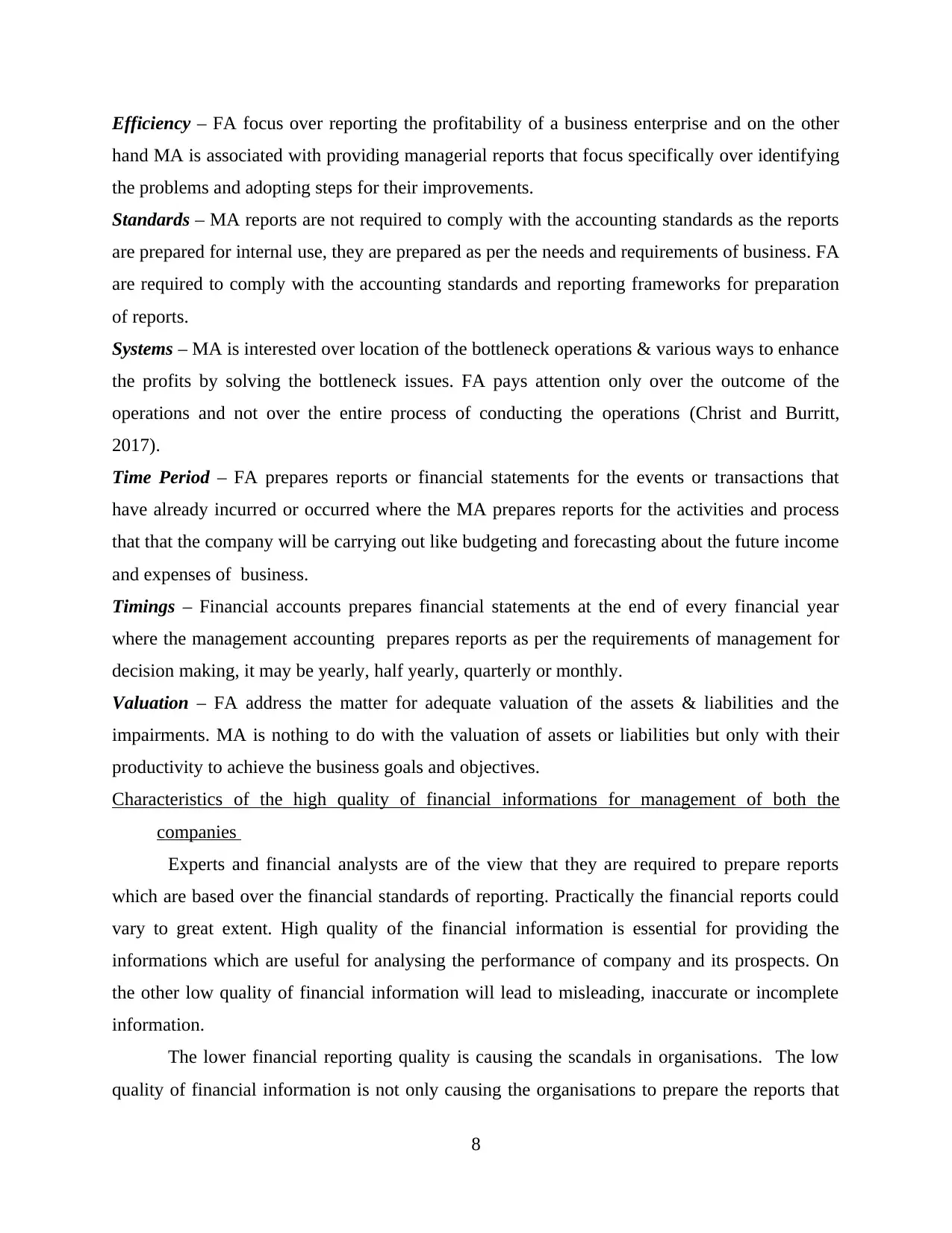
Efficiency – FA focus over reporting the profitability of a business enterprise and on the other
hand MA is associated with providing managerial reports that focus specifically over identifying
the problems and adopting steps for their improvements.
Standards – MA reports are not required to comply with the accounting standards as the reports
are prepared for internal use, they are prepared as per the needs and requirements of business. FA
are required to comply with the accounting standards and reporting frameworks for preparation
of reports.
Systems – MA is interested over location of the bottleneck operations & various ways to enhance
the profits by solving the bottleneck issues. FA pays attention only over the outcome of the
operations and not over the entire process of conducting the operations (Christ and Burritt,
2017).
Time Period – FA prepares reports or financial statements for the events or transactions that
have already incurred or occurred where the MA prepares reports for the activities and process
that that the company will be carrying out like budgeting and forecasting about the future income
and expenses of business.
Timings – Financial accounts prepares financial statements at the end of every financial year
where the management accounting prepares reports as per the requirements of management for
decision making, it may be yearly, half yearly, quarterly or monthly.
Valuation – FA address the matter for adequate valuation of the assets & liabilities and the
impairments. MA is nothing to do with the valuation of assets or liabilities but only with their
productivity to achieve the business goals and objectives.
Characteristics of the high quality of financial informations for management of both the
companies
Experts and financial analysts are of the view that they are required to prepare reports
which are based over the financial standards of reporting. Practically the financial reports could
vary to great extent. High quality of the financial information is essential for providing the
informations which are useful for analysing the performance of company and its prospects. On
the other low quality of financial information will lead to misleading, inaccurate or incomplete
information.
The lower financial reporting quality is causing the scandals in organisations. The low
quality of financial information is not only causing the organisations to prepare the reports that
8
hand MA is associated with providing managerial reports that focus specifically over identifying
the problems and adopting steps for their improvements.
Standards – MA reports are not required to comply with the accounting standards as the reports
are prepared for internal use, they are prepared as per the needs and requirements of business. FA
are required to comply with the accounting standards and reporting frameworks for preparation
of reports.
Systems – MA is interested over location of the bottleneck operations & various ways to enhance
the profits by solving the bottleneck issues. FA pays attention only over the outcome of the
operations and not over the entire process of conducting the operations (Christ and Burritt,
2017).
Time Period – FA prepares reports or financial statements for the events or transactions that
have already incurred or occurred where the MA prepares reports for the activities and process
that that the company will be carrying out like budgeting and forecasting about the future income
and expenses of business.
Timings – Financial accounts prepares financial statements at the end of every financial year
where the management accounting prepares reports as per the requirements of management for
decision making, it may be yearly, half yearly, quarterly or monthly.
Valuation – FA address the matter for adequate valuation of the assets & liabilities and the
impairments. MA is nothing to do with the valuation of assets or liabilities but only with their
productivity to achieve the business goals and objectives.
Characteristics of the high quality of financial informations for management of both the
companies
Experts and financial analysts are of the view that they are required to prepare reports
which are based over the financial standards of reporting. Practically the financial reports could
vary to great extent. High quality of the financial information is essential for providing the
informations which are useful for analysing the performance of company and its prospects. On
the other low quality of financial information will lead to misleading, inaccurate or incomplete
information.
The lower financial reporting quality is causing the scandals in organisations. The low
quality of financial information is not only causing the organisations to prepare the reports that
8
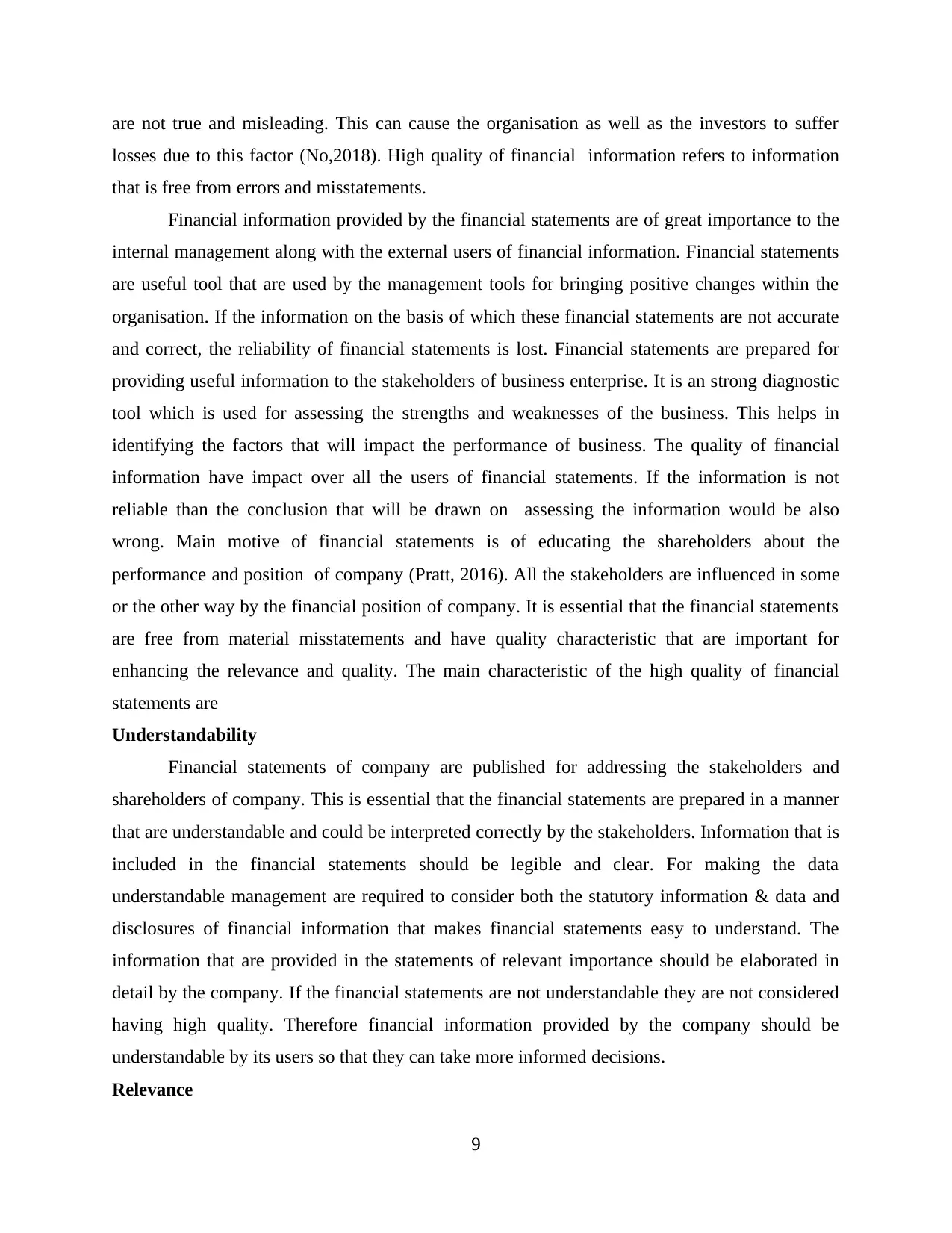
are not true and misleading. This can cause the organisation as well as the investors to suffer
losses due to this factor (No,2018). High quality of financial information refers to information
that is free from errors and misstatements.
Financial information provided by the financial statements are of great importance to the
internal management along with the external users of financial information. Financial statements
are useful tool that are used by the management tools for bringing positive changes within the
organisation. If the information on the basis of which these financial statements are not accurate
and correct, the reliability of financial statements is lost. Financial statements are prepared for
providing useful information to the stakeholders of business enterprise. It is an strong diagnostic
tool which is used for assessing the strengths and weaknesses of the business. This helps in
identifying the factors that will impact the performance of business. The quality of financial
information have impact over all the users of financial statements. If the information is not
reliable than the conclusion that will be drawn on assessing the information would be also
wrong. Main motive of financial statements is of educating the shareholders about the
performance and position of company (Pratt, 2016). All the stakeholders are influenced in some
or the other way by the financial position of company. It is essential that the financial statements
are free from material misstatements and have quality characteristic that are important for
enhancing the relevance and quality. The main characteristic of the high quality of financial
statements are
Understandability
Financial statements of company are published for addressing the stakeholders and
shareholders of company. This is essential that the financial statements are prepared in a manner
that are understandable and could be interpreted correctly by the stakeholders. Information that is
included in the financial statements should be legible and clear. For making the data
understandable management are required to consider both the statutory information & data and
disclosures of financial information that makes financial statements easy to understand. The
information that are provided in the statements of relevant importance should be elaborated in
detail by the company. If the financial statements are not understandable they are not considered
having high quality. Therefore financial information provided by the company should be
understandable by its users so that they can take more informed decisions.
Relevance
9
losses due to this factor (No,2018). High quality of financial information refers to information
that is free from errors and misstatements.
Financial information provided by the financial statements are of great importance to the
internal management along with the external users of financial information. Financial statements
are useful tool that are used by the management tools for bringing positive changes within the
organisation. If the information on the basis of which these financial statements are not accurate
and correct, the reliability of financial statements is lost. Financial statements are prepared for
providing useful information to the stakeholders of business enterprise. It is an strong diagnostic
tool which is used for assessing the strengths and weaknesses of the business. This helps in
identifying the factors that will impact the performance of business. The quality of financial
information have impact over all the users of financial statements. If the information is not
reliable than the conclusion that will be drawn on assessing the information would be also
wrong. Main motive of financial statements is of educating the shareholders about the
performance and position of company (Pratt, 2016). All the stakeholders are influenced in some
or the other way by the financial position of company. It is essential that the financial statements
are free from material misstatements and have quality characteristic that are important for
enhancing the relevance and quality. The main characteristic of the high quality of financial
statements are
Understandability
Financial statements of company are published for addressing the stakeholders and
shareholders of company. This is essential that the financial statements are prepared in a manner
that are understandable and could be interpreted correctly by the stakeholders. Information that is
included in the financial statements should be legible and clear. For making the data
understandable management are required to consider both the statutory information & data and
disclosures of financial information that makes financial statements easy to understand. The
information that are provided in the statements of relevant importance should be elaborated in
detail by the company. If the financial statements are not understandable they are not considered
having high quality. Therefore financial information provided by the company should be
understandable by its users so that they can take more informed decisions.
Relevance
9
⊘ This is a preview!⊘
Do you want full access?
Subscribe today to unlock all pages.
Trusted by 1+ million students worldwide

1 out of 16


Related Documents


Your All-in-One AI-Powered Toolkit for Academic Success.
+13062052269
info@desklib.com
Available 24*7 on WhatsApp / Email
![[object Object]](/_next/static/media/star-bottom.7253800d.svg)
Unlock your academic potential
Copyright © 2020–2026 A2Z Services. All Rights Reserved. Developed and managed by ZUCOL.