Financial Accounting Report: UK Legal and Regulatory Framework
VerifiedAdded on 2020/01/15
|25
|7868
|170
Report
AI Summary
This financial accounting report provides a comprehensive overview of the subject, covering key aspects such as the legal and regulatory influences on financial statements, including the Companies Act of 1985, 1989, and 2006, Partnership Act of 1890, European Union Directives, International Accounting Standards (IAS), and UK GAAP, FRS, and IFRS. The report analyzes the preparation of financial statements, including adjusted trial balances, income statements, and statements of financial position for various entities like Ella's and Atlas Plc. It also delves into financial ratio calculations, interpretation, and comparative analysis, including investment ratios, and concludes with a memorandum report for management. The report also covers the impact of issuing ordinary shares on financial statements. The report is structured into two main tasks, each with multiple parts that address specific accounting standards and practices, offering a deep dive into the core concepts of financial accounting and reporting.

FINANCIAL
ACCOUNTING
ACCOUNTING

Paraphrase This Document
Need a fresh take? Get an instant paraphrase of this document with our AI Paraphraser
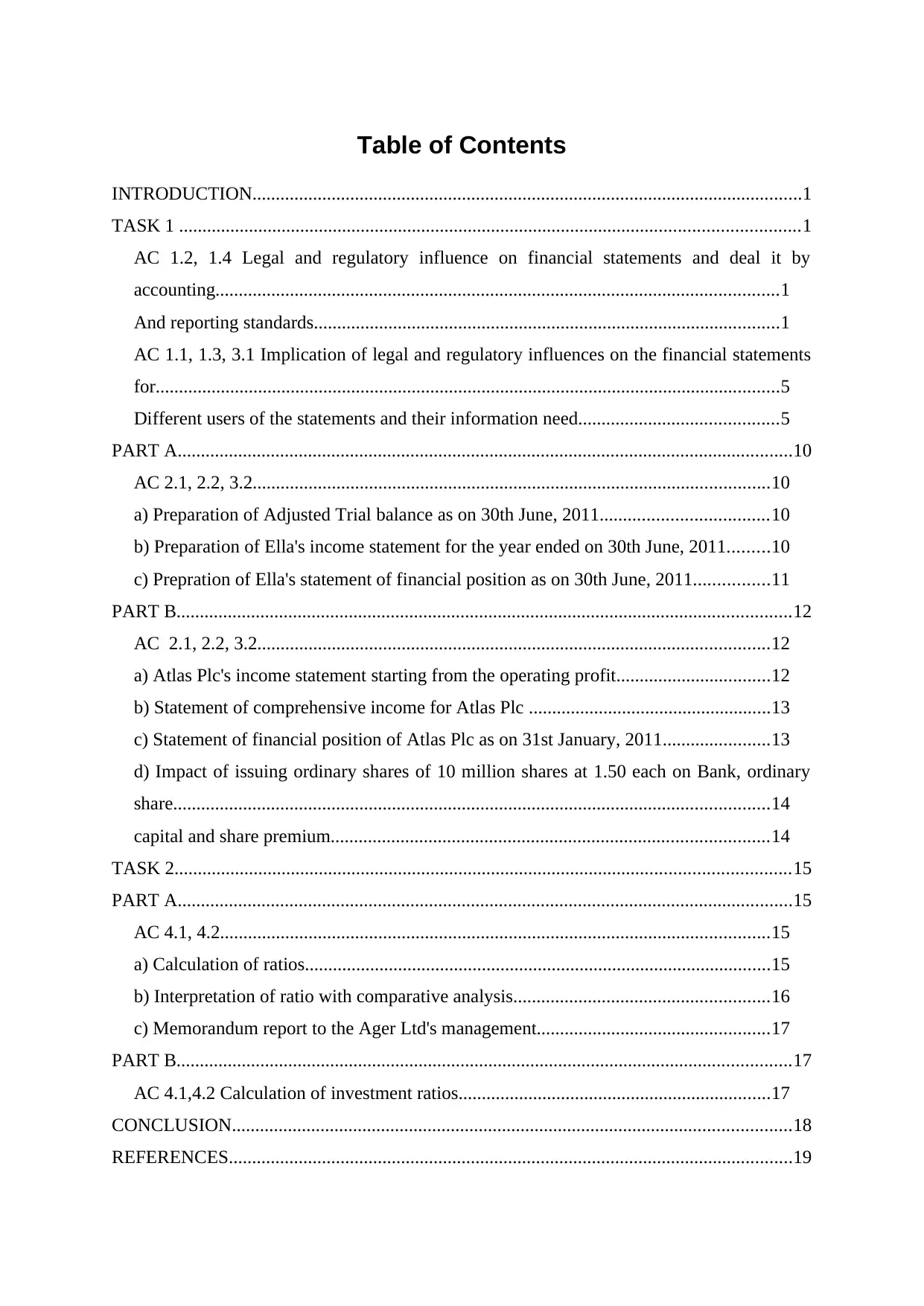
Table of Contents
INTRODUCTION......................................................................................................................1
TASK 1 .....................................................................................................................................1
AC 1.2, 1.4 Legal and regulatory influence on financial statements and deal it by
accounting.........................................................................................................................1
And reporting standards....................................................................................................1
AC 1.1, 1.3, 3.1 Implication of legal and regulatory influences on the financial statements
for......................................................................................................................................5
Different users of the statements and their information need...........................................5
PART A....................................................................................................................................10
AC 2.1, 2.2, 3.2...............................................................................................................10
a) Preparation of Adjusted Trial balance as on 30th June, 2011....................................10
b) Preparation of Ella's income statement for the year ended on 30th June, 2011.........10
c) Prepration of Ella's statement of financial position as on 30th June, 2011................11
PART B....................................................................................................................................12
AC 2.1, 2.2, 3.2..............................................................................................................12
a) Atlas Plc's income statement starting from the operating profit.................................12
b) Statement of comprehensive income for Atlas Plc ....................................................13
c) Statement of financial position of Atlas Plc as on 31st January, 2011.......................13
d) Impact of issuing ordinary shares of 10 million shares at 1.50 each on Bank, ordinary
share................................................................................................................................14
capital and share premium..............................................................................................14
TASK 2....................................................................................................................................15
PART A....................................................................................................................................15
AC 4.1, 4.2......................................................................................................................15
a) Calculation of ratios....................................................................................................15
b) Interpretation of ratio with comparative analysis.......................................................16
c) Memorandum report to the Ager Ltd's management..................................................17
PART B....................................................................................................................................17
AC 4.1,4.2 Calculation of investment ratios...................................................................17
CONCLUSION........................................................................................................................18
REFERENCES.........................................................................................................................19
INTRODUCTION......................................................................................................................1
TASK 1 .....................................................................................................................................1
AC 1.2, 1.4 Legal and regulatory influence on financial statements and deal it by
accounting.........................................................................................................................1
And reporting standards....................................................................................................1
AC 1.1, 1.3, 3.1 Implication of legal and regulatory influences on the financial statements
for......................................................................................................................................5
Different users of the statements and their information need...........................................5
PART A....................................................................................................................................10
AC 2.1, 2.2, 3.2...............................................................................................................10
a) Preparation of Adjusted Trial balance as on 30th June, 2011....................................10
b) Preparation of Ella's income statement for the year ended on 30th June, 2011.........10
c) Prepration of Ella's statement of financial position as on 30th June, 2011................11
PART B....................................................................................................................................12
AC 2.1, 2.2, 3.2..............................................................................................................12
a) Atlas Plc's income statement starting from the operating profit.................................12
b) Statement of comprehensive income for Atlas Plc ....................................................13
c) Statement of financial position of Atlas Plc as on 31st January, 2011.......................13
d) Impact of issuing ordinary shares of 10 million shares at 1.50 each on Bank, ordinary
share................................................................................................................................14
capital and share premium..............................................................................................14
TASK 2....................................................................................................................................15
PART A....................................................................................................................................15
AC 4.1, 4.2......................................................................................................................15
a) Calculation of ratios....................................................................................................15
b) Interpretation of ratio with comparative analysis.......................................................16
c) Memorandum report to the Ager Ltd's management..................................................17
PART B....................................................................................................................................17
AC 4.1,4.2 Calculation of investment ratios...................................................................17
CONCLUSION........................................................................................................................18
REFERENCES.........................................................................................................................19

Index of Tables
Table 1: Preparation of Adjusted Trial balance of Ella's as at 30th June, 2011.......................10
Table 2: Preparation of Ella's income statement for the year ended on 30th June, 2011.........10
Table 3: Prepration of Ella's statement of financial position as on 30th June, 2011................11
Table 4: Statement of financial position of Atlas Plc as on 31st January, 2011......................13
Table 1: Preparation of Adjusted Trial balance of Ella's as at 30th June, 2011.......................10
Table 2: Preparation of Ella's income statement for the year ended on 30th June, 2011.........10
Table 3: Prepration of Ella's statement of financial position as on 30th June, 2011................11
Table 4: Statement of financial position of Atlas Plc as on 31st January, 2011......................13
⊘ This is a preview!⊘
Do you want full access?
Subscribe today to unlock all pages.

Trusted by 1+ million students worldwide
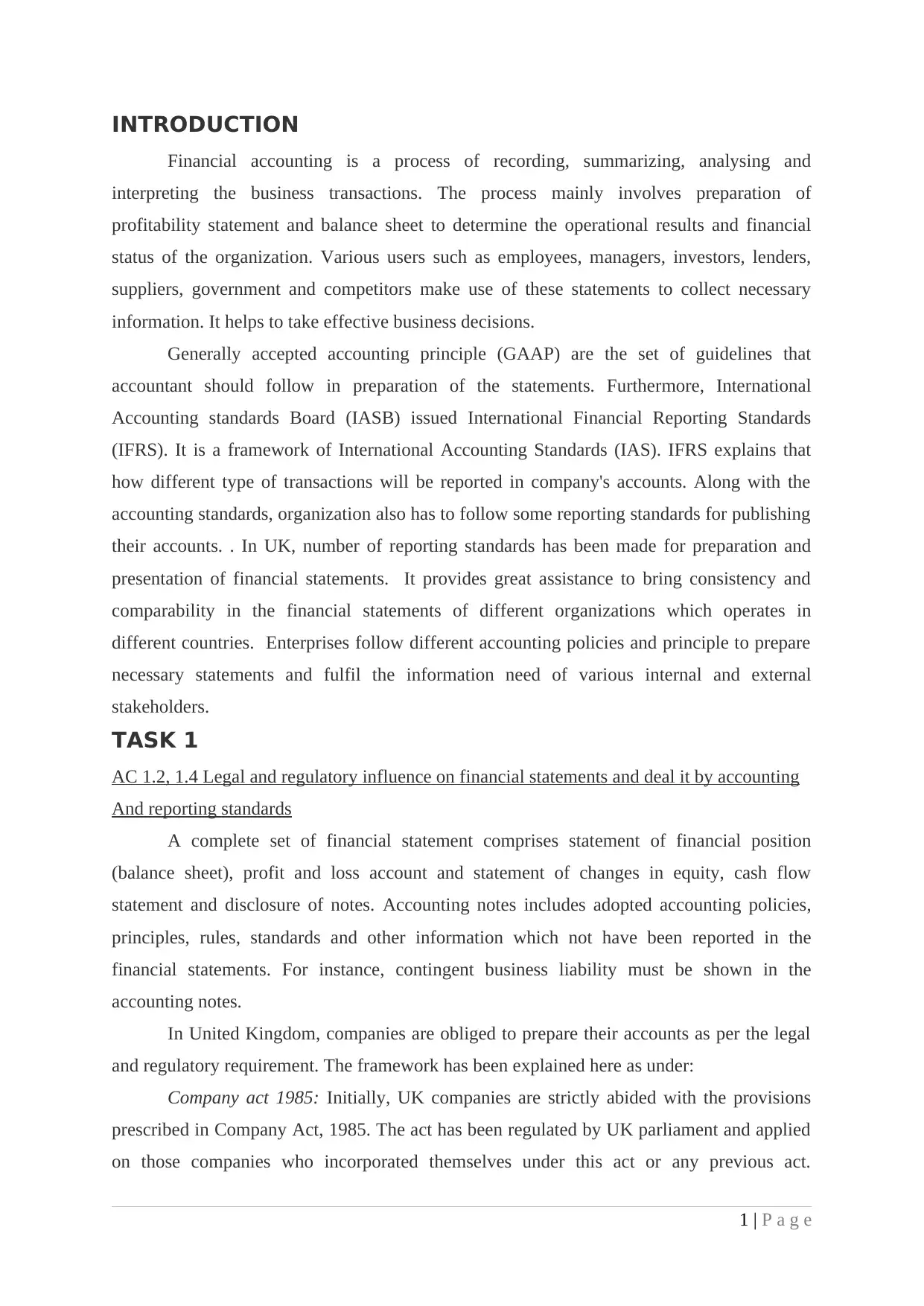
INTRODUCTION
Financial accounting is a process of recording, summarizing, analysing and
interpreting the business transactions. The process mainly involves preparation of
profitability statement and balance sheet to determine the operational results and financial
status of the organization. Various users such as employees, managers, investors, lenders,
suppliers, government and competitors make use of these statements to collect necessary
information. It helps to take effective business decisions.
Generally accepted accounting principle (GAAP) are the set of guidelines that
accountant should follow in preparation of the statements. Furthermore, International
Accounting standards Board (IASB) issued International Financial Reporting Standards
(IFRS). It is a framework of International Accounting Standards (IAS). IFRS explains that
how different type of transactions will be reported in company's accounts. Along with the
accounting standards, organization also has to follow some reporting standards for publishing
their accounts. . In UK, number of reporting standards has been made for preparation and
presentation of financial statements. It provides great assistance to bring consistency and
comparability in the financial statements of different organizations which operates in
different countries. Enterprises follow different accounting policies and principle to prepare
necessary statements and fulfil the information need of various internal and external
stakeholders.
TASK 1
AC 1.2, 1.4 Legal and regulatory influence on financial statements and deal it by accounting
And reporting standards
A complete set of financial statement comprises statement of financial position
(balance sheet), profit and loss account and statement of changes in equity, cash flow
statement and disclosure of notes. Accounting notes includes adopted accounting policies,
principles, rules, standards and other information which not have been reported in the
financial statements. For instance, contingent business liability must be shown in the
accounting notes.
In United Kingdom, companies are obliged to prepare their accounts as per the legal
and regulatory requirement. The framework has been explained here as under:
Company act 1985: Initially, UK companies are strictly abided with the provisions
prescribed in Company Act, 1985. The act has been regulated by UK parliament and applied
on those companies who incorporated themselves under this act or any previous act.
1 | P a g e
Financial accounting is a process of recording, summarizing, analysing and
interpreting the business transactions. The process mainly involves preparation of
profitability statement and balance sheet to determine the operational results and financial
status of the organization. Various users such as employees, managers, investors, lenders,
suppliers, government and competitors make use of these statements to collect necessary
information. It helps to take effective business decisions.
Generally accepted accounting principle (GAAP) are the set of guidelines that
accountant should follow in preparation of the statements. Furthermore, International
Accounting standards Board (IASB) issued International Financial Reporting Standards
(IFRS). It is a framework of International Accounting Standards (IAS). IFRS explains that
how different type of transactions will be reported in company's accounts. Along with the
accounting standards, organization also has to follow some reporting standards for publishing
their accounts. . In UK, number of reporting standards has been made for preparation and
presentation of financial statements. It provides great assistance to bring consistency and
comparability in the financial statements of different organizations which operates in
different countries. Enterprises follow different accounting policies and principle to prepare
necessary statements and fulfil the information need of various internal and external
stakeholders.
TASK 1
AC 1.2, 1.4 Legal and regulatory influence on financial statements and deal it by accounting
And reporting standards
A complete set of financial statement comprises statement of financial position
(balance sheet), profit and loss account and statement of changes in equity, cash flow
statement and disclosure of notes. Accounting notes includes adopted accounting policies,
principles, rules, standards and other information which not have been reported in the
financial statements. For instance, contingent business liability must be shown in the
accounting notes.
In United Kingdom, companies are obliged to prepare their accounts as per the legal
and regulatory requirement. The framework has been explained here as under:
Company act 1985: Initially, UK companies are strictly abided with the provisions
prescribed in Company Act, 1985. The act has been regulated by UK parliament and applied
on those companies who incorporated themselves under this act or any previous act.
1 | P a g e
Paraphrase This Document
Need a fresh take? Get an instant paraphrase of this document with our AI Paraphraser
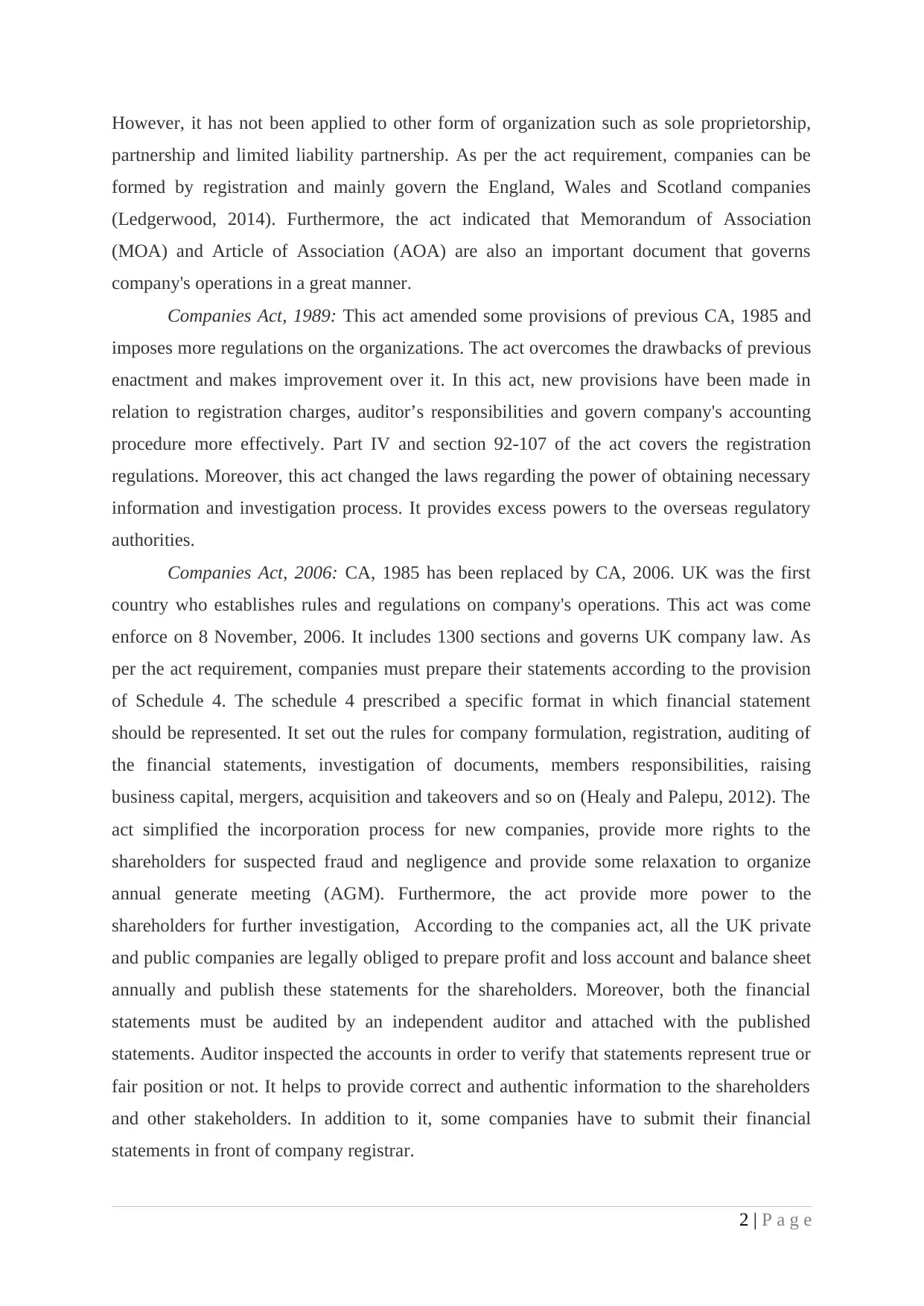
However, it has not been applied to other form of organization such as sole proprietorship,
partnership and limited liability partnership. As per the act requirement, companies can be
formed by registration and mainly govern the England, Wales and Scotland companies
(Ledgerwood, 2014). Furthermore, the act indicated that Memorandum of Association
(MOA) and Article of Association (AOA) are also an important document that governs
company's operations in a great manner.
Companies Act, 1989: This act amended some provisions of previous CA, 1985 and
imposes more regulations on the organizations. The act overcomes the drawbacks of previous
enactment and makes improvement over it. In this act, new provisions have been made in
relation to registration charges, auditor’s responsibilities and govern company's accounting
procedure more effectively. Part IV and section 92-107 of the act covers the registration
regulations. Moreover, this act changed the laws regarding the power of obtaining necessary
information and investigation process. It provides excess powers to the overseas regulatory
authorities.
Companies Act, 2006: CA, 1985 has been replaced by CA, 2006. UK was the first
country who establishes rules and regulations on company's operations. This act was come
enforce on 8 November, 2006. It includes 1300 sections and governs UK company law. As
per the act requirement, companies must prepare their statements according to the provision
of Schedule 4. The schedule 4 prescribed a specific format in which financial statement
should be represented. It set out the rules for company formulation, registration, auditing of
the financial statements, investigation of documents, members responsibilities, raising
business capital, mergers, acquisition and takeovers and so on (Healy and Palepu, 2012). The
act simplified the incorporation process for new companies, provide more rights to the
shareholders for suspected fraud and negligence and provide some relaxation to organize
annual generate meeting (AGM). Furthermore, the act provide more power to the
shareholders for further investigation, According to the companies act, all the UK private
and public companies are legally obliged to prepare profit and loss account and balance sheet
annually and publish these statements for the shareholders. Moreover, both the financial
statements must be audited by an independent auditor and attached with the published
statements. Auditor inspected the accounts in order to verify that statements represent true or
fair position or not. It helps to provide correct and authentic information to the shareholders
and other stakeholders. In addition to it, some companies have to submit their financial
statements in front of company registrar.
2 | P a g e
partnership and limited liability partnership. As per the act requirement, companies can be
formed by registration and mainly govern the England, Wales and Scotland companies
(Ledgerwood, 2014). Furthermore, the act indicated that Memorandum of Association
(MOA) and Article of Association (AOA) are also an important document that governs
company's operations in a great manner.
Companies Act, 1989: This act amended some provisions of previous CA, 1985 and
imposes more regulations on the organizations. The act overcomes the drawbacks of previous
enactment and makes improvement over it. In this act, new provisions have been made in
relation to registration charges, auditor’s responsibilities and govern company's accounting
procedure more effectively. Part IV and section 92-107 of the act covers the registration
regulations. Moreover, this act changed the laws regarding the power of obtaining necessary
information and investigation process. It provides excess powers to the overseas regulatory
authorities.
Companies Act, 2006: CA, 1985 has been replaced by CA, 2006. UK was the first
country who establishes rules and regulations on company's operations. This act was come
enforce on 8 November, 2006. It includes 1300 sections and governs UK company law. As
per the act requirement, companies must prepare their statements according to the provision
of Schedule 4. The schedule 4 prescribed a specific format in which financial statement
should be represented. It set out the rules for company formulation, registration, auditing of
the financial statements, investigation of documents, members responsibilities, raising
business capital, mergers, acquisition and takeovers and so on (Healy and Palepu, 2012). The
act simplified the incorporation process for new companies, provide more rights to the
shareholders for suspected fraud and negligence and provide some relaxation to organize
annual generate meeting (AGM). Furthermore, the act provide more power to the
shareholders for further investigation, According to the companies act, all the UK private
and public companies are legally obliged to prepare profit and loss account and balance sheet
annually and publish these statements for the shareholders. Moreover, both the financial
statements must be audited by an independent auditor and attached with the published
statements. Auditor inspected the accounts in order to verify that statements represent true or
fair position or not. It helps to provide correct and authentic information to the shareholders
and other stakeholders. In addition to it, some companies have to submit their financial
statements in front of company registrar.
2 | P a g e
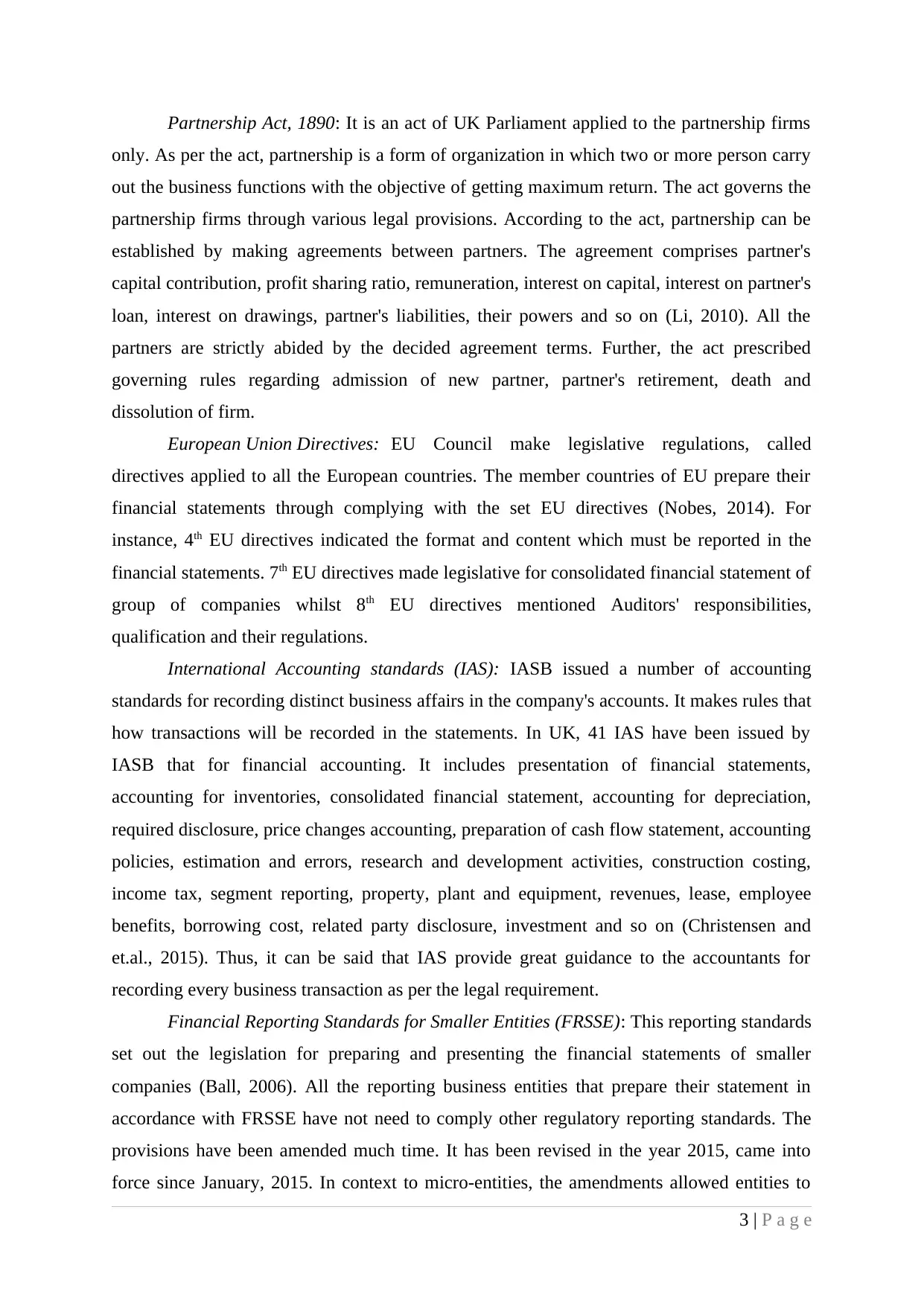
Partnership Act, 1890: It is an act of UK Parliament applied to the partnership firms
only. As per the act, partnership is a form of organization in which two or more person carry
out the business functions with the objective of getting maximum return. The act governs the
partnership firms through various legal provisions. According to the act, partnership can be
established by making agreements between partners. The agreement comprises partner's
capital contribution, profit sharing ratio, remuneration, interest on capital, interest on partner's
loan, interest on drawings, partner's liabilities, their powers and so on (Li, 2010). All the
partners are strictly abided by the decided agreement terms. Further, the act prescribed
governing rules regarding admission of new partner, partner's retirement, death and
dissolution of firm.
European Union Directives: EU Council make legislative regulations, called
directives applied to all the European countries. The member countries of EU prepare their
financial statements through complying with the set EU directives (Nobes, 2014). For
instance, 4th EU directives indicated the format and content which must be reported in the
financial statements. 7th EU directives made legislative for consolidated financial statement of
group of companies whilst 8th EU directives mentioned Auditors' responsibilities,
qualification and their regulations.
International Accounting standards (IAS): IASB issued a number of accounting
standards for recording distinct business affairs in the company's accounts. It makes rules that
how transactions will be recorded in the statements. In UK, 41 IAS have been issued by
IASB that for financial accounting. It includes presentation of financial statements,
accounting for inventories, consolidated financial statement, accounting for depreciation,
required disclosure, price changes accounting, preparation of cash flow statement, accounting
policies, estimation and errors, research and development activities, construction costing,
income tax, segment reporting, property, plant and equipment, revenues, lease, employee
benefits, borrowing cost, related party disclosure, investment and so on (Christensen and
et.al., 2015). Thus, it can be said that IAS provide great guidance to the accountants for
recording every business transaction as per the legal requirement.
Financial Reporting Standards for Smaller Entities (FRSSE): This reporting standards
set out the legislation for preparing and presenting the financial statements of smaller
companies (Ball, 2006). All the reporting business entities that prepare their statement in
accordance with FRSSE have not need to comply other regulatory reporting standards. The
provisions have been amended much time. It has been revised in the year 2015, came into
force since January, 2015. In context to micro-entities, the amendments allowed entities to
3 | P a g e
only. As per the act, partnership is a form of organization in which two or more person carry
out the business functions with the objective of getting maximum return. The act governs the
partnership firms through various legal provisions. According to the act, partnership can be
established by making agreements between partners. The agreement comprises partner's
capital contribution, profit sharing ratio, remuneration, interest on capital, interest on partner's
loan, interest on drawings, partner's liabilities, their powers and so on (Li, 2010). All the
partners are strictly abided by the decided agreement terms. Further, the act prescribed
governing rules regarding admission of new partner, partner's retirement, death and
dissolution of firm.
European Union Directives: EU Council make legislative regulations, called
directives applied to all the European countries. The member countries of EU prepare their
financial statements through complying with the set EU directives (Nobes, 2014). For
instance, 4th EU directives indicated the format and content which must be reported in the
financial statements. 7th EU directives made legislative for consolidated financial statement of
group of companies whilst 8th EU directives mentioned Auditors' responsibilities,
qualification and their regulations.
International Accounting standards (IAS): IASB issued a number of accounting
standards for recording distinct business affairs in the company's accounts. It makes rules that
how transactions will be recorded in the statements. In UK, 41 IAS have been issued by
IASB that for financial accounting. It includes presentation of financial statements,
accounting for inventories, consolidated financial statement, accounting for depreciation,
required disclosure, price changes accounting, preparation of cash flow statement, accounting
policies, estimation and errors, research and development activities, construction costing,
income tax, segment reporting, property, plant and equipment, revenues, lease, employee
benefits, borrowing cost, related party disclosure, investment and so on (Christensen and
et.al., 2015). Thus, it can be said that IAS provide great guidance to the accountants for
recording every business transaction as per the legal requirement.
Financial Reporting Standards for Smaller Entities (FRSSE): This reporting standards
set out the legislation for preparing and presenting the financial statements of smaller
companies (Ball, 2006). All the reporting business entities that prepare their statement in
accordance with FRSSE have not need to comply other regulatory reporting standards. The
provisions have been amended much time. It has been revised in the year 2015, came into
force since January, 2015. In context to micro-entities, the amendments allowed entities to
3 | P a g e
⊘ This is a preview!⊘
Do you want full access?
Subscribe today to unlock all pages.
Trusted by 1+ million students worldwide
use different measurement basis and reduces disclosure requirements and explanatory notes.
But, these standards have been withdrawn from January, 2016 as new FRS replaced it.
UK GAAP: Generally Accepted Accounting Principles (GAAP) described the set of
guidelines while drafting company's accounts. GAAP is a standard accounting framework
that includes principles, standards, rules and accounting conventions for recording and
summarizing the transactions. However, after 1st January, 2015, New UK GAAP has been
made in the way of FRS for new legal and regulatory framework (Chen and Gavious, 2015).
FRC 100, 101, 102 and 103 have been issued in replacement of historical UK GAAP.
According to it, companies who are constructing their statements using FRSSE were not
needed to follow GAAP while all the other reporters have to prepare their statements in
accordance with these principles.
Financial Reporting Standards (FRS): UK Accounting Standard Board (ASB) issued
FRS that provides guidance to the accountants while preparing necessary financial
statements. FRS 100 makes provisions for financial reporting requirements whereas 101
reduce the disclosure of explanatory accounting notes. However, FRS 103 is about insurance
contracts and FRS 102 has been issued for Interim Financial Reporting (Chaudhry and et.al,
2015). On contrary, reporting standards FRS 105 is applicable to the Micro- entities.
Financial Reporting Council (FRC) is a statutory body that have responsibility for creating
accounting standards in UK and Ireland. Moreover, UK Accounting Standards Committee
(ASC) issued Statements of Accounting Practices (SSAPs). It provides important guidelines
and helps to represent true and fair position of enterprises through its financial statements.
Statement of Standard Accounting Practices (SSAP): Accounting Standard Board
(ASB) issued SSAP for the company's accounting practices. The standards make high
regulations on the publicly traded companies to follow certain specified accounting rules in
order to present their statements (Chen, Ding and Xu, 2014). Number of SSAP has been
made by the board for accounting and reporting standards. It includes standards for
accounting for government grants; value added tax (VAT), inventory and long term contracts,
research and development, investment properties, foreign currency transaction, lease and hire
purchase transactions, segmental business reporting and so on.
International Financial Reporting Standards (IFRS): International Accounting
standard Board (IASB) constructs reporting regulations by issuing IFRS. This are the global
standards set out for presenting company's financial statements helps to improve
comparability between the statements across international boundaries (Mackenzie and et.al,
2012). Established UK companies that traded their securities in regulated stock exchanges
4 | P a g e
But, these standards have been withdrawn from January, 2016 as new FRS replaced it.
UK GAAP: Generally Accepted Accounting Principles (GAAP) described the set of
guidelines while drafting company's accounts. GAAP is a standard accounting framework
that includes principles, standards, rules and accounting conventions for recording and
summarizing the transactions. However, after 1st January, 2015, New UK GAAP has been
made in the way of FRS for new legal and regulatory framework (Chen and Gavious, 2015).
FRC 100, 101, 102 and 103 have been issued in replacement of historical UK GAAP.
According to it, companies who are constructing their statements using FRSSE were not
needed to follow GAAP while all the other reporters have to prepare their statements in
accordance with these principles.
Financial Reporting Standards (FRS): UK Accounting Standard Board (ASB) issued
FRS that provides guidance to the accountants while preparing necessary financial
statements. FRS 100 makes provisions for financial reporting requirements whereas 101
reduce the disclosure of explanatory accounting notes. However, FRS 103 is about insurance
contracts and FRS 102 has been issued for Interim Financial Reporting (Chaudhry and et.al,
2015). On contrary, reporting standards FRS 105 is applicable to the Micro- entities.
Financial Reporting Council (FRC) is a statutory body that have responsibility for creating
accounting standards in UK and Ireland. Moreover, UK Accounting Standards Committee
(ASC) issued Statements of Accounting Practices (SSAPs). It provides important guidelines
and helps to represent true and fair position of enterprises through its financial statements.
Statement of Standard Accounting Practices (SSAP): Accounting Standard Board
(ASB) issued SSAP for the company's accounting practices. The standards make high
regulations on the publicly traded companies to follow certain specified accounting rules in
order to present their statements (Chen, Ding and Xu, 2014). Number of SSAP has been
made by the board for accounting and reporting standards. It includes standards for
accounting for government grants; value added tax (VAT), inventory and long term contracts,
research and development, investment properties, foreign currency transaction, lease and hire
purchase transactions, segmental business reporting and so on.
International Financial Reporting Standards (IFRS): International Accounting
standard Board (IASB) constructs reporting regulations by issuing IFRS. This are the global
standards set out for presenting company's financial statements helps to improve
comparability between the statements across international boundaries (Mackenzie and et.al,
2012). Established UK companies that traded their securities in regulated stock exchanges
4 | P a g e
Paraphrase This Document
Need a fresh take? Get an instant paraphrase of this document with our AI Paraphraser
such as LSE, needed to comply their statements in accordance with IFRS. Different
companies who operate at distinct land prepare their statements through adopting their
nation's accounting standards. Therefore, all the entities are not able to understand the
statements appropriately. However, in the present market, international transactions are
increasing at rapid rate. Thus, it become necessary financial statements provide broad
understanding of company’s affairs and help them to take effective investment decisions.
IFRS is the best solution of this problem because it set out the rules which must be followed
by the accountants in maintaining their books of accounts. The most important advantage of
issuing IFRS is it harmonizes the accounting process across various EU countries (Ahmed,
Neel and Wang, 2013). According to IFRS, companies have to follow same accounting rules
and principles to drafting their financial statements. Going concern concept, accrual basis of
recording the transactions, materiality concept, consistency approach and fair presentation are
some of the basic principles of IFRS which must be followed by the accountants in their
financial accounting process. Relevance and faithful representation are the fundamental
qualitative characteristics of IFRS. Moreover, it improves comparability, reliability,
timeliness and understandability of the financial statements for the business entities (Alali
and Foote, 2012). Thus, it became clear that IFRS provide huge assistance to the investors
and other users through providing qualitative information. They are able to use financial
statements of the organization for gathering required information and take qualified and
strategic decisions.
AC 1.1, 1.3, 3.1 Implication of legal and regulatory influences on the financial statements for
Different users of the statements and their information need
There are number of users existed in every business organizations includes both the
internal and external users. Internal users are the part of enterprises while external users are
the outsiders. The stakeholders are very much interested in knowing company's performance
through its produced financial statements. Further, their information need also tends to vary
from each other. Different users of the organization and their information requirements with
the influences of legal and regulatory framework have been described here as under:
Investors: This group consists of both existed and potential investors. Existing
investors are those make invested their funds in the organization while external shareholders
are those who are considering about whether to invest or not in the company. There are two
kinds of shareholders equity shareholders and preference shareholders. Shareholders are the
investors of the company who invested their funds in the form of share capital. They take risk
through investing their own funds. The main objectives of shareholders are to getting
5 | P a g e
companies who operate at distinct land prepare their statements through adopting their
nation's accounting standards. Therefore, all the entities are not able to understand the
statements appropriately. However, in the present market, international transactions are
increasing at rapid rate. Thus, it become necessary financial statements provide broad
understanding of company’s affairs and help them to take effective investment decisions.
IFRS is the best solution of this problem because it set out the rules which must be followed
by the accountants in maintaining their books of accounts. The most important advantage of
issuing IFRS is it harmonizes the accounting process across various EU countries (Ahmed,
Neel and Wang, 2013). According to IFRS, companies have to follow same accounting rules
and principles to drafting their financial statements. Going concern concept, accrual basis of
recording the transactions, materiality concept, consistency approach and fair presentation are
some of the basic principles of IFRS which must be followed by the accountants in their
financial accounting process. Relevance and faithful representation are the fundamental
qualitative characteristics of IFRS. Moreover, it improves comparability, reliability,
timeliness and understandability of the financial statements for the business entities (Alali
and Foote, 2012). Thus, it became clear that IFRS provide huge assistance to the investors
and other users through providing qualitative information. They are able to use financial
statements of the organization for gathering required information and take qualified and
strategic decisions.
AC 1.1, 1.3, 3.1 Implication of legal and regulatory influences on the financial statements for
Different users of the statements and their information need
There are number of users existed in every business organizations includes both the
internal and external users. Internal users are the part of enterprises while external users are
the outsiders. The stakeholders are very much interested in knowing company's performance
through its produced financial statements. Further, their information need also tends to vary
from each other. Different users of the organization and their information requirements with
the influences of legal and regulatory framework have been described here as under:
Investors: This group consists of both existed and potential investors. Existing
investors are those make invested their funds in the organization while external shareholders
are those who are considering about whether to invest or not in the company. There are two
kinds of shareholders equity shareholders and preference shareholders. Shareholders are the
investors of the company who invested their funds in the form of share capital. They take risk
through investing their own funds. The main objectives of shareholders are to getting
5 | P a g e
maximum amount of profitability on their investment. Therefore, they are very much interest
to know company's operational as well as financial health. They need information about
business profits, cash earnings capacity, financial strength, solvency position and fund
security (Spence and Rinaldi, 2014). They demand regular income on their investment in the
form of dividend. In context to short term shareholders perspective, they are interest to have
regular dividend receipts while in relation to long term perspective, they determine future
earning capacity of the business. They make risk and return analysis associated with their
invested funds through analysing company's performance and take decisions to invest in that
organization who provide maximum return to them.
Legal and regulatory accounting and reporting framework gains significant
importance for the shareholders. Under the UK company laws, CA, 2006 provide more power
and information rights to the investors. They have legal right to investigate any further
information from the company directors (Dhaliwal and et.al, 2014). However, regulatory
accounting and reporting standards impose legal obligations to the companies to represent
true and fair performance. Thus, investors can collect authentic and accurate financial
information and take decisions accordingly. They gather information through company's
balance sheet to determine solvency position in order to determine financial risk (Epstein and
Jermakowicz, 2010). High proportion of debt in the capital structure will indicate high
financial risk and vice versa. Moreover, using debt funds in a very low proportion also
considered disadvantageous because company cannot take benefits from trading on equity.
Appropriate capital structure maintains good solvency position and reduces financial risk.
Furthermore, investors make use of cash flow statement to recognise business cash
generating capacity and ensure their regular dividend return. Thus, it is clear that better
solvency position, cash generating ability, good profitability and financial strength highly
satisfies the shareholders objectives and attracts large number of investors to the
organization.
Lenders: Lenders provide funds on credit to the companies include short-term,
medium-term and long-term funds providers. Short-term loan providers are mainly concerned
about their timely interest receipts. Therefore, they determine company's cash generating
capabilities to ensure their receipts. Good cash collecting capacity brings high level of
satisfaction among lenders and vice versa. However, medium-term and long-term fund
providers are more interested to analysing future cash earning capacity because they lend
funds for high time duration. Financial institution such as banks major use of this
6 | P a g e
to know company's operational as well as financial health. They need information about
business profits, cash earnings capacity, financial strength, solvency position and fund
security (Spence and Rinaldi, 2014). They demand regular income on their investment in the
form of dividend. In context to short term shareholders perspective, they are interest to have
regular dividend receipts while in relation to long term perspective, they determine future
earning capacity of the business. They make risk and return analysis associated with their
invested funds through analysing company's performance and take decisions to invest in that
organization who provide maximum return to them.
Legal and regulatory accounting and reporting framework gains significant
importance for the shareholders. Under the UK company laws, CA, 2006 provide more power
and information rights to the investors. They have legal right to investigate any further
information from the company directors (Dhaliwal and et.al, 2014). However, regulatory
accounting and reporting standards impose legal obligations to the companies to represent
true and fair performance. Thus, investors can collect authentic and accurate financial
information and take decisions accordingly. They gather information through company's
balance sheet to determine solvency position in order to determine financial risk (Epstein and
Jermakowicz, 2010). High proportion of debt in the capital structure will indicate high
financial risk and vice versa. Moreover, using debt funds in a very low proportion also
considered disadvantageous because company cannot take benefits from trading on equity.
Appropriate capital structure maintains good solvency position and reduces financial risk.
Furthermore, investors make use of cash flow statement to recognise business cash
generating capacity and ensure their regular dividend return. Thus, it is clear that better
solvency position, cash generating ability, good profitability and financial strength highly
satisfies the shareholders objectives and attracts large number of investors to the
organization.
Lenders: Lenders provide funds on credit to the companies include short-term,
medium-term and long-term funds providers. Short-term loan providers are mainly concerned
about their timely interest receipts. Therefore, they determine company's cash generating
capabilities to ensure their receipts. Good cash collecting capacity brings high level of
satisfaction among lenders and vice versa. However, medium-term and long-term fund
providers are more interested to analysing future cash earning capacity because they lend
funds for high time duration. Financial institution such as banks major use of this
6 | P a g e
⊘ This is a preview!⊘
Do you want full access?
Subscribe today to unlock all pages.
Trusted by 1+ million students worldwide
information. Accounting standards impose liabilities to the organization for presenting all the
required information for the lenders. For instance, the provisions of Financial Reporting
Standard (FRS) 1 and IAS 7 are about preparation of cash flow statement. It helps to provide
all the relevant information and assist lenders to predict net realisable value of the assets. In
addition to it, standards for drafting and publishing the statements and reporting borrowing
cost in accordance with IAS 23 helps to provide prominent information to the lenders for
decision making (Flower, 2015). Another, statements based on IFRS, provides feasibility to
the lenders for making comparative study. Fund providers’ uses profitability statements to
determine current as well as future business profitability and ensure regular interest incomes
till the time of maturity period. They determine the borrower ability to repay the borrowed
funds at an implied interest charges. Furthermore, they collect information through balance
sheet in order to determine fund security. Analysis of liquidity and solvency position provide
great assistance to them in their decision-making process. They grant loans to the
organization which have good assets base and liquidity position. Organizations having good
financial health are more able to generate funds from lenders and mitigate their financial
need.
Suppliers: It refers to the person who provides credit facility to the business such as
trade creditors. They fulfil the organization's working capital need through supplying on
credit. They need information regarding operational results and financial status in terms of
liquidity. Moreover, they estimate the future business earnings and cash collecting capacity.
They evaluate current business profitability from profit and loss account and also predict the
possibility of future performance. Furthermore, cash flow statement prepared as per the
provisions of IAS 7 provides huge assistance to analyse company's ability to collect cash. In
addition to it, presentation of financial statement by adopting IAS 1 helps to represent true
and fair company's performance. Another, IAS 2 is applicable for recording business
inventories correctly (Davies and Green, 2013). Financial position statement provides
information in relation to business liquidity. Creditors evaluate company's ability to repay
their short term liabilities effectively. Good liquid assets imply good credit worthiness of the
business and vice versa. Through analysing company's performance, suppliers will be able to
safeguard their credit. Furthermore, organizations that have better liquid availability can
attract large number of trade creditors to the business at their credit terms. They will be able
to attain credit for the extent time period.
7 | P a g e
required information for the lenders. For instance, the provisions of Financial Reporting
Standard (FRS) 1 and IAS 7 are about preparation of cash flow statement. It helps to provide
all the relevant information and assist lenders to predict net realisable value of the assets. In
addition to it, standards for drafting and publishing the statements and reporting borrowing
cost in accordance with IAS 23 helps to provide prominent information to the lenders for
decision making (Flower, 2015). Another, statements based on IFRS, provides feasibility to
the lenders for making comparative study. Fund providers’ uses profitability statements to
determine current as well as future business profitability and ensure regular interest incomes
till the time of maturity period. They determine the borrower ability to repay the borrowed
funds at an implied interest charges. Furthermore, they collect information through balance
sheet in order to determine fund security. Analysis of liquidity and solvency position provide
great assistance to them in their decision-making process. They grant loans to the
organization which have good assets base and liquidity position. Organizations having good
financial health are more able to generate funds from lenders and mitigate their financial
need.
Suppliers: It refers to the person who provides credit facility to the business such as
trade creditors. They fulfil the organization's working capital need through supplying on
credit. They need information regarding operational results and financial status in terms of
liquidity. Moreover, they estimate the future business earnings and cash collecting capacity.
They evaluate current business profitability from profit and loss account and also predict the
possibility of future performance. Furthermore, cash flow statement prepared as per the
provisions of IAS 7 provides huge assistance to analyse company's ability to collect cash. In
addition to it, presentation of financial statement by adopting IAS 1 helps to represent true
and fair company's performance. Another, IAS 2 is applicable for recording business
inventories correctly (Davies and Green, 2013). Financial position statement provides
information in relation to business liquidity. Creditors evaluate company's ability to repay
their short term liabilities effectively. Good liquid assets imply good credit worthiness of the
business and vice versa. Through analysing company's performance, suppliers will be able to
safeguard their credit. Furthermore, organizations that have better liquid availability can
attract large number of trade creditors to the business at their credit terms. They will be able
to attain credit for the extent time period.
7 | P a g e
Paraphrase This Document
Need a fresh take? Get an instant paraphrase of this document with our AI Paraphraser
Managers: Managers are the internal users of the organization responsible for running
business functions without any hazards. Board of Directors (BOD), executives, CEO and
CFO are the parts of management team. They need information regarding company's profits
and financial position. They gather information business revenues, expenditures and
profitability and make analysis of it to determine operational difficulties. Thus, IAS for
recording revenues and cost provide more correct information to them. It helps managers to
design policies for maximizing incomes and reduce expenses so as to have greater
availability of profits. Along with the profits maximization, managers also administrate funds
in an adequate manner. Thus, they assess company's cash flow statement and evaluate cash
inflows and outflows to ensure better cash availability for regular business functioning
(Chalmers, Godfrey and Lynch, 2012). Budgetary tools are extensively used by managers for
optimum allocation of resources and administrate funds appropriately. Through analysing
such budget they will be able to take decisions for having surplus cash availability. Another,
managers require information about the financial stability thus; they make use of balance
sheet to determine solvency, liquidity and efficiency. Legal and regulatory authorities
prescribed the formats, content, recording and reporting regulations for the companies. IAS
provisions described the recording process for each component of the financial statements
such as property, plant and machinery, lease government grants, investment and so on. Thus,
managers can determine financial difficulties through assessing the financial performance and
take strategic and effective managerial decisions accordingly. They manage company's
activities or affairs through designing various business policies and improve their competitive
strength.
Government: EU countries government also works as external business users.
Corporate taxes are the major part of governmental incomes. Therefore, one of the most
important information needs of government is to gathering information about company's
profits. They measure business profitability and determine the corporation tax liabilities. It
helps to decide company's tax obligations and compare it with the reported tax amount in tax
return. In case of inappropriate payments, they have right to impose penalties and other kind
of law suits to the organizations. IAS 12 provision imposes obligations to the company for
accounting of income tax (Bushman and Piotroski, 2006). Government also keep records of
business progress to make plans for economic development and growth in future period. They
determine business performance of various sectors and industries to make economic policies.
Furthermore, it prohibited illegal business practices through making rules and regulations. In
8 | P a g e
business functions without any hazards. Board of Directors (BOD), executives, CEO and
CFO are the parts of management team. They need information regarding company's profits
and financial position. They gather information business revenues, expenditures and
profitability and make analysis of it to determine operational difficulties. Thus, IAS for
recording revenues and cost provide more correct information to them. It helps managers to
design policies for maximizing incomes and reduce expenses so as to have greater
availability of profits. Along with the profits maximization, managers also administrate funds
in an adequate manner. Thus, they assess company's cash flow statement and evaluate cash
inflows and outflows to ensure better cash availability for regular business functioning
(Chalmers, Godfrey and Lynch, 2012). Budgetary tools are extensively used by managers for
optimum allocation of resources and administrate funds appropriately. Through analysing
such budget they will be able to take decisions for having surplus cash availability. Another,
managers require information about the financial stability thus; they make use of balance
sheet to determine solvency, liquidity and efficiency. Legal and regulatory authorities
prescribed the formats, content, recording and reporting regulations for the companies. IAS
provisions described the recording process for each component of the financial statements
such as property, plant and machinery, lease government grants, investment and so on. Thus,
managers can determine financial difficulties through assessing the financial performance and
take strategic and effective managerial decisions accordingly. They manage company's
activities or affairs through designing various business policies and improve their competitive
strength.
Government: EU countries government also works as external business users.
Corporate taxes are the major part of governmental incomes. Therefore, one of the most
important information needs of government is to gathering information about company's
profits. They measure business profitability and determine the corporation tax liabilities. It
helps to decide company's tax obligations and compare it with the reported tax amount in tax
return. In case of inappropriate payments, they have right to impose penalties and other kind
of law suits to the organizations. IAS 12 provision imposes obligations to the company for
accounting of income tax (Bushman and Piotroski, 2006). Government also keep records of
business progress to make plans for economic development and growth in future period. They
determine business performance of various sectors and industries to make economic policies.
Furthermore, it prohibited illegal business practices through making rules and regulations. In
8 | P a g e
addition to it, it determines competition level to ensure fair competition among the
organization.
Competitors: In the present age, competition is increasing at exponential rate.
Therefore, it seems to be very important for the companies to compete effectively.
Competitors analyse the financial statements and measure business performance for
comparison purpose. They determine leading company's policies, regulations and strategies
and implement it in their own organization to enhance their competitive strength (Daske and
Gebhardt, 2006). It helps to design strategic and competitive policies to improve their
competitiveness. This in turn, entity will be able to compete effectively with the rival firms.
Statements based on IFRS improve comparability which assists competitors to make
comparison of it with their own statements.
Employees: They are the internal users who provide services to the public and bring
profitability for the business. They have the objectives of extensive job security and good
monetary as well as non-monetary rewards. IAS 19 for employee benefits provides reliable
and correct information to the employees for their purpose. They collect information through
profitability statements and predict future company performance. Improving the business
operational and financial position helps to satisfy their objectives. High profit earned
organizations provide more wages and remuneration to the workers (Conceptual and Legal
Framework, n. d.). Further, there is a great chance of increasing the employee's salaries in
terms of future period. Moreover, financially stable organization provide high job security
while worst performing companies are not able to providing better monetary benefits to the
workers and impact them adversely.
General public: All the organization provide services to the public thus, they are also
the part of external users. Therefore, they need information about the impact of company's
operating functions on economy, environment and community (Radebaugh, 2014). Moreover,
increasing job opportunities helps to reduce unemployment within the country and impact the
public favourably. This in turn, results in improving the income level of the people, increase
their purchasing power and improving the life style. They also have the objectives of safe
environment thus, organization need to follow all the UK environmental laws and regulations
of concerned statutory and regulatory authorities (Overview of Financial Reporting
Framework, 2015). Accounting for corporate social responsibility provides huge assistance to
the public for gathering this kind of information. As per the standards, it is the liability of
organization to fulfil their social responsibilities.
9 | P a g e
organization.
Competitors: In the present age, competition is increasing at exponential rate.
Therefore, it seems to be very important for the companies to compete effectively.
Competitors analyse the financial statements and measure business performance for
comparison purpose. They determine leading company's policies, regulations and strategies
and implement it in their own organization to enhance their competitive strength (Daske and
Gebhardt, 2006). It helps to design strategic and competitive policies to improve their
competitiveness. This in turn, entity will be able to compete effectively with the rival firms.
Statements based on IFRS improve comparability which assists competitors to make
comparison of it with their own statements.
Employees: They are the internal users who provide services to the public and bring
profitability for the business. They have the objectives of extensive job security and good
monetary as well as non-monetary rewards. IAS 19 for employee benefits provides reliable
and correct information to the employees for their purpose. They collect information through
profitability statements and predict future company performance. Improving the business
operational and financial position helps to satisfy their objectives. High profit earned
organizations provide more wages and remuneration to the workers (Conceptual and Legal
Framework, n. d.). Further, there is a great chance of increasing the employee's salaries in
terms of future period. Moreover, financially stable organization provide high job security
while worst performing companies are not able to providing better monetary benefits to the
workers and impact them adversely.
General public: All the organization provide services to the public thus, they are also
the part of external users. Therefore, they need information about the impact of company's
operating functions on economy, environment and community (Radebaugh, 2014). Moreover,
increasing job opportunities helps to reduce unemployment within the country and impact the
public favourably. This in turn, results in improving the income level of the people, increase
their purchasing power and improving the life style. They also have the objectives of safe
environment thus, organization need to follow all the UK environmental laws and regulations
of concerned statutory and regulatory authorities (Overview of Financial Reporting
Framework, 2015). Accounting for corporate social responsibility provides huge assistance to
the public for gathering this kind of information. As per the standards, it is the liability of
organization to fulfil their social responsibilities.
9 | P a g e
⊘ This is a preview!⊘
Do you want full access?
Subscribe today to unlock all pages.
Trusted by 1+ million students worldwide

1 out of 25


Related Documents


Your All-in-One AI-Powered Toolkit for Academic Success.
+13062052269
info@desklib.com
Available 24*7 on WhatsApp / Email
![[object Object]](/_next/static/media/star-bottom.7253800d.svg)
Unlock your academic potential
Copyright © 2020–2026 A2Z Services. All Rights Reserved. Developed and managed by ZUCOL.