Financial Accounting Report: Double-Entry Bookkeeping and Ratios
VerifiedAdded on 2020/01/16
|10
|2138
|359
Report
AI Summary
This report provides a detailed overview of financial accounting principles and their application, focusing on the context of Mark & Spencer. It begins with an introduction to financial accounting, its importance, and the various systems used, including double-entry bookkeeping, prime entry books, and the nominal ledger. The report then explores the preparation of financial statements, including the income statement and statement of financial position, in accordance with IAS. It includes calculations of ratios such as return on capital employed, gross profit margin, and net profit margin. Further, the report discusses the Bank Reconciliation Statement (BRS), its purpose, and the process of updating the cash book. It also covers the calculation of debtors' balances, reconciliation statements, and the correction of errors in trial balances. Finally, the report concludes by summarizing the key findings and referencing relevant sources.

FINANCIAL ACCOUNTING

Paraphrase This Document
Need a fresh take? Get an instant paraphrase of this document with our AI Paraphraser
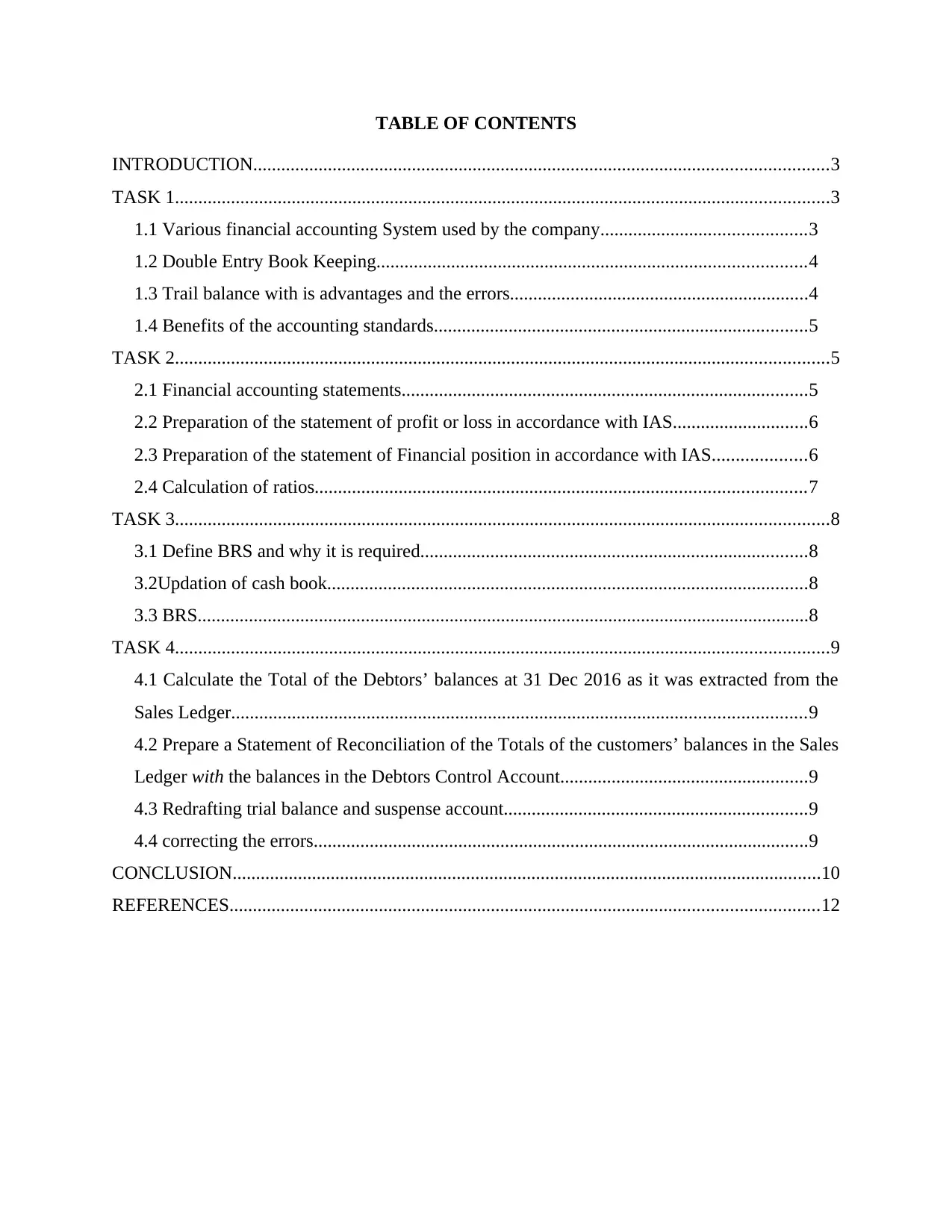
TABLE OF CONTENTS
INTRODUCTION...........................................................................................................................3
TASK 1............................................................................................................................................3
1.1 Various financial accounting System used by the company............................................3
1.2 Double Entry Book Keeping............................................................................................4
1.3 Trail balance with is advantages and the errors................................................................4
1.4 Benefits of the accounting standards................................................................................5
TASK 2............................................................................................................................................5
2.1 Financial accounting statements.......................................................................................5
2.2 Preparation of the statement of profit or loss in accordance with IAS.............................6
2.3 Preparation of the statement of Financial position in accordance with IAS....................6
2.4 Calculation of ratios.........................................................................................................7
TASK 3............................................................................................................................................8
3.1 Define BRS and why it is required...................................................................................8
3.2Updation of cash book.......................................................................................................8
3.3 BRS...................................................................................................................................8
TASK 4............................................................................................................................................9
4.1 Calculate the Total of the Debtors’ balances at 31 Dec 2016 as it was extracted from the
Sales Ledger...........................................................................................................................9
4.2 Prepare a Statement of Reconciliation of the Totals of the customers’ balances in the Sales
Ledger with the balances in the Debtors Control Account.....................................................9
4.3 Redrafting trial balance and suspense account.................................................................9
4.4 correcting the errors..........................................................................................................9
CONCLUSION..............................................................................................................................10
REFERENCES..............................................................................................................................12
INTRODUCTION...........................................................................................................................3
TASK 1............................................................................................................................................3
1.1 Various financial accounting System used by the company............................................3
1.2 Double Entry Book Keeping............................................................................................4
1.3 Trail balance with is advantages and the errors................................................................4
1.4 Benefits of the accounting standards................................................................................5
TASK 2............................................................................................................................................5
2.1 Financial accounting statements.......................................................................................5
2.2 Preparation of the statement of profit or loss in accordance with IAS.............................6
2.3 Preparation of the statement of Financial position in accordance with IAS....................6
2.4 Calculation of ratios.........................................................................................................7
TASK 3............................................................................................................................................8
3.1 Define BRS and why it is required...................................................................................8
3.2Updation of cash book.......................................................................................................8
3.3 BRS...................................................................................................................................8
TASK 4............................................................................................................................................9
4.1 Calculate the Total of the Debtors’ balances at 31 Dec 2016 as it was extracted from the
Sales Ledger...........................................................................................................................9
4.2 Prepare a Statement of Reconciliation of the Totals of the customers’ balances in the Sales
Ledger with the balances in the Debtors Control Account.....................................................9
4.3 Redrafting trial balance and suspense account.................................................................9
4.4 correcting the errors..........................................................................................................9
CONCLUSION..............................................................................................................................10
REFERENCES..............................................................................................................................12
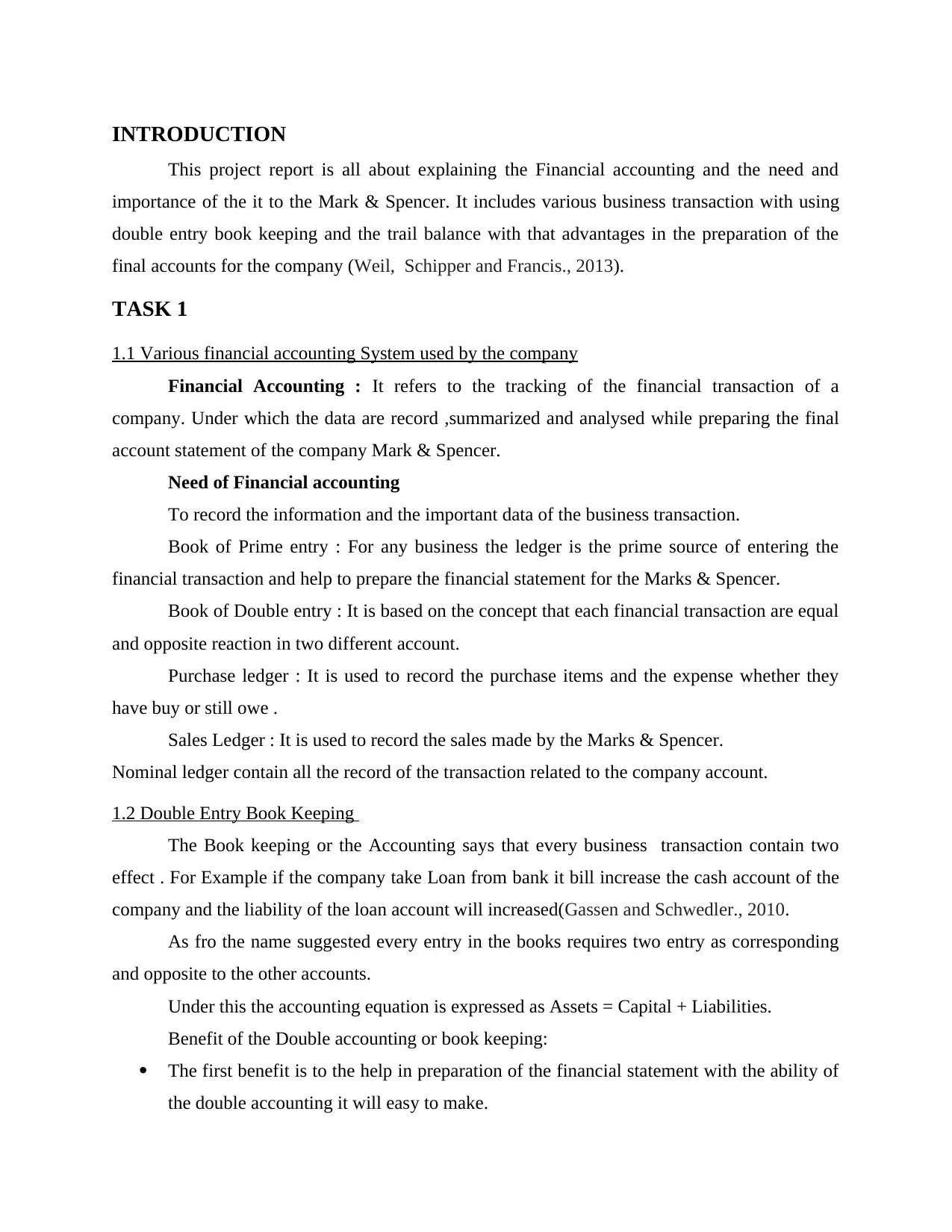
INTRODUCTION
This project report is all about explaining the Financial accounting and the need and
importance of the it to the Mark & Spencer. It includes various business transaction with using
double entry book keeping and the trail balance with that advantages in the preparation of the
final accounts for the company (Weil, Schipper and Francis., 2013).
TASK 1
1.1 Various financial accounting System used by the company
Financial Accounting : It refers to the tracking of the financial transaction of a
company. Under which the data are record ,summarized and analysed while preparing the final
account statement of the company Mark & Spencer.
Need of Financial accounting
To record the information and the important data of the business transaction.
Book of Prime entry : For any business the ledger is the prime source of entering the
financial transaction and help to prepare the financial statement for the Marks & Spencer.
Book of Double entry : It is based on the concept that each financial transaction are equal
and opposite reaction in two different account.
Purchase ledger : It is used to record the purchase items and the expense whether they
have buy or still owe .
Sales Ledger : It is used to record the sales made by the Marks & Spencer.
Nominal ledger contain all the record of the transaction related to the company account.
1.2 Double Entry Book Keeping
The Book keeping or the Accounting says that every business transaction contain two
effect . For Example if the company take Loan from bank it bill increase the cash account of the
company and the liability of the loan account will increased(Gassen and Schwedler., 2010.
As fro the name suggested every entry in the books requires two entry as corresponding
and opposite to the other accounts.
Under this the accounting equation is expressed as Assets = Capital + Liabilities.
Benefit of the Double accounting or book keeping:
The first benefit is to the help in preparation of the financial statement with the ability of
the double accounting it will easy to make.
This project report is all about explaining the Financial accounting and the need and
importance of the it to the Mark & Spencer. It includes various business transaction with using
double entry book keeping and the trail balance with that advantages in the preparation of the
final accounts for the company (Weil, Schipper and Francis., 2013).
TASK 1
1.1 Various financial accounting System used by the company
Financial Accounting : It refers to the tracking of the financial transaction of a
company. Under which the data are record ,summarized and analysed while preparing the final
account statement of the company Mark & Spencer.
Need of Financial accounting
To record the information and the important data of the business transaction.
Book of Prime entry : For any business the ledger is the prime source of entering the
financial transaction and help to prepare the financial statement for the Marks & Spencer.
Book of Double entry : It is based on the concept that each financial transaction are equal
and opposite reaction in two different account.
Purchase ledger : It is used to record the purchase items and the expense whether they
have buy or still owe .
Sales Ledger : It is used to record the sales made by the Marks & Spencer.
Nominal ledger contain all the record of the transaction related to the company account.
1.2 Double Entry Book Keeping
The Book keeping or the Accounting says that every business transaction contain two
effect . For Example if the company take Loan from bank it bill increase the cash account of the
company and the liability of the loan account will increased(Gassen and Schwedler., 2010.
As fro the name suggested every entry in the books requires two entry as corresponding
and opposite to the other accounts.
Under this the accounting equation is expressed as Assets = Capital + Liabilities.
Benefit of the Double accounting or book keeping:
The first benefit is to the help in preparation of the financial statement with the ability of
the double accounting it will easy to make.
⊘ This is a preview!⊘
Do you want full access?
Subscribe today to unlock all pages.

Trusted by 1+ million students worldwide
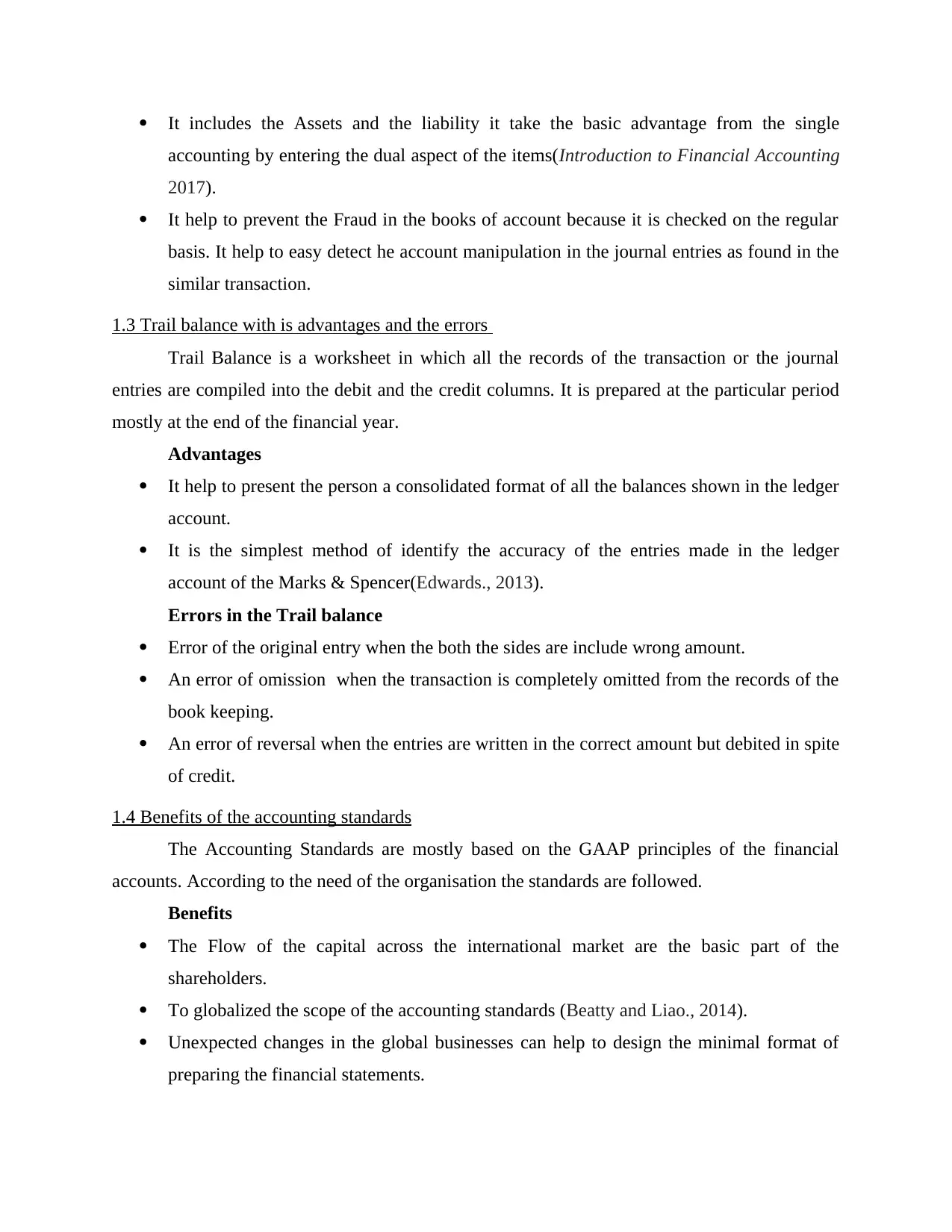
It includes the Assets and the liability it take the basic advantage from the single
accounting by entering the dual aspect of the items(Introduction to Financial Accounting
2017).
It help to prevent the Fraud in the books of account because it is checked on the regular
basis. It help to easy detect he account manipulation in the journal entries as found in the
similar transaction.
1.3 Trail balance with is advantages and the errors
Trail Balance is a worksheet in which all the records of the transaction or the journal
entries are compiled into the debit and the credit columns. It is prepared at the particular period
mostly at the end of the financial year.
Advantages
It help to present the person a consolidated format of all the balances shown in the ledger
account.
It is the simplest method of identify the accuracy of the entries made in the ledger
account of the Marks & Spencer(Edwards., 2013).
Errors in the Trail balance
Error of the original entry when the both the sides are include wrong amount.
An error of omission when the transaction is completely omitted from the records of the
book keeping.
An error of reversal when the entries are written in the correct amount but debited in spite
of credit.
1.4 Benefits of the accounting standards
The Accounting Standards are mostly based on the GAAP principles of the financial
accounts. According to the need of the organisation the standards are followed.
Benefits
The Flow of the capital across the international market are the basic part of the
shareholders.
To globalized the scope of the accounting standards (Beatty and Liao., 2014).
Unexpected changes in the global businesses can help to design the minimal format of
preparing the financial statements.
accounting by entering the dual aspect of the items(Introduction to Financial Accounting
2017).
It help to prevent the Fraud in the books of account because it is checked on the regular
basis. It help to easy detect he account manipulation in the journal entries as found in the
similar transaction.
1.3 Trail balance with is advantages and the errors
Trail Balance is a worksheet in which all the records of the transaction or the journal
entries are compiled into the debit and the credit columns. It is prepared at the particular period
mostly at the end of the financial year.
Advantages
It help to present the person a consolidated format of all the balances shown in the ledger
account.
It is the simplest method of identify the accuracy of the entries made in the ledger
account of the Marks & Spencer(Edwards., 2013).
Errors in the Trail balance
Error of the original entry when the both the sides are include wrong amount.
An error of omission when the transaction is completely omitted from the records of the
book keeping.
An error of reversal when the entries are written in the correct amount but debited in spite
of credit.
1.4 Benefits of the accounting standards
The Accounting Standards are mostly based on the GAAP principles of the financial
accounts. According to the need of the organisation the standards are followed.
Benefits
The Flow of the capital across the international market are the basic part of the
shareholders.
To globalized the scope of the accounting standards (Beatty and Liao., 2014).
Unexpected changes in the global businesses can help to design the minimal format of
preparing the financial statements.
Paraphrase This Document
Need a fresh take? Get an instant paraphrase of this document with our AI Paraphraser
TASK 2
2.1 Financial accounting statements
Income statement:- Through analyzing this financial statement, proper cost incurred for
expenditures and gained revenue are analyzed. On the basis of this statement analysis,
further business operations are implemented in future time. In this regard, varieties of
ideas are created for balancing between expenses and earned income for organisation's
effectiveness.
Balance sheet:- Under this statement analysis, assets and liabilities of organization.
However, financial performance of entity is presented by which further ideas are created
to balance expenses and enhancing earning capacity of organization.
Profit and loss account:- Financial statement as profit and loss account is useful to present
earning potential of organization. However, through analyzing this account, further
implementation is created for reducing losses and enhancing gains.
Cash flow/ fund flow analysis:- By preparing this financial statement, flow of cash and
fund is recognized. In this regard, economic structure of organization is analyzed that
leads to make decisions for improving profitability.
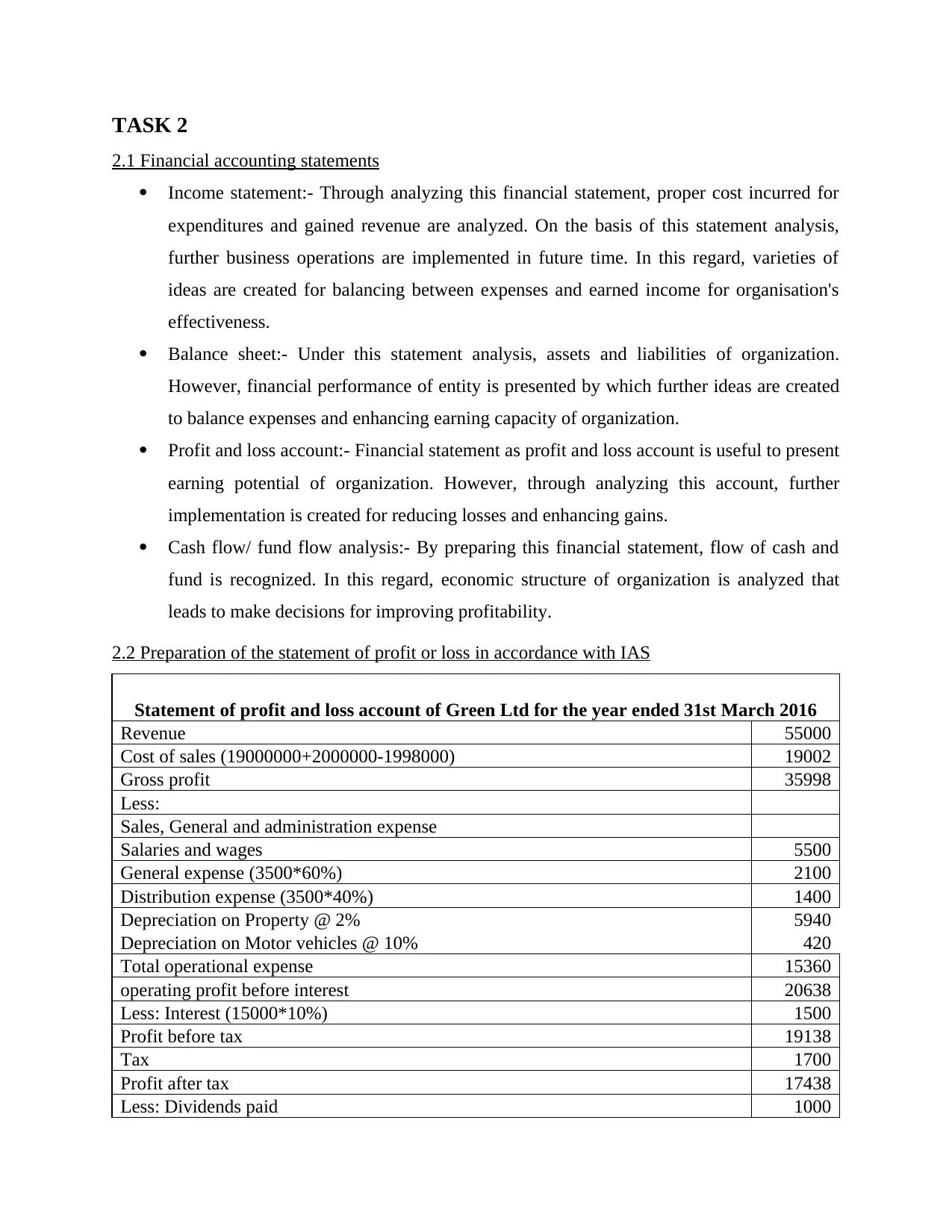
2.2 Preparation of the statement of profit or loss in accordance with IAS
Statement of profit and loss account of Green Ltd for the year ended 31st March 2016
Revenue 55000
Cost of sales (19000000+2000000-1998000) 19002
Gross profit 35998
Less:
Sales, General and administration expense
Salaries and wages 5500
General expense (3500*60%) 2100
Distribution expense (3500*40%) 1400
Depreciation on Property @ 2% 5940
Depreciation on Motor vehicles @ 10% 420
Total operational expense 15360
operating profit before interest 20638
Less: Interest (15000*10%) 1500
Profit before tax 19138
Tax 1700
Profit after tax 17438
Less: Dividends paid 1000
2.1 Financial accounting statements
Income statement:- Through analyzing this financial statement, proper cost incurred for
expenditures and gained revenue are analyzed. On the basis of this statement analysis,
further business operations are implemented in future time. In this regard, varieties of
ideas are created for balancing between expenses and earned income for organisation's
effectiveness.
Balance sheet:- Under this statement analysis, assets and liabilities of organization.
However, financial performance of entity is presented by which further ideas are created
to balance expenses and enhancing earning capacity of organization.
Profit and loss account:- Financial statement as profit and loss account is useful to present
earning potential of organization. However, through analyzing this account, further
implementation is created for reducing losses and enhancing gains.
Cash flow/ fund flow analysis:- By preparing this financial statement, flow of cash and
fund is recognized. In this regard, economic structure of organization is analyzed that
leads to make decisions for improving profitability.
2.2 Preparation of the statement of profit or loss in accordance with IAS
Statement of profit and loss account of Green Ltd for the year ended 31st March 2016
Revenue 55000
Cost of sales (19000000+2000000-1998000) 19002
Gross profit 35998
Less:
Sales, General and administration expense
Salaries and wages 5500
General expense (3500*60%) 2100
Distribution expense (3500*40%) 1400
Depreciation on Property @ 2% 5940
Depreciation on Motor vehicles @ 10% 420
Total operational expense 15360
operating profit before interest 20638
Less: Interest (15000*10%) 1500
Profit before tax 19138
Tax 1700
Profit after tax 17438
Less: Dividends paid 1000
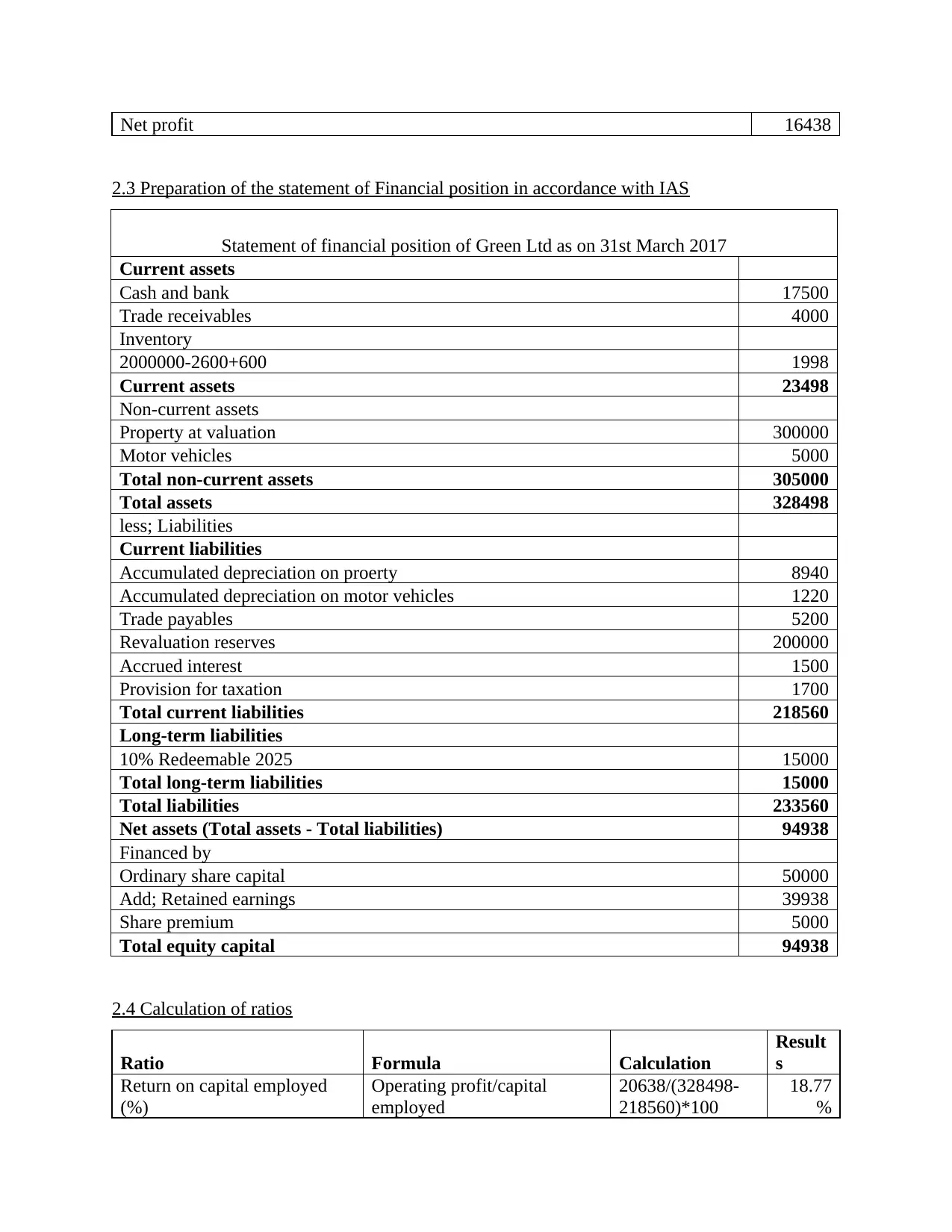
Net profit 16438
2.3 Preparation of the statement of Financial position in accordance with IAS
Statement of financial position of Green Ltd as on 31st March 2017
Current assets
Cash and bank 17500
Trade receivables 4000
Inventory
2000000-2600+600 1998
Current assets 23498
Non-current assets
Property at valuation 300000
Motor vehicles 5000
Total non-current assets 305000
Total assets 328498
less; Liabilities
Current liabilities
Accumulated depreciation on proerty 8940
Accumulated depreciation on motor vehicles 1220
Trade payables 5200
Revaluation reserves 200000
Accrued interest 1500
Provision for taxation 1700
Total current liabilities 218560
Long-term liabilities
10% Redeemable 2025 15000
Total long-term liabilities 15000
Total liabilities 233560
Net assets (Total assets - Total liabilities) 94938
Financed by
Ordinary share capital 50000
Add; Retained earnings 39938
Share premium 5000
Total equity capital 94938
2.4 Calculation of ratios
Ratio Formula Calculation
Result
s
Return on capital employed
(%)
Operating profit/capital
employed
20638/(328498-
218560)*100
18.77
%
2.3 Preparation of the statement of Financial position in accordance with IAS
Statement of financial position of Green Ltd as on 31st March 2017
Current assets
Cash and bank 17500
Trade receivables 4000
Inventory
2000000-2600+600 1998
Current assets 23498
Non-current assets
Property at valuation 300000
Motor vehicles 5000
Total non-current assets 305000
Total assets 328498
less; Liabilities
Current liabilities
Accumulated depreciation on proerty 8940
Accumulated depreciation on motor vehicles 1220
Trade payables 5200
Revaluation reserves 200000
Accrued interest 1500
Provision for taxation 1700
Total current liabilities 218560
Long-term liabilities
10% Redeemable 2025 15000
Total long-term liabilities 15000
Total liabilities 233560
Net assets (Total assets - Total liabilities) 94938
Financed by
Ordinary share capital 50000
Add; Retained earnings 39938
Share premium 5000
Total equity capital 94938
2.4 Calculation of ratios
Ratio Formula Calculation
Result
s
Return on capital employed
(%)
Operating profit/capital
employed
20638/(328498-
218560)*100
18.77
%
⊘ This is a preview!⊘
Do you want full access?
Subscribe today to unlock all pages.
Trusted by 1+ million students worldwide
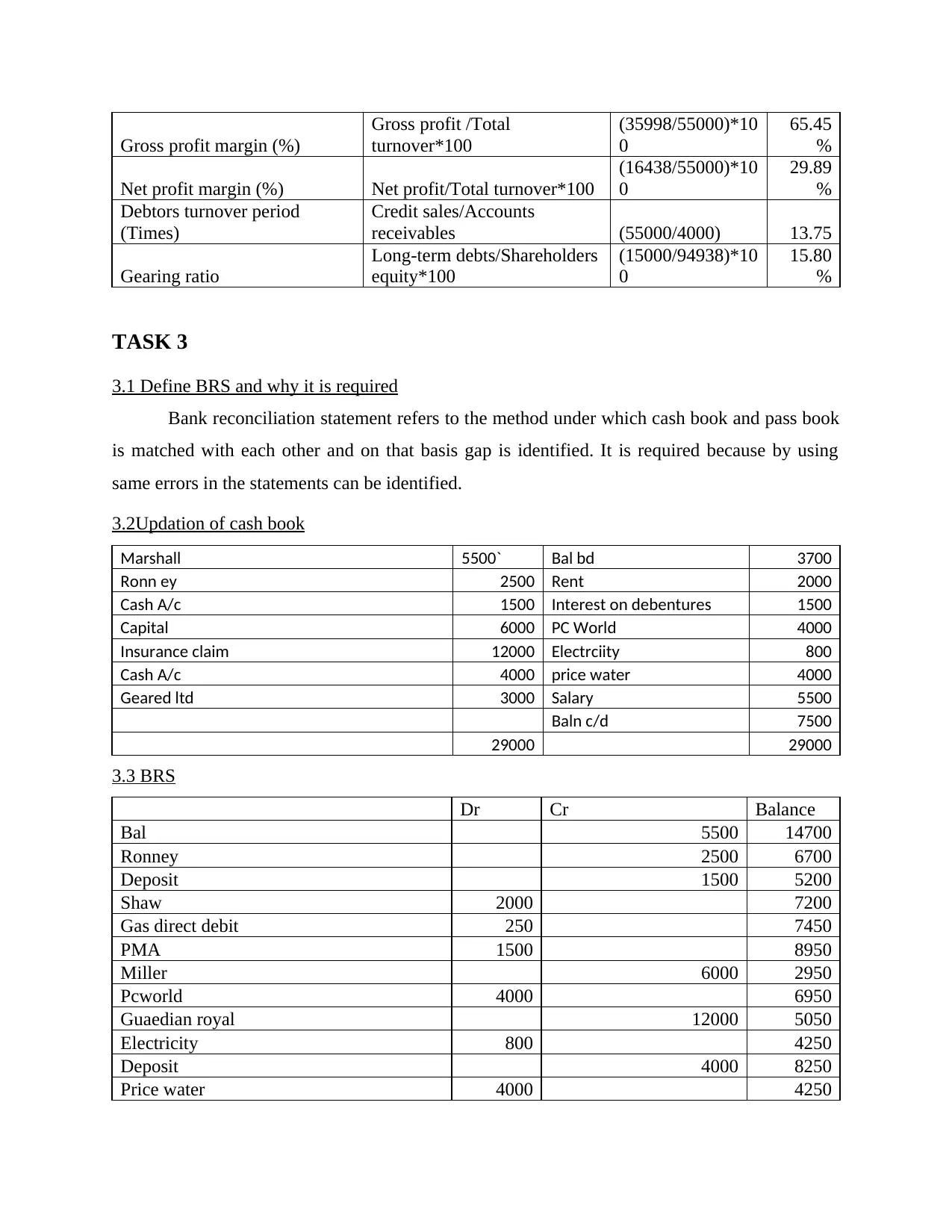
Gross profit margin (%)
Gross profit /Total
turnover*100
(35998/55000)*10
0
65.45
%
Net profit margin (%) Net profit/Total turnover*100
(16438/55000)*10
0
29.89
%
Debtors turnover period
(Times)
Credit sales/Accounts
receivables (55000/4000) 13.75
Gearing ratio
Long-term debts/Shareholders
equity*100
(15000/94938)*10
0
15.80
%
TASK 3
3.1 Define BRS and why it is required
Bank reconciliation statement refers to the method under which cash book and pass book
is matched with each other and on that basis gap is identified. It is required because by using
same errors in the statements can be identified.
3.2Updation of cash book
Marshall 5500` Bal bd 3700
Ronn ey 2500 Rent 2000
Cash A/c 1500 Interest on debentures 1500
Capital 6000 PC World 4000
Insurance claim 12000 Electrciity 800
Cash A/c 4000 price water 4000
Geared ltd 3000 Salary 5500
Baln c/d 7500
29000 29000
3.3 BRS
Dr Cr Balance
Bal 5500 14700
Ronney 2500 6700
Deposit 1500 5200
Shaw 2000 7200
Gas direct debit 250 7450
PMA 1500 8950
Miller 6000 2950
Pcworld 4000 6950
Guaedian royal 12000 5050
Electricity 800 4250
Deposit 4000 8250
Price water 4000 4250
Gross profit /Total
turnover*100
(35998/55000)*10
0
65.45
%
Net profit margin (%) Net profit/Total turnover*100
(16438/55000)*10
0
29.89
%
Debtors turnover period
(Times)
Credit sales/Accounts
receivables (55000/4000) 13.75
Gearing ratio
Long-term debts/Shareholders
equity*100
(15000/94938)*10
0
15.80
%
TASK 3
3.1 Define BRS and why it is required
Bank reconciliation statement refers to the method under which cash book and pass book
is matched with each other and on that basis gap is identified. It is required because by using
same errors in the statements can be identified.
3.2Updation of cash book
Marshall 5500` Bal bd 3700
Ronn ey 2500 Rent 2000
Cash A/c 1500 Interest on debentures 1500
Capital 6000 PC World 4000
Insurance claim 12000 Electrciity 800
Cash A/c 4000 price water 4000
Geared ltd 3000 Salary 5500
Baln c/d 7500
29000 29000
3.3 BRS
Dr Cr Balance
Bal 5500 14700
Ronney 2500 6700
Deposit 1500 5200
Shaw 2000 7200
Gas direct debit 250 7450
PMA 1500 8950
Miller 6000 2950
Pcworld 4000 6950
Guaedian royal 12000 5050
Electricity 800 4250
Deposit 4000 8250
Price water 4000 4250
Paraphrase This Document
Need a fresh take? Get an instant paraphrase of this document with our AI Paraphraser
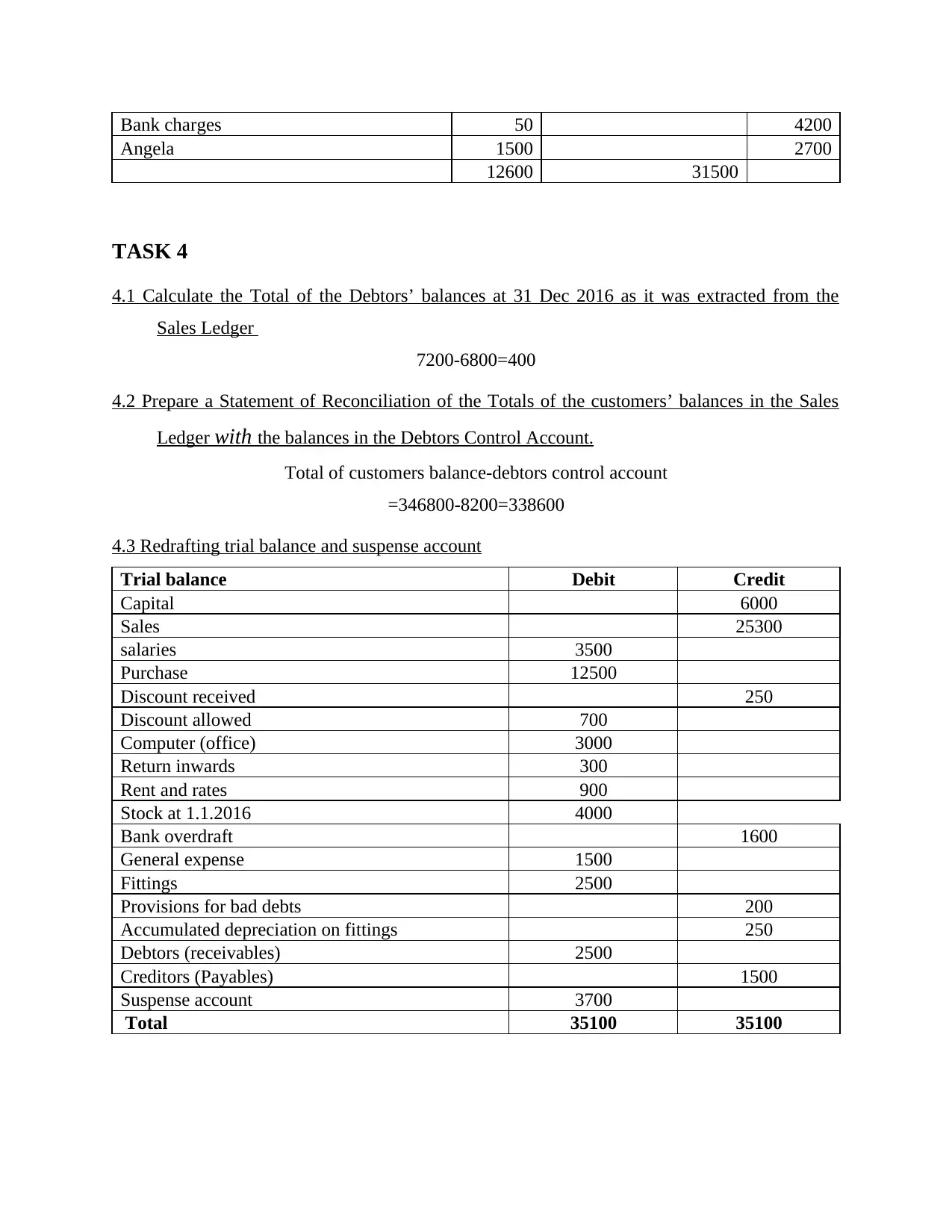
Bank charges 50 4200
Angela 1500 2700
12600 31500
TASK 4
4.1 Calculate the Total of the Debtors’ balances at 31 Dec 2016 as it was extracted from the
Sales Ledger
7200-6800=400
4.2 Prepare a Statement of Reconciliation of the Totals of the customers’ balances in the Sales
Ledger with the balances in the Debtors Control Account.
Total of customers balance-debtors control account
=346800-8200=338600
4.3 Redrafting trial balance and suspense account
Trial balance Debit Credit
Capital 6000
Sales 25300
salaries 3500
Purchase 12500
Discount received 250
Discount allowed 700
Computer (office) 3000
Return inwards 300
Rent and rates 900
Stock at 1.1.2016 4000
Bank overdraft 1600
General expense 1500
Fittings 2500
Provisions for bad debts 200
Accumulated depreciation on fittings 250
Debtors (receivables) 2500
Creditors (Payables) 1500
Suspense account 3700
Total 35100 35100
Angela 1500 2700
12600 31500
TASK 4
4.1 Calculate the Total of the Debtors’ balances at 31 Dec 2016 as it was extracted from the
Sales Ledger
7200-6800=400
4.2 Prepare a Statement of Reconciliation of the Totals of the customers’ balances in the Sales
Ledger with the balances in the Debtors Control Account.
Total of customers balance-debtors control account
=346800-8200=338600
4.3 Redrafting trial balance and suspense account
Trial balance Debit Credit
Capital 6000
Sales 25300
salaries 3500
Purchase 12500
Discount received 250
Discount allowed 700
Computer (office) 3000
Return inwards 300
Rent and rates 900
Stock at 1.1.2016 4000
Bank overdraft 1600
General expense 1500
Fittings 2500
Provisions for bad debts 200
Accumulated depreciation on fittings 250
Debtors (receivables) 2500
Creditors (Payables) 1500
Suspense account 3700
Total 35100 35100
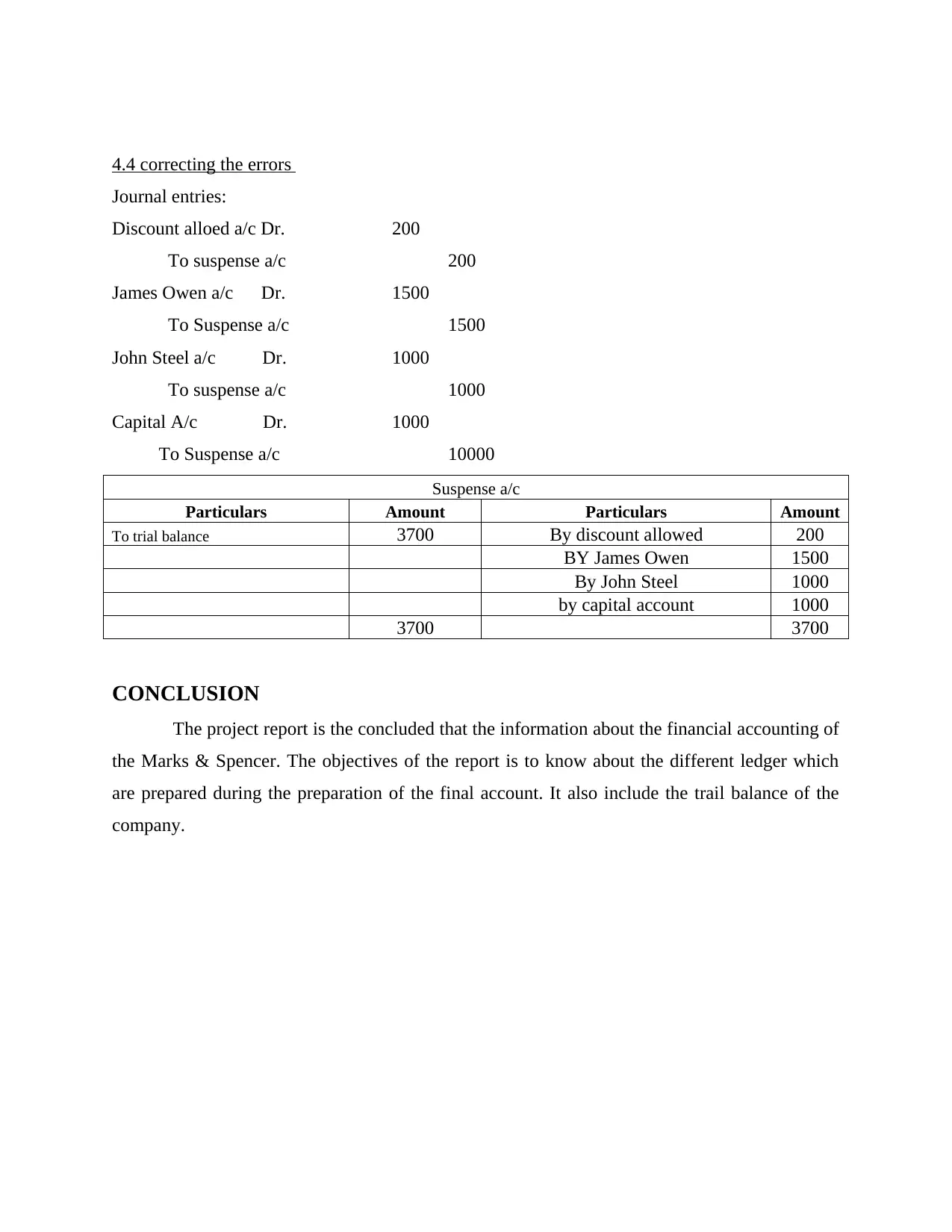
4.4 correcting the errors
Journal entries:
Discount alloed a/c Dr. 200
To suspense a/c 200
James Owen a/c Dr. 1500
To Suspense a/c 1500
John Steel a/c Dr. 1000
To suspense a/c 1000
Capital A/c Dr. 1000
To Suspense a/c 10000
Suspense a/c
Particulars Amount Particulars Amount
To trial balance 3700 By discount allowed 200
BY James Owen 1500
By John Steel 1000
by capital account 1000
3700 3700
CONCLUSION
The project report is the concluded that the information about the financial accounting of
the Marks & Spencer. The objectives of the report is to know about the different ledger which
are prepared during the preparation of the final account. It also include the trail balance of the
company.
Journal entries:
Discount alloed a/c Dr. 200
To suspense a/c 200
James Owen a/c Dr. 1500
To Suspense a/c 1500
John Steel a/c Dr. 1000
To suspense a/c 1000
Capital A/c Dr. 1000
To Suspense a/c 10000
Suspense a/c
Particulars Amount Particulars Amount
To trial balance 3700 By discount allowed 200
BY James Owen 1500
By John Steel 1000
by capital account 1000
3700 3700
CONCLUSION
The project report is the concluded that the information about the financial accounting of
the Marks & Spencer. The objectives of the report is to know about the different ledger which
are prepared during the preparation of the final account. It also include the trail balance of the
company.
⊘ This is a preview!⊘
Do you want full access?
Subscribe today to unlock all pages.
Trusted by 1+ million students worldwide
REFERENCES
Books and Journal
Beatty, A and Liao, S., 2014. Financial accounting in the banking industry: A review of the
empirical literature.Journal of Accounting and Economics.58(2). pp.339-383.
Edwards, J.R., 2013.A History of Financial Accounting (RLE Accounting)(Vol. 29). Routledge.
Gassen, J and Schwedler, K., 2010. The decision usefulness of financial accounting
measurement concepts: Evidence from an online survey of professional investors and
their advisors.European Accounting Review.19(3). pp.495-509.
Weil, R.L., Schipper, K and Francis, J., 2013.Financial accounting: an introduction to concepts,
methods and uses. Cengage Learning.
Online
Introduction to Financial Accounting 2017. [Online]. Available
through:<https://www.accountingcoach.com/financial-accounting/explanation>.
[Accessed on 13th May 2017].
Books and Journal
Beatty, A and Liao, S., 2014. Financial accounting in the banking industry: A review of the
empirical literature.Journal of Accounting and Economics.58(2). pp.339-383.
Edwards, J.R., 2013.A History of Financial Accounting (RLE Accounting)(Vol. 29). Routledge.
Gassen, J and Schwedler, K., 2010. The decision usefulness of financial accounting
measurement concepts: Evidence from an online survey of professional investors and
their advisors.European Accounting Review.19(3). pp.495-509.
Weil, R.L., Schipper, K and Francis, J., 2013.Financial accounting: an introduction to concepts,
methods and uses. Cengage Learning.
Online
Introduction to Financial Accounting 2017. [Online]. Available
through:<https://www.accountingcoach.com/financial-accounting/explanation>.
[Accessed on 13th May 2017].

1 out of 10


Related Documents


Your All-in-One AI-Powered Toolkit for Academic Success.
+13062052269
info@desklib.com
Available 24*7 on WhatsApp / Email
![[object Object]](/_next/static/media/star-bottom.7253800d.svg)
Unlock your academic potential
Copyright © 2020–2026 A2Z Services. All Rights Reserved. Developed and managed by ZUCOL.