Apple Inc. Finance Report: Sources, Policies, and Analysis
VerifiedAdded on 2020/05/28
|12
|2873
|32
Report
AI Summary
This report provides a detailed financial analysis of Apple Inc., examining various aspects of corporate finance. It begins with an executive summary and table of contents, followed by an introduction to the company's operations. The discussion section delves into the sources of long-term finance, including equity shares, preference shares, debentures, retained earnings, and long-term loans, with specific examples from Apple Inc. The report also analyzes working capital management, exploring different approaches like hedging, conservative, and aggressive strategies, and calculates the current ratio for Apple. Furthermore, it discusses different dividend policies, such as stable dividend policy, policy of no immediate dividend, policy of regular extra dividends, policy of regular stock dividends, and policy to pay irregular dividends, highlighting Apple's stable dividend policy. Finally, the report examines the external economic factors, such as the growth of developing countries and economic stability of developed countries, that influence Apple's business and presents the company's business model, covering aspects like app development, publishing, content ownership, and associated costs. The report concludes with references to the sources used.
Running head: APPLE INC.
APPLE INC.
Name of the Student
Name of the University
Author Note
APPLE INC.
Name of the Student
Name of the University
Author Note

Paraphrase This Document
Need a fresh take? Get an instant paraphrase of this document with our AI Paraphraser
1APPLE INC.
Executive Summary
Finance is often referred to as the blood of the business. A firm can never function
without the availability of finance. Management of finance is extremely important as it
helps in efficient management of the business. The given report throws light on the
various financial aspects of the phone company Apple Inc. Apple is a multinational
company with its operations spread all around the globe. Various questions pertaining
to the theory of corporate finance have been answered in the given assignment along
with application to the real life example of the company. The ratio analysis has also
been done along with other important financial aspects.
Executive Summary
Finance is often referred to as the blood of the business. A firm can never function
without the availability of finance. Management of finance is extremely important as it
helps in efficient management of the business. The given report throws light on the
various financial aspects of the phone company Apple Inc. Apple is a multinational
company with its operations spread all around the globe. Various questions pertaining
to the theory of corporate finance have been answered in the given assignment along
with application to the real life example of the company. The ratio analysis has also
been done along with other important financial aspects.
2APPLE INC.
Table of Contents
Introduction...................................................................................................................... 4
Discussion........................................................................................................................4
Answer 1.......................................................................................................................4
Answer 2.......................................................................................................................5
Answer 3.......................................................................................................................6
Answer 4.......................................................................................................................7
References.....................................................................................................................11
Table of Contents
Introduction...................................................................................................................... 4
Discussion........................................................................................................................4
Answer 1.......................................................................................................................4
Answer 2.......................................................................................................................5
Answer 3.......................................................................................................................6
Answer 4.......................................................................................................................7
References.....................................................................................................................11
⊘ This is a preview!⊘
Do you want full access?
Subscribe today to unlock all pages.

Trusted by 1+ million students worldwide
3APPLE INC.
Introduction
Apple Inc. Is a software and communication companies, which operates in
various parts of the globe. The company was in a struggling position during the 90s era
but it bounced back under the guidance of Steve Jobs (Hillier et al. 2013). In 1995, the
company reported its first profits and paid its first dividends. The given report discusses
the various financing aspects of the company and aims to address the various
assessment questions.
Discussion
Answer 1
A business cannot run without finance. Many companies prefer to have long-term
sources of finance as long term sources of finance need not be paid off immediately and
can be utilized for the development of the business. There are various sources of long-
term finance and they have been discussed below.
Equity Shares
A public limited company may raise appropriate funds from the promoters of the
business or from the public. This can be done by issuing ordinary equity shares. The
shareholders achieve ownership rights and tend to get dividends made on the profit of
the company (Flannery and Hankins 2013).They tend to undertake the risk of the
company. From the point of view of a company, this can be described as a good source
of finance for the company. However, the shareholders tend to get involved in the
decision making of the firm. However, this kind of financing can be considered a safe
option, as the dividends need to be paid if the firm does not earn profit. The capital
structure of the firm is divided into various classes of shares (Fracassi 2016).However,
they are not tax deductable and this increases the tax expenses of the company
Preference Shares
This is similar to the shares but they carry preferential rights. These rights means
that dividends needs to be paid to the shareholders first and then to others. In case of
winding up of the company, these preference shareholders are given their capital first.
These are similar to debts but are not tax deductible. As there are no fixed charges
involved the leveraging costs are, lower (Ehrhardt and Brigham 2016). One advantage
of this type of share is that the shareholders do not have any voting rights therefore; the
management interference is minimum in this case.
Debentures
Very often, the companies aim to acclaim finance for long-term purposes through
debentures. Debentures also divide the capital of the firm into different debentures. The
investors of the company can purchase those debentures and these debentures pay out
interests. The interests can be paid out irrespective of the profitability of the firm
Introduction
Apple Inc. Is a software and communication companies, which operates in
various parts of the globe. The company was in a struggling position during the 90s era
but it bounced back under the guidance of Steve Jobs (Hillier et al. 2013). In 1995, the
company reported its first profits and paid its first dividends. The given report discusses
the various financing aspects of the company and aims to address the various
assessment questions.
Discussion
Answer 1
A business cannot run without finance. Many companies prefer to have long-term
sources of finance as long term sources of finance need not be paid off immediately and
can be utilized for the development of the business. There are various sources of long-
term finance and they have been discussed below.
Equity Shares
A public limited company may raise appropriate funds from the promoters of the
business or from the public. This can be done by issuing ordinary equity shares. The
shareholders achieve ownership rights and tend to get dividends made on the profit of
the company (Flannery and Hankins 2013).They tend to undertake the risk of the
company. From the point of view of a company, this can be described as a good source
of finance for the company. However, the shareholders tend to get involved in the
decision making of the firm. However, this kind of financing can be considered a safe
option, as the dividends need to be paid if the firm does not earn profit. The capital
structure of the firm is divided into various classes of shares (Fracassi 2016).However,
they are not tax deductable and this increases the tax expenses of the company
Preference Shares
This is similar to the shares but they carry preferential rights. These rights means
that dividends needs to be paid to the shareholders first and then to others. In case of
winding up of the company, these preference shareholders are given their capital first.
These are similar to debts but are not tax deductible. As there are no fixed charges
involved the leveraging costs are, lower (Ehrhardt and Brigham 2016). One advantage
of this type of share is that the shareholders do not have any voting rights therefore; the
management interference is minimum in this case.
Debentures
Very often, the companies aim to acclaim finance for long-term purposes through
debentures. Debentures also divide the capital of the firm into different debentures. The
investors of the company can purchase those debentures and these debentures pay out
interests. The interests can be paid out irrespective of the profitability of the firm
Paraphrase This Document
Need a fresh take? Get an instant paraphrase of this document with our AI Paraphraser
4APPLE INC.
(Vernimmen et al. 2014). The debenture holders may not have voting rights but they
would surely receive their debt amount. The interest on debentures is tax deductable
and this tends to save costs for the company.
Retained Earnings
These are the savings of the company, which tend to be used by the company
for the welfare of the organization. Safest form of financing
Long term Loans
These are taken from various financial institutions, which then charge interest to
the borrowers. The interest charged is tax deductable. This form also does not affect the
decision making of the firm.
The Apple Company follows both a debt as well as equity capital structure. The
company has Long-term debts of $194714000 as per September 2017 and total equity
of 134,047,000
The suitable gearing ratio for the company would be Debt to Equity Ratio, which
measures the solvency of the firm and is calculated as total debt divide by total equity.
The ratio has deteriorated from 2015 to 2017 (Moffett, Stonehill and Eiteman 2017).
The Debt Equity Ratio is = 194714000/134047000
=1.5
This indicates higher rate of debt financing.
Answer 2
Working Capital Management
Working capital Management concentrates on the various issues that arise in
managing the day-to-day transactions in the business. The main objective of the
working capital management is to manage the current assets as well as the current
liabilities of the firm in a way that the satisfactory level of the working capital is
maintained.
Theories of Working Capital Management
Hedging Approach- In this approach the maturity of the various sources of the
fund should match with the nature of the assets that need to be financed (Keen
2013). The hedging approach tends to suggest that there exists seasonal
variations and that along with permanent financing, short-term finances should
be obtained.
Conservative Approach- In the conservative Approach, it is stated that the total
funds requirement should be met by long-term sources whereas the short-term
funds should only be used in cases of emergency.
(Vernimmen et al. 2014). The debenture holders may not have voting rights but they
would surely receive their debt amount. The interest on debentures is tax deductable
and this tends to save costs for the company.
Retained Earnings
These are the savings of the company, which tend to be used by the company
for the welfare of the organization. Safest form of financing
Long term Loans
These are taken from various financial institutions, which then charge interest to
the borrowers. The interest charged is tax deductable. This form also does not affect the
decision making of the firm.
The Apple Company follows both a debt as well as equity capital structure. The
company has Long-term debts of $194714000 as per September 2017 and total equity
of 134,047,000
The suitable gearing ratio for the company would be Debt to Equity Ratio, which
measures the solvency of the firm and is calculated as total debt divide by total equity.
The ratio has deteriorated from 2015 to 2017 (Moffett, Stonehill and Eiteman 2017).
The Debt Equity Ratio is = 194714000/134047000
=1.5
This indicates higher rate of debt financing.
Answer 2
Working Capital Management
Working capital Management concentrates on the various issues that arise in
managing the day-to-day transactions in the business. The main objective of the
working capital management is to manage the current assets as well as the current
liabilities of the firm in a way that the satisfactory level of the working capital is
maintained.
Theories of Working Capital Management
Hedging Approach- In this approach the maturity of the various sources of the
fund should match with the nature of the assets that need to be financed (Keen
2013). The hedging approach tends to suggest that there exists seasonal
variations and that along with permanent financing, short-term finances should
be obtained.
Conservative Approach- In the conservative Approach, it is stated that the total
funds requirement should be met by long-term sources whereas the short-term
funds should only be used in cases of emergency.
5APPLE INC.
Aggressive approach- The aggressive approach states that a part of the
permanent working capital of the firm can financed by short-term sources. This
approach tends to minimize the excess liquidity while meeting the short-term
requirements.
Hence, the company needs to follow a suitable method of working capital and
meet their own requirements accordingly.
The primary working capital ratio is the current ratio, which can be calculated by
dividing the current assets by current liabilities.
Current Assets= 128645000$
Current Liabilities= 100814000$
Ratio = 1.2
The current ratio of Apple above average. The company is in a good financial
position and it is being able to meet its current liabilities.
The working capital of the firm is 128645000$-100814000$
=2783100$
It can be stated that the company has been managing its finances extremely well
and that even after it pays all its liabilities it will easily be able to save a huge amount of
money for its working capital.
Answer 3
There are different kinds of dividend policies that are as follows:
1. Stable dividend policy wherein the firms pay fixed sum of dividend and maintain this
for all the times regardless of the different fluctuations in the market. This is advised that
the companies must follow stable dividend policy wherein the stakeholders are assured
to be given fixed rate of dividend per share. When the different earnings of the firm are
rising at a regular interval there is satisfaction in the management and the earnings that
are increased are sustainable in nature (Firth et al. 2016). Per amount of dividend is
increased as well in correspondence with the fall in the price of the shares as well.
Stable dividend policy fosters a proper rise in the value of the shares and the
different investors pay higher premium to the different shares that promises certainty of
the dividend income. However, in designing stable dividend policy, the future earning
power of the firm has to be determined and the rate of dividend has to be fixed as well.
2. Policy of no immediate dividend- This kind of policy requires huge amount of funds
in order to finance the different programmes on expansion. When the access of the
firms is difficult in the capital market and the availability of such funds is costlier in
nature as well. Issue of bonus shares follows policy of no immediate dividend, as this
will increase the capital of firm (Gopalan, Nanda and Seru 2014).
Aggressive approach- The aggressive approach states that a part of the
permanent working capital of the firm can financed by short-term sources. This
approach tends to minimize the excess liquidity while meeting the short-term
requirements.
Hence, the company needs to follow a suitable method of working capital and
meet their own requirements accordingly.
The primary working capital ratio is the current ratio, which can be calculated by
dividing the current assets by current liabilities.
Current Assets= 128645000$
Current Liabilities= 100814000$
Ratio = 1.2
The current ratio of Apple above average. The company is in a good financial
position and it is being able to meet its current liabilities.
The working capital of the firm is 128645000$-100814000$
=2783100$
It can be stated that the company has been managing its finances extremely well
and that even after it pays all its liabilities it will easily be able to save a huge amount of
money for its working capital.
Answer 3
There are different kinds of dividend policies that are as follows:
1. Stable dividend policy wherein the firms pay fixed sum of dividend and maintain this
for all the times regardless of the different fluctuations in the market. This is advised that
the companies must follow stable dividend policy wherein the stakeholders are assured
to be given fixed rate of dividend per share. When the different earnings of the firm are
rising at a regular interval there is satisfaction in the management and the earnings that
are increased are sustainable in nature (Firth et al. 2016). Per amount of dividend is
increased as well in correspondence with the fall in the price of the shares as well.
Stable dividend policy fosters a proper rise in the value of the shares and the
different investors pay higher premium to the different shares that promises certainty of
the dividend income. However, in designing stable dividend policy, the future earning
power of the firm has to be determined and the rate of dividend has to be fixed as well.
2. Policy of no immediate dividend- This kind of policy requires huge amount of funds
in order to finance the different programmes on expansion. When the access of the
firms is difficult in the capital market and the availability of such funds is costlier in
nature as well. Issue of bonus shares follows policy of no immediate dividend, as this
will increase the capital of firm (Gopalan, Nanda and Seru 2014).
⊘ This is a preview!⊘
Do you want full access?
Subscribe today to unlock all pages.
Trusted by 1+ million students worldwide
6APPLE INC.
3. Policy of regular extra dividends- The extra dividends are allowed only once in a
year and the requirement of annual dividend will be exceeded by some given sum of
amount. These kind of policies provide proper impression to different stakeholders the
extra dividends are paid as the firms has outstanding earnings that will be skipped when
the business will drop to normal level (Kajola, Adewumi and Oworu 2015).
4. Policy of regular stock dividends- Wherein the firms who are following this policy
pay the dividends in stock instead of cash and these are known as the bonus shares.
These bonus shares are used to capitalize the reinvested earnings of different firms.
5. Policy to pay irregular dividends – The firm who follows such policy does not pay
fixed amount of dividends and the share of the dividend varies in correspondence with
the change in level of earnings. Firms with the unstable earnings adopt this policy and a
large part of the entire profit may be ploughed back in the year as well (Floyd, Li and
Skinner 2015).
Dividend Policy followed by Apple Inc
Apple follows the Stable Dividend Policy post 1995, as the company is paying
stable and fixed amount of dividend regardless of any kind of fluctuations in the market.
It has been seen that Apple Inc follows the stable dividend policy and the different
stockholders of Apple Inc are assured of receiving fixed dividends per share as well
(Apple 2018). The entire management of Apple Inc has tried their level best in
maintaining the rate of dividend. Apple Inc follows the stable dividend policy as this
policy helps in fostering a rise in the value of the shares.
Answer 4
The economic factors, which are present in the external environment of Apple,
tend to create opportunities for the firm in various fields. The external environment of
the company consists of various inflation rates, exchange rates, fiscal policies and other
factors that tend to influence the working of the firm. Most of the external environment
factors tend to create opportunities for the firm (Apple 2018). The following are
considered the most significant external environmental factors
Rapid growth of developing countries (opportunity)
Stable economies of developed countries (opportunity)
The developing economies are growing tremendously. The income of the various
groups present have been increasing and this tend
The economic stability of most developed countries creates opportunities for
companies like Apple to expand their businesses. However, the rapid growth of
developing countries serve as an opportunity to the company who can then grow their
market and adhere to the needs of the various users. This rapid growth of the company
can be described as a calculated risk as it tends to have an impact on the share prices
and in the same way be risky and lower them (Boyer 2013). Once the company is able
to expand to the various countries then the profitability of the company will also
3. Policy of regular extra dividends- The extra dividends are allowed only once in a
year and the requirement of annual dividend will be exceeded by some given sum of
amount. These kind of policies provide proper impression to different stakeholders the
extra dividends are paid as the firms has outstanding earnings that will be skipped when
the business will drop to normal level (Kajola, Adewumi and Oworu 2015).
4. Policy of regular stock dividends- Wherein the firms who are following this policy
pay the dividends in stock instead of cash and these are known as the bonus shares.
These bonus shares are used to capitalize the reinvested earnings of different firms.
5. Policy to pay irregular dividends – The firm who follows such policy does not pay
fixed amount of dividends and the share of the dividend varies in correspondence with
the change in level of earnings. Firms with the unstable earnings adopt this policy and a
large part of the entire profit may be ploughed back in the year as well (Floyd, Li and
Skinner 2015).
Dividend Policy followed by Apple Inc
Apple follows the Stable Dividend Policy post 1995, as the company is paying
stable and fixed amount of dividend regardless of any kind of fluctuations in the market.
It has been seen that Apple Inc follows the stable dividend policy and the different
stockholders of Apple Inc are assured of receiving fixed dividends per share as well
(Apple 2018). The entire management of Apple Inc has tried their level best in
maintaining the rate of dividend. Apple Inc follows the stable dividend policy as this
policy helps in fostering a rise in the value of the shares.
Answer 4
The economic factors, which are present in the external environment of Apple,
tend to create opportunities for the firm in various fields. The external environment of
the company consists of various inflation rates, exchange rates, fiscal policies and other
factors that tend to influence the working of the firm. Most of the external environment
factors tend to create opportunities for the firm (Apple 2018). The following are
considered the most significant external environmental factors
Rapid growth of developing countries (opportunity)
Stable economies of developed countries (opportunity)
The developing economies are growing tremendously. The income of the various
groups present have been increasing and this tend
The economic stability of most developed countries creates opportunities for
companies like Apple to expand their businesses. However, the rapid growth of
developing countries serve as an opportunity to the company who can then grow their
market and adhere to the needs of the various users. This rapid growth of the company
can be described as a calculated risk as it tends to have an impact on the share prices
and in the same way be risky and lower them (Boyer 2013). Once the company is able
to expand to the various countries then the profitability of the company will also
Paraphrase This Document
Need a fresh take? Get an instant paraphrase of this document with our AI Paraphraser
7APPLE INC.
increases. This increased profitability has a cyclic effect, which will then help the
company to increase their share prices.
The second opportunity lies in increasing the operations of the company in the
developed companies. There are various opportunities available to the Apple In. in the
developed country as well. It can customize its products and the software, which it
offers, and thereby gain popularity.
Apple Inc. has been reporting profits since a long time. Some of its activities can
be described as risk taking but the decision makers of the firm tend to take calculated
risks that then get returns for their risks, which have been taken by the company.
increases. This increased profitability has a cyclic effect, which will then help the
company to increase their share prices.
The second opportunity lies in increasing the operations of the company in the
developed companies. There are various opportunities available to the Apple In. in the
developed country as well. It can customize its products and the software, which it
offers, and thereby gain popularity.
Apple Inc. has been reporting profits since a long time. Some of its activities can
be described as risk taking but the decision makers of the firm tend to take calculated
risks that then get returns for their risks, which have been taken by the company.
8APPLE INC.
Business Model
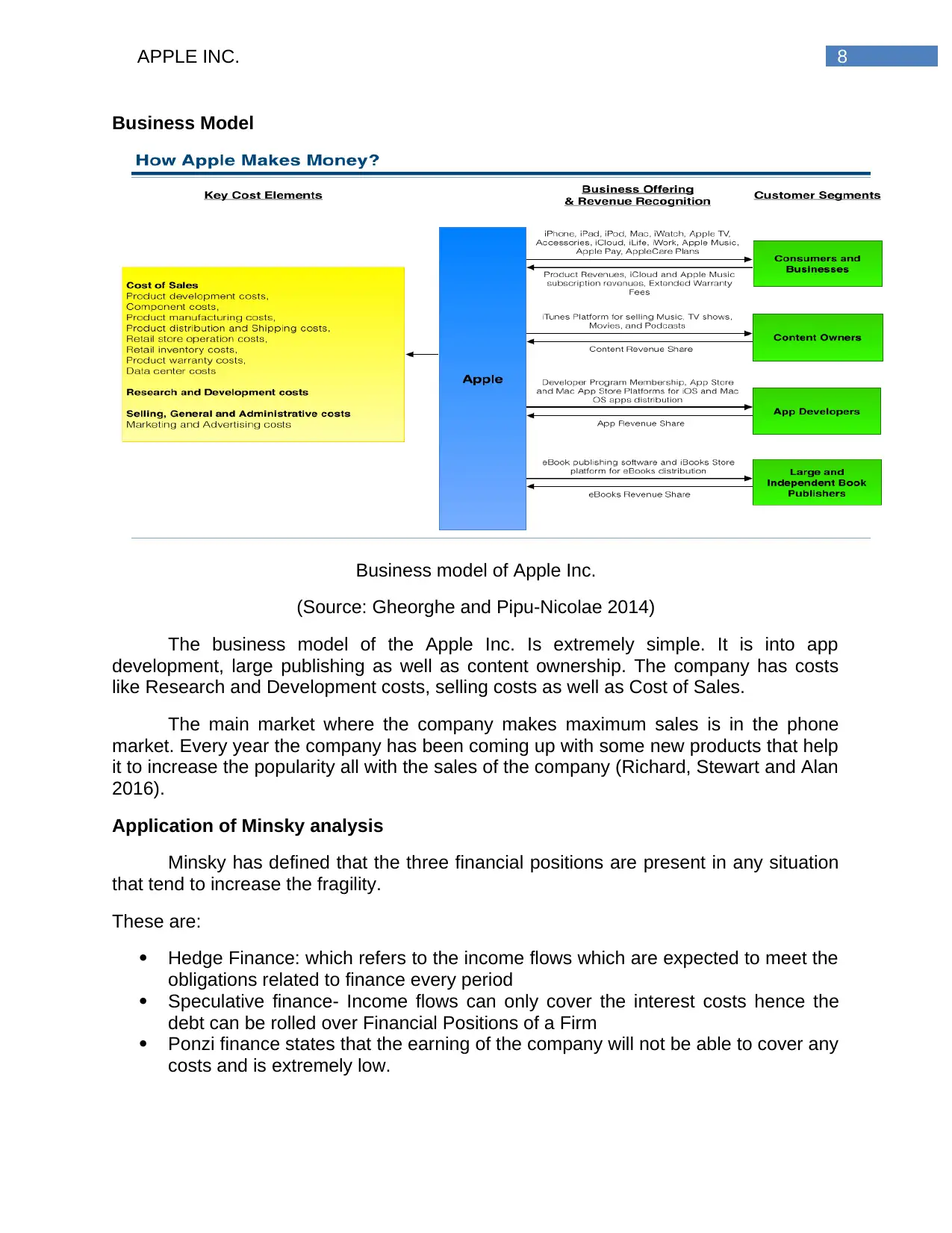
Business model of Apple Inc.
(Source: Gheorghe and Pipu-Nicolae 2014)
The business model of the Apple Inc. Is extremely simple. It is into app
development, large publishing as well as content ownership. The company has costs
like Research and Development costs, selling costs as well as Cost of Sales.
The main market where the company makes maximum sales is in the phone
market. Every year the company has been coming up with some new products that help
it to increase the popularity all with the sales of the company (Richard, Stewart and Alan
2016).
Application of Minsky analysis
Minsky has defined that the three financial positions are present in any situation
that tend to increase the fragility.
These are:
Hedge Finance: which refers to the income flows which are expected to meet the
obligations related to finance every period
Speculative finance- Income flows can only cover the interest costs hence the
debt can be rolled over Financial Positions of a Firm
Ponzi finance states that the earning of the company will not be able to cover any
costs and is extremely low.
Business Model
Business model of Apple Inc.
(Source: Gheorghe and Pipu-Nicolae 2014)
The business model of the Apple Inc. Is extremely simple. It is into app
development, large publishing as well as content ownership. The company has costs
like Research and Development costs, selling costs as well as Cost of Sales.
The main market where the company makes maximum sales is in the phone
market. Every year the company has been coming up with some new products that help
it to increase the popularity all with the sales of the company (Richard, Stewart and Alan
2016).
Application of Minsky analysis
Minsky has defined that the three financial positions are present in any situation
that tend to increase the fragility.
These are:
Hedge Finance: which refers to the income flows which are expected to meet the
obligations related to finance every period
Speculative finance- Income flows can only cover the interest costs hence the
debt can be rolled over Financial Positions of a Firm
Ponzi finance states that the earning of the company will not be able to cover any
costs and is extremely low.
⊘ This is a preview!⊘
Do you want full access?
Subscribe today to unlock all pages.
Trusted by 1+ million students worldwide
9APPLE INC.
The various companies often shift to these three phases of financing capabilities
(Arnold 2013). The shift towards the Ponzi finance is unintentional. According to the
analysis, which can be conducted after analyzing the financial reports of the firm, the
company is currently in the Hedge Financing position where the earnings of the
company will be able to cover all its costs. This is a good condition to be in and this
shows that the stability of the firm is good and this increases the goodwill of the firm in
the eyes of the investors.
The various companies often shift to these three phases of financing capabilities
(Arnold 2013). The shift towards the Ponzi finance is unintentional. According to the
analysis, which can be conducted after analyzing the financial reports of the firm, the
company is currently in the Hedge Financing position where the earnings of the
company will be able to cover all its costs. This is a good condition to be in and this
shows that the stability of the firm is good and this increases the goodwill of the firm in
the eyes of the investors.
Paraphrase This Document
Need a fresh take? Get an instant paraphrase of this document with our AI Paraphraser
10APPLE INC.
References
Apple. ,2018. iPhone. [online] Available at: https://www.apple.com/iphone/ [Accessed 4
Jan. 2018].
Apple. ,2018. Investor Relations - Financial Information - Apple. [online] Available at:
http://investor.apple.com/financials.cfm [Accessed 6 Jan. 2018].
Arnold, G., 2013. Corporate financial management. Pearson Higher Ed.
Boyer, R., 2013. The global financial crisis in historical perspective: An economic
analysis combining Minsky, Hayek, Fisher, Keynes and the regulation
approach. Accounting, Economics and Law, 3(3), pp.93-139.
Ehrhardt, M.C. and Brigham, E.F., 2016. Corporate finance: A focused approach.
Cengage learning.
Firth, M., Gao, J., Shen, J. and Zhang, Y., 2016. Institutional stock ownership and firms’
cash dividend policies: Evidence from China. Journal of Banking & Finance, 65, pp.91-
107.
Flannery, M.J. and Hankins, K.W., 2013. Estimating dynamic panel models in corporate
finance. Journal of Corporate Finance, 19, pp.1-19.
Floyd, E., Li, N. and Skinner, D.J., 2015. Payout policy through the financial crisis: The
growth of repurchases and the resilience of dividends. Journal of Financial
Economics, 118(2), pp.299-316
Fracassi, C., 2016. Corporate finance policies and social networks. Management
Science.
Gheorghe, S. and Pipu-Nicolae, B., 2014. Financial Diagnosis Of Stocks. Annals-
Economy Series, 6, pp.60-68.
Gopalan, R., Nanda, V. and Seru, A., 2014. Internal capital market and dividend
policies: Evidence from business groups. The Review of Financial Studies, 27(4),
pp.1102-1142.
Hillier, D., Ross, S., Westerfield, R., Jaffe, J. and Jordan, B., 2013. Corporate finance.
McGraw Hill.
Kajola, S.O., Adewumi, A.A. and Oworu, O.O., 2015. Dividend pay-out policy and firm
financial performance: evidence from Nigerian listed non-financial firms. International
Journal of Economics, Commerce and Management, pp.1-12.
Keen, S., 2013. A monetary Minsky model of the Great Moderation and the Great
Recession. Journal of Economic Behavior & Organization, 86, pp.221-235.
References
Apple. ,2018. iPhone. [online] Available at: https://www.apple.com/iphone/ [Accessed 4
Jan. 2018].
Apple. ,2018. Investor Relations - Financial Information - Apple. [online] Available at:
http://investor.apple.com/financials.cfm [Accessed 6 Jan. 2018].
Arnold, G., 2013. Corporate financial management. Pearson Higher Ed.
Boyer, R., 2013. The global financial crisis in historical perspective: An economic
analysis combining Minsky, Hayek, Fisher, Keynes and the regulation
approach. Accounting, Economics and Law, 3(3), pp.93-139.
Ehrhardt, M.C. and Brigham, E.F., 2016. Corporate finance: A focused approach.
Cengage learning.
Firth, M., Gao, J., Shen, J. and Zhang, Y., 2016. Institutional stock ownership and firms’
cash dividend policies: Evidence from China. Journal of Banking & Finance, 65, pp.91-
107.
Flannery, M.J. and Hankins, K.W., 2013. Estimating dynamic panel models in corporate
finance. Journal of Corporate Finance, 19, pp.1-19.
Floyd, E., Li, N. and Skinner, D.J., 2015. Payout policy through the financial crisis: The
growth of repurchases and the resilience of dividends. Journal of Financial
Economics, 118(2), pp.299-316
Fracassi, C., 2016. Corporate finance policies and social networks. Management
Science.
Gheorghe, S. and Pipu-Nicolae, B., 2014. Financial Diagnosis Of Stocks. Annals-
Economy Series, 6, pp.60-68.
Gopalan, R., Nanda, V. and Seru, A., 2014. Internal capital market and dividend
policies: Evidence from business groups. The Review of Financial Studies, 27(4),
pp.1102-1142.
Hillier, D., Ross, S., Westerfield, R., Jaffe, J. and Jordan, B., 2013. Corporate finance.
McGraw Hill.
Kajola, S.O., Adewumi, A.A. and Oworu, O.O., 2015. Dividend pay-out policy and firm
financial performance: evidence from Nigerian listed non-financial firms. International
Journal of Economics, Commerce and Management, pp.1-12.
Keen, S., 2013. A monetary Minsky model of the Great Moderation and the Great
Recession. Journal of Economic Behavior & Organization, 86, pp.221-235.
11APPLE INC.
Moffett, M.H., Stonehill, A.I. and Eiteman, D.K., 2017. Fundamentals of multinational
finance. Pearson.
Richard, A.B., Stewart, C.M. and Alan, J.M., 2016. Fundamentals of corporate finance.
Vernimmen, P., Quiry, P., Dallocchio, M., Le Fur, Y. and Salvi, A., 2014. Corporate
finance: theory and practice. John Wiley & Sons.
Moffett, M.H., Stonehill, A.I. and Eiteman, D.K., 2017. Fundamentals of multinational
finance. Pearson.
Richard, A.B., Stewart, C.M. and Alan, J.M., 2016. Fundamentals of corporate finance.
Vernimmen, P., Quiry, P., Dallocchio, M., Le Fur, Y. and Salvi, A., 2014. Corporate
finance: theory and practice. John Wiley & Sons.
⊘ This is a preview!⊘
Do you want full access?
Subscribe today to unlock all pages.
Trusted by 1+ million students worldwide

1 out of 12


Related Documents


Your All-in-One AI-Powered Toolkit for Academic Success.
+13062052269
info@desklib.com
Available 24*7 on WhatsApp / Email
![[object Object]](/_next/static/media/star-bottom.7253800d.svg)
Unlock your academic potential
Copyright © 2020–2026 A2Z Services. All Rights Reserved. Developed and managed by ZUCOL.