Financial Analysis Assignment: Accounting Concepts and Practices

Verified

Added on  2022/11/22

|5
|440
|54
Homework Assignment
AI Summary
This document presents a solution to a financial analysis assignment, focusing on key accounting principles. The assignment explores the double-entry system of accounting, explaining its rationale and impact on financial statements. It further differentiates between gains, losses, and revenue, providing definitions and examples to illustrate their significance in financial reporting. The solution also includes a discussion on the relationship between costs, revenues, and expenses in the context of business operations. This assignment offers a comprehensive understanding of fundamental accounting concepts and their practical application in analyzing financial data. The document provides a clear explanation of the concepts, making it a valuable resource for students studying financial analysis and accounting.
Document Page
Running head: FINANCIAL ANALYSIS
Financial Analysis
Name of the Student
Name of the University
Author Note
tabler-icon-diamond-filled.svg

Paraphrase This Document

Need a fresh take? Get an instant paraphrase of this document with our AI Paraphraser
Document Page
1FINANCIAL ANALYSIS
Table of Contents
Answer to Question 1...................................................................................................................2
Answer to Question 2...................................................................................................................2
References....................................................................................................................................3
Document Page
2FINANCIAL ANALYSIS
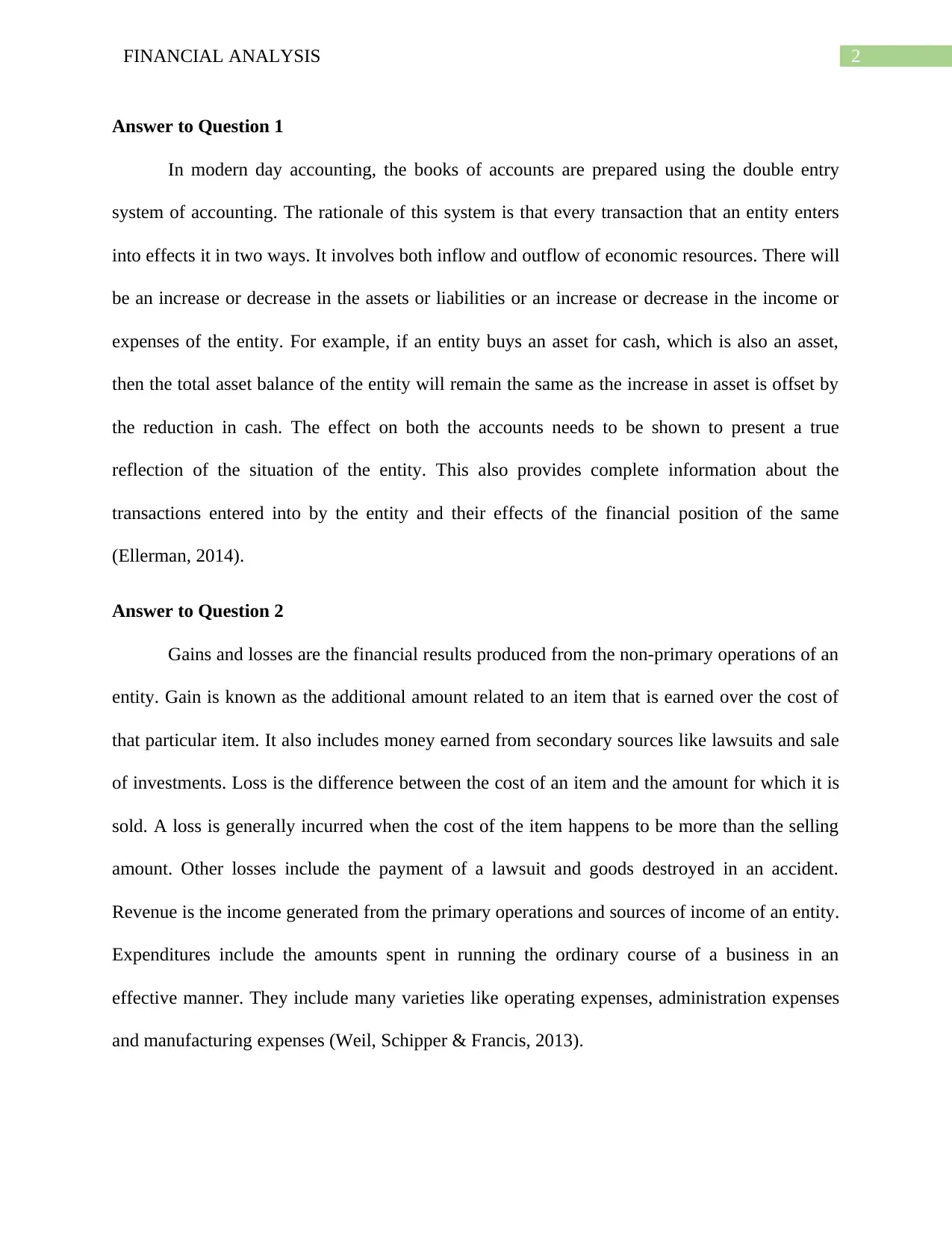
Answer to Question 1
In modern day accounting, the books of accounts are prepared using the double entry
system of accounting. The rationale of this system is that every transaction that an entity enters
into effects it in two ways. It involves both inflow and outflow of economic resources. There will
be an increase or decrease in the assets or liabilities or an increase or decrease in the income or
expenses of the entity. For example, if an entity buys an asset for cash, which is also an asset,
then the total asset balance of the entity will remain the same as the increase in asset is offset by
the reduction in cash. The effect on both the accounts needs to be shown to present a true
reflection of the situation of the entity. This also provides complete information about the
transactions entered into by the entity and their effects of the financial position of the same
(Ellerman, 2014).
Answer to Question 2
Gains and losses are the financial results produced from the non-primary operations of an
entity. Gain is known as the additional amount related to an item that is earned over the cost of
that particular item. It also includes money earned from secondary sources like lawsuits and sale
of investments. Loss is the difference between the cost of an item and the amount for which it is
sold. A loss is generally incurred when the cost of the item happens to be more than the selling
amount. Other losses include the payment of a lawsuit and goods destroyed in an accident.
Revenue is the income generated from the primary operations and sources of income of an entity.
Expenditures include the amounts spent in running the ordinary course of a business in an
effective manner. They include many varieties like operating expenses, administration expenses
and manufacturing expenses (Weil, Schipper & Francis, 2013).
Document Page
3FINANCIAL ANALYSIS
References
Ellerman, D. (2014). On double entry bookkeeping: The mathematical treatment. Accounting
Education, 23(5), 483-501.
Weil, R. L., Schipper, K., & Francis, J. (2013). Financial accounting: an introduction to
concepts, methods and uses. Cengage Learning.
tabler-icon-diamond-filled.svg

Paraphrase This Document

Need a fresh take? Get an instant paraphrase of this document with our AI Paraphraser
Document Page
4FINANCIAL ANALYSIS
chevron_up_icon
1 out of 5
circle_padding
hide_on_mobile
zoom_out_icon
[object Object]