Financial Analysis of Debenhams Plc Investment Decision Report (MBA)
VerifiedAdded on 2023/06/10
|23
|4251
|294
Report
AI Summary
This report presents a comprehensive financial analysis of Debenhams Plc, evaluating its investment decisions through capital budgeting techniques. It begins with an executive summary and an introduction to the company, followed by an examination of its current mid-term outlook. The report then delves into a detailed financial ratio analysis, including liquidity, profitability, efficiency, and market-based ratios, assessing Debenhams Plc's performance over the past three years. It also critically assesses the company's approach to working capital management. Furthermore, the report explores a project financial investment project method, computing the adjusted present value (APV) and discussing its advantages and disadvantages. It utilizes the Net Present Value (NPV) method with the Weighted Average Cost of Capital (WACC) to evaluate the project, assuming a 30% debt. Finally, the report offers recommendations and concludes with a summary of the findings, referencing relevant academic literature and providing supporting appendices.
Debenhams Plc
Investment decision
Financial capital budgeting analysis
Name of the Student-
Student Id-
Investment decision
Financial capital budgeting analysis
Name of the Student-
Student Id-

Paraphrase This Document
Need a fresh take? Get an instant paraphrase of this document with our AI Paraphraser
Executive Summary
Organization is accompanied with the several set of activities in which several acts
are performed to achieve the certain goals and objectives. There are several factors which
might positively and negatively impact the future growth and effective business outcomes of
the Organizaiton. Ratio analysis assists in assessing the present and future business outcomes
and current business outlook. Currently, Debenhams Plc has been performing well in market.
Nonetheless, ratio analysis has reflected that company has decreased its profitability by 50%
since last three years and also maintained high financial leverage. Capital budgeting tool such
as NPV, IRR and Payback period has reflected that company may chose this project due to its
high NPV and increased business outcomes.
Organization is accompanied with the several set of activities in which several acts
are performed to achieve the certain goals and objectives. There are several factors which
might positively and negatively impact the future growth and effective business outcomes of
the Organizaiton. Ratio analysis assists in assessing the present and future business outcomes
and current business outlook. Currently, Debenhams Plc has been performing well in market.
Nonetheless, ratio analysis has reflected that company has decreased its profitability by 50%
since last three years and also maintained high financial leverage. Capital budgeting tool such
as NPV, IRR and Payback period has reflected that company may chose this project due to its
high NPV and increased business outcomes.
Table of Contents
Executive Summary...............................................................................................................................1
Introduction...........................................................................................................................................1
Task 1....................................................................................................................................................1
Decription of Debenhams Plc............................................................................................................1
Current mid-term (3-5 years) outlook................................................................................................2
Financial ratio analysis of Debenhams Plc........................................................................................2
Liquidity ratio................................................................................................................................2
Profitability ratio...........................................................................................................................3
Efficiency ratio..............................................................................................................................4
Market based Ratio........................................................................................................................6
Interpret and assess Debenhams Plc’s performance in the most recent year and comparison of the
same with its last three year performance..........................................................................................8
Critically assess the company’s approach to working capital management.......................................9
Task-2..................................................................................................................................................10
Project financial investment project method..................................................................................10
Computation of the adjusted present value of the undertaken project..........................................10
Advantage and disadvantages of using the Adjusted present value in the project............................14
Using NPV evaluate the project using the Weighted Average Cost of Capital (WACC) assuming a
30% debt..........................................................................................................................................15
Recommendation.................................................................................................................................15
Conclusion...........................................................................................................................................16
References...........................................................................................................................................17
Appendix.............................................................................................................................................18
Executive Summary...............................................................................................................................1
Introduction...........................................................................................................................................1
Task 1....................................................................................................................................................1
Decription of Debenhams Plc............................................................................................................1
Current mid-term (3-5 years) outlook................................................................................................2
Financial ratio analysis of Debenhams Plc........................................................................................2
Liquidity ratio................................................................................................................................2
Profitability ratio...........................................................................................................................3
Efficiency ratio..............................................................................................................................4
Market based Ratio........................................................................................................................6
Interpret and assess Debenhams Plc’s performance in the most recent year and comparison of the
same with its last three year performance..........................................................................................8
Critically assess the company’s approach to working capital management.......................................9
Task-2..................................................................................................................................................10
Project financial investment project method..................................................................................10
Computation of the adjusted present value of the undertaken project..........................................10
Advantage and disadvantages of using the Adjusted present value in the project............................14
Using NPV evaluate the project using the Weighted Average Cost of Capital (WACC) assuming a
30% debt..........................................................................................................................................15
Recommendation.................................................................................................................................15
Conclusion...........................................................................................................................................16
References...........................................................................................................................................17
Appendix.............................................................................................................................................18
⊘ This is a preview!⊘
Do you want full access?
Subscribe today to unlock all pages.

Trusted by 1+ million students worldwide
Introduction
With the economic changes and ramified development, each and every company
needs to manage its financial performance and risk effectively with a view to sustainable
growth in the long run. It is analyzed that there are several financial tools which could be
used by company to analysis the financial performance such as ratio analysis, capital
budgeting, du pont analysis, top down analysis and bottom up analysis of company. In this
report, financial analysis of Debenhams Plc has been taken into consideration. This report
analyses the financial leverage, profitability, efficiency and market outlook of company since
last three years.
Task 1
Decription of Debenhams Plc
It is a British multinational retailer operating under a department store format in
United Kingdom Ireland with franchise stores in other countries. The main business of
company is to offer the goods and services to its clients from the retail stores. The current
stock price at which the shares of the company traded is DEB (LON) 12.75 GBX +0.79
(+6.61%). It reflects the positive outlook for the future profitability of the business. The last
year revenue of company was 234.17 billion GBP (2016) which increased by 12% as
compared to current mid-term (3-5 years). This company has future business sustainability to
achieve the market share to 25% in the Australia by expanding its business in long run
(Debenhams plc., 2017).
Current mid-term (3-5 years) outlook
Company has planned to issue share in market of £306.4 million to finance its
undertaken project. In addition to this, with the increasing profitability of the business since
last three years, company has elected projects which have been used by the board of
managers to expand its business. However, the raised capital from the issue of capital have
been planned to expand its multi retail stores in United Kingdom market. This company has
set up its mission to strengthen its market share in UK and other states as well. This
undertaken strategic plans and project which focuses on the customization of the products
and services offered in market will assist organization to meet its Current mid-term (3-5
With the economic changes and ramified development, each and every company
needs to manage its financial performance and risk effectively with a view to sustainable
growth in the long run. It is analyzed that there are several financial tools which could be
used by company to analysis the financial performance such as ratio analysis, capital
budgeting, du pont analysis, top down analysis and bottom up analysis of company. In this
report, financial analysis of Debenhams Plc has been taken into consideration. This report
analyses the financial leverage, profitability, efficiency and market outlook of company since
last three years.
Task 1
Decription of Debenhams Plc
It is a British multinational retailer operating under a department store format in
United Kingdom Ireland with franchise stores in other countries. The main business of
company is to offer the goods and services to its clients from the retail stores. The current
stock price at which the shares of the company traded is DEB (LON) 12.75 GBX +0.79
(+6.61%). It reflects the positive outlook for the future profitability of the business. The last
year revenue of company was 234.17 billion GBP (2016) which increased by 12% as
compared to current mid-term (3-5 years). This company has future business sustainability to
achieve the market share to 25% in the Australia by expanding its business in long run
(Debenhams plc., 2017).
Current mid-term (3-5 years) outlook
Company has planned to issue share in market of £306.4 million to finance its
undertaken project. In addition to this, with the increasing profitability of the business since
last three years, company has elected projects which have been used by the board of
managers to expand its business. However, the raised capital from the issue of capital have
been planned to expand its multi retail stores in United Kingdom market. This company has
set up its mission to strengthen its market share in UK and other states as well. This
undertaken strategic plans and project which focuses on the customization of the products
and services offered in market will assist organization to meet its Current mid-term (3-5
Paraphrase This Document
Need a fresh take? Get an instant paraphrase of this document with our AI Paraphraser
years) outlook. In addition to this, company has also planned to lower down its financial
leverage. It is considered that high financial leverage would be negative indicators for the
future growth and may result to destruction of business at the time of sluggish market
condition. It is analyzed that by increasing the overall share capital in business, company
could easily lower down the cost of capital of its business (Debenhams plc., 2016).
Financial ratio analysis of Debenhams Plc
This ratio analysis assists in setting up the relation between the two financial factors
of the business. This ratio is divided into five parts to assess the financial position of
company (Brigham, Ehrhardt, Nason, & Gessaroli, 2016).
Liquidity ratio
Current ratio
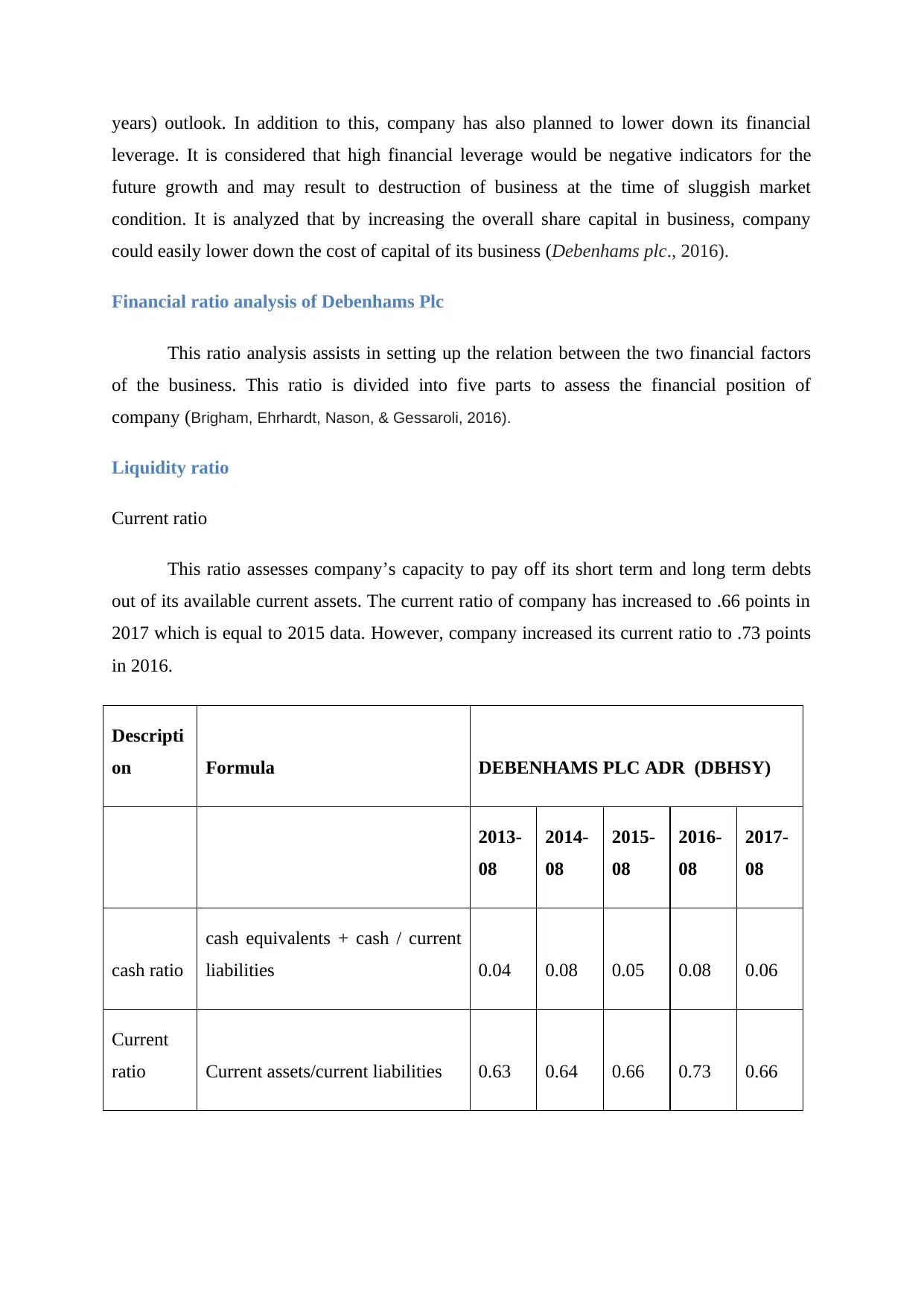
This ratio assesses company’s capacity to pay off its short term and long term debts
out of its available current assets. The current ratio of company has increased to .66 points in
2017 which is equal to 2015 data. However, company increased its current ratio to .73 points
in 2016.
Descripti
on Formula DEBENHAMS PLC ADR (DBHSY)
2013-
08
2014-
08
2015-
08
2016-
08
2017-
08
cash ratio
cash equivalents + cash / current
liabilities 0.04 0.08 0.05 0.08 0.06
Current
ratio Current assets/current liabilities 0.63 0.64 0.66 0.73 0.66
leverage. It is considered that high financial leverage would be negative indicators for the
future growth and may result to destruction of business at the time of sluggish market
condition. It is analyzed that by increasing the overall share capital in business, company
could easily lower down the cost of capital of its business (Debenhams plc., 2016).
Financial ratio analysis of Debenhams Plc
This ratio analysis assists in setting up the relation between the two financial factors
of the business. This ratio is divided into five parts to assess the financial position of
company (Brigham, Ehrhardt, Nason, & Gessaroli, 2016).
Liquidity ratio
Current ratio
This ratio assesses company’s capacity to pay off its short term and long term debts
out of its available current assets. The current ratio of company has increased to .66 points in
2017 which is equal to 2015 data. However, company increased its current ratio to .73 points
in 2016.
Descripti
on Formula DEBENHAMS PLC ADR (DBHSY)
2013-
08
2014-
08
2015-
08
2016-
08
2017-
08
cash ratio
cash equivalents + cash / current
liabilities 0.04 0.08 0.05 0.08 0.06
Current
ratio Current assets/current liabilities 0.63 0.64 0.66 0.73 0.66
Quick
Ratio
Current assets-Inventory/current
liabilities 0.15 0.18 0.18 0.26 0.19
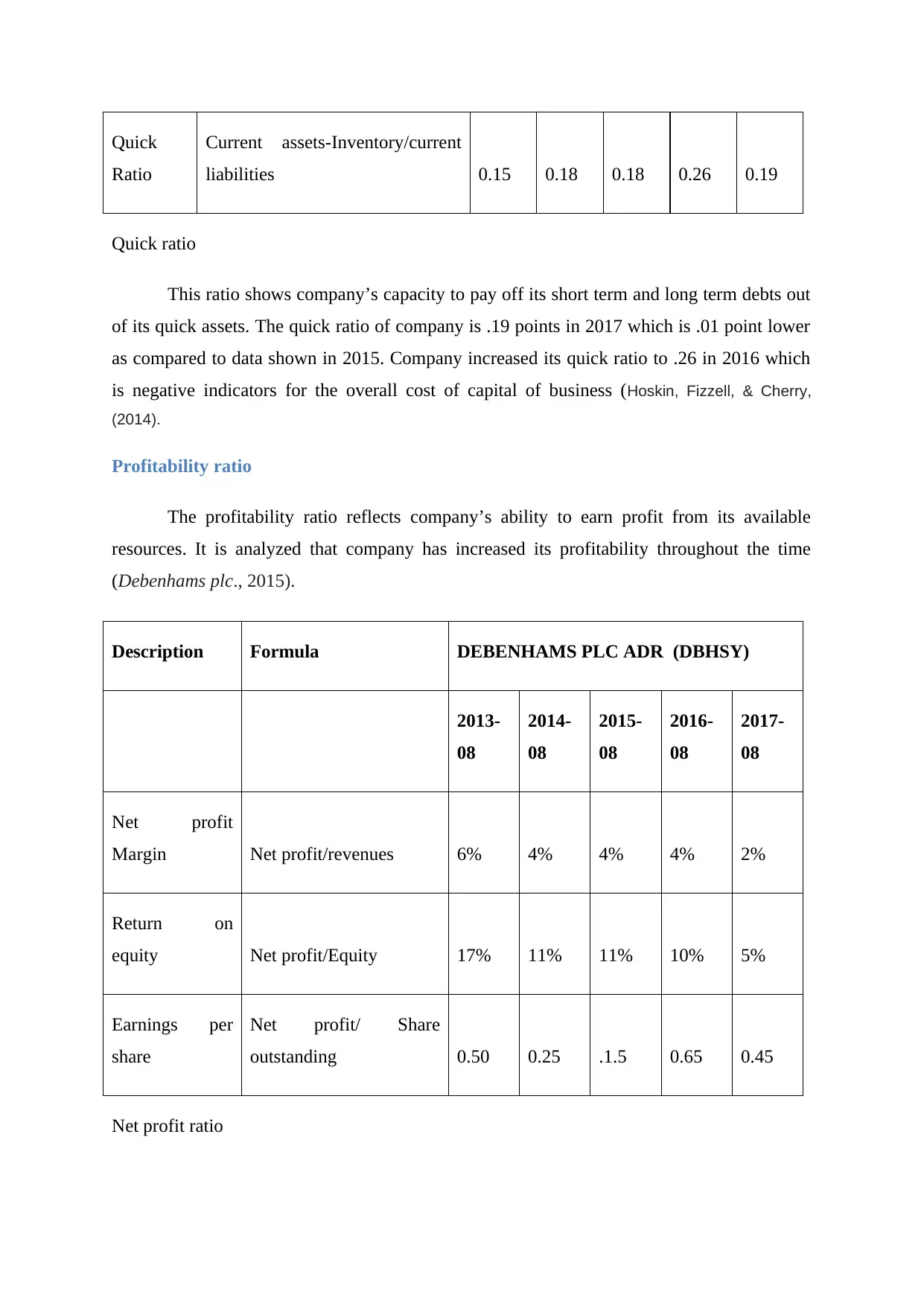
Quick ratio
This ratio shows company’s capacity to pay off its short term and long term debts out
of its quick assets. The quick ratio of company is .19 points in 2017 which is .01 point lower
as compared to data shown in 2015. Company increased its quick ratio to .26 in 2016 which
is negative indicators for the overall cost of capital of business (Hoskin, Fizzell, & Cherry,
(2014).
Profitability ratio
The profitability ratio reflects company’s ability to earn profit from its available
resources. It is analyzed that company has increased its profitability throughout the time
(Debenhams plc., 2015).
Description Formula DEBENHAMS PLC ADR (DBHSY)
2013-
08
2014-
08
2015-
08
2016-
08
2017-
08
Net profit
Margin Net profit/revenues 6% 4% 4% 4% 2%
Return on
equity Net profit/Equity 17% 11% 11% 10% 5%
Earnings per
share
Net profit/ Share
outstanding 0.50 0.25 .1.5 0.65 0.45
Net profit ratio
Ratio
Current assets-Inventory/current
liabilities 0.15 0.18 0.18 0.26 0.19
Quick ratio
This ratio shows company’s capacity to pay off its short term and long term debts out
of its quick assets. The quick ratio of company is .19 points in 2017 which is .01 point lower
as compared to data shown in 2015. Company increased its quick ratio to .26 in 2016 which
is negative indicators for the overall cost of capital of business (Hoskin, Fizzell, & Cherry,
(2014).
Profitability ratio
The profitability ratio reflects company’s ability to earn profit from its available
resources. It is analyzed that company has increased its profitability throughout the time
(Debenhams plc., 2015).
Description Formula DEBENHAMS PLC ADR (DBHSY)
2013-
08
2014-
08
2015-
08
2016-
08
2017-
08
Net profit
Margin Net profit/revenues 6% 4% 4% 4% 2%
Return on
equity Net profit/Equity 17% 11% 11% 10% 5%
Earnings per
share
Net profit/ Share
outstanding 0.50 0.25 .1.5 0.65 0.45
Net profit ratio
⊘ This is a preview!⊘
Do you want full access?
Subscribe today to unlock all pages.
Trusted by 1+ million students worldwide
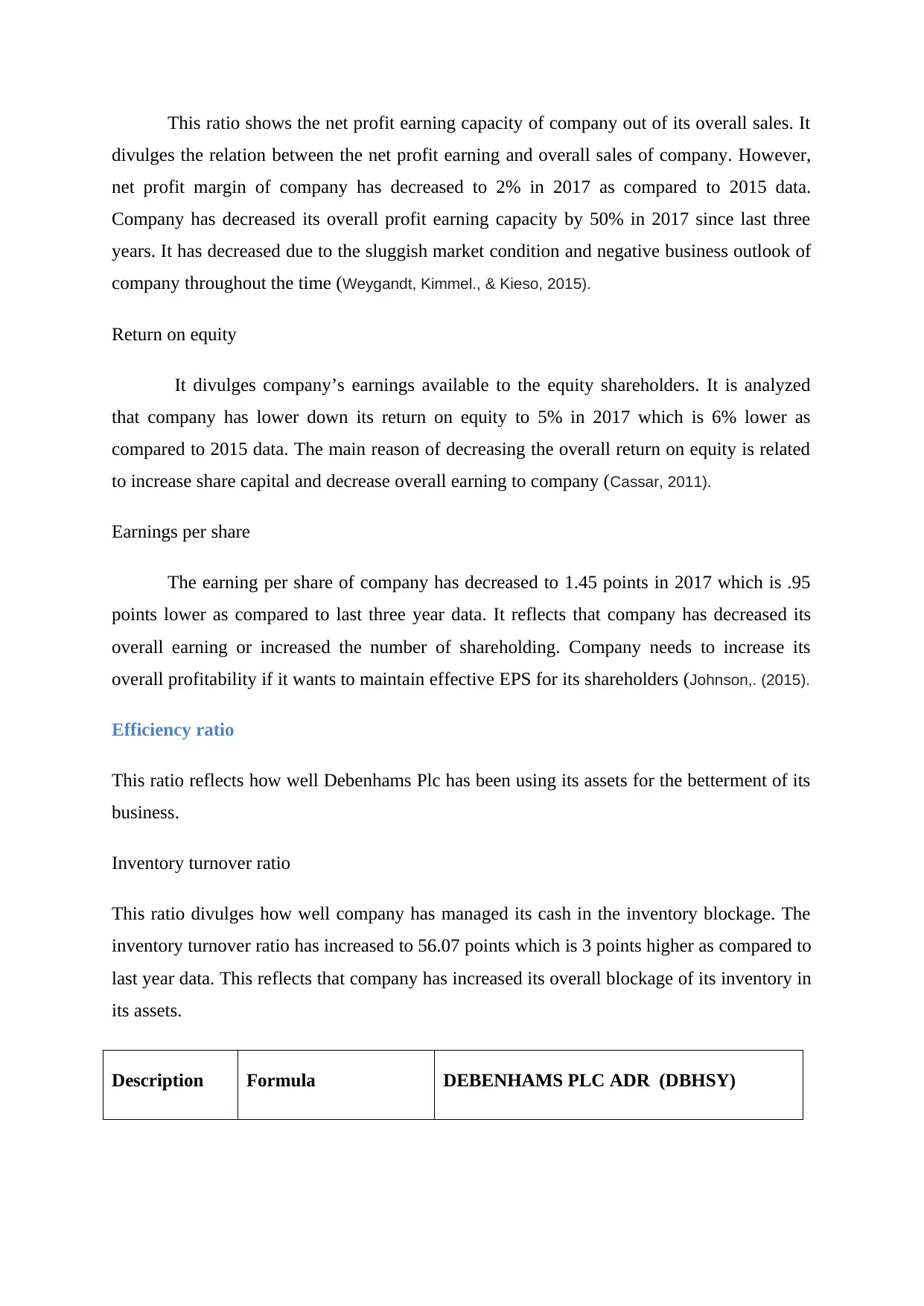
This ratio shows the net profit earning capacity of company out of its overall sales. It
divulges the relation between the net profit earning and overall sales of company. However,
net profit margin of company has decreased to 2% in 2017 as compared to 2015 data.
Company has decreased its overall profit earning capacity by 50% in 2017 since last three
years. It has decreased due to the sluggish market condition and negative business outlook of
company throughout the time (Weygandt, Kimmel., & Kieso, 2015).
Return on equity
It divulges company’s earnings available to the equity shareholders. It is analyzed
that company has lower down its return on equity to 5% in 2017 which is 6% lower as
compared to 2015 data. The main reason of decreasing the overall return on equity is related
to increase share capital and decrease overall earning to company (Cassar, 2011).
Earnings per share
The earning per share of company has decreased to 1.45 points in 2017 which is .95
points lower as compared to last three year data. It reflects that company has decreased its
overall earning or increased the number of shareholding. Company needs to increase its
overall profitability if it wants to maintain effective EPS for its shareholders (Johnson,. (2015).
Efficiency ratio
This ratio reflects how well Debenhams Plc has been using its assets for the betterment of its
business.
Inventory turnover ratio
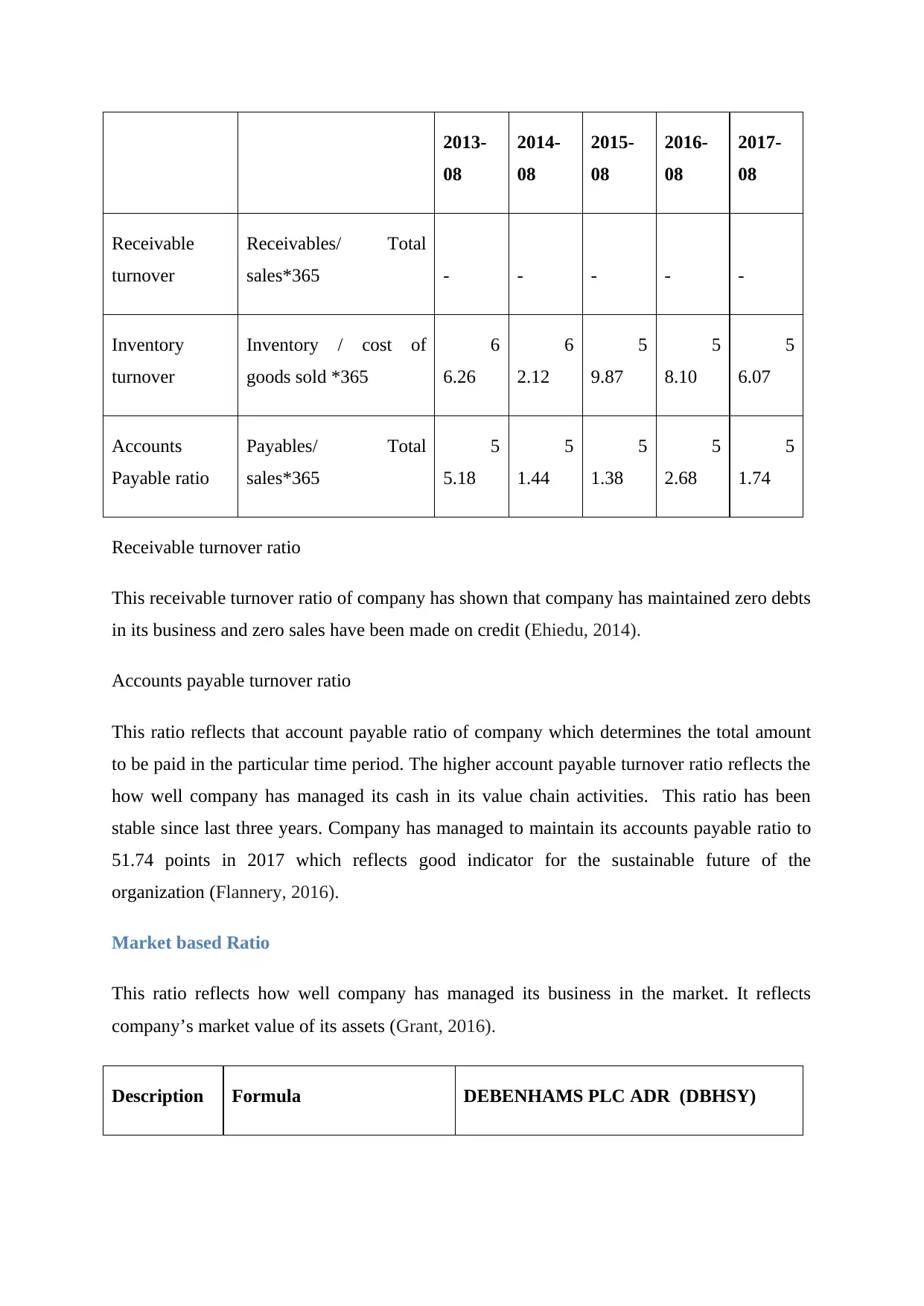
This ratio divulges how well company has managed its cash in the inventory blockage. The
inventory turnover ratio has increased to 56.07 points which is 3 points higher as compared to
last year data. This reflects that company has increased its overall blockage of its inventory in
its assets.
Description Formula DEBENHAMS PLC ADR (DBHSY)
divulges the relation between the net profit earning and overall sales of company. However,
net profit margin of company has decreased to 2% in 2017 as compared to 2015 data.
Company has decreased its overall profit earning capacity by 50% in 2017 since last three
years. It has decreased due to the sluggish market condition and negative business outlook of
company throughout the time (Weygandt, Kimmel., & Kieso, 2015).
Return on equity
It divulges company’s earnings available to the equity shareholders. It is analyzed
that company has lower down its return on equity to 5% in 2017 which is 6% lower as
compared to 2015 data. The main reason of decreasing the overall return on equity is related
to increase share capital and decrease overall earning to company (Cassar, 2011).
Earnings per share
The earning per share of company has decreased to 1.45 points in 2017 which is .95
points lower as compared to last three year data. It reflects that company has decreased its
overall earning or increased the number of shareholding. Company needs to increase its
overall profitability if it wants to maintain effective EPS for its shareholders (Johnson,. (2015).
Efficiency ratio
This ratio reflects how well Debenhams Plc has been using its assets for the betterment of its
business.
Inventory turnover ratio
This ratio divulges how well company has managed its cash in the inventory blockage. The
inventory turnover ratio has increased to 56.07 points which is 3 points higher as compared to
last year data. This reflects that company has increased its overall blockage of its inventory in
its assets.
Description Formula DEBENHAMS PLC ADR (DBHSY)
Paraphrase This Document
Need a fresh take? Get an instant paraphrase of this document with our AI Paraphraser
2013-
08
2014-
08
2015-
08
2016-
08
2017-
08
Receivable
turnover
Receivables/ Total
sales*365 - - - - -
Inventory
turnover
Inventory / cost of
goods sold *365
6
6.26
6
2.12
5
9.87
5
8.10
5
6.07
Accounts
Payable ratio
Payables/ Total
sales*365
5
5.18
5
1.44
5
1.38
5
2.68
5
1.74
Receivable turnover ratio
This receivable turnover ratio of company has shown that company has maintained zero debts
in its business and zero sales have been made on credit (Ehiedu, 2014).
Accounts payable turnover ratio
This ratio reflects that account payable ratio of company which determines the total amount
to be paid in the particular time period. The higher account payable turnover ratio reflects the
how well company has managed its cash in its value chain activities. This ratio has been
stable since last three years. Company has managed to maintain its accounts payable ratio to
51.74 points in 2017 which reflects good indicator for the sustainable future of the
organization (Flannery, 2016).
Market based Ratio
This ratio reflects how well company has managed its business in the market. It reflects
company’s market value of its assets (Grant, 2016).
Description Formula DEBENHAMS PLC ADR (DBHSY)
08
2014-
08
2015-
08
2016-
08
2017-
08
Receivable
turnover
Receivables/ Total
sales*365 - - - - -
Inventory
turnover
Inventory / cost of
goods sold *365
6
6.26
6
2.12
5
9.87
5
8.10
5
6.07
Accounts
Payable ratio
Payables/ Total
sales*365
5
5.18
5
1.44
5
1.38
5
2.68
5
1.74
Receivable turnover ratio
This receivable turnover ratio of company has shown that company has maintained zero debts
in its business and zero sales have been made on credit (Ehiedu, 2014).
Accounts payable turnover ratio
This ratio reflects that account payable ratio of company which determines the total amount
to be paid in the particular time period. The higher account payable turnover ratio reflects the
how well company has managed its cash in its value chain activities. This ratio has been
stable since last three years. Company has managed to maintain its accounts payable ratio to
51.74 points in 2017 which reflects good indicator for the sustainable future of the
organization (Flannery, 2016).
Market based Ratio
This ratio reflects how well company has managed its business in the market. It reflects
company’s market value of its assets (Grant, 2016).
Description Formula DEBENHAMS PLC ADR (DBHSY)
2013-
08
2014-
08
2015
-08
2016-
08
2017-
08
Price /
earnings ratio
Market value per share /
earnings per share
2
5.50
5
0.60 44
2
2.23
2
8.11
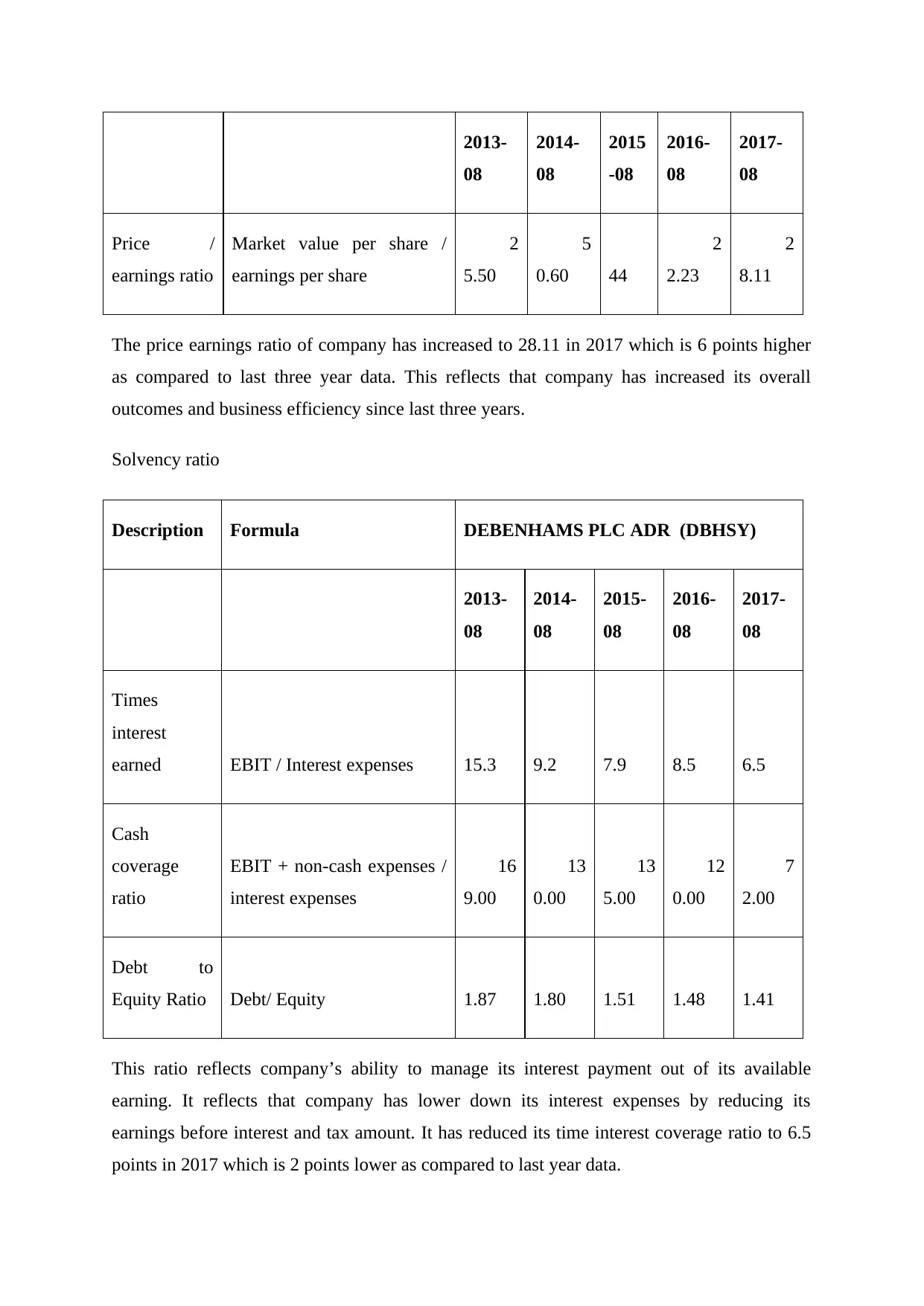
The price earnings ratio of company has increased to 28.11 in 2017 which is 6 points higher
as compared to last three year data. This reflects that company has increased its overall
outcomes and business efficiency since last three years.
Solvency ratio
Description Formula DEBENHAMS PLC ADR (DBHSY)
2013-
08
2014-
08
2015-
08
2016-
08
2017-
08
Times
interest
earned EBIT / Interest expenses 15.3 9.2 7.9 8.5 6.5
Cash
coverage
ratio
EBIT + non-cash expenses /
interest expenses
16
9.00
13
0.00
13
5.00
12
0.00
7
2.00
Debt to
Equity Ratio Debt/ Equity 1.87 1.80 1.51 1.48 1.41
This ratio reflects company’s ability to manage its interest payment out of its available
earning. It reflects that company has lower down its interest expenses by reducing its
earnings before interest and tax amount. It has reduced its time interest coverage ratio to 6.5
points in 2017 which is 2 points lower as compared to last year data.
08
2014-
08
2015
-08
2016-
08
2017-
08
Price /
earnings ratio
Market value per share /
earnings per share
2
5.50
5
0.60 44
2
2.23
2
8.11
The price earnings ratio of company has increased to 28.11 in 2017 which is 6 points higher
as compared to last three year data. This reflects that company has increased its overall
outcomes and business efficiency since last three years.
Solvency ratio
Description Formula DEBENHAMS PLC ADR (DBHSY)
2013-
08
2014-
08
2015-
08
2016-
08
2017-
08
Times
interest
earned EBIT / Interest expenses 15.3 9.2 7.9 8.5 6.5
Cash
coverage
ratio
EBIT + non-cash expenses /
interest expenses
16
9.00
13
0.00
13
5.00
12
0.00
7
2.00
Debt to
Equity Ratio Debt/ Equity 1.87 1.80 1.51 1.48 1.41
This ratio reflects company’s ability to manage its interest payment out of its available
earning. It reflects that company has lower down its interest expenses by reducing its
earnings before interest and tax amount. It has reduced its time interest coverage ratio to 6.5
points in 2017 which is 2 points lower as compared to last year data.
⊘ This is a preview!⊘
Do you want full access?
Subscribe today to unlock all pages.
Trusted by 1+ million students worldwide
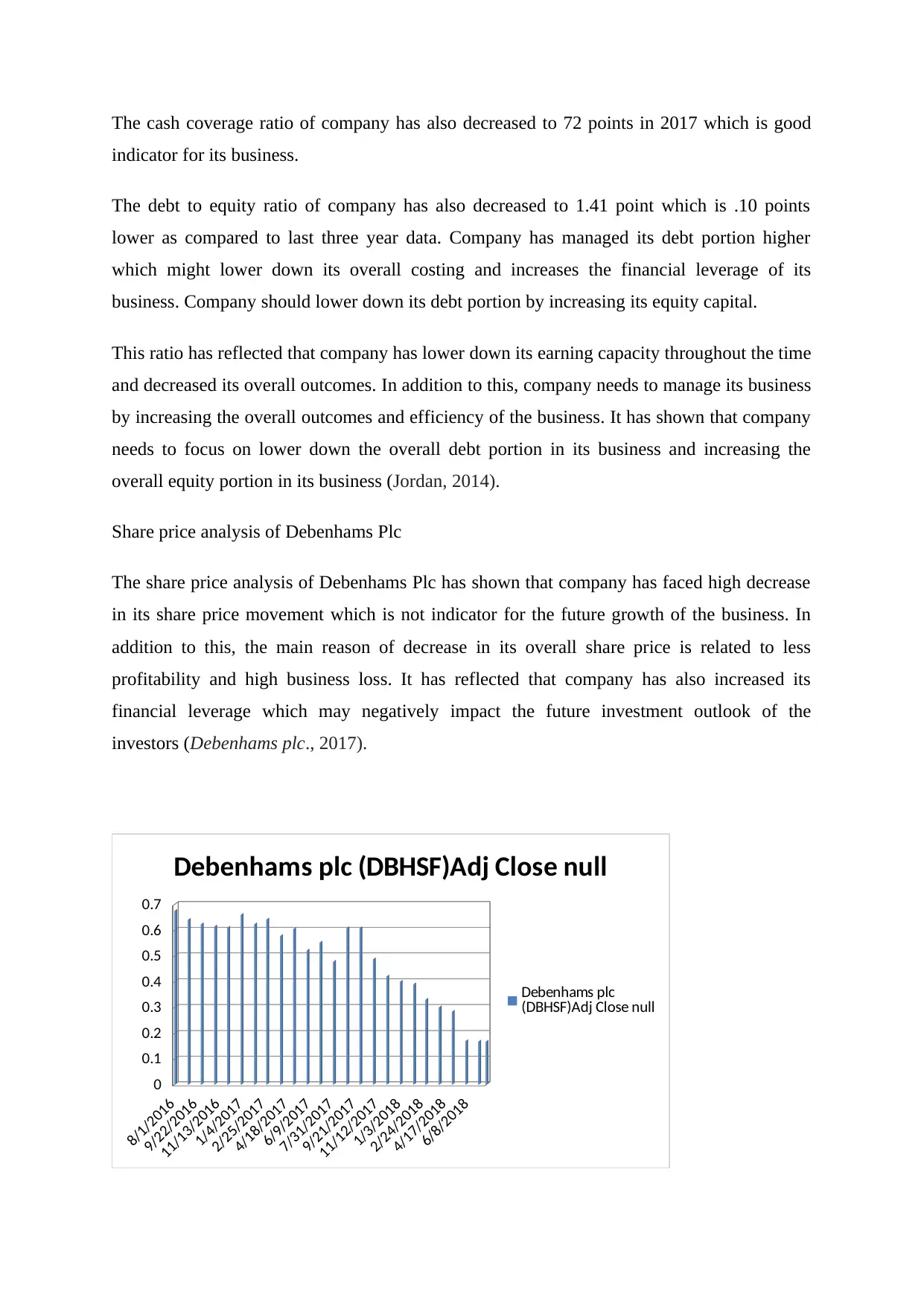
The cash coverage ratio of company has also decreased to 72 points in 2017 which is good
indicator for its business.
The debt to equity ratio of company has also decreased to 1.41 point which is .10 points
lower as compared to last three year data. Company has managed its debt portion higher
which might lower down its overall costing and increases the financial leverage of its
business. Company should lower down its debt portion by increasing its equity capital.
This ratio has reflected that company has lower down its earning capacity throughout the time
and decreased its overall outcomes. In addition to this, company needs to manage its business
by increasing the overall outcomes and efficiency of the business. It has shown that company
needs to focus on lower down the overall debt portion in its business and increasing the
overall equity portion in its business (Jordan, 2014).
Share price analysis of Debenhams Plc
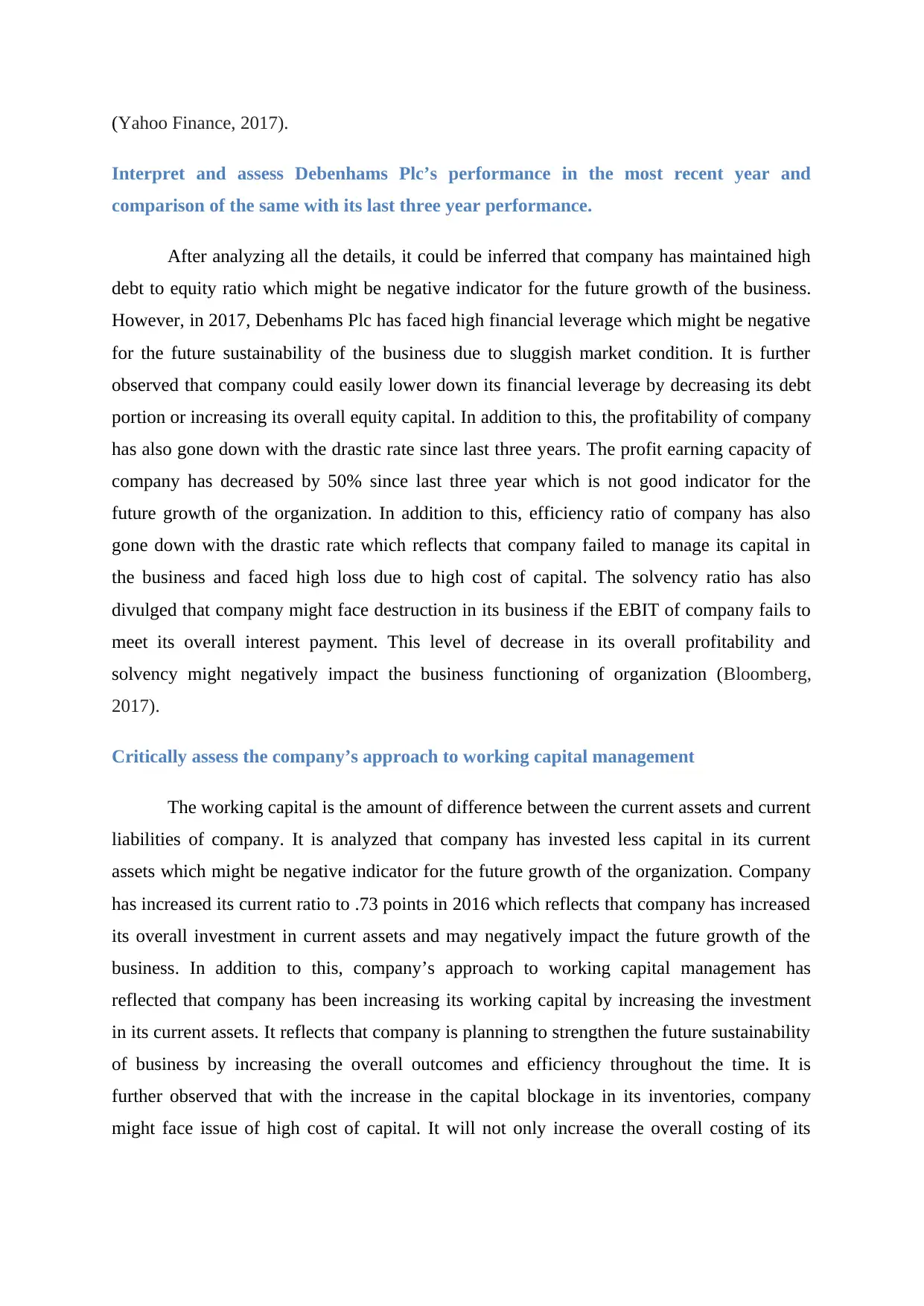
The share price analysis of Debenhams Plc has shown that company has faced high decrease
in its share price movement which is not indicator for the future growth of the business. In
addition to this, the main reason of decrease in its overall share price is related to less
profitability and high business loss. It has reflected that company has also increased its
financial leverage which may negatively impact the future investment outlook of the
investors (Debenhams plc., 2017).
8/1/2016
9/22/2016
11/13/2016
1/4/2017
2/25/2017
4/18/2017
6/9/2017
7/31/2017
9/21/2017
11/12/2017
1/3/2018
2/24/2018
4/17/2018
6/8/2018
0
0.1
0.2
0.3
0.4
0.5
0.6
0.7
Debenhams plc (DBHSF)Adj Close null
Debenhams plc
(DBHSF)Adj Close null
indicator for its business.
The debt to equity ratio of company has also decreased to 1.41 point which is .10 points
lower as compared to last three year data. Company has managed its debt portion higher
which might lower down its overall costing and increases the financial leverage of its
business. Company should lower down its debt portion by increasing its equity capital.
This ratio has reflected that company has lower down its earning capacity throughout the time
and decreased its overall outcomes. In addition to this, company needs to manage its business
by increasing the overall outcomes and efficiency of the business. It has shown that company
needs to focus on lower down the overall debt portion in its business and increasing the
overall equity portion in its business (Jordan, 2014).
Share price analysis of Debenhams Plc
The share price analysis of Debenhams Plc has shown that company has faced high decrease
in its share price movement which is not indicator for the future growth of the business. In
addition to this, the main reason of decrease in its overall share price is related to less
profitability and high business loss. It has reflected that company has also increased its
financial leverage which may negatively impact the future investment outlook of the
investors (Debenhams plc., 2017).
8/1/2016
9/22/2016
11/13/2016
1/4/2017
2/25/2017
4/18/2017
6/9/2017
7/31/2017
9/21/2017
11/12/2017
1/3/2018
2/24/2018
4/17/2018
6/8/2018
0
0.1
0.2
0.3
0.4
0.5
0.6
0.7
Debenhams plc (DBHSF)Adj Close null
Debenhams plc
(DBHSF)Adj Close null
Paraphrase This Document
Need a fresh take? Get an instant paraphrase of this document with our AI Paraphraser
(Yahoo Finance, 2017).
Interpret and assess Debenhams Plc’s performance in the most recent year and
comparison of the same with its last three year performance.
After analyzing all the details, it could be inferred that company has maintained high
debt to equity ratio which might be negative indicator for the future growth of the business.
However, in 2017, Debenhams Plc has faced high financial leverage which might be negative
for the future sustainability of the business due to sluggish market condition. It is further
observed that company could easily lower down its financial leverage by decreasing its debt
portion or increasing its overall equity capital. In addition to this, the profitability of company
has also gone down with the drastic rate since last three years. The profit earning capacity of
company has decreased by 50% since last three year which is not good indicator for the
future growth of the organization. In addition to this, efficiency ratio of company has also
gone down with the drastic rate which reflects that company failed to manage its capital in
the business and faced high loss due to high cost of capital. The solvency ratio has also
divulged that company might face destruction in its business if the EBIT of company fails to
meet its overall interest payment. This level of decrease in its overall profitability and
solvency might negatively impact the business functioning of organization (Bloomberg,
2017).
Critically assess the company’s approach to working capital management
The working capital is the amount of difference between the current assets and current
liabilities of company. It is analyzed that company has invested less capital in its current
assets which might be negative indicator for the future growth of the organization. Company
has increased its current ratio to .73 points in 2016 which reflects that company has increased
its overall investment in current assets and may negatively impact the future growth of the
business. In addition to this, company’s approach to working capital management has
reflected that company has been increasing its working capital by increasing the investment
in its current assets. It reflects that company is planning to strengthen the future sustainability
of business by increasing the overall outcomes and efficiency throughout the time. It is
further observed that with the increase in the capital blockage in its inventories, company
might face issue of high cost of capital. It will not only increase the overall costing of its
Interpret and assess Debenhams Plc’s performance in the most recent year and
comparison of the same with its last three year performance.
After analyzing all the details, it could be inferred that company has maintained high
debt to equity ratio which might be negative indicator for the future growth of the business.
However, in 2017, Debenhams Plc has faced high financial leverage which might be negative
for the future sustainability of the business due to sluggish market condition. It is further
observed that company could easily lower down its financial leverage by decreasing its debt
portion or increasing its overall equity capital. In addition to this, the profitability of company
has also gone down with the drastic rate since last three years. The profit earning capacity of
company has decreased by 50% since last three year which is not good indicator for the
future growth of the organization. In addition to this, efficiency ratio of company has also
gone down with the drastic rate which reflects that company failed to manage its capital in
the business and faced high loss due to high cost of capital. The solvency ratio has also
divulged that company might face destruction in its business if the EBIT of company fails to
meet its overall interest payment. This level of decrease in its overall profitability and
solvency might negatively impact the business functioning of organization (Bloomberg,
2017).
Critically assess the company’s approach to working capital management
The working capital is the amount of difference between the current assets and current
liabilities of company. It is analyzed that company has invested less capital in its current
assets which might be negative indicator for the future growth of the organization. Company
has increased its current ratio to .73 points in 2016 which reflects that company has increased
its overall investment in current assets and may negatively impact the future growth of the
business. In addition to this, company’s approach to working capital management has
reflected that company has been increasing its working capital by increasing the investment
in its current assets. It reflects that company is planning to strengthen the future sustainability
of business by increasing the overall outcomes and efficiency throughout the time. It is
further observed that with the increase in the capital blockage in its inventories, company
might face issue of high cost of capital. It will not only increase the overall costing of its

retail services in market but also lower down the overall return on capital employed in
business.
business.
⊘ This is a preview!⊘
Do you want full access?
Subscribe today to unlock all pages.
Trusted by 1+ million students worldwide

1 out of 23


Related Documents


Your All-in-One AI-Powered Toolkit for Academic Success.
+13062052269
info@desklib.com
Available 24*7 on WhatsApp / Email
![[object Object]](/_next/static/media/star-bottom.7253800d.svg)
Unlock your academic potential
Copyright © 2020–2026 A2Z Services. All Rights Reserved. Developed and managed by ZUCOL.