Financial Analysis Report - Project Evaluation, University Finance

Verified

Added on  2021/04/16

|6
|550
|117
Report
AI Summary
This report presents a financial analysis of a project, focusing on Net Present Value (NPV) calculations to determine its feasibility. The analysis considers various factors, including initial cash flow, labor and energy costs, administrative expenses, and depreciation. It assesses the impact of erosion expenses and explores scenarios with potential sales price increases and cost reductions. The report calculates post-tax cash flows and NPV under different conditions, providing recommendations based on the positive NPV results. The analysis also emphasizes the importance of considering opportunity costs and securing necessary finances for the project. The report concludes with a recommendation to proceed with the project due to its positive NPV, highlighting key considerations for successful implementation.

Document Page
Financial Analysis
201
7
tabler-icon-diamond-filled.svg

Paraphrase This Document

Need a fresh take? Get an instant paraphrase of this document with our AI Paraphraser
Document Page
1
By student name
Professor
University
Date: Januray 30 , 2018.
1 | P a g e
Document Page
2
Contents
Analysis…………………………………………………………………..........................................
..............3
Key
Points………………………………………………………………………………………………………
………….…4
References.....
…………………………………………………………….....................................................5
2 | P a g e
Document Page
3
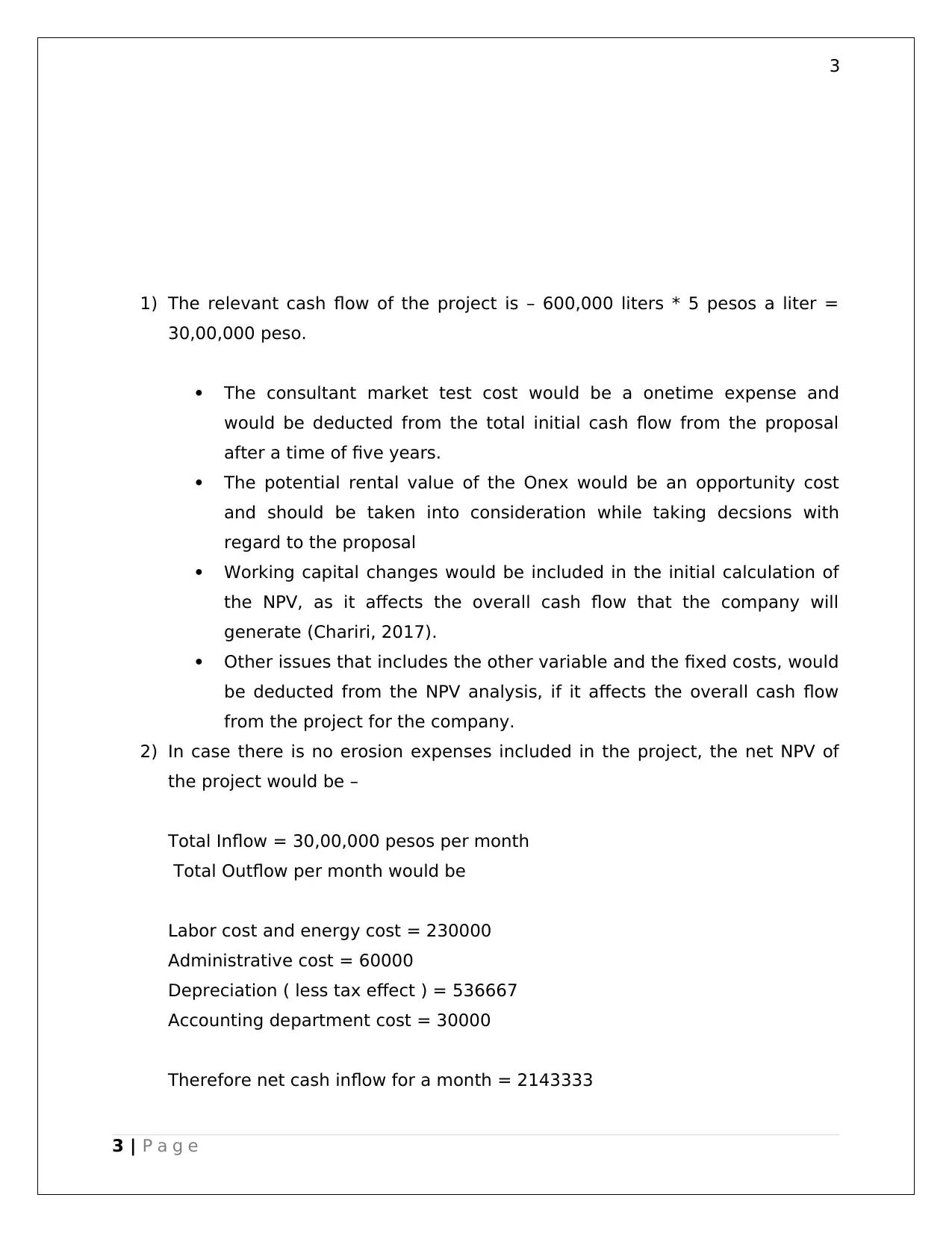
1) The relevant cash flow of the project is – 600,000 liters * 5 pesos a liter =
30,00,000 peso.
The consultant market test cost would be a onetime expense and
would be deducted from the total initial cash flow from the proposal
after a time of five years.
The potential rental value of the Onex would be an opportunity cost
and should be taken into consideration while taking decsions with
regard to the proposal
Working capital changes would be included in the initial calculation of
the NPV, as it affects the overall cash flow that the company will
generate (Chariri, 2017).
Other issues that includes the other variable and the fixed costs, would
be deducted from the NPV analysis, if it affects the overall cash flow
from the project for the company.
2) In case there is no erosion expenses included in the project, the net NPV of
the project would be –
Total Inflow = 30,00,000 pesos per month
Total Outflow per month would be
Labor cost and energy cost = 230000
Administrative cost = 60000
Depreciation ( less tax effect ) = 536667
Accounting department cost = 30000
Therefore net cash inflow for a month = 2143333
3 | P a g e
tabler-icon-diamond-filled.svg

Paraphrase This Document

Need a fresh take? Get an instant paraphrase of this document with our AI Paraphraser
Document Page
4
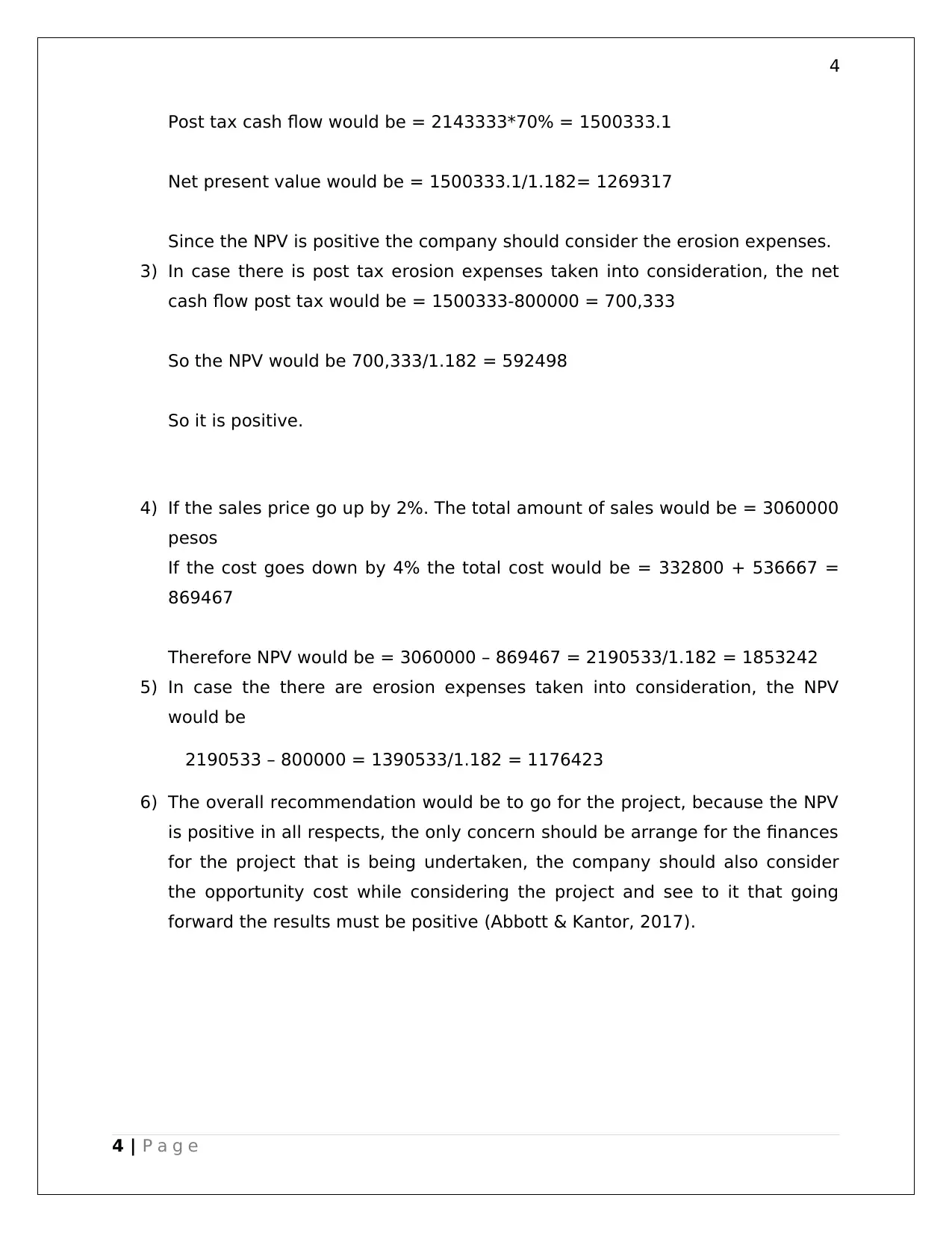
Post tax cash flow would be = 2143333*70% = 1500333.1
Net present value would be = 1500333.1/1.182= 1269317
Since the NPV is positive the company should consider the erosion expenses.
3) In case there is post tax erosion expenses taken into consideration, the net
cash flow post tax would be = 1500333-800000 = 700,333
So the NPV would be 700,333/1.182 = 592498
So it is positive.
4) If the sales price go up by 2%. The total amount of sales would be = 3060000
pesos
If the cost goes down by 4% the total cost would be = 332800 + 536667 =
869467
Therefore NPV would be = 3060000 – 869467 = 2190533/1.182 = 1853242
5) In case the there are erosion expenses taken into consideration, the NPV
would be
2190533 – 800000 = 1390533/1.182 = 1176423
6) The overall recommendation would be to go for the project, because the NPV
is positive in all respects, the only concern should be arrange for the finances
for the project that is being undertaken, the company should also consider
the opportunity cost while considering the project and see to it that going
forward the results must be positive (Abbott & Kantor, 2017).
4 | P a g e
Document Page
5
References
Abbott, M. & Kantor, A., 2017. Fair Value Measurement and Mandated Accounting
Changes: The Case of the Victorian Rail Track Corporation. Australian accounting
Review.
Chariri, A., 2017. FINANCIAL REPORTING PRACTICE AS A RITUAL: UNDERSTANDING
ACCOUNTING WITHIN INSTITUTIONAL FRAMEWORK. Journal of Economics, Business
and Accountancy, 14(1).
5 | P a g e
chevron_up_icon
1 out of 6
circle_padding
hide_on_mobile
zoom_out_icon
[object Object]