International Financial Markets and Institutions Analysis Report
VerifiedAdded on 2023/01/09
|10
|3797
|80
Report
AI Summary
This report provides an in-depth analysis of international financial markets and institutions. It begins with an overview of financial markets, emphasizing the importance of financial regulation in maintaining stability and the role of Basel III regulations. The report then examines the 2008-09 financial crisis, its causes, and the subsequent economic recession. The impact of Brexit on the UK stock market and the pound sterling is also discussed, including factors affecting movements in both markets. The report further explores the determinants of short and long-term interest rates and their influence on the economy. The analysis covers various aspects of financial markets, economic growth, and the effects of political events on financial instruments, providing a comprehensive understanding of the subject matter.
International Financial Markets
and Institutions
and Institutions

Paraphrase This Document
Need a fresh take? Get an instant paraphrase of this document with our AI Paraphraser
Table of Content
INTRODUCTION...........................................................................................................................3
1...................................................................................................................................................3
2 Impact of Brexit on UK stock market and pound sterling........................................................4
Factors that affects movements in both stock and currency market............................................5
3 Determinates of short and long term interest rates...................................................................6
CONCLUSION................................................................................................................................8
REFERENCES................................................................................................................................9
INTRODUCTION...........................................................................................................................3
1...................................................................................................................................................3
2 Impact of Brexit on UK stock market and pound sterling........................................................4
Factors that affects movements in both stock and currency market............................................5
3 Determinates of short and long term interest rates...................................................................6
CONCLUSION................................................................................................................................8
REFERENCES................................................................................................................................9
INTRODUCTION
Financial market referred as the marketplace where the creation & trading of the financial
assets takes place that includes debentures, bonds, shares, currencies and derivatives. It plays a
vital role in allocating the limited resources in country’s economy and acts as intermediary
between investors and the savers through mobilizing the funds into it. Such market facilitates
platform to sellers and buyers in meeting for the trading assets at the price identified by the
market forces. The present study is based on analysis of the financial crisis occurred and
importance of financial regulation in bringing stability. Further, it highlights the Basel 3
regulation norms that help the banks in remaining as safe and also provides overview of interest
rate and its role in economy.
1.
The financial crisis resulted in the year 2008-09 was seen as worst economic case since
great depression present in 1929. It has occurred despite efforts of Federal Reserve & department
of US of treasury. Further, crisis led to great recession in the areas where prices of housing
dropped higher than the price plunge at time of great depression. 2 years after recession ends,
unemployment remained above 9% and this does not counted to those who discouraged the
workers who have given up in looking for job. In the year 2006, the prices of housing started to
decline for first time in the decades and in this situation firstly realtors has applauded. They
thought that the market of real estate will return towards more of sustainable level. They do not
realize that there were so many homeowners having questionable credit. In addition to it, banks
approved the loans for the 100% and more of home’s value. Many of the economist blamed
community reinvestment related that pushed the banks in making investments within the
subprime areas (Abreu, Alves and Gulamhussen, 2019). Other economist has blamed Fannie
Mae & Freddie Mac for an entire crisis. For them the solution is close or privatizing 2 agencies.
In case they were been shut down, housing market will collapse as they guarantees majority of
the mortgages. Two main laws have deregulated financial system as they allowed the banks for
investing in the housing relating derivatives. Such complex financial products were seen as so
much profitable that they motivated banks in lending towards ever-risky borrowers. This kind of
instability results to the financial crisis in the year 2008-09 and counted as major cause.
It has been argued that there is a need for various regulations and policies which
addresses different channels & kind of contagion. Financial regulation act as the major tool for
regulating the banks in the recent years. This had been coordinated worldwide by way of the
Basel agreements that act as the major tool in ensuring the stability within the financial system
internationally (Ashfaq, 2016). The traditional related justification in academic literature for the
capital regulation is seen as that which is required to offset the moral hazards from the deposit
insurance. As banks have an access to the low cost finance that is guaranteed by government,
they would have incentive in taking significant level of risk. In case risks pay off, it would
receive upside, whereas if they do not then the losses are been borne or introduced by
Financial market referred as the marketplace where the creation & trading of the financial
assets takes place that includes debentures, bonds, shares, currencies and derivatives. It plays a
vital role in allocating the limited resources in country’s economy and acts as intermediary
between investors and the savers through mobilizing the funds into it. Such market facilitates
platform to sellers and buyers in meeting for the trading assets at the price identified by the
market forces. The present study is based on analysis of the financial crisis occurred and
importance of financial regulation in bringing stability. Further, it highlights the Basel 3
regulation norms that help the banks in remaining as safe and also provides overview of interest
rate and its role in economy.
1.
The financial crisis resulted in the year 2008-09 was seen as worst economic case since
great depression present in 1929. It has occurred despite efforts of Federal Reserve & department
of US of treasury. Further, crisis led to great recession in the areas where prices of housing
dropped higher than the price plunge at time of great depression. 2 years after recession ends,
unemployment remained above 9% and this does not counted to those who discouraged the
workers who have given up in looking for job. In the year 2006, the prices of housing started to
decline for first time in the decades and in this situation firstly realtors has applauded. They
thought that the market of real estate will return towards more of sustainable level. They do not
realize that there were so many homeowners having questionable credit. In addition to it, banks
approved the loans for the 100% and more of home’s value. Many of the economist blamed
community reinvestment related that pushed the banks in making investments within the
subprime areas (Abreu, Alves and Gulamhussen, 2019). Other economist has blamed Fannie
Mae & Freddie Mac for an entire crisis. For them the solution is close or privatizing 2 agencies.
In case they were been shut down, housing market will collapse as they guarantees majority of
the mortgages. Two main laws have deregulated financial system as they allowed the banks for
investing in the housing relating derivatives. Such complex financial products were seen as so
much profitable that they motivated banks in lending towards ever-risky borrowers. This kind of
instability results to the financial crisis in the year 2008-09 and counted as major cause.
It has been argued that there is a need for various regulations and policies which
addresses different channels & kind of contagion. Financial regulation act as the major tool for
regulating the banks in the recent years. This had been coordinated worldwide by way of the
Basel agreements that act as the major tool in ensuring the stability within the financial system
internationally (Ashfaq, 2016). The traditional related justification in academic literature for the
capital regulation is seen as that which is required to offset the moral hazards from the deposit
insurance. As banks have an access to the low cost finance that is guaranteed by government,
they would have incentive in taking significant level of risk. In case risks pay off, it would
receive upside, whereas if they do not then the losses are been borne or introduced by
⊘ This is a preview!⊘
Do you want full access?
Subscribe today to unlock all pages.

Trusted by 1+ million students worldwide
government. Financial regulation helps in offsetting incentives for the bank in taking risks as
they ensure that stakeholders would be losing significantly. Moreover, capital acted as buffer in
absorbing losses and thus, making banks as more resilient towards the losses and shocks & most
importantly reduces contagion risk (Tarullo, 2019). However, considerable empirical related
evidence reflected that non-financial firms as well as banks have bankruptcy costs. When the
equity market and deposit are been segmented & bankruptcy cost present for the bank, equity
capital is counted as costly as compared to the deposits & banks holds a positive value of equity
capital through the way in reducing such type of social costs which rises from the failure.
Basel 3 regulation referred as fundamental component of G-20’s financial related reform
agenda. It enhances the bar in relation to prudential framework that was present in the effect
before global financial related crisis in various ways. Specifically, through placing common
equity at core of capital needs and imposing the standards for ensuring that other kinds of the
capital instruments allowed are been truly absorbing loss, This regulation greatly enhance quality
of the capital and introduced an innovative safety measures that was not previously considered as
part of the supervisors toolkit (Grodecka and Finocchiaro, 2018). It involves conservation of
capital buffer which promotes the corrective action by way of restrictions on the dividend &
bonus payments when common equity tier 1 capital of bank deteriorates. It also involves
countercyclical buffer which at discretion of appropriate authorities needs banks in holding more
of the capital in the good times for preparing downturns in economy and thereby adding macro-
prudential component to framework.
Moreover, it includes capital surcharge of around 1% to 3.5% of the risk weighted
holdings for globally systematic important banks that vary in accordance to banks degree of the
importance and intends for taking into consideration an externalities which their failure would be
imposing on economy. It provides for series of principles in order to determine domestically
systematic significant banks through national regulating authorities which include need for
enhanced level of loss absorbency (Allen and Gu, 2018). The Basel 3 regulation also presented
the minimum level of leverage ratio which complements with the capital needs through
protecting against the risks which might not be adequately indicated in the risk weightings. This
regulation also highlighted first international standards for the bank liquidity & funding that is
designed for promoting resilience of bank’s liquidity risk related profile towards short term
liquid shocks and an excessive maturity mismatch in the funding. This regulation allows the
banks in jurisdictions that are mostly impacted by crisis for rebuilding the capital buffers.
Furthermore, Basel rules are seen as international minimums instead a “one size fit all”
approaches. This helps the banks in adopting more strict standards and bringing their respective
regulations in line with new type of standards on quick basis.
2 Impact of Brexit on UK stock market and pound sterling
As illustrated by Ferrara and Sattler, (2018) brexit is government policies of UK to
leave European Union in June 2016 in order to have independent control over economy
operation. 51% of people of UK voted to leave on the other hand 48.1% people agree to remain
they ensure that stakeholders would be losing significantly. Moreover, capital acted as buffer in
absorbing losses and thus, making banks as more resilient towards the losses and shocks & most
importantly reduces contagion risk (Tarullo, 2019). However, considerable empirical related
evidence reflected that non-financial firms as well as banks have bankruptcy costs. When the
equity market and deposit are been segmented & bankruptcy cost present for the bank, equity
capital is counted as costly as compared to the deposits & banks holds a positive value of equity
capital through the way in reducing such type of social costs which rises from the failure.
Basel 3 regulation referred as fundamental component of G-20’s financial related reform
agenda. It enhances the bar in relation to prudential framework that was present in the effect
before global financial related crisis in various ways. Specifically, through placing common
equity at core of capital needs and imposing the standards for ensuring that other kinds of the
capital instruments allowed are been truly absorbing loss, This regulation greatly enhance quality
of the capital and introduced an innovative safety measures that was not previously considered as
part of the supervisors toolkit (Grodecka and Finocchiaro, 2018). It involves conservation of
capital buffer which promotes the corrective action by way of restrictions on the dividend &
bonus payments when common equity tier 1 capital of bank deteriorates. It also involves
countercyclical buffer which at discretion of appropriate authorities needs banks in holding more
of the capital in the good times for preparing downturns in economy and thereby adding macro-
prudential component to framework.
Moreover, it includes capital surcharge of around 1% to 3.5% of the risk weighted
holdings for globally systematic important banks that vary in accordance to banks degree of the
importance and intends for taking into consideration an externalities which their failure would be
imposing on economy. It provides for series of principles in order to determine domestically
systematic significant banks through national regulating authorities which include need for
enhanced level of loss absorbency (Allen and Gu, 2018). The Basel 3 regulation also presented
the minimum level of leverage ratio which complements with the capital needs through
protecting against the risks which might not be adequately indicated in the risk weightings. This
regulation also highlighted first international standards for the bank liquidity & funding that is
designed for promoting resilience of bank’s liquidity risk related profile towards short term
liquid shocks and an excessive maturity mismatch in the funding. This regulation allows the
banks in jurisdictions that are mostly impacted by crisis for rebuilding the capital buffers.
Furthermore, Basel rules are seen as international minimums instead a “one size fit all”
approaches. This helps the banks in adopting more strict standards and bringing their respective
regulations in line with new type of standards on quick basis.
2 Impact of Brexit on UK stock market and pound sterling
As illustrated by Ferrara and Sattler, (2018) brexit is government policies of UK to
leave European Union in June 2016 in order to have independent control over economy
operation. 51% of people of UK voted to leave on the other hand 48.1% people agree to remain
Paraphrase This Document
Need a fresh take? Get an instant paraphrase of this document with our AI Paraphraser
with European Union so as per votes government decided to referendum. It can be stated that
Brexit has major impact on economic, culture and politics of UK or currency market. United
Kingdom is facing situation of recession since Brexit as a result pound value have been
decreasing consistently. Thus it had leave pound sterling to euro exchange rate 15% lower than
pre- referendum level. It has also been noticed that pound values in immediately declining as
compared to Australian and US dollar. Thus more and more people are likely to exchange pound
currency into others because they are getting less value of pound as compared to other
currencies. Thus, as per opinion of Ferrara and Sattler, it is lucrative offers for each individual
that is buying pound for current exchanges rates. After referendum of UK from EU there was
sudden increase in expense of import and cheaper export so that more people likes to export
products to other company to earn maximum profitability. Traders such as buyers and seller are
free to determinate worth of pound as it is freely floated on currency market after impact of
Brexit on UK economic. So, when value of pound increases or rise more currency is been used
and whereas if it decreases that it is more sold. Exchange of stock or products and services have
decreased as most of the trade of UK was with European member or countries which contributed
in economic slowdown and overall decreased in employment opportunities within United
Kingdom.
Lee and Chou, (2018) stated that government in order to increased export of products and
services for economic growth have reduce cost of export and increased cost of import so that
people are less prefer to buy products of other countries. Tight controls over monetary policies
were made by bank of England and several institutional investors planned to raise their long term
projects for sterling pound. Uncertainty of impact of Brexit is one of the major factors that have
lead to continuous decreased in prices of pound so it is the biggest enemy. UK market is selling
sterling currency in large quantities that have resulted in weakening value of pound because of
less demand of investors. Therefore one of the reason of decreasing value of pound and stock
market as per author is holding short position thus they borrow and sell currency. October 2016
the pound value has been slumped up to 2.1% as compared to Australian dollars and 2.2% of US
dollar. So, it can be stated that overall brexit have an adverse impact on stock and pound sterling
that have resulted in inflation, high employment rates and decreased in disposable income of
customers.
Factors that affects movements in both stock and currency market
As noted by Touny and et.al., (2019) there are several factors that impact on stock and
currency market of particular country such as economic growth, stability of country, interest
rates, related market and confidence among people. The author have explained about several
factors that have adverse impact on both stock and currency market of United Kingdom. One of
the factors is level of economic growth as high growth illustrated that firm are earning more and
more profitability thus overall increase in share prices or stock market. But UK is facing
economic slowdown due to Brexit which have impacted negatively on prices of stock and value
of currency. Another factor that influence movement of stock and currency is interest rates as
Brexit has major impact on economic, culture and politics of UK or currency market. United
Kingdom is facing situation of recession since Brexit as a result pound value have been
decreasing consistently. Thus it had leave pound sterling to euro exchange rate 15% lower than
pre- referendum level. It has also been noticed that pound values in immediately declining as
compared to Australian and US dollar. Thus more and more people are likely to exchange pound
currency into others because they are getting less value of pound as compared to other
currencies. Thus, as per opinion of Ferrara and Sattler, it is lucrative offers for each individual
that is buying pound for current exchanges rates. After referendum of UK from EU there was
sudden increase in expense of import and cheaper export so that more people likes to export
products to other company to earn maximum profitability. Traders such as buyers and seller are
free to determinate worth of pound as it is freely floated on currency market after impact of
Brexit on UK economic. So, when value of pound increases or rise more currency is been used
and whereas if it decreases that it is more sold. Exchange of stock or products and services have
decreased as most of the trade of UK was with European member or countries which contributed
in economic slowdown and overall decreased in employment opportunities within United
Kingdom.
Lee and Chou, (2018) stated that government in order to increased export of products and
services for economic growth have reduce cost of export and increased cost of import so that
people are less prefer to buy products of other countries. Tight controls over monetary policies
were made by bank of England and several institutional investors planned to raise their long term
projects for sterling pound. Uncertainty of impact of Brexit is one of the major factors that have
lead to continuous decreased in prices of pound so it is the biggest enemy. UK market is selling
sterling currency in large quantities that have resulted in weakening value of pound because of
less demand of investors. Therefore one of the reason of decreasing value of pound and stock
market as per author is holding short position thus they borrow and sell currency. October 2016
the pound value has been slumped up to 2.1% as compared to Australian dollars and 2.2% of US
dollar. So, it can be stated that overall brexit have an adverse impact on stock and pound sterling
that have resulted in inflation, high employment rates and decreased in disposable income of
customers.
Factors that affects movements in both stock and currency market
As noted by Touny and et.al., (2019) there are several factors that impact on stock and
currency market of particular country such as economic growth, stability of country, interest
rates, related market and confidence among people. The author have explained about several
factors that have adverse impact on both stock and currency market of United Kingdom. One of
the factors is level of economic growth as high growth illustrated that firm are earning more and
more profitability thus overall increase in share prices or stock market. But UK is facing
economic slowdown due to Brexit which have impacted negatively on prices of stock and value
of currency. Another factor that influence movement of stock and currency is interest rates as
lower interest rates increase profit margin of firm and attract more investors to make their saving
in purchase of share in order to earn maximum return. Therefore as per author lower interest
rates contributed in easily or quickly movement of stock and currency within particular country.
Stability of economy is also necessary as it is potential threat on future growth and economic
stability thus less number of people are ready to make purchase of stock or exchange currency.
Brexit is uncertain events so UK economic is facing situation of instability that have lead to less
movement of stock and currency. People also need to have strong confidence and belief that in
near future the market will grow as it motivates them to make invest in best possible manner to
earn more profitability. Such people of United Kingdom have less confidence and expectation
that economic will grow in near future so they are ready to sells stock and currency.
Another point or factors as per view Ghiocel, (2019) of is related market or in or term
choice of investors to buy or invest in particular stock market for getting better result or
outcome. Such as in case investors thinks that prices of government bond is more high and it is
likely to fall in coming years so they will prefer buying stock market. Price to earnings ratios it
means that if there is continuous rise in prices of share people will be influenced to make
purchased of stock or currency for their personal gains. Inflation is term that means raise in
general level of prices of products and services within economic that is increase in interest rates,
depreciation in value of currency. Brexit have resulted in inflation thus decreased in values of
currency and stock market in United Kingdom. Thus, it can be stated that all factors have adverse
impacts on choice, preference of individual to buy currency or stock thus affects or influence
currency and stock market of any country.
3 Determinates of short and long term interest rates
As illustrated by Buckle and Thompson, (2020) interest rates is a term which means overall cost
of borrowing money from any financial institution or banks or it may be termed as compensation
for taking risk of lending money by individual. Lower interest rates encourage and attract more
individual to borrow funds in order to buy house or start business for satisfaction of their
requirements. Interest rates keeps on changing that have impact on needs and preference of
customers, demand and supply of stock market. It can be stated that bank of England is
responsible for setting repo rates thus it is rate at which commercial bank such as natwest and
Lloyds lend money to other individuals. Ever month an meeting is held by monetary policy
committee of Bank of England to take decision regarding rate of interest that need to be charged
from people living in UK for lending them capital. Another determinate that is considered by
bank of England while deciding interest rates is inflation rates need to be close to 2 % that is
between 1% and 3%. Thus in case of increase in inflation rates Bank of England charges high
interest so that less people are interest or motivates to borrow money for fulfilment of their
respective requirements. Therefore it contributed in reducing aggregate demand, spending and
investment as most of the people are ready to save much of their income. So, bank of England by
changing interest rates is able to reduce inflation and promote economy growth and
in purchase of share in order to earn maximum return. Therefore as per author lower interest
rates contributed in easily or quickly movement of stock and currency within particular country.
Stability of economy is also necessary as it is potential threat on future growth and economic
stability thus less number of people are ready to make purchase of stock or exchange currency.
Brexit is uncertain events so UK economic is facing situation of instability that have lead to less
movement of stock and currency. People also need to have strong confidence and belief that in
near future the market will grow as it motivates them to make invest in best possible manner to
earn more profitability. Such people of United Kingdom have less confidence and expectation
that economic will grow in near future so they are ready to sells stock and currency.
Another point or factors as per view Ghiocel, (2019) of is related market or in or term
choice of investors to buy or invest in particular stock market for getting better result or
outcome. Such as in case investors thinks that prices of government bond is more high and it is
likely to fall in coming years so they will prefer buying stock market. Price to earnings ratios it
means that if there is continuous rise in prices of share people will be influenced to make
purchased of stock or currency for their personal gains. Inflation is term that means raise in
general level of prices of products and services within economic that is increase in interest rates,
depreciation in value of currency. Brexit have resulted in inflation thus decreased in values of
currency and stock market in United Kingdom. Thus, it can be stated that all factors have adverse
impacts on choice, preference of individual to buy currency or stock thus affects or influence
currency and stock market of any country.
3 Determinates of short and long term interest rates
As illustrated by Buckle and Thompson, (2020) interest rates is a term which means overall cost
of borrowing money from any financial institution or banks or it may be termed as compensation
for taking risk of lending money by individual. Lower interest rates encourage and attract more
individual to borrow funds in order to buy house or start business for satisfaction of their
requirements. Interest rates keeps on changing that have impact on needs and preference of
customers, demand and supply of stock market. It can be stated that bank of England is
responsible for setting repo rates thus it is rate at which commercial bank such as natwest and
Lloyds lend money to other individuals. Ever month an meeting is held by monetary policy
committee of Bank of England to take decision regarding rate of interest that need to be charged
from people living in UK for lending them capital. Another determinate that is considered by
bank of England while deciding interest rates is inflation rates need to be close to 2 % that is
between 1% and 3%. Thus in case of increase in inflation rates Bank of England charges high
interest so that less people are interest or motivates to borrow money for fulfilment of their
respective requirements. Therefore it contributed in reducing aggregate demand, spending and
investment as most of the people are ready to save much of their income. So, bank of England by
changing interest rates is able to reduce inflation and promote economy growth and
⊘ This is a preview!⊘
Do you want full access?
Subscribe today to unlock all pages.
Trusted by 1+ million students worldwide
development. Long term interest rate refers to investment in field for longer period of time such
as government bond which have maturity period of 10 years. More the long term investment and
borrowing capital then high interest rates are charged by central bank to control money and
enhance living standard of people. Thus, it can be stated that supply and demand are two
important factors that determinate actual interest rates that individual have to pay for borrowing
specific amount of money. Types of loans is another factors that impact on long and short term
interest rates as there is broad categories of loans, having different eligibility criteria which
needed to be fulfilled by individual. Thus as per author there may be significant different in
interest rates depending upon types of loan selected by particular person for satisfaction of its
needs. For period of time loan is taken has also impacted upon rates of interest needed to be
charged such as if there are short term loans have low interest rates but high monthly payment.
On other hand long term interest rates have high interest rates and low monthly payment made to
financial institution. Therefore the more is length of loan interest rate will be charged high as
compared to loan for short period. Economic growth and development, income level of
individual are some other factors which contributed in deciding accurate interest rate that need to
be charged for lending money.
Rate of interest is seen as the most essential aspect of American economic structure. They
mainly induce borrowing cost, return on the savings and are considered as crucial elements of
total return of various investments. Further, certain type of interest rate facilitates useful insight
in future financial market and economic activity. It means the rate that is been offered by
banking institution that impacts decision of people in relation to whether to spend or save the
money (Roulet, 2018). At the time when the interest rates are increasing, people tends to deposit
or save more amount of money. Doing so, customers postpone their present spending to the later
date that is by keeping the money aside for the purpose of future spending. In addition to this,
when the rate of interest are been elevated, people intends to borrow less amount of funds as it
costs much in taking out loans at present and act as a means for lower spending in coming years
when loans get due. An organization operates its business in same way, as higher rate of interest
would raise their cost of business & reducing incentives for the borrowings. It is also been used
as instrument within the economic policy as setting rate of interest for achieving monetary policy
purpose, often the price stability or stable inflation seems as responsibility of central bank
(Chateau, 2016). It has also been stated that interest rate indirectly induces domestic demand
towards the services and goods through the impact on exchange rate.
When rate of interest falls, it deemed as very less profitable for the households in saving
& therefore they would increase their consumption rate. Borrowing also become as very less
expensive with an attached increase in the investment as high demand results to greater rise in
the wages and prices. Lower value of interest rate makes less appealing for investing in the NOK
and also less attractive for the Norwegian companies & households for raising loans in context of
other currencies. Lower rate of interest would leads to reduced level of capital inflow & weaker
areas. This makes the imported goods as more expensive and along with this; weaker section
as government bond which have maturity period of 10 years. More the long term investment and
borrowing capital then high interest rates are charged by central bank to control money and
enhance living standard of people. Thus, it can be stated that supply and demand are two
important factors that determinate actual interest rates that individual have to pay for borrowing
specific amount of money. Types of loans is another factors that impact on long and short term
interest rates as there is broad categories of loans, having different eligibility criteria which
needed to be fulfilled by individual. Thus as per author there may be significant different in
interest rates depending upon types of loan selected by particular person for satisfaction of its
needs. For period of time loan is taken has also impacted upon rates of interest needed to be
charged such as if there are short term loans have low interest rates but high monthly payment.
On other hand long term interest rates have high interest rates and low monthly payment made to
financial institution. Therefore the more is length of loan interest rate will be charged high as
compared to loan for short period. Economic growth and development, income level of
individual are some other factors which contributed in deciding accurate interest rate that need to
be charged for lending money.
Rate of interest is seen as the most essential aspect of American economic structure. They
mainly induce borrowing cost, return on the savings and are considered as crucial elements of
total return of various investments. Further, certain type of interest rate facilitates useful insight
in future financial market and economic activity. It means the rate that is been offered by
banking institution that impacts decision of people in relation to whether to spend or save the
money (Roulet, 2018). At the time when the interest rates are increasing, people tends to deposit
or save more amount of money. Doing so, customers postpone their present spending to the later
date that is by keeping the money aside for the purpose of future spending. In addition to this,
when the rate of interest are been elevated, people intends to borrow less amount of funds as it
costs much in taking out loans at present and act as a means for lower spending in coming years
when loans get due. An organization operates its business in same way, as higher rate of interest
would raise their cost of business & reducing incentives for the borrowings. It is also been used
as instrument within the economic policy as setting rate of interest for achieving monetary policy
purpose, often the price stability or stable inflation seems as responsibility of central bank
(Chateau, 2016). It has also been stated that interest rate indirectly induces domestic demand
towards the services and goods through the impact on exchange rate.
When rate of interest falls, it deemed as very less profitable for the households in saving
& therefore they would increase their consumption rate. Borrowing also become as very less
expensive with an attached increase in the investment as high demand results to greater rise in
the wages and prices. Lower value of interest rate makes less appealing for investing in the NOK
and also less attractive for the Norwegian companies & households for raising loans in context of
other currencies. Lower rate of interest would leads to reduced level of capital inflow & weaker
areas. This makes the imported goods as more expensive and along with this; weaker section
Paraphrase This Document
Need a fresh take? Get an instant paraphrase of this document with our AI Paraphraser
increases an activity, capacity and profitability in paying to internationally exposed segment. In
long run, interest rate influences the capital accumulation in an economy and potential for the
growth of economy in future periods (Glushkova, 2018). The equilibrium rate of interest ensures
that the capital accumulation corresponds with that of the savings in economy. This leads to a
potential output which over the time satisfies the demand without generating any pressure within
entire economy. The equilibrium rate of interest is been determined by the long run phenomena
attached with system of economy, whereas neutral rate is been defined based on influence on the
pressures in economy and thus on inflation. In long term, this rate would correspond towards
long term equal interest percentage in overall economy (Horvath, 2018). This long term interest
rate is identified by way of structural relationship in economy like consumer impatience &
growth rate of economy.
CONCLUSION
It can be concluded form above report that Brexit have impacted negatively on
growth and development of UK economy as there is lack of employment opportunities and less
disposable income with people. The above analysis also stated that rate of interest have great
impact on overall sustainability or growth of economy. At last, it can also be stated that there are
several financial regulation that have contributed in stability of financial market and institutions.
long run, interest rate influences the capital accumulation in an economy and potential for the
growth of economy in future periods (Glushkova, 2018). The equilibrium rate of interest ensures
that the capital accumulation corresponds with that of the savings in economy. This leads to a
potential output which over the time satisfies the demand without generating any pressure within
entire economy. The equilibrium rate of interest is been determined by the long run phenomena
attached with system of economy, whereas neutral rate is been defined based on influence on the
pressures in economy and thus on inflation. In long term, this rate would correspond towards
long term equal interest percentage in overall economy (Horvath, 2018). This long term interest
rate is identified by way of structural relationship in economy like consumer impatience &
growth rate of economy.
CONCLUSION
It can be concluded form above report that Brexit have impacted negatively on
growth and development of UK economy as there is lack of employment opportunities and less
disposable income with people. The above analysis also stated that rate of interest have great
impact on overall sustainability or growth of economy. At last, it can also be stated that there are
several financial regulation that have contributed in stability of financial market and institutions.
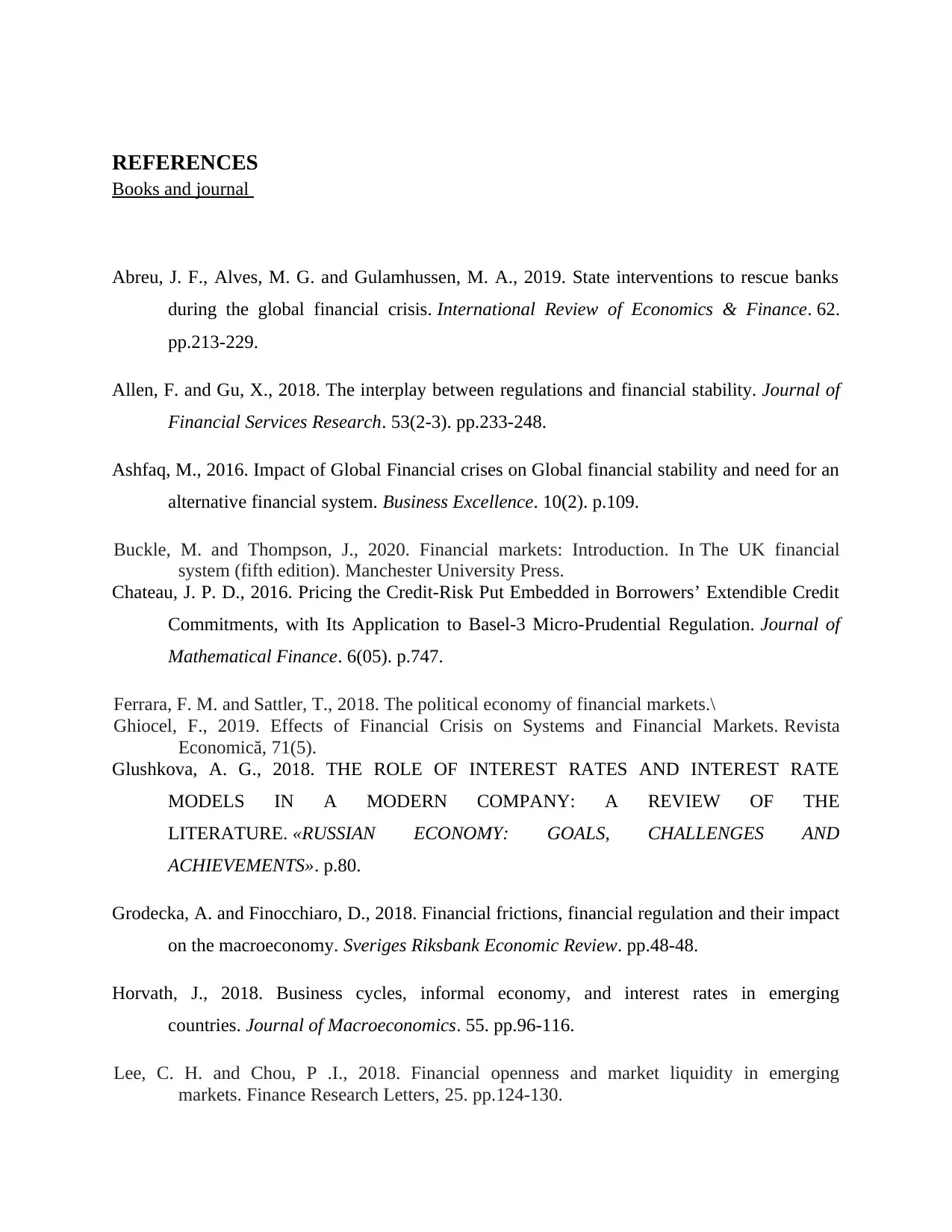
REFERENCES
Books and journal
Abreu, J. F., Alves, M. G. and Gulamhussen, M. A., 2019. State interventions to rescue banks
during the global financial crisis. International Review of Economics & Finance. 62.
pp.213-229.
Allen, F. and Gu, X., 2018. The interplay between regulations and financial stability. Journal of
Financial Services Research. 53(2-3). pp.233-248.
Ashfaq, M., 2016. Impact of Global Financial crises on Global financial stability and need for an
alternative financial system. Business Excellence. 10(2). p.109.
Buckle, M. and Thompson, J., 2020. Financial markets: Introduction. In The UK financial
system (fifth edition). Manchester University Press.
Chateau, J. P. D., 2016. Pricing the Credit-Risk Put Embedded in Borrowers’ Extendible Credit
Commitments, with Its Application to Basel-3 Micro-Prudential Regulation. Journal of
Mathematical Finance. 6(05). p.747.
Ferrara, F. M. and Sattler, T., 2018. The political economy of financial markets.\
Ghiocel, F., 2019. Effects of Financial Crisis on Systems and Financial Markets. Revista
Economică, 71(5).
Glushkova, A. G., 2018. THE ROLE OF INTEREST RATES AND INTEREST RATE
MODELS IN A MODERN COMPANY: A REVIEW OF THE
LITERATURE. «RUSSIAN ECONOMY: GOALS, CHALLENGES AND
ACHIEVEMENTS». p.80.
Grodecka, A. and Finocchiaro, D., 2018. Financial frictions, financial regulation and their impact
on the macroeconomy. Sveriges Riksbank Economic Review. pp.48-48.
Horvath, J., 2018. Business cycles, informal economy, and interest rates in emerging
countries. Journal of Macroeconomics. 55. pp.96-116.
Lee, C. H. and Chou, P .I., 2018. Financial openness and market liquidity in emerging
markets. Finance Research Letters, 25. pp.124-130.
Books and journal
Abreu, J. F., Alves, M. G. and Gulamhussen, M. A., 2019. State interventions to rescue banks
during the global financial crisis. International Review of Economics & Finance. 62.
pp.213-229.
Allen, F. and Gu, X., 2018. The interplay between regulations and financial stability. Journal of
Financial Services Research. 53(2-3). pp.233-248.
Ashfaq, M., 2016. Impact of Global Financial crises on Global financial stability and need for an
alternative financial system. Business Excellence. 10(2). p.109.
Buckle, M. and Thompson, J., 2020. Financial markets: Introduction. In The UK financial
system (fifth edition). Manchester University Press.
Chateau, J. P. D., 2016. Pricing the Credit-Risk Put Embedded in Borrowers’ Extendible Credit
Commitments, with Its Application to Basel-3 Micro-Prudential Regulation. Journal of
Mathematical Finance. 6(05). p.747.
Ferrara, F. M. and Sattler, T., 2018. The political economy of financial markets.\
Ghiocel, F., 2019. Effects of Financial Crisis on Systems and Financial Markets. Revista
Economică, 71(5).
Glushkova, A. G., 2018. THE ROLE OF INTEREST RATES AND INTEREST RATE
MODELS IN A MODERN COMPANY: A REVIEW OF THE
LITERATURE. «RUSSIAN ECONOMY: GOALS, CHALLENGES AND
ACHIEVEMENTS». p.80.
Grodecka, A. and Finocchiaro, D., 2018. Financial frictions, financial regulation and their impact
on the macroeconomy. Sveriges Riksbank Economic Review. pp.48-48.
Horvath, J., 2018. Business cycles, informal economy, and interest rates in emerging
countries. Journal of Macroeconomics. 55. pp.96-116.
Lee, C. H. and Chou, P .I., 2018. Financial openness and market liquidity in emerging
markets. Finance Research Letters, 25. pp.124-130.
⊘ This is a preview!⊘
Do you want full access?
Subscribe today to unlock all pages.
Trusted by 1+ million students worldwide
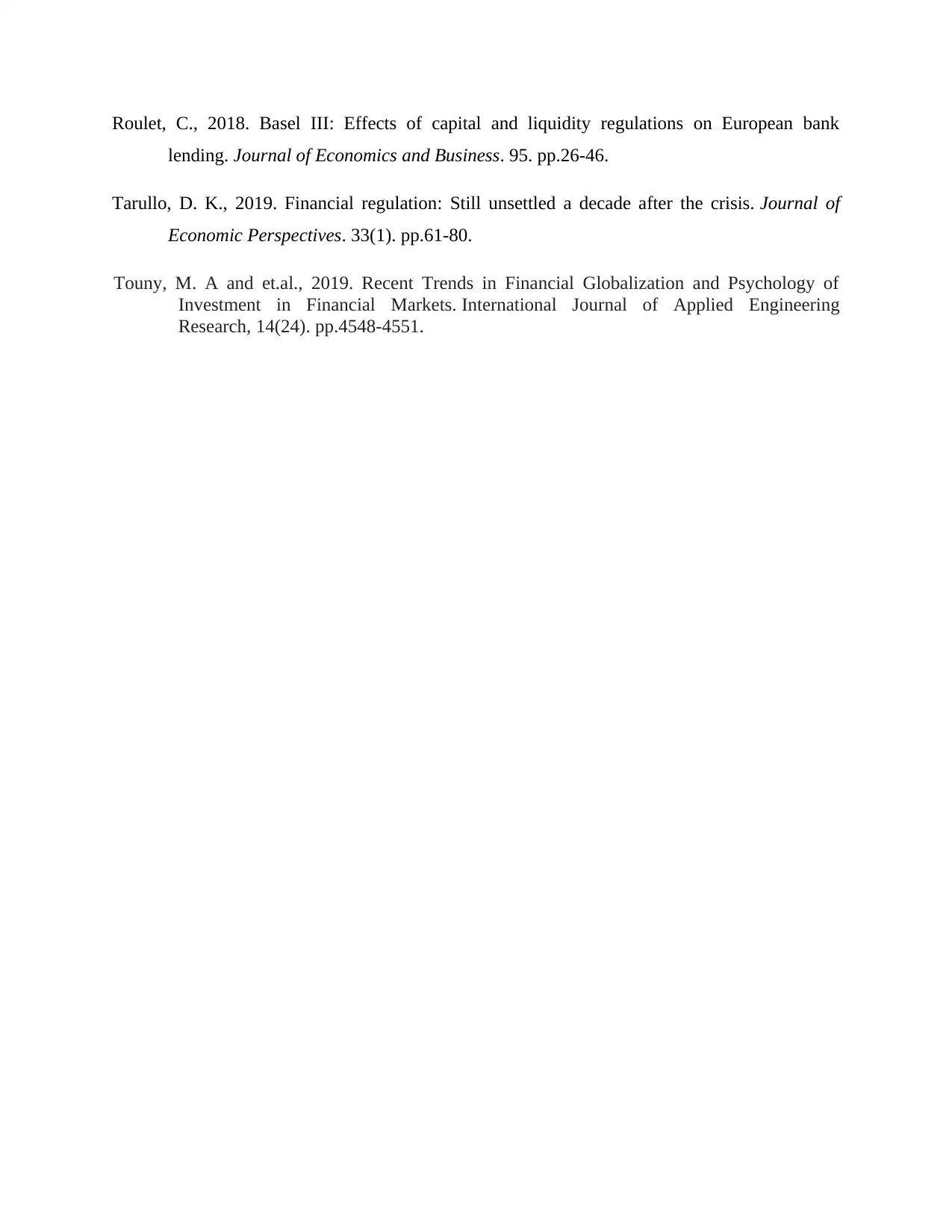
Roulet, C., 2018. Basel III: Effects of capital and liquidity regulations on European bank
lending. Journal of Economics and Business. 95. pp.26-46.
Tarullo, D. K., 2019. Financial regulation: Still unsettled a decade after the crisis. Journal of
Economic Perspectives. 33(1). pp.61-80.
Touny, M. A and et.al., 2019. Recent Trends in Financial Globalization and Psychology of
Investment in Financial Markets. International Journal of Applied Engineering
Research, 14(24). pp.4548-4551.
lending. Journal of Economics and Business. 95. pp.26-46.
Tarullo, D. K., 2019. Financial regulation: Still unsettled a decade after the crisis. Journal of
Economic Perspectives. 33(1). pp.61-80.
Touny, M. A and et.al., 2019. Recent Trends in Financial Globalization and Psychology of
Investment in Financial Markets. International Journal of Applied Engineering
Research, 14(24). pp.4548-4551.

1 out of 10


Related Documents


Your All-in-One AI-Powered Toolkit for Academic Success.
+13062052269
info@desklib.com
Available 24*7 on WhatsApp / Email
![[object Object]](/_next/static/media/star-bottom.7253800d.svg)
Unlock your academic potential
Copyright © 2020–2026 A2Z Services. All Rights Reserved. Developed and managed by ZUCOL.