Financial Decision Making Report: Analysis of Alpha Ltd Finances
VerifiedAdded on 2021/02/20
|12
|3842
|84
Report
AI Summary
This report provides a comprehensive analysis of financial decision-making processes, emphasizing the crucial role of accounting and financial systems. The report delves into the application of various management accounting techniques, including financial planning, analysis of financial statements, historical cost accounting, standard costing, budgetary control, marginal costing, fund flow statements, cash flow statements, revaluation accounting, and statistical/graphical techniques, all of which are essential for effective planning, control, and decision-making within a business. The report also includes a case study focused on Alpha Ltd, examining the calculation and interpretation of various financial ratios to assess its financial performance. The conclusion highlights the importance of financial statement analysis for informed decision-making and the value of management accounting systems in supporting organizational goals.

Financial Decision
Making
Making

Paraphrase This Document
Need a fresh take? Get an instant paraphrase of this document with our AI Paraphraser
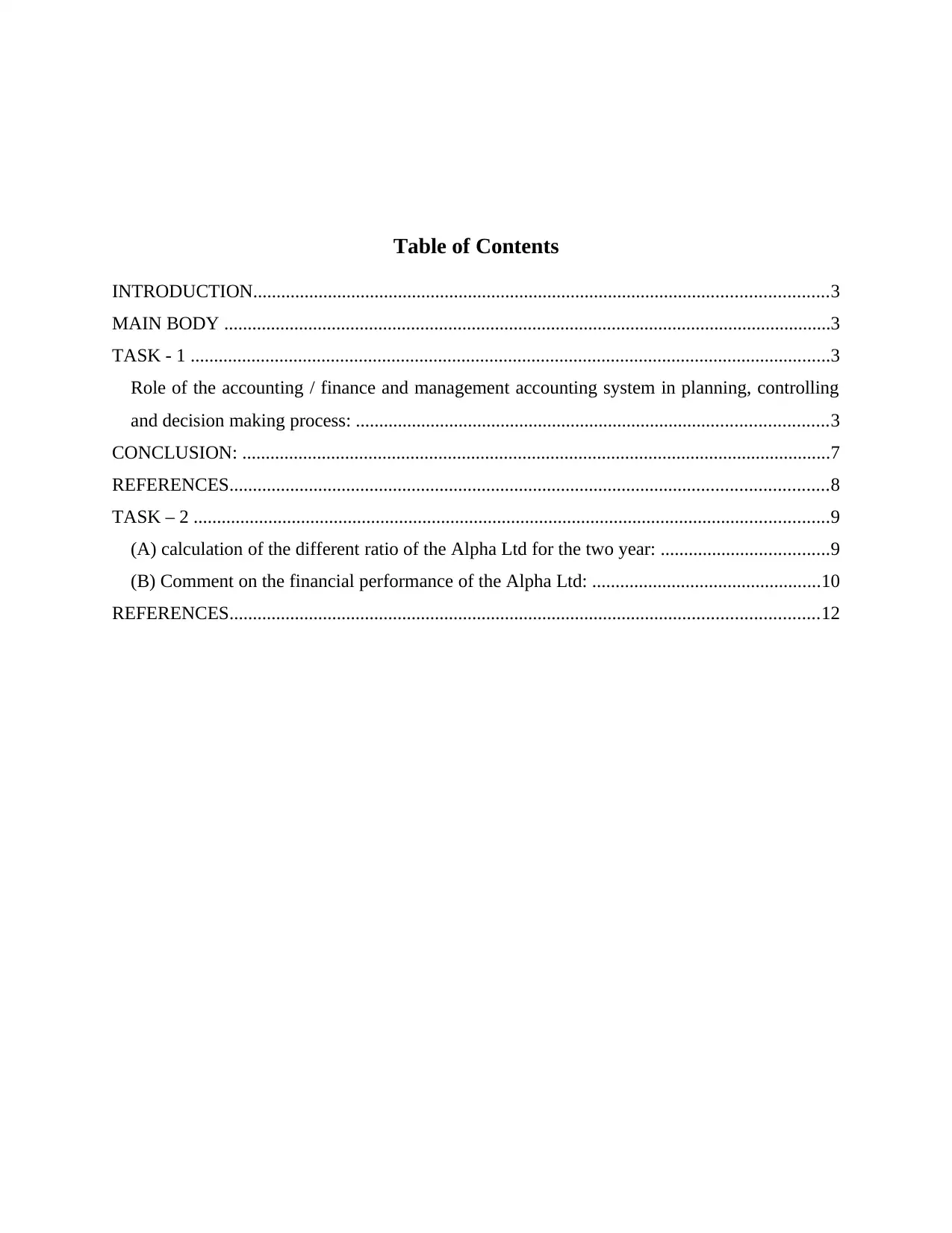
Table of Contents
INTRODUCTION...........................................................................................................................3
MAIN BODY ..................................................................................................................................3
TASK - 1 .........................................................................................................................................3
Role of the accounting / finance and management accounting system in planning, controlling
and decision making process: .....................................................................................................3
CONCLUSION: ..............................................................................................................................7
REFERENCES................................................................................................................................8
TASK – 2 ........................................................................................................................................9
(A) calculation of the different ratio of the Alpha Ltd for the two year: ....................................9
(B) Comment on the financial performance of the Alpha Ltd: .................................................10
REFERENCES..............................................................................................................................12
INTRODUCTION...........................................................................................................................3
MAIN BODY ..................................................................................................................................3
TASK - 1 .........................................................................................................................................3
Role of the accounting / finance and management accounting system in planning, controlling
and decision making process: .....................................................................................................3
CONCLUSION: ..............................................................................................................................7
REFERENCES................................................................................................................................8
TASK – 2 ........................................................................................................................................9
(A) calculation of the different ratio of the Alpha Ltd for the two year: ....................................9
(B) Comment on the financial performance of the Alpha Ltd: .................................................10
REFERENCES..............................................................................................................................12
INTRODUCTION
The term finance is defined as management of the large amount of money by a particular
department in the firm (Loibl, 2018). It includes the management of the assets, liabilities,
revenue and expenses and debts of the business. It involves the procurement and utilization of
the funds in the so that a business can carry out the financial operation in a efficient manner. The
finance / accounting function based on the making the decision by the finance management with
the data and information by financial statement and reports. The financial decision involves the
decision related to raise the fund from the share capital and debentures. These are the
fundamental business information and system that help in decision making process related to
financial information and data. In the report, the management accounting system and techniques
that is relevant with financial and other information in respect of the organisation. It also covers
the financial ratio that is based on the financial statement like trading and p&l account and the
final account of the company. The accounting and financial system of an organisation play a
significant role in in order to prepare the financial statement and reports in the business.
To better understand the financial decision making concepts, company Zara is chosen to prepare
this report. The company is retail sector that is placed in the Spain. The company is founded in
the year of 1974 and the management of the company is planing to carried out its activities at
different location and the product are clothing, accessories, shoes, swimwear, beauty and
perfumes in upcoming years. It is crucial to the business management to measure the financial
statements and reports so they able to make the decision for the requirement of the financing
resources to expand the business.
The term finance is defined as management of the large amount of money by a particular
department in the firm (Loibl, 2018). It includes the management of the assets, liabilities,
revenue and expenses and debts of the business. It involves the procurement and utilization of
the funds in the so that a business can carry out the financial operation in a efficient manner. The
finance / accounting function based on the making the decision by the finance management with
the data and information by financial statement and reports. The financial decision involves the
decision related to raise the fund from the share capital and debentures. These are the
fundamental business information and system that help in decision making process related to
financial information and data. In the report, the management accounting system and techniques
that is relevant with financial and other information in respect of the organisation. It also covers
the financial ratio that is based on the financial statement like trading and p&l account and the
final account of the company. The accounting and financial system of an organisation play a
significant role in in order to prepare the financial statement and reports in the business.
To better understand the financial decision making concepts, company Zara is chosen to prepare
this report. The company is retail sector that is placed in the Spain. The company is founded in
the year of 1974 and the management of the company is planing to carried out its activities at
different location and the product are clothing, accessories, shoes, swimwear, beauty and
perfumes in upcoming years. It is crucial to the business management to measure the financial
statements and reports so they able to make the decision for the requirement of the financing
resources to expand the business.
⊘ This is a preview!⊘
Do you want full access?
Subscribe today to unlock all pages.

Trusted by 1+ million students worldwide
MAIN BODY
TASK - 1
Role of the accounting / finance and management accounting system in planning, controlling and
decision making process:
The management accounting techniques and system are the basic business operation that
help in the devising the planning process, performance management and decision making
process and provides the structured expertise in the particular profession to control the reporting.
It is controlling activities that help in formulation of the business strategies and implications of
the rules and operating process in the system. There are different types of the management
accounting system that are needed to operate the business activities. Some of the management
accounting system are described as under:
Financial Planning: This is long term process of estimating the required capital and funds
to invest in the particular projects. It frames the long term policies of the business related
to procurement of funds, investment and management of financial resources. The
financial plan covered the comprehensive statement of funds related to Alpha company
that described the long term objective, funds, saving, expenses and management of the
resources in order to uses in the future. The management of the Zara is needed to use the
financial resources in a effective manner in the future projects as per the financial
planning of the business (Danovi, Riv and Azzola, 2016).
Analysis of the financial statement: This process contents the analysing and inter-prate
the financial statement and reports in front of management of the company (Lichtenberg,
Qualls and Smyer, 2015). These financial statement covers the fundamental structure of
finance like final accounts as trading and p&l account, balance sheet and other reports of
the company. This is the particular process of measuring the financial statements for the
purposes of the decision making in the alpha Ltd These reports and statement are used by
the external stakeholder to understand the financial health as well as business
performance.
Historical cost accounting: It is a economic term that is defined in the cost accounting
that drives the value of an assets on the final accounts as per its original cost when assets
is purchased on the same amount. The historical cost method is used for the fix assets in
TASK - 1
Role of the accounting / finance and management accounting system in planning, controlling and
decision making process:
The management accounting techniques and system are the basic business operation that
help in the devising the planning process, performance management and decision making
process and provides the structured expertise in the particular profession to control the reporting.
It is controlling activities that help in formulation of the business strategies and implications of
the rules and operating process in the system. There are different types of the management
accounting system that are needed to operate the business activities. Some of the management
accounting system are described as under:
Financial Planning: This is long term process of estimating the required capital and funds
to invest in the particular projects. It frames the long term policies of the business related
to procurement of funds, investment and management of financial resources. The
financial plan covered the comprehensive statement of funds related to Alpha company
that described the long term objective, funds, saving, expenses and management of the
resources in order to uses in the future. The management of the Zara is needed to use the
financial resources in a effective manner in the future projects as per the financial
planning of the business (Danovi, Riv and Azzola, 2016).
Analysis of the financial statement: This process contents the analysing and inter-prate
the financial statement and reports in front of management of the company (Lichtenberg,
Qualls and Smyer, 2015). These financial statement covers the fundamental structure of
finance like final accounts as trading and p&l account, balance sheet and other reports of
the company. This is the particular process of measuring the financial statements for the
purposes of the decision making in the alpha Ltd These reports and statement are used by
the external stakeholder to understand the financial health as well as business
performance.
Historical cost accounting: It is a economic term that is defined in the cost accounting
that drives the value of an assets on the final accounts as per its original cost when assets
is purchased on the same amount. The historical cost method is used for the fix assets in
Paraphrase This Document
Need a fresh take? Get an instant paraphrase of this document with our AI Paraphraser
various country by following GAAP generally accepted accounting principle. The
historical cost is not updated or changes on yearly basis (Danovi, Riv and Azzola, 2016).
Zara company is using this system for the cost accounting purpose by valuing the assets
on the cost of acquisition.
Standard costing: It is defined as premeditated cost that is forecasted on the performing of
business operating and activities for producing the goods and services at normal level of
production. It is used as planning tools that manage and control the cost activities at
normal production level (Bentley and Teeguarden, 2018). It estimates the cost of a
processing unit of the business. Zara Ltd is using this system to forecast the budgeted cost
for certain level of the production. And compare with actual output to find the variances.
Budgetary control: This is process of the management accounting system that estimate
figures the cost of production like cost of direct material, labour and overhead at
particular level of manufacturing and compare with the actual output of production
(Epstein, Buhovac and Yuthas, 2015). This is mechanism that control the spending limit
of an processing unit and make a favourable comparison between actual and standard to
find the deviation in the overall cost. In the Zara company, management is using this tool
in the accounting system to find the estimated cost of the particular task and project at
manufacturing unit.
Marginal costing: It refers to cost of the one extra unit of production. This cost is
calculated change in the cost which arise when total output is increased by certain unit of
manufactured. This cost covers both the cost fix and variable cost for the accounting
purpose. Fix cost are fix on the total production unit and variable may fluctuate as per
unit of output. In the Zara company, this techniques of the cost accounting is used in the
preparation of the marginal statement.
Fund flow statement: it is financial statement that shows the funds and resources
generated and allocated for the particular period of time. It includes the cash inflow and
outflow of the funds from the different operation of the business. And also represent the
sources and application of the fund from these activities. Company Zara is using this
tools to the know the flow of the money in the business.
Cash flow statement: It is statement that disclose the cash fund arise from the different
operation of the business over a period of time. It includes the business activities such as
historical cost is not updated or changes on yearly basis (Danovi, Riv and Azzola, 2016).
Zara company is using this system for the cost accounting purpose by valuing the assets
on the cost of acquisition.
Standard costing: It is defined as premeditated cost that is forecasted on the performing of
business operating and activities for producing the goods and services at normal level of
production. It is used as planning tools that manage and control the cost activities at
normal production level (Bentley and Teeguarden, 2018). It estimates the cost of a
processing unit of the business. Zara Ltd is using this system to forecast the budgeted cost
for certain level of the production. And compare with actual output to find the variances.
Budgetary control: This is process of the management accounting system that estimate
figures the cost of production like cost of direct material, labour and overhead at
particular level of manufacturing and compare with the actual output of production
(Epstein, Buhovac and Yuthas, 2015). This is mechanism that control the spending limit
of an processing unit and make a favourable comparison between actual and standard to
find the deviation in the overall cost. In the Zara company, management is using this tool
in the accounting system to find the estimated cost of the particular task and project at
manufacturing unit.
Marginal costing: It refers to cost of the one extra unit of production. This cost is
calculated change in the cost which arise when total output is increased by certain unit of
manufactured. This cost covers both the cost fix and variable cost for the accounting
purpose. Fix cost are fix on the total production unit and variable may fluctuate as per
unit of output. In the Zara company, this techniques of the cost accounting is used in the
preparation of the marginal statement.
Fund flow statement: it is financial statement that shows the funds and resources
generated and allocated for the particular period of time. It includes the cash inflow and
outflow of the funds from the different operation of the business. And also represent the
sources and application of the fund from these activities. Company Zara is using this
tools to the know the flow of the money in the business.
Cash flow statement: It is statement that disclose the cash fund arise from the different
operation of the business over a period of time. It includes the business activities such as

operational, investment and financing. It signify the changes in the balance sheet and
income statement affects the cash and cash equivalent. Company Zara is using this tools
to know cash fund on the annually basis.
Revaluation accounting: It represent the positive changes between fair market value and
original cost of the particular assets(Lee and Lee, 2015). The increment in the price of the
assets reflects through current market value that need to be adjusted by the revaluation
account. In the same manner company alpha is finding the correct market value of its
assets.
Statical and graphical techniques: This is the practical approaches that is related with
analysing and measuring the financial data and information by the help of bar graph and
charts. In this tools, the interpretation is presented by evaluating the financial states and
graph. Zara is using this tool to better representation of the financial statement and
reports.
Communicating: As per this management accounting tools, management are required the
the financial statement and data to make the business decision. It further, they published
the final data to make available for the end user.
Critical analysis- All the data and information that are required to management in order to
make a business decision related to future (Walter, 2016). So all the management accounting
techniques and system are mandatory as it provides support to the business management in order
to further analyse and determine the financial position of the business. Here, some importance of
these accounting tools and techniques are mentioned as under:
Performance measurement - These accounting tools provides a supports on the measuring
the actual performance of an entity. By applying the method of standard costing and
budgetary control system at the level of production, the estimated data and information
can be attained to understand the situation of the manufacturing unit. Alpha is using these
tools to know the actual performance of the particular unit.
Increment in the efficiency of the business: The management accounting tools and
techniques are really helpful in enhancement the business functional and operational
activities of the production unit. It increases the business performance by elevating the
operational productivity of the manufacturing unit. Company is using accounting tool to
increase the effectiveness of the business.
income statement affects the cash and cash equivalent. Company Zara is using this tools
to know cash fund on the annually basis.
Revaluation accounting: It represent the positive changes between fair market value and
original cost of the particular assets(Lee and Lee, 2015). The increment in the price of the
assets reflects through current market value that need to be adjusted by the revaluation
account. In the same manner company alpha is finding the correct market value of its
assets.
Statical and graphical techniques: This is the practical approaches that is related with
analysing and measuring the financial data and information by the help of bar graph and
charts. In this tools, the interpretation is presented by evaluating the financial states and
graph. Zara is using this tool to better representation of the financial statement and
reports.
Communicating: As per this management accounting tools, management are required the
the financial statement and data to make the business decision. It further, they published
the final data to make available for the end user.
Critical analysis- All the data and information that are required to management in order to
make a business decision related to future (Walter, 2016). So all the management accounting
techniques and system are mandatory as it provides support to the business management in order
to further analyse and determine the financial position of the business. Here, some importance of
these accounting tools and techniques are mentioned as under:
Performance measurement - These accounting tools provides a supports on the measuring
the actual performance of an entity. By applying the method of standard costing and
budgetary control system at the level of production, the estimated data and information
can be attained to understand the situation of the manufacturing unit. Alpha is using these
tools to know the actual performance of the particular unit.
Increment in the efficiency of the business: The management accounting tools and
techniques are really helpful in enhancement the business functional and operational
activities of the production unit. It increases the business performance by elevating the
operational productivity of the manufacturing unit. Company is using accounting tool to
increase the effectiveness of the business.
⊘ This is a preview!⊘
Do you want full access?
Subscribe today to unlock all pages.
Trusted by 1+ million students worldwide
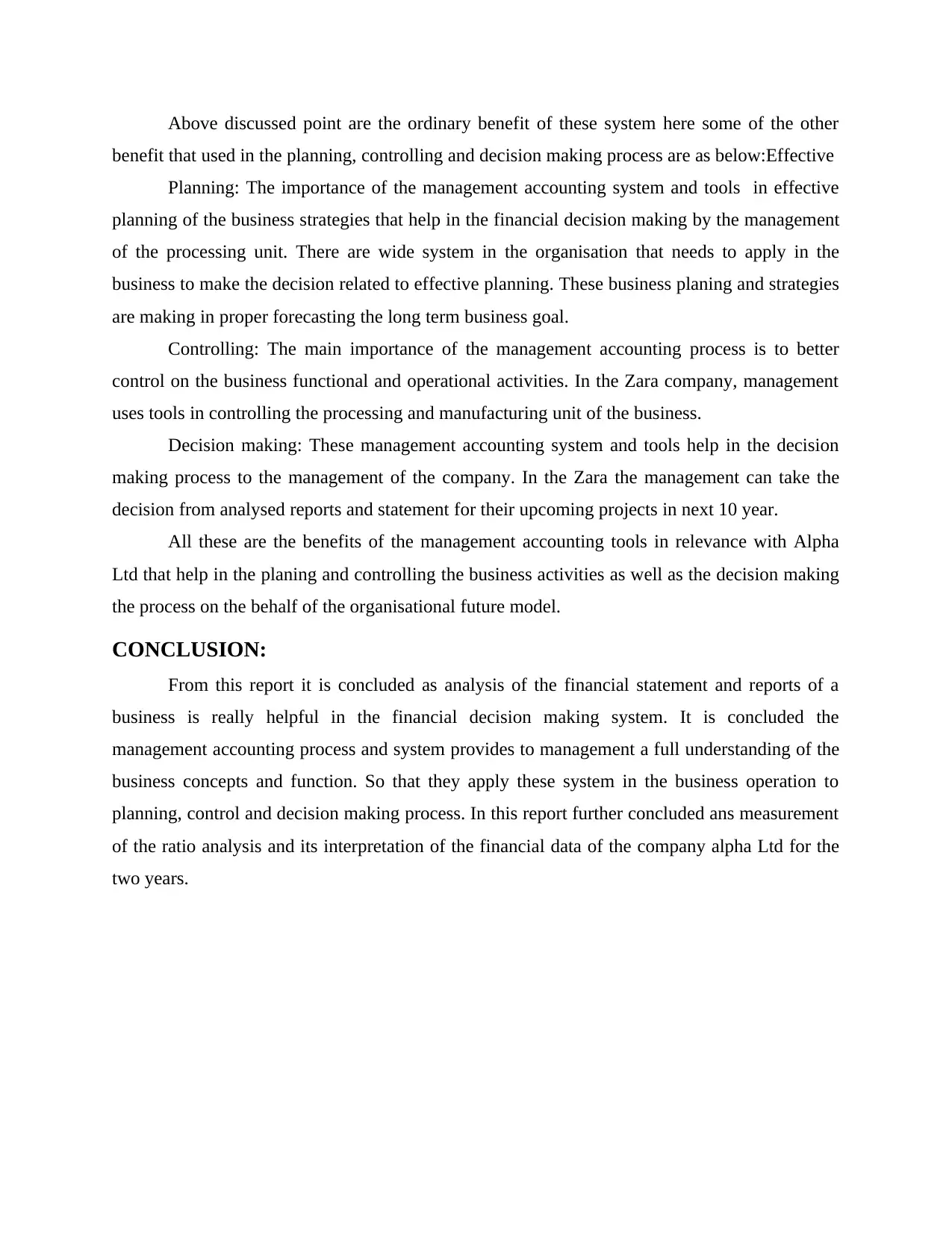
Above discussed point are the ordinary benefit of these system here some of the other
benefit that used in the planning, controlling and decision making process are as below:Effective
Planning: The importance of the management accounting system and tools in effective
planning of the business strategies that help in the financial decision making by the management
of the processing unit. There are wide system in the organisation that needs to apply in the
business to make the decision related to effective planning. These business planing and strategies
are making in proper forecasting the long term business goal.
Controlling: The main importance of the management accounting process is to better
control on the business functional and operational activities. In the Zara company, management
uses tools in controlling the processing and manufacturing unit of the business.
Decision making: These management accounting system and tools help in the decision
making process to the management of the company. In the Zara the management can take the
decision from analysed reports and statement for their upcoming projects in next 10 year.
All these are the benefits of the management accounting tools in relevance with Alpha
Ltd that help in the planing and controlling the business activities as well as the decision making
the process on the behalf of the organisational future model.
CONCLUSION:
From this report it is concluded as analysis of the financial statement and reports of a
business is really helpful in the financial decision making system. It is concluded the
management accounting process and system provides to management a full understanding of the
business concepts and function. So that they apply these system in the business operation to
planning, control and decision making process. In this report further concluded ans measurement
of the ratio analysis and its interpretation of the financial data of the company alpha Ltd for the
two years.
benefit that used in the planning, controlling and decision making process are as below:Effective
Planning: The importance of the management accounting system and tools in effective
planning of the business strategies that help in the financial decision making by the management
of the processing unit. There are wide system in the organisation that needs to apply in the
business to make the decision related to effective planning. These business planing and strategies
are making in proper forecasting the long term business goal.
Controlling: The main importance of the management accounting process is to better
control on the business functional and operational activities. In the Zara company, management
uses tools in controlling the processing and manufacturing unit of the business.
Decision making: These management accounting system and tools help in the decision
making process to the management of the company. In the Zara the management can take the
decision from analysed reports and statement for their upcoming projects in next 10 year.
All these are the benefits of the management accounting tools in relevance with Alpha
Ltd that help in the planing and controlling the business activities as well as the decision making
the process on the behalf of the organisational future model.
CONCLUSION:
From this report it is concluded as analysis of the financial statement and reports of a
business is really helpful in the financial decision making system. It is concluded the
management accounting process and system provides to management a full understanding of the
business concepts and function. So that they apply these system in the business operation to
planning, control and decision making process. In this report further concluded ans measurement
of the ratio analysis and its interpretation of the financial data of the company alpha Ltd for the
two years.
Paraphrase This Document
Need a fresh take? Get an instant paraphrase of this document with our AI Paraphraser
REFERENCES
Books and journals:
Loibl, C., 2018. 26 Living in Poverty: Understanding the Financial Behaviour of Vulnerable
Groups. CENTRE FOR DECISION RESEARCH, UNIVERSITY OF LEEDS, UK, p.421.
Bentley, W .R. and Teeguarden, D .E., 2018. Financial maturity: a theoretical review. In
Economics of Forestry. (pp. 67-78). Routledge.
Lichtenberg, P. A., Qualls, S. H. and Smyer, M. A., 2015. Competency and decision-making
capacity: Negotiating health and financial decision making.
Epstein, M. J., Buhovac, A .R. and Yuthas, K., 2015. Managing social, environmental and
financial performance simultaneously. Long range planning. 48(1). pp.35-45.
Lee, S .W. and Lee, K. H., 2015. Decision Making Model for Selecting Financial Company
Server Privilege Account Operations. Journal of the Korea Institute of Information
Security and Cryptology. 25(6). pp.1607-1620.
Walter, C., 2016. The financial Logos: The framing of financial decision-making by
mathematical modelling. Research in International Business and Finance. 37. pp.597-
604.
Finke, M .S., Howe, J. S. and Huston, S .J., 2016. Old age and the decline in financial literacy.
Management Science. 63(1). pp.213-230.
Brounen, D., Koedijk, K .G. and Pownall, R .A., 2016. Household financial planning and savings
behavior. Journal of International Money and Finance. 69. pp.95-107.
Correia, T., Dussault, G. and Pontes, C., 2015. The impact of the financial crisis on human
resources for health policies in three southern-Europe countries. Health Policy. 119(12).
pp.1600-1605.
Wald, D .J. and Franco, G., 2016. Money matters: Rapid post-earthquake financial decision-
making. Natural Hazards Observer. 40(7). pp.24-27.
Baker, H .K. and Ricciardi, V., 2015. Understanding behavioral aspects of financial planning and
investing. Journal of financial Planning. 28(3). pp.22-26.
Loerwald, D. and Stemmann, A., 2016. Behavioral finance and financial literacy: Educational
implications of biases in financial decision making. In International Handbook of
Financial Literacy. (pp. 25-38). Springer, Singapore.
Books and journals:
Loibl, C., 2018. 26 Living in Poverty: Understanding the Financial Behaviour of Vulnerable
Groups. CENTRE FOR DECISION RESEARCH, UNIVERSITY OF LEEDS, UK, p.421.
Bentley, W .R. and Teeguarden, D .E., 2018. Financial maturity: a theoretical review. In
Economics of Forestry. (pp. 67-78). Routledge.
Lichtenberg, P. A., Qualls, S. H. and Smyer, M. A., 2015. Competency and decision-making
capacity: Negotiating health and financial decision making.
Epstein, M. J., Buhovac, A .R. and Yuthas, K., 2015. Managing social, environmental and
financial performance simultaneously. Long range planning. 48(1). pp.35-45.
Lee, S .W. and Lee, K. H., 2015. Decision Making Model for Selecting Financial Company
Server Privilege Account Operations. Journal of the Korea Institute of Information
Security and Cryptology. 25(6). pp.1607-1620.
Walter, C., 2016. The financial Logos: The framing of financial decision-making by
mathematical modelling. Research in International Business and Finance. 37. pp.597-
604.
Finke, M .S., Howe, J. S. and Huston, S .J., 2016. Old age and the decline in financial literacy.
Management Science. 63(1). pp.213-230.
Brounen, D., Koedijk, K .G. and Pownall, R .A., 2016. Household financial planning and savings
behavior. Journal of International Money and Finance. 69. pp.95-107.
Correia, T., Dussault, G. and Pontes, C., 2015. The impact of the financial crisis on human
resources for health policies in three southern-Europe countries. Health Policy. 119(12).
pp.1600-1605.
Wald, D .J. and Franco, G., 2016. Money matters: Rapid post-earthquake financial decision-
making. Natural Hazards Observer. 40(7). pp.24-27.
Baker, H .K. and Ricciardi, V., 2015. Understanding behavioral aspects of financial planning and
investing. Journal of financial Planning. 28(3). pp.22-26.
Loerwald, D. and Stemmann, A., 2016. Behavioral finance and financial literacy: Educational
implications of biases in financial decision making. In International Handbook of
Financial Literacy. (pp. 25-38). Springer, Singapore.
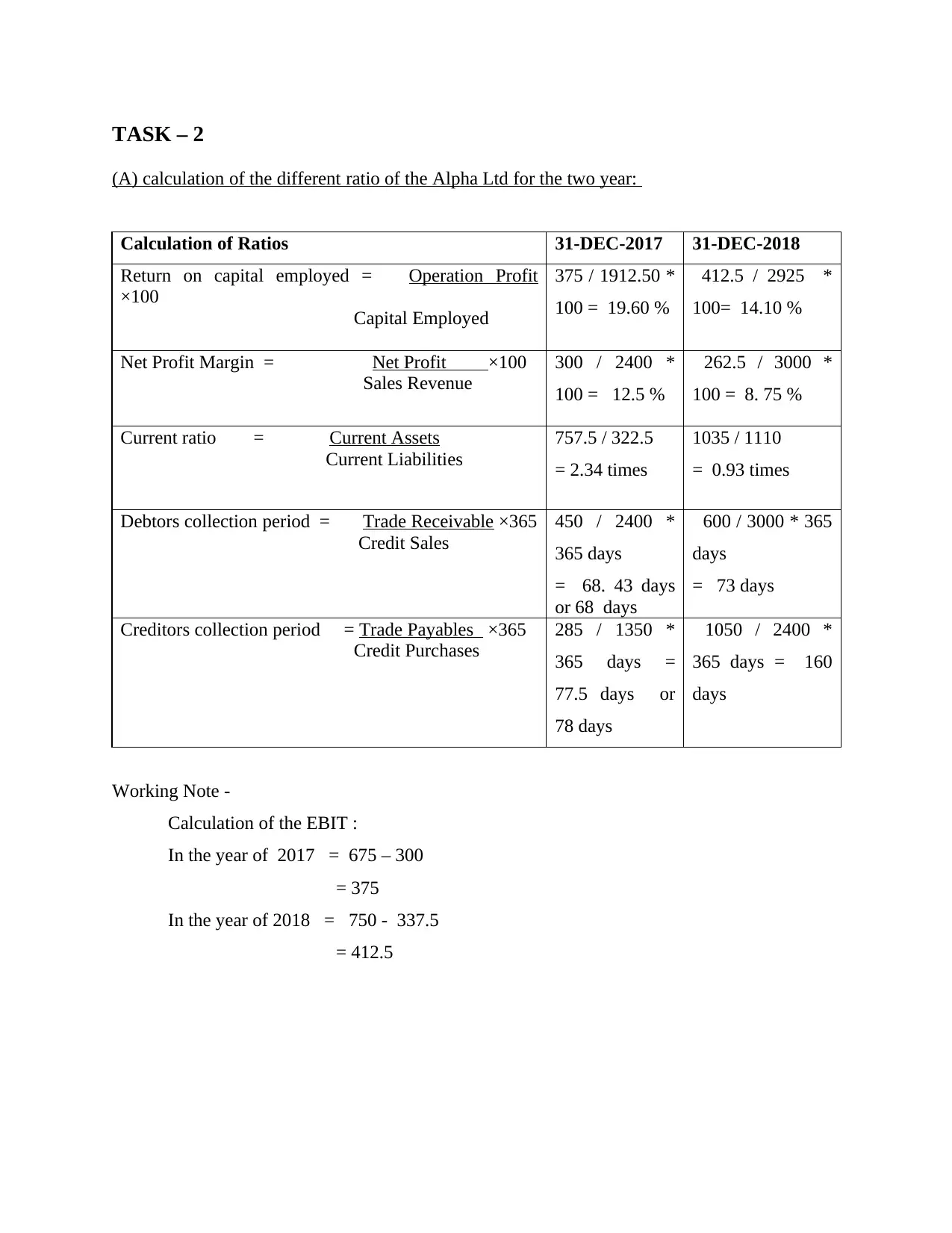
TASK – 2
(A) calculation of the different ratio of the Alpha Ltd for the two year:
Calculation of Ratios 31-DEC-2017 31-DEC-2018
Return on capital employed = Operation Profit
×100
Capital Employed
375 / 1912.50 *
100 = 19.60 %
412.5 / 2925 *
100= 14.10 %
Net Profit Margin = Net Profit ×100
Sales Revenue
300 / 2400 *
100 = 12.5 %
262.5 / 3000 *
100 = 8. 75 %
Current ratio = Current Assets
Current Liabilities
757.5 / 322.5
= 2.34 times
1035 / 1110
= 0.93 times
Debtors collection period = Trade Receivable ×365
Credit Sales
450 / 2400 *
365 days
= 68. 43 days
or 68 days
600 / 3000 * 365
days
= 73 days
Creditors collection period = Trade Payables ×365
Credit Purchases
285 / 1350 *
365 days =
77.5 days or
78 days
1050 / 2400 *
365 days = 160
days
Working Note -
Calculation of the EBIT :
In the year of 2017 = 675 – 300
= 375
In the year of 2018 = 750 - 337.5
= 412.5
(A) calculation of the different ratio of the Alpha Ltd for the two year:
Calculation of Ratios 31-DEC-2017 31-DEC-2018
Return on capital employed = Operation Profit
×100
Capital Employed
375 / 1912.50 *
100 = 19.60 %
412.5 / 2925 *
100= 14.10 %
Net Profit Margin = Net Profit ×100
Sales Revenue
300 / 2400 *
100 = 12.5 %
262.5 / 3000 *
100 = 8. 75 %
Current ratio = Current Assets
Current Liabilities
757.5 / 322.5
= 2.34 times
1035 / 1110
= 0.93 times
Debtors collection period = Trade Receivable ×365
Credit Sales
450 / 2400 *
365 days
= 68. 43 days
or 68 days
600 / 3000 * 365
days
= 73 days
Creditors collection period = Trade Payables ×365
Credit Purchases
285 / 1350 *
365 days =
77.5 days or
78 days
1050 / 2400 *
365 days = 160
days
Working Note -
Calculation of the EBIT :
In the year of 2017 = 675 – 300
= 375
In the year of 2018 = 750 - 337.5
= 412.5
⊘ This is a preview!⊘
Do you want full access?
Subscribe today to unlock all pages.
Trusted by 1+ million students worldwide
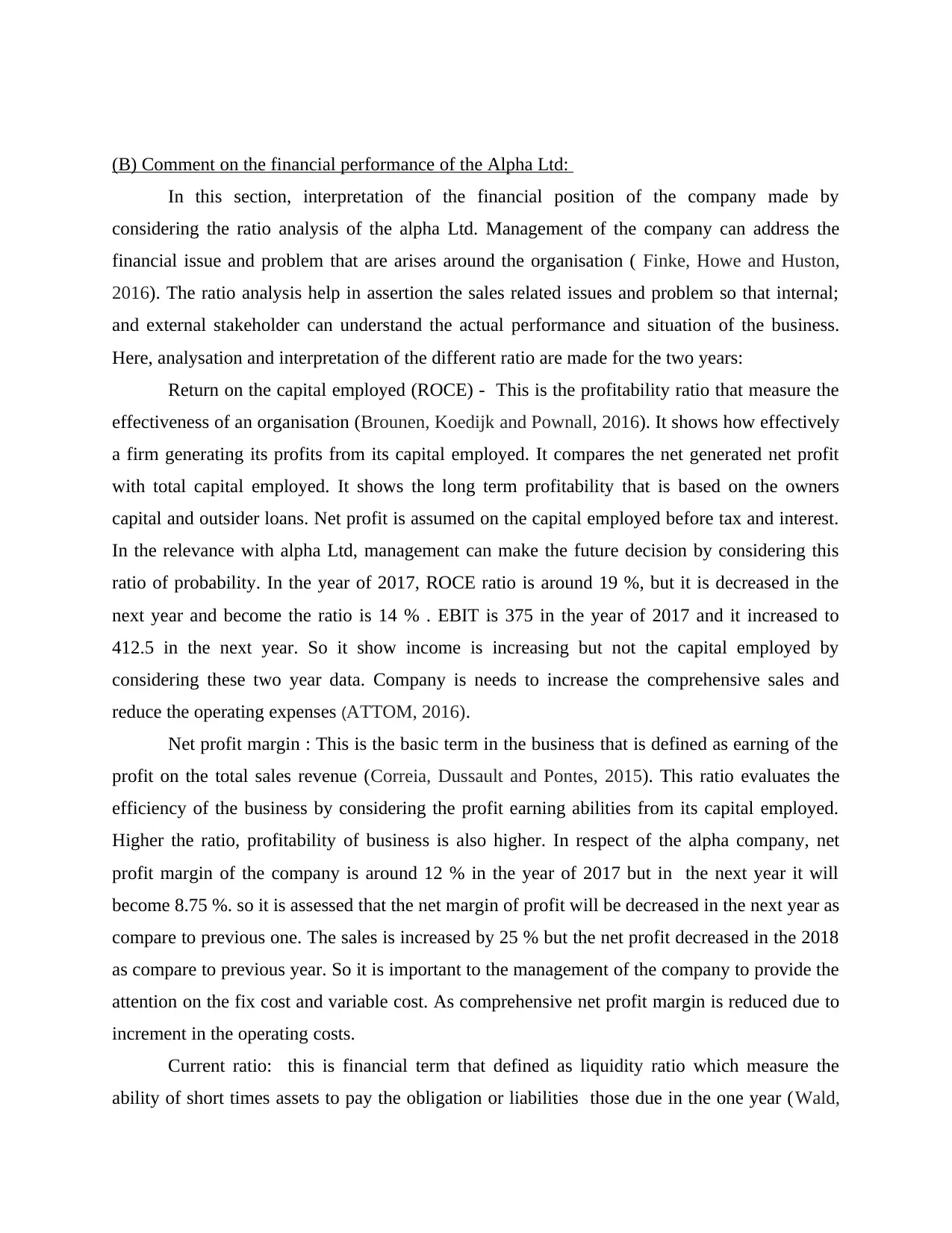
(B) Comment on the financial performance of the Alpha Ltd:
In this section, interpretation of the financial position of the company made by
considering the ratio analysis of the alpha Ltd. Management of the company can address the
financial issue and problem that are arises around the organisation ( Finke, Howe and Huston,
2016). The ratio analysis help in assertion the sales related issues and problem so that internal;
and external stakeholder can understand the actual performance and situation of the business.
Here, analysation and interpretation of the different ratio are made for the two years:
Return on the capital employed (ROCE) - This is the profitability ratio that measure the
effectiveness of an organisation (Brounen, Koedijk and Pownall, 2016). It shows how effectively
a firm generating its profits from its capital employed. It compares the net generated net profit
with total capital employed. It shows the long term profitability that is based on the owners
capital and outsider loans. Net profit is assumed on the capital employed before tax and interest.
In the relevance with alpha Ltd, management can make the future decision by considering this
ratio of probability. In the year of 2017, ROCE ratio is around 19 %, but it is decreased in the
next year and become the ratio is 14 % . EBIT is 375 in the year of 2017 and it increased to
412.5 in the next year. So it show income is increasing but not the capital employed by
considering these two year data. Company is needs to increase the comprehensive sales and
reduce the operating expenses (ATTOM, 2016).
Net profit margin : This is the basic term in the business that is defined as earning of the
profit on the total sales revenue (Correia, Dussault and Pontes, 2015). This ratio evaluates the
efficiency of the business by considering the profit earning abilities from its capital employed.
Higher the ratio, profitability of business is also higher. In respect of the alpha company, net
profit margin of the company is around 12 % in the year of 2017 but in the next year it will
become 8.75 %. so it is assessed that the net margin of profit will be decreased in the next year as
compare to previous one. The sales is increased by 25 % but the net profit decreased in the 2018
as compare to previous year. So it is important to the management of the company to provide the
attention on the fix cost and variable cost. As comprehensive net profit margin is reduced due to
increment in the operating costs.
Current ratio: this is financial term that defined as liquidity ratio which measure the
ability of short times assets to pay the obligation or liabilities those due in the one year (Wald,
In this section, interpretation of the financial position of the company made by
considering the ratio analysis of the alpha Ltd. Management of the company can address the
financial issue and problem that are arises around the organisation ( Finke, Howe and Huston,
2016). The ratio analysis help in assertion the sales related issues and problem so that internal;
and external stakeholder can understand the actual performance and situation of the business.
Here, analysation and interpretation of the different ratio are made for the two years:
Return on the capital employed (ROCE) - This is the profitability ratio that measure the
effectiveness of an organisation (Brounen, Koedijk and Pownall, 2016). It shows how effectively
a firm generating its profits from its capital employed. It compares the net generated net profit
with total capital employed. It shows the long term profitability that is based on the owners
capital and outsider loans. Net profit is assumed on the capital employed before tax and interest.
In the relevance with alpha Ltd, management can make the future decision by considering this
ratio of probability. In the year of 2017, ROCE ratio is around 19 %, but it is decreased in the
next year and become the ratio is 14 % . EBIT is 375 in the year of 2017 and it increased to
412.5 in the next year. So it show income is increasing but not the capital employed by
considering these two year data. Company is needs to increase the comprehensive sales and
reduce the operating expenses (ATTOM, 2016).
Net profit margin : This is the basic term in the business that is defined as earning of the
profit on the total sales revenue (Correia, Dussault and Pontes, 2015). This ratio evaluates the
efficiency of the business by considering the profit earning abilities from its capital employed.
Higher the ratio, profitability of business is also higher. In respect of the alpha company, net
profit margin of the company is around 12 % in the year of 2017 but in the next year it will
become 8.75 %. so it is assessed that the net margin of profit will be decreased in the next year as
compare to previous one. The sales is increased by 25 % but the net profit decreased in the 2018
as compare to previous year. So it is important to the management of the company to provide the
attention on the fix cost and variable cost. As comprehensive net profit margin is reduced due to
increment in the operating costs.
Current ratio: this is financial term that defined as liquidity ratio which measure the
ability of short times assets to pay the obligation or liabilities those due in the one year (Wald,
Paraphrase This Document
Need a fresh take? Get an instant paraphrase of this document with our AI Paraphraser
and Franco, 2016). company can maximize its current assets to pay the short term obligation of
the business. It compare the firm's current assets and liabilities. The ideal ratio is 2 : 1. In respect
to company alpha Ltd, current ratio in the year of 2017 is above 2 which shows a ideal situation.
In this condition company have enough assets to pay the its current liabilities. But in the year
2018, current ratio decreased to 0.93 times which is below 2. that means company is not able to
pay its liabilities. It need to improve the current assets by the management of Alpha Ltd (Habib
and Huang, 2019).
Debtors collection period: This is defined as average amount of days it takes to cover the
owned money from its customers (Loerwald and Stemmann, 2016). It shows the how many days
it will take to cover the amount of debt from its debtors. The main objectives behind it to know
the solvent customers which will pay the the amount with in given credit time period. In
particular company alpha Ltd the debtors collection period is 68 day in the year of 2017 which is
around 2.25 month. This is good for the organisation. But in the next year they paid the credit
amount in 73 days. It is almost same in both the year (Hendri, 2015).
Creditors payment period- The term creditors payment period has been defined as a type
of ratio whose purpose of calculation is to find out the average time period taken by company
(Baker and Ricciardi, 2015). With the use of this ratio companies' efficiency to make payment
can be assessed. This ratio is being calculated in terms of days which means if this ratio is in
higher days then it is estimated that company's ability to make payment is lower. On the other
hand if this ratio is in lower days then it is estimated that company's efficiency is good. Herein,
the aspect of above Alpha limited company, this ratio is of 73 days in year 2017 which increased
in further year 2018 and became of 160 days. It is indicating that company's debt payment
efficiency has been decreased which is needed to be improved. So it is recommended to
company's finance department that they should try to make their transactions in cash so that their
ratio can be improve (Wu, Wei and Peng, 2015).
the business. It compare the firm's current assets and liabilities. The ideal ratio is 2 : 1. In respect
to company alpha Ltd, current ratio in the year of 2017 is above 2 which shows a ideal situation.
In this condition company have enough assets to pay the its current liabilities. But in the year
2018, current ratio decreased to 0.93 times which is below 2. that means company is not able to
pay its liabilities. It need to improve the current assets by the management of Alpha Ltd (Habib
and Huang, 2019).
Debtors collection period: This is defined as average amount of days it takes to cover the
owned money from its customers (Loerwald and Stemmann, 2016). It shows the how many days
it will take to cover the amount of debt from its debtors. The main objectives behind it to know
the solvent customers which will pay the the amount with in given credit time period. In
particular company alpha Ltd the debtors collection period is 68 day in the year of 2017 which is
around 2.25 month. This is good for the organisation. But in the next year they paid the credit
amount in 73 days. It is almost same in both the year (Hendri, 2015).
Creditors payment period- The term creditors payment period has been defined as a type
of ratio whose purpose of calculation is to find out the average time period taken by company
(Baker and Ricciardi, 2015). With the use of this ratio companies' efficiency to make payment
can be assessed. This ratio is being calculated in terms of days which means if this ratio is in
higher days then it is estimated that company's ability to make payment is lower. On the other
hand if this ratio is in lower days then it is estimated that company's efficiency is good. Herein,
the aspect of above Alpha limited company, this ratio is of 73 days in year 2017 which increased
in further year 2018 and became of 160 days. It is indicating that company's debt payment
efficiency has been decreased which is needed to be improved. So it is recommended to
company's finance department that they should try to make their transactions in cash so that their
ratio can be improve (Wu, Wei and Peng, 2015).
REFERENCES
Books and journals:
ATTOM, B.E., 2016. WORKING CAPITAL MANAGEMENT AS A FINANCIAL
STRATEGY TO IMPROVE PROFITABILITY AND GROWTH OF MICRO AND
SMALL-SCALE ENTERPRISES (MSEs) OPERATING IN THE CENTRAL REGION
OF GHANA. CLEAR International Journal of Research in Commerce & Management.
7(7).
Danovi, A., Riva, P. and Azzola, M., 2016. Avoiding bankruptcy in Italy: Preventive
arrangement with creditors. In Contemporary issues in finance: Current challenges from
across Europe (pp. 77-94). Emerald Group Publishing Limited.
Habib, A. and Huang, H.J., 2019. Abnormally long audit report lags and future stock price crash
risk: evidence from China. International Journal of Managerial Finance.
Hendri, E., 2015. Pengaruh Debt To Asset Ratio (DAR), Long Term Debt To Equity Ratio
(LTDER) dan Net Profit Margin (NPM) Terhadap Harga Saham Pada Perusahan
Perbankan Yang Terdaftar di Bursa Efek Indonesia. Jurnal Media Wahana Ekonomika.
12(2).
Wu, G., Wei, X., Zhang, Z., Chen, Q. and Peng, L., 2015. A Graphene‐Based Vacuum Transistor
with a High ON/OFF Current Ratio. Advanced Functional Materials. 25(37). pp.5972-
5978.
Books and journals:
ATTOM, B.E., 2016. WORKING CAPITAL MANAGEMENT AS A FINANCIAL
STRATEGY TO IMPROVE PROFITABILITY AND GROWTH OF MICRO AND
SMALL-SCALE ENTERPRISES (MSEs) OPERATING IN THE CENTRAL REGION
OF GHANA. CLEAR International Journal of Research in Commerce & Management.
7(7).
Danovi, A., Riva, P. and Azzola, M., 2016. Avoiding bankruptcy in Italy: Preventive
arrangement with creditors. In Contemporary issues in finance: Current challenges from
across Europe (pp. 77-94). Emerald Group Publishing Limited.
Habib, A. and Huang, H.J., 2019. Abnormally long audit report lags and future stock price crash
risk: evidence from China. International Journal of Managerial Finance.
Hendri, E., 2015. Pengaruh Debt To Asset Ratio (DAR), Long Term Debt To Equity Ratio
(LTDER) dan Net Profit Margin (NPM) Terhadap Harga Saham Pada Perusahan
Perbankan Yang Terdaftar di Bursa Efek Indonesia. Jurnal Media Wahana Ekonomika.
12(2).
Wu, G., Wei, X., Zhang, Z., Chen, Q. and Peng, L., 2015. A Graphene‐Based Vacuum Transistor
with a High ON/OFF Current Ratio. Advanced Functional Materials. 25(37). pp.5972-
5978.
⊘ This is a preview!⊘
Do you want full access?
Subscribe today to unlock all pages.
Trusted by 1+ million students worldwide

1 out of 12


Related Documents


Your All-in-One AI-Powered Toolkit for Academic Success.
+13062052269
info@desklib.com
Available 24*7 on WhatsApp / Email
![[object Object]](/_next/static/media/star-bottom.7253800d.svg)
Unlock your academic potential
Copyright © 2020–2026 A2Z Services. All Rights Reserved. Developed and managed by ZUCOL.