Accounting 350: Budgeting, Benchmarks, and Cost Systems Report

Verified

Added on  2020/02/24

|6
|1081
|62
Report
AI Summary
This report analyzes a furniture manufacturing company, focusing on its value chain, budgeting, benchmarks, and cost systems. The report begins with an overview of the company's primary and support activities within the value chain, considering inbound and outbound logistics, operations, marketing, and human resource management. It then details the preparation and review steps of a master budget for effective financial management. Key benchmarks, including cost reduction, production targets, customer experience, and compliance, are discussed to enhance efficiency and customer satisfaction. Finally, the report explains the use of the absorption costing system for cost allocation and inventory valuation, while also mentioning the potential benefits of activity-based costing to improve accuracy. The report concludes with a list of relevant references.

Document Page
Accounting 350
tabler-icon-diamond-filled.svg

Paraphrase This Document

Need a fresh take? Get an instant paraphrase of this document with our AI Paraphraser
Document Page
TABLE OF CONTENTS
Manufacturing company and value chain..................................................................................3
Type of budget and essential budget review steps.....................................................................4
Benchmarks and associated benefits..........................................................................................4
Cost system................................................................................................................................4
References..................................................................................................................................5
Document Page
MANUFACTURING COMPANY AND VALUE CHAIN
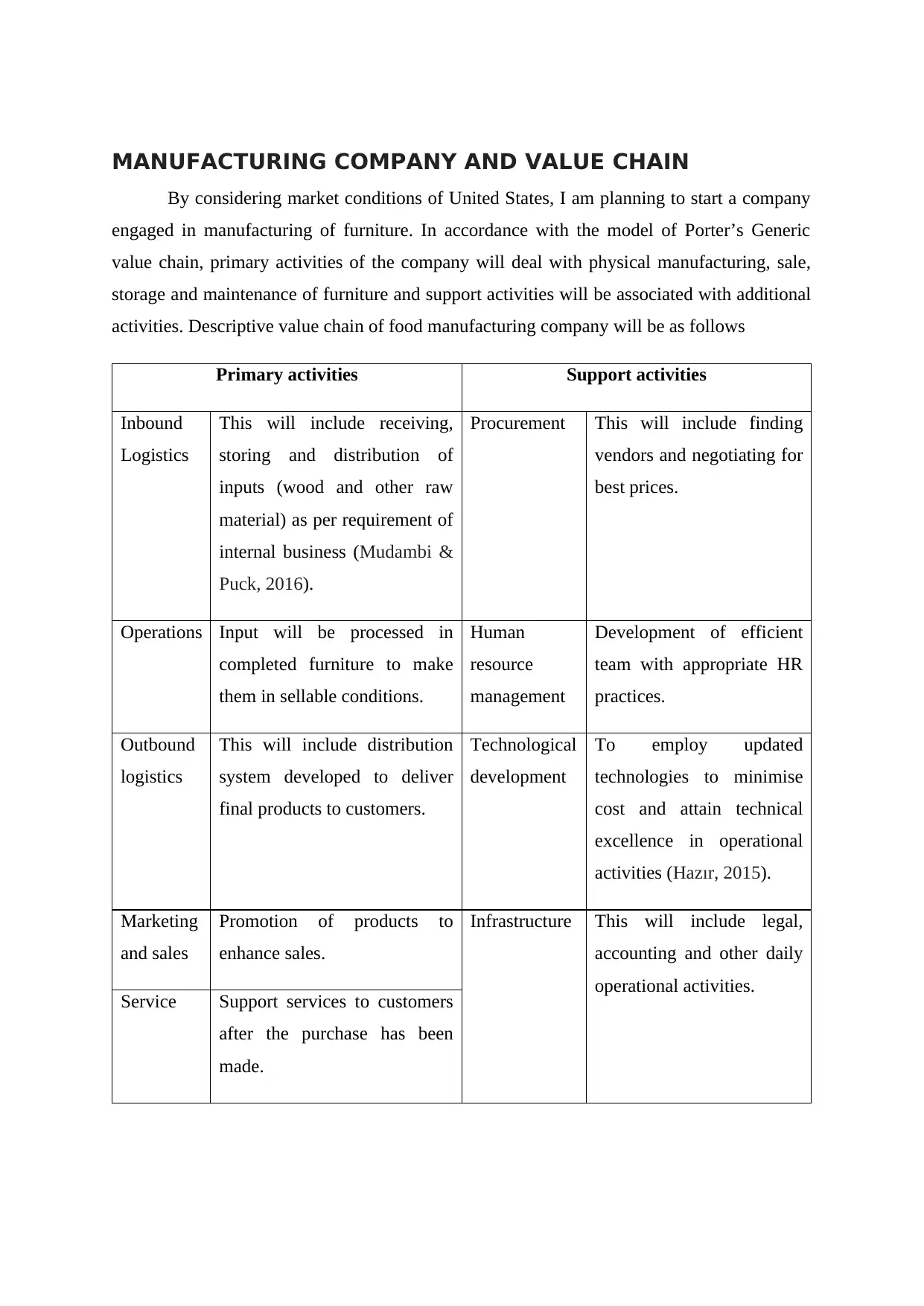
By considering market conditions of United States, I am planning to start a company
engaged in manufacturing of furniture. In accordance with the model of Porter’s Generic
value chain, primary activities of the company will deal with physical manufacturing, sale,
storage and maintenance of furniture and support activities will be associated with additional
activities. Descriptive value chain of food manufacturing company will be as follows
Primary activities Support activities
Inbound
Logistics
This will include receiving,
storing and distribution of
inputs (wood and other raw
material) as per requirement of
internal business (Mudambi &
Puck, 2016).
Procurement This will include finding
vendors and negotiating for
best prices.
Operations Input will be processed in
completed furniture to make
them in sellable conditions.
Human
resource
management
Development of efficient
team with appropriate HR
practices.
Outbound
logistics
This will include distribution
system developed to deliver
final products to customers.
Technological
development
To employ updated
technologies to minimise
cost and attain technical
excellence in operational
activities (Hazır, 2015).
Marketing
and sales
Promotion of products to
enhance sales.
Infrastructure This will include legal,
accounting and other daily
operational activities.
Service Support services to customers
after the purchase has been
made.
Document Page
TYPE OF BUDGET AND ESSENTIAL BUDGET REVIEW
STEPS
For effective financial management and planning, the master budget will be prepared
by considering operational activities of furniture manufacturing company. Considered budget
is an aggregate of individual budgets of the company and will present the complete picture
for their financial health by considering all activities (Kamensky, 2014). This budget will
combine factors such as sales, assets, operating expenses and associated income streams. By
making use of this budget, the company will be able to create financial goals and monitor
their overall performance. This approach will align all departments and their respective
managers for better coordination and communication.
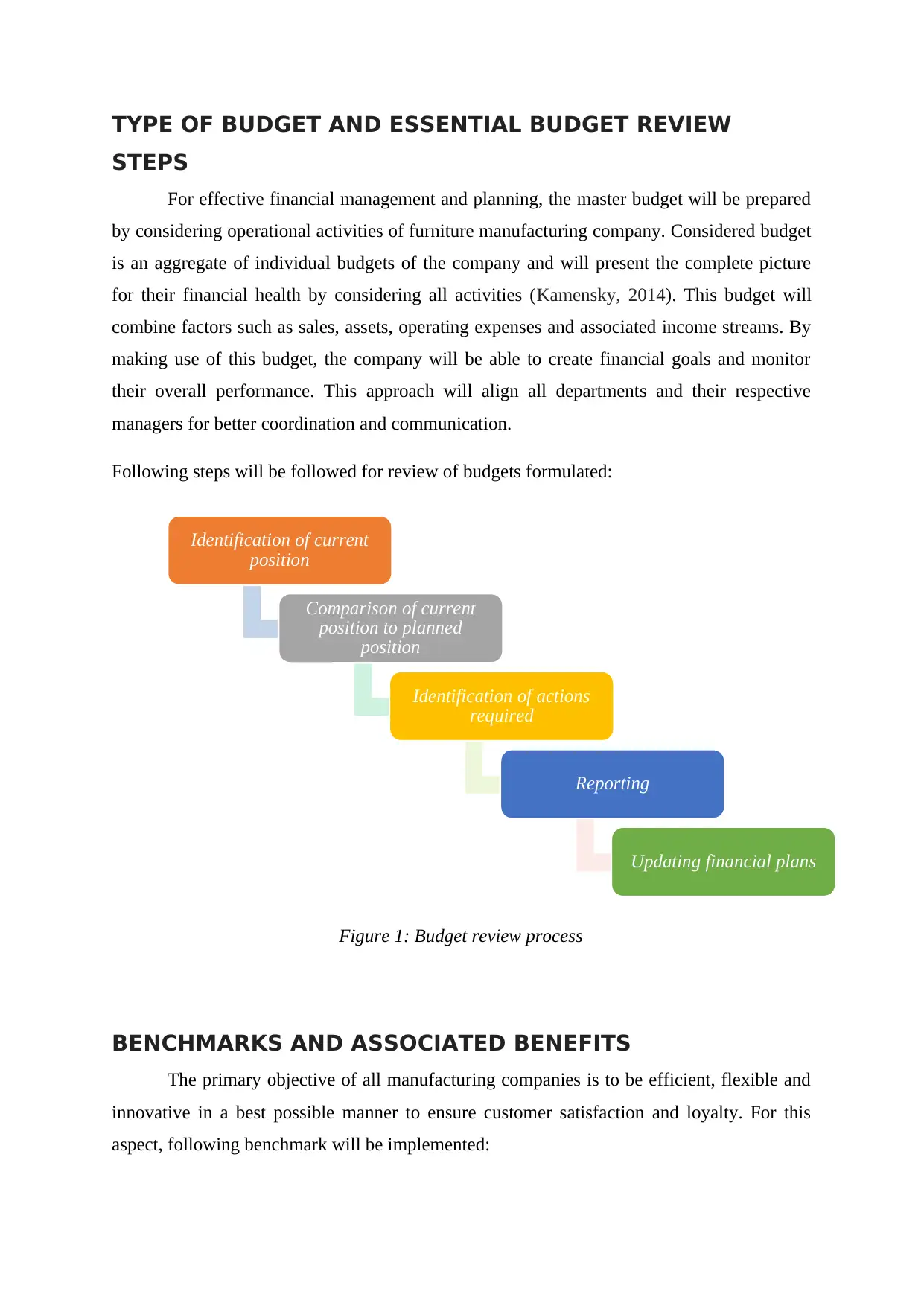
Following steps will be followed for review of budgets formulated:
Figure 1: Budget review process
BENCHMARKS AND ASSOCIATED BENEFITS
The primary objective of all manufacturing companies is to be efficient, flexible and
innovative in a best possible manner to ensure customer satisfaction and loyalty. For this
aspect, following benchmark will be implemented:
Identification of current
position
Comparison of current
position to planned
position
Identification of actions
required
Reporting
Updating financial plans
tabler-icon-diamond-filled.svg

Paraphrase This Document

Need a fresh take? Get an instant paraphrase of this document with our AI Paraphraser
Document Page
Cost reduction and profitability increase: For this benchmark, management is required to set
a target for manufacturing cost per unit, Downtime in Proportion to Operating Time and
Productivity in Revenue per Employee. With this benchmark, furniture processing will be
cost effective and as per prepared budgets (DRURY, 2013). Further, downtime will be
minimised, and employee performance will be assessed in an appropriate manner to ensure
overall productivity.
Production targets: Targets for production will be established at regular time intervals for
workers. This benchmark will assist the company in making optimum utilisation of available
capacity and have control over inventory turnover.
Customer experience: Regarding this benchmark, the company should set a target for on time
delivery and yield to ensure the final product is delivered as per promise without
unreasonable delay. Further, product quality should be maintained by ensuring quality,
qualification of staff and utilised equipment (Weygandt, Kimmel & Kieso, 2015). With this
approach, business will be able to enhance customer satisfaction and built their reputation in
the market.
Ensuring compliance: Appropriate procedure and standards will be set for all operational
activities by considering native laws and furniture industry standards. With this approach,
work issues can be prevented, and operational activities will be conducted in accordance with
laws and ethics.
COST SYSTEM
Furniture manufacturing company will make use of absorption costing system for
preparing cost sheets and accounting. It is a process of accumulating or expensing the cost
involved in the entire production process and allocating to individual products. This method
is required to maintain the inventory valuation. The various costs that are assigned under this
costing method are direct material, direct labour, variable manufacturing overhead and fixed
manufacturing overhead (Mudambi & Puck, 2016). However, the primary challenge in this
costing system is that product cost may not be directly traceable to the product because
absorption costing requires allocation of overhead cost to the product (Rushton, Croucher and
Baker, 2014). The other costing method is considered better as they do not require allocation
of overheads. It can help in generating profit by producing more products than it can sell
because absorption costing method allocates fixed manufacturing overhead to total unit
Document Page
produced and if some of them are not sold then the fixed overhead costs allotted to extra units
is never charged to expense thus increasing the profits (Weygandt, Kimmel & Kieso,
2015).To resolve the above-described challenges, absorption costing will be applied with the
approach of activity based costing in ensure relevant figures and accurate analysis for
business.
chevron_up_icon
1 out of 6
circle_padding
hide_on_mobile
zoom_out_icon
[object Object]