Financial Analysis: Smart Safety Break-Even and Production Variance

Verified

Added on  2020/03/23

|4
|445
|49
Report
AI Summary
This report provides a financial analysis of Smart Safety, focusing on break-even points and production volume variance. It examines the impact of fixed and variable costs on the company's net operating income. The analysis highlights how changes in production volume affect the allocation of fixed overhead costs, influencing the break-even point. The report references relevant literature to support its findings, including the works of Garrison et al. (2010) and Roth (2008). The conclusion emphasizes the significance of the budgeted production level method in allocating fixed overheads and its effect on net income, even when sales and other factors remain constant. The report suggests that the increase in actual production from 52,000 to 62,400 units resulted in a favorable volume variance, but this also impacted the net operating income due to changes in the fixed cost allocation. The report is a great resource for students who need help with similar assignments.
Document Page
COST ACCOUNTING
SMART SAFETY BREAK-EVEN ANALYSIS AND PRODUCTION VOLUME VARIANCE
Student’s Name
Institutional Affiliation
tabler-icon-diamond-filled.svg

Paraphrase This Document

Need a fresh take? Get an instant paraphrase of this document with our AI Paraphraser
Document Page
COST ACCOUNTING
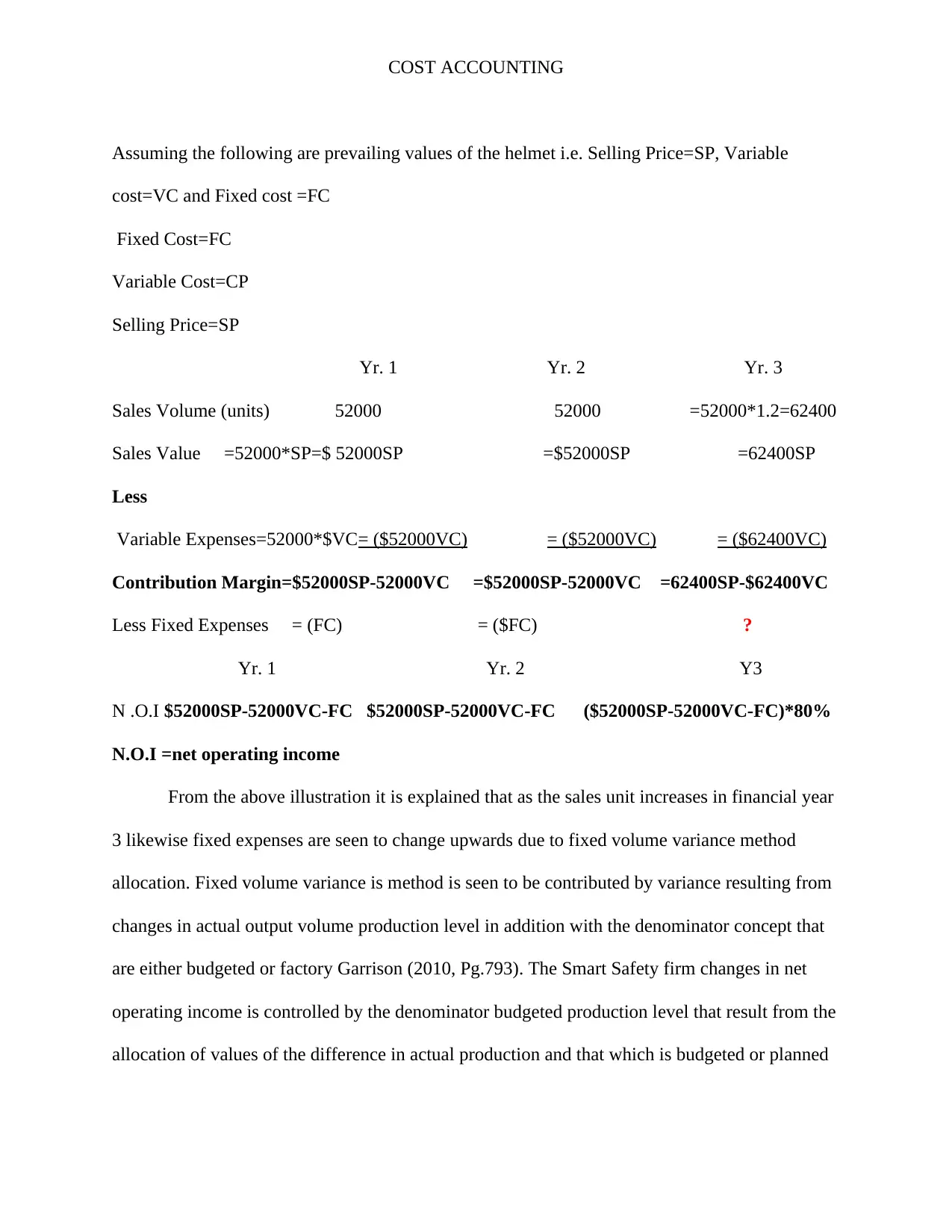
Assuming the following are prevailing values of the helmet i.e. Selling Price=SP, Variable
cost=VC and Fixed cost =FC
Fixed Cost=FC
Variable Cost=CP
Selling Price=SP
Yr. 1 Yr. 2 Yr. 3
Sales Volume (units) 52000 52000 =52000*1.2=62400
Sales Value =52000*SP=$ 52000SP =$52000SP =62400SP
Less
Variable Expenses=52000*$VC= ($52000VC) = ($52000VC) = ($62400VC)
Contribution Margin=$52000SP-52000VC =$52000SP-52000VC =62400SP-$62400VC
Less Fixed Expenses = (FC) = ($FC) ?
Yr. 1 Yr. 2 Y3
N .O.I $52000SP-52000VC-FC $52000SP-52000VC-FC ($52000SP-52000VC-FC)*80%
N.O.I =net operating income
From the above illustration it is explained that as the sales unit increases in financial year
3 likewise fixed expenses are seen to change upwards due to fixed volume variance method
allocation. Fixed volume variance is method is seen to be contributed by variance resulting from
changes in actual output volume production level in addition with the denominator concept that
are either budgeted or factory Garrison (2010, Pg.793). The Smart Safety firm changes in net
operating income is controlled by the denominator budgeted production level that result from the
allocation of values of the difference in actual production and that which is budgeted or planned
Document Page
COST ACCOUNTING
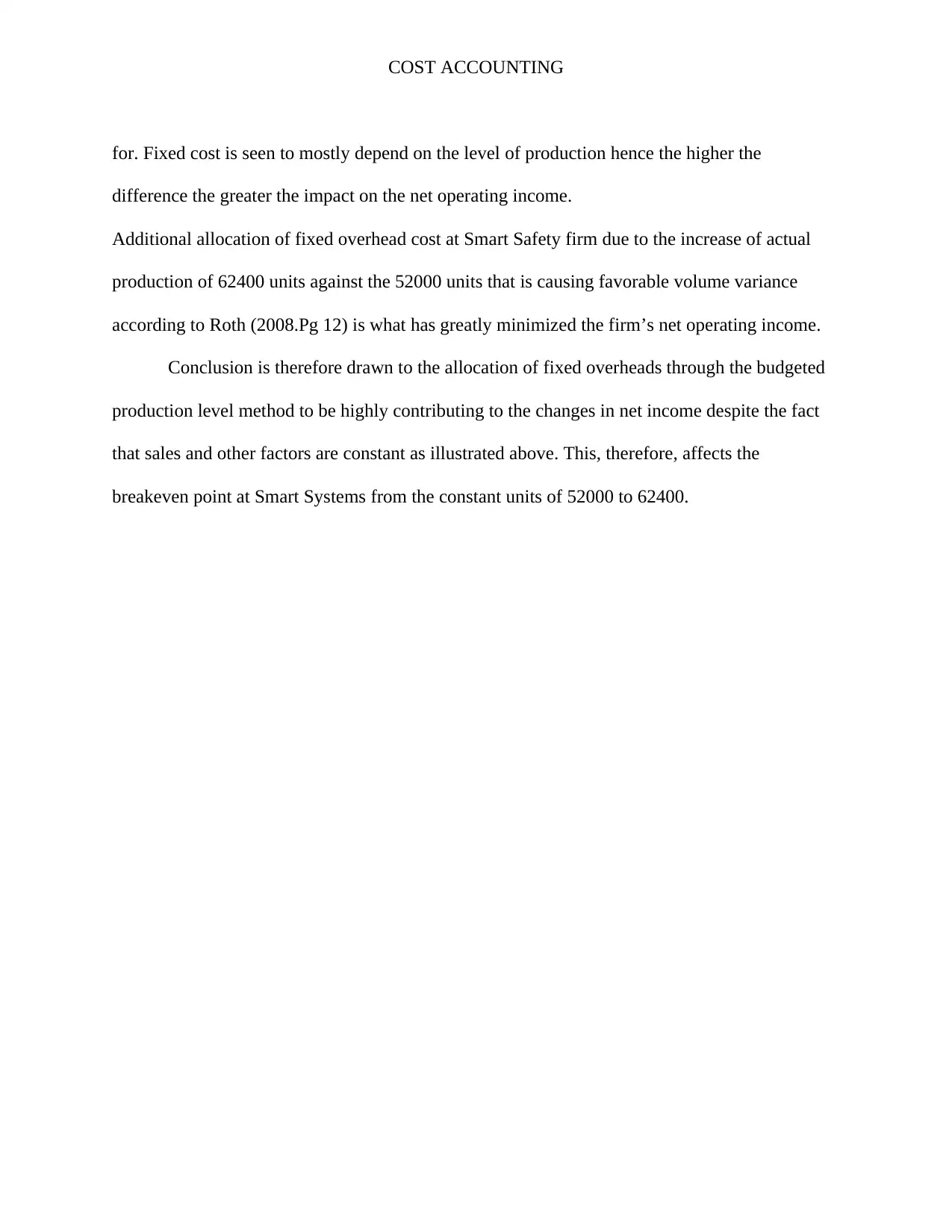
for. Fixed cost is seen to mostly depend on the level of production hence the higher the
difference the greater the impact on the net operating income.
Additional allocation of fixed overhead cost at Smart Safety firm due to the increase of actual
production of 62400 units against the 52000 units that is causing favorable volume variance
according to Roth (2008.Pg 12) is what has greatly minimized the firm’s net operating income.
Conclusion is therefore drawn to the allocation of fixed overheads through the budgeted
production level method to be highly contributing to the changes in net income despite the fact
that sales and other factors are constant as illustrated above. This, therefore, affects the
breakeven point at Smart Systems from the constant units of 52000 to 62400.
Document Page
COST ACCOUNTING
References
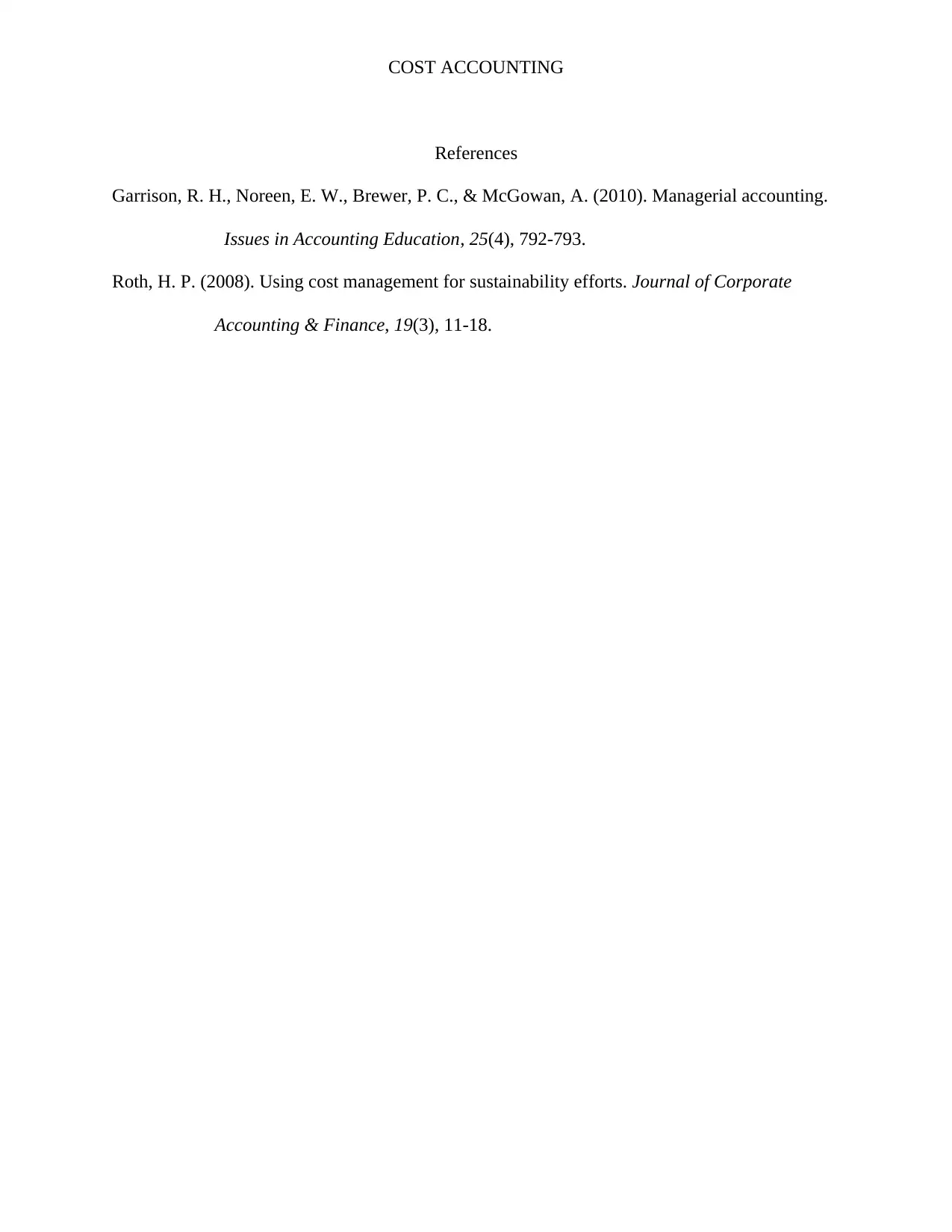
Garrison, R. H., Noreen, E. W., Brewer, P. C., & McGowan, A. (2010). Managerial accounting.
Issues in Accounting Education, 25(4), 792-793.
Roth, H. P. (2008). Using cost management for sustainability efforts. Journal of Corporate
Accounting & Finance, 19(3), 11-18.
chevron_up_icon
1 out of 4
circle_padding
hide_on_mobile
zoom_out_icon
[object Object]