Strategic Analysis Report: Financial Ratios and Starbucks Performance
VerifiedAdded on 2020/06/06
|13
|3566
|152
Report
AI Summary
This report provides a strategic and financial analysis of Starbucks. It begins with an introduction to the company, followed by an examination of its financial ratios, including profitability, activity, liquidity, and other relevant metrics over a three-year period. The report then delves into external factors affecting Starbucks using PESTEL analysis, and internal factors through SWOT and value chain analysis. The analysis includes market share, industrial life cycle stages, competitive strategies, and Porter's Five Forces. The report aims to evaluate Starbucks' strategic choices and provide insights into its performance, market position, and future prospects. The report also explores the challenges and opportunities faced by the company, offering recommendations based on the financial and strategic assessments. Finally, the report concludes with a summary of the key findings and a review of the company's overall strategic position.
Strategic management
Feedback from tutor
Hi there
These are the amendments which I require.
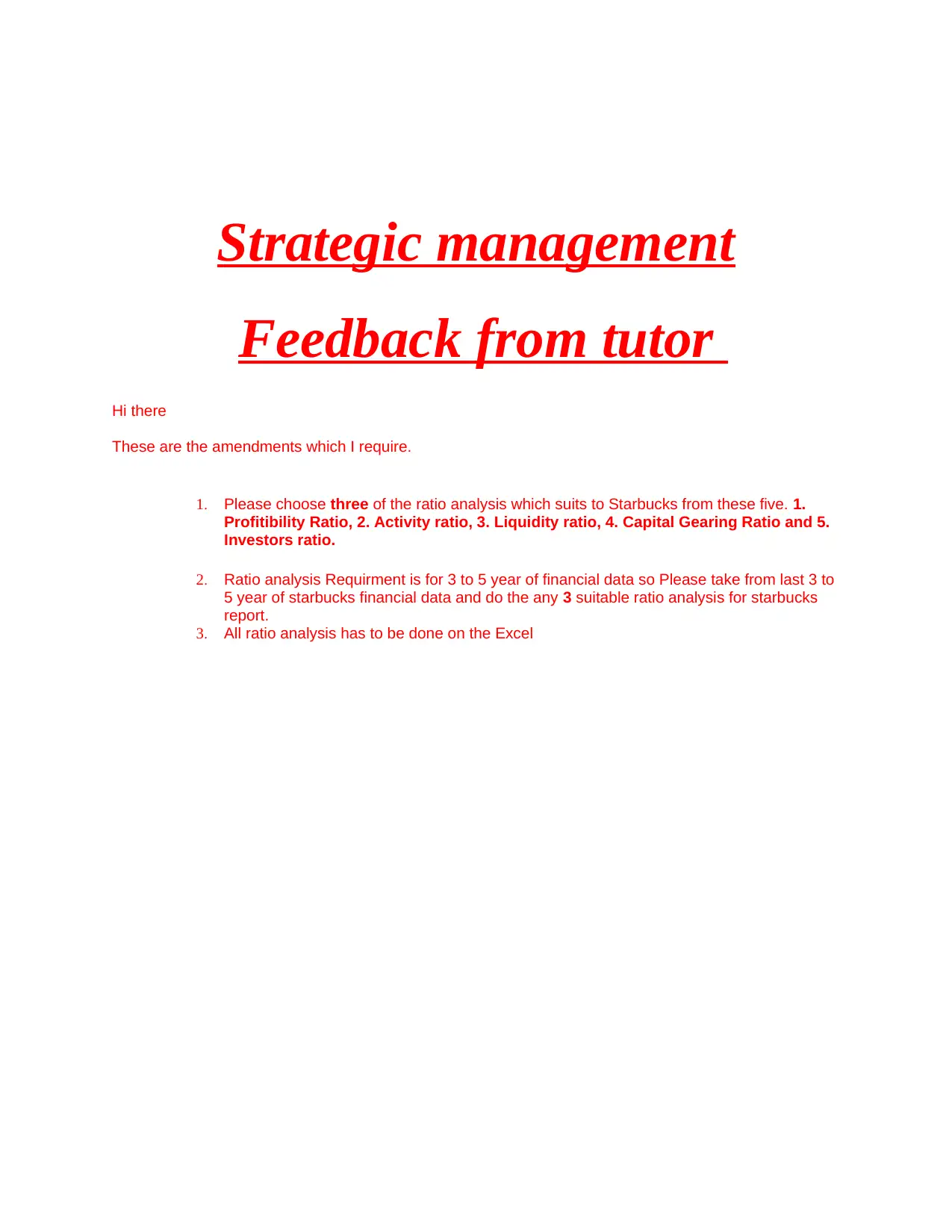
1. Please choose three of the ratio analysis which suits to Starbucks from these five. 1.
Profitibility Ratio, 2. Activity ratio, 3. Liquidity ratio, 4. Capital Gearing Ratio and 5.
Investors ratio.
2. Ratio analysis Requirment is for 3 to 5 year of financial data so Please take from last 3 to
5 year of starbucks financial data and do the any 3 suitable ratio analysis for starbucks
report.
3. All ratio analysis has to be done on the Excel
Feedback from tutor
Hi there
These are the amendments which I require.
1. Please choose three of the ratio analysis which suits to Starbucks from these five. 1.
Profitibility Ratio, 2. Activity ratio, 3. Liquidity ratio, 4. Capital Gearing Ratio and 5.
Investors ratio.
2. Ratio analysis Requirment is for 3 to 5 year of financial data so Please take from last 3 to
5 year of starbucks financial data and do the any 3 suitable ratio analysis for starbucks
report.
3. All ratio analysis has to be done on the Excel

Paraphrase This Document
Need a fresh take? Get an instant paraphrase of this document with our AI Paraphraser

Table of Contents
INTRODUCTION...........................................................................................................................4
Background of the company............................................................................................................5
Financial ratio of Starbucks .......................................................................................................5
External analysis of Starbucks ...................................................................................................8
Internal analysis of Starbucks:....................................................................................................9
Porter's five forces:....................................................................................................................10
Value chain analysis:.................................................................................................................11
CONCLUSION..............................................................................................................................12
References......................................................................................................................................13
.......................................................................................................................................................15
INTRODUCTION...........................................................................................................................4
Background of the company............................................................................................................5
Financial ratio of Starbucks .......................................................................................................5
External analysis of Starbucks ...................................................................................................8
Internal analysis of Starbucks:....................................................................................................9
Porter's five forces:....................................................................................................................10
Value chain analysis:.................................................................................................................11
CONCLUSION..............................................................................................................................12
References......................................................................................................................................13
.......................................................................................................................................................15
INTRODUCTION
It is important for all organisation to evaluate their strategies related to operations of
business. For this purpose company have to find out its its internal and external factors which
directly affect its business functions. There are various factor which helps to identify internal and
external factors. The strategic reviews and choices are include in this report. Starbucks is largest
coffee house which operate its business in wide geographical area. Company produce many
products such as dairy products, coffee and many more. This report includes financial status, life
cycle and market share of the Starbucks. There is also mentioned how organisation face their
threats and opportunities with the help of SWOT analysis and also includes external analysis
with the help of PESTEL analysis. Report includes company's competitive strategies for full fill
their targets and goals. Value chain analysis of the organisation is also mentioned in report.
Background of the company
Financial analyses:
It is essential for a business organization to analyses its financial position which provide a actual
position of the company(Ambrosini and Bowman, 2009). There are three types of statement
prepared by the company which includes income statement, balance sheet, trading and P&L
account. In this context, Starbucks required that to evolute these statement which help to increase
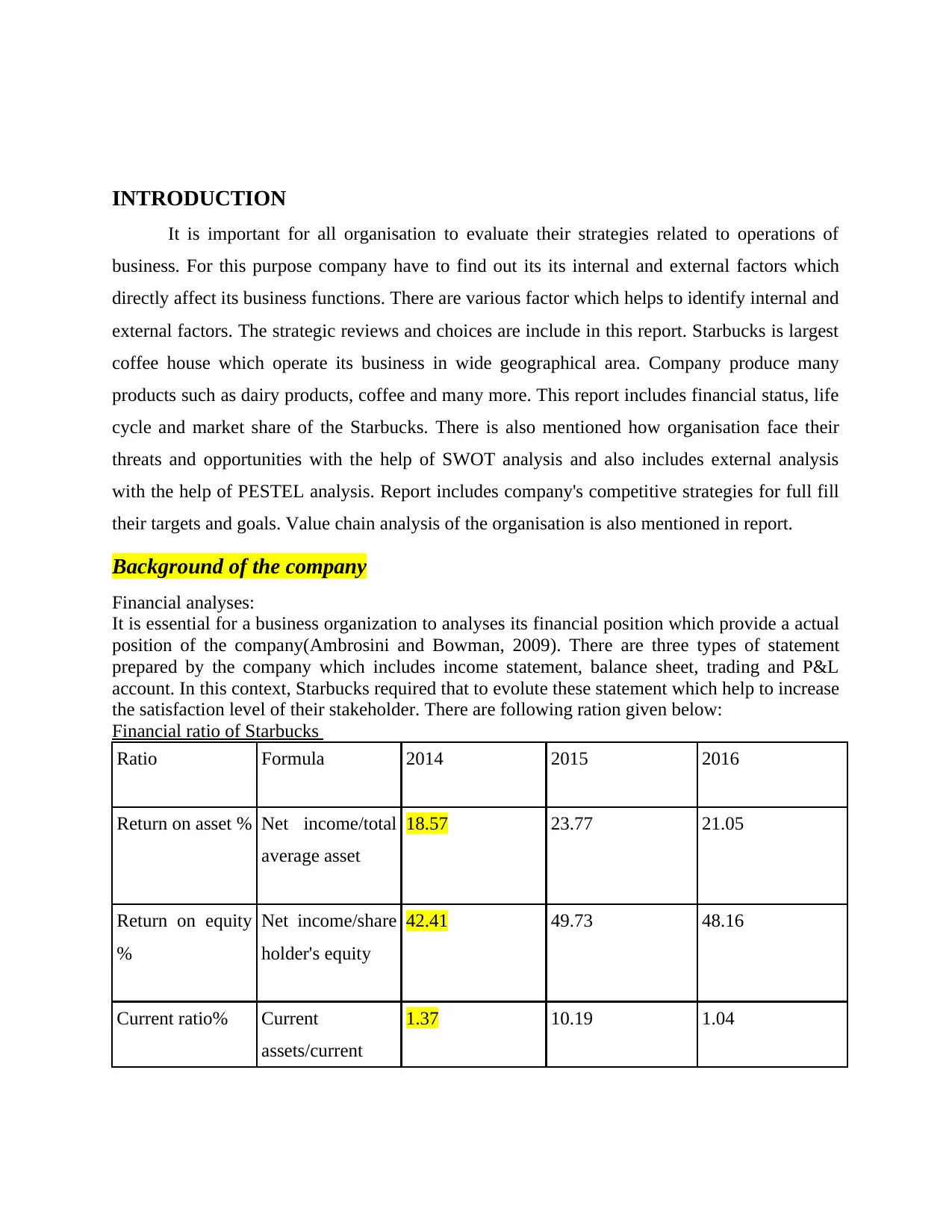
the satisfaction level of their stakeholder. There are following ration given below:
Financial ratio of Starbucks
Ratio Formula 2014 2015 2016
Return on asset % Net income/total
average asset
18.57 23.77 21.05
Return on equity
%
Net income/share
holder's equity
42.41 49.73 48.16
Current ratio% Current
assets/current
1.37 10.19 1.04
It is important for all organisation to evaluate their strategies related to operations of
business. For this purpose company have to find out its its internal and external factors which
directly affect its business functions. There are various factor which helps to identify internal and
external factors. The strategic reviews and choices are include in this report. Starbucks is largest
coffee house which operate its business in wide geographical area. Company produce many
products such as dairy products, coffee and many more. This report includes financial status, life
cycle and market share of the Starbucks. There is also mentioned how organisation face their
threats and opportunities with the help of SWOT analysis and also includes external analysis
with the help of PESTEL analysis. Report includes company's competitive strategies for full fill
their targets and goals. Value chain analysis of the organisation is also mentioned in report.
Background of the company
Financial analyses:
It is essential for a business organization to analyses its financial position which provide a actual
position of the company(Ambrosini and Bowman, 2009). There are three types of statement
prepared by the company which includes income statement, balance sheet, trading and P&L
account. In this context, Starbucks required that to evolute these statement which help to increase
the satisfaction level of their stakeholder. There are following ration given below:
Financial ratio of Starbucks
Ratio Formula 2014 2015 2016
Return on asset % Net income/total
average asset
18.57 23.77 21.05
Return on equity
%
Net income/share
holder's equity
42.41 49.73 48.16
Current ratio% Current
assets/current
1.37 10.19 1.04
⊘ This is a preview!⊘
Do you want full access?
Subscribe today to unlock all pages.

Trusted by 1+ million students worldwide

liabilities
Quick ratio% cash+cash
equivalents+short
term
investment+curre
nt
receivables/curre
nt liabilities
0.81 0.64 0.67
Fixed asset
turnover
Inventory
turnover ratio
4.90
6.23
5.04
6.50
4.94
6.34
As per the above given ration it has been represent that the financial position of the company is
quite good which plays a prominent role in the success for them. For example, current ration
is .64 percent which is quite good as compare to last year and the company is able to pay its
current obligation without selling their fixed assets.
Market share:
Every business organization is more focused on the sales and market share of their company.
They tries to increase its position in the market as compare to its competitors(Audebrand,, 2010).
In the context of given scenario, Starbucks tries to maintain its market share in the market.
According to the given data more than, 50 percent market share hold by three major corporation
including Starbucks. It shows the performance of the company is quite goods as compare to other
coffee chain.
The competition level in the UK is too high which having adverse impact on the performance
and sales of the cited company. Therefore it is the responsibility of higher authorities is to
expand their market share(Bottani and Rizzi, 2006). There are various emerging market such as
Quick ratio% cash+cash
equivalents+short
term
investment+curre
nt
receivables/curre
nt liabilities
0.81 0.64 0.67
Fixed asset
turnover
Inventory
turnover ratio
4.90
6.23
5.04
6.50
4.94
6.34
As per the above given ration it has been represent that the financial position of the company is
quite good which plays a prominent role in the success for them. For example, current ration
is .64 percent which is quite good as compare to last year and the company is able to pay its
current obligation without selling their fixed assets.
Market share:
Every business organization is more focused on the sales and market share of their company.
They tries to increase its position in the market as compare to its competitors(Audebrand,, 2010).
In the context of given scenario, Starbucks tries to maintain its market share in the market.
According to the given data more than, 50 percent market share hold by three major corporation
including Starbucks. It shows the performance of the company is quite goods as compare to other
coffee chain.
The competition level in the UK is too high which having adverse impact on the performance
and sales of the cited company. Therefore it is the responsibility of higher authorities is to
expand their market share(Bottani and Rizzi, 2006). There are various emerging market such as
Paraphrase This Document
Need a fresh take? Get an instant paraphrase of this document with our AI Paraphraser
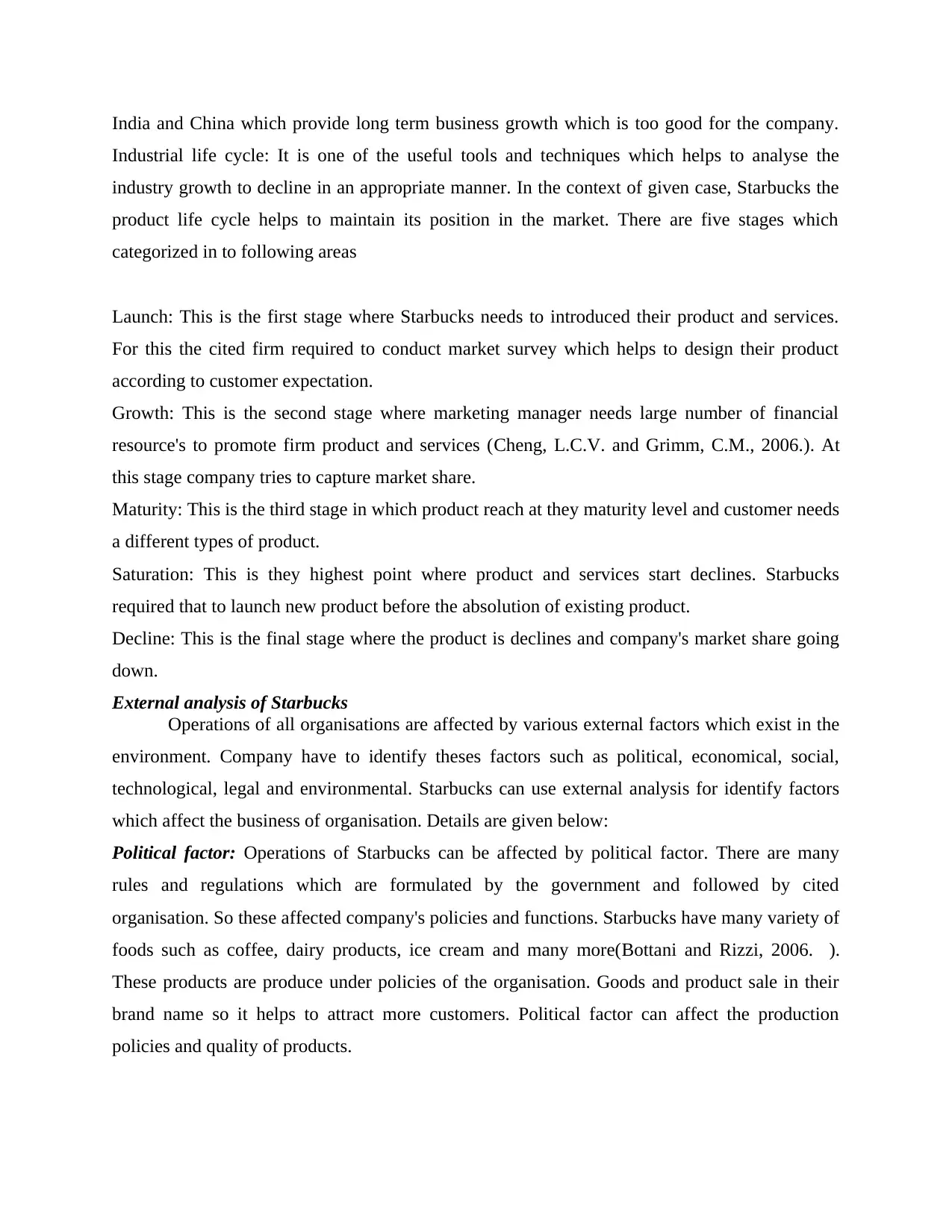
India and China which provide long term business growth which is too good for the company.
Industrial life cycle: It is one of the useful tools and techniques which helps to analyse the
industry growth to decline in an appropriate manner. In the context of given case, Starbucks the
product life cycle helps to maintain its position in the market. There are five stages which
categorized in to following areas
Launch: This is the first stage where Starbucks needs to introduced their product and services.
For this the cited firm required to conduct market survey which helps to design their product
according to customer expectation.
Growth: This is the second stage where marketing manager needs large number of financial
resource's to promote firm product and services (Cheng, L.C.V. and Grimm, C.M., 2006.). At
this stage company tries to capture market share.
Maturity: This is the third stage in which product reach at they maturity level and customer needs
a different types of product.
Saturation: This is they highest point where product and services start declines. Starbucks
required that to launch new product before the absolution of existing product.
Decline: This is the final stage where the product is declines and company's market share going
down.
External analysis of Starbucks
Operations of all organisations are affected by various external factors which exist in the
environment. Company have to identify theses factors such as political, economical, social,
technological, legal and environmental. Starbucks can use external analysis for identify factors
which affect the business of organisation. Details are given below:
Political factor: Operations of Starbucks can be affected by political factor. There are many
rules and regulations which are formulated by the government and followed by cited
organisation. So these affected company's policies and functions. Starbucks have many variety of
foods such as coffee, dairy products, ice cream and many more(Bottani and Rizzi, 2006. ).
These products are produce under policies of the organisation. Goods and product sale in their
brand name so it helps to attract more customers. Political factor can affect the production
policies and quality of products.
Industrial life cycle: It is one of the useful tools and techniques which helps to analyse the
industry growth to decline in an appropriate manner. In the context of given case, Starbucks the
product life cycle helps to maintain its position in the market. There are five stages which
categorized in to following areas
Launch: This is the first stage where Starbucks needs to introduced their product and services.
For this the cited firm required to conduct market survey which helps to design their product
according to customer expectation.
Growth: This is the second stage where marketing manager needs large number of financial
resource's to promote firm product and services (Cheng, L.C.V. and Grimm, C.M., 2006.). At
this stage company tries to capture market share.
Maturity: This is the third stage in which product reach at they maturity level and customer needs
a different types of product.
Saturation: This is they highest point where product and services start declines. Starbucks
required that to launch new product before the absolution of existing product.
Decline: This is the final stage where the product is declines and company's market share going
down.
External analysis of Starbucks
Operations of all organisations are affected by various external factors which exist in the
environment. Company have to identify theses factors such as political, economical, social,
technological, legal and environmental. Starbucks can use external analysis for identify factors
which affect the business of organisation. Details are given below:
Political factor: Operations of Starbucks can be affected by political factor. There are many
rules and regulations which are formulated by the government and followed by cited
organisation. So these affected company's policies and functions. Starbucks have many variety of
foods such as coffee, dairy products, ice cream and many more(Bottani and Rizzi, 2006. ).
These products are produce under policies of the organisation. Goods and product sale in their
brand name so it helps to attract more customers. Political factor can affect the production
policies and quality of products.
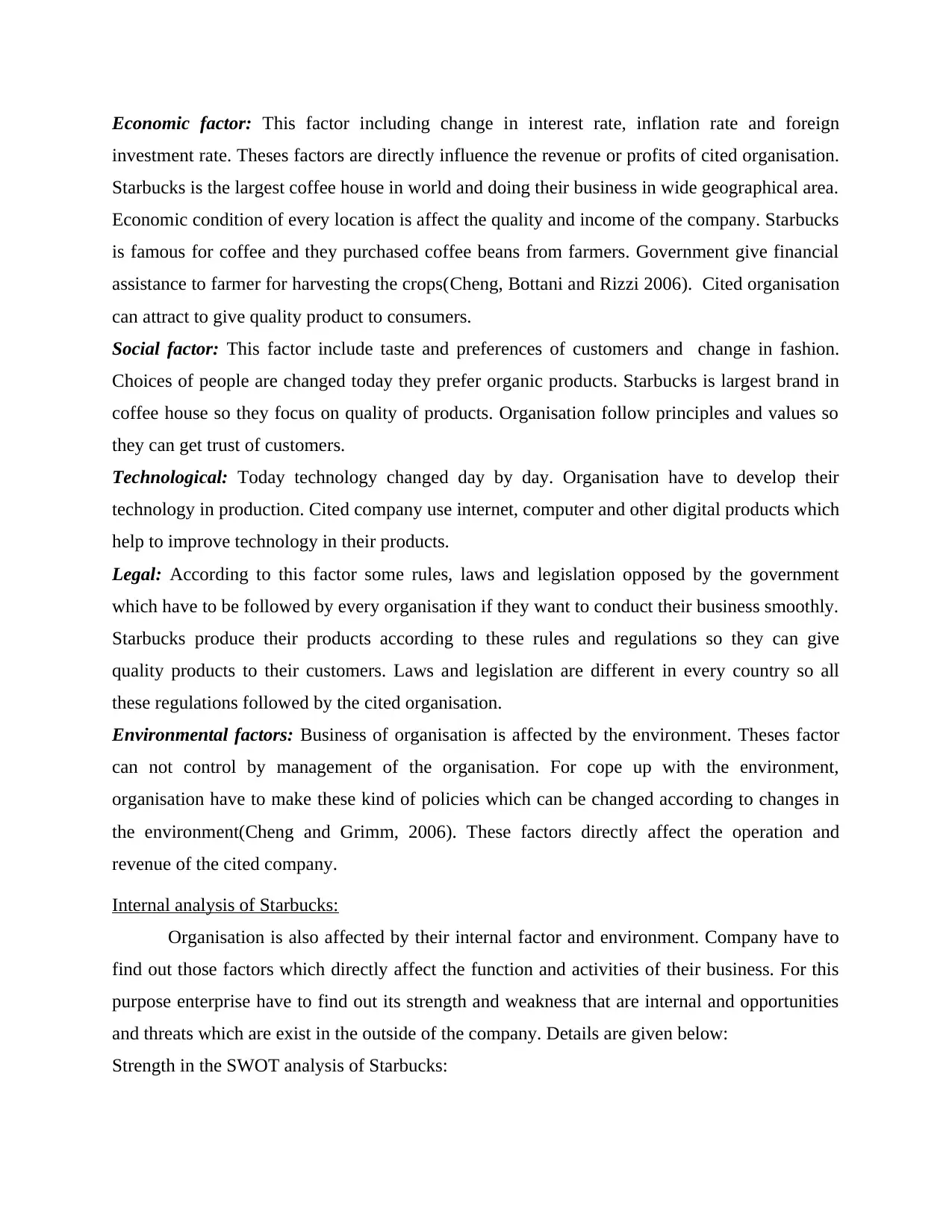
Economic factor: This factor including change in interest rate, inflation rate and foreign
investment rate. Theses factors are directly influence the revenue or profits of cited organisation.
Starbucks is the largest coffee house in world and doing their business in wide geographical area.
Economic condition of every location is affect the quality and income of the company. Starbucks
is famous for coffee and they purchased coffee beans from farmers. Government give financial
assistance to farmer for harvesting the crops(Cheng, Bottani and Rizzi 2006). Cited organisation
can attract to give quality product to consumers.
Social factor: This factor include taste and preferences of customers and change in fashion.
Choices of people are changed today they prefer organic products. Starbucks is largest brand in
coffee house so they focus on quality of products. Organisation follow principles and values so
they can get trust of customers.
Technological: Today technology changed day by day. Organisation have to develop their
technology in production. Cited company use internet, computer and other digital products which
help to improve technology in their products.
Legal: According to this factor some rules, laws and legislation opposed by the government
which have to be followed by every organisation if they want to conduct their business smoothly.
Starbucks produce their products according to these rules and regulations so they can give
quality products to their customers. Laws and legislation are different in every country so all
these regulations followed by the cited organisation.
Environmental factors: Business of organisation is affected by the environment. Theses factor
can not control by management of the organisation. For cope up with the environment,
organisation have to make these kind of policies which can be changed according to changes in
the environment(Cheng and Grimm, 2006). These factors directly affect the operation and
revenue of the cited company.
Internal analysis of Starbucks:
Organisation is also affected by their internal factor and environment. Company have to
find out those factors which directly affect the function and activities of their business. For this
purpose enterprise have to find out its strength and weakness that are internal and opportunities
and threats which are exist in the outside of the company. Details are given below:
Strength in the SWOT analysis of Starbucks:
investment rate. Theses factors are directly influence the revenue or profits of cited organisation.
Starbucks is the largest coffee house in world and doing their business in wide geographical area.
Economic condition of every location is affect the quality and income of the company. Starbucks
is famous for coffee and they purchased coffee beans from farmers. Government give financial
assistance to farmer for harvesting the crops(Cheng, Bottani and Rizzi 2006). Cited organisation
can attract to give quality product to consumers.
Social factor: This factor include taste and preferences of customers and change in fashion.
Choices of people are changed today they prefer organic products. Starbucks is largest brand in
coffee house so they focus on quality of products. Organisation follow principles and values so
they can get trust of customers.
Technological: Today technology changed day by day. Organisation have to develop their
technology in production. Cited company use internet, computer and other digital products which
help to improve technology in their products.
Legal: According to this factor some rules, laws and legislation opposed by the government
which have to be followed by every organisation if they want to conduct their business smoothly.
Starbucks produce their products according to these rules and regulations so they can give
quality products to their customers. Laws and legislation are different in every country so all
these regulations followed by the cited organisation.
Environmental factors: Business of organisation is affected by the environment. Theses factor
can not control by management of the organisation. For cope up with the environment,
organisation have to make these kind of policies which can be changed according to changes in
the environment(Cheng and Grimm, 2006). These factors directly affect the operation and
revenue of the cited company.
Internal analysis of Starbucks:
Organisation is also affected by their internal factor and environment. Company have to
find out those factors which directly affect the function and activities of their business. For this
purpose enterprise have to find out its strength and weakness that are internal and opportunities
and threats which are exist in the outside of the company. Details are given below:
Strength in the SWOT analysis of Starbucks:
⊘ This is a preview!⊘
Do you want full access?
Subscribe today to unlock all pages.
Trusted by 1+ million students worldwide
Large work force: Cited organisation have large number employees engaged in wide area in
their stores. They give their services in every corner of world. They maintain their quality of
products in every area. This is strength of cited organisation by which they can attract more
customers in the market.
Research and development centre: Starbucks has open their research and development centres
for identify new products which they can produce for increasing their sells(Furrer, O., Thomas,
and Goussevskaia, 2008). Many people and corporate industrialist are worked in the these
centres.
Weaknesses:
Brand composition: This is the major weakness of cited organisation because there are so many
other coffee houses available in the market so it create confusion and misunderstanding between
customers and organisations.
Customer loyalty: Sometimes organisation is not provide proper services to their customer so it
directly affect the customer satisfaction and loyalty.
Opportunities:
Management information system: Starbucks have effective information system by which they
can produce services according to choices of the customers.
Expending market: Cited organisation can expend their market share by segmentation of
market. They can also provide best products in urban areas with effective distribution channels.
Threat:
Competition: This is the big threat for every organisation. There are many other coffee houses
exist in the market which give same services like cited organisation. If cost of production is
increase than price of products automatically increase and they affect profit level of the
company.
Price of products: Organisation have to give better prices for their products to their customers if
they don't do this than it will became a major threat of cited organisation(Hill Jonesand
Schilling2011).
Porter's five forces:
Porter identify five competitive forces which helps to a organisation to sustain for long
time in market. It will also help to determine industry's strength and weaknesses. Five factors are
mentioned below:
their stores. They give their services in every corner of world. They maintain their quality of
products in every area. This is strength of cited organisation by which they can attract more
customers in the market.
Research and development centre: Starbucks has open their research and development centres
for identify new products which they can produce for increasing their sells(Furrer, O., Thomas,
and Goussevskaia, 2008). Many people and corporate industrialist are worked in the these
centres.
Weaknesses:
Brand composition: This is the major weakness of cited organisation because there are so many
other coffee houses available in the market so it create confusion and misunderstanding between
customers and organisations.
Customer loyalty: Sometimes organisation is not provide proper services to their customer so it
directly affect the customer satisfaction and loyalty.
Opportunities:
Management information system: Starbucks have effective information system by which they
can produce services according to choices of the customers.
Expending market: Cited organisation can expend their market share by segmentation of
market. They can also provide best products in urban areas with effective distribution channels.
Threat:
Competition: This is the big threat for every organisation. There are many other coffee houses
exist in the market which give same services like cited organisation. If cost of production is
increase than price of products automatically increase and they affect profit level of the
company.
Price of products: Organisation have to give better prices for their products to their customers if
they don't do this than it will became a major threat of cited organisation(Hill Jonesand
Schilling2011).
Porter's five forces:
Porter identify five competitive forces which helps to a organisation to sustain for long
time in market. It will also help to determine industry's strength and weaknesses. Five factors are
mentioned below:
Paraphrase This Document
Need a fresh take? Get an instant paraphrase of this document with our AI Paraphraser
Competition in the industry: There is many competitors available in the market which affect
business of a industry. It is major threat for a organisation which propounded by porter. Large
number of competitors produce same kinds of products and services which affect number of
customer of the organisation. They have to power to affect the profit level of the company.
Customers and suppliers have to consider competitor's products and services when they make
policies regarding their production.
Threats of new entrants into an industry: A organisation's business also affected by new
entrants in the market. If a business can easily started in market without considerable investment
than this threat for existing companies. Some factors which have to be consider by a organisation
such as what rules and regulations, strategies and products which will produce by new entry. For
example if a new coffee house open in the market of UK than cited organisation have to be
consider these factors so that they can deliver better services to their customer against new
industry.
Buyer power: Customers are the key factor for success any organisation. Buyer have power to
affect the income or profit level of the organisation. If there is fewer buyer available in the
market than they can affect the industry. This model include some important things such as how
many customers available in the market, what are their income level, how much they can spend
for purchasing the products and do they have power to effect terms and condition of the industry.
Starbucks also consider their total customers and their choices which help to produce quality
services to their customers.
Threat of substitutes: This is also a major factor which affect revenue of organisation. In market
there are many other manufactures available who produce same kind of goods and services.
Starbucks have to consider strength factors of other substitutes so they can provide better
services to their clients against its substitute goods(Grunig,2006). For example if customers
depend to a enterprise to provide good or service and that can be easily substitute with other
good and service and this substitution is easy for consumers than it directly affect power of
company.
Power of suppliers: This factor include total power of supplier by which a organisation transfer
its goods and services to its customers. Power is affected by the key aspects of goods and
services. A organisation is also consider that how many suppliers available in the market, how
they are control prices in the fluctuate market.
business of a industry. It is major threat for a organisation which propounded by porter. Large
number of competitors produce same kinds of products and services which affect number of
customer of the organisation. They have to power to affect the profit level of the company.
Customers and suppliers have to consider competitor's products and services when they make
policies regarding their production.
Threats of new entrants into an industry: A organisation's business also affected by new
entrants in the market. If a business can easily started in market without considerable investment
than this threat for existing companies. Some factors which have to be consider by a organisation
such as what rules and regulations, strategies and products which will produce by new entry. For
example if a new coffee house open in the market of UK than cited organisation have to be
consider these factors so that they can deliver better services to their customer against new
industry.
Buyer power: Customers are the key factor for success any organisation. Buyer have power to
affect the income or profit level of the organisation. If there is fewer buyer available in the
market than they can affect the industry. This model include some important things such as how
many customers available in the market, what are their income level, how much they can spend
for purchasing the products and do they have power to effect terms and condition of the industry.
Starbucks also consider their total customers and their choices which help to produce quality
services to their customers.
Threat of substitutes: This is also a major factor which affect revenue of organisation. In market
there are many other manufactures available who produce same kind of goods and services.
Starbucks have to consider strength factors of other substitutes so they can provide better
services to their clients against its substitute goods(Grunig,2006). For example if customers
depend to a enterprise to provide good or service and that can be easily substitute with other
good and service and this substitution is easy for consumers than it directly affect power of
company.
Power of suppliers: This factor include total power of supplier by which a organisation transfer
its goods and services to its customers. Power is affected by the key aspects of goods and
services. A organisation is also consider that how many suppliers available in the market, how
they are control prices in the fluctuate market.
Company have to focus on these five porter model if they want to compete in the market
and provide quality goods and services to the customers. It will help to the organisation
increasing sustainability in the market for long time.
Value chain analysis:
Value chain is based on the process of company. This idea is basically designed for
manufacturing industries. This process is started from arrange inputs, transform and give output
as product and services. Organisations is converted thousands of activities making input from
output. These activities can be categorised as primary and support activities. value chain analysis
is help to identify profit against its cost. Output involves consumption of resources such as
material, labour, land, equipment and building(Hill, Jones, and Schilling, ., 2014). This concept
of value chain is propounded by porter. Value chain analysis include some activities:
Inbound logistics: This activity is related with the suppliers. According to this function it is
important to make good relation with the suppliers and include all the activities such as receive
goods, store them and supply them to customers.
Operations: This activity includes core functions of the company for which they conduct their
business. It includes services and goods which a industry manufacture.
Outbound logistics: This step involve all the activities which need to be required for full fill the
activities of collect input material, store them and distribute to the customer.
Marketing and sales: This is the important activity of value chain. Once products are ready to
sales than organisation is conduct marketing programme for increasing its sales by attracting the
customers of market. It includes give information to the clients about the products offered by the
organisation.
Service: This is the last step in core activities in value chain. It includes all the activities by
which a organisation give best services after sale their product.
Value chain is also include some secondary activities given below:
Procurement: This step include identify resources and material for the production in the
company. It not only includes identification of resources but also acquire these material and
resources.
Human resource management: This is the major activity in any kind of organisation because
without workforce a company cannot operate its business effectively. It includes some important
activities such as recruitment, selection, training, development and give them remuneration for
and provide quality goods and services to the customers. It will help to the organisation
increasing sustainability in the market for long time.
Value chain analysis:
Value chain is based on the process of company. This idea is basically designed for
manufacturing industries. This process is started from arrange inputs, transform and give output
as product and services. Organisations is converted thousands of activities making input from
output. These activities can be categorised as primary and support activities. value chain analysis
is help to identify profit against its cost. Output involves consumption of resources such as
material, labour, land, equipment and building(Hill, Jones, and Schilling, ., 2014). This concept
of value chain is propounded by porter. Value chain analysis include some activities:
Inbound logistics: This activity is related with the suppliers. According to this function it is
important to make good relation with the suppliers and include all the activities such as receive
goods, store them and supply them to customers.
Operations: This activity includes core functions of the company for which they conduct their
business. It includes services and goods which a industry manufacture.
Outbound logistics: This step involve all the activities which need to be required for full fill the
activities of collect input material, store them and distribute to the customer.
Marketing and sales: This is the important activity of value chain. Once products are ready to
sales than organisation is conduct marketing programme for increasing its sales by attracting the
customers of market. It includes give information to the clients about the products offered by the
organisation.
Service: This is the last step in core activities in value chain. It includes all the activities by
which a organisation give best services after sale their product.
Value chain is also include some secondary activities given below:
Procurement: This step include identify resources and material for the production in the
company. It not only includes identification of resources but also acquire these material and
resources.
Human resource management: This is the major activity in any kind of organisation because
without workforce a company cannot operate its business effectively. It includes some important
activities such as recruitment, selection, training, development and give them remuneration for
⊘ This is a preview!⊘
Do you want full access?
Subscribe today to unlock all pages.
Trusted by 1+ million students worldwide
their efforts in the company(M.A., 2011.). It also involve promotion, retrenchment and
retirement of the employees.
Technological development: When a company produce goods and services they need
technological development in their resources, input material and procedures so they can give
quality services to their customers.
Infrastructure: This activity is include provide infrastructure facilities to the company which is
very important to conduct smooth operation in the company. These facilities includes functions
of many departments such s legal, public affairs, quality assurance, finance and government
relations.
Every organisation have to follow this supply chain if they want to operate its business in
effective manner.
CONCLUSION
As per the report, there are various competitive strategies are taken by the organisation.
There are various internal and external factors which influence theses strategies. Company have
to focus on the strength and weakness which are inside in the organisation on the other hand
there is also opportunities and threat which are exist in the outside of the environment. Report is
also includes porter's five model which helps to a company maintain its sustainability in the
market. According to this report we can conclude that activities of supply chain is also followed
by every organisation. As per the report background of cited company has also taken.
References
Books and Journal
Ambrosini, V. and Bowman, C., 2009. What are dynamic capabilities and are they a useful
construct in strategic management?. International journal of management reviews.
11(1). pp.29-49.
Audebrand, L.K., 2010. Sustainability in strategic management education: The quest for new
root metaphors. Academy of Management Learning & Education. 9(3). pp.413-428.
Bottani, E. and Rizzi, A., 2006. Strategic management of logistics service: A fuzzy QFD
approach. International Journal of Production Economics. 103(2). pp.585-599.
retirement of the employees.
Technological development: When a company produce goods and services they need
technological development in their resources, input material and procedures so they can give
quality services to their customers.
Infrastructure: This activity is include provide infrastructure facilities to the company which is
very important to conduct smooth operation in the company. These facilities includes functions
of many departments such s legal, public affairs, quality assurance, finance and government
relations.
Every organisation have to follow this supply chain if they want to operate its business in
effective manner.
CONCLUSION
As per the report, there are various competitive strategies are taken by the organisation.
There are various internal and external factors which influence theses strategies. Company have
to focus on the strength and weakness which are inside in the organisation on the other hand
there is also opportunities and threat which are exist in the outside of the environment. Report is
also includes porter's five model which helps to a company maintain its sustainability in the
market. According to this report we can conclude that activities of supply chain is also followed
by every organisation. As per the report background of cited company has also taken.
References
Books and Journal
Ambrosini, V. and Bowman, C., 2009. What are dynamic capabilities and are they a useful
construct in strategic management?. International journal of management reviews.
11(1). pp.29-49.
Audebrand, L.K., 2010. Sustainability in strategic management education: The quest for new
root metaphors. Academy of Management Learning & Education. 9(3). pp.413-428.
Bottani, E. and Rizzi, A., 2006. Strategic management of logistics service: A fuzzy QFD
approach. International Journal of Production Economics. 103(2). pp.585-599.
Paraphrase This Document
Need a fresh take? Get an instant paraphrase of this document with our AI Paraphraser

Cheng, L.C.V. and Grimm, C.M., 2006. The application of empirical strategic management
research to supply chain management. Journal of Business Logistics. 27(1). pp.1-55.
Furrer, O., Thomas, H. and Goussevskaia, A., 2008. The structure and evolution of the strategic
management field: A content analysis of 26 years of strategic management research.
International Journal of Management Reviews. 10(1). pp.1-23.
Grunig, J.E., 2006. Furnishing the edifice: Ongoing research on public relations as a strategic
management function. Journal of Public Relations Research. 18(2). pp.151-176.
Hill, C.W., Jones, G.R. and Schilling, M.A., 2014. Strategic management: theory: an integrated
approach. Cengage Learning.
Hitt, M.A., 2011. Relevance of strategic management theory and research for supply chain
management. Journal of Supply Chain Management. 47(1). pp.9-13.
Hitt, M.A., Ireland, R.D. and Hoskisson, R.E., 2012. Strategic management cases:
competitiveness and globalization. Cengage Learning.
Hodgkinson, G.P. and Healey, M.P., 2011. Psychological foundations of dynamic capabilities:
reflexion and reflection in strategic management.Strategic Management Journal.
32(13). pp.1500-1516.
Hult, G.T.M., Ketchen, D.J. and Arrfelt, M., 2007. Strategic supply chain management:
Improving performance through a culture of competitiveness and knowledge
development. Strategic management journal. 28(10). pp.1035-1052.
Johanson, J. and Vahlne, J.E., 2009. The Uppsala internationalization process model revisited:
From liability of foreignness to liability of outsidership. Journal of international
business studies. 40(9). pp.1411-1431.
Kraus, S. and Kauranen, I., 2009. Strategic management and entrepreneurship: Friends or foes.
International Journal of Business Science and Applied Management. 4(1). pp.37-50.
research to supply chain management. Journal of Business Logistics. 27(1). pp.1-55.
Furrer, O., Thomas, H. and Goussevskaia, A., 2008. The structure and evolution of the strategic
management field: A content analysis of 26 years of strategic management research.
International Journal of Management Reviews. 10(1). pp.1-23.
Grunig, J.E., 2006. Furnishing the edifice: Ongoing research on public relations as a strategic
management function. Journal of Public Relations Research. 18(2). pp.151-176.
Hill, C.W., Jones, G.R. and Schilling, M.A., 2014. Strategic management: theory: an integrated
approach. Cengage Learning.
Hitt, M.A., 2011. Relevance of strategic management theory and research for supply chain
management. Journal of Supply Chain Management. 47(1). pp.9-13.
Hitt, M.A., Ireland, R.D. and Hoskisson, R.E., 2012. Strategic management cases:
competitiveness and globalization. Cengage Learning.
Hodgkinson, G.P. and Healey, M.P., 2011. Psychological foundations of dynamic capabilities:
reflexion and reflection in strategic management.Strategic Management Journal.
32(13). pp.1500-1516.
Hult, G.T.M., Ketchen, D.J. and Arrfelt, M., 2007. Strategic supply chain management:
Improving performance through a culture of competitiveness and knowledge
development. Strategic management journal. 28(10). pp.1035-1052.
Johanson, J. and Vahlne, J.E., 2009. The Uppsala internationalization process model revisited:
From liability of foreignness to liability of outsidership. Journal of international
business studies. 40(9). pp.1411-1431.
Kraus, S. and Kauranen, I., 2009. Strategic management and entrepreneurship: Friends or foes.
International Journal of Business Science and Applied Management. 4(1). pp.37-50.
Nerur, S.P., Rasheed, A.A. and Natarajan, V., 2008. The intellectual structure of the strategic
management field: An author co‐citation analysis. Strategic Management Journal.
29(3). pp.319-336.
Parnell, J.A., 2008. Sustainable strategic management: construct, parameters, research directions.
International Journal of Sustainable Strategic Management. 1(1). pp.35-45.
management field: An author co‐citation analysis. Strategic Management Journal.
29(3). pp.319-336.
Parnell, J.A., 2008. Sustainable strategic management: construct, parameters, research directions.
International Journal of Sustainable Strategic Management. 1(1). pp.35-45.
⊘ This is a preview!⊘
Do you want full access?
Subscribe today to unlock all pages.
Trusted by 1+ million students worldwide

1 out of 13


Related Documents


Your All-in-One AI-Powered Toolkit for Academic Success.
+13062052269
info@desklib.com
Available 24*7 on WhatsApp / Email
![[object Object]](/_next/static/media/star-bottom.7253800d.svg)
Unlock your academic potential
Copyright © 2020–2026 A2Z Services. All Rights Reserved. Developed and managed by ZUCOL.