Financial Analysis: Costs, Accounting & Funding in Travel Tourism
VerifiedAdded on 2024/06/07
|20
|3509
|289
Report
AI Summary
This report provides a comprehensive analysis of finance and funding within the travel and tourism sector, emphasizing the importance of cost management, volume analysis, and profit considerations for informed decision-making. It explores various pricing methods employed in the tour and travel industries, along with factors that significantly influence profitability. The report assesses the utility of management accounting information as a vital decision-making tool, interpreting financial accounts to aid in strategic planning. A key focus is on understanding the sources and distribution of funding for both public and non-public tourism development, including the analysis of capital projects. The inclusion of a case study, such as the Dalata Hotel Group, illustrates the practical application of financial ratios and performance analysis, offering a holistic view of financial management in the tourism sector.
Finance and Funding in the Travel and Tourism Sector

Paraphrase This Document
Need a fresh take? Get an instant paraphrase of this document with our AI Paraphraser
Contents
Introduction....................................................................................................................................3
TASK 1...........................................................................................................................................4
LO1- Understand the importance of costs, volume and profit for management decision
making in travel and tourism.......................................................................................................4
1.1 Explain the importance of costs and volume in financial management of travel and tourism
business........................................................................................................................................4
1.2 Analyze pricing methods used in tour and travel industries..................................................5
1.3 Analyze factors influencing profit for tour and travel businesses.........................................6
Task 2..............................................................................................................................................7
LO2 Understand the use of management accounting information as a decision-making tool
in travel and tourism businesses...................................................................................................7
2.1 Explain different types of management accounting information that could be used in travel
and tourism businesses.................................................................................................................7
2.2 Essess the use of management accounting information as a decision-making tool...............7
Task 3..............................................................................................................................................9
LO3 Be able to interpret financial accounts to assist decision making in travel and tourism
businesses........................................................................................................................................9
3.1 Interpret travel and tourism financial accounts......................................................................9
Task 4............................................................................................................................................11
LO4 Understand sources and distribution of funding for public and non-public tourism
development..................................................................................................................................11
Introduction....................................................................................................................................3
TASK 1...........................................................................................................................................4
LO1- Understand the importance of costs, volume and profit for management decision
making in travel and tourism.......................................................................................................4
1.1 Explain the importance of costs and volume in financial management of travel and tourism
business........................................................................................................................................4
1.2 Analyze pricing methods used in tour and travel industries..................................................5
1.3 Analyze factors influencing profit for tour and travel businesses.........................................6
Task 2..............................................................................................................................................7
LO2 Understand the use of management accounting information as a decision-making tool
in travel and tourism businesses...................................................................................................7
2.1 Explain different types of management accounting information that could be used in travel
and tourism businesses.................................................................................................................7
2.2 Essess the use of management accounting information as a decision-making tool...............7
Task 3..............................................................................................................................................9
LO3 Be able to interpret financial accounts to assist decision making in travel and tourism
businesses........................................................................................................................................9
3.1 Interpret travel and tourism financial accounts......................................................................9
Task 4............................................................................................................................................11
LO4 Understand sources and distribution of funding for public and non-public tourism
development..................................................................................................................................11

4.1 Analyse sources and distribution of funding for the development of capital projects
associated with tourism..............................................................................................................11
Conclusion....................................................................................................................................14
References.....................................................................................................................................15
associated with tourism..............................................................................................................11
Conclusion....................................................................................................................................14
References.....................................................................................................................................15
⊘ This is a preview!⊘
Do you want full access?
Subscribe today to unlock all pages.

Trusted by 1+ million students worldwide
Introduction
This report tells the importance of the travel and tourism in the finance and funding. It explains
the cost and volume of the tourism. The report shows the current ratios of the hotel Dalata Hotel
Group. They also represent the increase and decrease of the hotel on the bases of the year 2017,
2016. The travel and tourism always plays an essential part in the financial sector. It always
influences their customers by proving the best facilities to them. This report focuses on the
factors of the travelling and also analyses the economical projects. The report defines the origin
and an administration of the funding. The report measures that the tourism is the fast growing
method to obtain the profit for the government. This report also shows the various factors of the
finance for the best understanding. This report covers all the data of the revenue and rate that are
central phases for the progression of the finance. It also acknowledges the management
accounting and funding distribution. These helps to analysis in the routine of the business.
This report tells the importance of the travel and tourism in the finance and funding. It explains
the cost and volume of the tourism. The report shows the current ratios of the hotel Dalata Hotel
Group. They also represent the increase and decrease of the hotel on the bases of the year 2017,
2016. The travel and tourism always plays an essential part in the financial sector. It always
influences their customers by proving the best facilities to them. This report focuses on the
factors of the travelling and also analyses the economical projects. The report defines the origin
and an administration of the funding. The report measures that the tourism is the fast growing
method to obtain the profit for the government. This report also shows the various factors of the
finance for the best understanding. This report covers all the data of the revenue and rate that are
central phases for the progression of the finance. It also acknowledges the management
accounting and funding distribution. These helps to analysis in the routine of the business.
Paraphrase This Document
Need a fresh take? Get an instant paraphrase of this document with our AI Paraphraser
TASK 1
LO1- Understand the importance of costs, volume and profit for management decision
making in travel and tourism
1.1 Explain the importance of costs and volume in financial management of travel and
tourism business.
Carnival Corporation & plc is one of the largest vacation travel company which has group of
cruise brands in Europe, Australia as well as in North America. Costs are the sum or total of all
expenditures incurred in the production of a business’s products and services. There are different
type of costs such as fixed cost, variable cost, semi variable cost and overheads. Costs should be
analysed in any business to calculate or assess the profits. There are different techniques to
assess profitability of Carnival Corporation & plc such as Break even analysis, economies and
diseconomies of scale. Following are the explanations to different costs and volumes:
Direct cost: Costs, those can directly be accountable to any particular product or project are
considered as Direct costs. In case of Carnival Corporation & plc Direct labor, Direct material
cost are treated as Direct costs.
Indirect cost: Costs, those can not be assigned to any particular project or product and are used
in multiple activities are called indirect costs. For example- departmental costs, salaries of
employees, rent and utilities etc.
Fixed cost: These are considered as expenses not related to numbers of goods produced or sold.
These costs remain same for all level of sales activities. They are independent in nature.
Examples are Rent, salaries, interest expense etc.
Variable cost: These costs completely depend on production of goods or services. These change
in proportion to the output increased. Some of the examples of these costs are sales commission,
cost of material consumed, direct labor costs etc.
Break even analysis: This analysis can be done by Carnival Corporation & plc to determine a
point on which there will be no profit and no loss situation in the company. After this break even
LO1- Understand the importance of costs, volume and profit for management decision
making in travel and tourism
1.1 Explain the importance of costs and volume in financial management of travel and
tourism business.
Carnival Corporation & plc is one of the largest vacation travel company which has group of
cruise brands in Europe, Australia as well as in North America. Costs are the sum or total of all
expenditures incurred in the production of a business’s products and services. There are different
type of costs such as fixed cost, variable cost, semi variable cost and overheads. Costs should be
analysed in any business to calculate or assess the profits. There are different techniques to
assess profitability of Carnival Corporation & plc such as Break even analysis, economies and
diseconomies of scale. Following are the explanations to different costs and volumes:
Direct cost: Costs, those can directly be accountable to any particular product or project are
considered as Direct costs. In case of Carnival Corporation & plc Direct labor, Direct material
cost are treated as Direct costs.
Indirect cost: Costs, those can not be assigned to any particular project or product and are used
in multiple activities are called indirect costs. For example- departmental costs, salaries of
employees, rent and utilities etc.
Fixed cost: These are considered as expenses not related to numbers of goods produced or sold.
These costs remain same for all level of sales activities. They are independent in nature.
Examples are Rent, salaries, interest expense etc.
Variable cost: These costs completely depend on production of goods or services. These change
in proportion to the output increased. Some of the examples of these costs are sales commission,
cost of material consumed, direct labor costs etc.
Break even analysis: This analysis can be done by Carnival Corporation & plc to determine a
point on which there will be no profit and no loss situation in the company. After this break even
point if there is further sale of units then it will turn into a profit making entity. It is a method to
analyze a point where Carnival Corporation & plc will recover its all incurred costs.
Economies and Diseconomies of scale: With the increment in level of production, saving
gained proportionately is known as economy of scale. With the increase in output, generally the
average cost falls down. That indicates occurrence of economies of scale.
Marginal increase in costs of any company due to increment in output is considered as
diseconomies of scale.
1.2 Analyze pricing methods used in tour and travel industries.
There are different methods of pricing used by different brands of cruises of Carnival
Corporation & plc to maximize their profits. Some of these are discussed as follows:
1. Cost-led pricing method: This is one of the most general methods of pricing in which
all variable as well as fixed expenses involved in manufacturing goods or providing any
services are included along with a certain percentage of margin to arrive at the pricing of
products or services. This method of pricing is practically impossible and irrelevant
because it is not possible to calculate all the costs and the volumes cannot be predicted to
recover these costs.
2. Market-led: Under this method of pricing the Carnival corporation & plc analyses
Market prices of similar type of cruises of any other brand. If there are any additional
features in cruise then market price can be set accordingly higher or on the same rate
provided by other company. This is also called competition based pricing.
3. Cost plus pricing: This method of pricing is used widely by many brands of cruises of
Carnival Corporation & plc company. Under this method of pricing all direct costs such
as labor cost, material costs are added up with all overhead costs of cruise and then a
markup percentage is also added in it to arrive at the sale price.
4. Return on investment: This method is widely used by monopolists or leaders of market.
Calculation of sales price of cruise is determined after considering the target of required
rate of return. First of all the objective of rate of return to be achieved is decided. Then
analyze a point where Carnival Corporation & plc will recover its all incurred costs.
Economies and Diseconomies of scale: With the increment in level of production, saving
gained proportionately is known as economy of scale. With the increase in output, generally the
average cost falls down. That indicates occurrence of economies of scale.
Marginal increase in costs of any company due to increment in output is considered as
diseconomies of scale.
1.2 Analyze pricing methods used in tour and travel industries.
There are different methods of pricing used by different brands of cruises of Carnival
Corporation & plc to maximize their profits. Some of these are discussed as follows:
1. Cost-led pricing method: This is one of the most general methods of pricing in which
all variable as well as fixed expenses involved in manufacturing goods or providing any
services are included along with a certain percentage of margin to arrive at the pricing of
products or services. This method of pricing is practically impossible and irrelevant
because it is not possible to calculate all the costs and the volumes cannot be predicted to
recover these costs.
2. Market-led: Under this method of pricing the Carnival corporation & plc analyses
Market prices of similar type of cruises of any other brand. If there are any additional
features in cruise then market price can be set accordingly higher or on the same rate
provided by other company. This is also called competition based pricing.
3. Cost plus pricing: This method of pricing is used widely by many brands of cruises of
Carnival Corporation & plc company. Under this method of pricing all direct costs such
as labor cost, material costs are added up with all overhead costs of cruise and then a
markup percentage is also added in it to arrive at the sale price.
4. Return on investment: This method is widely used by monopolists or leaders of market.
Calculation of sales price of cruise is determined after considering the target of required
rate of return. First of all the objective of rate of return to be achieved is decided. Then
⊘ This is a preview!⊘
Do you want full access?
Subscribe today to unlock all pages.
Trusted by 1+ million students worldwide

price structure of Cruises shall be arranged accordingly to accomplish the goal of targeted
rate of return.
rate of return.
Paraphrase This Document
Need a fresh take? Get an instant paraphrase of this document with our AI Paraphraser
1.3 Analyze factors influencing profit for tour and travel businesses.
There are many factors that influence of effect the profits of Carnival Corporation & plc. Profit
is earned by any company when the cost incurred in manufacturing of cruises or other costs
involved there in are completely recovered. The money made from sale after covering the cost
is considered as profit. Following are some factors explained influencing profits of Carnival
Corporation & plc:
1. Seasonal variations: There are times when it’s a peek season in business of tour and
travels such as summer vacations when people love to travel and enjoy their holidays. In
peek season, profits of the organization increase but when it is showing reverse trend, it
seems to be difficult to recover its costs. Hence the earning capacity of Carnival
Corporation & plc get effected with seasonal variations.
2. Political environment: There are many political parties and they have their own plans
and policies to adopt regarding taxes and other factors influencing businesses. It further
affects the profitability and earning capacity of the organization. It is important to have
stability in political environment so that Carnival Corporation & plc can develop and
execute their strategies properly to earn higher profits.
3. Economic environment: Economic factors such as interest rates, inflation rates also
affects profits of company. If there are high rates of interest then cost of capital of the
organization will also be effected and will increase accordingly. It effects the expansion
plans of business as well hence profits are also influenced.
4. Social environment: It includes trends, taste and interest of general public. If its travel
and tourism business or any other kind of business, these social factors influence profits
of such business to a great extent. Suppose, people are loving to plan holidays, they want
to use their disposable income in tour planning then it will help in increasing business of
Carnival Corporation & plc. Hence profits will accordingly increase.
There are many factors that influence of effect the profits of Carnival Corporation & plc. Profit
is earned by any company when the cost incurred in manufacturing of cruises or other costs
involved there in are completely recovered. The money made from sale after covering the cost
is considered as profit. Following are some factors explained influencing profits of Carnival
Corporation & plc:
1. Seasonal variations: There are times when it’s a peek season in business of tour and
travels such as summer vacations when people love to travel and enjoy their holidays. In
peek season, profits of the organization increase but when it is showing reverse trend, it
seems to be difficult to recover its costs. Hence the earning capacity of Carnival
Corporation & plc get effected with seasonal variations.
2. Political environment: There are many political parties and they have their own plans
and policies to adopt regarding taxes and other factors influencing businesses. It further
affects the profitability and earning capacity of the organization. It is important to have
stability in political environment so that Carnival Corporation & plc can develop and
execute their strategies properly to earn higher profits.
3. Economic environment: Economic factors such as interest rates, inflation rates also
affects profits of company. If there are high rates of interest then cost of capital of the
organization will also be effected and will increase accordingly. It effects the expansion
plans of business as well hence profits are also influenced.
4. Social environment: It includes trends, taste and interest of general public. If its travel
and tourism business or any other kind of business, these social factors influence profits
of such business to a great extent. Suppose, people are loving to plan holidays, they want
to use their disposable income in tour planning then it will help in increasing business of
Carnival Corporation & plc. Hence profits will accordingly increase.
Task 2
LO2 Understand the use of management accounting information as a decision-making tool
in travel and tourism businesses
2.1 Explain different types of management accounting information that could be used in
travel and tourism businesses
2.2 Essess the use of management accounting information as a decision-making tool.
Description
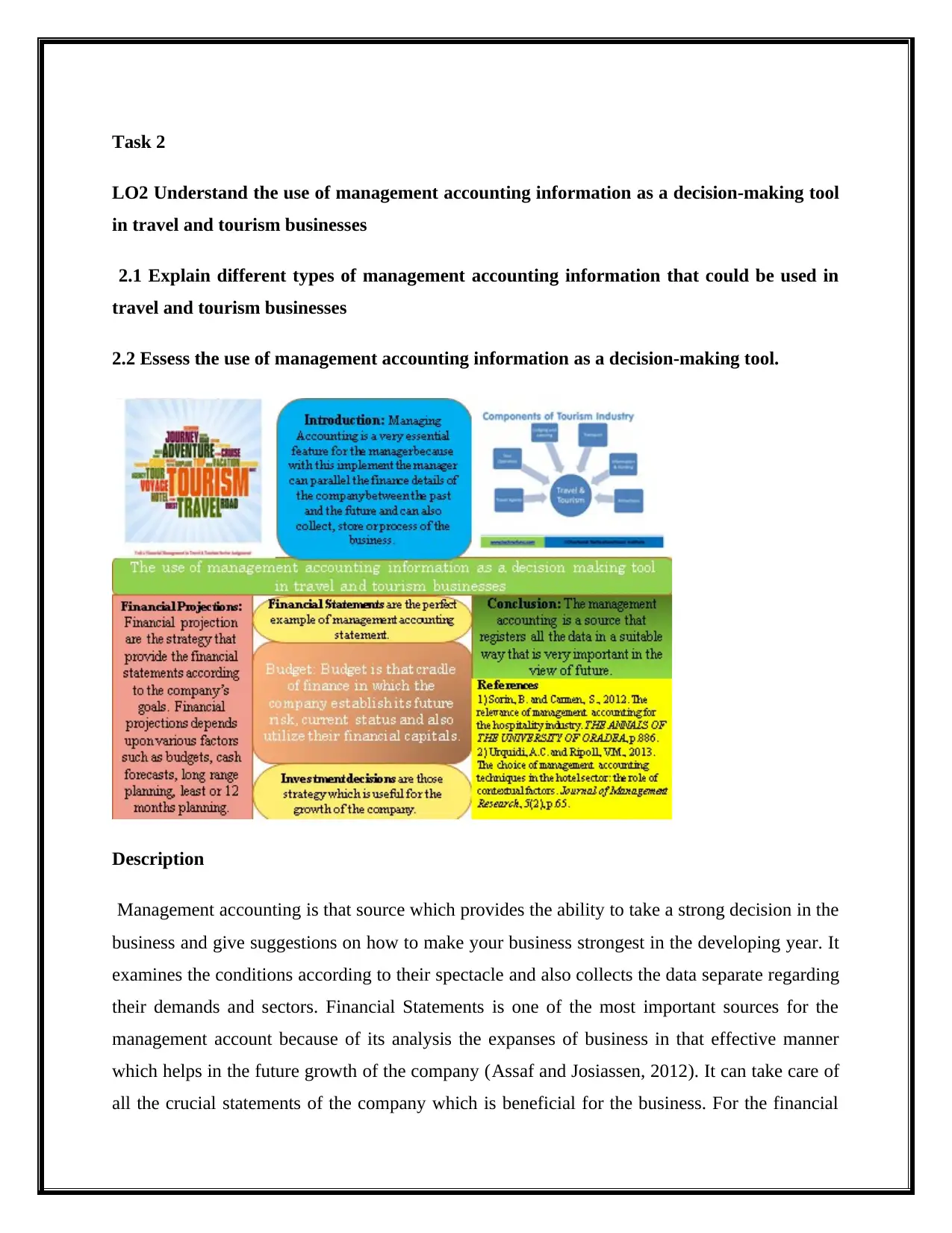
Management accounting is that source which provides the ability to take a strong decision in the
business and give suggestions on how to make your business strongest in the developing year. It
examines the conditions according to their spectacle and also collects the data separate regarding
their demands and sectors. Financial Statements is one of the most important sources for the
management account because of its analysis the expanses of business in that effective manner
which helps in the future growth of the company (Assaf and Josiassen, 2012). It can take care of
all the crucial statements of the company which is beneficial for the business. For the financial
LO2 Understand the use of management accounting information as a decision-making tool
in travel and tourism businesses
2.1 Explain different types of management accounting information that could be used in
travel and tourism businesses
2.2 Essess the use of management accounting information as a decision-making tool.
Description
Management accounting is that source which provides the ability to take a strong decision in the
business and give suggestions on how to make your business strongest in the developing year. It
examines the conditions according to their spectacle and also collects the data separate regarding
their demands and sectors. Financial Statements is one of the most important sources for the
management account because of its analysis the expanses of business in that effective manner
which helps in the future growth of the company (Assaf and Josiassen, 2012). It can take care of
all the crucial statements of the company which is beneficial for the business. For the financial
⊘ This is a preview!⊘
Do you want full access?
Subscribe today to unlock all pages.
Trusted by 1+ million students worldwide

statements, Budget is also a helping feature. It provides all the structure of the finance and using
the financial funds in the effective manners. Management Accounting provides the investment
for the maximum return in the form of funds to the manager and also provides the benefits in the
huge amount (Bazerman and Moore, 2012).
the financial funds in the effective manners. Management Accounting provides the investment
for the maximum return in the form of funds to the manager and also provides the benefits in the
huge amount (Bazerman and Moore, 2012).
Paraphrase This Document
Need a fresh take? Get an instant paraphrase of this document with our AI Paraphraser
Task 3
LO3 Be able to interpret financial accounts to assist decision making in travel and tourism
businesses
3.1 Interpret travel and tourism financial accounts
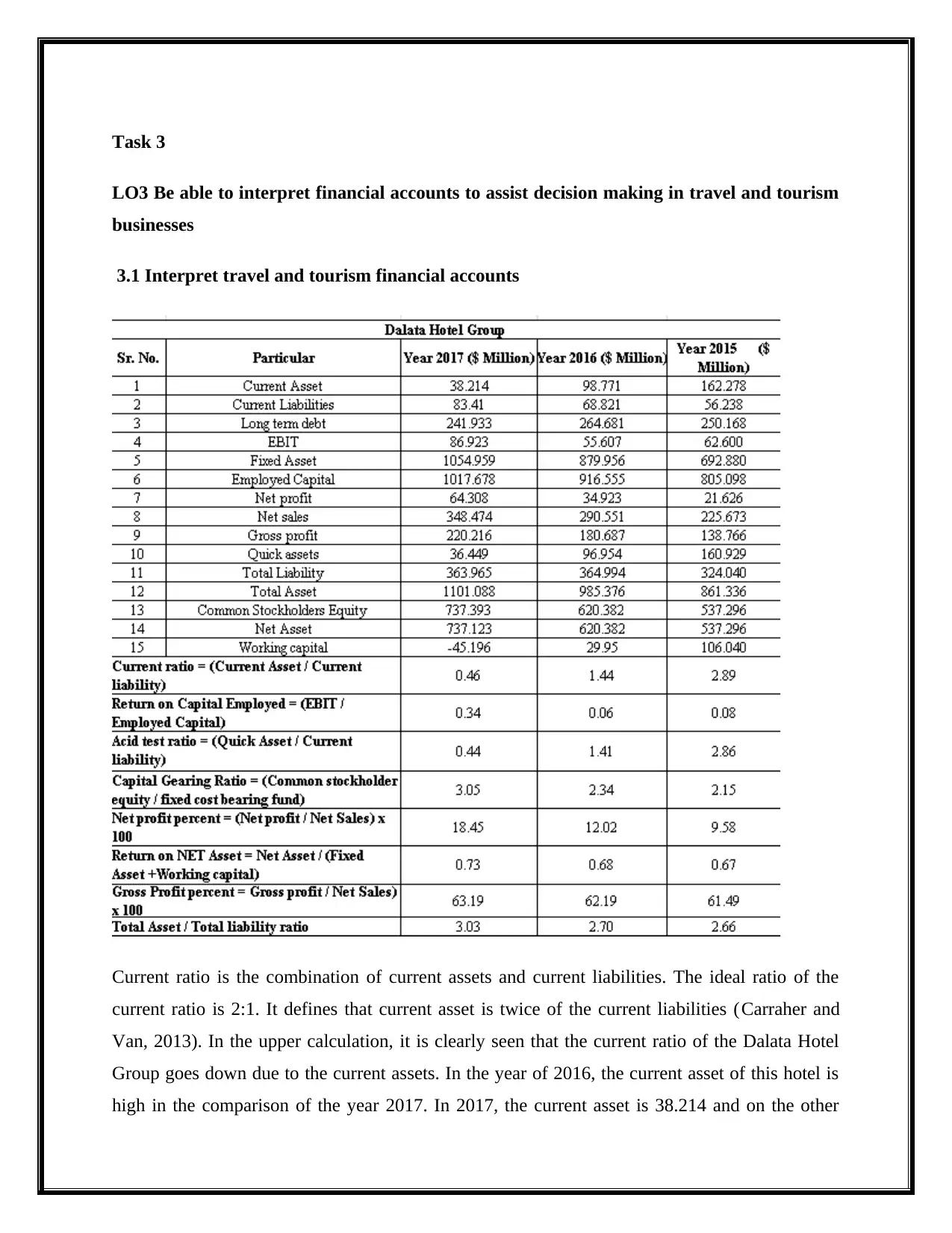
Current ratio is the combination of current assets and current liabilities. The ideal ratio of the
current ratio is 2:1. It defines that current asset is twice of the current liabilities (Carraher and
Van, 2013). In the upper calculation, it is clearly seen that the current ratio of the Dalata Hotel
Group goes down due to the current assets. In the year of 2016, the current asset of this hotel is
high in the comparison of the year 2017. In 2017, the current asset is 38.214 and on the other
LO3 Be able to interpret financial accounts to assist decision making in travel and tourism
businesses
3.1 Interpret travel and tourism financial accounts
Current ratio is the combination of current assets and current liabilities. The ideal ratio of the
current ratio is 2:1. It defines that current asset is twice of the current liabilities (Carraher and
Van, 2013). In the upper calculation, it is clearly seen that the current ratio of the Dalata Hotel
Group goes down due to the current assets. In the year of 2016, the current asset of this hotel is
high in the comparison of the year 2017. In 2017, the current asset is 38.214 and on the other
hand, the current asset is obtained 98.771 in 2016. The company obtain the decrease in the
assets on the basis of two year analysis, is 60.557. There is also one more ratio which comes in
the current ratio that is 1.5. The current ratio 1.5 defines that in how much business covers for
every $1 of current liabilities.
Suppose the ratio of any business is 1.5:1. It shows that the business has the current ratio of
$1.50 for every current liabilities of $1.
Generally, the current ratio of the company lies between 1.5% and 3%. If the company comes
inside this range, it shows that company has good financial strength. Sometimes the company has
to face that their current assets are more than 2. It shows that the current assets of the company
are high then the company has no authority to use their current assets and its short-term financial
plan (Drexler, et.al, 2014). Due to this, the company faces a lot’s of problems in their working
area as well as financial parts also. The low current ratio is always supported by the strongest
current flow.
If the current ratio of the Organization increases, it shows that the company improves his growth
and if it decreases, it shows that the company has a poor growth. In the upper analysis of hotel
Dalata Hotel Group has shown the decrease in current ratio on the basis of the calculation of
2017 and 2016.
Quick Ratio is also known as “acid-test ratio”. The ratio measures that how the company meets
its financial standards and financial liabilities. It also determines the cash flow, security of
markets and the receiving data of accounts. The company buys and maintains the fixed assets for
the use of long term and these assets are not quickly converted into cash regarding land,
apparatus and buildings (Font, et. al, 2012).
Employee Capital is known as the fund of the capital. The measurement of the employee capital
bases upon the fixed assets and current liabilities. It is calculated by adding fixed assets or
subtracting the current liabilities.
Gross profit is a profit that is earned by the company after deducting the cost of selling and
buying goods. The gross profit is based upon the capital statements of the company. Gross profit
assets on the basis of two year analysis, is 60.557. There is also one more ratio which comes in
the current ratio that is 1.5. The current ratio 1.5 defines that in how much business covers for
every $1 of current liabilities.
Suppose the ratio of any business is 1.5:1. It shows that the business has the current ratio of
$1.50 for every current liabilities of $1.
Generally, the current ratio of the company lies between 1.5% and 3%. If the company comes
inside this range, it shows that company has good financial strength. Sometimes the company has
to face that their current assets are more than 2. It shows that the current assets of the company
are high then the company has no authority to use their current assets and its short-term financial
plan (Drexler, et.al, 2014). Due to this, the company faces a lot’s of problems in their working
area as well as financial parts also. The low current ratio is always supported by the strongest
current flow.
If the current ratio of the Organization increases, it shows that the company improves his growth
and if it decreases, it shows that the company has a poor growth. In the upper analysis of hotel
Dalata Hotel Group has shown the decrease in current ratio on the basis of the calculation of
2017 and 2016.
Quick Ratio is also known as “acid-test ratio”. The ratio measures that how the company meets
its financial standards and financial liabilities. It also determines the cash flow, security of
markets and the receiving data of accounts. The company buys and maintains the fixed assets for
the use of long term and these assets are not quickly converted into cash regarding land,
apparatus and buildings (Font, et. al, 2012).
Employee Capital is known as the fund of the capital. The measurement of the employee capital
bases upon the fixed assets and current liabilities. It is calculated by adding fixed assets or
subtracting the current liabilities.
Gross profit is a profit that is earned by the company after deducting the cost of selling and
buying goods. The gross profit is based upon the capital statements of the company. Gross profit
⊘ This is a preview!⊘
Do you want full access?
Subscribe today to unlock all pages.
Trusted by 1+ million students worldwide

1 out of 20


Related Documents


Your All-in-One AI-Powered Toolkit for Academic Success.
+13062052269
info@desklib.com
Available 24*7 on WhatsApp / Email
![[object Object]](/_next/static/media/star-bottom.7253800d.svg)
Unlock your academic potential
Copyright © 2020–2026 A2Z Services. All Rights Reserved. Developed and managed by ZUCOL.