Audit Report: Assessment of Rogers Communications Financial Position
VerifiedAdded on 2021/04/24
|21
|5024
|69
Report
AI Summary
This audit report provides a detailed analysis of the audit process for Rogers Communications, a major Canadian telecommunications company. The report outlines the audit planning memorandum, including business information, management integrity assessment, and auditor independence considerations. It addresses risks associated with the audit engagement, such as fraudulent revenue recognition and management override of controls. Preliminary audit planning, risk assessment procedures, and the approach to the audit are discussed, including pre-engagement activities, staffing, and time budgeting. The report also covers materiality levels, internal controls, documentation, and sampling decisions. It details the performance of planned audit programs, audit findings, and concludes with an opinion on the financial statements based on the audit procedures and evidence collected.
Running head: AUDIT
Audit
Name of the Student:
Name of the university:
Authors note:
Audit
Name of the Student:
Name of the university:
Authors note:

Paraphrase This Document
Need a fresh take? Get an instant paraphrase of this document with our AI Paraphraser
1AUDIT
Table of Contents
Introduction:....................................................................................................................................2
Business information:......................................................................................................................2
Integrity and responsibility of the management:.............................................................................3
Auditor’s independence and transparency:......................................................................................3
Risk associated with the audit engagement:....................................................................................4
Preliminary audit planning:.............................................................................................................5
Risk assessment:..........................................................................................................................5
Approach:........................................................................................................................................6
Pre-engagement activities:...............................................................................................................7
Staffing and time budget:.................................................................................................................7
Materiality:......................................................................................................................................8
Internal controls within the company:...........................................................................................10
Documentation...............................................................................................................................12
Sampling decisions:.......................................................................................................................12
Performance of planned audit programs:.......................................................................................13
Audit findings:...............................................................................................................................16
Conclusion:....................................................................................................................................17
Reference.......................................................................................................................................18
Table of Contents
Introduction:....................................................................................................................................2
Business information:......................................................................................................................2
Integrity and responsibility of the management:.............................................................................3
Auditor’s independence and transparency:......................................................................................3
Risk associated with the audit engagement:....................................................................................4
Preliminary audit planning:.............................................................................................................5
Risk assessment:..........................................................................................................................5
Approach:........................................................................................................................................6
Pre-engagement activities:...............................................................................................................7
Staffing and time budget:.................................................................................................................7
Materiality:......................................................................................................................................8
Internal controls within the company:...........................................................................................10
Documentation...............................................................................................................................12
Sampling decisions:.......................................................................................................................12
Performance of planned audit programs:.......................................................................................13
Audit findings:...............................................................................................................................16
Conclusion:....................................................................................................................................17
Reference.......................................................................................................................................18
2AUDIT
Introduction:
The purpose of the Audit Planning Memorandum is to provide a brief to the Audit
committee on the approach that have been adopted for the audit of Rogers Communications.
The main aim of auditing is to provide independent opinion on the financial statements of an
organization. The opinion of the auditors on the financial statements will help the users of the
financial statements to take correct decisions affecting their interests in such organizations. Audit
must be carried out in accordance with the Generally Accepted Auditing Standards in order to
ensure that the audit opinion is in accordance with the standards on auditing (Gildenhuis & Roos,
2015). In this document, an audit shall be conducted on the financial statements of Rogers
Communications, one of the largest companies in terms market valuation in the whole of
Canada. The document shall contain the procedures to be followed in the audit of the financial
statements of Rogers Communications from pre-audit engagement to the conclusion of the audit
of the company.
Business information:
Rogers Communications is one of the largest companies in the whole of Canada and it
operates in the field of communications and technology. To be more specific the company
operates in the field of wireless communications, cable television, telephone, internet and other
forms of communications in the country and other parts of the world. Founded in the year 1960
by Rogers Vacuum Tube Company the company has it’s headquarter situated in Toronto,
Ontario, Canada. Alan Hoe is the current chairman of the company with Joe Natale as the
president and Chief Executive Officer of the company (Krahmer & Phillips, 2016). The
company’s shares are listed on the Toronto stock exchange and New York Stock Exchange with
the ticker RCI. Over the years, the company has invented new ways to enrich the experience of
Introduction:
The purpose of the Audit Planning Memorandum is to provide a brief to the Audit
committee on the approach that have been adopted for the audit of Rogers Communications.
The main aim of auditing is to provide independent opinion on the financial statements of an
organization. The opinion of the auditors on the financial statements will help the users of the
financial statements to take correct decisions affecting their interests in such organizations. Audit
must be carried out in accordance with the Generally Accepted Auditing Standards in order to
ensure that the audit opinion is in accordance with the standards on auditing (Gildenhuis & Roos,
2015). In this document, an audit shall be conducted on the financial statements of Rogers
Communications, one of the largest companies in terms market valuation in the whole of
Canada. The document shall contain the procedures to be followed in the audit of the financial
statements of Rogers Communications from pre-audit engagement to the conclusion of the audit
of the company.
Business information:
Rogers Communications is one of the largest companies in the whole of Canada and it
operates in the field of communications and technology. To be more specific the company
operates in the field of wireless communications, cable television, telephone, internet and other
forms of communications in the country and other parts of the world. Founded in the year 1960
by Rogers Vacuum Tube Company the company has it’s headquarter situated in Toronto,
Ontario, Canada. Alan Hoe is the current chairman of the company with Joe Natale as the
president and Chief Executive Officer of the company (Krahmer & Phillips, 2016). The
company’s shares are listed on the Toronto stock exchange and New York Stock Exchange with
the ticker RCI. Over the years, the company has invented new ways to enrich the experience of
⊘ This is a preview!⊘
Do you want full access?
Subscribe today to unlock all pages.

Trusted by 1+ million students worldwide
3AUDIT
its customers by providing wireless network services as well as internet connectivity with
unrivalled quality and transmission power. Bell Canada is the primary competitor of the
company with substantial media assets to provide similar wireless network, cable television,
telephone services and internet connectivity.
Integrity and responsibility of the management:
The management over the years have conducted the business operations with honesty and
integrity to take the company to the top of the telecommunication and network business in the
country. The company is not only the largest telecommunication company in the country but also
one of the largest companies in all across Canada. Over the years, the annual reports of the
company containing the financial statements of the company have been prepared in accordance
with the International Financial Reporting Standards increase the confidence of the auditors on
the integrity and honesty of the management (Council, 2015).
The management is responsible for the preparation and presentation of the financial
statements of the company and the auditors are only reasonable to express an appropriate opinion
on the financial statements of the company. Thus, the use of appropriate accounting standards to
prepare and present the financial statements of the company is the responsibility of the
management and the auditor has nothing to do with the preparation and presentation of these
statements (Rose & Rose, 2014).
Auditor’s independence and transparency:
The Canadian Auditing standard (CAS) 260 “Communicating of Audit matters with
those charged with Governance” requires that the auditor should communicate any relationship
that exists between the company and the auditor. The auditor of the company is required to be
its customers by providing wireless network services as well as internet connectivity with
unrivalled quality and transmission power. Bell Canada is the primary competitor of the
company with substantial media assets to provide similar wireless network, cable television,
telephone services and internet connectivity.
Integrity and responsibility of the management:
The management over the years have conducted the business operations with honesty and
integrity to take the company to the top of the telecommunication and network business in the
country. The company is not only the largest telecommunication company in the country but also
one of the largest companies in all across Canada. Over the years, the annual reports of the
company containing the financial statements of the company have been prepared in accordance
with the International Financial Reporting Standards increase the confidence of the auditors on
the integrity and honesty of the management (Council, 2015).
The management is responsible for the preparation and presentation of the financial
statements of the company and the auditors are only reasonable to express an appropriate opinion
on the financial statements of the company. Thus, the use of appropriate accounting standards to
prepare and present the financial statements of the company is the responsibility of the
management and the auditor has nothing to do with the preparation and presentation of these
statements (Rose & Rose, 2014).
Auditor’s independence and transparency:
The Canadian Auditing standard (CAS) 260 “Communicating of Audit matters with
those charged with Governance” requires that the auditor should communicate any relationship
that exists between the company and the auditor. The auditor of the company is required to be
Paraphrase This Document
Need a fresh take? Get an instant paraphrase of this document with our AI Paraphraser
4AUDIT
independent of the entity so that the auditor can provide an unbiased opinion on the financial
statement of the company (Miro et al., 2015). It is important to consider the independence while
appointing the auditor of the company and at the. Planning stage. Thus, no employee of the
company or any person who has any interests associated with the company shall be appointed as
the auditors of the company. In this case, the Auditor is independent of the entity and it can be
assured that the audit firms conforms to the highest level of governance standard.
Risk associated with the audit engagement:
The professional standards requires the auditor to consider these two kinds of risks:
Fraudulent revenue recognition;
Management override of control;
There are certain risks that revenues are recognised fraudulently to provide a different picture
of the financial situation of the organisation. The auditor should assess the risk of fraudulent
revenue recognition both at the time of accepting the engagement and at the planning stages of
audit (Okafor, 2015).
The management has the position of power to manipulate the accounting records and prepare
a financial statement with the fraudulent intention. The auditor should assess this risk at the
planning stage. In order to assess this risk test of control is conducted. In addition to this
substantive audit, procedure is conducted over the accounting estimates, journal entries and
significant transactions that occur in the normal course of business (Rahma et al., 2016).
There are two types of risks associated with the expression of audit opinion. Firstly, the
risk of expressing an opinion that the financial statements of the company are free of material
errors and misstatements whereas these are not. Secondly the risk of expressing an opinion that
independent of the entity so that the auditor can provide an unbiased opinion on the financial
statement of the company (Miro et al., 2015). It is important to consider the independence while
appointing the auditor of the company and at the. Planning stage. Thus, no employee of the
company or any person who has any interests associated with the company shall be appointed as
the auditors of the company. In this case, the Auditor is independent of the entity and it can be
assured that the audit firms conforms to the highest level of governance standard.
Risk associated with the audit engagement:
The professional standards requires the auditor to consider these two kinds of risks:
Fraudulent revenue recognition;
Management override of control;
There are certain risks that revenues are recognised fraudulently to provide a different picture
of the financial situation of the organisation. The auditor should assess the risk of fraudulent
revenue recognition both at the time of accepting the engagement and at the planning stages of
audit (Okafor, 2015).
The management has the position of power to manipulate the accounting records and prepare
a financial statement with the fraudulent intention. The auditor should assess this risk at the
planning stage. In order to assess this risk test of control is conducted. In addition to this
substantive audit, procedure is conducted over the accounting estimates, journal entries and
significant transactions that occur in the normal course of business (Rahma et al., 2016).
There are two types of risks associated with the expression of audit opinion. Firstly, the
risk of expressing an opinion that the financial statements of the company are free of material
errors and misstatements whereas these are not. Secondly the risk of expressing an opinion that
5AUDIT
the financial statements of the company are not free from misstatements whereas the financial
statements not contain any material errors or misstatements (Chonowitz, 2015). The auditors are
mainly concerned with the risk of expressing an inappropriate opinion on the financial
statements that the statement are free of material errors where in fact the statements contain
material errors.
After appraising the findings from the pre-engagement activities, the auditors shall
determine whether it would be appropriate to accept the engagement as auditor of the company
to express an appropriate audit opinion on the financial statements of the company.
Preliminary audit planning:
Preliminary audit planning is mainly dependent on the identified risks in the audit of the
financial statements of the company. Generally the pre-engagement activities and preliminary
investigation about the affairs and operations of the company will help us to identify the risks
associated with the audit of the financial statements of the company (Onoja & Usman, 2015).
Based on the findings of preliminary audit planning shall be made. The preliminary audit
planning of the company shall have to be made after considering figures and trends identified
from the brief financial statements of the company, i.e. income statement, Balance sheet and cash
flow statement of the company.
Risk assessment:
In order to assess the risk of material misstatement at the overall financial statement level
it is important to have significant knowledge about the financial performance and position of the
company. The auditors will use the financial statements of the company, i.e. Income statement of
the financial statements of the company are not free from misstatements whereas the financial
statements not contain any material errors or misstatements (Chonowitz, 2015). The auditors are
mainly concerned with the risk of expressing an inappropriate opinion on the financial
statements that the statement are free of material errors where in fact the statements contain
material errors.
After appraising the findings from the pre-engagement activities, the auditors shall
determine whether it would be appropriate to accept the engagement as auditor of the company
to express an appropriate audit opinion on the financial statements of the company.
Preliminary audit planning:
Preliminary audit planning is mainly dependent on the identified risks in the audit of the
financial statements of the company. Generally the pre-engagement activities and preliminary
investigation about the affairs and operations of the company will help us to identify the risks
associated with the audit of the financial statements of the company (Onoja & Usman, 2015).
Based on the findings of preliminary audit planning shall be made. The preliminary audit
planning of the company shall have to be made after considering figures and trends identified
from the brief financial statements of the company, i.e. income statement, Balance sheet and cash
flow statement of the company.
Risk assessment:
In order to assess the risk of material misstatement at the overall financial statement level
it is important to have significant knowledge about the financial performance and position of the
company. The auditors will use the financial statements of the company, i.e. Income statement of
⊘ This is a preview!⊘
Do you want full access?
Subscribe today to unlock all pages.
Trusted by 1+ million students worldwide
6AUDIT
the company, Balance sheet, cash flow statement of the company, statement of changes in equity
and notes to accounts (Martin et al., 2016).
The auditor will use effective audit procedures to collect necessary audit evidence based
on which the opinion shall be formulated. The necessary documents supporting the revenue as
provided in the financial statements along with the supporting documents against the
expenditures incurred shall be made available by the management of the company to allow the
auditors to conduct an effective audit (Kumar & Sharma, 2015). The overall risks assessment of
the audit will be dependent on the integrity and honesty of the management, employee and other
staffs of the company as the auditors will have to depend on the documents, written and oral
representations along with financial statements prepared by the internal staffs of the company.
As has already mentioned that the company has followed the IFRSs to prepare the financial
statements thus, the auditors can place reliance on the financial statements and conduct the audit
(Toolkit, 2014). Apart from that the auditors will verify the integrity and honesty of the
management to determine the extent to which they can place reliance on the evidences and
representations made by them while conducting the audit of the financial statements of the
company.
Approach:
In order to conduct an effective audit of the financial statements of any organization it is
important to follow the generally accepted auditing standards that have been universally accepted
to be effective auditing standards (Dhand & Diab, 2015). The following procedures shall be
properly followed in the audit of the financial statements of an organization in order to express
an appropriate audit opinion on the financial statements of the organization:
the company, Balance sheet, cash flow statement of the company, statement of changes in equity
and notes to accounts (Martin et al., 2016).
The auditor will use effective audit procedures to collect necessary audit evidence based
on which the opinion shall be formulated. The necessary documents supporting the revenue as
provided in the financial statements along with the supporting documents against the
expenditures incurred shall be made available by the management of the company to allow the
auditors to conduct an effective audit (Kumar & Sharma, 2015). The overall risks assessment of
the audit will be dependent on the integrity and honesty of the management, employee and other
staffs of the company as the auditors will have to depend on the documents, written and oral
representations along with financial statements prepared by the internal staffs of the company.
As has already mentioned that the company has followed the IFRSs to prepare the financial
statements thus, the auditors can place reliance on the financial statements and conduct the audit
(Toolkit, 2014). Apart from that the auditors will verify the integrity and honesty of the
management to determine the extent to which they can place reliance on the evidences and
representations made by them while conducting the audit of the financial statements of the
company.
Approach:
In order to conduct an effective audit of the financial statements of any organization it is
important to follow the generally accepted auditing standards that have been universally accepted
to be effective auditing standards (Dhand & Diab, 2015). The following procedures shall be
properly followed in the audit of the financial statements of an organization in order to express
an appropriate audit opinion on the financial statements of the organization:
Paraphrase This Document
Need a fresh take? Get an instant paraphrase of this document with our AI Paraphraser
7AUDIT
I. Pre-engagement activities.
II. Preliminary audit panning and risk identification.
III. Risk assessment procedures to plan an audit.
IV. Internal control documentation and testing.
V. Decisions to use sampling techniques and the basis of such decision.
VI. Appropriate use of such sampling techniques to express an appropriate opinion on the
financial statements of the company.
VII. Performance of audit programs as planned taking into consideration the entity and its
activities.
VIII. Review of the audit findings.
IX. Expression of an opinion on the financial statements of the company on the basis of
the audit procedures and appraisal of the evidence collected during the course of the
audit.
Pre-engagement activities:
Obtaining an understanding of the entity and its environment of whose financial
statements are being audited in order to have the basis understanding about the financial
statements of the company. It is essential to obtain necessary knowledge about the nature of the
entity and its business operations to conduct an audit effectively (Johnson, 2017). Apart from
obtaining an understanding about the entity and its environment it is equally important to assess
whether the management of the organization is honest and have necessary integrity to provide
information about the company and to what extent the auditors can place reliance on the
financial as well as non-financial information provided by the management. Accordingly, let us
conduct the pre-engagement activities to start the audit on the right note (Enget, 2015).
I. Pre-engagement activities.
II. Preliminary audit panning and risk identification.
III. Risk assessment procedures to plan an audit.
IV. Internal control documentation and testing.
V. Decisions to use sampling techniques and the basis of such decision.
VI. Appropriate use of such sampling techniques to express an appropriate opinion on the
financial statements of the company.
VII. Performance of audit programs as planned taking into consideration the entity and its
activities.
VIII. Review of the audit findings.
IX. Expression of an opinion on the financial statements of the company on the basis of
the audit procedures and appraisal of the evidence collected during the course of the
audit.
Pre-engagement activities:
Obtaining an understanding of the entity and its environment of whose financial
statements are being audited in order to have the basis understanding about the financial
statements of the company. It is essential to obtain necessary knowledge about the nature of the
entity and its business operations to conduct an audit effectively (Johnson, 2017). Apart from
obtaining an understanding about the entity and its environment it is equally important to assess
whether the management of the organization is honest and have necessary integrity to provide
information about the company and to what extent the auditors can place reliance on the
financial as well as non-financial information provided by the management. Accordingly, let us
conduct the pre-engagement activities to start the audit on the right note (Enget, 2015).
8AUDIT
Staffing and time budget:
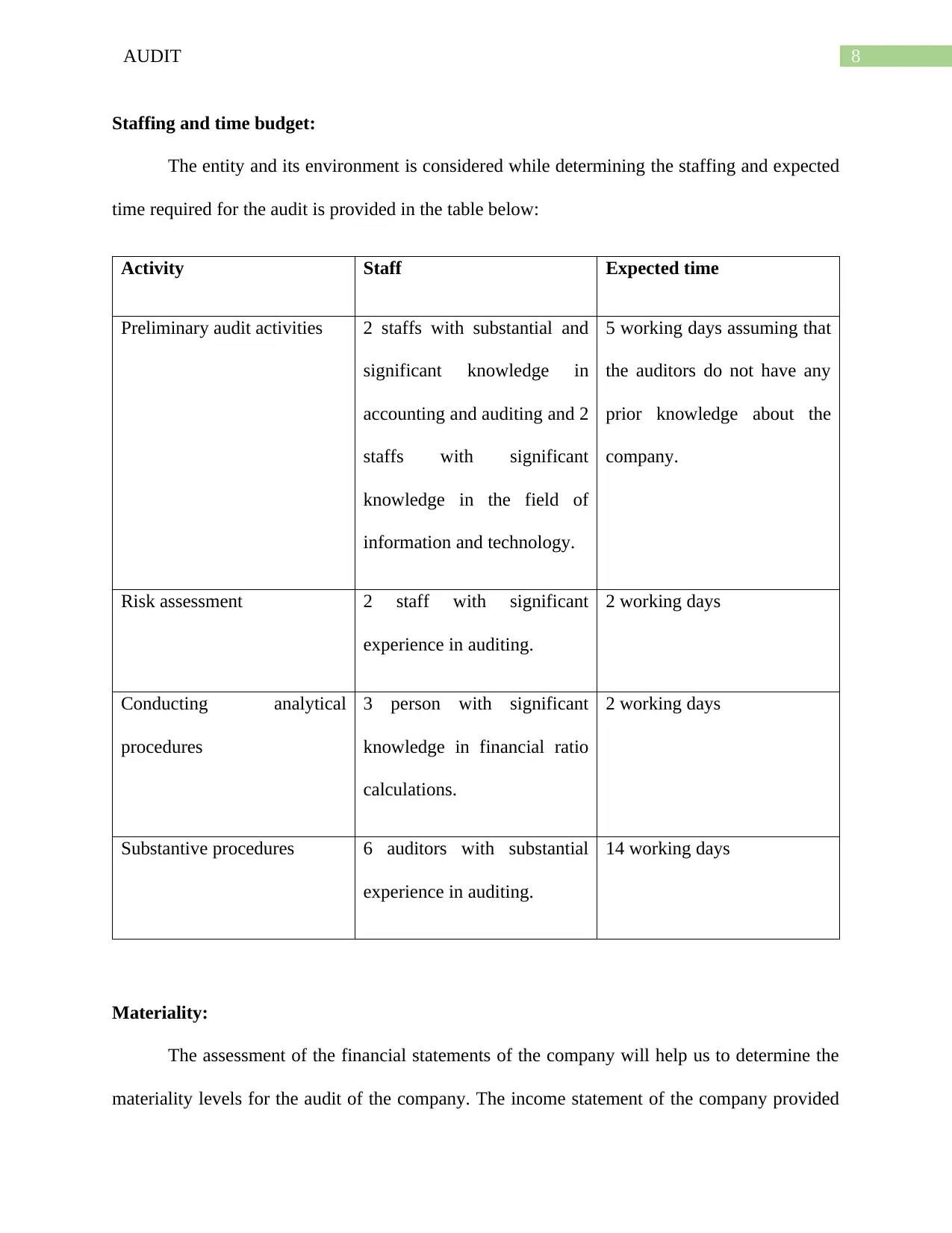
The entity and its environment is considered while determining the staffing and expected
time required for the audit is provided in the table below:
Activity Staff Expected time
Preliminary audit activities 2 staffs with substantial and
significant knowledge in
accounting and auditing and 2
staffs with significant
knowledge in the field of
information and technology.
5 working days assuming that
the auditors do not have any
prior knowledge about the
company.
Risk assessment 2 staff with significant
experience in auditing.
2 working days
Conducting analytical
procedures
3 person with significant
knowledge in financial ratio
calculations.
2 working days
Substantive procedures 6 auditors with substantial
experience in auditing.
14 working days
Materiality:
The assessment of the financial statements of the company will help us to determine the
materiality levels for the audit of the company. The income statement of the company provided
Staffing and time budget:
The entity and its environment is considered while determining the staffing and expected
time required for the audit is provided in the table below:
Activity Staff Expected time
Preliminary audit activities 2 staffs with substantial and
significant knowledge in
accounting and auditing and 2
staffs with significant
knowledge in the field of
information and technology.
5 working days assuming that
the auditors do not have any
prior knowledge about the
company.
Risk assessment 2 staff with significant
experience in auditing.
2 working days
Conducting analytical
procedures
3 person with significant
knowledge in financial ratio
calculations.
2 working days
Substantive procedures 6 auditors with substantial
experience in auditing.
14 working days
Materiality:
The assessment of the financial statements of the company will help us to determine the
materiality levels for the audit of the company. The income statement of the company provided
⊘ This is a preview!⊘
Do you want full access?
Subscribe today to unlock all pages.
Trusted by 1+ million students worldwide
9AUDIT
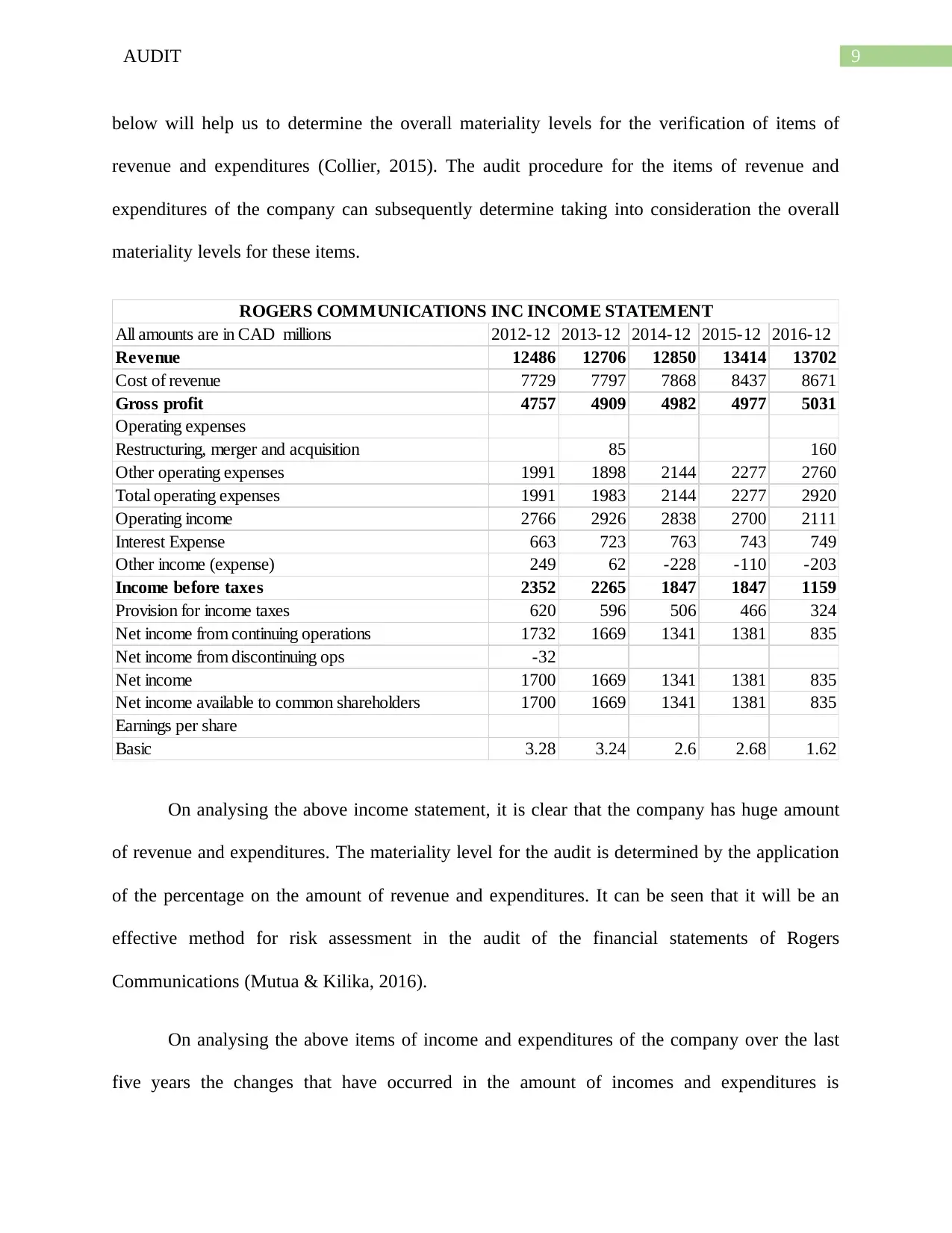
below will help us to determine the overall materiality levels for the verification of items of
revenue and expenditures (Collier, 2015). The audit procedure for the items of revenue and
expenditures of the company can subsequently determine taking into consideration the overall
materiality levels for these items.
All amounts are in CAD millions 2012-12 2013-12 2014-12 2015-12 2016-12
Revenue 12486 12706 12850 13414 13702
Cost of revenue 7729 7797 7868 8437 8671
Gross profit 4757 4909 4982 4977 5031
Operating expenses
Restructuring, merger and acquisition 85 160
Other operating expenses 1991 1898 2144 2277 2760
Total operating expenses 1991 1983 2144 2277 2920
Operating income 2766 2926 2838 2700 2111
Interest Expense 663 723 763 743 749
Other income (expense) 249 62 -228 -110 -203
Income before taxes 2352 2265 1847 1847 1159
Provision for income taxes 620 596 506 466 324
Net income from continuing operations 1732 1669 1341 1381 835
Net income from discontinuing ops -32
Net income 1700 1669 1341 1381 835
Net income available to common shareholders 1700 1669 1341 1381 835
Earnings per share
Basic 3.28 3.24 2.6 2.68 1.62
ROGERS COMMUNICATIONS INC INCOME STATEMENT
On analysing the above income statement, it is clear that the company has huge amount
of revenue and expenditures. The materiality level for the audit is determined by the application
of the percentage on the amount of revenue and expenditures. It can be seen that it will be an
effective method for risk assessment in the audit of the financial statements of Rogers
Communications (Mutua & Kilika, 2016).
On analysing the above items of income and expenditures of the company over the last
five years the changes that have occurred in the amount of incomes and expenditures is
below will help us to determine the overall materiality levels for the verification of items of
revenue and expenditures (Collier, 2015). The audit procedure for the items of revenue and
expenditures of the company can subsequently determine taking into consideration the overall
materiality levels for these items.
All amounts are in CAD millions 2012-12 2013-12 2014-12 2015-12 2016-12
Revenue 12486 12706 12850 13414 13702
Cost of revenue 7729 7797 7868 8437 8671
Gross profit 4757 4909 4982 4977 5031
Operating expenses
Restructuring, merger and acquisition 85 160
Other operating expenses 1991 1898 2144 2277 2760
Total operating expenses 1991 1983 2144 2277 2920
Operating income 2766 2926 2838 2700 2111
Interest Expense 663 723 763 743 749
Other income (expense) 249 62 -228 -110 -203
Income before taxes 2352 2265 1847 1847 1159
Provision for income taxes 620 596 506 466 324
Net income from continuing operations 1732 1669 1341 1381 835
Net income from discontinuing ops -32
Net income 1700 1669 1341 1381 835
Net income available to common shareholders 1700 1669 1341 1381 835
Earnings per share
Basic 3.28 3.24 2.6 2.68 1.62
ROGERS COMMUNICATIONS INC INCOME STATEMENT
On analysing the above income statement, it is clear that the company has huge amount
of revenue and expenditures. The materiality level for the audit is determined by the application
of the percentage on the amount of revenue and expenditures. It can be seen that it will be an
effective method for risk assessment in the audit of the financial statements of Rogers
Communications (Mutua & Kilika, 2016).
On analysing the above items of income and expenditures of the company over the last
five years the changes that have occurred in the amount of incomes and expenditures is
Paraphrase This Document
Need a fresh take? Get an instant paraphrase of this document with our AI Paraphraser
10AUDIT
calculated. The main purpose of the calculation is to analyse the trend in the amount of revenues
and expenditures, as these will help us to conduct the audit effectively (Vandermoor, 2017).
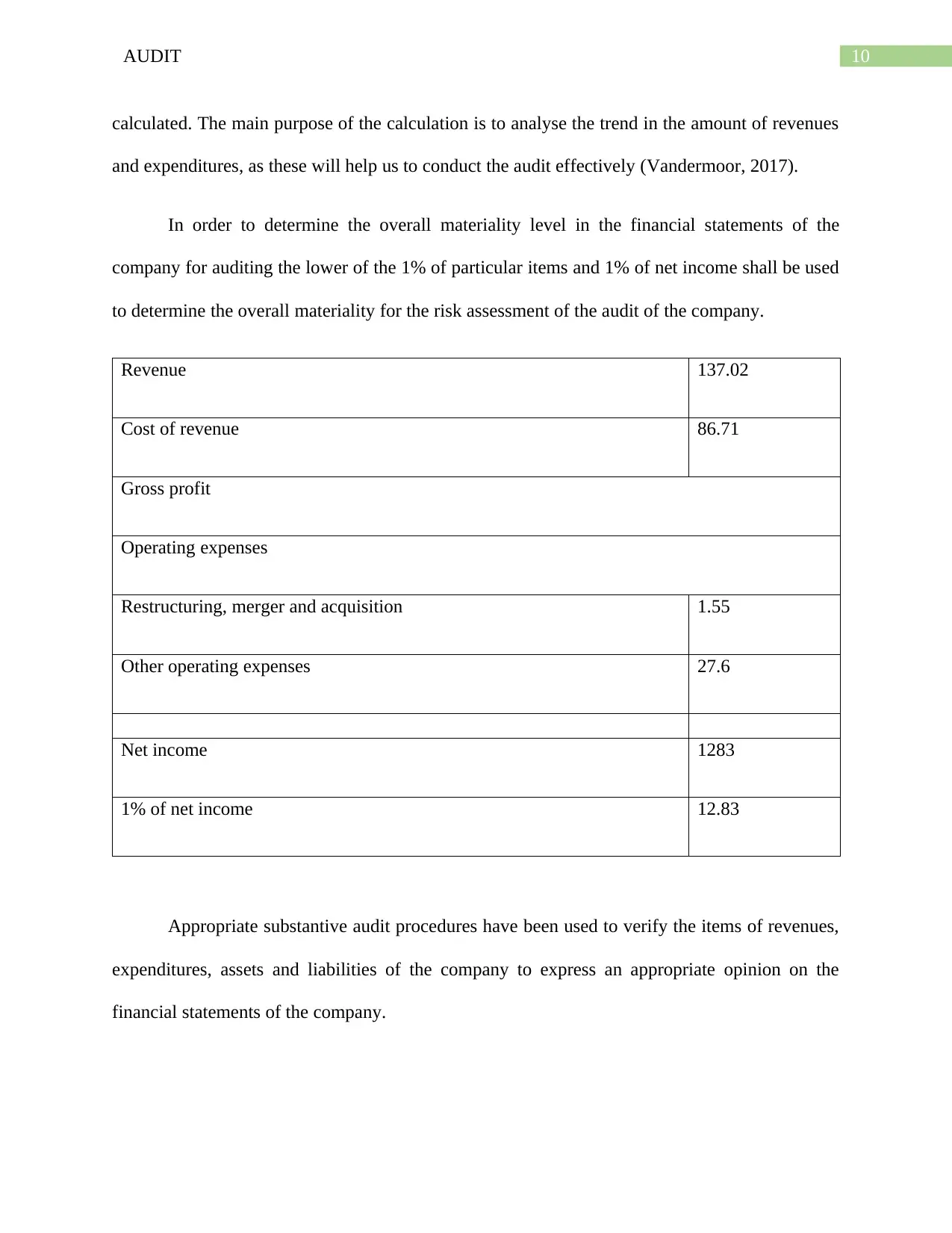
In order to determine the overall materiality level in the financial statements of the
company for auditing the lower of the 1% of particular items and 1% of net income shall be used
to determine the overall materiality for the risk assessment of the audit of the company.
Revenue 137.02
Cost of revenue 86.71
Gross profit
Operating expenses
Restructuring, merger and acquisition 1.55
Other operating expenses 27.6
Net income 1283
1% of net income 12.83
Appropriate substantive audit procedures have been used to verify the items of revenues,
expenditures, assets and liabilities of the company to express an appropriate opinion on the
financial statements of the company.
calculated. The main purpose of the calculation is to analyse the trend in the amount of revenues
and expenditures, as these will help us to conduct the audit effectively (Vandermoor, 2017).
In order to determine the overall materiality level in the financial statements of the
company for auditing the lower of the 1% of particular items and 1% of net income shall be used
to determine the overall materiality for the risk assessment of the audit of the company.
Revenue 137.02
Cost of revenue 86.71
Gross profit
Operating expenses
Restructuring, merger and acquisition 1.55
Other operating expenses 27.6
Net income 1283
1% of net income 12.83
Appropriate substantive audit procedures have been used to verify the items of revenues,
expenditures, assets and liabilities of the company to express an appropriate opinion on the
financial statements of the company.
11AUDIT
Internal controls within the company:
The auditors to assess their appropriateness and correctness shall verify the internal
controls, which have been installed within the organizations, properly. In case of Rogers
Communications, the company has installed number of internal controls that have been up-dated
at periodic intervals to ensure their effectiveness and efficiency (Young & Waterhouse, 2015).
The digital employee cards will help us to track the actual attendance of the employees and
accordingly, the payment of salaries and wages to the employees can be verified to assess the
correctness of the accounting treatment and financial disclosure in the financial statements of the
company for the item of salaries and wages of the company. The company has maintain clear
line of separation in duty and have segregated the responsibilities of different employees and
workers including the management thus, the auditors will not find it difficult to determine the
employees responsible for different works and jobs within the organization and accordingly, will
be able to conduct the audit properly (Sorunke, 2016). The employees have also been rotated by
the management at periodical intervals to reduce the possibility of frauds by ensuring that an
employee do not get the chance to collide with other employees to take carry out any unethical
acts at the expense of the company. The use of close circuit cameras within the office and factory
premises is also one of the methods to control and manage the functions within the organization
effectively. The management has a standard procedure to conduct through testing of these
internal controls to see whether these need any changes in order to be more effective that these
are at any point of time (Egbon et al., 2017). Apart from that, the company has separate
accounting departments that are responsible to maintain the books of accounts of the company.
The accrual basis of accounting and double entry system to record the accounting transactions
have been followed to maintain the books of accounts of the company. Apart from that, the
Internal controls within the company:
The auditors to assess their appropriateness and correctness shall verify the internal
controls, which have been installed within the organizations, properly. In case of Rogers
Communications, the company has installed number of internal controls that have been up-dated
at periodic intervals to ensure their effectiveness and efficiency (Young & Waterhouse, 2015).
The digital employee cards will help us to track the actual attendance of the employees and
accordingly, the payment of salaries and wages to the employees can be verified to assess the
correctness of the accounting treatment and financial disclosure in the financial statements of the
company for the item of salaries and wages of the company. The company has maintain clear
line of separation in duty and have segregated the responsibilities of different employees and
workers including the management thus, the auditors will not find it difficult to determine the
employees responsible for different works and jobs within the organization and accordingly, will
be able to conduct the audit properly (Sorunke, 2016). The employees have also been rotated by
the management at periodical intervals to reduce the possibility of frauds by ensuring that an
employee do not get the chance to collide with other employees to take carry out any unethical
acts at the expense of the company. The use of close circuit cameras within the office and factory
premises is also one of the methods to control and manage the functions within the organization
effectively. The management has a standard procedure to conduct through testing of these
internal controls to see whether these need any changes in order to be more effective that these
are at any point of time (Egbon et al., 2017). Apart from that, the company has separate
accounting departments that are responsible to maintain the books of accounts of the company.
The accrual basis of accounting and double entry system to record the accounting transactions
have been followed to maintain the books of accounts of the company. Apart from that, the
⊘ This is a preview!⊘
Do you want full access?
Subscribe today to unlock all pages.
Trusted by 1+ million students worldwide

1 out of 21


Related Documents


Your All-in-One AI-Powered Toolkit for Academic Success.
+13062052269
info@desklib.com
Available 24*7 on WhatsApp / Email
![[object Object]](/_next/static/media/star-bottom.7253800d.svg)
Unlock your academic potential
Copyright © 2020–2026 A2Z Services. All Rights Reserved. Developed and managed by ZUCOL.