Financial Audit Report: Financial Auditing, SEGRO Plc, 2019
VerifiedAdded on 2023/04/08
|15
|3015
|148
Report
AI Summary
This report presents a financial audit strategy document (Audit Planning Memorandum) for SEGRO Plc for the year ending December 31, 2019. It includes an engagement letter outlining responsibilities and instructions for reporting, followed by a planning meeting summary. The report details the client's history, business, and industry, along with relevant laws and regulations. It analyzes financial reporting, including changes in accounting policies like IFRS 9, IFRS 15, and IFRS 16, and calculates materiality based on total assets. Analytical procedures are described to determine audit risk areas, identifying higher-risk areas such as revenue recognition, loan agreement violations, and management override. A timetable for reporting and basic budget are also included. The report adheres to ISA 300 guidelines and incorporates a bibliography, providing a comprehensive overview of the audit process.

Running head: FINANCIAL AUDITING
Financial Auditing
Name of the Student
Name of the University
Author’s Note
Financial Auditing
Name of the Student
Name of the University
Author’s Note

Paraphrase This Document
Need a fresh take? Get an instant paraphrase of this document with our AI Paraphraser
1FINANCIAL AUDITING
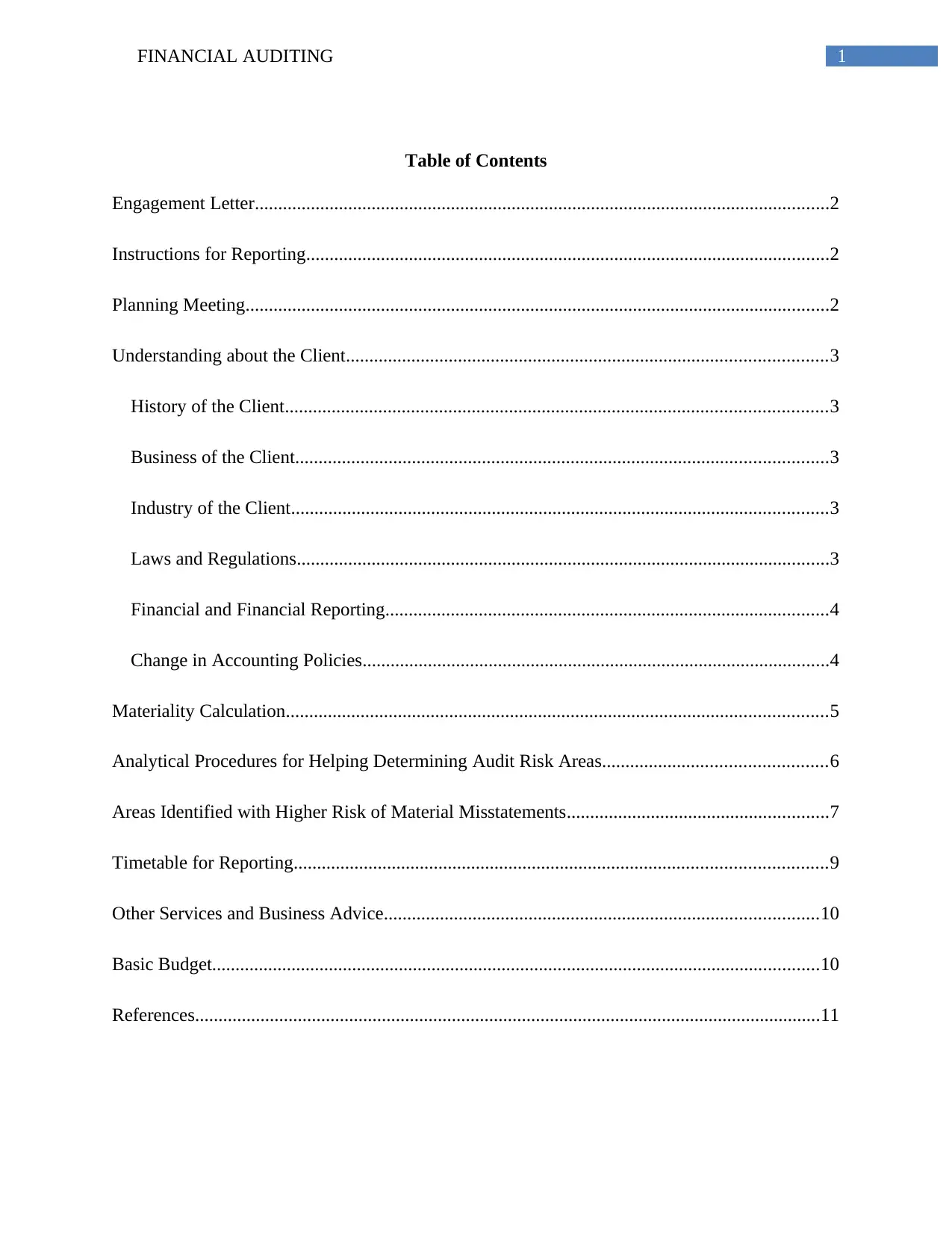
Table of Contents
Engagement Letter...........................................................................................................................2
Instructions for Reporting................................................................................................................2
Planning Meeting.............................................................................................................................2
Understanding about the Client.......................................................................................................3
History of the Client....................................................................................................................3
Business of the Client..................................................................................................................3
Industry of the Client...................................................................................................................3
Laws and Regulations..................................................................................................................3
Financial and Financial Reporting...............................................................................................4
Change in Accounting Policies....................................................................................................4
Materiality Calculation....................................................................................................................5
Analytical Procedures for Helping Determining Audit Risk Areas................................................6
Areas Identified with Higher Risk of Material Misstatements........................................................7
Timetable for Reporting..................................................................................................................9
Other Services and Business Advice.............................................................................................10
Basic Budget..................................................................................................................................10
References......................................................................................................................................11
Table of Contents
Engagement Letter...........................................................................................................................2
Instructions for Reporting................................................................................................................2
Planning Meeting.............................................................................................................................2
Understanding about the Client.......................................................................................................3
History of the Client....................................................................................................................3
Business of the Client..................................................................................................................3
Industry of the Client...................................................................................................................3
Laws and Regulations..................................................................................................................3
Financial and Financial Reporting...............................................................................................4
Change in Accounting Policies....................................................................................................4
Materiality Calculation....................................................................................................................5
Analytical Procedures for Helping Determining Audit Risk Areas................................................6
Areas Identified with Higher Risk of Material Misstatements........................................................7
Timetable for Reporting..................................................................................................................9
Other Services and Business Advice.............................................................................................10
Basic Budget..................................................................................................................................10
References......................................................................................................................................11
2FINANCIAL AUDITING
Engagement Letter
According to ISA 300, it is the responsibility of the engagement partner and the other
major members of the audit engagement team to involve in the process of audit planning. For
this reason, the audit engagement team of SEGRO Plc needs to draft a Letter of Audit
Engagement and needs to ensure the signing of the audit client on this letter (ifac.org 2019). This
can be considered as one of the major documents in audit operations.
Instructions for Reporting
The audit team of SEGRO Plc needs to prepare a statutory audit report under the
Companies Act 2006 along with a supporting tax calculation for the consolidated financial
statements of the company. It can be expected that SEGRO Plc will publish the audited financial
statements and accounts in the Annual Report 2019. It is needed to mention it in this context that
the audit engagement team will not be responsible for issuing any other report of SEGRO Plc
(ifac.org 2019). The audit engagement team and the audit client must adhere to this requirement
of the audit profession.
Planning Meeting
As per ISA 300, it is needed for the audit engagement team to discuss all the aspects of
their audit engagement with the senior management team of the audit client and the same aspect
is applicable for SEGRO Plc (ifac.org 2019). A meeting has taken place between the audit
engagement team and the directors of SEGRO Plc for the purpose of the audit planning. Certain
members of the audit firm and SEGRO Plc attested the meeting minute; they are the Audit
Engagement Letter
According to ISA 300, it is the responsibility of the engagement partner and the other
major members of the audit engagement team to involve in the process of audit planning. For
this reason, the audit engagement team of SEGRO Plc needs to draft a Letter of Audit
Engagement and needs to ensure the signing of the audit client on this letter (ifac.org 2019). This
can be considered as one of the major documents in audit operations.
Instructions for Reporting
The audit team of SEGRO Plc needs to prepare a statutory audit report under the
Companies Act 2006 along with a supporting tax calculation for the consolidated financial
statements of the company. It can be expected that SEGRO Plc will publish the audited financial
statements and accounts in the Annual Report 2019. It is needed to mention it in this context that
the audit engagement team will not be responsible for issuing any other report of SEGRO Plc
(ifac.org 2019). The audit engagement team and the audit client must adhere to this requirement
of the audit profession.
Planning Meeting
As per ISA 300, it is needed for the audit engagement team to discuss all the aspects of
their audit engagement with the senior management team of the audit client and the same aspect
is applicable for SEGRO Plc (ifac.org 2019). A meeting has taken place between the audit
engagement team and the directors of SEGRO Plc for the purpose of the audit planning. Certain
members of the audit firm and SEGRO Plc attested the meeting minute; they are the Audit
⊘ This is a preview!⊘
Do you want full access?
Subscribe today to unlock all pages.

Trusted by 1+ million students worldwide
3FINANCIAL AUDITING
Partner, Audit Manager, Managing Director and Financial Director. This needs to be considered
as an essential document for the audit planning purpose (ifac.org 2019).
Understanding about the Client
History of the Client
The former name of SEGRO Plc was Slough Estate. The company converted their
business to Real Estate Investment Trust at the time of the introduction of REITs in United
Kingdom (UK) in 2007. The company was founded in the year of 1920 (segro.com 2019).
Business of the Client
The main operation of SEGRO Plc can be seen in owning, developing and managing
warehouses along with industrial properties for their customers in the regions of UK and
Continental Europe (segro.com 2019). The presence of three aspects can be seen in the business
model of SEGRO Plc; they are buying assets and lands with the aim to add value, actively
managing the business portfolio through leasing space and servicing the customers, and selling
the assets in appropriate places with the aim to gain profits (segro.com 2019).
Industry of the Client
It needs to be mentioned that SEGRO Plc operates in the property industry of UK. This
particular industry is regulated in accordance with the Scottish and English land law. The
property industry in UK is considered as the largest property market Europe. The market size of
the commercial real estate market of UK is around 250 billion Euros. This industry is also
considered as one of the major contributors towards the economic development of the country.
Partner, Audit Manager, Managing Director and Financial Director. This needs to be considered
as an essential document for the audit planning purpose (ifac.org 2019).
Understanding about the Client
History of the Client
The former name of SEGRO Plc was Slough Estate. The company converted their
business to Real Estate Investment Trust at the time of the introduction of REITs in United
Kingdom (UK) in 2007. The company was founded in the year of 1920 (segro.com 2019).
Business of the Client
The main operation of SEGRO Plc can be seen in owning, developing and managing
warehouses along with industrial properties for their customers in the regions of UK and
Continental Europe (segro.com 2019). The presence of three aspects can be seen in the business
model of SEGRO Plc; they are buying assets and lands with the aim to add value, actively
managing the business portfolio through leasing space and servicing the customers, and selling
the assets in appropriate places with the aim to gain profits (segro.com 2019).
Industry of the Client
It needs to be mentioned that SEGRO Plc operates in the property industry of UK. This
particular industry is regulated in accordance with the Scottish and English land law. The
property industry in UK is considered as the largest property market Europe. The market size of
the commercial real estate market of UK is around 250 billion Euros. This industry is also
considered as one of the major contributors towards the economic development of the country.
Paraphrase This Document
Need a fresh take? Get an instant paraphrase of this document with our AI Paraphraser
4FINANCIAL AUDITING
Laws and Regulations
There are certain laws and regulations and SEGRO Plc is required to comply with these
while conducting their business operations. They are English Land Law, English Trust Law,
English Personal Property Law, United Kingdom Intellectual Property Law and others.
Financial and Financial Reporting
The financial statements of SEGRO Plc have been prepared as per the standards of
International Financial Reporting Standards (IFRS) as adopted by the EU, IFRS Interpretation
Committee (IFRS IC) interpretation and the sections of Companies Act 2006. In addition, the
financial statements of the company also comply with Article 4 of the EU IAS Regulations
(segro.com 2019).
In addition, SEGRO Plc prepares their financial statements on the basis of going concern.
It needs to be mentioned that SEGRO Plc has favorable debt-maturity profile, strong liquidity
position and extensive headroom against financial agreements. For these reasons, there is not any
doubt about the ability of SEGRO Plc to continue as a going concern for unforeseeable period
(segro.com 2019).
Change in Accounting Policies
It also needs to be mentioned that SEGRO Plc has recently adopted certain new financial
reporting regulations that have certain effects on financial reporting and financial outcome of the
company (segro.com 2019). These regulations are IFRS 9 ‘Financial Instruments’, IFRS 15
‘Revenue from Contracts with Customers’, Amendments to IAS 40, ‘Investment property
relating to transfer of investment property’, Annual Improvements to IFRSs 2014-2016 Cycle
and Amendments to IFRS 2, ‘Share-based Payment’ on clarifying how to account for certain
Laws and Regulations
There are certain laws and regulations and SEGRO Plc is required to comply with these
while conducting their business operations. They are English Land Law, English Trust Law,
English Personal Property Law, United Kingdom Intellectual Property Law and others.
Financial and Financial Reporting
The financial statements of SEGRO Plc have been prepared as per the standards of
International Financial Reporting Standards (IFRS) as adopted by the EU, IFRS Interpretation
Committee (IFRS IC) interpretation and the sections of Companies Act 2006. In addition, the
financial statements of the company also comply with Article 4 of the EU IAS Regulations
(segro.com 2019).
In addition, SEGRO Plc prepares their financial statements on the basis of going concern.
It needs to be mentioned that SEGRO Plc has favorable debt-maturity profile, strong liquidity
position and extensive headroom against financial agreements. For these reasons, there is not any
doubt about the ability of SEGRO Plc to continue as a going concern for unforeseeable period
(segro.com 2019).
Change in Accounting Policies
It also needs to be mentioned that SEGRO Plc has recently adopted certain new financial
reporting regulations that have certain effects on financial reporting and financial outcome of the
company (segro.com 2019). These regulations are IFRS 9 ‘Financial Instruments’, IFRS 15
‘Revenue from Contracts with Customers’, Amendments to IAS 40, ‘Investment property
relating to transfer of investment property’, Annual Improvements to IFRSs 2014-2016 Cycle
and Amendments to IFRS 2, ‘Share-based Payment’ on clarifying how to account for certain
5FINANCIAL AUDITING
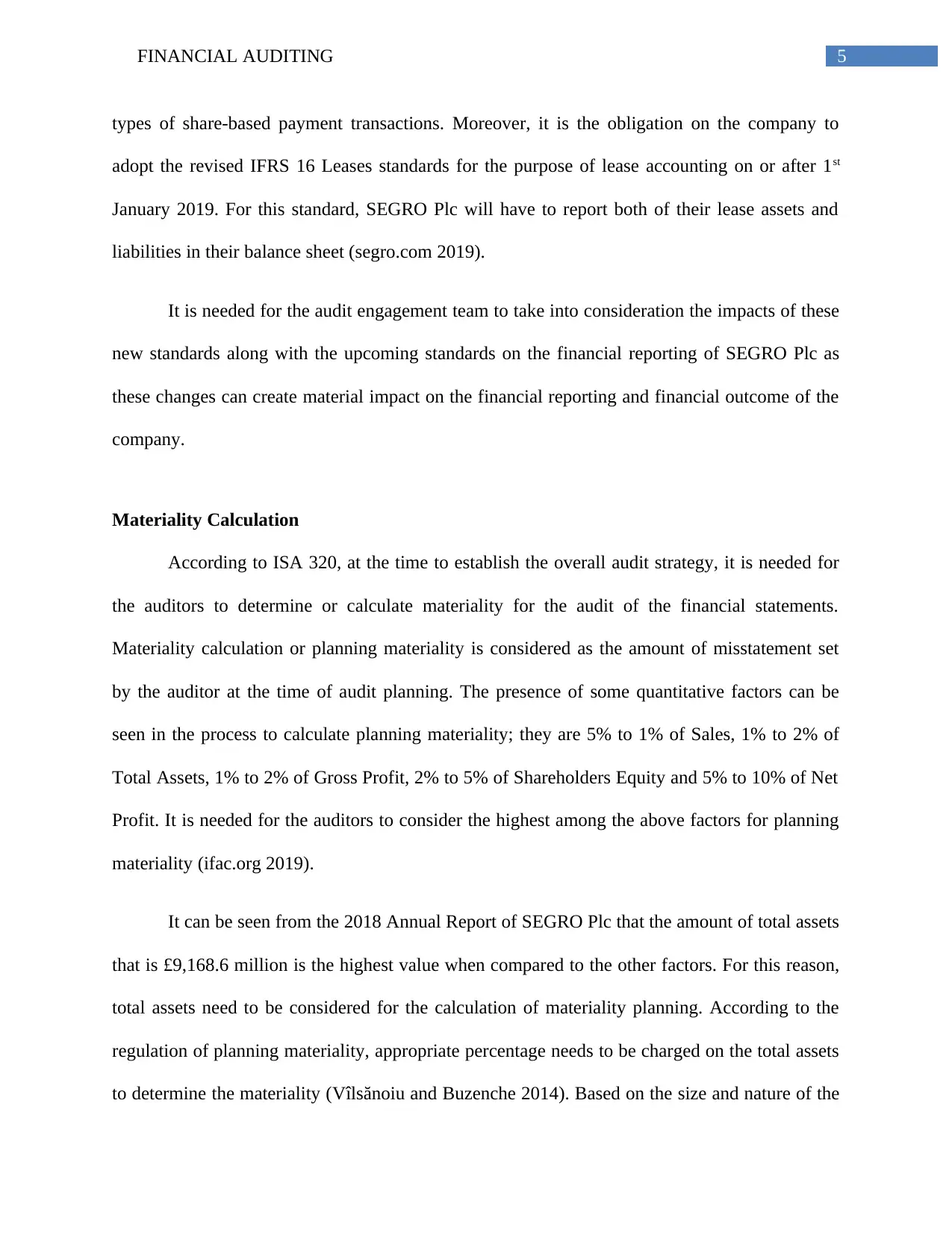
types of share-based payment transactions. Moreover, it is the obligation on the company to
adopt the revised IFRS 16 Leases standards for the purpose of lease accounting on or after 1st
January 2019. For this standard, SEGRO Plc will have to report both of their lease assets and
liabilities in their balance sheet (segro.com 2019).
It is needed for the audit engagement team to take into consideration the impacts of these
new standards along with the upcoming standards on the financial reporting of SEGRO Plc as
these changes can create material impact on the financial reporting and financial outcome of the
company.
Materiality Calculation
According to ISA 320, at the time to establish the overall audit strategy, it is needed for
the auditors to determine or calculate materiality for the audit of the financial statements.
Materiality calculation or planning materiality is considered as the amount of misstatement set
by the auditor at the time of audit planning. The presence of some quantitative factors can be
seen in the process to calculate planning materiality; they are 5% to 1% of Sales, 1% to 2% of
Total Assets, 1% to 2% of Gross Profit, 2% to 5% of Shareholders Equity and 5% to 10% of Net
Profit. It is needed for the auditors to consider the highest among the above factors for planning
materiality (ifac.org 2019).
It can be seen from the 2018 Annual Report of SEGRO Plc that the amount of total assets
that is £9,168.6 million is the highest value when compared to the other factors. For this reason,
total assets need to be considered for the calculation of materiality planning. According to the
regulation of planning materiality, appropriate percentage needs to be charged on the total assets
to determine the materiality (Vîlsănoiu and Buzenche 2014). Based on the size and nature of the
types of share-based payment transactions. Moreover, it is the obligation on the company to
adopt the revised IFRS 16 Leases standards for the purpose of lease accounting on or after 1st
January 2019. For this standard, SEGRO Plc will have to report both of their lease assets and
liabilities in their balance sheet (segro.com 2019).
It is needed for the audit engagement team to take into consideration the impacts of these
new standards along with the upcoming standards on the financial reporting of SEGRO Plc as
these changes can create material impact on the financial reporting and financial outcome of the
company.
Materiality Calculation
According to ISA 320, at the time to establish the overall audit strategy, it is needed for
the auditors to determine or calculate materiality for the audit of the financial statements.
Materiality calculation or planning materiality is considered as the amount of misstatement set
by the auditor at the time of audit planning. The presence of some quantitative factors can be
seen in the process to calculate planning materiality; they are 5% to 1% of Sales, 1% to 2% of
Total Assets, 1% to 2% of Gross Profit, 2% to 5% of Shareholders Equity and 5% to 10% of Net
Profit. It is needed for the auditors to consider the highest among the above factors for planning
materiality (ifac.org 2019).
It can be seen from the 2018 Annual Report of SEGRO Plc that the amount of total assets
that is £9,168.6 million is the highest value when compared to the other factors. For this reason,
total assets need to be considered for the calculation of materiality planning. According to the
regulation of planning materiality, appropriate percentage needs to be charged on the total assets
to determine the materiality (Vîlsănoiu and Buzenche 2014). Based on the size and nature of the
⊘ This is a preview!⊘
Do you want full access?
Subscribe today to unlock all pages.
Trusted by 1+ million students worldwide
6FINANCIAL AUDITING
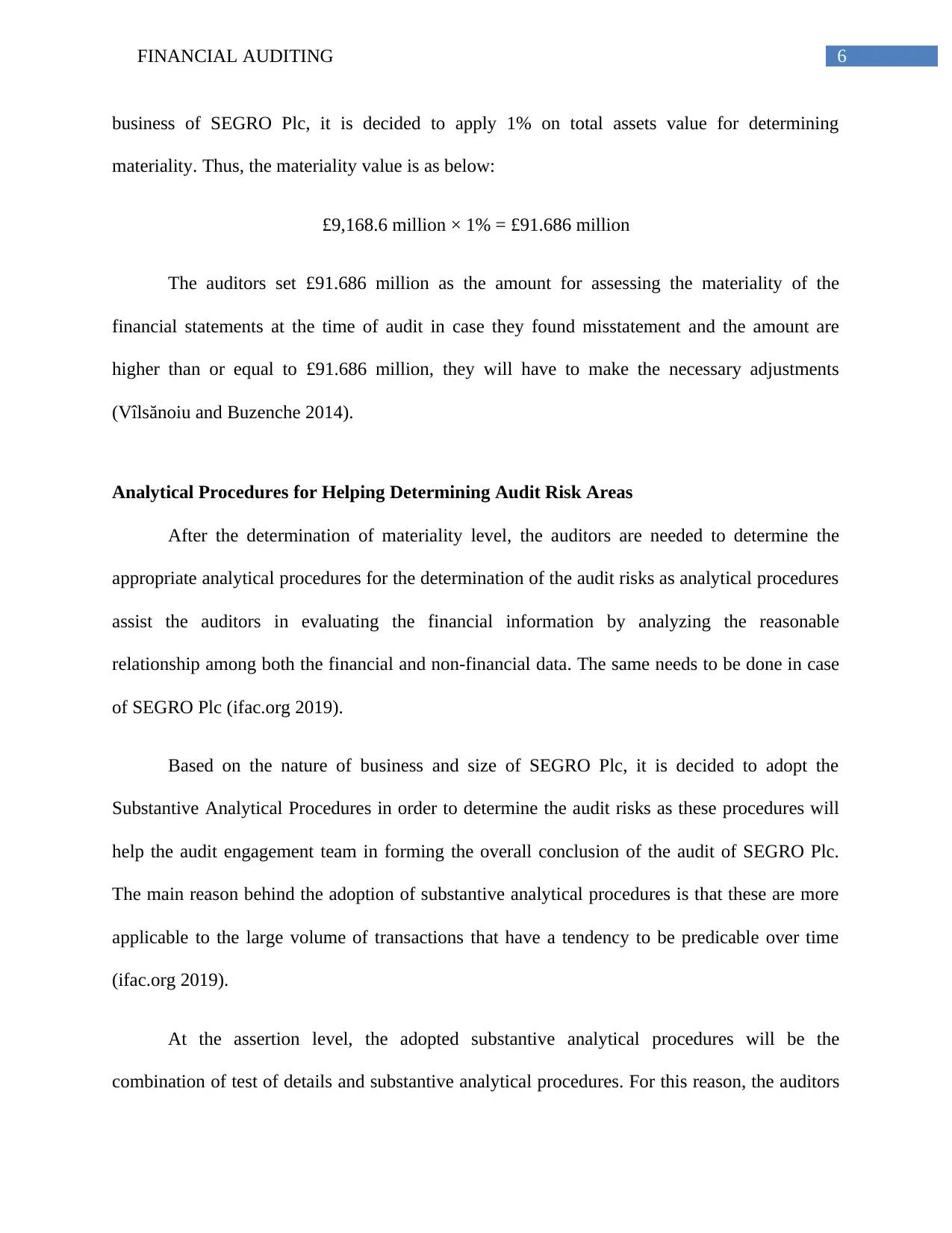
business of SEGRO Plc, it is decided to apply 1% on total assets value for determining
materiality. Thus, the materiality value is as below:
£9,168.6 million × 1% = £91.686 million
The auditors set £91.686 million as the amount for assessing the materiality of the
financial statements at the time of audit in case they found misstatement and the amount are
higher than or equal to £91.686 million, they will have to make the necessary adjustments
(Vîlsănoiu and Buzenche 2014).
Analytical Procedures for Helping Determining Audit Risk Areas
After the determination of materiality level, the auditors are needed to determine the
appropriate analytical procedures for the determination of the audit risks as analytical procedures
assist the auditors in evaluating the financial information by analyzing the reasonable
relationship among both the financial and non-financial data. The same needs to be done in case
of SEGRO Plc (ifac.org 2019).
Based on the nature of business and size of SEGRO Plc, it is decided to adopt the
Substantive Analytical Procedures in order to determine the audit risks as these procedures will
help the audit engagement team in forming the overall conclusion of the audit of SEGRO Plc.
The main reason behind the adoption of substantive analytical procedures is that these are more
applicable to the large volume of transactions that have a tendency to be predicable over time
(ifac.org 2019).
At the assertion level, the adopted substantive analytical procedures will be the
combination of test of details and substantive analytical procedures. For this reason, the auditors
business of SEGRO Plc, it is decided to apply 1% on total assets value for determining
materiality. Thus, the materiality value is as below:
£9,168.6 million × 1% = £91.686 million
The auditors set £91.686 million as the amount for assessing the materiality of the
financial statements at the time of audit in case they found misstatement and the amount are
higher than or equal to £91.686 million, they will have to make the necessary adjustments
(Vîlsănoiu and Buzenche 2014).
Analytical Procedures for Helping Determining Audit Risk Areas
After the determination of materiality level, the auditors are needed to determine the
appropriate analytical procedures for the determination of the audit risks as analytical procedures
assist the auditors in evaluating the financial information by analyzing the reasonable
relationship among both the financial and non-financial data. The same needs to be done in case
of SEGRO Plc (ifac.org 2019).
Based on the nature of business and size of SEGRO Plc, it is decided to adopt the
Substantive Analytical Procedures in order to determine the audit risks as these procedures will
help the audit engagement team in forming the overall conclusion of the audit of SEGRO Plc.
The main reason behind the adoption of substantive analytical procedures is that these are more
applicable to the large volume of transactions that have a tendency to be predicable over time
(ifac.org 2019).
At the assertion level, the adopted substantive analytical procedures will be the
combination of test of details and substantive analytical procedures. For this reason, the auditors
Paraphrase This Document
Need a fresh take? Get an instant paraphrase of this document with our AI Paraphraser
7FINANCIAL AUDITING
need to inquire of the management of SEGRO Plc for the availability as well as reliability of the
required information for the application of substantive analytical procedures (Pike, Curtis and
Chui 2013).
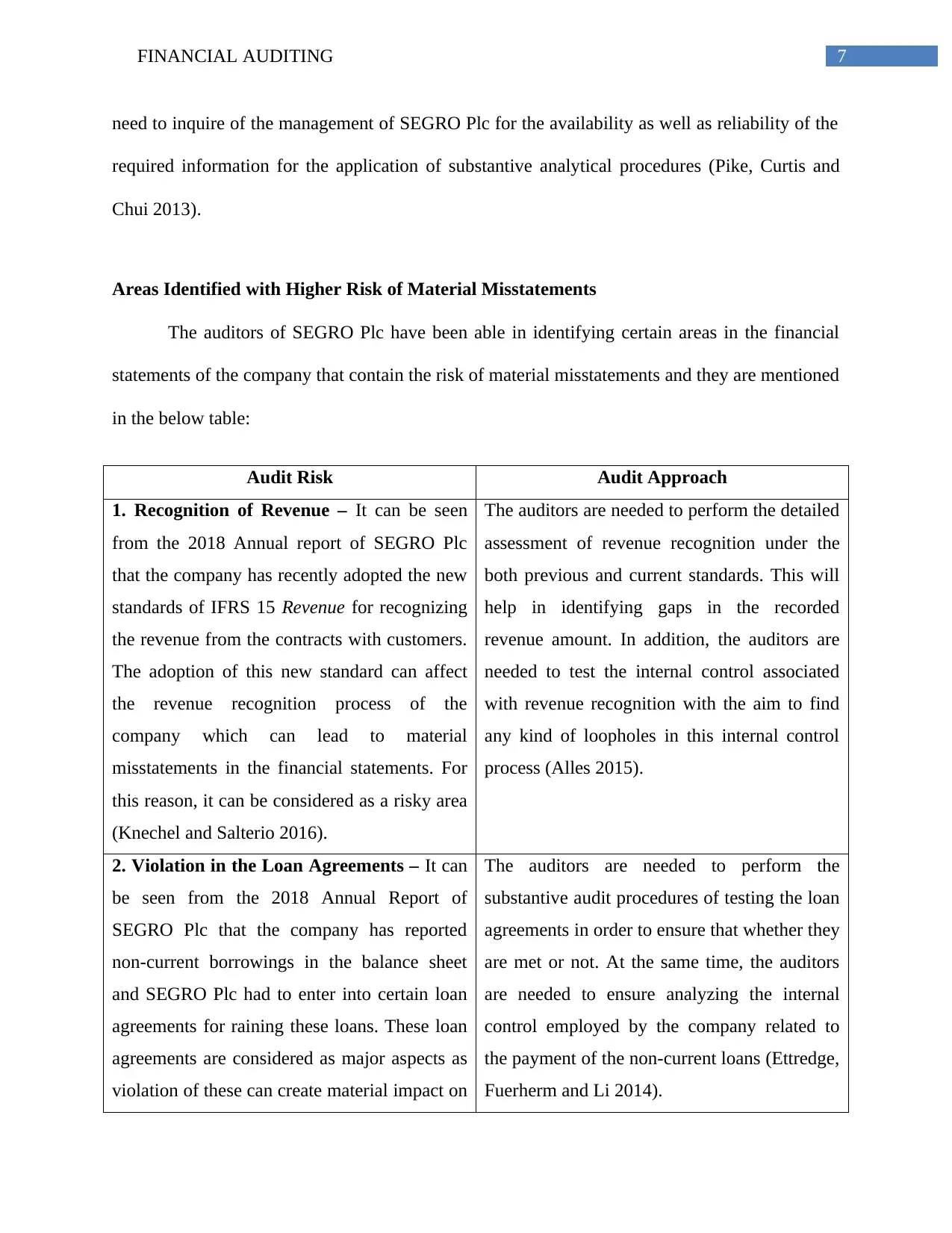
Areas Identified with Higher Risk of Material Misstatements
The auditors of SEGRO Plc have been able in identifying certain areas in the financial
statements of the company that contain the risk of material misstatements and they are mentioned
in the below table:
Audit Risk Audit Approach
1. Recognition of Revenue – It can be seen
from the 2018 Annual report of SEGRO Plc
that the company has recently adopted the new
standards of IFRS 15 Revenue for recognizing
the revenue from the contracts with customers.
The adoption of this new standard can affect
the revenue recognition process of the
company which can lead to material
misstatements in the financial statements. For
this reason, it can be considered as a risky area
(Knechel and Salterio 2016).
The auditors are needed to perform the detailed
assessment of revenue recognition under the
both previous and current standards. This will
help in identifying gaps in the recorded
revenue amount. In addition, the auditors are
needed to test the internal control associated
with revenue recognition with the aim to find
any kind of loopholes in this internal control
process (Alles 2015).
2. Violation in the Loan Agreements – It can
be seen from the 2018 Annual Report of
SEGRO Plc that the company has reported
non-current borrowings in the balance sheet
and SEGRO Plc had to enter into certain loan
agreements for raining these loans. These loan
agreements are considered as major aspects as
violation of these can create material impact on
The auditors are needed to perform the
substantive audit procedures of testing the loan
agreements in order to ensure that whether they
are met or not. At the same time, the auditors
are needed to ensure analyzing the internal
control employed by the company related to
the payment of the non-current loans (Ettredge,
Fuerherm and Li 2014).
need to inquire of the management of SEGRO Plc for the availability as well as reliability of the
required information for the application of substantive analytical procedures (Pike, Curtis and
Chui 2013).
Areas Identified with Higher Risk of Material Misstatements
The auditors of SEGRO Plc have been able in identifying certain areas in the financial
statements of the company that contain the risk of material misstatements and they are mentioned
in the below table:
Audit Risk Audit Approach
1. Recognition of Revenue – It can be seen
from the 2018 Annual report of SEGRO Plc
that the company has recently adopted the new
standards of IFRS 15 Revenue for recognizing
the revenue from the contracts with customers.
The adoption of this new standard can affect
the revenue recognition process of the
company which can lead to material
misstatements in the financial statements. For
this reason, it can be considered as a risky area
(Knechel and Salterio 2016).
The auditors are needed to perform the detailed
assessment of revenue recognition under the
both previous and current standards. This will
help in identifying gaps in the recorded
revenue amount. In addition, the auditors are
needed to test the internal control associated
with revenue recognition with the aim to find
any kind of loopholes in this internal control
process (Alles 2015).
2. Violation in the Loan Agreements – It can
be seen from the 2018 Annual Report of
SEGRO Plc that the company has reported
non-current borrowings in the balance sheet
and SEGRO Plc had to enter into certain loan
agreements for raining these loans. These loan
agreements are considered as major aspects as
violation of these can create material impact on
The auditors are needed to perform the
substantive audit procedures of testing the loan
agreements in order to ensure that whether they
are met or not. At the same time, the auditors
are needed to ensure analyzing the internal
control employed by the company related to
the payment of the non-current loans (Ettredge,
Fuerherm and Li 2014).
8FINANCIAL AUDITING
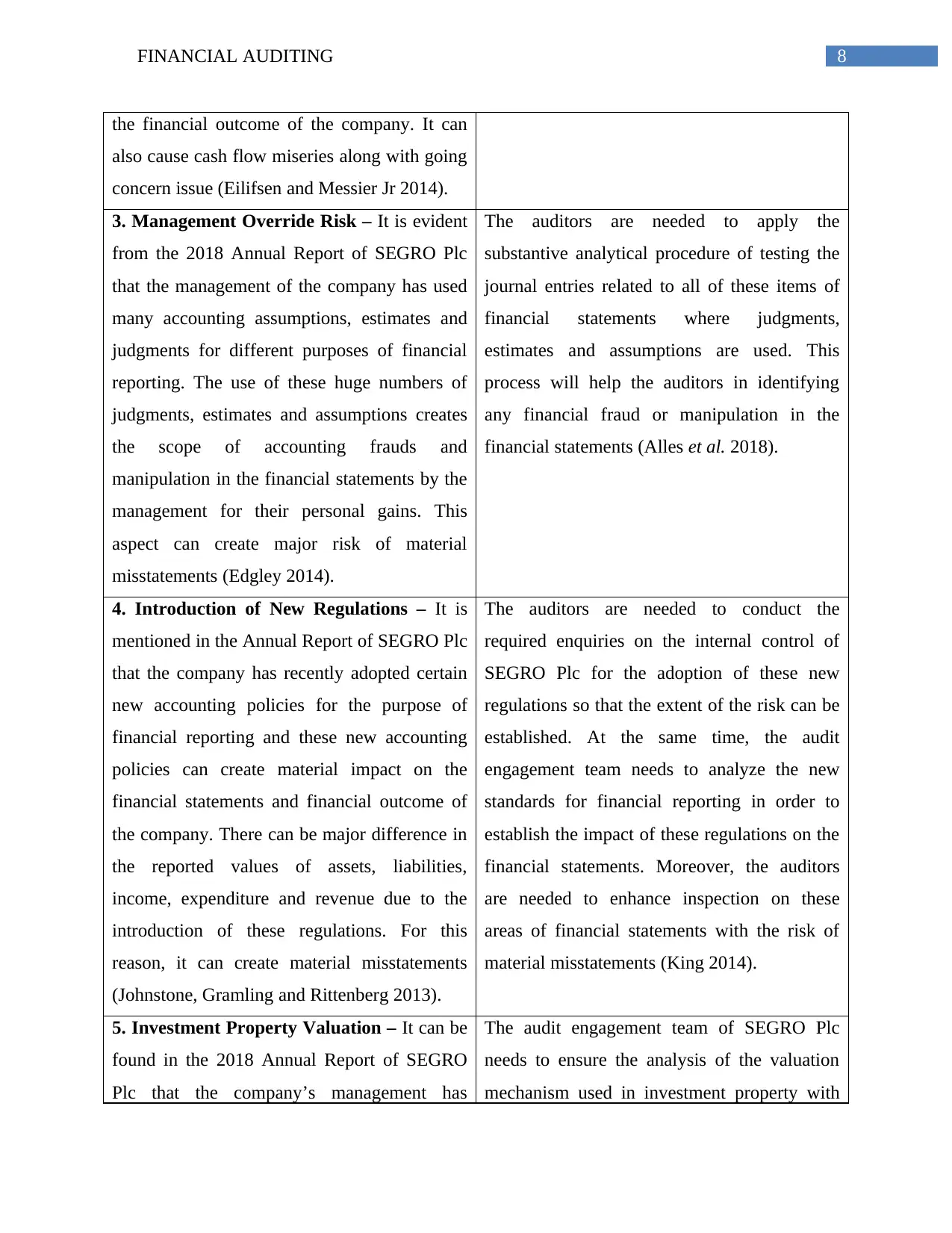
the financial outcome of the company. It can
also cause cash flow miseries along with going
concern issue (Eilifsen and Messier Jr 2014).
3. Management Override Risk – It is evident
from the 2018 Annual Report of SEGRO Plc
that the management of the company has used
many accounting assumptions, estimates and
judgments for different purposes of financial
reporting. The use of these huge numbers of
judgments, estimates and assumptions creates
the scope of accounting frauds and
manipulation in the financial statements by the
management for their personal gains. This
aspect can create major risk of material
misstatements (Edgley 2014).
The auditors are needed to apply the
substantive analytical procedure of testing the
journal entries related to all of these items of
financial statements where judgments,
estimates and assumptions are used. This
process will help the auditors in identifying
any financial fraud or manipulation in the
financial statements (Alles et al. 2018).
4. Introduction of New Regulations – It is
mentioned in the Annual Report of SEGRO Plc
that the company has recently adopted certain
new accounting policies for the purpose of
financial reporting and these new accounting
policies can create material impact on the
financial statements and financial outcome of
the company. There can be major difference in
the reported values of assets, liabilities,
income, expenditure and revenue due to the
introduction of these regulations. For this
reason, it can create material misstatements
(Johnstone, Gramling and Rittenberg 2013).
The auditors are needed to conduct the
required enquiries on the internal control of
SEGRO Plc for the adoption of these new
regulations so that the extent of the risk can be
established. At the same time, the audit
engagement team needs to analyze the new
standards for financial reporting in order to
establish the impact of these regulations on the
financial statements. Moreover, the auditors
are needed to enhance inspection on these
areas of financial statements with the risk of
material misstatements (King 2014).
5. Investment Property Valuation – It can be
found in the 2018 Annual Report of SEGRO
Plc that the company’s management has
The audit engagement team of SEGRO Plc
needs to ensure the analysis of the valuation
mechanism used in investment property with
the financial outcome of the company. It can
also cause cash flow miseries along with going
concern issue (Eilifsen and Messier Jr 2014).
3. Management Override Risk – It is evident
from the 2018 Annual Report of SEGRO Plc
that the management of the company has used
many accounting assumptions, estimates and
judgments for different purposes of financial
reporting. The use of these huge numbers of
judgments, estimates and assumptions creates
the scope of accounting frauds and
manipulation in the financial statements by the
management for their personal gains. This
aspect can create major risk of material
misstatements (Edgley 2014).
The auditors are needed to apply the
substantive analytical procedure of testing the
journal entries related to all of these items of
financial statements where judgments,
estimates and assumptions are used. This
process will help the auditors in identifying
any financial fraud or manipulation in the
financial statements (Alles et al. 2018).
4. Introduction of New Regulations – It is
mentioned in the Annual Report of SEGRO Plc
that the company has recently adopted certain
new accounting policies for the purpose of
financial reporting and these new accounting
policies can create material impact on the
financial statements and financial outcome of
the company. There can be major difference in
the reported values of assets, liabilities,
income, expenditure and revenue due to the
introduction of these regulations. For this
reason, it can create material misstatements
(Johnstone, Gramling and Rittenberg 2013).
The auditors are needed to conduct the
required enquiries on the internal control of
SEGRO Plc for the adoption of these new
regulations so that the extent of the risk can be
established. At the same time, the audit
engagement team needs to analyze the new
standards for financial reporting in order to
establish the impact of these regulations on the
financial statements. Moreover, the auditors
are needed to enhance inspection on these
areas of financial statements with the risk of
material misstatements (King 2014).
5. Investment Property Valuation – It can be
found in the 2018 Annual Report of SEGRO
Plc that the company’s management has
The audit engagement team of SEGRO Plc
needs to ensure the analysis of the valuation
mechanism used in investment property with
⊘ This is a preview!⊘
Do you want full access?
Subscribe today to unlock all pages.
Trusted by 1+ million students worldwide
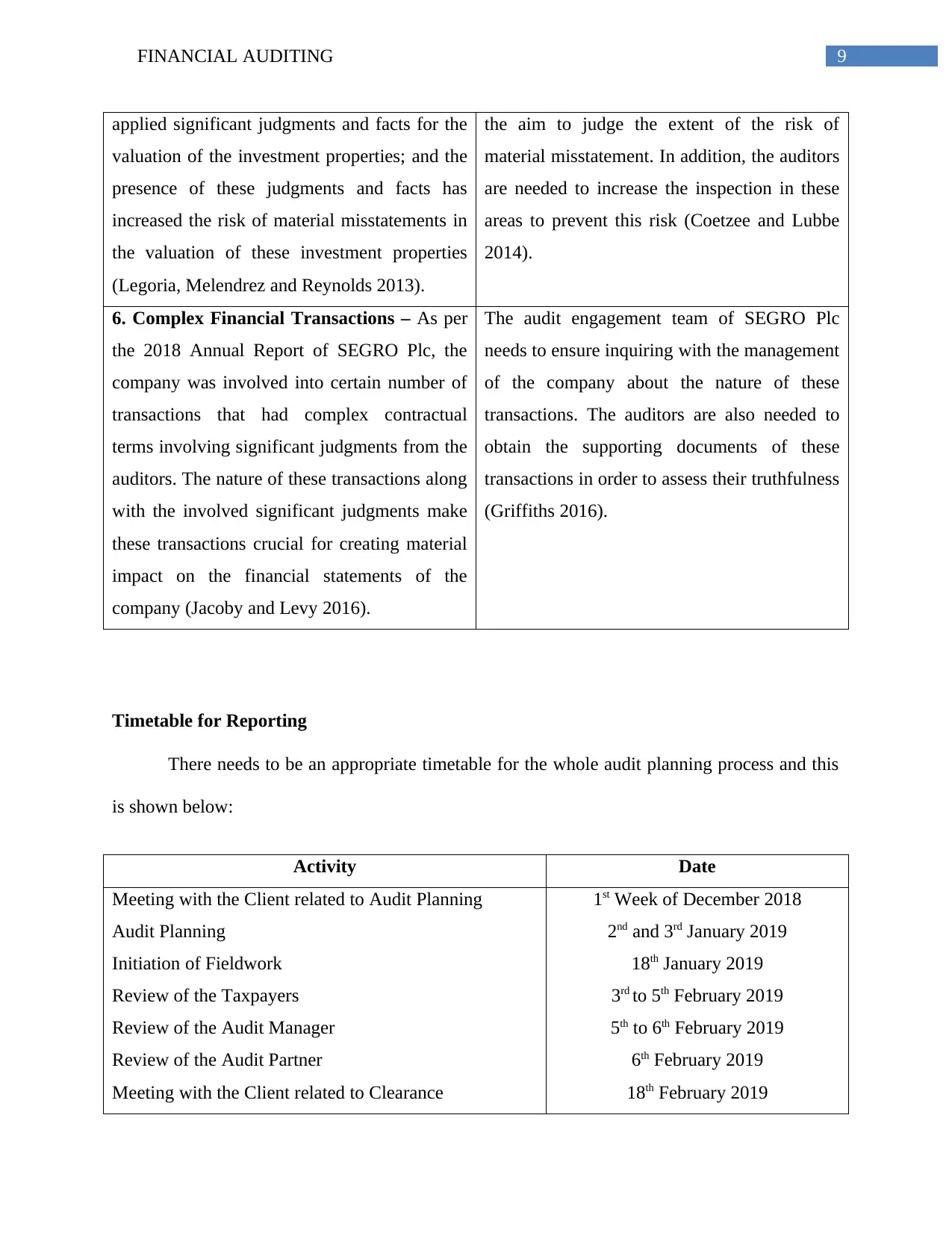
9FINANCIAL AUDITING
applied significant judgments and facts for the
valuation of the investment properties; and the
presence of these judgments and facts has
increased the risk of material misstatements in
the valuation of these investment properties
(Legoria, Melendrez and Reynolds 2013).
the aim to judge the extent of the risk of
material misstatement. In addition, the auditors
are needed to increase the inspection in these
areas to prevent this risk (Coetzee and Lubbe
2014).
6. Complex Financial Transactions – As per
the 2018 Annual Report of SEGRO Plc, the
company was involved into certain number of
transactions that had complex contractual
terms involving significant judgments from the
auditors. The nature of these transactions along
with the involved significant judgments make
these transactions crucial for creating material
impact on the financial statements of the
company (Jacoby and Levy 2016).
The audit engagement team of SEGRO Plc
needs to ensure inquiring with the management
of the company about the nature of these
transactions. The auditors are also needed to
obtain the supporting documents of these
transactions in order to assess their truthfulness
(Griffiths 2016).
Timetable for Reporting
There needs to be an appropriate timetable for the whole audit planning process and this
is shown below:
Activity Date
Meeting with the Client related to Audit Planning
Audit Planning
Initiation of Fieldwork
Review of the Taxpayers
Review of the Audit Manager
Review of the Audit Partner
Meeting with the Client related to Clearance
1st Week of December 2018
2nd and 3rd January 2019
18th January 2019
3rd to 5th February 2019
5th to 6th February 2019
6th February 2019
18th February 2019
applied significant judgments and facts for the
valuation of the investment properties; and the
presence of these judgments and facts has
increased the risk of material misstatements in
the valuation of these investment properties
(Legoria, Melendrez and Reynolds 2013).
the aim to judge the extent of the risk of
material misstatement. In addition, the auditors
are needed to increase the inspection in these
areas to prevent this risk (Coetzee and Lubbe
2014).
6. Complex Financial Transactions – As per
the 2018 Annual Report of SEGRO Plc, the
company was involved into certain number of
transactions that had complex contractual
terms involving significant judgments from the
auditors. The nature of these transactions along
with the involved significant judgments make
these transactions crucial for creating material
impact on the financial statements of the
company (Jacoby and Levy 2016).
The audit engagement team of SEGRO Plc
needs to ensure inquiring with the management
of the company about the nature of these
transactions. The auditors are also needed to
obtain the supporting documents of these
transactions in order to assess their truthfulness
(Griffiths 2016).
Timetable for Reporting
There needs to be an appropriate timetable for the whole audit planning process and this
is shown below:
Activity Date
Meeting with the Client related to Audit Planning
Audit Planning
Initiation of Fieldwork
Review of the Taxpayers
Review of the Audit Manager
Review of the Audit Partner
Meeting with the Client related to Clearance
1st Week of December 2018
2nd and 3rd January 2019
18th January 2019
3rd to 5th February 2019
5th to 6th February 2019
6th February 2019
18th February 2019
Paraphrase This Document
Need a fresh take? Get an instant paraphrase of this document with our AI Paraphraser
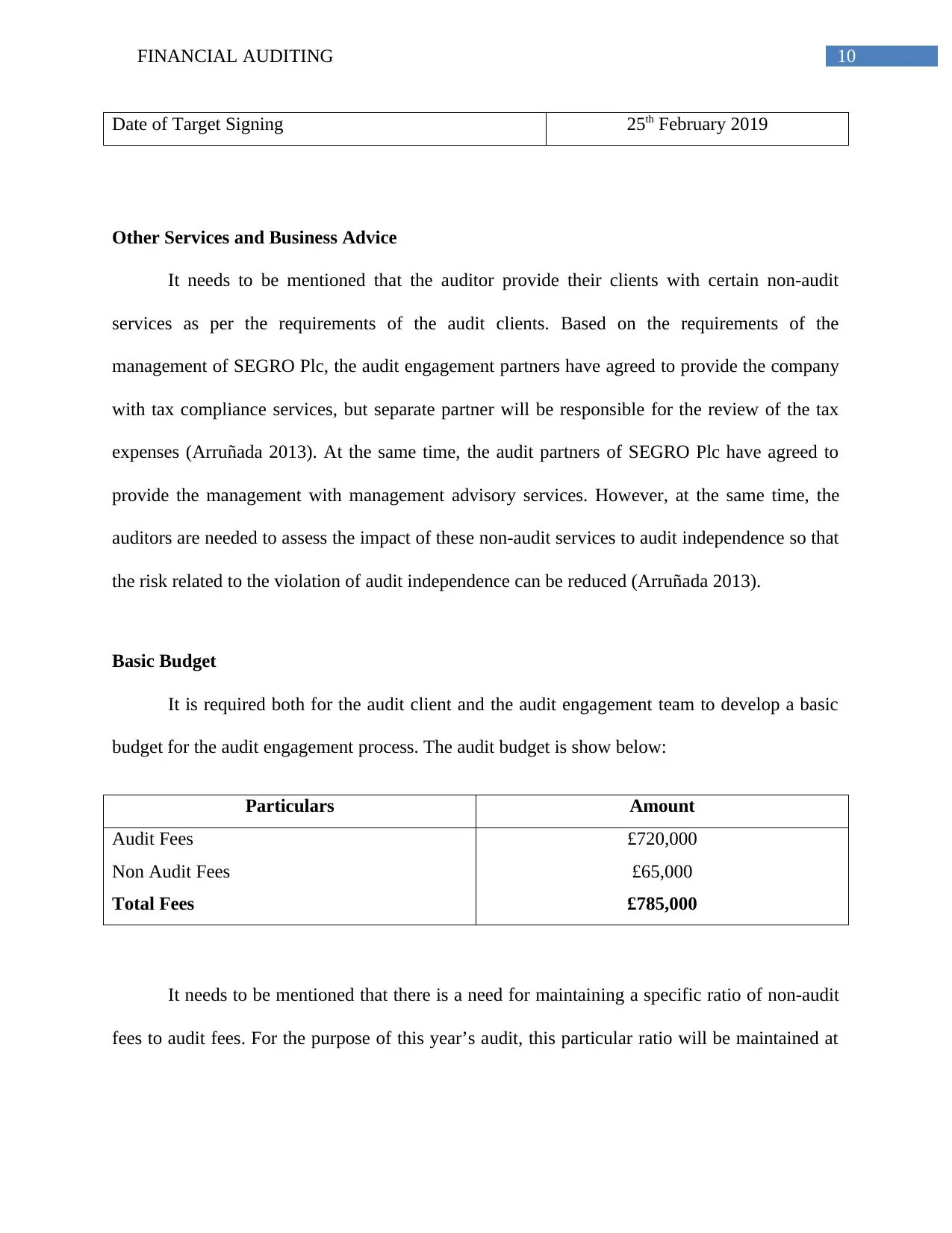
10FINANCIAL AUDITING
Date of Target Signing 25th February 2019
Other Services and Business Advice
It needs to be mentioned that the auditor provide their clients with certain non-audit
services as per the requirements of the audit clients. Based on the requirements of the
management of SEGRO Plc, the audit engagement partners have agreed to provide the company
with tax compliance services, but separate partner will be responsible for the review of the tax
expenses (Arruñada 2013). At the same time, the audit partners of SEGRO Plc have agreed to
provide the management with management advisory services. However, at the same time, the
auditors are needed to assess the impact of these non-audit services to audit independence so that
the risk related to the violation of audit independence can be reduced (Arruñada 2013).
Basic Budget
It is required both for the audit client and the audit engagement team to develop a basic
budget for the audit engagement process. The audit budget is show below:
Particulars Amount
Audit Fees
Non Audit Fees
Total Fees
£720,000
£65,000
£785,000
It needs to be mentioned that there is a need for maintaining a specific ratio of non-audit
fees to audit fees. For the purpose of this year’s audit, this particular ratio will be maintained at
Date of Target Signing 25th February 2019
Other Services and Business Advice
It needs to be mentioned that the auditor provide their clients with certain non-audit
services as per the requirements of the audit clients. Based on the requirements of the
management of SEGRO Plc, the audit engagement partners have agreed to provide the company
with tax compliance services, but separate partner will be responsible for the review of the tax
expenses (Arruñada 2013). At the same time, the audit partners of SEGRO Plc have agreed to
provide the management with management advisory services. However, at the same time, the
auditors are needed to assess the impact of these non-audit services to audit independence so that
the risk related to the violation of audit independence can be reduced (Arruñada 2013).
Basic Budget
It is required both for the audit client and the audit engagement team to develop a basic
budget for the audit engagement process. The audit budget is show below:
Particulars Amount
Audit Fees
Non Audit Fees
Total Fees
£720,000
£65,000
£785,000
It needs to be mentioned that there is a need for maintaining a specific ratio of non-audit
fees to audit fees. For the purpose of this year’s audit, this particular ratio will be maintained at

11FINANCIAL AUDITING
10%. This audit budget will provide the necessary direction to the audit work of the audit
engagement team of SERGO Plc.
10%. This audit budget will provide the necessary direction to the audit work of the audit
engagement team of SERGO Plc.
⊘ This is a preview!⊘
Do you want full access?
Subscribe today to unlock all pages.
Trusted by 1+ million students worldwide

1 out of 15


Related Documents


Your All-in-One AI-Powered Toolkit for Academic Success.
+13062052269
info@desklib.com
Available 24*7 on WhatsApp / Email
![[object Object]](/_next/static/media/star-bottom.7253800d.svg)
Unlock your academic potential
Copyright © 2020–2026 A2Z Services. All Rights Reserved. Developed and managed by ZUCOL.