TownScape PLC: Budgeting Analysis and Cost Management Report
VerifiedAdded on 2021/05/31
|7
|3964
|25
Report
AI Summary
This report analyzes various budgeting methods, including traditional, zero-based, activity-based, and rolling budgets, within the context of TownScape PLC's financial planning. It explores the purposes of budgeting, the processes involved, and how budgeting aids in business model development. The report details the stages of strategic planning, long-term plan creation, annual budget preparation, and monitoring of results. It examines the application of traditional budgeting, including incremental budgeting, and assesses its appropriateness for different business scenarios. Furthermore, the report delves into alternative budgeting methods such as rolling, zero-based, and activity-based budgets, explaining their improvements over traditional approaches and their respective drawbacks. The analysis considers the impact of factors like market changes, new customer acquisition, and fluctuating costs on the budgeting process, offering insights into effective cost management strategies.
Part 1
i. An understanding of the purposes of preparing a budget; what processes the company
needs to follow; and how the budget process itself can help development of the
business model.
The projected budget is a table showing the financial health of your company for the current or
future year. Hence, it records all the required expenses and the profits generated. This document
will allow you to have a global and detailed view of all charges and receipts. It will allow you to
identify and classify the latter so as to provide the necessary readjustments in the event of a
probable imbalance. It is likely to vary and evolve according to certain evaluation criteria. It can
happen that during the year a new element occurs as for example:
Higher taxes payable
Market decline or rise
Fluctuation of raw material prices
Acquiring new customers and increasing certain needs
For instance, TownScape PLC are envisaging to explore new markets outside the EU in anticipation of
the UK leaving the European common market. They will probably acquire new customers and as a
consequence, there will be additional needs and this needs to be taken into consideration and must
be reflected in the budget. Thus, the budget should not be a succession of calculations and vague
data but must be based on estimates carefully studied and rigorously verified.
Therefore, it is important to have a process to follow when establishing the budget. This process
involves many stages including strategic planning, creation of long-term plan to implement
strategies, preparation of the annual budget within the context of the long-term plan, the
monitoring of actual results and the response to deviations from the plan
Strategic Planning
When you run a business, it's easy to get bogged down in everyday problems and forget the broader
context. However, successful businesses invest time to create and manage budgets, prepare and
review business plans and regularly monitor finances and performance
The purpose of strategic planning is to define the direction that a company wants to take in the
medium to long term. Projects, activities are planned for a period of 3 years, 5 years or more, to
meet the objectives (turnover, etc.) that the company's management has set. Strategic planning is a
process of continuous reflection and can make all the difference in the growth of your business. It
will allow you to focus resources on improving profits, reducing costs and increasing return on
investment. The key benefit of strategic planning is that it allows you to focus on the direction of
your business and provides targets that will help your business grow.
Creation of long-term plan to implement strategies
The business must set a series of targets and determine the actions to take in order to meet those
targets and ultimately to achieve its strategic planning. When creating a long term plan, a business
should first determine and evaluate possible strategies. Then, a clear strategy must be established
and relevant activities must be defined with a target date for each activity. It is then necessary to
evaluate the needs, coordinate the actions to be carried out, and quantify the projected results. It is
important to understand that with the creation of a long-term plan, a business sets some goals to
attain a certain position many years ahead.
i. An understanding of the purposes of preparing a budget; what processes the company
needs to follow; and how the budget process itself can help development of the
business model.
The projected budget is a table showing the financial health of your company for the current or
future year. Hence, it records all the required expenses and the profits generated. This document
will allow you to have a global and detailed view of all charges and receipts. It will allow you to
identify and classify the latter so as to provide the necessary readjustments in the event of a
probable imbalance. It is likely to vary and evolve according to certain evaluation criteria. It can
happen that during the year a new element occurs as for example:
Higher taxes payable
Market decline or rise
Fluctuation of raw material prices
Acquiring new customers and increasing certain needs
For instance, TownScape PLC are envisaging to explore new markets outside the EU in anticipation of
the UK leaving the European common market. They will probably acquire new customers and as a
consequence, there will be additional needs and this needs to be taken into consideration and must
be reflected in the budget. Thus, the budget should not be a succession of calculations and vague
data but must be based on estimates carefully studied and rigorously verified.
Therefore, it is important to have a process to follow when establishing the budget. This process
involves many stages including strategic planning, creation of long-term plan to implement
strategies, preparation of the annual budget within the context of the long-term plan, the
monitoring of actual results and the response to deviations from the plan
Strategic Planning
When you run a business, it's easy to get bogged down in everyday problems and forget the broader
context. However, successful businesses invest time to create and manage budgets, prepare and
review business plans and regularly monitor finances and performance
The purpose of strategic planning is to define the direction that a company wants to take in the
medium to long term. Projects, activities are planned for a period of 3 years, 5 years or more, to
meet the objectives (turnover, etc.) that the company's management has set. Strategic planning is a
process of continuous reflection and can make all the difference in the growth of your business. It
will allow you to focus resources on improving profits, reducing costs and increasing return on
investment. The key benefit of strategic planning is that it allows you to focus on the direction of
your business and provides targets that will help your business grow.
Creation of long-term plan to implement strategies
The business must set a series of targets and determine the actions to take in order to meet those
targets and ultimately to achieve its strategic planning. When creating a long term plan, a business
should first determine and evaluate possible strategies. Then, a clear strategy must be established
and relevant activities must be defined with a target date for each activity. It is then necessary to
evaluate the needs, coordinate the actions to be carried out, and quantify the projected results. It is
important to understand that with the creation of a long-term plan, a business sets some goals to
attain a certain position many years ahead.

Paraphrase This Document
Need a fresh take? Get an instant paraphrase of this document with our AI Paraphraser
Preparation of the annual budget within the context of the long-term plan
Creating, monitoring and managing a budget is critical to the success of a business. This should help
any business to allocate resources where they are needed in order to stay profitable and successful.
The annual budget is a chart showing the financial health of your business for the current or future
year. It thus identifies all the required expenses and the profits generated. It is a financial document
intended to list all the expenses and revenues of a company. It allows a business to better control
costs and to guard against inappropriate management of your resources. It acts as a roadmap
throughout the exercise of the activity.
For instance, Townscape is planning to rollout 15 new products in 2019. Therefore, when preparing
the annual budget, the company must take into consideration the expenses related to the rollout of
new products
Monitoring of actual results and the response to deviations from the plan
After elaborating a budget, it is crucial to follow the gaps or the deviations between what was
planned and what has been actually done. Indeed, no need to make a super forecast of activity if it
does not correspond to the reality and if the gaps are not analysed. Monitoring consists of:
1. Follow the execution level of the budget
2. Compare the execution level with that planned or budgeted.
3. Analyse discrepancies between actual activity and budgeted activity
4. Implement corrective actions to improve business performance
In fact, the budget process can help development of the business model since it gives the ability to
make constant improvements and anticipate problems. This process also provides reliable financial
information on which to base decisions. Finally, the budget process facilitates decision-making of a
business.
ii. Considering what are the important cost drivers for this business, identify the specific
areas where cost budgeting will be important. Demonstrate the application of
traditional budgeting approaches (including incremental budgeting) to plan future cost
management for this specific business.
When preparing a budget, TownScape must predict the expenses in the year to come and list them
in the budget document. There are many areas where cost budgeting will be important for
TownScape including setting up new plants to increase the manufacturing capacity in order to
honour new contracts. TownScape will probably need to buy new machineries, new equipment and
additional workforce will be required to work in the new plants. They will need to think about the
wage costs of the new personnel. Apart from that, they will eventually buy or hire some yards to
implement the new plant and all these expenses must be budgeted.
With regards to TownScape budget approach, traditional budgeting may be applied to plan future
cost management. TownScape can use an incremental budget on the budget from the previous year
as a basis or the actual return with additional amounts added for the new budget. As new contracts
have been signed, new products will be rollout in 2019 and manufacturing capacity is predicted to
increase, the budget will be adjusted during the course of the year to reflect new changes. The
working method will remain the same however, there will be a slight change in budget allocations
compared to the previous period.
Creating, monitoring and managing a budget is critical to the success of a business. This should help
any business to allocate resources where they are needed in order to stay profitable and successful.
The annual budget is a chart showing the financial health of your business for the current or future
year. It thus identifies all the required expenses and the profits generated. It is a financial document
intended to list all the expenses and revenues of a company. It allows a business to better control
costs and to guard against inappropriate management of your resources. It acts as a roadmap
throughout the exercise of the activity.
For instance, Townscape is planning to rollout 15 new products in 2019. Therefore, when preparing
the annual budget, the company must take into consideration the expenses related to the rollout of
new products
Monitoring of actual results and the response to deviations from the plan
After elaborating a budget, it is crucial to follow the gaps or the deviations between what was
planned and what has been actually done. Indeed, no need to make a super forecast of activity if it
does not correspond to the reality and if the gaps are not analysed. Monitoring consists of:
1. Follow the execution level of the budget
2. Compare the execution level with that planned or budgeted.
3. Analyse discrepancies between actual activity and budgeted activity
4. Implement corrective actions to improve business performance
In fact, the budget process can help development of the business model since it gives the ability to
make constant improvements and anticipate problems. This process also provides reliable financial
information on which to base decisions. Finally, the budget process facilitates decision-making of a
business.
ii. Considering what are the important cost drivers for this business, identify the specific
areas where cost budgeting will be important. Demonstrate the application of
traditional budgeting approaches (including incremental budgeting) to plan future cost
management for this specific business.
When preparing a budget, TownScape must predict the expenses in the year to come and list them
in the budget document. There are many areas where cost budgeting will be important for
TownScape including setting up new plants to increase the manufacturing capacity in order to
honour new contracts. TownScape will probably need to buy new machineries, new equipment and
additional workforce will be required to work in the new plants. They will need to think about the
wage costs of the new personnel. Apart from that, they will eventually buy or hire some yards to
implement the new plant and all these expenses must be budgeted.
With regards to TownScape budget approach, traditional budgeting may be applied to plan future
cost management. TownScape can use an incremental budget on the budget from the previous year
as a basis or the actual return with additional amounts added for the new budget. As new contracts
have been signed, new products will be rollout in 2019 and manufacturing capacity is predicted to
increase, the budget will be adjusted during the course of the year to reflect new changes. The
working method will remain the same however, there will be a slight change in budget allocations
compared to the previous period.
iii. Analysing whether a traditional budgetary system is appropriate to all or any parts of
the business in its planned future form
Traditional budgetary system is more appropriate for short-term plan or for business that do not
expect a significant growth. In the case of TownScape, traditional budget may be required for some
areas of the business but it won’t necessary work for every aspect of the business. For instance,
before concluding new contracts, they were pro in a particular context with more or less fixed
contracts and there was not significant change in the way the business was run. We could say it was
business as usual and the traditional budgeting system perfectly suits this context.
Now the business will experience significant changes in the future after signing contracts with 15
local authorities. Apart from that, they are preparing to launch 15 new products. It is also important
to bear in mind that the UK is leaving the EU and as a result, there will be financial implications for
TownScape given that they also have a customer base within the EU. As an example, the company
may lose some advantages regarding taxation and customs excise after the UK leave the EU.
TownScape is also envisaging to explore new markets outside the EU.
Therefore, there will be some implications in terms of costs and expenses in the years to come. A
traditional budgetary system will not be appropriate anymore. Instead, budget costs should be
affected by business activities. The best option for TownScape is now to use the volume of future
activities instead of its historical expenses.
Part 2
An understanding of the following alternative budget methods: rolling budgets, zero
based budgets and activity based budgets. Explain how each method attempts to
improve on the traditional approach and what their respective drawback
An understanding of the following alternative budget methods: rolling budgets, zero based budgets
and activity based budgets. Explain how each method attempts to improve on the traditional
approach and what their respective drawbacks might be
Apart from the traditional approach, there are other budgets methods including zero based budgets,
activity based budget and rolling budgets. These budget methods try to enhance the traditional
approach that take the past budget and correct it with minor variations. However, these methods
also have their shortcomings.
Zero Based Budget
Zero based budget is a budgeting method by which an organisation starts on a blank page. The idea
behind this approach is that the budget must be consistent with the organization's strategy
regardless of the past. Each function, each expense must be evaluated in terms of contributions to
the strategy before it can be budgeted.
Zero based budget approach is easy to imagine when one does start from scratch, as in the case of a
business start-up with limited capital. In such a case, each expense is weighed so as not to risk
putting the project in jeopardy. This approach is more difficult in an existing organization where the
decisions and expenditures made in the previous fiscal year can be a basis upon which the budget of
the following year will be elaborated.
the business in its planned future form
Traditional budgetary system is more appropriate for short-term plan or for business that do not
expect a significant growth. In the case of TownScape, traditional budget may be required for some
areas of the business but it won’t necessary work for every aspect of the business. For instance,
before concluding new contracts, they were pro in a particular context with more or less fixed
contracts and there was not significant change in the way the business was run. We could say it was
business as usual and the traditional budgeting system perfectly suits this context.
Now the business will experience significant changes in the future after signing contracts with 15
local authorities. Apart from that, they are preparing to launch 15 new products. It is also important
to bear in mind that the UK is leaving the EU and as a result, there will be financial implications for
TownScape given that they also have a customer base within the EU. As an example, the company
may lose some advantages regarding taxation and customs excise after the UK leave the EU.
TownScape is also envisaging to explore new markets outside the EU.
Therefore, there will be some implications in terms of costs and expenses in the years to come. A
traditional budgetary system will not be appropriate anymore. Instead, budget costs should be
affected by business activities. The best option for TownScape is now to use the volume of future
activities instead of its historical expenses.
Part 2
An understanding of the following alternative budget methods: rolling budgets, zero
based budgets and activity based budgets. Explain how each method attempts to
improve on the traditional approach and what their respective drawback
An understanding of the following alternative budget methods: rolling budgets, zero based budgets
and activity based budgets. Explain how each method attempts to improve on the traditional
approach and what their respective drawbacks might be
Apart from the traditional approach, there are other budgets methods including zero based budgets,
activity based budget and rolling budgets. These budget methods try to enhance the traditional
approach that take the past budget and correct it with minor variations. However, these methods
also have their shortcomings.
Zero Based Budget
Zero based budget is a budgeting method by which an organisation starts on a blank page. The idea
behind this approach is that the budget must be consistent with the organization's strategy
regardless of the past. Each function, each expense must be evaluated in terms of contributions to
the strategy before it can be budgeted.
Zero based budget approach is easy to imagine when one does start from scratch, as in the case of a
business start-up with limited capital. In such a case, each expense is weighed so as not to risk
putting the project in jeopardy. This approach is more difficult in an existing organization where the
decisions and expenditures made in the previous fiscal year can be a basis upon which the budget of
the following year will be elaborated.
⊘ This is a preview!⊘
Do you want full access?
Subscribe today to unlock all pages.

Trusted by 1+ million students worldwide
Activity Based Budget (ABB)
Activity based budget is an activity-based cost analysis tool that seeks to model the relationships
between resources, their consumption patterns and business objectives. In broad outline, the ABC
method divides the activities of a company to analyse the cost chains and evaluate the profitability
of each reference.
Concretely, the activity-based budgeting procedure consists of taking as starting point the activities
necessary to achieve the products, orders or services requested by the customers (budgeted cost
objects), in order to budget the resources that will be consumed by these activities
This approach is particularly relevant to sectors where indirect costs are significant. It studies the
management of costs by activity in the context of a transversal approach oriented to the business
process. The goal is to model the loads by activities / processes and to better control them. This
method has many benefits including:
• A better understanding of the costs (direct and indirect) related to each product
• An administration based on cost management
• Reduced overhead costs by minimizing excess capacity
The main drawback of ABB is it requires the mobilisation and the training of personnel. The latter
should be well trained to understand this method and apply within the organisation. Activity based
budget may also require the use of specific software given its complexity.
Rolling budgets
A rolling budget is a budget that is continuously updated. This means an organisation can divide a
period in sub-periods. This consists in subdividing the 12-month budget period into sub-periods,
subtracting as soon as a sub-period ends the budgetary data concerning it and reviewing the budget
data of the next sub-periods while adding the forecasts for an additional sub-period. Usually, the
sub-period is a quarter (3 months)
The main advantage of this approach is that a full year budget is always available. Also, the fact that
the budget is regularly updated, the information on the budget document is not out of date. With
rolling budget, any unexpected change can be dealt with quickly and the company does not need to
wait for 12 months before reflecting it in the budget.
However, this process is time consuming given that every 3 months, a new budget must be
elaborated rather than 12 months of the traditional approach. Also, a frequent revision of the
budget may be somehow distractive for the employees and this may affect their productivity
How each method helps in improving the traditional approach and their drawbacks has been
explained below:
Zero Based Budget: - The concept of zero based budgeting is relatively a novel concept. It was
originally brought for initiating a new concept of budgeting where every year the budget would be
started from the scratch. It was a major improvement from the traditional form of budgeting, where
only minor tweaking were done from the budgets of the previous years ((Zeller and Metzger, 2013).
Activity based budget is an activity-based cost analysis tool that seeks to model the relationships
between resources, their consumption patterns and business objectives. In broad outline, the ABC
method divides the activities of a company to analyse the cost chains and evaluate the profitability
of each reference.
Concretely, the activity-based budgeting procedure consists of taking as starting point the activities
necessary to achieve the products, orders or services requested by the customers (budgeted cost
objects), in order to budget the resources that will be consumed by these activities
This approach is particularly relevant to sectors where indirect costs are significant. It studies the
management of costs by activity in the context of a transversal approach oriented to the business
process. The goal is to model the loads by activities / processes and to better control them. This
method has many benefits including:
• A better understanding of the costs (direct and indirect) related to each product
• An administration based on cost management
• Reduced overhead costs by minimizing excess capacity
The main drawback of ABB is it requires the mobilisation and the training of personnel. The latter
should be well trained to understand this method and apply within the organisation. Activity based
budget may also require the use of specific software given its complexity.
Rolling budgets
A rolling budget is a budget that is continuously updated. This means an organisation can divide a
period in sub-periods. This consists in subdividing the 12-month budget period into sub-periods,
subtracting as soon as a sub-period ends the budgetary data concerning it and reviewing the budget
data of the next sub-periods while adding the forecasts for an additional sub-period. Usually, the
sub-period is a quarter (3 months)
The main advantage of this approach is that a full year budget is always available. Also, the fact that
the budget is regularly updated, the information on the budget document is not out of date. With
rolling budget, any unexpected change can be dealt with quickly and the company does not need to
wait for 12 months before reflecting it in the budget.
However, this process is time consuming given that every 3 months, a new budget must be
elaborated rather than 12 months of the traditional approach. Also, a frequent revision of the
budget may be somehow distractive for the employees and this may affect their productivity
How each method helps in improving the traditional approach and their drawbacks has been
explained below:
Zero Based Budget: - The concept of zero based budgeting is relatively a novel concept. It was
originally brought for initiating a new concept of budgeting where every year the budget would be
started from the scratch. It was a major improvement from the traditional form of budgeting, where
only minor tweaking were done from the budgets of the previous years ((Zeller and Metzger, 2013).
Paraphrase This Document
Need a fresh take? Get an instant paraphrase of this document with our AI Paraphraser
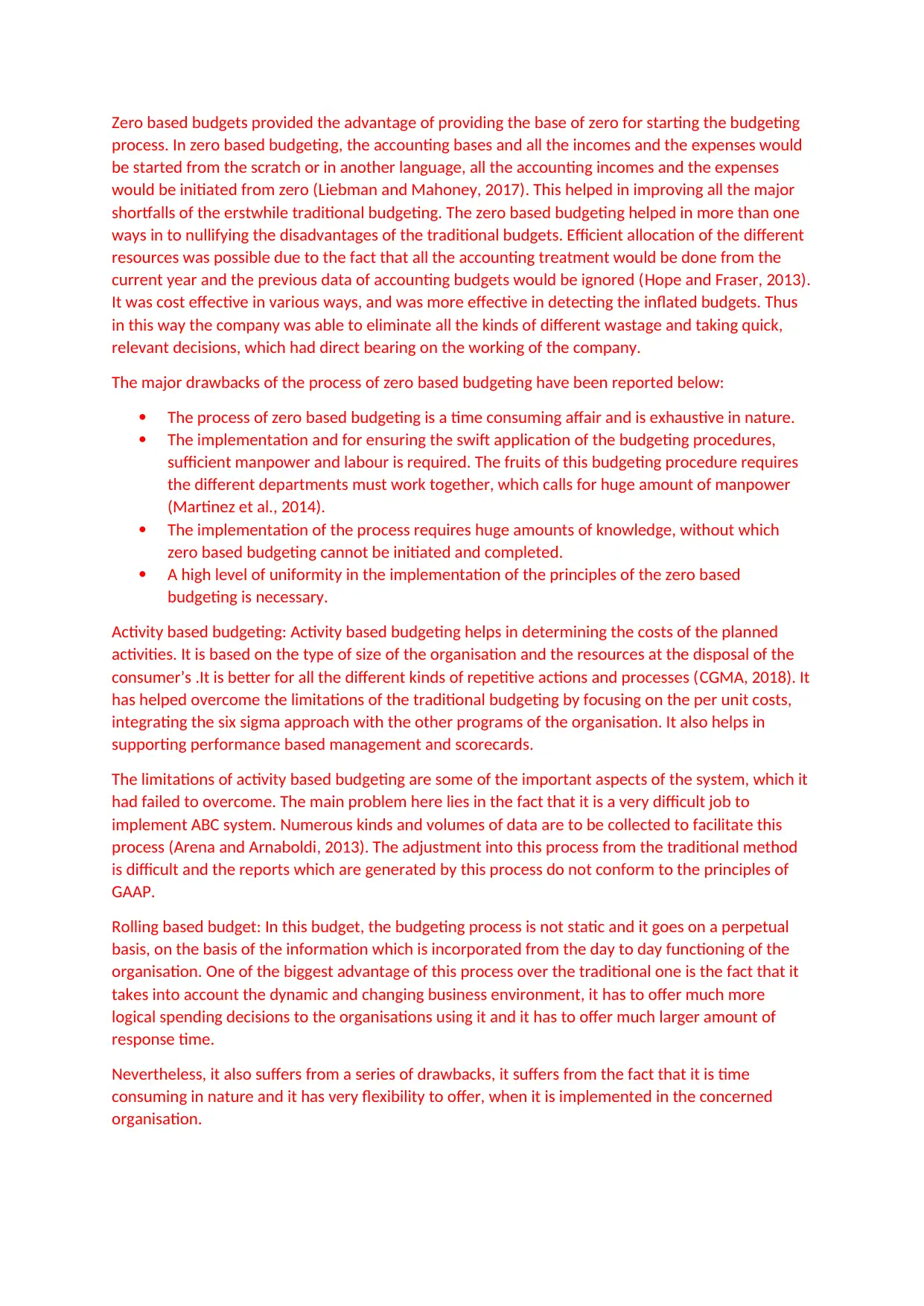
Zero based budgets provided the advantage of providing the base of zero for starting the budgeting
process. In zero based budgeting, the accounting bases and all the incomes and the expenses would
be started from the scratch or in another language, all the accounting incomes and the expenses
would be initiated from zero (Liebman and Mahoney, 2017). This helped in improving all the major
shortfalls of the erstwhile traditional budgeting. The zero based budgeting helped in more than one
ways in to nullifying the disadvantages of the traditional budgets. Efficient allocation of the different
resources was possible due to the fact that all the accounting treatment would be done from the
current year and the previous data of accounting budgets would be ignored (Hope and Fraser, 2013).
It was cost effective in various ways, and was more effective in detecting the inflated budgets. Thus
in this way the company was able to eliminate all the kinds of different wastage and taking quick,
relevant decisions, which had direct bearing on the working of the company.
The major drawbacks of the process of zero based budgeting have been reported below:
The process of zero based budgeting is a time consuming affair and is exhaustive in nature.
The implementation and for ensuring the swift application of the budgeting procedures,
sufficient manpower and labour is required. The fruits of this budgeting procedure requires
the different departments must work together, which calls for huge amount of manpower
(Martinez et al., 2014).
The implementation of the process requires huge amounts of knowledge, without which
zero based budgeting cannot be initiated and completed.
A high level of uniformity in the implementation of the principles of the zero based
budgeting is necessary.
Activity based budgeting: Activity based budgeting helps in determining the costs of the planned
activities. It is based on the type of size of the organisation and the resources at the disposal of the
consumer’s .It is better for all the different kinds of repetitive actions and processes (CGMA, 2018). It
has helped overcome the limitations of the traditional budgeting by focusing on the per unit costs,
integrating the six sigma approach with the other programs of the organisation. It also helps in
supporting performance based management and scorecards.
The limitations of activity based budgeting are some of the important aspects of the system, which it
had failed to overcome. The main problem here lies in the fact that it is a very difficult job to
implement ABC system. Numerous kinds and volumes of data are to be collected to facilitate this
process (Arena and Arnaboldi, 2013). The adjustment into this process from the traditional method
is difficult and the reports which are generated by this process do not conform to the principles of
GAAP.
Rolling based budget: In this budget, the budgeting process is not static and it goes on a perpetual
basis, on the basis of the information which is incorporated from the day to day functioning of the
organisation. One of the biggest advantage of this process over the traditional one is the fact that it
takes into account the dynamic and changing business environment, it has to offer much more
logical spending decisions to the organisations using it and it has to offer much larger amount of
response time.
Nevertheless, it also suffers from a series of drawbacks, it suffers from the fact that it is time
consuming in nature and it has very flexibility to offer, when it is implemented in the concerned
organisation.
process. In zero based budgeting, the accounting bases and all the incomes and the expenses would
be started from the scratch or in another language, all the accounting incomes and the expenses
would be initiated from zero (Liebman and Mahoney, 2017). This helped in improving all the major
shortfalls of the erstwhile traditional budgeting. The zero based budgeting helped in more than one
ways in to nullifying the disadvantages of the traditional budgets. Efficient allocation of the different
resources was possible due to the fact that all the accounting treatment would be done from the
current year and the previous data of accounting budgets would be ignored (Hope and Fraser, 2013).
It was cost effective in various ways, and was more effective in detecting the inflated budgets. Thus
in this way the company was able to eliminate all the kinds of different wastage and taking quick,
relevant decisions, which had direct bearing on the working of the company.
The major drawbacks of the process of zero based budgeting have been reported below:
The process of zero based budgeting is a time consuming affair and is exhaustive in nature.
The implementation and for ensuring the swift application of the budgeting procedures,
sufficient manpower and labour is required. The fruits of this budgeting procedure requires
the different departments must work together, which calls for huge amount of manpower
(Martinez et al., 2014).
The implementation of the process requires huge amounts of knowledge, without which
zero based budgeting cannot be initiated and completed.
A high level of uniformity in the implementation of the principles of the zero based
budgeting is necessary.
Activity based budgeting: Activity based budgeting helps in determining the costs of the planned
activities. It is based on the type of size of the organisation and the resources at the disposal of the
consumer’s .It is better for all the different kinds of repetitive actions and processes (CGMA, 2018). It
has helped overcome the limitations of the traditional budgeting by focusing on the per unit costs,
integrating the six sigma approach with the other programs of the organisation. It also helps in
supporting performance based management and scorecards.
The limitations of activity based budgeting are some of the important aspects of the system, which it
had failed to overcome. The main problem here lies in the fact that it is a very difficult job to
implement ABC system. Numerous kinds and volumes of data are to be collected to facilitate this
process (Arena and Arnaboldi, 2013). The adjustment into this process from the traditional method
is difficult and the reports which are generated by this process do not conform to the principles of
GAAP.
Rolling based budget: In this budget, the budgeting process is not static and it goes on a perpetual
basis, on the basis of the information which is incorporated from the day to day functioning of the
organisation. One of the biggest advantage of this process over the traditional one is the fact that it
takes into account the dynamic and changing business environment, it has to offer much more
logical spending decisions to the organisations using it and it has to offer much larger amount of
response time.
Nevertheless, it also suffers from a series of drawbacks, it suffers from the fact that it is time
consuming in nature and it has very flexibility to offer, when it is implemented in the concerned
organisation.
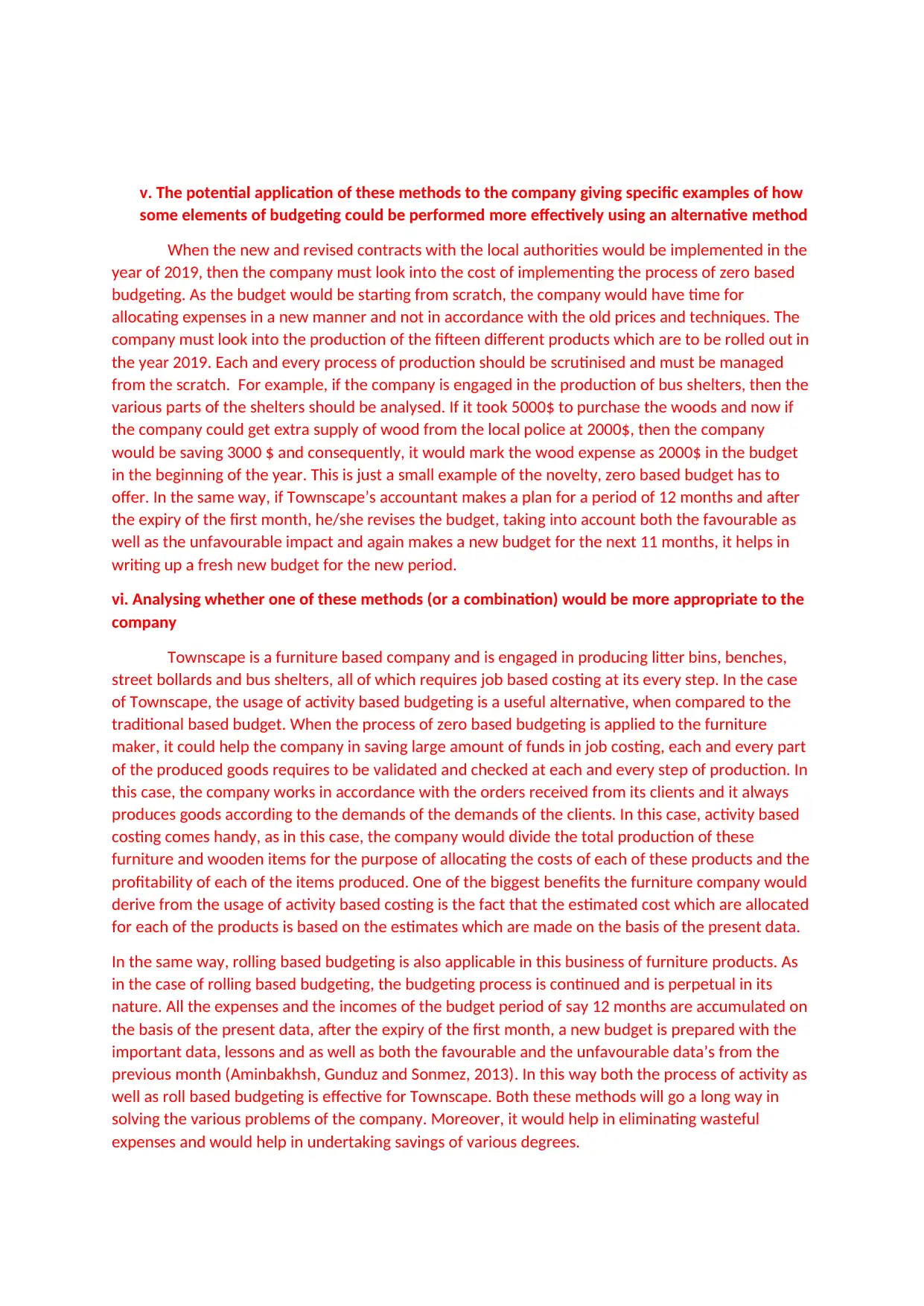
v. The potential application of these methods to the company giving specific examples of how
some elements of budgeting could be performed more effectively using an alternative method
When the new and revised contracts with the local authorities would be implemented in the
year of 2019, then the company must look into the cost of implementing the process of zero based
budgeting. As the budget would be starting from scratch, the company would have time for
allocating expenses in a new manner and not in accordance with the old prices and techniques. The
company must look into the production of the fifteen different products which are to be rolled out in
the year 2019. Each and every process of production should be scrutinised and must be managed
from the scratch. For example, if the company is engaged in the production of bus shelters, then the
various parts of the shelters should be analysed. If it took 5000$ to purchase the woods and now if
the company could get extra supply of wood from the local police at 2000$, then the company
would be saving 3000 $ and consequently, it would mark the wood expense as 2000$ in the budget
in the beginning of the year. This is just a small example of the novelty, zero based budget has to
offer. In the same way, if Townscape’s accountant makes a plan for a period of 12 months and after
the expiry of the first month, he/she revises the budget, taking into account both the favourable as
well as the unfavourable impact and again makes a new budget for the next 11 months, it helps in
writing up a fresh new budget for the new period.
vi. Analysing whether one of these methods (or a combination) would be more appropriate to the
company
Townscape is a furniture based company and is engaged in producing litter bins, benches,
street bollards and bus shelters, all of which requires job based costing at its every step. In the case
of Townscape, the usage of activity based budgeting is a useful alternative, when compared to the
traditional based budget. When the process of zero based budgeting is applied to the furniture
maker, it could help the company in saving large amount of funds in job costing, each and every part
of the produced goods requires to be validated and checked at each and every step of production. In
this case, the company works in accordance with the orders received from its clients and it always
produces goods according to the demands of the demands of the clients. In this case, activity based
costing comes handy, as in this case, the company would divide the total production of these
furniture and wooden items for the purpose of allocating the costs of each of these products and the
profitability of each of the items produced. One of the biggest benefits the furniture company would
derive from the usage of activity based costing is the fact that the estimated cost which are allocated
for each of the products is based on the estimates which are made on the basis of the present data.
In the same way, rolling based budgeting is also applicable in this business of furniture products. As
in the case of rolling based budgeting, the budgeting process is continued and is perpetual in its
nature. All the expenses and the incomes of the budget period of say 12 months are accumulated on
the basis of the present data, after the expiry of the first month, a new budget is prepared with the
important data, lessons and as well as both the favourable and the unfavourable data’s from the
previous month (Aminbakhsh, Gunduz and Sonmez, 2013). In this way both the process of activity as
well as roll based budgeting is effective for Townscape. Both these methods will go a long way in
solving the various problems of the company. Moreover, it would help in eliminating wasteful
expenses and would help in undertaking savings of various degrees.
some elements of budgeting could be performed more effectively using an alternative method
When the new and revised contracts with the local authorities would be implemented in the
year of 2019, then the company must look into the cost of implementing the process of zero based
budgeting. As the budget would be starting from scratch, the company would have time for
allocating expenses in a new manner and not in accordance with the old prices and techniques. The
company must look into the production of the fifteen different products which are to be rolled out in
the year 2019. Each and every process of production should be scrutinised and must be managed
from the scratch. For example, if the company is engaged in the production of bus shelters, then the
various parts of the shelters should be analysed. If it took 5000$ to purchase the woods and now if
the company could get extra supply of wood from the local police at 2000$, then the company
would be saving 3000 $ and consequently, it would mark the wood expense as 2000$ in the budget
in the beginning of the year. This is just a small example of the novelty, zero based budget has to
offer. In the same way, if Townscape’s accountant makes a plan for a period of 12 months and after
the expiry of the first month, he/she revises the budget, taking into account both the favourable as
well as the unfavourable impact and again makes a new budget for the next 11 months, it helps in
writing up a fresh new budget for the new period.
vi. Analysing whether one of these methods (or a combination) would be more appropriate to the
company
Townscape is a furniture based company and is engaged in producing litter bins, benches,
street bollards and bus shelters, all of which requires job based costing at its every step. In the case
of Townscape, the usage of activity based budgeting is a useful alternative, when compared to the
traditional based budget. When the process of zero based budgeting is applied to the furniture
maker, it could help the company in saving large amount of funds in job costing, each and every part
of the produced goods requires to be validated and checked at each and every step of production. In
this case, the company works in accordance with the orders received from its clients and it always
produces goods according to the demands of the demands of the clients. In this case, activity based
costing comes handy, as in this case, the company would divide the total production of these
furniture and wooden items for the purpose of allocating the costs of each of these products and the
profitability of each of the items produced. One of the biggest benefits the furniture company would
derive from the usage of activity based costing is the fact that the estimated cost which are allocated
for each of the products is based on the estimates which are made on the basis of the present data.
In the same way, rolling based budgeting is also applicable in this business of furniture products. As
in the case of rolling based budgeting, the budgeting process is continued and is perpetual in its
nature. All the expenses and the incomes of the budget period of say 12 months are accumulated on
the basis of the present data, after the expiry of the first month, a new budget is prepared with the
important data, lessons and as well as both the favourable and the unfavourable data’s from the
previous month (Aminbakhsh, Gunduz and Sonmez, 2013). In this way both the process of activity as
well as roll based budgeting is effective for Townscape. Both these methods will go a long way in
solving the various problems of the company. Moreover, it would help in eliminating wasteful
expenses and would help in undertaking savings of various degrees.
⊘ This is a preview!⊘
Do you want full access?
Subscribe today to unlock all pages.
Trusted by 1+ million students worldwide
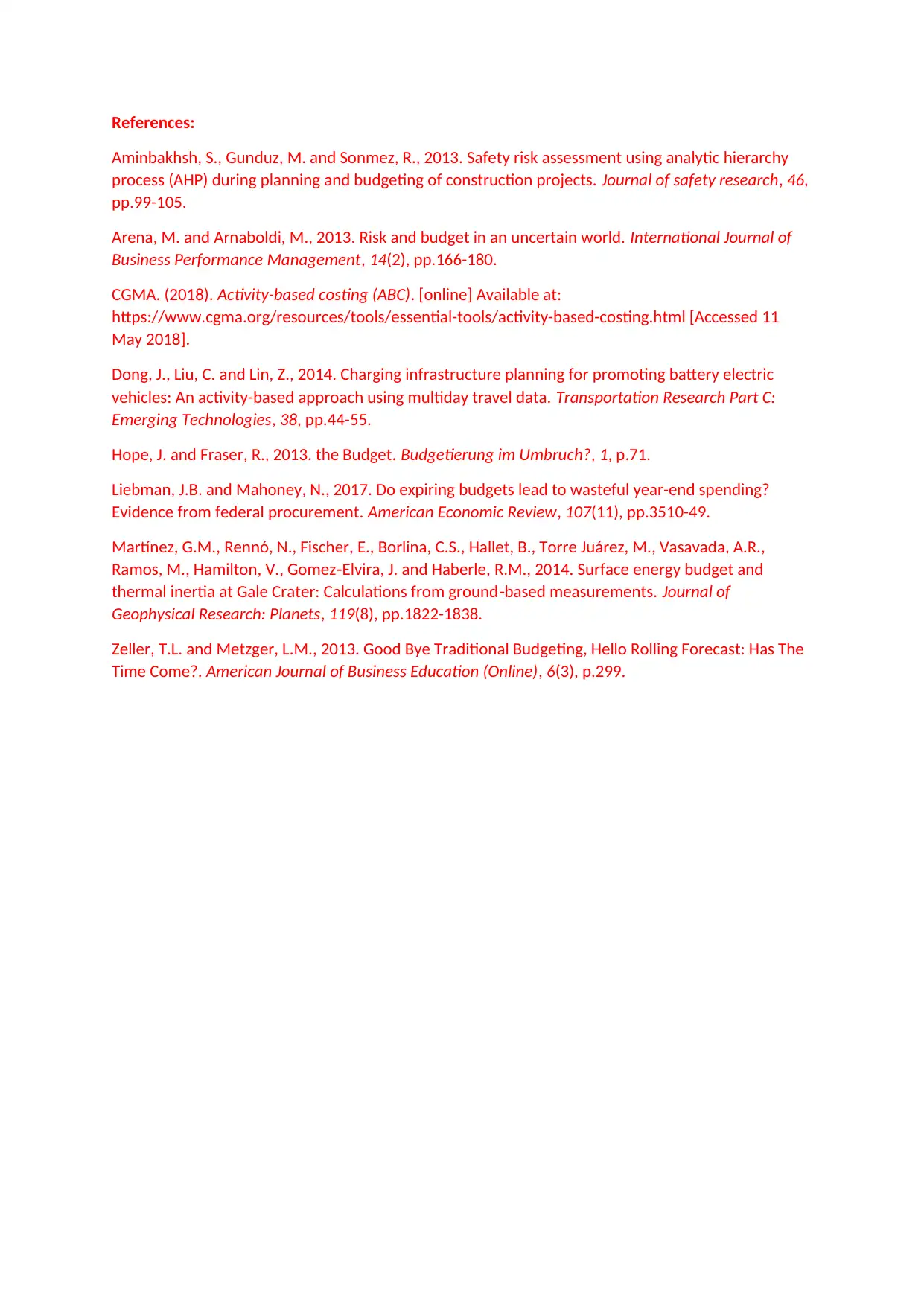
References:
Aminbakhsh, S., Gunduz, M. and Sonmez, R., 2013. Safety risk assessment using analytic hierarchy
process (AHP) during planning and budgeting of construction projects. Journal of safety research, 46,
pp.99-105.
Arena, M. and Arnaboldi, M., 2013. Risk and budget in an uncertain world. International Journal of
Business Performance Management, 14(2), pp.166-180.
CGMA. (2018). Activity-based costing (ABC). [online] Available at:
https://www.cgma.org/resources/tools/essential-tools/activity-based-costing.html [Accessed 11
May 2018].
Dong, J., Liu, C. and Lin, Z., 2014. Charging infrastructure planning for promoting battery electric
vehicles: An activity-based approach using multiday travel data. Transportation Research Part C:
Emerging Technologies, 38, pp.44-55.
Hope, J. and Fraser, R., 2013. the Budget. Budgetierung im Umbruch?, 1, p.71.
Liebman, J.B. and Mahoney, N., 2017. Do expiring budgets lead to wasteful year-end spending?
Evidence from federal procurement. American Economic Review, 107(11), pp.3510-49.
Martínez, G.M., Rennó, N., Fischer, E., Borlina, C.S., Hallet, B., Torre Juárez, M., Vasavada, A.R.,
Ramos, M., Hamilton, V., Gomez Elvira, J. and Haberle, R.M., 2014. Surface energy budget and‐
thermal inertia at Gale Crater: Calculations from ground based measurements.‐ Journal of
Geophysical Research: Planets, 119(8), pp.1822-1838.
Zeller, T.L. and Metzger, L.M., 2013. Good Bye Traditional Budgeting, Hello Rolling Forecast: Has The
Time Come?. American Journal of Business Education (Online), 6(3), p.299.
Aminbakhsh, S., Gunduz, M. and Sonmez, R., 2013. Safety risk assessment using analytic hierarchy
process (AHP) during planning and budgeting of construction projects. Journal of safety research, 46,
pp.99-105.
Arena, M. and Arnaboldi, M., 2013. Risk and budget in an uncertain world. International Journal of
Business Performance Management, 14(2), pp.166-180.
CGMA. (2018). Activity-based costing (ABC). [online] Available at:
https://www.cgma.org/resources/tools/essential-tools/activity-based-costing.html [Accessed 11
May 2018].
Dong, J., Liu, C. and Lin, Z., 2014. Charging infrastructure planning for promoting battery electric
vehicles: An activity-based approach using multiday travel data. Transportation Research Part C:
Emerging Technologies, 38, pp.44-55.
Hope, J. and Fraser, R., 2013. the Budget. Budgetierung im Umbruch?, 1, p.71.
Liebman, J.B. and Mahoney, N., 2017. Do expiring budgets lead to wasteful year-end spending?
Evidence from federal procurement. American Economic Review, 107(11), pp.3510-49.
Martínez, G.M., Rennó, N., Fischer, E., Borlina, C.S., Hallet, B., Torre Juárez, M., Vasavada, A.R.,
Ramos, M., Hamilton, V., Gomez Elvira, J. and Haberle, R.M., 2014. Surface energy budget and‐
thermal inertia at Gale Crater: Calculations from ground based measurements.‐ Journal of
Geophysical Research: Planets, 119(8), pp.1822-1838.
Zeller, T.L. and Metzger, L.M., 2013. Good Bye Traditional Budgeting, Hello Rolling Forecast: Has The
Time Come?. American Journal of Business Education (Online), 6(3), p.299.

1 out of 7


Related Documents


Your All-in-One AI-Powered Toolkit for Academic Success.
+13062052269
info@desklib.com
Available 24*7 on WhatsApp / Email
![[object Object]](/_next/static/media/star-bottom.7253800d.svg)
Unlock your academic potential
Copyright © 2020–2026 A2Z Services. All Rights Reserved. Developed and managed by ZUCOL.