Financial Market and Capital Budgeting Analysis: HI5002 Report
VerifiedAdded on 2022/09/06
|13
|2137
|18
Report
AI Summary
This report, prepared for the HI5002 Finance for Business course at Holmes Institute, provides a detailed analysis of financial markets and capital budgeting. It begins with an overview of key financial principles such as cash flow, time value of money, risk and reward, market prices, and agency problems. The report then delves into the Australian financial market, examining the secondary bond market, bond rating services, and the differences between government and corporate bonds, including yield to maturity and interest rate risk. Furthermore, it explores the Australian share market, including listed stocks, market capitalization, and the oldest share index (ALL-Ordinary Index), along with its historical trends. The analysis extends to capital budgeting techniques, incorporating sensitivity analysis of NPV values and break-even analysis to assess project feasibility. The report concludes by summarizing the findings and highlighting the importance of financial market analysis for informed investment decisions, particularly within the Australian context.

Finance For Business - Masters

Paraphrase This Document
Need a fresh take? Get an instant paraphrase of this document with our AI Paraphraser
Introduction
The financial market conditions have been analysed on two different perspectives, where adequate dissections have
been conducted on three financial products with appropriate news feeds. In addition, adequate analysis is mainly
conducted on the overall principles of finance, which is evaluated on the basis of relevant news. Hence, with the
analysis adequate information regarding the financial market is evaluated, which could help in understanding the
measure that can be used by the investors
Further analysis is mainly depicted on Australian financial markets, where the Australian bond market is mainly
evaluated to detect appropriate measures that can be used by investors. In addition, the relevant information regarding
the rating agencies of the bond rating services is depicted, which allow the investors to understand the current valuation
of the security. Furthermore, the analysis regarding the current Australian index is evaluated for determining the oldest
index that is being operated in Australia.
The analysis is also conducted on the risk analysis of a particular project while utilising sensitivity analysis on the NPV
calculation. The overall sensitivity analysis would mainly ensure the organisation regarding the financial feasibility of
the new project and the negative impact it might have on their overall performance in the long run. In addition, the
relevant analysis on the break-even point is used by the organisation to determine the accurate level of performance of
the project.
The financial market conditions have been analysed on two different perspectives, where adequate dissections have
been conducted on three financial products with appropriate news feeds. In addition, adequate analysis is mainly
conducted on the overall principles of finance, which is evaluated on the basis of relevant news. Hence, with the
analysis adequate information regarding the financial market is evaluated, which could help in understanding the
measure that can be used by the investors
Further analysis is mainly depicted on Australian financial markets, where the Australian bond market is mainly
evaluated to detect appropriate measures that can be used by investors. In addition, the relevant information regarding
the rating agencies of the bond rating services is depicted, which allow the investors to understand the current valuation
of the security. Furthermore, the analysis regarding the current Australian index is evaluated for determining the oldest
index that is being operated in Australia.
The analysis is also conducted on the risk analysis of a particular project while utilising sensitivity analysis on the NPV
calculation. The overall sensitivity analysis would mainly ensure the organisation regarding the financial feasibility of
the new project and the negative impact it might have on their overall performance in the long run. In addition, the
relevant analysis on the break-even point is used by the organisation to determine the accurate level of performance of
the project.
Key Financial Product’s
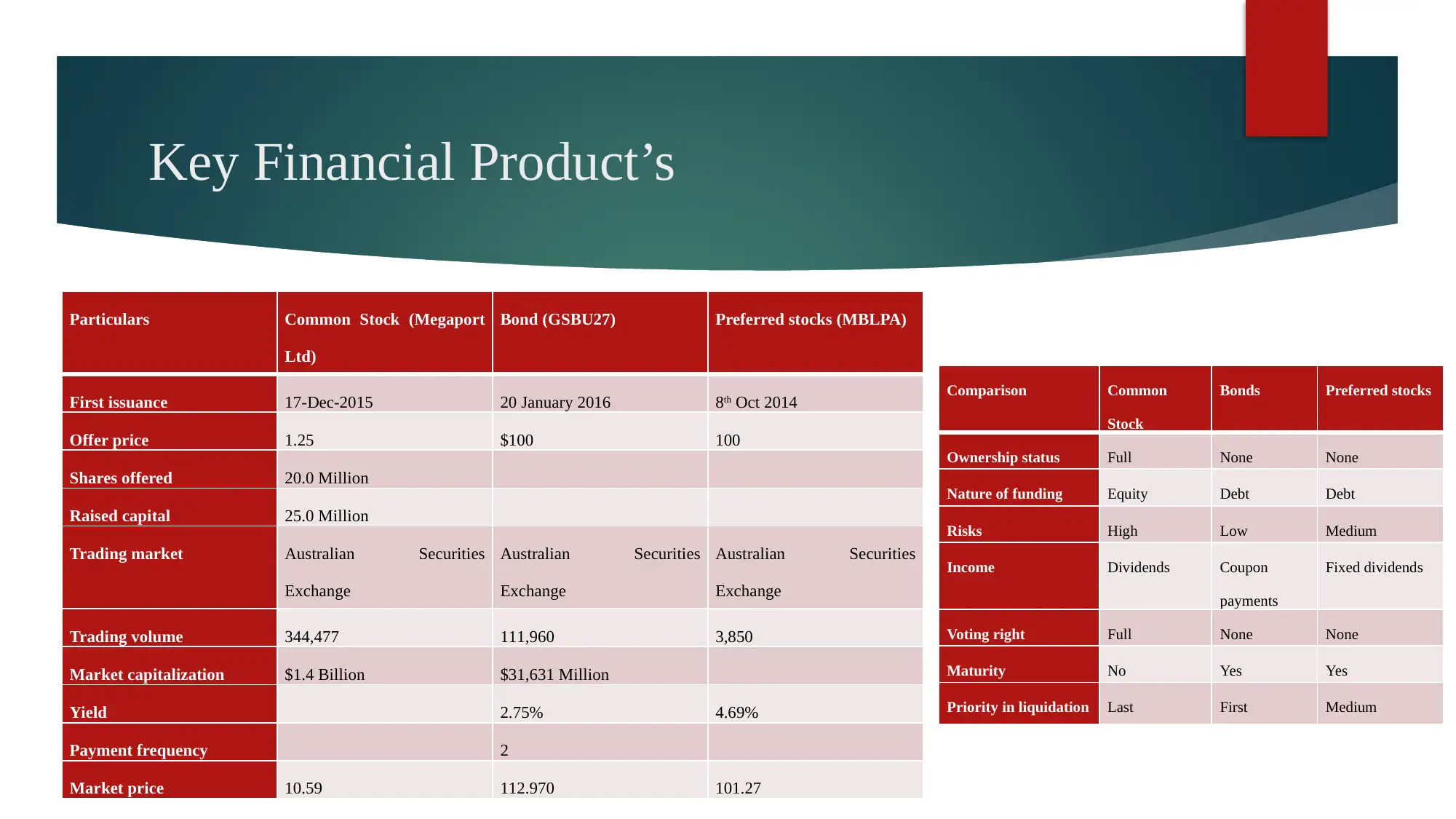
Comparison Common
Stock
Bonds Preferred stocks
Ownership status Full None None
Nature of funding Equity Debt Debt
Risks High Low Medium
Income Dividends Coupon
payments
Fixed dividends
Voting right Full None None
Maturity No Yes Yes
Priority in liquidation Last First Medium
Particulars Common Stock (Megaport
Ltd)
Bond (GSBU27) Preferred stocks (MBLPA)
First issuance 17-Dec-2015 20 January 2016 8th Oct 2014
Offer price 1.25 $100 100
Shares offered 20.0 Million
Raised capital 25.0 Million
Trading market Australian Securities
Exchange
Australian Securities
Exchange
Australian Securities
Exchange
Trading volume 344,477 111,960 3,850
Market capitalization $1.4 Billion $31,631 Million
Yield 2.75% 4.69%
Payment frequency 2
Market price 10.59 112.970 101.27
Comparison Common
Stock
Bonds Preferred stocks
Ownership status Full None None
Nature of funding Equity Debt Debt
Risks High Low Medium
Income Dividends Coupon
payments
Fixed dividends
Voting right Full None None
Maturity No Yes Yes
Priority in liquidation Last First Medium
Particulars Common Stock (Megaport
Ltd)
Bond (GSBU27) Preferred stocks (MBLPA)
First issuance 17-Dec-2015 20 January 2016 8th Oct 2014
Offer price 1.25 $100 100
Shares offered 20.0 Million
Raised capital 25.0 Million
Trading market Australian Securities
Exchange
Australian Securities
Exchange
Australian Securities
Exchange
Trading volume 344,477 111,960 3,850
Market capitalization $1.4 Billion $31,631 Million
Yield 2.75% 4.69%
Payment frequency 2
Market price 10.59 112.970 101.27
⊘ This is a preview!⊘
Do you want full access?
Subscribe today to unlock all pages.

Trusted by 1+ million students worldwide

Five Basic Principles of Finance
Cash Flow Is What Matters: Majority of the investors while valuing the appropriate market value of an
organisation considers cash flow. Therefore, cashflows is what matters while valuing a company
financial perspective and future growth.
Money Has a Time Value: Money is considered to have a time value, where companies use the
information to make their investment more viable and productive.
Risk Requires a Reward: The risk to reward concept is relevantly appropriate, where investors rely on
the risk components to detect the relevant returns from an investment.
Market Prices Are Generally Right: The information that is circulated in the market mainly helps in
determining the correct market prices, which are considered generally right.
Conflicts of Interest Cause Agency Problems: There are certain problems that are associated with the
agency problems, where a conflict could arise between the managers and shareholders of the
organisation.
Cash Flow Is What Matters: Majority of the investors while valuing the appropriate market value of an
organisation considers cash flow. Therefore, cashflows is what matters while valuing a company
financial perspective and future growth.
Money Has a Time Value: Money is considered to have a time value, where companies use the
information to make their investment more viable and productive.
Risk Requires a Reward: The risk to reward concept is relevantly appropriate, where investors rely on
the risk components to detect the relevant returns from an investment.
Market Prices Are Generally Right: The information that is circulated in the market mainly helps in
determining the correct market prices, which are considered generally right.
Conflicts of Interest Cause Agency Problems: There are certain problems that are associated with the
agency problems, where a conflict could arise between the managers and shareholders of the
organisation.
Paraphrase This Document
Need a fresh take? Get an instant paraphrase of this document with our AI Paraphraser

Evaluating the Australian Bond market
Secondary market of bonds in Australia:
The bonds are traded in the Australian Securities Exchange, as it is the
largest market in the country. There are different types of bonds that are
traded in the market such as Government Bonds, Corporate Bonds and
Floating Rate Notes. Therefore, the analysis has ensured that the three
different types of bonds mainly circulate in the secondary market, where
the organisations and government could issue the security for collecting
the relevant funds from the market (Asx.com.au 2019).
Bond rating services present in Australia:
The bonds for providing relevant rating for the securities use the bond
rating securities such as Standard & Poor’s credit rating, Moody’s credit
rating, Fitch’s credit rating and DBRS’s credit rating for Australia. These
rating mainly allow the investors to detect the overall returns and risk
associated with the investment. Hence, the credit rating agencies pay a
vital role in the distribution and trading of the bonds in the Australian
market.
Key differences of Australian Government Bonds
and Australian Corporate Bonds:
Business and firms mainly guarantee the corporate
bonds, whereas the Australian government is
responsible for the payments and returns of the
government bonds in Australia (Asx.com.au 2019).
The government bonds are associated with fixed
returns in form of coupon payment, whereas in
corporate bonds the overall returns are mainly volatile.
Corporate bonds are mainly provided credit rating on
their current financial performance, whereas the credit
rating on government bonds is given on the current
fiscal deficit of the country.
Secondary market of bonds in Australia:
The bonds are traded in the Australian Securities Exchange, as it is the
largest market in the country. There are different types of bonds that are
traded in the market such as Government Bonds, Corporate Bonds and
Floating Rate Notes. Therefore, the analysis has ensured that the three
different types of bonds mainly circulate in the secondary market, where
the organisations and government could issue the security for collecting
the relevant funds from the market (Asx.com.au 2019).
Bond rating services present in Australia:
The bonds for providing relevant rating for the securities use the bond
rating securities such as Standard & Poor’s credit rating, Moody’s credit
rating, Fitch’s credit rating and DBRS’s credit rating for Australia. These
rating mainly allow the investors to detect the overall returns and risk
associated with the investment. Hence, the credit rating agencies pay a
vital role in the distribution and trading of the bonds in the Australian
market.
Key differences of Australian Government Bonds
and Australian Corporate Bonds:
Business and firms mainly guarantee the corporate
bonds, whereas the Australian government is
responsible for the payments and returns of the
government bonds in Australia (Asx.com.au 2019).
The government bonds are associated with fixed
returns in form of coupon payment, whereas in
corporate bonds the overall returns are mainly volatile.
Corporate bonds are mainly provided credit rating on
their current financial performance, whereas the credit
rating on government bonds is given on the current
fiscal deficit of the country.

Evaluating the Australian Bond market
Yield to maturity relationship with coupon rate
The yield to maturity has a direct relation with the overall coupon rate, as investor mainly utilise the
information to determine the actual price of the bonds. Furthermore, the yield to maturity is derived from
formula, where the current coupon rate, face value and market value of the bond. Hence, it is detected that
that YTM values is directly linked with the actual coupon payment of the bond. Hence, when the coupon
payment is higher than YTM then the overall demand for h bond is higher and vice versa (Baum and
Crosby 2014).
Impact of interest rate risk on bond prices
The interest rate risk is considered to be one of the major factors, which is used for determining the
current value of bond. The interest rate risk mainly analyses the overall interest conditions of a country,
where rising interest rates than the coupon rate makes the bond less demanded by the investors. On the
other hand, the bond is demanded when the interest rate is lower than the actual coupon rate, where
investors are keen on investing in the bond market rather than in banks.
Yield to maturity relationship with coupon rate
The yield to maturity has a direct relation with the overall coupon rate, as investor mainly utilise the
information to determine the actual price of the bonds. Furthermore, the yield to maturity is derived from
formula, where the current coupon rate, face value and market value of the bond. Hence, it is detected that
that YTM values is directly linked with the actual coupon payment of the bond. Hence, when the coupon
payment is higher than YTM then the overall demand for h bond is higher and vice versa (Baum and
Crosby 2014).
Impact of interest rate risk on bond prices
The interest rate risk is considered to be one of the major factors, which is used for determining the
current value of bond. The interest rate risk mainly analyses the overall interest conditions of a country,
where rising interest rates than the coupon rate makes the bond less demanded by the investors. On the
other hand, the bond is demanded when the interest rate is lower than the actual coupon rate, where
investors are keen on investing in the bond market rather than in banks.
⊘ This is a preview!⊘
Do you want full access?
Subscribe today to unlock all pages.
Trusted by 1+ million students worldwide

Fact Finding of Australian Share market
Listed stock in Australia: The name of listed stock market in Australia is “Australian Securities
Exchange” (ASX), where the stocks are listed in the market. The current market conditions have
indicated that around 2,258 stocks are listed in the market. Therefore, companies utilise the
capital market to initiate their IPOs, which helps in conducting relevant investment decisions
(Asx.com.au 2019).
Market capitalization: The market capitalisation is computed by multiplying the share market
and number of shares issued in the market. The market capitalisation is used for determining the
current values of the company in the capital market (Asx.com.au 2019).
Oldest share index of Australia: The oldest share index in Australian is ALL-Ordinary Index,
which was established in January of 1980. The index mainly comprises of approximately 500
largest companies by market capitalisation, which help in depicting the current market conditions
Australia (Asx.com.au 2019).
Listed stock in Australia: The name of listed stock market in Australia is “Australian Securities
Exchange” (ASX), where the stocks are listed in the market. The current market conditions have
indicated that around 2,258 stocks are listed in the market. Therefore, companies utilise the
capital market to initiate their IPOs, which helps in conducting relevant investment decisions
(Asx.com.au 2019).
Market capitalization: The market capitalisation is computed by multiplying the share market
and number of shares issued in the market. The market capitalisation is used for determining the
current values of the company in the capital market (Asx.com.au 2019).
Oldest share index of Australia: The oldest share index in Australian is ALL-Ordinary Index,
which was established in January of 1980. The index mainly comprises of approximately 500
largest companies by market capitalisation, which help in depicting the current market conditions
Australia (Asx.com.au 2019).
Paraphrase This Document
Need a fresh take? Get an instant paraphrase of this document with our AI Paraphraser
3-year historical movement and trend of the
index
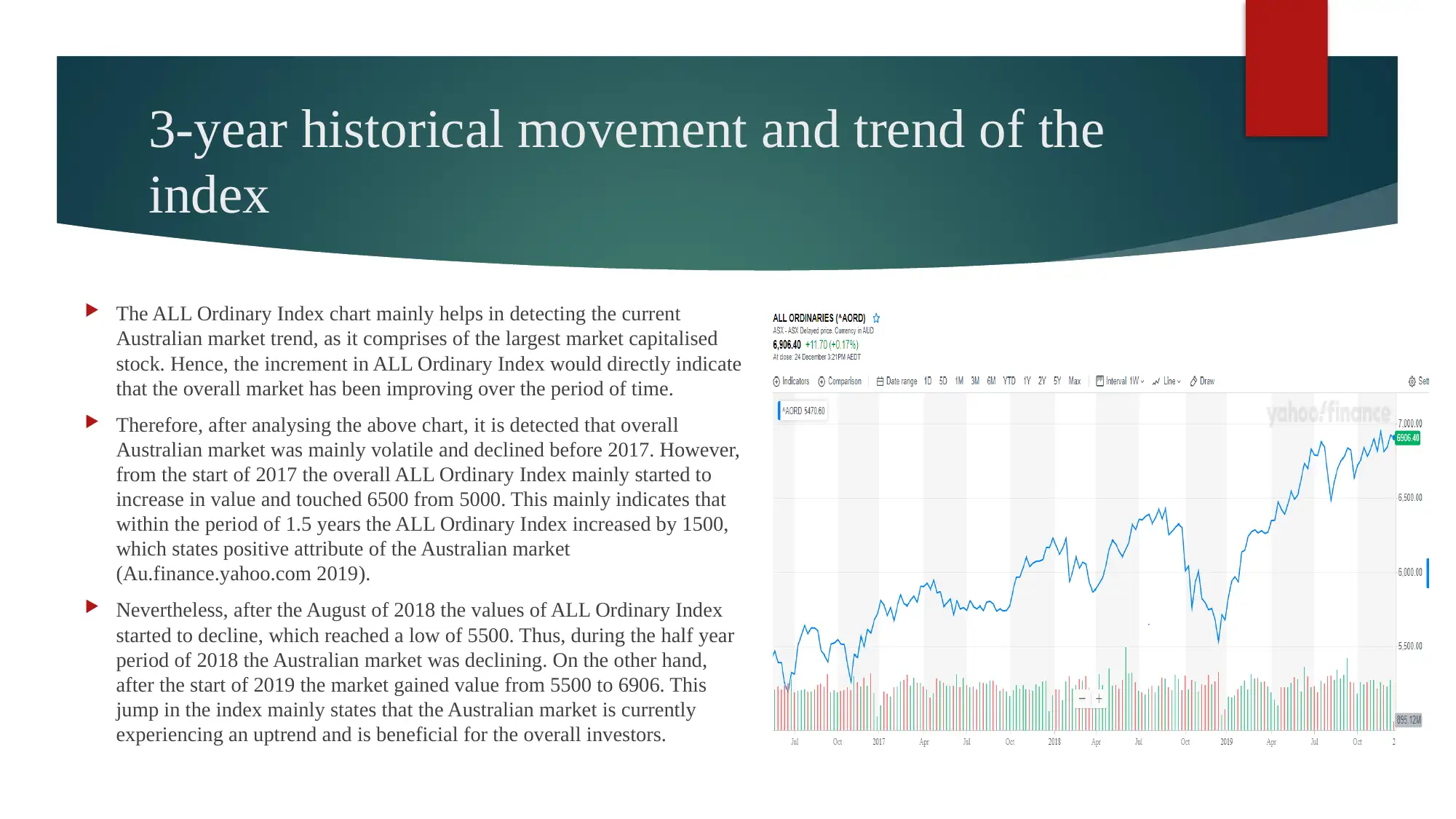
The ALL Ordinary Index chart mainly helps in detecting the current
Australian market trend, as it comprises of the largest market capitalised
stock. Hence, the increment in ALL Ordinary Index would directly indicate
that the overall market has been improving over the period of time.
Therefore, after analysing the above chart, it is detected that overall
Australian market was mainly volatile and declined before 2017. However,
from the start of 2017 the overall ALL Ordinary Index mainly started to
increase in value and touched 6500 from 5000. This mainly indicates that
within the period of 1.5 years the ALL Ordinary Index increased by 1500,
which states positive attribute of the Australian market
(Au.finance.yahoo.com 2019).
Nevertheless, after the August of 2018 the values of ALL Ordinary Index
started to decline, which reached a low of 5500. Thus, during the half year
period of 2018 the Australian market was declining. On the other hand,
after the start of 2019 the market gained value from 5500 to 6906. This
jump in the index mainly states that the Australian market is currently
experiencing an uptrend and is beneficial for the overall investors.
index
The ALL Ordinary Index chart mainly helps in detecting the current
Australian market trend, as it comprises of the largest market capitalised
stock. Hence, the increment in ALL Ordinary Index would directly indicate
that the overall market has been improving over the period of time.
Therefore, after analysing the above chart, it is detected that overall
Australian market was mainly volatile and declined before 2017. However,
from the start of 2017 the overall ALL Ordinary Index mainly started to
increase in value and touched 6500 from 5000. This mainly indicates that
within the period of 1.5 years the ALL Ordinary Index increased by 1500,
which states positive attribute of the Australian market
(Au.finance.yahoo.com 2019).
Nevertheless, after the August of 2018 the values of ALL Ordinary Index
started to decline, which reached a low of 5500. Thus, during the half year
period of 2018 the Australian market was declining. On the other hand,
after the start of 2019 the market gained value from 5500 to 6906. This
jump in the index mainly states that the Australian market is currently
experiencing an uptrend and is beneficial for the overall investors.
Sensitivity analysis on the NPV values
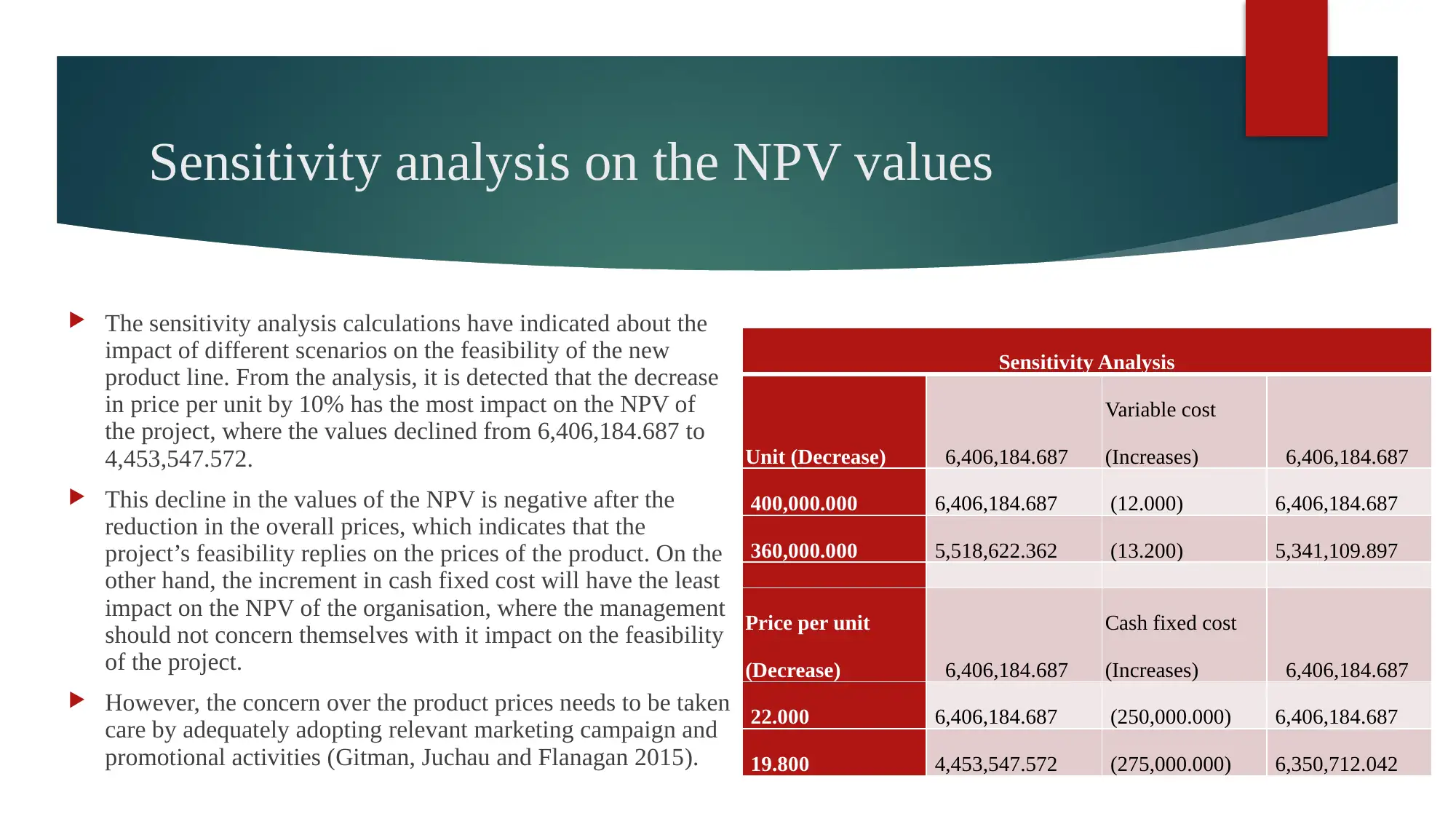
Sensitivity Analysis
Unit (Decrease) 6,406,184.687
Variable cost
(Increases) 6,406,184.687
400,000.000 6,406,184.687 (12.000) 6,406,184.687
360,000.000 5,518,622.362 (13.200) 5,341,109.897
Price per unit
(Decrease) 6,406,184.687
Cash fixed cost
(Increases) 6,406,184.687
22.000 6,406,184.687 (250,000.000) 6,406,184.687
19.800 4,453,547.572 (275,000.000) 6,350,712.042
The sensitivity analysis calculations have indicated about the
impact of different scenarios on the feasibility of the new
product line. From the analysis, it is detected that the decrease
in price per unit by 10% has the most impact on the NPV of
the project, where the values declined from 6,406,184.687 to
4,453,547.572.
This decline in the values of the NPV is negative after the
reduction in the overall prices, which indicates that the
project’s feasibility replies on the prices of the product. On the
other hand, the increment in cash fixed cost will have the least
impact on the NPV of the organisation, where the management
should not concern themselves with it impact on the feasibility
of the project.
However, the concern over the product prices needs to be taken
care by adequately adopting relevant marketing campaign and
promotional activities (Gitman, Juchau and Flanagan 2015).
Sensitivity Analysis
Unit (Decrease) 6,406,184.687
Variable cost
(Increases) 6,406,184.687
400,000.000 6,406,184.687 (12.000) 6,406,184.687
360,000.000 5,518,622.362 (13.200) 5,341,109.897
Price per unit
(Decrease) 6,406,184.687
Cash fixed cost
(Increases) 6,406,184.687
22.000 6,406,184.687 (250,000.000) 6,406,184.687
19.800 4,453,547.572 (275,000.000) 6,350,712.042
The sensitivity analysis calculations have indicated about the
impact of different scenarios on the feasibility of the new
product line. From the analysis, it is detected that the decrease
in price per unit by 10% has the most impact on the NPV of
the project, where the values declined from 6,406,184.687 to
4,453,547.572.
This decline in the values of the NPV is negative after the
reduction in the overall prices, which indicates that the
project’s feasibility replies on the prices of the product. On the
other hand, the increment in cash fixed cost will have the least
impact on the NPV of the organisation, where the management
should not concern themselves with it impact on the feasibility
of the project.
However, the concern over the product prices needs to be taken
care by adequately adopting relevant marketing campaign and
promotional activities (Gitman, Juchau and Flanagan 2015).
⊘ This is a preview!⊘
Do you want full access?
Subscribe today to unlock all pages.
Trusted by 1+ million students worldwide
NPV Break Even Analysis
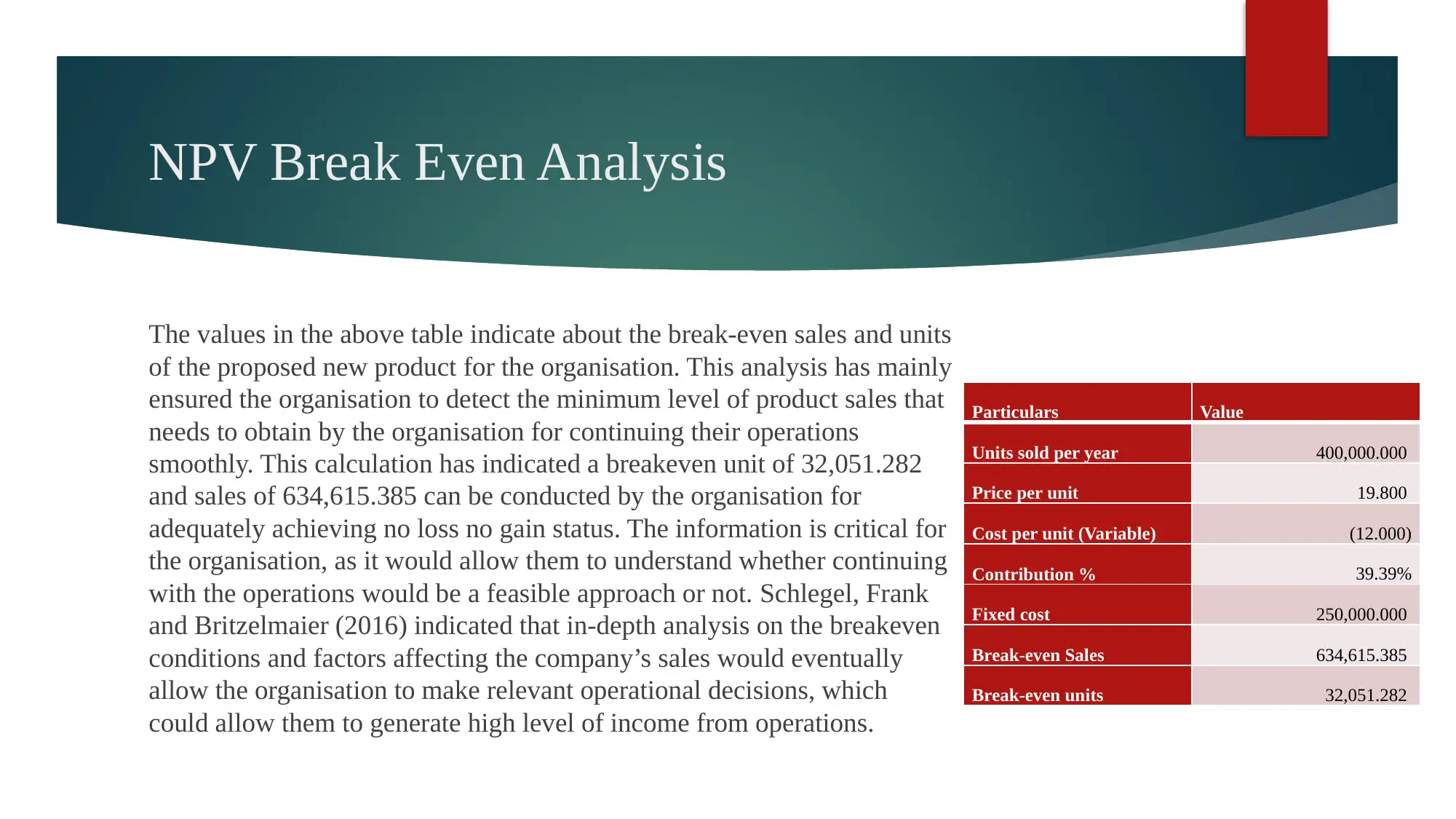
The values in the above table indicate about the break-even sales and units
of the proposed new product for the organisation. This analysis has mainly
ensured the organisation to detect the minimum level of product sales that
needs to obtain by the organisation for continuing their operations
smoothly. This calculation has indicated a breakeven unit of 32,051.282
and sales of 634,615.385 can be conducted by the organisation for
adequately achieving no loss no gain status. The information is critical for
the organisation, as it would allow them to understand whether continuing
with the operations would be a feasible approach or not. Schlegel, Frank
and Britzelmaier (2016) indicated that in-depth analysis on the breakeven
conditions and factors affecting the company’s sales would eventually
allow the organisation to make relevant operational decisions, which
could allow them to generate high level of income from operations.
Particulars Value
Units sold per year 400,000.000
Price per unit 19.800
Cost per unit (Variable) (12.000)
Contribution % 39.39%
Fixed cost 250,000.000
Break-even Sales 634,615.385
Break-even units 32,051.282
The values in the above table indicate about the break-even sales and units
of the proposed new product for the organisation. This analysis has mainly
ensured the organisation to detect the minimum level of product sales that
needs to obtain by the organisation for continuing their operations
smoothly. This calculation has indicated a breakeven unit of 32,051.282
and sales of 634,615.385 can be conducted by the organisation for
adequately achieving no loss no gain status. The information is critical for
the organisation, as it would allow them to understand whether continuing
with the operations would be a feasible approach or not. Schlegel, Frank
and Britzelmaier (2016) indicated that in-depth analysis on the breakeven
conditions and factors affecting the company’s sales would eventually
allow the organisation to make relevant operational decisions, which
could allow them to generate high level of income from operations.
Particulars Value
Units sold per year 400,000.000
Price per unit 19.800
Cost per unit (Variable) (12.000)
Contribution % 39.39%
Fixed cost 250,000.000
Break-even Sales 634,615.385
Break-even units 32,051.282
Paraphrase This Document
Need a fresh take? Get an instant paraphrase of this document with our AI Paraphraser
Conclusion
The assessment focuses on analysing the current financial market and Capital Budgeting conditions. The
financial market of Australia is mainly analysed on the basis of bond markets and stock market, which could
help investors ion making relevant decisions. Furthermore, investors can utilise the information of ALL
Ordinary Index to determine the current market conditions in Australian market, while making relevant
investment decisions. Furthermore, ASX (Australian Securities Exchange) is considered as one of the largest
market, where both bonds and stocks are traded. The ASX market also contains Options, Hybrids, Warrants and
ASX futures.
The further analysis is based on the overall investment appraisal techniques and sensitivity analysis on the NPV
values. The investment appraisal techniques are mainly used for understanding the overall financial viability of a
particular project. On the other hand, sensitivity analysis helps in understanding the current factors that might
influence the NPV values to change significantly over the period of time. The analysis on the breakeven units
allows the companies to detect whether the investment is viable. Thus, the proposed project is viable for the
organisation based on sensitivity analysis and breakeven units. Hence, the reduction of 10% in price per unit
would require 32,051.282 units or sales value of 634,615.385 for achieving no profit no loss.
The assessment focuses on analysing the current financial market and Capital Budgeting conditions. The
financial market of Australia is mainly analysed on the basis of bond markets and stock market, which could
help investors ion making relevant decisions. Furthermore, investors can utilise the information of ALL
Ordinary Index to determine the current market conditions in Australian market, while making relevant
investment decisions. Furthermore, ASX (Australian Securities Exchange) is considered as one of the largest
market, where both bonds and stocks are traded. The ASX market also contains Options, Hybrids, Warrants and
ASX futures.
The further analysis is based on the overall investment appraisal techniques and sensitivity analysis on the NPV
values. The investment appraisal techniques are mainly used for understanding the overall financial viability of a
particular project. On the other hand, sensitivity analysis helps in understanding the current factors that might
influence the NPV values to change significantly over the period of time. The analysis on the breakeven units
allows the companies to detect whether the investment is viable. Thus, the proposed project is viable for the
organisation based on sensitivity analysis and breakeven units. Hence, the reduction of 10% in price per unit
would require 32,051.282 units or sales value of 634,615.385 for achieving no profit no loss.
Reference and Bibliography
Alkaraan, F., 2016. Strategic investment decision-making–Scanning and screening investment opportunities: The
expansion of Guinness in West Africa. Meditari Accountancy Research, 24(4), pp.505-526.
Asx.com.au. 2019. Home - Australian Securities Exchange - ASX. [online] Available at:
https://www.asx.com.au/index.htm [Accessed 26 Dec. 2019].
Baum, A.E. and Crosby, N., 2014. Property investment appraisal. John Wiley & Sons.
Fool.com.au. 2019. These are the first ASX shares I would buy in 2020 // Motley Fool Australia. [online] Available at:
https://www.fool.com.au/2019/12/26/these-are-the-first-asx-shares-i-would-buy-in-2020/ [Accessed 26 Dec. 2019].
Herzog, B. 2019. Bellevue tech startup Limeade raises millions from IPO — in Australia. [online] The Seattle Times.
Available at: https://www.seattletimes.com/business/technology/bellevue-tech-startup-limeade-raises-millions-from-
ipo-in-australia/ [Accessed 26 Dec. 2019].
Milenković, M., Švadlenka, L., Bojović, N. and Melichar, V., 2016. Railway Investment Appraisal Techniques.
In Handbook of Research on Emerging Innovations in Rail Transportation Engineering (pp. 67-99). IGI Global.
Morgans.com.au. 2019. [online] Available at: https://www.morgans.com.au/asxfi/MBLPA.pdf [Accessed 23 Dec. 2019].
Smee, B. 2019. Leading Australian engineers turn their backs on new fossil fuel projects. [online] the Guardian.
Available at: https://www.theguardian.com/environment/2019/oct/21/leading-engineers-turn-their-backs-on-new-fossil-
fuel-projects [Accessed 26 Dec. 2019].
Alkaraan, F., 2016. Strategic investment decision-making–Scanning and screening investment opportunities: The
expansion of Guinness in West Africa. Meditari Accountancy Research, 24(4), pp.505-526.
Asx.com.au. 2019. Home - Australian Securities Exchange - ASX. [online] Available at:
https://www.asx.com.au/index.htm [Accessed 26 Dec. 2019].
Baum, A.E. and Crosby, N., 2014. Property investment appraisal. John Wiley & Sons.
Fool.com.au. 2019. These are the first ASX shares I would buy in 2020 // Motley Fool Australia. [online] Available at:
https://www.fool.com.au/2019/12/26/these-are-the-first-asx-shares-i-would-buy-in-2020/ [Accessed 26 Dec. 2019].
Herzog, B. 2019. Bellevue tech startup Limeade raises millions from IPO — in Australia. [online] The Seattle Times.
Available at: https://www.seattletimes.com/business/technology/bellevue-tech-startup-limeade-raises-millions-from-
ipo-in-australia/ [Accessed 26 Dec. 2019].
Milenković, M., Švadlenka, L., Bojović, N. and Melichar, V., 2016. Railway Investment Appraisal Techniques.
In Handbook of Research on Emerging Innovations in Rail Transportation Engineering (pp. 67-99). IGI Global.
Morgans.com.au. 2019. [online] Available at: https://www.morgans.com.au/asxfi/MBLPA.pdf [Accessed 23 Dec. 2019].
Smee, B. 2019. Leading Australian engineers turn their backs on new fossil fuel projects. [online] the Guardian.
Available at: https://www.theguardian.com/environment/2019/oct/21/leading-engineers-turn-their-backs-on-new-fossil-
fuel-projects [Accessed 26 Dec. 2019].
⊘ This is a preview!⊘
Do you want full access?
Subscribe today to unlock all pages.
Trusted by 1+ million students worldwide

1 out of 13


Related Documents


Your All-in-One AI-Powered Toolkit for Academic Success.
+13062052269
info@desklib.com
Available 24*7 on WhatsApp / Email
![[object Object]](/_next/static/media/star-bottom.7253800d.svg)
Unlock your academic potential
Copyright © 2020–2026 A2Z Services. All Rights Reserved. Developed and managed by ZUCOL.