Capital Structure and Payout Policies of Masters Ltd: Case Study
VerifiedAdded on 2020/07/22
|10
|2745
|56
Case Study
AI Summary
This case study examines the financial aspects of Masters Ltd, focusing on capital structure and payout policies. It delves into various capital structure theories like net income approach, net operating income approach, traditional approach, and Modigliani and Miller approach, discussing their implications and practical considerations. The analysis includes a hypothetical financial analysis of a proposed project, evaluating revenue, expenses, and net profits over five years. The study further explores investment appraisal techniques such as Net Present Value (NPV), Internal Rate of Return (IRR), Payback Period, Discounted Payback Period, and Profitability Index to assess the project's viability and make informed financial decisions. The case study provides a comprehensive overview of financial planning and analysis within the context of Masters Ltd.

Finance Case Study 2

Paraphrase This Document
Need a fresh take? Get an instant paraphrase of this document with our AI Paraphraser

Table of Contents
INTRODUCTION...........................................................................................................................1
TASK 1............................................................................................................................................1
1.1 Capital structure and pay-out policies ..................................................................................1
1.2 Evaluating policy and practical considerations.....................................................................4
TASK 2............................................................................................................................................5
Financial analysis .......................................................................................................................5
Valuable recommendation..........................................................................................................7
CONCLUSION................................................................................................................................7
REFERENCES................................................................................................................................9
INTRODUCTION...........................................................................................................................1
TASK 1............................................................................................................................................1
1.1 Capital structure and pay-out policies ..................................................................................1
1.2 Evaluating policy and practical considerations.....................................................................4
TASK 2............................................................................................................................................5
Financial analysis .......................................................................................................................5
Valuable recommendation..........................................................................................................7
CONCLUSION................................................................................................................................7
REFERENCES................................................................................................................................9
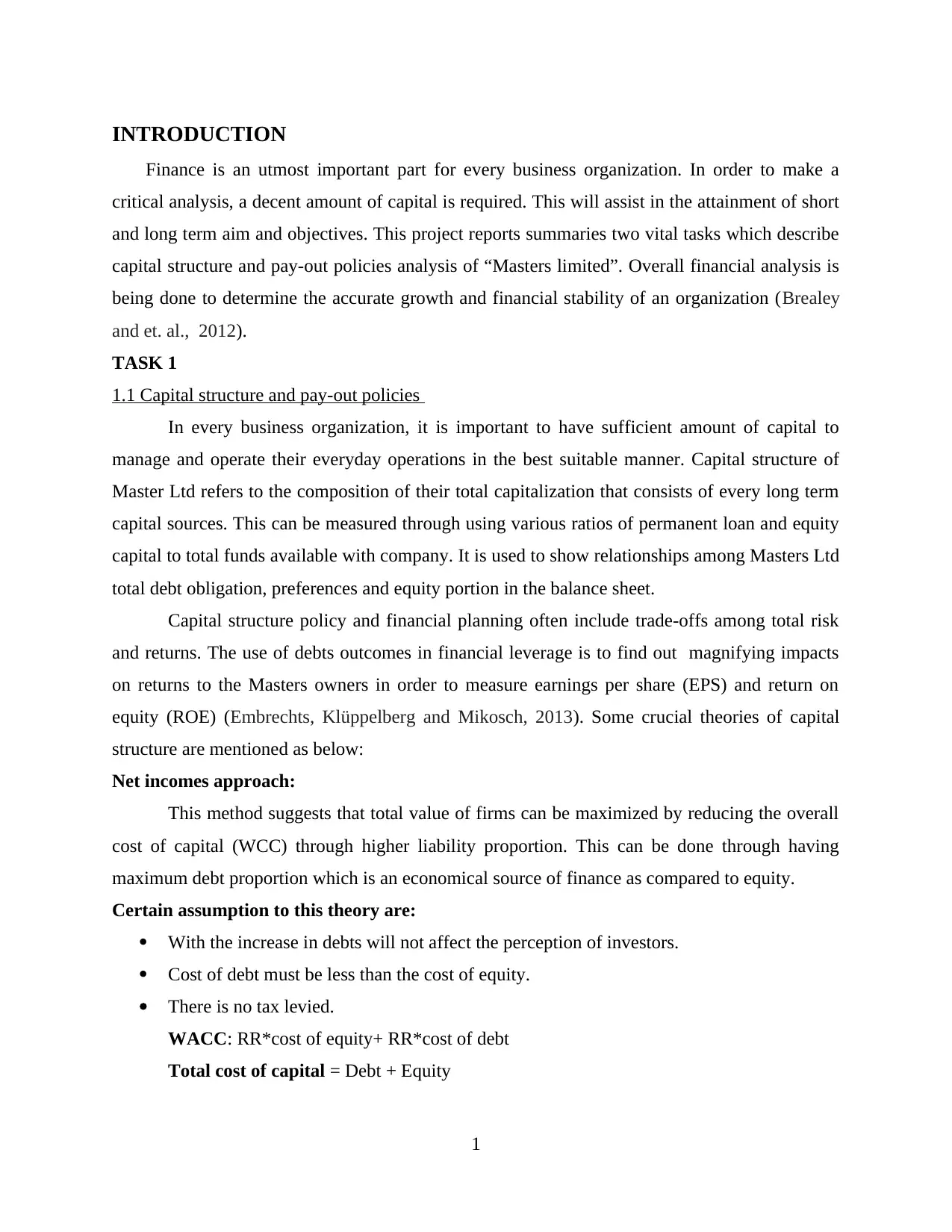
INTRODUCTION
Finance is an utmost important part for every business organization. In order to make a
critical analysis, a decent amount of capital is required. This will assist in the attainment of short
and long term aim and objectives. This project reports summaries two vital tasks which describe
capital structure and pay-out policies analysis of “Masters limited”. Overall financial analysis is
being done to determine the accurate growth and financial stability of an organization (Brealey
and et. al., 2012).
TASK 1
1.1 Capital structure and pay-out policies
In every business organization, it is important to have sufficient amount of capital to
manage and operate their everyday operations in the best suitable manner. Capital structure of
Master Ltd refers to the composition of their total capitalization that consists of every long term
capital sources. This can be measured through using various ratios of permanent loan and equity
capital to total funds available with company. It is used to show relationships among Masters Ltd
total debt obligation, preferences and equity portion in the balance sheet.
Capital structure policy and financial planning often include trade-offs among total risk
and returns. The use of debts outcomes in financial leverage is to find out magnifying impacts
on returns to the Masters owners in order to measure earnings per share (EPS) and return on
equity (ROE) (Embrechts, Klüppelberg and Mikosch, 2013). Some crucial theories of capital
structure are mentioned as below:
Net incomes approach:
This method suggests that total value of firms can be maximized by reducing the overall
cost of capital (WCC) through higher liability proportion. This can be done through having
maximum debt proportion which is an economical source of finance as compared to equity.
Certain assumption to this theory are:
With the increase in debts will not affect the perception of investors.
Cost of debt must be less than the cost of equity.
There is no tax levied.
WACC: RR*cost of equity+ RR*cost of debt
Total cost of capital = Debt + Equity
1
Finance is an utmost important part for every business organization. In order to make a
critical analysis, a decent amount of capital is required. This will assist in the attainment of short
and long term aim and objectives. This project reports summaries two vital tasks which describe
capital structure and pay-out policies analysis of “Masters limited”. Overall financial analysis is
being done to determine the accurate growth and financial stability of an organization (Brealey
and et. al., 2012).
TASK 1
1.1 Capital structure and pay-out policies
In every business organization, it is important to have sufficient amount of capital to
manage and operate their everyday operations in the best suitable manner. Capital structure of
Master Ltd refers to the composition of their total capitalization that consists of every long term
capital sources. This can be measured through using various ratios of permanent loan and equity
capital to total funds available with company. It is used to show relationships among Masters Ltd
total debt obligation, preferences and equity portion in the balance sheet.
Capital structure policy and financial planning often include trade-offs among total risk
and returns. The use of debts outcomes in financial leverage is to find out magnifying impacts
on returns to the Masters owners in order to measure earnings per share (EPS) and return on
equity (ROE) (Embrechts, Klüppelberg and Mikosch, 2013). Some crucial theories of capital
structure are mentioned as below:
Net incomes approach:
This method suggests that total value of firms can be maximized by reducing the overall
cost of capital (WCC) through higher liability proportion. This can be done through having
maximum debt proportion which is an economical source of finance as compared to equity.
Certain assumption to this theory are:
With the increase in debts will not affect the perception of investors.
Cost of debt must be less than the cost of equity.
There is no tax levied.
WACC: RR*cost of equity+ RR*cost of debt
Total cost of capital = Debt + Equity
1
⊘ This is a preview!⊘
Do you want full access?
Subscribe today to unlock all pages.

Trusted by 1+ million students worldwide
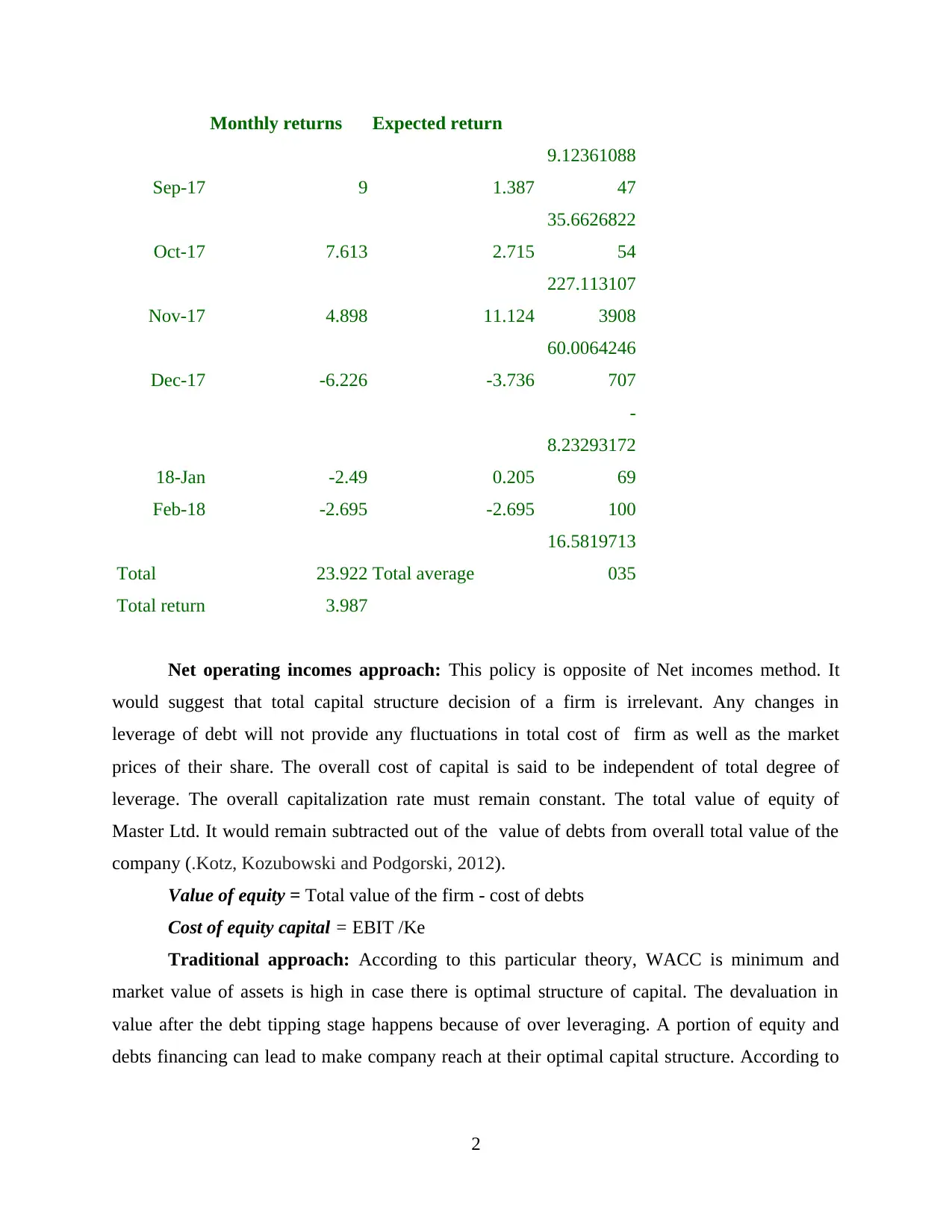
Monthly returns Expected return
Sep-17 9 1.387
9.12361088
47
Oct-17 7.613 2.715
35.6626822
54
Nov-17 4.898 11.124
227.113107
3908
Dec-17 -6.226 -3.736
60.0064246
707
18-Jan -2.49 0.205
-
8.23293172
69
Feb-18 -2.695 -2.695 100
Total 23.922 Total average
16.5819713
035
Total return 3.987
Net operating incomes approach: This policy is opposite of Net incomes method. It
would suggest that total capital structure decision of a firm is irrelevant. Any changes in
leverage of debt will not provide any fluctuations in total cost of firm as well as the market
prices of their share. The overall cost of capital is said to be independent of total degree of
leverage. The overall capitalization rate must remain constant. The total value of equity of
Master Ltd. It would remain subtracted out of the value of debts from overall total value of the
company (.Kotz, Kozubowski and Podgorski, 2012).
Value of equity = Total value of the firm - cost of debts
Cost of equity capital = EBIT /Ke
Traditional approach: According to this particular theory, WACC is minimum and
market value of assets is high in case there is optimal structure of capital. The devaluation in
value after the debt tipping stage happens because of over leveraging. A portion of equity and
debts financing can lead to make company reach at their optimal capital structure. According to
2
Sep-17 9 1.387
9.12361088
47
Oct-17 7.613 2.715
35.6626822
54
Nov-17 4.898 11.124
227.113107
3908
Dec-17 -6.226 -3.736
60.0064246
707
18-Jan -2.49 0.205
-
8.23293172
69
Feb-18 -2.695 -2.695 100
Total 23.922 Total average
16.5819713
035
Total return 3.987
Net operating incomes approach: This policy is opposite of Net incomes method. It
would suggest that total capital structure decision of a firm is irrelevant. Any changes in
leverage of debt will not provide any fluctuations in total cost of firm as well as the market
prices of their share. The overall cost of capital is said to be independent of total degree of
leverage. The overall capitalization rate must remain constant. The total value of equity of
Master Ltd. It would remain subtracted out of the value of debts from overall total value of the
company (.Kotz, Kozubowski and Podgorski, 2012).
Value of equity = Total value of the firm - cost of debts
Cost of equity capital = EBIT /Ke
Traditional approach: According to this particular theory, WACC is minimum and
market value of assets is high in case there is optimal structure of capital. The devaluation in
value after the debt tipping stage happens because of over leveraging. A portion of equity and
debts financing can lead to make company reach at their optimal capital structure. According to
2
Paraphrase This Document
Need a fresh take? Get an instant paraphrase of this document with our AI Paraphraser
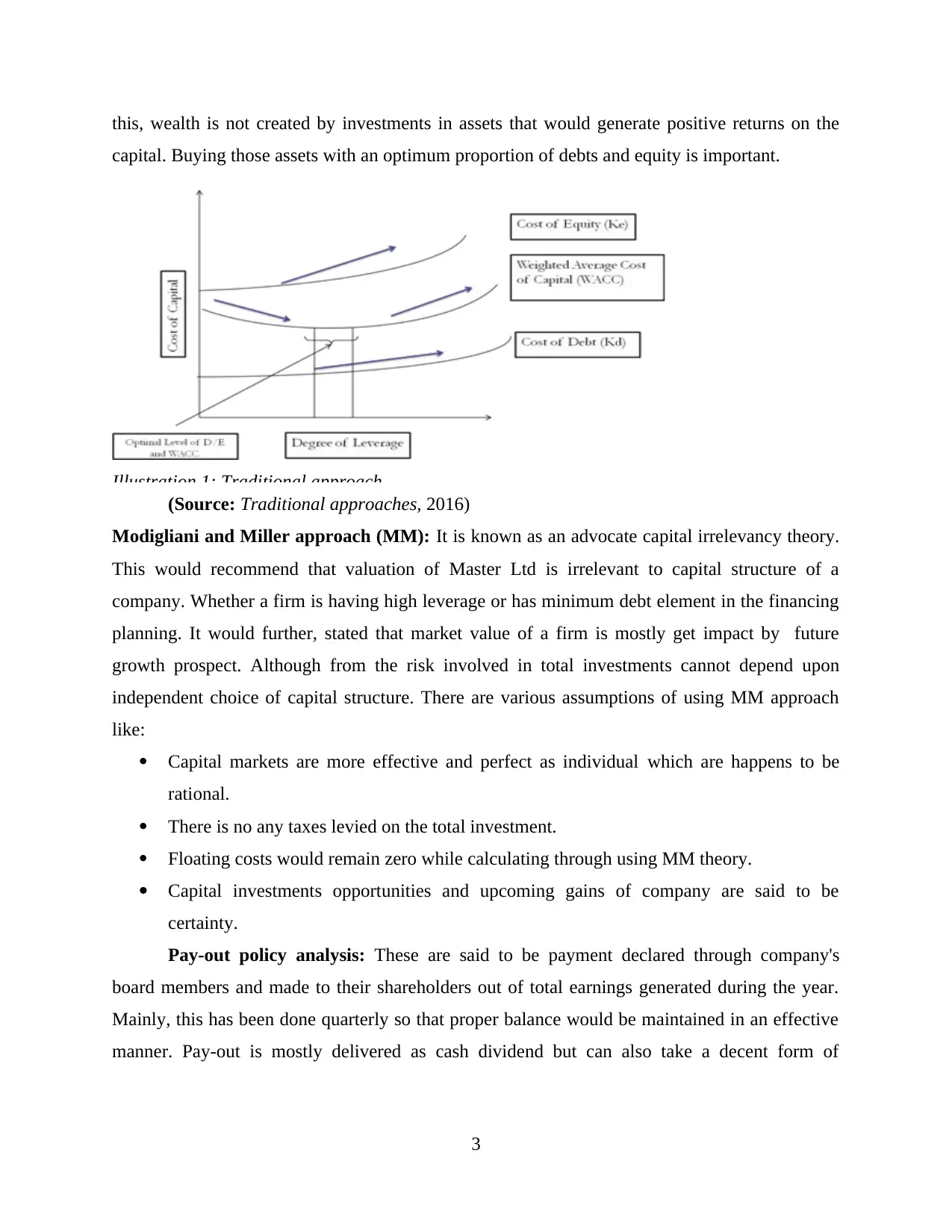
this, wealth is not created by investments in assets that would generate positive returns on the
capital. Buying those assets with an optimum proportion of debts and equity is important.
Illustration 1: Traditional approach
(Source: Traditional approaches, 2016)
Modigliani and Miller approach (MM): It is known as an advocate capital irrelevancy theory.
This would recommend that valuation of Master Ltd is irrelevant to capital structure of a
company. Whether a firm is having high leverage or has minimum debt element in the financing
planning. It would further, stated that market value of a firm is mostly get impact by future
growth prospect. Although from the risk involved in total investments cannot depend upon
independent choice of capital structure. There are various assumptions of using MM approach
like:
Capital markets are more effective and perfect as individual which are happens to be
rational.
There is no any taxes levied on the total investment.
Floating costs would remain zero while calculating through using MM theory.
Capital investments opportunities and upcoming gains of company are said to be
certainty.
Pay-out policy analysis: These are said to be payment declared through company's
board members and made to their shareholders out of total earnings generated during the year.
Mainly, this has been done quarterly so that proper balance would be maintained in an effective
manner. Pay-out is mostly delivered as cash dividend but can also take a decent form of
3
capital. Buying those assets with an optimum proportion of debts and equity is important.
Illustration 1: Traditional approach
(Source: Traditional approaches, 2016)
Modigliani and Miller approach (MM): It is known as an advocate capital irrelevancy theory.
This would recommend that valuation of Master Ltd is irrelevant to capital structure of a
company. Whether a firm is having high leverage or has minimum debt element in the financing
planning. It would further, stated that market value of a firm is mostly get impact by future
growth prospect. Although from the risk involved in total investments cannot depend upon
independent choice of capital structure. There are various assumptions of using MM approach
like:
Capital markets are more effective and perfect as individual which are happens to be
rational.
There is no any taxes levied on the total investment.
Floating costs would remain zero while calculating through using MM theory.
Capital investments opportunities and upcoming gains of company are said to be
certainty.
Pay-out policy analysis: These are said to be payment declared through company's
board members and made to their shareholders out of total earnings generated during the year.
Mainly, this has been done quarterly so that proper balance would be maintained in an effective
manner. Pay-out is mostly delivered as cash dividend but can also take a decent form of
3
inventory of other property. Investment opportunities are always presented in terms of volatility
which is expected in upcoming earnings (Mandelbrot, 2013).
Dividend irrelevancy theory: It is known as an effective theory which an investors does
not need to consider themselves with master Ltd as dividend policy. Thus, they have an option to
sell a little portion of their investment portfolios of equity in case if there is any requirement of
cash. They proposed that the dividend policy of Master Ltd has no impact on the inventory cost
of a firm’s capital structure.
Tax-preferences theory: It is crucial for a company to make consider tax benefits for
investors. Capital gains are more taxed at minimum rate than dividends. As such, investors or
shareholders can prefers capital gains to dividends of company.
1.2 Evaluating policy and practical considerations
In accordance to get maximum benefits from the various capital structure theories, it has
been seen that every method would deliver the best outcomes to company. In tax environment is
mostly allowing the effective deduction of value, capital structure does affecting the total value
of a Master Ltd and their related stock prices. The importance of capital structure theory value
even if there is any assumption in their theory does not taken into account (Addison, 2017).
In order to determine the impacts of capital structure theories, it is essential to understand
the concept by using proper assumption as an examples. It is discussed underneath:
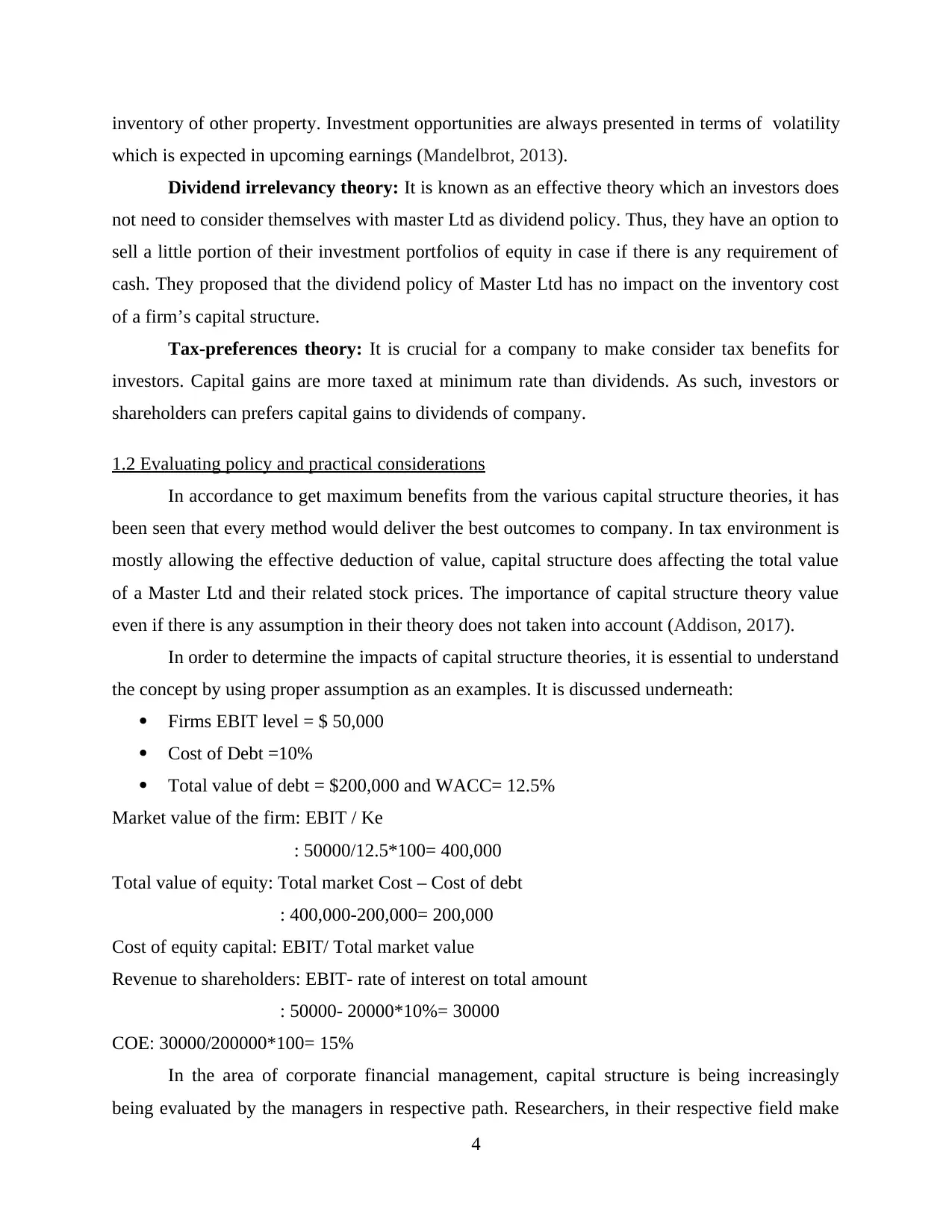
Firms EBIT level = $ 50,000
Cost of Debt =10%
Total value of debt = $200,000 and WACC= 12.5%
Market value of the firm: EBIT / Ke
: 50000/12.5*100= 400,000
Total value of equity: Total market Cost – Cost of debt
: 400,000-200,000= 200,000
Cost of equity capital: EBIT/ Total market value
Revenue to shareholders: EBIT- rate of interest on total amount
: 50000- 20000*10%= 30000
COE: 30000/200000*100= 15%
In the area of corporate financial management, capital structure is being increasingly
being evaluated by the managers in respective path. Researchers, in their respective field make
4
which is expected in upcoming earnings (Mandelbrot, 2013).
Dividend irrelevancy theory: It is known as an effective theory which an investors does
not need to consider themselves with master Ltd as dividend policy. Thus, they have an option to
sell a little portion of their investment portfolios of equity in case if there is any requirement of
cash. They proposed that the dividend policy of Master Ltd has no impact on the inventory cost
of a firm’s capital structure.
Tax-preferences theory: It is crucial for a company to make consider tax benefits for
investors. Capital gains are more taxed at minimum rate than dividends. As such, investors or
shareholders can prefers capital gains to dividends of company.
1.2 Evaluating policy and practical considerations
In accordance to get maximum benefits from the various capital structure theories, it has
been seen that every method would deliver the best outcomes to company. In tax environment is
mostly allowing the effective deduction of value, capital structure does affecting the total value
of a Master Ltd and their related stock prices. The importance of capital structure theory value
even if there is any assumption in their theory does not taken into account (Addison, 2017).
In order to determine the impacts of capital structure theories, it is essential to understand
the concept by using proper assumption as an examples. It is discussed underneath:
Firms EBIT level = $ 50,000
Cost of Debt =10%
Total value of debt = $200,000 and WACC= 12.5%
Market value of the firm: EBIT / Ke
: 50000/12.5*100= 400,000
Total value of equity: Total market Cost – Cost of debt
: 400,000-200,000= 200,000
Cost of equity capital: EBIT/ Total market value
Revenue to shareholders: EBIT- rate of interest on total amount
: 50000- 20000*10%= 30000
COE: 30000/200000*100= 15%
In the area of corporate financial management, capital structure is being increasingly
being evaluated by the managers in respective path. Researchers, in their respective field make
4
⊘ This is a preview!⊘
Do you want full access?
Subscribe today to unlock all pages.
Trusted by 1+ million students worldwide

huge works in order to increase their maximum market value and planning to generating as much
return as they can through their overall investments.
TASK 2
Financial analysis
Under this mentioned section, a hypothetical assumption of data to determine financial
position of the company. Masters has currently been searching to make crucial importance at
international manufacturers with very minimum costs. To deal with such kind of issues they are
planning to make a well organise project plan in order to face tough competition but this would
be more risky as compare to present situations. The top management of Master Ltd has decided
to make financial analysis of the propose project (Buchanan, 2014). In order to evaluate positive
aspects of their future plan they need to determine total net profitability during the next 5 year.
The total net profit comes out of their initial investments of $10 million.
Revenue COGS S&D
expenses
Depreciation Total
expenses
Net profits
Year 0 -100,000,000
Year 1 10000000 5000000 1,500,000 2,000,000 8,500,000 1,500,000
Year 2 11440000 5720000 1545000 2,000,000 9,265,000 2,175,000
Year 3 13087360 6543680 1591350 2,000,000 10,135,030 2,952,330
Year 4 11568568 5784284 1639090.5 2,000,000 9,423,375 2,145,194
Year 5 10226684.1 5113342 1688263.215 2,000,000 8,801,605 1,425,078.81
Tax@30% net profit
450,000 1,050,000
652,500 1,522,500
885,699 2,066,631
643,558 1,501,635
427,523.6
4
997,555.17
5
return as they can through their overall investments.
TASK 2
Financial analysis
Under this mentioned section, a hypothetical assumption of data to determine financial
position of the company. Masters has currently been searching to make crucial importance at
international manufacturers with very minimum costs. To deal with such kind of issues they are
planning to make a well organise project plan in order to face tough competition but this would
be more risky as compare to present situations. The top management of Master Ltd has decided
to make financial analysis of the propose project (Buchanan, 2014). In order to evaluate positive
aspects of their future plan they need to determine total net profitability during the next 5 year.
The total net profit comes out of their initial investments of $10 million.
Revenue COGS S&D
expenses
Depreciation Total
expenses
Net profits
Year 0 -100,000,000
Year 1 10000000 5000000 1,500,000 2,000,000 8,500,000 1,500,000
Year 2 11440000 5720000 1545000 2,000,000 9,265,000 2,175,000
Year 3 13087360 6543680 1591350 2,000,000 10,135,030 2,952,330
Year 4 11568568 5784284 1639090.5 2,000,000 9,423,375 2,145,194
Year 5 10226684.1 5113342 1688263.215 2,000,000 8,801,605 1,425,078.81
Tax@30% net profit
450,000 1,050,000
652,500 1,522,500
885,699 2,066,631
643,558 1,501,635
427,523.6
4
997,555.17
5
Paraphrase This Document
Need a fresh take? Get an instant paraphrase of this document with our AI Paraphraser
From the above calculation, it has been seen that with the initial investments of $10
million they are getting sufficient amount of net profit as 1425078 in the end of 5 year. As the
cash flows are not similar with the initial investment because of which they are getting return on
by charging valuable amount of depreciation on straight line basis. After deducting 30% of total
tax rate the are getting net profit of 997555 in end of 5th year. For making more effective analyse
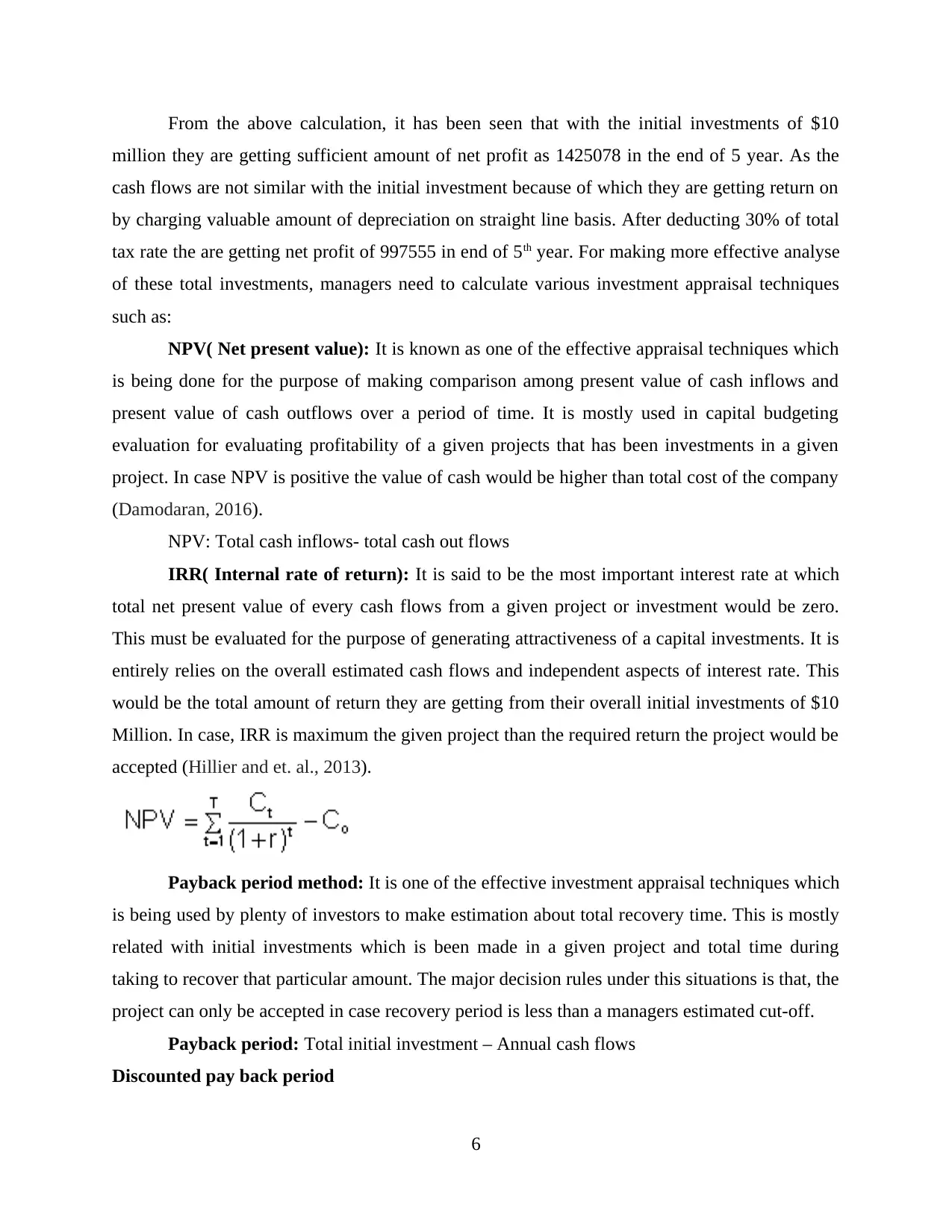
of these total investments, managers need to calculate various investment appraisal techniques
such as:
NPV( Net present value): It is known as one of the effective appraisal techniques which
is being done for the purpose of making comparison among present value of cash inflows and
present value of cash outflows over a period of time. It is mostly used in capital budgeting
evaluation for evaluating profitability of a given projects that has been investments in a given
project. In case NPV is positive the value of cash would be higher than total cost of the company
(Damodaran, 2016).
NPV: Total cash inflows- total cash out flows
IRR( Internal rate of return): It is said to be the most important interest rate at which
total net present value of every cash flows from a given project or investment would be zero.
This must be evaluated for the purpose of generating attractiveness of a capital investments. It is
entirely relies on the overall estimated cash flows and independent aspects of interest rate. This
would be the total amount of return they are getting from their overall initial investments of $10
Million. In case, IRR is maximum the given project than the required return the project would be
accepted (Hillier and et. al., 2013).
Payback period method: It is one of the effective investment appraisal techniques which
is being used by plenty of investors to make estimation about total recovery time. This is mostly
related with initial investments which is been made in a given project and total time during
taking to recover that particular amount. The major decision rules under this situations is that, the
project can only be accepted in case recovery period is less than a managers estimated cut-off.
Payback period: Total initial investment – Annual cash flows
Discounted pay back period
6
million they are getting sufficient amount of net profit as 1425078 in the end of 5 year. As the
cash flows are not similar with the initial investment because of which they are getting return on
by charging valuable amount of depreciation on straight line basis. After deducting 30% of total
tax rate the are getting net profit of 997555 in end of 5th year. For making more effective analyse
of these total investments, managers need to calculate various investment appraisal techniques
such as:
NPV( Net present value): It is known as one of the effective appraisal techniques which
is being done for the purpose of making comparison among present value of cash inflows and
present value of cash outflows over a period of time. It is mostly used in capital budgeting
evaluation for evaluating profitability of a given projects that has been investments in a given
project. In case NPV is positive the value of cash would be higher than total cost of the company
(Damodaran, 2016).
NPV: Total cash inflows- total cash out flows
IRR( Internal rate of return): It is said to be the most important interest rate at which
total net present value of every cash flows from a given project or investment would be zero.
This must be evaluated for the purpose of generating attractiveness of a capital investments. It is
entirely relies on the overall estimated cash flows and independent aspects of interest rate. This
would be the total amount of return they are getting from their overall initial investments of $10
Million. In case, IRR is maximum the given project than the required return the project would be
accepted (Hillier and et. al., 2013).
Payback period method: It is one of the effective investment appraisal techniques which
is being used by plenty of investors to make estimation about total recovery time. This is mostly
related with initial investments which is been made in a given project and total time during
taking to recover that particular amount. The major decision rules under this situations is that, the
project can only be accepted in case recovery period is less than a managers estimated cut-off.
Payback period: Total initial investment – Annual cash flows
Discounted pay back period
6
It is effective method which is used by the management of Master company regarding
determination of the profitability which is associated with the project. It is the method of capital
budgeting. This method provides the information regarding the number of years taken by the
organization to attain break even from undertaking of their initial expenditure, by discounting
future cash flows and recognition of time value of money (Yescombe, 2011).
It gives the understanding about the time period which is required to attain the break even
point after starting of new project. In this period, cumulative net present value of project is zero.
Profitability index
It is one of the important tool which is used by the management of Master company to
give rank to projects. This method is also known as Profit investment ratio. It is the ratio of pay-
off to the investment which is put on proposed project.
Cash flow P.V@15% Present value
1 -100000000
3,050,000 0.869565217 1304347.826
3,522,500 0.756143667 1644612.476
4,066,631 0.657516232 1941204.898
3,501,635 0.571753246 1226521.346
2,997,555.17 0.497176735 1,490,314.69
Total present value 7607001.239
Working capital -1304347.826
Total outflow -101304347.8
realisation of working capital 745765.1029
Total inflows 8352766.342
NPV -92951581.48
IRR 57.00%
Valuable recommendation
After making proper evaluation of information, the assumption of total 5 year is been
done. Out of which, it has been seen that they are not able to get sufficient amount of return over
their initial investments of $ 10 million.
7
determination of the profitability which is associated with the project. It is the method of capital
budgeting. This method provides the information regarding the number of years taken by the
organization to attain break even from undertaking of their initial expenditure, by discounting
future cash flows and recognition of time value of money (Yescombe, 2011).
It gives the understanding about the time period which is required to attain the break even
point after starting of new project. In this period, cumulative net present value of project is zero.
Profitability index
It is one of the important tool which is used by the management of Master company to
give rank to projects. This method is also known as Profit investment ratio. It is the ratio of pay-
off to the investment which is put on proposed project.
Cash flow P.V@15% Present value
1 -100000000
3,050,000 0.869565217 1304347.826
3,522,500 0.756143667 1644612.476
4,066,631 0.657516232 1941204.898
3,501,635 0.571753246 1226521.346
2,997,555.17 0.497176735 1,490,314.69
Total present value 7607001.239
Working capital -1304347.826
Total outflow -101304347.8
realisation of working capital 745765.1029
Total inflows 8352766.342
NPV -92951581.48
IRR 57.00%
Valuable recommendation
After making proper evaluation of information, the assumption of total 5 year is been
done. Out of which, it has been seen that they are not able to get sufficient amount of return over
their initial investments of $ 10 million.
7
⊘ This is a preview!⊘
Do you want full access?
Subscribe today to unlock all pages.
Trusted by 1+ million students worldwide

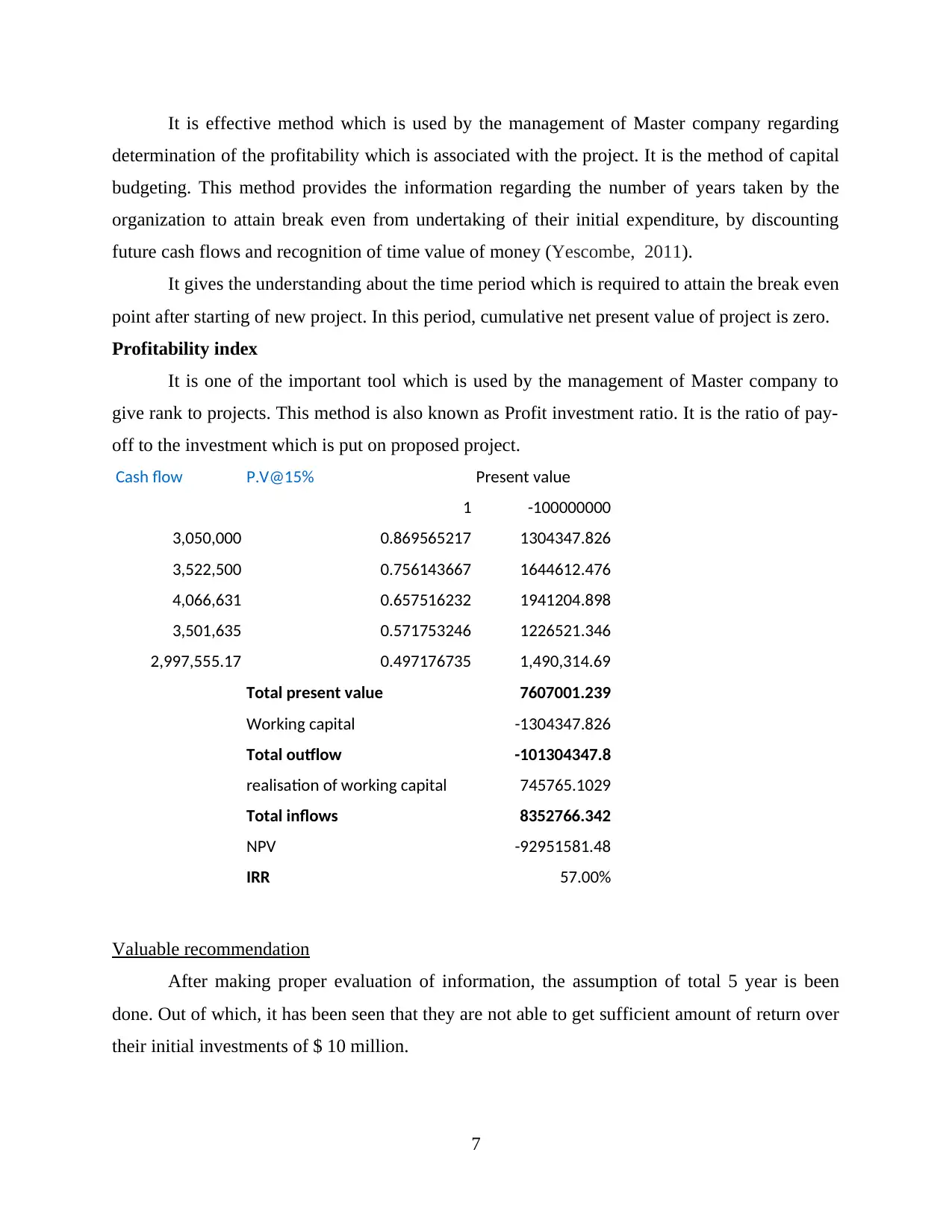
It has been suggested that to make use of data for 10 year so that accurate return and
recovery time duration can be generated. After the end of 5 year they are getting total present
value of 7607001. They need to make use of their capital investments so they valuable amount of
return they would get in near future.
CONCLUSION
It has been concluded from the above report that, large number of benefits are attained by
organization with the help of determination of capital structure and identification of pay out
ratios. It provides the opportunity regarding make effective decisions to improvement of their
profitability. Investment appraisal techniques also plays an important role to choose appropriate
project which is most profitable.
8
recovery time duration can be generated. After the end of 5 year they are getting total present
value of 7607001. They need to make use of their capital investments so they valuable amount of
return they would get in near future.
CONCLUSION
It has been concluded from the above report that, large number of benefits are attained by
organization with the help of determination of capital structure and identification of pay out
ratios. It provides the opportunity regarding make effective decisions to improvement of their
profitability. Investment appraisal techniques also plays an important role to choose appropriate
project which is most profitable.
8

1 out of 10


Related Documents


Your All-in-One AI-Powered Toolkit for Academic Success.
+13062052269
info@desklib.com
Available 24*7 on WhatsApp / Email
![[object Object]](/_next/static/media/star-bottom.7253800d.svg)
Unlock your academic potential
Copyright © 2020–2026 A2Z Services. All Rights Reserved. Developed and managed by ZUCOL.