Financial and Cost Accounting: Analysis and Assessment Assignment
VerifiedAdded on 2020/03/16
|14
|2291
|37
Homework Assignment
AI Summary
This document presents solutions to an accounting assessment, encompassing various aspects of financial and cost accounting. The answers cover topics such as the users of accounting information, the importance of an accounting system, steps for data accuracy, and the differences between financial and cost accounting. Further solutions include manufacturing statements, inventory valuation methods (FIFO, LIFO, weighted average), variance analysis (materials and labor), and break-even analysis. The assessment also includes case studies and true/false questions related to cost accounting principles and job costing.
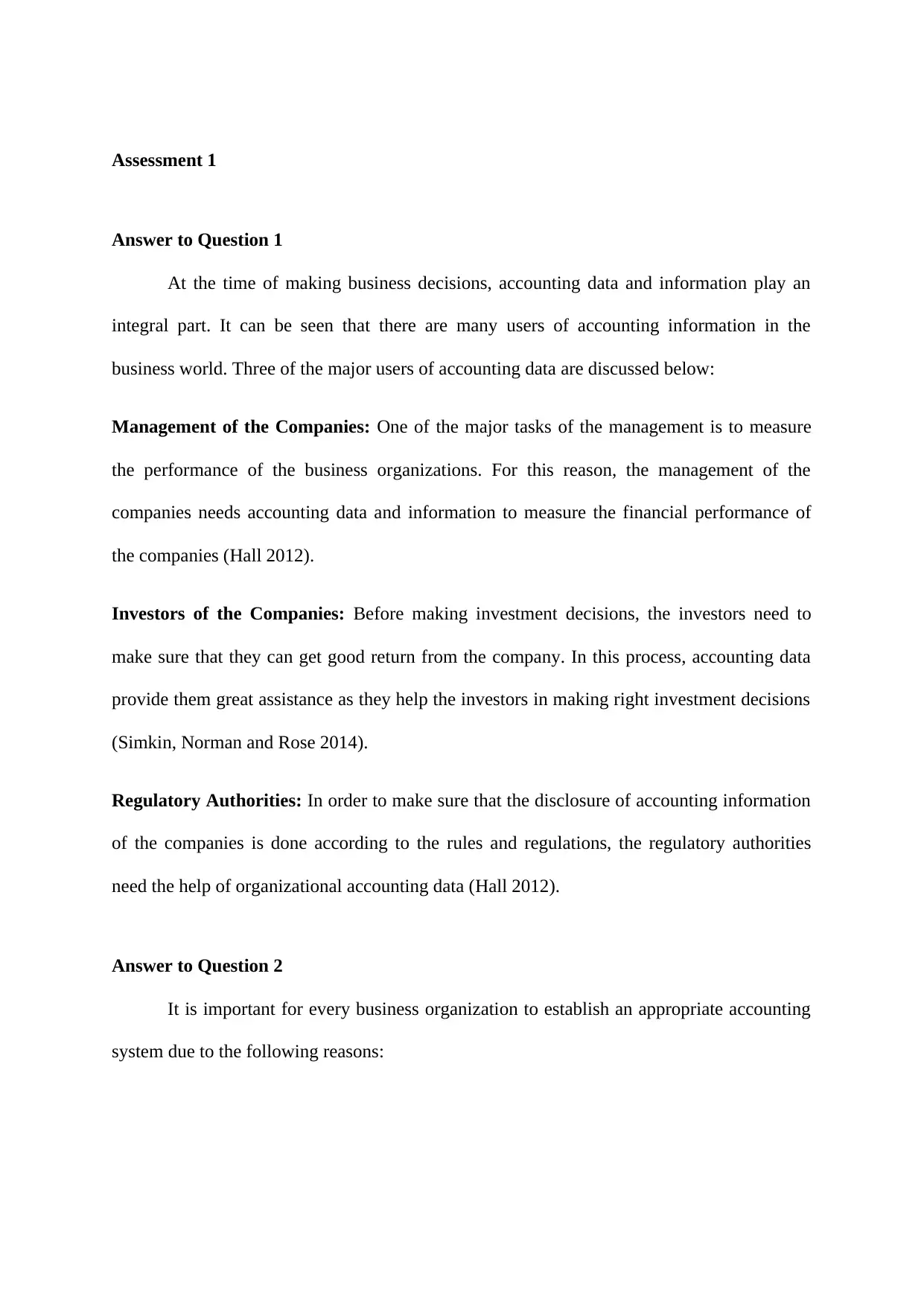
Assessment 1
Answer to Question 1
At the time of making business decisions, accounting data and information play an
integral part. It can be seen that there are many users of accounting information in the
business world. Three of the major users of accounting data are discussed below:
Management of the Companies: One of the major tasks of the management is to measure
the performance of the business organizations. For this reason, the management of the
companies needs accounting data and information to measure the financial performance of
the companies (Hall 2012).
Investors of the Companies: Before making investment decisions, the investors need to
make sure that they can get good return from the company. In this process, accounting data
provide them great assistance as they help the investors in making right investment decisions
(Simkin, Norman and Rose 2014).
Regulatory Authorities: In order to make sure that the disclosure of accounting information
of the companies is done according to the rules and regulations, the regulatory authorities
need the help of organizational accounting data (Hall 2012).
Answer to Question 2
It is important for every business organization to establish an appropriate accounting
system due to the following reasons:
Answer to Question 1
At the time of making business decisions, accounting data and information play an
integral part. It can be seen that there are many users of accounting information in the
business world. Three of the major users of accounting data are discussed below:
Management of the Companies: One of the major tasks of the management is to measure
the performance of the business organizations. For this reason, the management of the
companies needs accounting data and information to measure the financial performance of
the companies (Hall 2012).
Investors of the Companies: Before making investment decisions, the investors need to
make sure that they can get good return from the company. In this process, accounting data
provide them great assistance as they help the investors in making right investment decisions
(Simkin, Norman and Rose 2014).
Regulatory Authorities: In order to make sure that the disclosure of accounting information
of the companies is done according to the rules and regulations, the regulatory authorities
need the help of organizational accounting data (Hall 2012).
Answer to Question 2
It is important for every business organization to establish an appropriate accounting
system due to the following reasons:

Paraphrase This Document
Need a fresh take? Get an instant paraphrase of this document with our AI Paraphraser
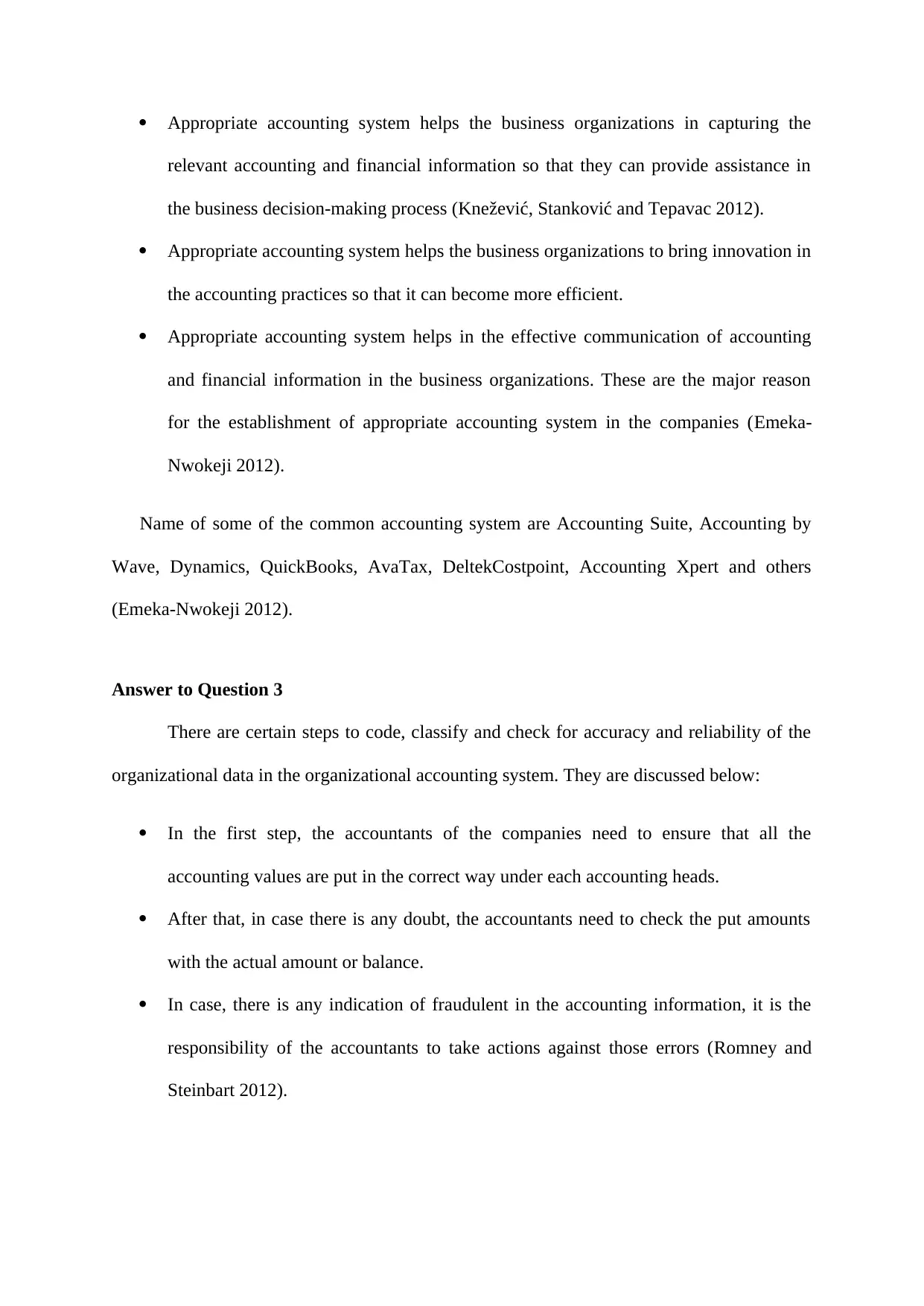
Appropriate accounting system helps the business organizations in capturing the
relevant accounting and financial information so that they can provide assistance in
the business decision-making process (Knežević, Stanković and Tepavac 2012).
Appropriate accounting system helps the business organizations to bring innovation in
the accounting practices so that it can become more efficient.
Appropriate accounting system helps in the effective communication of accounting
and financial information in the business organizations. These are the major reason
for the establishment of appropriate accounting system in the companies (Emeka-
Nwokeji 2012).
Name of some of the common accounting system are Accounting Suite, Accounting by
Wave, Dynamics, QuickBooks, AvaTax, DeltekCostpoint, Accounting Xpert and others
(Emeka-Nwokeji 2012).
Answer to Question 3
There are certain steps to code, classify and check for accuracy and reliability of the
organizational data in the organizational accounting system. They are discussed below:
In the first step, the accountants of the companies need to ensure that all the
accounting values are put in the correct way under each accounting heads.
After that, in case there is any doubt, the accountants need to check the put amounts
with the actual amount or balance.
In case, there is any indication of fraudulent in the accounting information, it is the
responsibility of the accountants to take actions against those errors (Romney and
Steinbart 2012).
relevant accounting and financial information so that they can provide assistance in
the business decision-making process (Knežević, Stanković and Tepavac 2012).
Appropriate accounting system helps the business organizations to bring innovation in
the accounting practices so that it can become more efficient.
Appropriate accounting system helps in the effective communication of accounting
and financial information in the business organizations. These are the major reason
for the establishment of appropriate accounting system in the companies (Emeka-
Nwokeji 2012).
Name of some of the common accounting system are Accounting Suite, Accounting by
Wave, Dynamics, QuickBooks, AvaTax, DeltekCostpoint, Accounting Xpert and others
(Emeka-Nwokeji 2012).
Answer to Question 3
There are certain steps to code, classify and check for accuracy and reliability of the
organizational data in the organizational accounting system. They are discussed below:
In the first step, the accountants of the companies need to ensure that all the
accounting values are put in the correct way under each accounting heads.
After that, in case there is any doubt, the accountants need to check the put amounts
with the actual amount or balance.
In case, there is any indication of fraudulent in the accounting information, it is the
responsibility of the accountants to take actions against those errors (Romney and
Steinbart 2012).
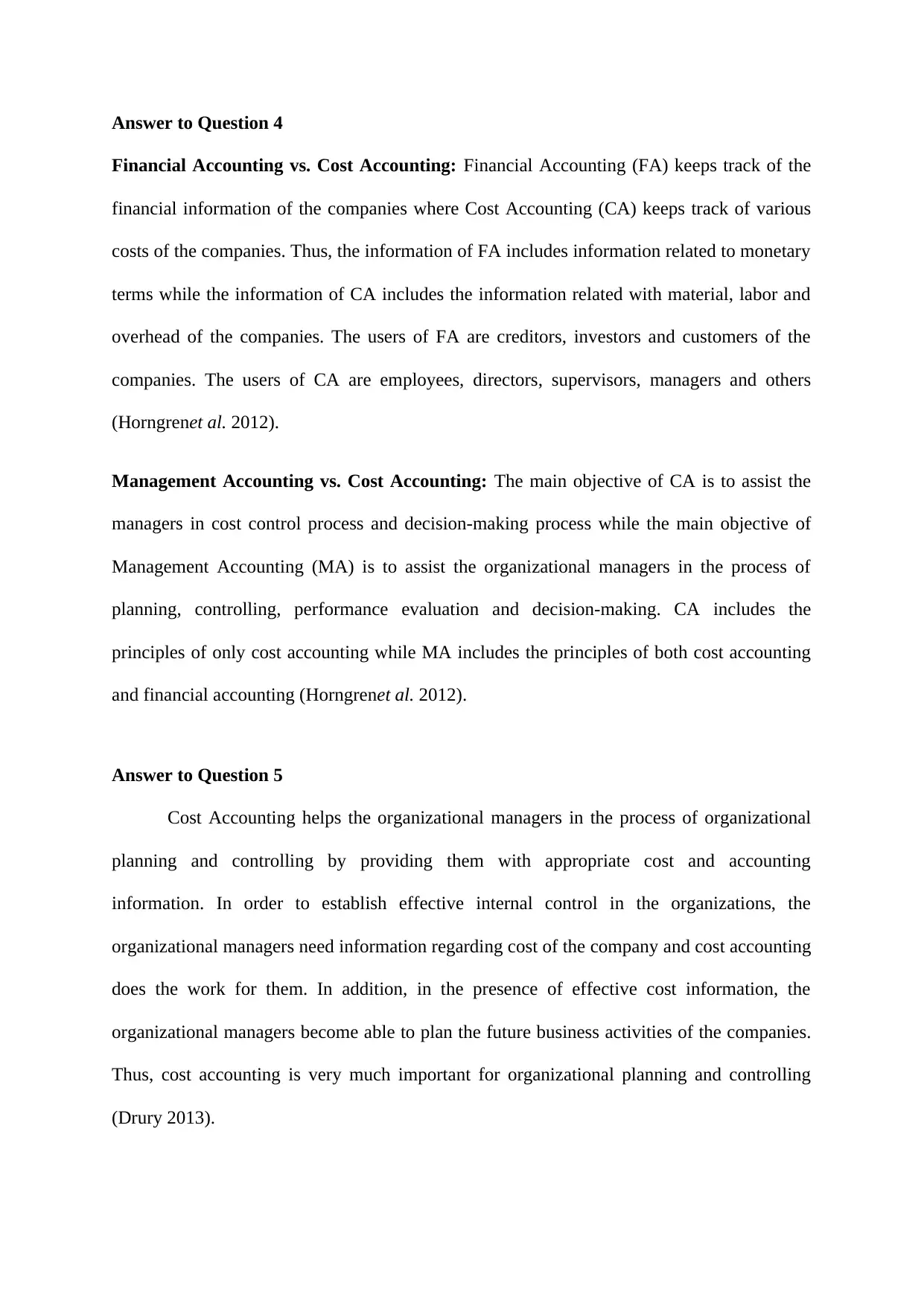
Answer to Question 4
Financial Accounting vs. Cost Accounting: Financial Accounting (FA) keeps track of the
financial information of the companies where Cost Accounting (CA) keeps track of various
costs of the companies. Thus, the information of FA includes information related to monetary
terms while the information of CA includes the information related with material, labor and
overhead of the companies. The users of FA are creditors, investors and customers of the
companies. The users of CA are employees, directors, supervisors, managers and others
(Horngrenet al. 2012).
Management Accounting vs. Cost Accounting: The main objective of CA is to assist the
managers in cost control process and decision-making process while the main objective of
Management Accounting (MA) is to assist the organizational managers in the process of
planning, controlling, performance evaluation and decision-making. CA includes the
principles of only cost accounting while MA includes the principles of both cost accounting
and financial accounting (Horngrenet al. 2012).
Answer to Question 5
Cost Accounting helps the organizational managers in the process of organizational
planning and controlling by providing them with appropriate cost and accounting
information. In order to establish effective internal control in the organizations, the
organizational managers need information regarding cost of the company and cost accounting
does the work for them. In addition, in the presence of effective cost information, the
organizational managers become able to plan the future business activities of the companies.
Thus, cost accounting is very much important for organizational planning and controlling
(Drury 2013).
Financial Accounting vs. Cost Accounting: Financial Accounting (FA) keeps track of the
financial information of the companies where Cost Accounting (CA) keeps track of various
costs of the companies. Thus, the information of FA includes information related to monetary
terms while the information of CA includes the information related with material, labor and
overhead of the companies. The users of FA are creditors, investors and customers of the
companies. The users of CA are employees, directors, supervisors, managers and others
(Horngrenet al. 2012).
Management Accounting vs. Cost Accounting: The main objective of CA is to assist the
managers in cost control process and decision-making process while the main objective of
Management Accounting (MA) is to assist the organizational managers in the process of
planning, controlling, performance evaluation and decision-making. CA includes the
principles of only cost accounting while MA includes the principles of both cost accounting
and financial accounting (Horngrenet al. 2012).
Answer to Question 5
Cost Accounting helps the organizational managers in the process of organizational
planning and controlling by providing them with appropriate cost and accounting
information. In order to establish effective internal control in the organizations, the
organizational managers need information regarding cost of the company and cost accounting
does the work for them. In addition, in the presence of effective cost information, the
organizational managers become able to plan the future business activities of the companies.
Thus, cost accounting is very much important for organizational planning and controlling
(Drury 2013).
⊘ This is a preview!⊘
Do you want full access?
Subscribe today to unlock all pages.

Trusted by 1+ million students worldwide
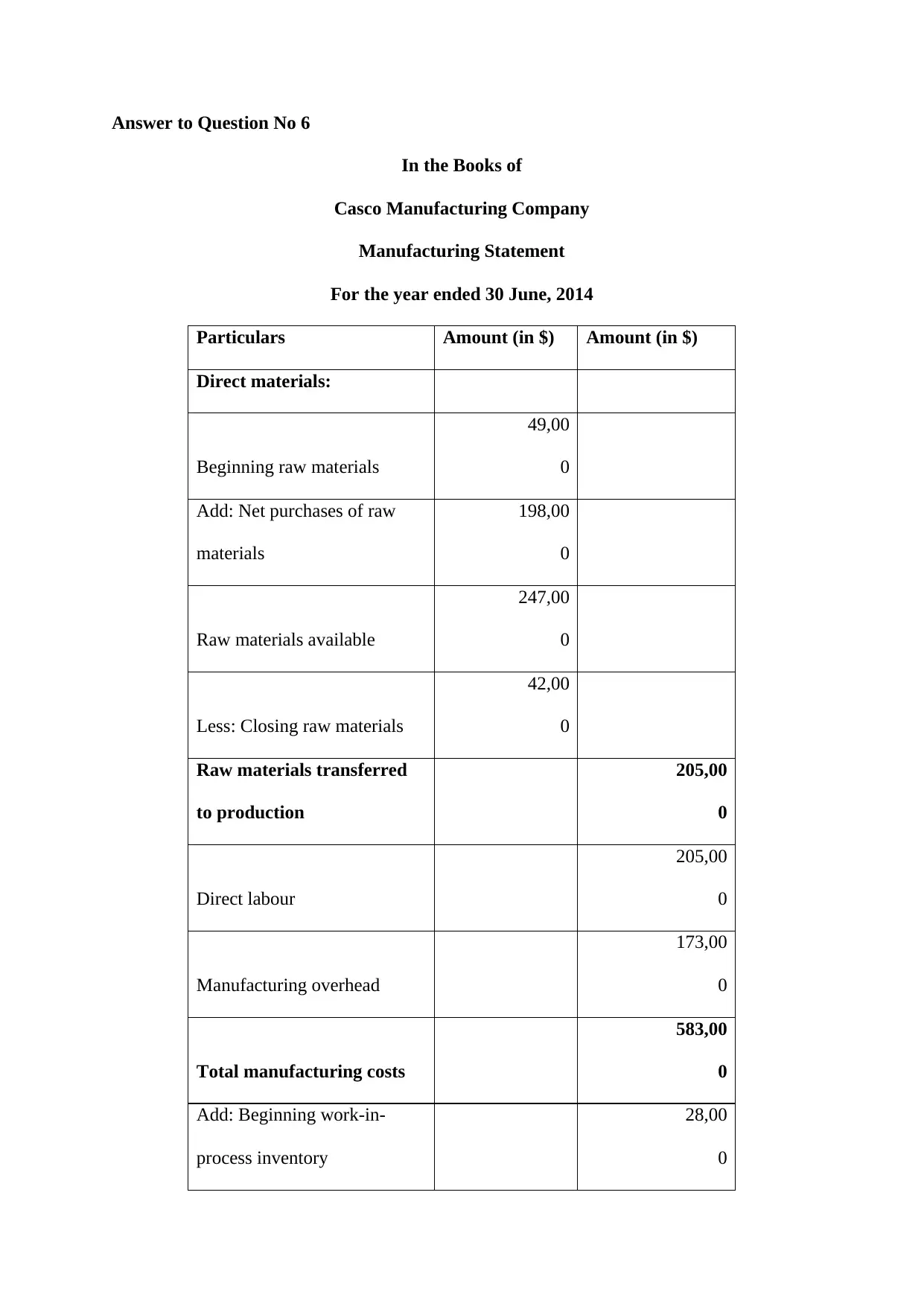
Answer to Question No 6
In the Books of
Casco Manufacturing Company
Manufacturing Statement
For the year ended 30 June, 2014
Particulars Amount (in $) Amount (in $)
Direct materials:
Beginning raw materials
49,00
0
Add: Net purchases of raw
materials
198,00
0
Raw materials available
247,00
0
Less: Closing raw materials
42,00
0
Raw materials transferred
to production
205,00
0
Direct labour
205,00
0
Manufacturing overhead
173,00
0
Total manufacturing costs
583,00
0
Add: Beginning work-in-
process inventory
28,00
0
In the Books of
Casco Manufacturing Company
Manufacturing Statement
For the year ended 30 June, 2014
Particulars Amount (in $) Amount (in $)
Direct materials:
Beginning raw materials
49,00
0
Add: Net purchases of raw
materials
198,00
0
Raw materials available
247,00
0
Less: Closing raw materials
42,00
0
Raw materials transferred
to production
205,00
0
Direct labour
205,00
0
Manufacturing overhead
173,00
0
Total manufacturing costs
583,00
0
Add: Beginning work-in-
process inventory
28,00
0
Paraphrase This Document
Need a fresh take? Get an instant paraphrase of this document with our AI Paraphraser
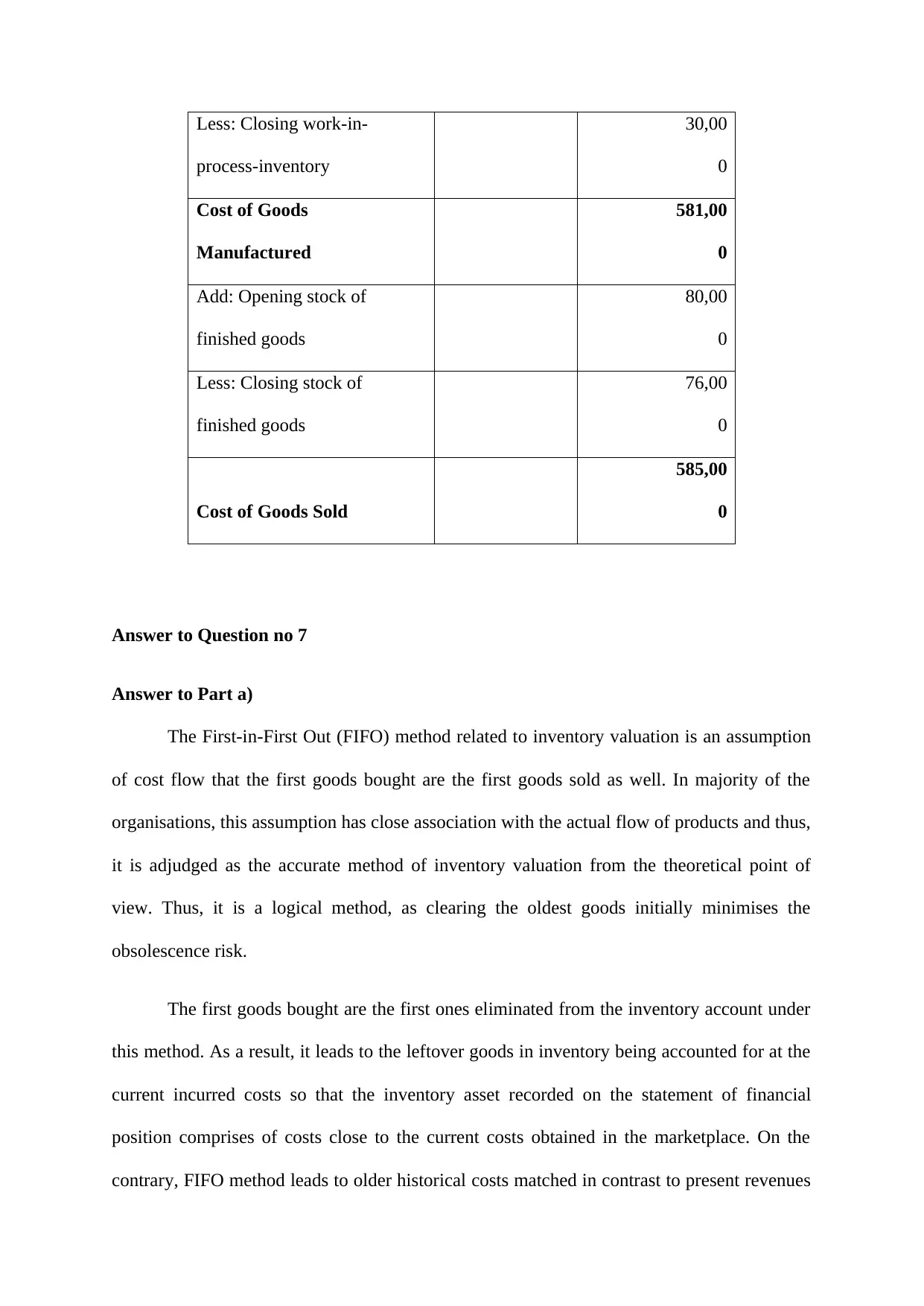
Less: Closing work-in-
process-inventory
30,00
0
Cost of Goods
Manufactured
581,00
0
Add: Opening stock of
finished goods
80,00
0
Less: Closing stock of
finished goods
76,00
0
Cost of Goods Sold
585,00
0
Answer to Question no 7
Answer to Part a)
The First-in-First Out (FIFO) method related to inventory valuation is an assumption
of cost flow that the first goods bought are the first goods sold as well. In majority of the
organisations, this assumption has close association with the actual flow of products and thus,
it is adjudged as the accurate method of inventory valuation from the theoretical point of
view. Thus, it is a logical method, as clearing the oldest goods initially minimises the
obsolescence risk.
The first goods bought are the first ones eliminated from the inventory account under
this method. As a result, it leads to the leftover goods in inventory being accounted for at the
current incurred costs so that the inventory asset recorded on the statement of financial
position comprises of costs close to the current costs obtained in the marketplace. On the
contrary, FIFO method leads to older historical costs matched in contrast to present revenues
process-inventory
30,00
0
Cost of Goods
Manufactured
581,00
0
Add: Opening stock of
finished goods
80,00
0
Less: Closing stock of
finished goods
76,00
0
Cost of Goods Sold
585,00
0
Answer to Question no 7
Answer to Part a)
The First-in-First Out (FIFO) method related to inventory valuation is an assumption
of cost flow that the first goods bought are the first goods sold as well. In majority of the
organisations, this assumption has close association with the actual flow of products and thus,
it is adjudged as the accurate method of inventory valuation from the theoretical point of
view. Thus, it is a logical method, as clearing the oldest goods initially minimises the
obsolescence risk.
The first goods bought are the first ones eliminated from the inventory account under
this method. As a result, it leads to the leftover goods in inventory being accounted for at the
current incurred costs so that the inventory asset recorded on the statement of financial
position comprises of costs close to the current costs obtained in the marketplace. On the
contrary, FIFO method leads to older historical costs matched in contrast to present revenues
along with the cost of sales. This implies that gross margin does not depict effective matching
of costs and revenues.
Answer to Part b)
Last-in-First-Out (LIFO) method is utilised for placing an accounting value on
inventory. This method is based on the assumption that the final item of inventory bought is
the first item sold. However, this method is used rarely in practice. If an organisation has to
utilise the process flow that LIFO has embodied, a major portion of its inventory would be
extremely old and this is likely to become obsolete. On the other hand, with the help of this
method, the organisation could cope up with the inflating prices, since the inventory cost rises
with the passage of time.
Answer to Part c)
The weighted average cost or moving average method is utilised in assigning the
average production cost to a product. This method is used in situations, in which the
inventory items are intermingled in such a manner that it is not possible to apportion a
particular cost to an individual unit. In addition, this method is useful when the accounting
system of an organisation is not sophisticated adequately in identifying FIFO or LIFO layers
of inventory. Finally, weighted average cost method is beneficial when there is greater
commoditisation of inventory items, in which there is no option for apportioning cost to an
individual unit.
Answer to Question no 8
Computation of Materials Price Variance:-
Particulars Details Units
Actual quantity A 5,000
Actual price per kilogram B $ 2.40
of costs and revenues.
Answer to Part b)
Last-in-First-Out (LIFO) method is utilised for placing an accounting value on
inventory. This method is based on the assumption that the final item of inventory bought is
the first item sold. However, this method is used rarely in practice. If an organisation has to
utilise the process flow that LIFO has embodied, a major portion of its inventory would be
extremely old and this is likely to become obsolete. On the other hand, with the help of this
method, the organisation could cope up with the inflating prices, since the inventory cost rises
with the passage of time.
Answer to Part c)
The weighted average cost or moving average method is utilised in assigning the
average production cost to a product. This method is used in situations, in which the
inventory items are intermingled in such a manner that it is not possible to apportion a
particular cost to an individual unit. In addition, this method is useful when the accounting
system of an organisation is not sophisticated adequately in identifying FIFO or LIFO layers
of inventory. Finally, weighted average cost method is beneficial when there is greater
commoditisation of inventory items, in which there is no option for apportioning cost to an
individual unit.
Answer to Question no 8
Computation of Materials Price Variance:-
Particulars Details Units
Actual quantity A 5,000
Actual price per kilogram B $ 2.40
⊘ This is a preview!⊘
Do you want full access?
Subscribe today to unlock all pages.
Trusted by 1+ million students worldwide
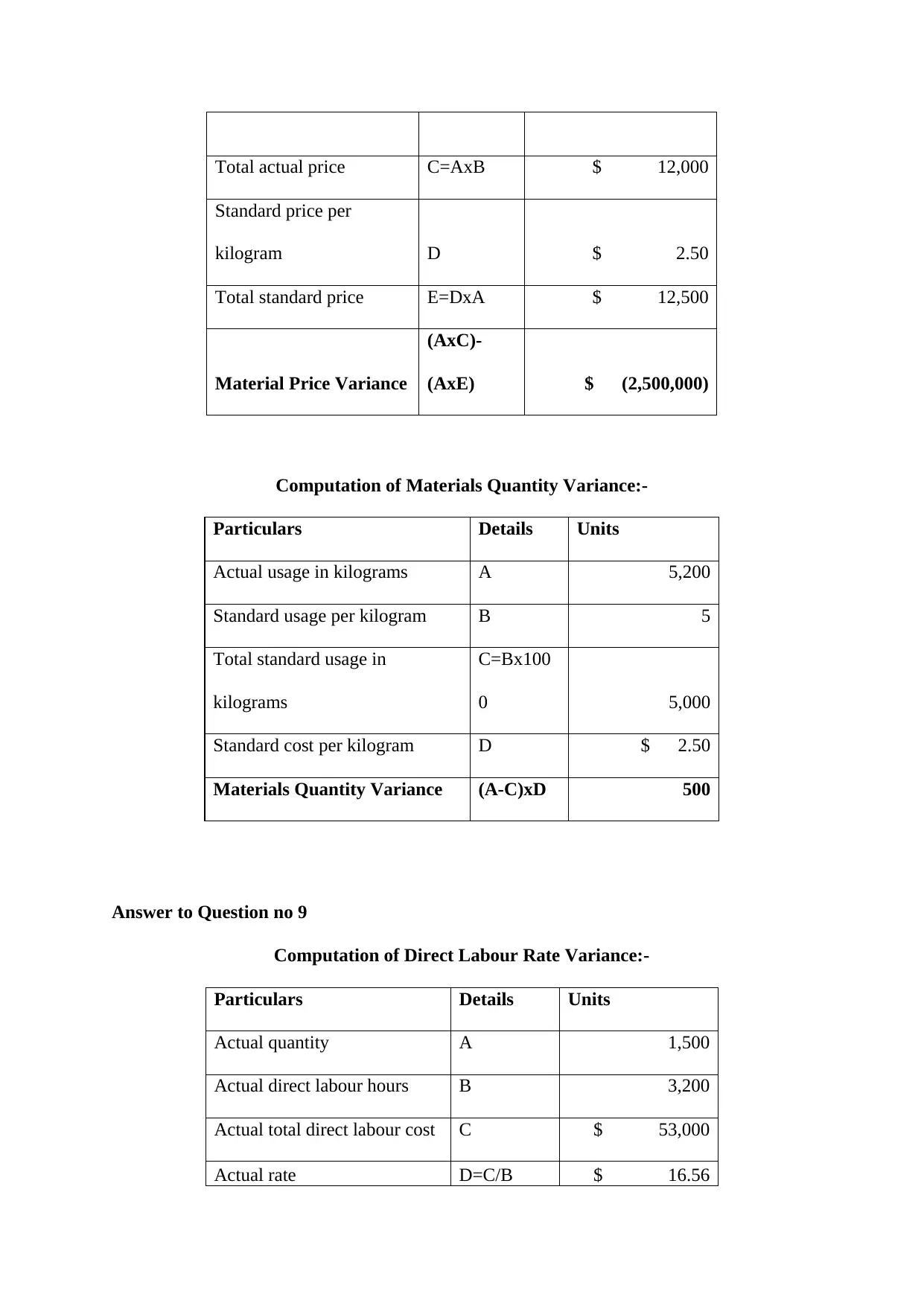
Total actual price C=AxB $ 12,000
Standard price per
kilogram D $ 2.50
Total standard price E=DxA $ 12,500
Material Price Variance
(AxC)-
(AxE) $ (2,500,000)
Computation of Materials Quantity Variance:-
Particulars Details Units
Actual usage in kilograms A 5,200
Standard usage per kilogram B 5
Total standard usage in
kilograms
C=Bx100
0 5,000
Standard cost per kilogram D $ 2.50
Materials Quantity Variance (A-C)xD 500
Answer to Question no 9
Computation of Direct Labour Rate Variance:-
Particulars Details Units
Actual quantity A 1,500
Actual direct labour hours B 3,200
Actual total direct labour cost C $ 53,000
Actual rate D=C/B $ 16.56
Standard price per
kilogram D $ 2.50
Total standard price E=DxA $ 12,500
Material Price Variance
(AxC)-
(AxE) $ (2,500,000)
Computation of Materials Quantity Variance:-
Particulars Details Units
Actual usage in kilograms A 5,200
Standard usage per kilogram B 5
Total standard usage in
kilograms
C=Bx100
0 5,000
Standard cost per kilogram D $ 2.50
Materials Quantity Variance (A-C)xD 500
Answer to Question no 9
Computation of Direct Labour Rate Variance:-
Particulars Details Units
Actual quantity A 1,500
Actual direct labour hours B 3,200
Actual total direct labour cost C $ 53,000
Actual rate D=C/B $ 16.56
Paraphrase This Document
Need a fresh take? Get an instant paraphrase of this document with our AI Paraphraser
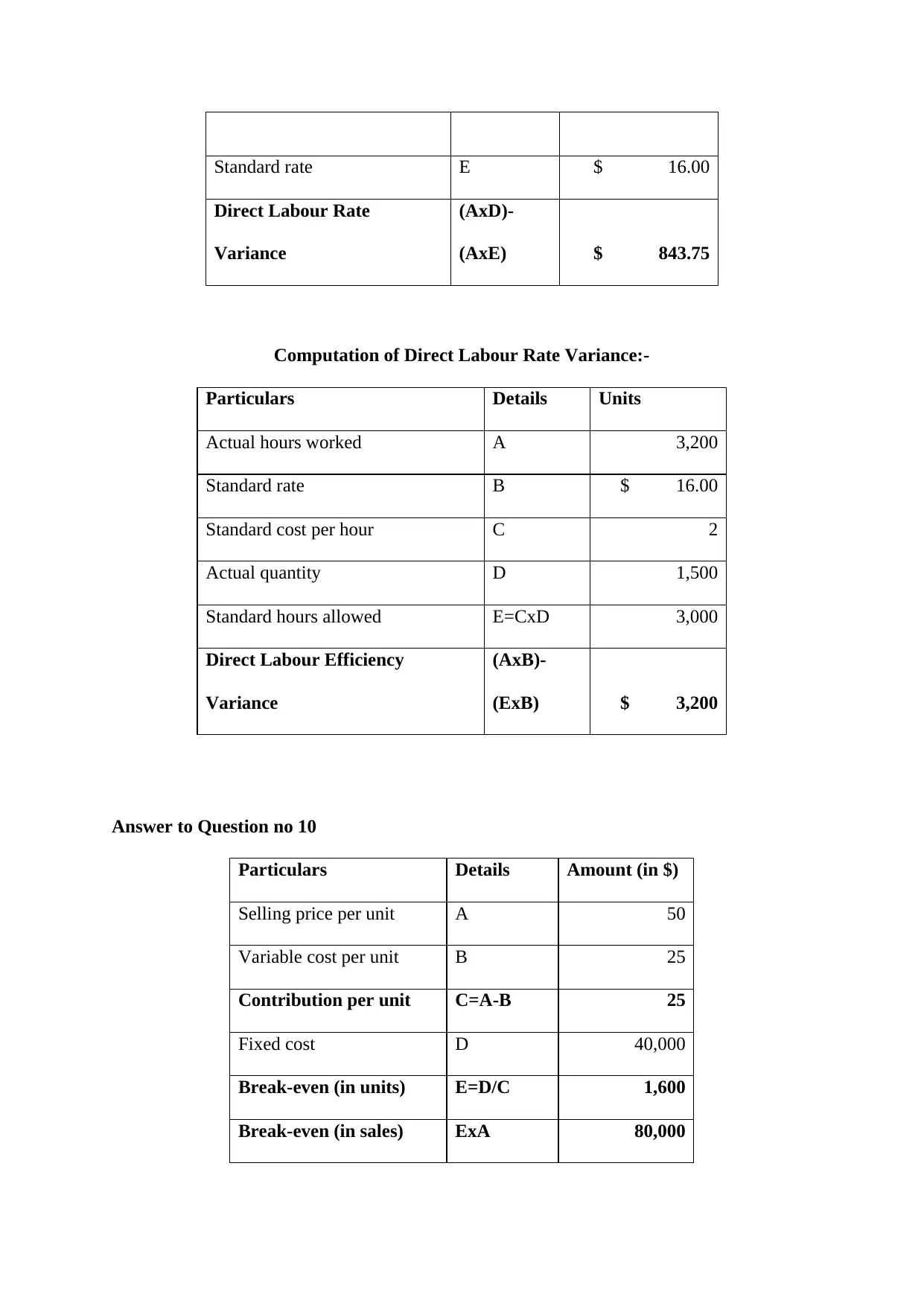
Standard rate E $ 16.00
Direct Labour Rate
Variance
(AxD)-
(AxE) $ 843.75
Computation of Direct Labour Rate Variance:-
Particulars Details Units
Actual hours worked A 3,200
Standard rate B $ 16.00
Standard cost per hour C 2
Actual quantity D 1,500
Standard hours allowed E=CxD 3,000
Direct Labour Efficiency
Variance
(AxB)-
(ExB) $ 3,200
Answer to Question no 10
Particulars Details Amount (in $)
Selling price per unit A 50
Variable cost per unit B 25
Contribution per unit C=A-B 25
Fixed cost D 40,000
Break-even (in units) E=D/C 1,600
Break-even (in sales) ExA 80,000
Direct Labour Rate
Variance
(AxD)-
(AxE) $ 843.75
Computation of Direct Labour Rate Variance:-
Particulars Details Units
Actual hours worked A 3,200
Standard rate B $ 16.00
Standard cost per hour C 2
Actual quantity D 1,500
Standard hours allowed E=CxD 3,000
Direct Labour Efficiency
Variance
(AxB)-
(ExB) $ 3,200
Answer to Question no 10
Particulars Details Amount (in $)
Selling price per unit A 50
Variable cost per unit B 25
Contribution per unit C=A-B 25
Fixed cost D 40,000
Break-even (in units) E=D/C 1,600
Break-even (in sales) ExA 80,000
Assessment 2
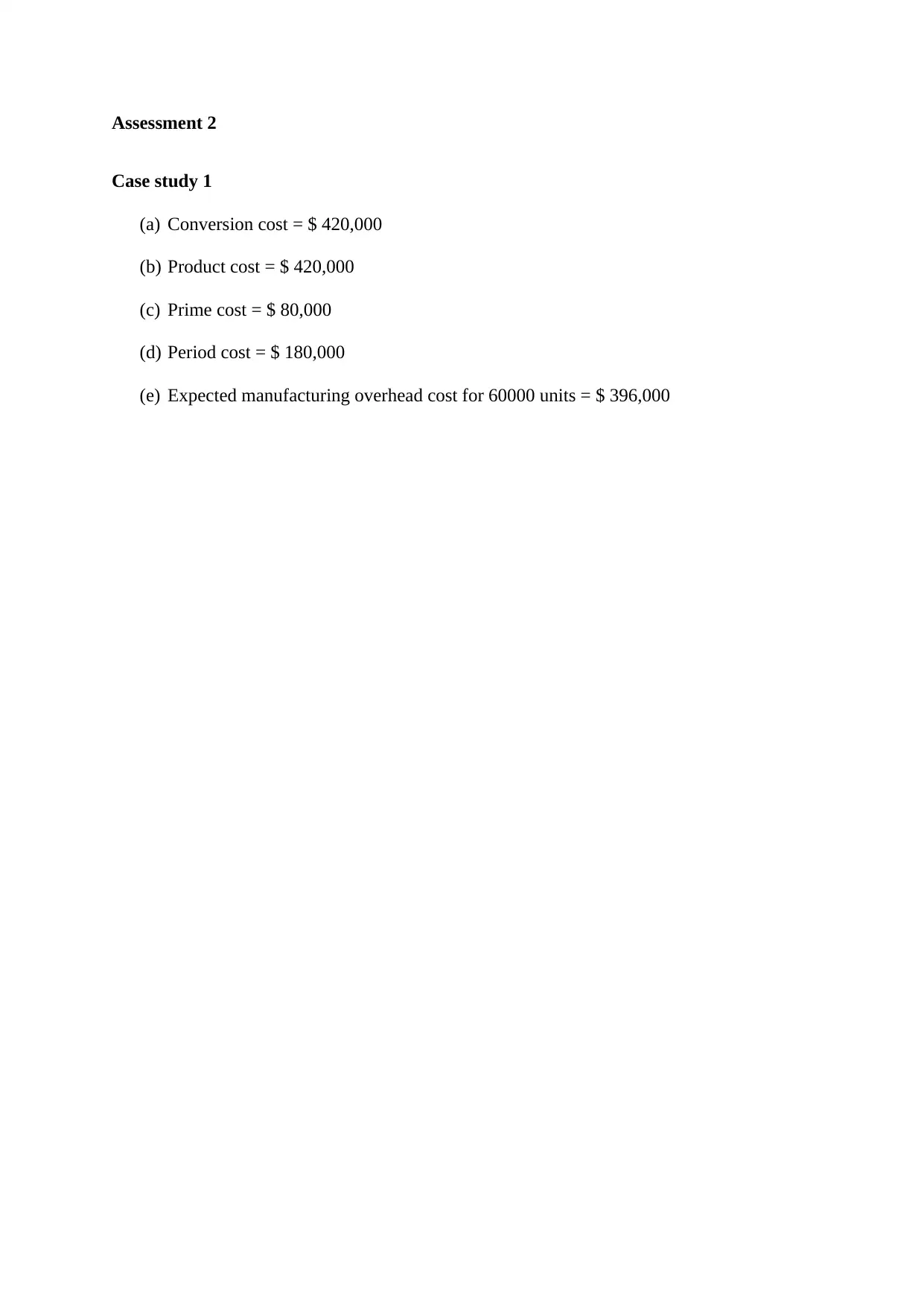
Case study 1
(a) Conversion cost = $ 420,000
(b) Product cost = $ 420,000
(c) Prime cost = $ 80,000
(d) Period cost = $ 180,000
(e) Expected manufacturing overhead cost for 60000 units = $ 396,000
Case study 1
(a) Conversion cost = $ 420,000
(b) Product cost = $ 420,000
(c) Prime cost = $ 80,000
(d) Period cost = $ 180,000
(e) Expected manufacturing overhead cost for 60000 units = $ 396,000
⊘ This is a preview!⊘
Do you want full access?
Subscribe today to unlock all pages.
Trusted by 1+ million students worldwide
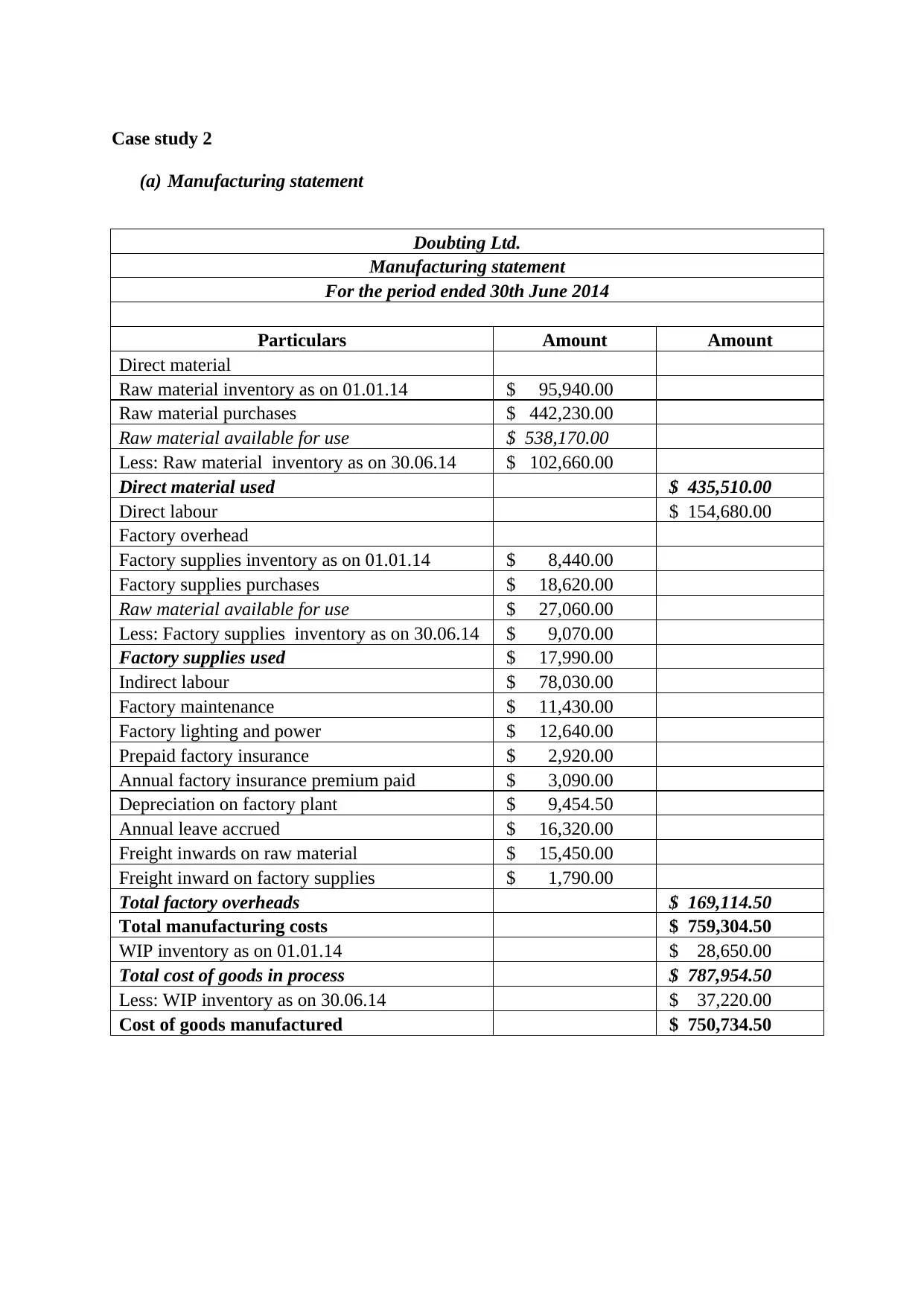
Case study 2
(a) Manufacturing statement
Doubting Ltd.
Manufacturing statement
For the period ended 30th June 2014
Particulars Amount Amount
Direct material
Raw material inventory as on 01.01.14 $ 95,940.00
Raw material purchases $ 442,230.00
Raw material available for use $ 538,170.00
Less: Raw material inventory as on 30.06.14 $ 102,660.00
Direct material used $ 435,510.00
Direct labour $ 154,680.00
Factory overhead
Factory supplies inventory as on 01.01.14 $ 8,440.00
Factory supplies purchases $ 18,620.00
Raw material available for use $ 27,060.00
Less: Factory supplies inventory as on 30.06.14 $ 9,070.00
Factory supplies used $ 17,990.00
Indirect labour $ 78,030.00
Factory maintenance $ 11,430.00
Factory lighting and power $ 12,640.00
Prepaid factory insurance $ 2,920.00
Annual factory insurance premium paid $ 3,090.00
Depreciation on factory plant $ 9,454.50
Annual leave accrued $ 16,320.00
Freight inwards on raw material $ 15,450.00
Freight inward on factory supplies $ 1,790.00
Total factory overheads $ 169,114.50
Total manufacturing costs $ 759,304.50
WIP inventory as on 01.01.14 $ 28,650.00
Total cost of goods in process $ 787,954.50
Less: WIP inventory as on 30.06.14 $ 37,220.00
Cost of goods manufactured $ 750,734.50
(a) Manufacturing statement
Doubting Ltd.
Manufacturing statement
For the period ended 30th June 2014
Particulars Amount Amount
Direct material
Raw material inventory as on 01.01.14 $ 95,940.00
Raw material purchases $ 442,230.00
Raw material available for use $ 538,170.00
Less: Raw material inventory as on 30.06.14 $ 102,660.00
Direct material used $ 435,510.00
Direct labour $ 154,680.00
Factory overhead
Factory supplies inventory as on 01.01.14 $ 8,440.00
Factory supplies purchases $ 18,620.00
Raw material available for use $ 27,060.00
Less: Factory supplies inventory as on 30.06.14 $ 9,070.00
Factory supplies used $ 17,990.00
Indirect labour $ 78,030.00
Factory maintenance $ 11,430.00
Factory lighting and power $ 12,640.00
Prepaid factory insurance $ 2,920.00
Annual factory insurance premium paid $ 3,090.00
Depreciation on factory plant $ 9,454.50
Annual leave accrued $ 16,320.00
Freight inwards on raw material $ 15,450.00
Freight inward on factory supplies $ 1,790.00
Total factory overheads $ 169,114.50
Total manufacturing costs $ 759,304.50
WIP inventory as on 01.01.14 $ 28,650.00
Total cost of goods in process $ 787,954.50
Less: WIP inventory as on 30.06.14 $ 37,220.00
Cost of goods manufactured $ 750,734.50
Paraphrase This Document
Need a fresh take? Get an instant paraphrase of this document with our AI Paraphraser
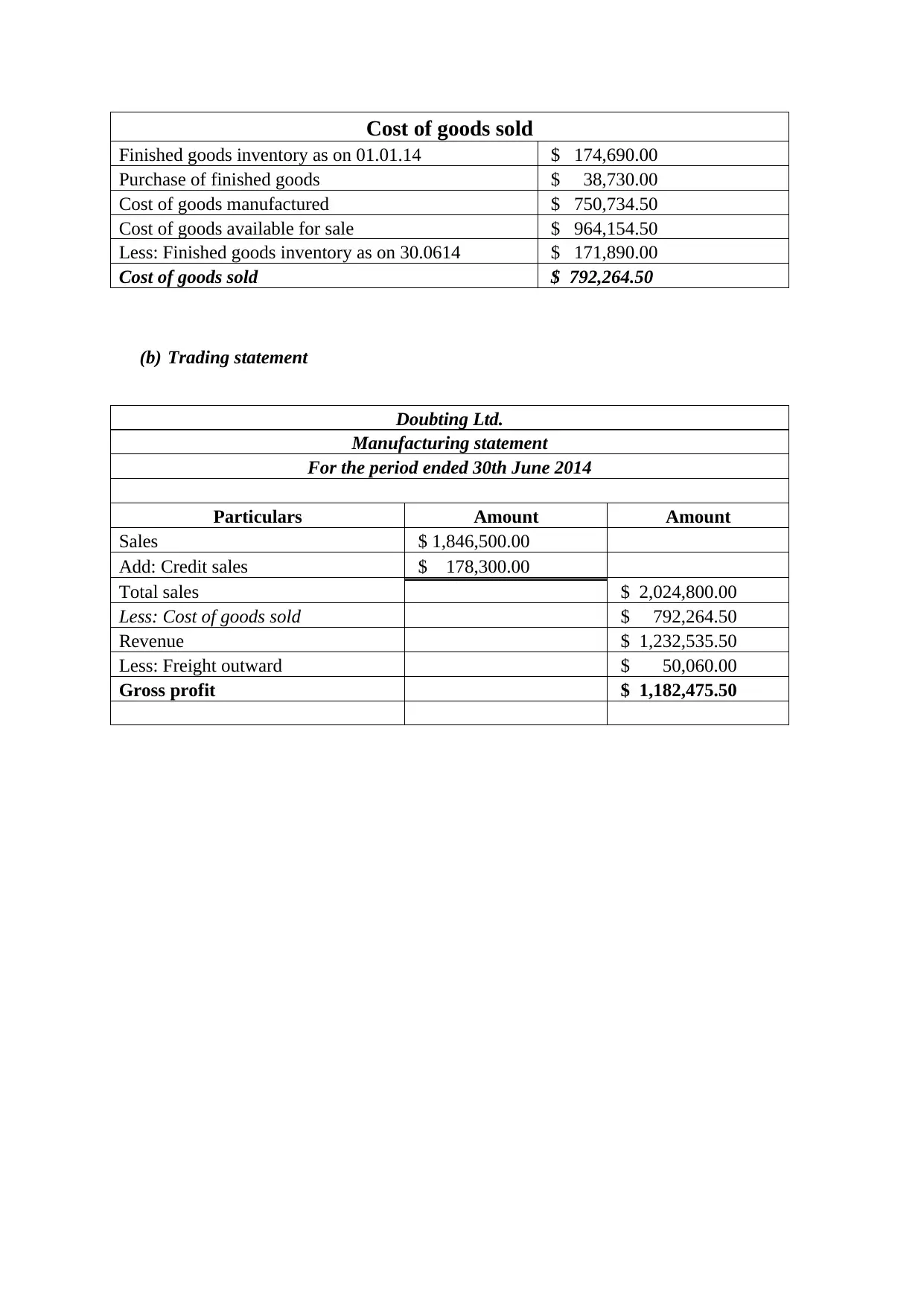
Cost of goods sold
Finished goods inventory as on 01.01.14 $ 174,690.00
Purchase of finished goods $ 38,730.00
Cost of goods manufactured $ 750,734.50
Cost of goods available for sale $ 964,154.50
Less: Finished goods inventory as on 30.0614 $ 171,890.00
Cost of goods sold $ 792,264.50
(b) Trading statement
Doubting Ltd.
Manufacturing statement
For the period ended 30th June 2014
Particulars Amount Amount
Sales $ 1,846,500.00
Add: Credit sales $ 178,300.00
Total sales $ 2,024,800.00
Less: Cost of goods sold $ 792,264.50
Revenue $ 1,232,535.50
Less: Freight outward $ 50,060.00
Gross profit $ 1,182,475.50
Finished goods inventory as on 01.01.14 $ 174,690.00
Purchase of finished goods $ 38,730.00
Cost of goods manufactured $ 750,734.50
Cost of goods available for sale $ 964,154.50
Less: Finished goods inventory as on 30.0614 $ 171,890.00
Cost of goods sold $ 792,264.50
(b) Trading statement
Doubting Ltd.
Manufacturing statement
For the period ended 30th June 2014
Particulars Amount Amount
Sales $ 1,846,500.00
Add: Credit sales $ 178,300.00
Total sales $ 2,024,800.00
Less: Cost of goods sold $ 792,264.50
Revenue $ 1,232,535.50
Less: Freight outward $ 50,060.00
Gross profit $ 1,182,475.50
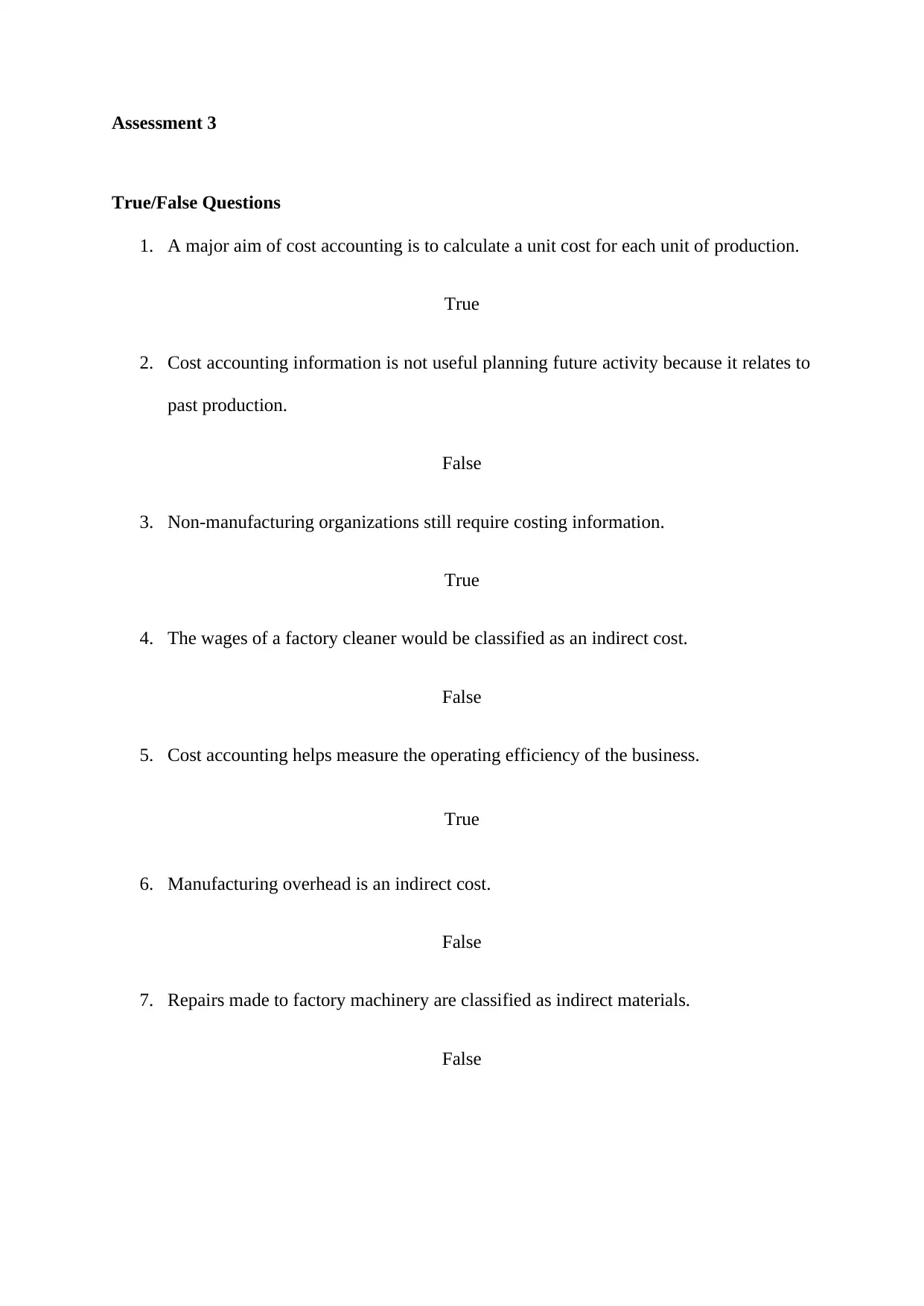
Assessment 3
True/False Questions
1. A major aim of cost accounting is to calculate a unit cost for each unit of production.
True
2. Cost accounting information is not useful planning future activity because it relates to
past production.
False
3. Non-manufacturing organizations still require costing information.
True
4. The wages of a factory cleaner would be classified as an indirect cost.
False
5. Cost accounting helps measure the operating efficiency of the business.
True
6. Manufacturing overhead is an indirect cost.
False
7. Repairs made to factory machinery are classified as indirect materials.
False
True/False Questions
1. A major aim of cost accounting is to calculate a unit cost for each unit of production.
True
2. Cost accounting information is not useful planning future activity because it relates to
past production.
False
3. Non-manufacturing organizations still require costing information.
True
4. The wages of a factory cleaner would be classified as an indirect cost.
False
5. Cost accounting helps measure the operating efficiency of the business.
True
6. Manufacturing overhead is an indirect cost.
False
7. Repairs made to factory machinery are classified as indirect materials.
False
⊘ This is a preview!⊘
Do you want full access?
Subscribe today to unlock all pages.
Trusted by 1+ million students worldwide

1 out of 14


Related Documents


Your All-in-One AI-Powered Toolkit for Academic Success.
+13062052269
info@desklib.com
Available 24*7 on WhatsApp / Email
![[object Object]](/_next/static/media/star-bottom.7253800d.svg)
Unlock your academic potential
Copyright © 2020–2026 A2Z Services. All Rights Reserved. Developed and managed by ZUCOL.