Financial Decision Making: Analysis of Poundland Group plc Performance
VerifiedAdded on 2020/01/28
|14
|3331
|6338
Report
AI Summary
This report provides a comprehensive analysis of financial decision-making, using the financial data of Poundland Group plc. The report begins by exploring financial and non-financial factors that influence decision-making, along with the impact of business risks and the differences between accrual and cash flow approaches. It then delves into cash flow management techniques. The second part of the report includes a detailed description and interpretation of Poundland's income statement and balance sheet, along with a thorough analysis of key financial ratios. The report assesses the value of Earnings Per Share (EPS) and Return on Capital Employed (ROCE) to determine the sustainability of Poundland's financial performance. It also provides examples of capital and revenue expenditures and discusses financial sources for long-term and working capital financing, including the pros and cons of off-balance sheet financing. The report concludes with a summary of the findings and provides references to support the analysis.

Financial
decision making
decision making

Paraphrase This Document
Need a fresh take? Get an instant paraphrase of this document with our AI Paraphraser
TABLE OF CONTENTS
Introduction......................................................................................................................................3
Task 1...............................................................................................................................................3
Examination of financial and non financial factors that assists in decision making process......3
Impact of business risks on financial decisions...........................................................................4
Difference between accrual and cash flow approaches in financial reporting.............................4
Techniques for management of cash flow...................................................................................5
Task 2...............................................................................................................................................6
Description of income statement and balance sheet of Poundland..............................................6
Interpretation of financial statements of Poundland....................................................................6
Assessment of the value of EPS and ROCE for determination of sustainability of Poundland. .8
Examples of capital and revenue expenditure that could be occurred by Poundland..................8
Financial sources for long-term financing and working
capital financing..........................................................................................................................9
Pros and Cons of off-balance sheet financing..............................................................................9
Conclusion.....................................................................................................................................10
References......................................................................................................................................11
2
Introduction......................................................................................................................................3
Task 1...............................................................................................................................................3
Examination of financial and non financial factors that assists in decision making process......3
Impact of business risks on financial decisions...........................................................................4
Difference between accrual and cash flow approaches in financial reporting.............................4
Techniques for management of cash flow...................................................................................5
Task 2...............................................................................................................................................6
Description of income statement and balance sheet of Poundland..............................................6
Interpretation of financial statements of Poundland....................................................................6
Assessment of the value of EPS and ROCE for determination of sustainability of Poundland. .8
Examples of capital and revenue expenditure that could be occurred by Poundland..................8
Financial sources for long-term financing and working
capital financing..........................................................................................................................9
Pros and Cons of off-balance sheet financing..............................................................................9
Conclusion.....................................................................................................................................10
References......................................................................................................................................11
2

ILLUSTRATION INDEX
Illustration 1: Difference between accrual and cash flow approach................................................5
3
Illustration 1: Difference between accrual and cash flow approach................................................5
3
⊘ This is a preview!⊘
Do you want full access?
Subscribe today to unlock all pages.

Trusted by 1+ million students worldwide
INTRODUCTION
Decision making is crucial task in a business entity because it has direct link with
profitability and growth opportunities. By considering this aspect, management of organization is
required to make viable decisions for business after appropriate analysis (Shim and et.al. 2008).
Present study is focused on description of various financial and non-financial factors required to
be consider in process of decision making. Described tools and techniques will be applied on the
given business information of Poundland Group plc in order to evaluate their financial position.
TASK 1
Examination of financial and non financial factors that assists in decision making process
Financial factors and non-financial factors both have crucial role in decision making
because it defines impact on profitability and feasibility. In order to make viable decision
following factors are required to be considered by management:
Financial factors Return on investment: Management of entities are required to consider rate of return
provided by the project or the decision taken by them (Wahlen and et.al., 2011). By
considering this factor they will be able to determine proposed decision is able to provide
expected returns or not. Cost and benefit: By considering cost and benefit appropriate decision can be taken by
management. It is because; it will provide comparison of potential revenue in against of
expenditure incurred by entity (Zawawi and Hoque, 2010). On the basis of this factor,
organization can make optimum utilization of available resources in order to enhance
profitability.
Non-financial factors Market research: In accordance with the economist Rob Hyndman, each business is
required to evaluate market environment prior to make any decision (Beenhakker, 2006).
With this research, management will be able to act in accordance with the customer
demand and prevailing trend in market. Competition: Competition is another non-financial factor that influence procedure of
decision making in business (Keller, 2013). It is because; management are required to
4
Decision making is crucial task in a business entity because it has direct link with
profitability and growth opportunities. By considering this aspect, management of organization is
required to make viable decisions for business after appropriate analysis (Shim and et.al. 2008).
Present study is focused on description of various financial and non-financial factors required to
be consider in process of decision making. Described tools and techniques will be applied on the
given business information of Poundland Group plc in order to evaluate their financial position.
TASK 1
Examination of financial and non financial factors that assists in decision making process
Financial factors and non-financial factors both have crucial role in decision making
because it defines impact on profitability and feasibility. In order to make viable decision
following factors are required to be considered by management:
Financial factors Return on investment: Management of entities are required to consider rate of return
provided by the project or the decision taken by them (Wahlen and et.al., 2011). By
considering this factor they will be able to determine proposed decision is able to provide
expected returns or not. Cost and benefit: By considering cost and benefit appropriate decision can be taken by
management. It is because; it will provide comparison of potential revenue in against of
expenditure incurred by entity (Zawawi and Hoque, 2010). On the basis of this factor,
organization can make optimum utilization of available resources in order to enhance
profitability.
Non-financial factors Market research: In accordance with the economist Rob Hyndman, each business is
required to evaluate market environment prior to make any decision (Beenhakker, 2006).
With this research, management will be able to act in accordance with the customer
demand and prevailing trend in market. Competition: Competition is another non-financial factor that influence procedure of
decision making in business (Keller, 2013). It is because; management are required to
4
Paraphrase This Document
Need a fresh take? Get an instant paraphrase of this document with our AI Paraphraser
consider strategies of their competitor in order to survive in highly competitive
environment.
Legal feasibility and social responsibility: In addition to the above described factor,
organization is also required to consider that proposed decision is not in contradiction
with the legal provisions or with their social responsibility.
Impact of business risks on financial decisions
Management of business organization is required to weigh up the business risks and costs
in order to attain better growth opportunities. For this aspect they are required to mitigate the
business risks in an effective manner (Sutter, 2006). In order to weigh up the risks from the
business, management is required to consider risk assessment analysis. Amount of risk involved
in business is based on following factors:
Severity of consequences of making wrong decision
Advantages for making right decision
Impact of risk on future activities
By considering this factor acceptability of risk can be determined by the organization and
safe decision can be taken. For this aspect, business can prepare portfolio by considering risk and
profitability opportunities of multiple strategies in different directions.
Difference between accrual and cash flow approaches in financial reporting
Accrual and cash flow approaches are accounting methods which are used to recording
business transactions in a particular accounting period. Main difference between these two
approaches is of timing regarding revenue recognition. In cash flow approaches, accounting is
done at the point of time where revenue is received or payment is made (Sivakumar, 2011). In
contrary to this, in accrual approach revenue is recorded when it is earned not when it is paid.
Accrual approach provides information of accurate profit because it only makes comparison of
matching revenue and expenses. However, this method does no focus on inflow and outflow of
cash. On the other hand, cash flow approach provide accurate information of inflow and outflow
but in case of profitability facts it does not provide correct financial facts. Cash flow approaches
is suitable only small firms and not profit entities as it is simple to understand and maintain.
5
environment.
Legal feasibility and social responsibility: In addition to the above described factor,
organization is also required to consider that proposed decision is not in contradiction
with the legal provisions or with their social responsibility.
Impact of business risks on financial decisions
Management of business organization is required to weigh up the business risks and costs
in order to attain better growth opportunities. For this aspect they are required to mitigate the
business risks in an effective manner (Sutter, 2006). In order to weigh up the risks from the
business, management is required to consider risk assessment analysis. Amount of risk involved
in business is based on following factors:
Severity of consequences of making wrong decision
Advantages for making right decision
Impact of risk on future activities
By considering this factor acceptability of risk can be determined by the organization and
safe decision can be taken. For this aspect, business can prepare portfolio by considering risk and
profitability opportunities of multiple strategies in different directions.
Difference between accrual and cash flow approaches in financial reporting
Accrual and cash flow approaches are accounting methods which are used to recording
business transactions in a particular accounting period. Main difference between these two
approaches is of timing regarding revenue recognition. In cash flow approaches, accounting is
done at the point of time where revenue is received or payment is made (Sivakumar, 2011). In
contrary to this, in accrual approach revenue is recorded when it is earned not when it is paid.
Accrual approach provides information of accurate profit because it only makes comparison of
matching revenue and expenses. However, this method does no focus on inflow and outflow of
cash. On the other hand, cash flow approach provide accurate information of inflow and outflow
but in case of profitability facts it does not provide correct financial facts. Cash flow approaches
is suitable only small firms and not profit entities as it is simple to understand and maintain.
5
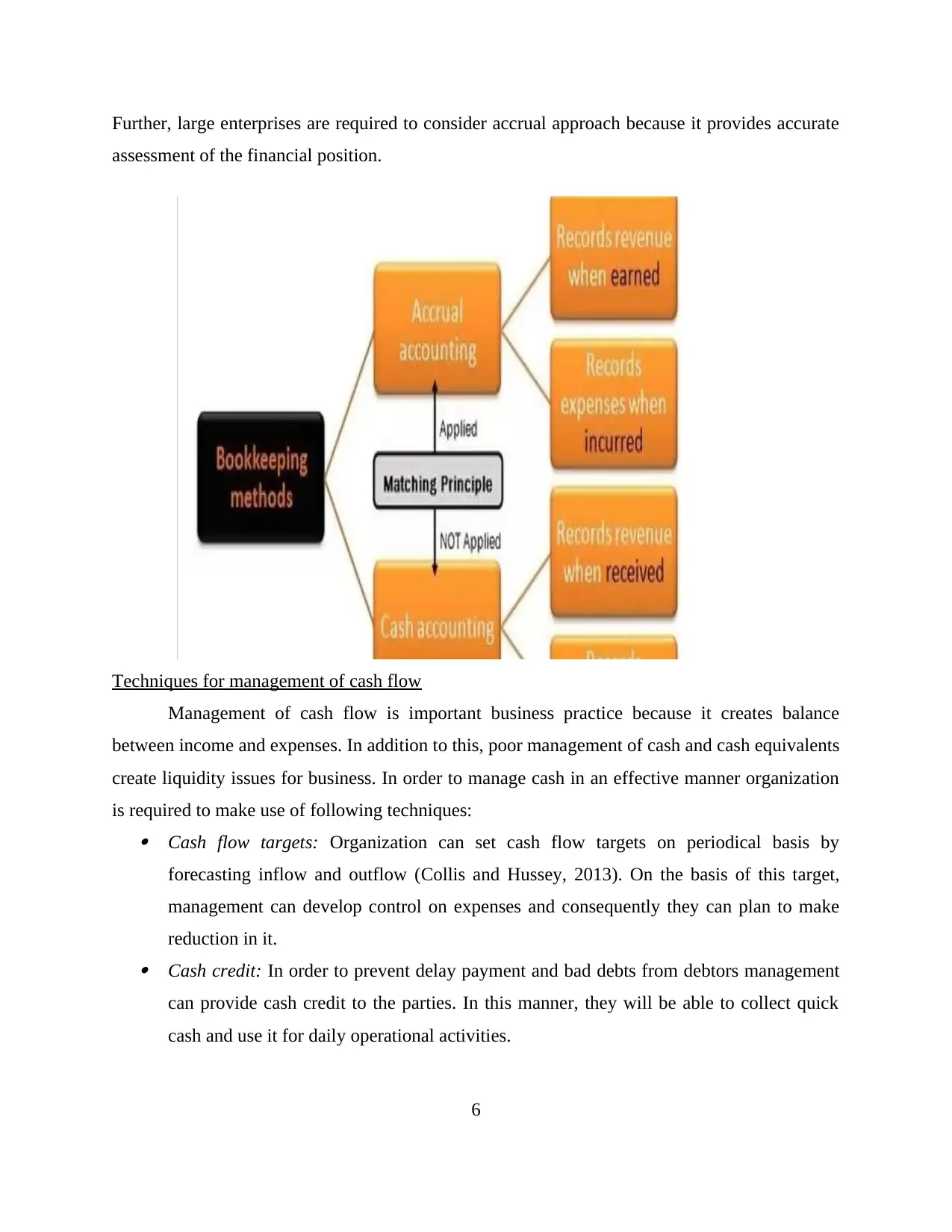
Further, large enterprises are required to consider accrual approach because it provides accurate
assessment of the financial position.
Techniques for management of cash flow
Management of cash flow is important business practice because it creates balance
between income and expenses. In addition to this, poor management of cash and cash equivalents
create liquidity issues for business. In order to manage cash in an effective manner organization
is required to make use of following techniques: Cash flow targets: Organization can set cash flow targets on periodical basis by
forecasting inflow and outflow (Collis and Hussey, 2013). On the basis of this target,
management can develop control on expenses and consequently they can plan to make
reduction in it. Cash credit: In order to prevent delay payment and bad debts from debtors management
can provide cash credit to the parties. In this manner, they will be able to collect quick
cash and use it for daily operational activities.
6
Illustr
assessment of the financial position.
Techniques for management of cash flow
Management of cash flow is important business practice because it creates balance
between income and expenses. In addition to this, poor management of cash and cash equivalents
create liquidity issues for business. In order to manage cash in an effective manner organization
is required to make use of following techniques: Cash flow targets: Organization can set cash flow targets on periodical basis by
forecasting inflow and outflow (Collis and Hussey, 2013). On the basis of this target,
management can develop control on expenses and consequently they can plan to make
reduction in it. Cash credit: In order to prevent delay payment and bad debts from debtors management
can provide cash credit to the parties. In this manner, they will be able to collect quick
cash and use it for daily operational activities.
6
Illustr
⊘ This is a preview!⊘
Do you want full access?
Subscribe today to unlock all pages.
Trusted by 1+ million students worldwide
Benefit of credit policy: Business entity can select suppliers with maximum credit period
policy in order to reduce period of operating cash cycle. With this approach, management
can use these funds for other activities without arranging loans from short term finance.
This will make reduction in interest cost (Davies and Crawford, 2011). However, in this
strategy, organization is required to consider the fact additional charge by creditor should
not be more than interest by financial institutions or any other opportunity cost.
TASK 2
Description of income statement and balance sheet of Poundland
Income statement
Income statement comprises figures of revenue and expenditure occurred in a particular
accounting period. On the basis of these financial values, net income or loss is computed earned
by business is shown in operating section. Income statement of Poundland Group plc shows that
net profit in 2014 is 13.8 million which is increased in 2015 by 14.54 million. This increase has
been occurred because increase in revenue is higher than increase in expenses. This profit is
attributable to the equity shareholders of the company.
Position statement
Position statement shows financial situation of an organization in a particular accounting
period. It comprises two sections i.e. liability and asset. Liability section shows sum of owner's
capital and outsider obligations. In accordance with the accounting equation, assets are
equivalent to the sum of outsider liability and capital fund. Position statement of Poundland
Group plc shows that equity in 2014 and 2015 is 186.48 million and 226.67 million respectively.
Further, as per accounting equation net assets of company in 2014 and 2015 is 186.48 million
and 226.67 million respectively.
Interpretation of financial statements of Poundland
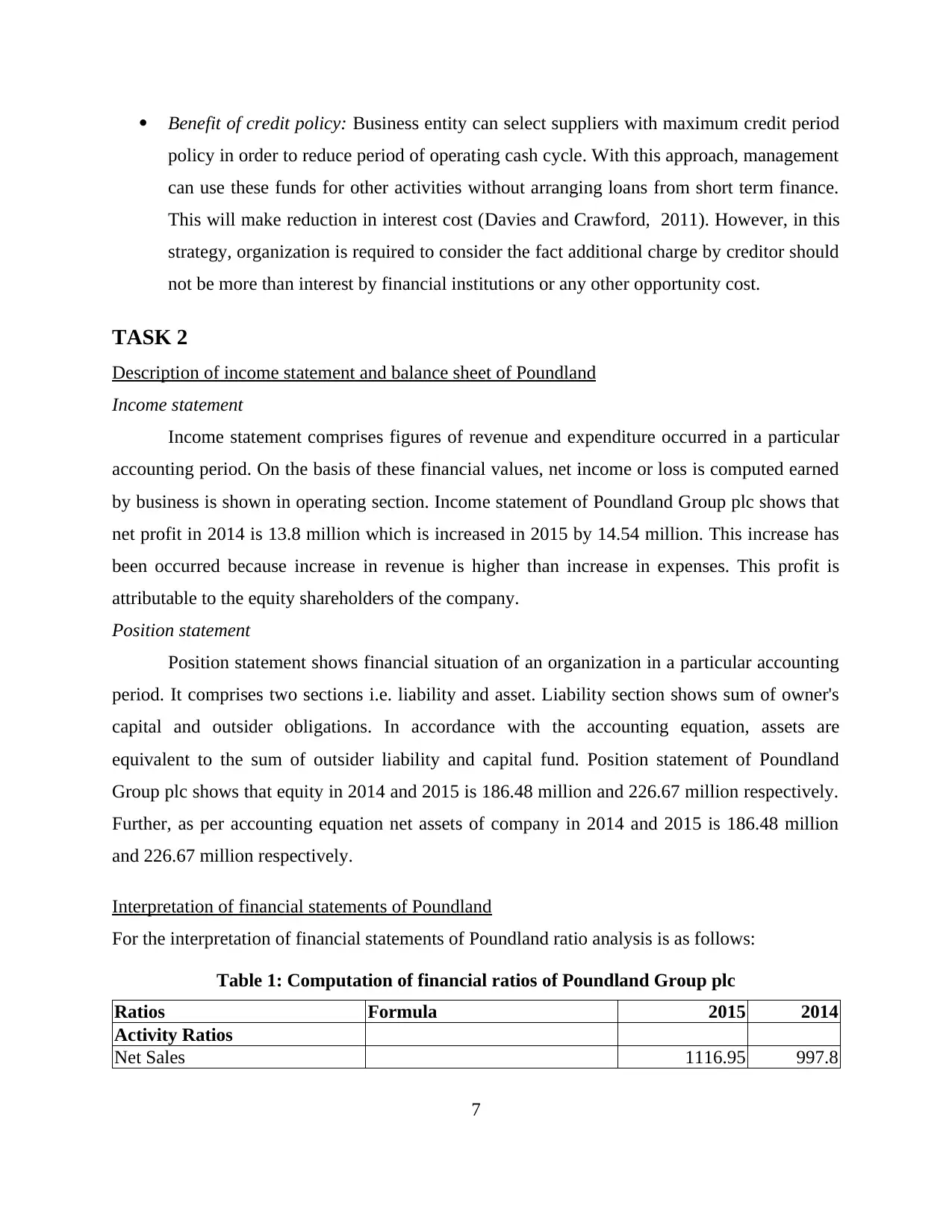
For the interpretation of financial statements of Poundland ratio analysis is as follows:
Table 1: Computation of financial ratios of Poundland Group plc
Ratios Formula 2015 2014
Activity Ratios
Net Sales 1116.95 997.8
7
policy in order to reduce period of operating cash cycle. With this approach, management
can use these funds for other activities without arranging loans from short term finance.
This will make reduction in interest cost (Davies and Crawford, 2011). However, in this
strategy, organization is required to consider the fact additional charge by creditor should
not be more than interest by financial institutions or any other opportunity cost.
TASK 2
Description of income statement and balance sheet of Poundland
Income statement
Income statement comprises figures of revenue and expenditure occurred in a particular
accounting period. On the basis of these financial values, net income or loss is computed earned
by business is shown in operating section. Income statement of Poundland Group plc shows that
net profit in 2014 is 13.8 million which is increased in 2015 by 14.54 million. This increase has
been occurred because increase in revenue is higher than increase in expenses. This profit is
attributable to the equity shareholders of the company.
Position statement
Position statement shows financial situation of an organization in a particular accounting
period. It comprises two sections i.e. liability and asset. Liability section shows sum of owner's
capital and outsider obligations. In accordance with the accounting equation, assets are
equivalent to the sum of outsider liability and capital fund. Position statement of Poundland
Group plc shows that equity in 2014 and 2015 is 186.48 million and 226.67 million respectively.
Further, as per accounting equation net assets of company in 2014 and 2015 is 186.48 million
and 226.67 million respectively.
Interpretation of financial statements of Poundland
For the interpretation of financial statements of Poundland ratio analysis is as follows:
Table 1: Computation of financial ratios of Poundland Group plc
Ratios Formula 2015 2014
Activity Ratios
Net Sales 1116.95 997.8
7
Paraphrase This Document
Need a fresh take? Get an instant paraphrase of this document with our AI Paraphraser
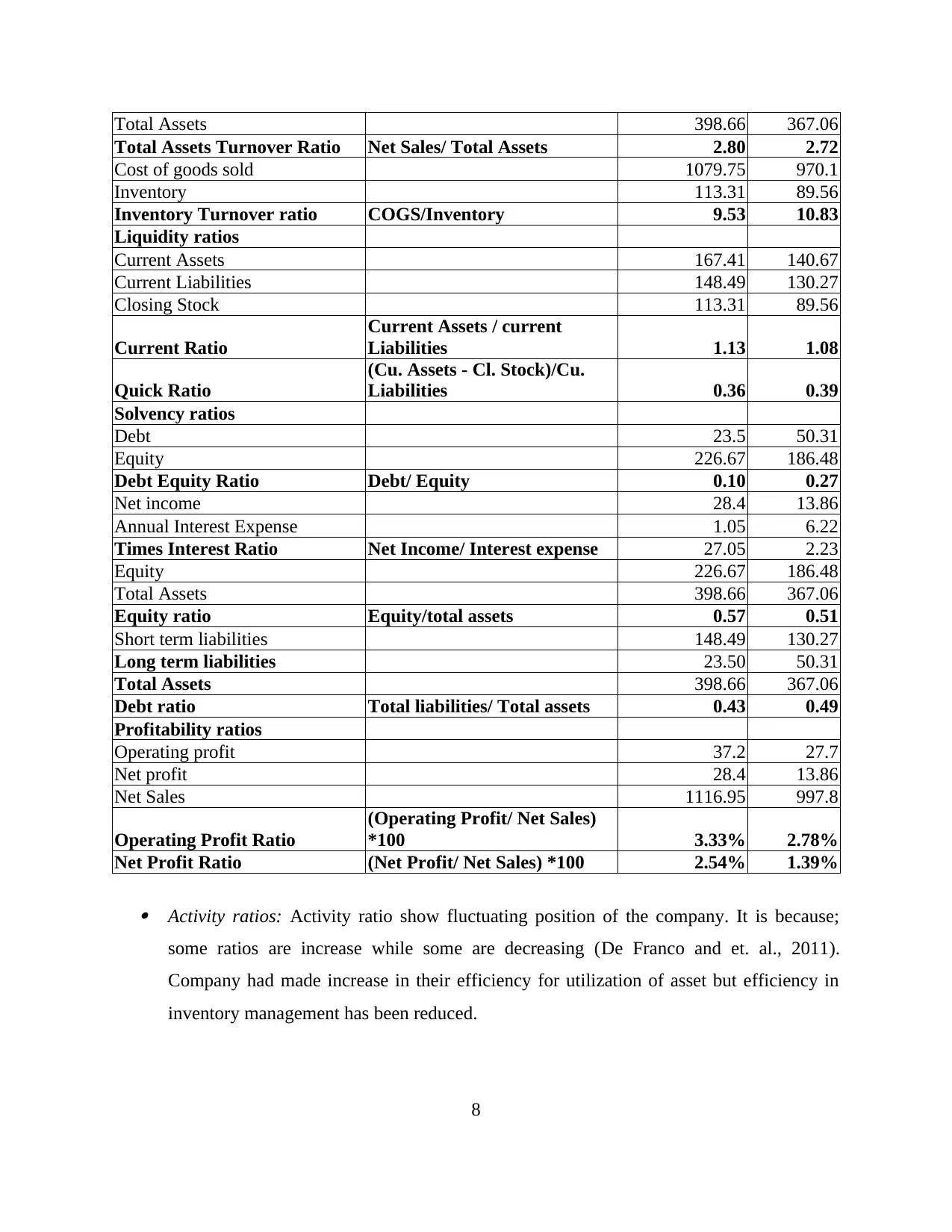
Total Assets 398.66 367.06
Total Assets Turnover Ratio Net Sales/ Total Assets 2.80 2.72
Cost of goods sold 1079.75 970.1
Inventory 113.31 89.56
Inventory Turnover ratio COGS/Inventory 9.53 10.83
Liquidity ratios
Current Assets 167.41 140.67
Current Liabilities 148.49 130.27
Closing Stock 113.31 89.56
Current Ratio
Current Assets / current
Liabilities 1.13 1.08
Quick Ratio
(Cu. Assets - Cl. Stock)/Cu.
Liabilities 0.36 0.39
Solvency ratios
Debt 23.5 50.31
Equity 226.67 186.48
Debt Equity Ratio Debt/ Equity 0.10 0.27
Net income 28.4 13.86
Annual Interest Expense 1.05 6.22
Times Interest Ratio Net Income/ Interest expense 27.05 2.23
Equity 226.67 186.48
Total Assets 398.66 367.06
Equity ratio Equity/total assets 0.57 0.51
Short term liabilities 148.49 130.27
Long term liabilities 23.50 50.31
Total Assets 398.66 367.06
Debt ratio Total liabilities/ Total assets 0.43 0.49
Profitability ratios
Operating profit 37.2 27.7
Net profit 28.4 13.86
Net Sales 1116.95 997.8
Operating Profit Ratio
(Operating Profit/ Net Sales)
*100 3.33% 2.78%
Net Profit Ratio (Net Profit/ Net Sales) *100 2.54% 1.39%
Activity ratios: Activity ratio show fluctuating position of the company. It is because;
some ratios are increase while some are decreasing (De Franco and et. al., 2011).
Company had made increase in their efficiency for utilization of asset but efficiency in
inventory management has been reduced.
8
Total Assets Turnover Ratio Net Sales/ Total Assets 2.80 2.72
Cost of goods sold 1079.75 970.1
Inventory 113.31 89.56
Inventory Turnover ratio COGS/Inventory 9.53 10.83
Liquidity ratios
Current Assets 167.41 140.67
Current Liabilities 148.49 130.27
Closing Stock 113.31 89.56
Current Ratio
Current Assets / current
Liabilities 1.13 1.08
Quick Ratio
(Cu. Assets - Cl. Stock)/Cu.
Liabilities 0.36 0.39
Solvency ratios
Debt 23.5 50.31
Equity 226.67 186.48
Debt Equity Ratio Debt/ Equity 0.10 0.27
Net income 28.4 13.86
Annual Interest Expense 1.05 6.22
Times Interest Ratio Net Income/ Interest expense 27.05 2.23
Equity 226.67 186.48
Total Assets 398.66 367.06
Equity ratio Equity/total assets 0.57 0.51
Short term liabilities 148.49 130.27
Long term liabilities 23.50 50.31
Total Assets 398.66 367.06
Debt ratio Total liabilities/ Total assets 0.43 0.49
Profitability ratios
Operating profit 37.2 27.7
Net profit 28.4 13.86
Net Sales 1116.95 997.8
Operating Profit Ratio
(Operating Profit/ Net Sales)
*100 3.33% 2.78%
Net Profit Ratio (Net Profit/ Net Sales) *100 2.54% 1.39%
Activity ratios: Activity ratio show fluctuating position of the company. It is because;
some ratios are increase while some are decreasing (De Franco and et. al., 2011).
Company had made increase in their efficiency for utilization of asset but efficiency in
inventory management has been reduced.
8
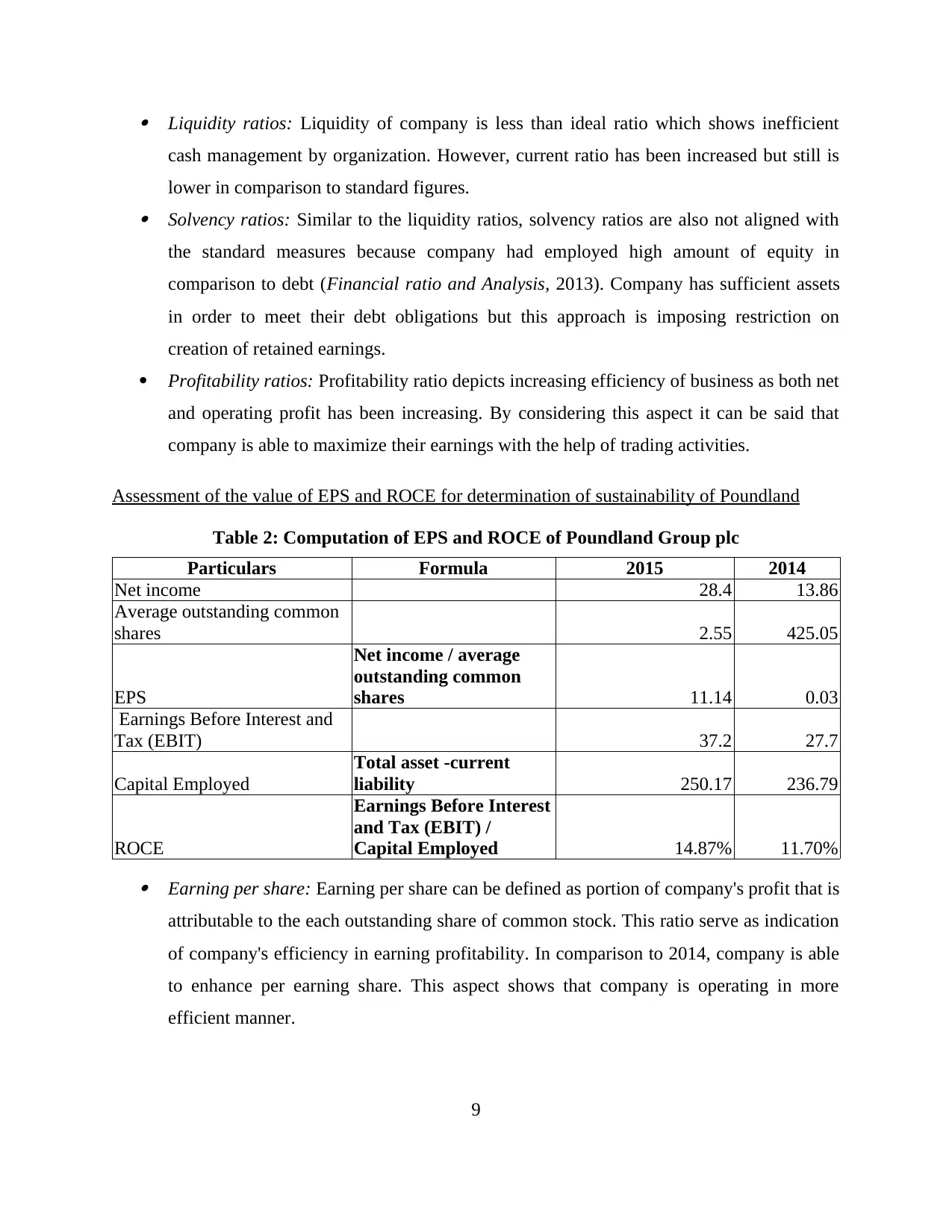
Liquidity ratios: Liquidity of company is less than ideal ratio which shows inefficient
cash management by organization. However, current ratio has been increased but still is
lower in comparison to standard figures. Solvency ratios: Similar to the liquidity ratios, solvency ratios are also not aligned with
the standard measures because company had employed high amount of equity in
comparison to debt (Financial ratio and Analysis, 2013). Company has sufficient assets
in order to meet their debt obligations but this approach is imposing restriction on
creation of retained earnings.
Profitability ratios: Profitability ratio depicts increasing efficiency of business as both net
and operating profit has been increasing. By considering this aspect it can be said that
company is able to maximize their earnings with the help of trading activities.
Assessment of the value of EPS and ROCE for determination of sustainability of Poundland
Table 2: Computation of EPS and ROCE of Poundland Group plc
Particulars Formula 2015 2014
Net income 28.4 13.86
Average outstanding common
shares 2.55 425.05
EPS
Net income / average
outstanding common
shares 11.14 0.03
Earnings Before Interest and
Tax (EBIT) 37.2 27.7
Capital Employed
Total asset -current
liability 250.17 236.79
ROCE
Earnings Before Interest
and Tax (EBIT) /
Capital Employed 14.87% 11.70% Earning per share: Earning per share can be defined as portion of company's profit that is
attributable to the each outstanding share of common stock. This ratio serve as indication
of company's efficiency in earning profitability. In comparison to 2014, company is able
to enhance per earning share. This aspect shows that company is operating in more
efficient manner.
9
cash management by organization. However, current ratio has been increased but still is
lower in comparison to standard figures. Solvency ratios: Similar to the liquidity ratios, solvency ratios are also not aligned with
the standard measures because company had employed high amount of equity in
comparison to debt (Financial ratio and Analysis, 2013). Company has sufficient assets
in order to meet their debt obligations but this approach is imposing restriction on
creation of retained earnings.
Profitability ratios: Profitability ratio depicts increasing efficiency of business as both net
and operating profit has been increasing. By considering this aspect it can be said that
company is able to maximize their earnings with the help of trading activities.
Assessment of the value of EPS and ROCE for determination of sustainability of Poundland
Table 2: Computation of EPS and ROCE of Poundland Group plc
Particulars Formula 2015 2014
Net income 28.4 13.86
Average outstanding common
shares 2.55 425.05
EPS
Net income / average
outstanding common
shares 11.14 0.03
Earnings Before Interest and
Tax (EBIT) 37.2 27.7
Capital Employed
Total asset -current
liability 250.17 236.79
ROCE
Earnings Before Interest
and Tax (EBIT) /
Capital Employed 14.87% 11.70% Earning per share: Earning per share can be defined as portion of company's profit that is
attributable to the each outstanding share of common stock. This ratio serve as indication
of company's efficiency in earning profitability. In comparison to 2014, company is able
to enhance per earning share. This aspect shows that company is operating in more
efficient manner.
9
⊘ This is a preview!⊘
Do you want full access?
Subscribe today to unlock all pages.
Trusted by 1+ million students worldwide
Return on capital employed: ROCE can be termed as financial ratio used for the
measurement of company's profitability and efficiency in comparison to the employed
capital (Gray and et. al., 2013). Increasing trend of ROCE shows efficient use of capital.
Further, ROCE of company is also showing increasing trend by which it can be said that
organization is making efficient use of available resources.
Examples of capital and revenue expenditure that could be occurred by Poundland
Capital expenditure is the expense which provides economic benefit for more than one
year. These expenses are non-recurring in nature and it provides value addition to the business.
Poundland Group Plc can incurred capital expenditure for purchase of asset or investment. With
this expenditure, management of company will be able to enhance efficiency and productivity.
Further, they can also expand their business in order to avail better growth opportunities (Gibson,
2010). On the other hand, revenue expenditure can be defined as amount incurred to attain
economic benefit for current accounting period. Example of revenue expenditure by considering
nature of Poundland Group Plc is repair and maintenance expenses.
Financial sources for long-term financing and working capital financing
In order to generate funds for long term financing management of Poundland Group Plc can
make use of following financial sources: Equity capital: Poundland Group plc can issue their ordinary share to the public in order
to generate capital funds. For this financial source they will be required to pay dividend
i.e. a portion of profit (Sources of finance, 2013). Further, there will be no obligation of
repayment of principal amount during the business life.
Debt capital: Management of company can also generate funds from financial
institutions. For this financial source they will be required to pay interest cost to the
lenders. This source will also increase long term obligation of business.
In accordance with the capital structure of the company management is required to
generate funds from debt capital in order to optimize their financial cost. With this source,
company have fixed obligation along with the benefit of tax shield (Acquiring and managing
financial resources, N.d.). Thus, by this source additional earning will be transferred for creation
of retained earnings.
10
measurement of company's profitability and efficiency in comparison to the employed
capital (Gray and et. al., 2013). Increasing trend of ROCE shows efficient use of capital.
Further, ROCE of company is also showing increasing trend by which it can be said that
organization is making efficient use of available resources.
Examples of capital and revenue expenditure that could be occurred by Poundland
Capital expenditure is the expense which provides economic benefit for more than one
year. These expenses are non-recurring in nature and it provides value addition to the business.
Poundland Group Plc can incurred capital expenditure for purchase of asset or investment. With
this expenditure, management of company will be able to enhance efficiency and productivity.
Further, they can also expand their business in order to avail better growth opportunities (Gibson,
2010). On the other hand, revenue expenditure can be defined as amount incurred to attain
economic benefit for current accounting period. Example of revenue expenditure by considering
nature of Poundland Group Plc is repair and maintenance expenses.
Financial sources for long-term financing and working capital financing
In order to generate funds for long term financing management of Poundland Group Plc can
make use of following financial sources: Equity capital: Poundland Group plc can issue their ordinary share to the public in order
to generate capital funds. For this financial source they will be required to pay dividend
i.e. a portion of profit (Sources of finance, 2013). Further, there will be no obligation of
repayment of principal amount during the business life.
Debt capital: Management of company can also generate funds from financial
institutions. For this financial source they will be required to pay interest cost to the
lenders. This source will also increase long term obligation of business.
In accordance with the capital structure of the company management is required to
generate funds from debt capital in order to optimize their financial cost. With this source,
company have fixed obligation along with the benefit of tax shield (Acquiring and managing
financial resources, N.d.). Thus, by this source additional earning will be transferred for creation
of retained earnings.
10
Paraphrase This Document
Need a fresh take? Get an instant paraphrase of this document with our AI Paraphraser
For working capital financing following financial source will be suitable for the organization: Bank overdraft: Organization can take benefit of bank overdraft services on their current
account. With this facility, they will be entitled to withdraw excessive amount in
comparison to their balance. For this source, they will be required to pay bank charges.
Credit policies and cash credit: In order to make delay payment of creditor they can
select supplier who provide benefit of credit policy. Further, for quick collection of cash
management can introduce policy of cash credit or take services of factoring.
Pros and Cons of off-balance sheet financing
It is a form of financing in which large capital expenditure are not reflected in the
position statements by making use of various classification method. General examples of off
balance sheet items are factoring, leasing, special projects, outsourcing and securitization. Major
benefit of this approach is that it assists in making reduction in debt equity ratio and leverage
ratio. This approach is also beneficial for mitigating the risk and reducing cost of borrowings as
lenders are not aware of the unrecorded liabilities. This approach also assists in avoiding
violation of some debt covenants as restrictions are applicable in the debt agreement for the
protection of lenders. Generally, these restrictions are imposed by adding condition of
maintaining particular ratio. In off-balance sheet, financing organization do not record obligation
due to which they can borrow funds without violating conditions that are stipulated by other
lenders. However, this approach enhances the risk for company because off balance sheet items
can become potential liability for business. Further, it also reduces the accuracy of financial
position of company as it has severe impact on the financial ratios of business. Mainly, it affects
the financing ratio because denominator i.e. debt is reduced and shows favourable position of
business which is not correct.
CONCLUSION
In accordance with the present study, conclusion can be drawn that financial decisions are
important for the success of business. Management of business entities are required to consider
proper analysis prior to making decision for the entity. With this approach, they will be able to
reduce risk in operational activities and can attain growth opportunities for the success. Financial
11
account. With this facility, they will be entitled to withdraw excessive amount in
comparison to their balance. For this source, they will be required to pay bank charges.
Credit policies and cash credit: In order to make delay payment of creditor they can
select supplier who provide benefit of credit policy. Further, for quick collection of cash
management can introduce policy of cash credit or take services of factoring.
Pros and Cons of off-balance sheet financing
It is a form of financing in which large capital expenditure are not reflected in the
position statements by making use of various classification method. General examples of off
balance sheet items are factoring, leasing, special projects, outsourcing and securitization. Major
benefit of this approach is that it assists in making reduction in debt equity ratio and leverage
ratio. This approach is also beneficial for mitigating the risk and reducing cost of borrowings as
lenders are not aware of the unrecorded liabilities. This approach also assists in avoiding
violation of some debt covenants as restrictions are applicable in the debt agreement for the
protection of lenders. Generally, these restrictions are imposed by adding condition of
maintaining particular ratio. In off-balance sheet, financing organization do not record obligation
due to which they can borrow funds without violating conditions that are stipulated by other
lenders. However, this approach enhances the risk for company because off balance sheet items
can become potential liability for business. Further, it also reduces the accuracy of financial
position of company as it has severe impact on the financial ratios of business. Mainly, it affects
the financing ratio because denominator i.e. debt is reduced and shows favourable position of
business which is not correct.
CONCLUSION
In accordance with the present study, conclusion can be drawn that financial decisions are
important for the success of business. Management of business entities are required to consider
proper analysis prior to making decision for the entity. With this approach, they will be able to
reduce risk in operational activities and can attain growth opportunities for the success. Financial
11

position of Poundland Group plc depicts that financial position of company has been improved
as they are able to enhance their profitability from trading activities. However, company is
required to make modifications in their capital structure for optimization of financial cost.
12
as they are able to enhance their profitability from trading activities. However, company is
required to make modifications in their capital structure for optimization of financial cost.
12
⊘ This is a preview!⊘
Do you want full access?
Subscribe today to unlock all pages.
Trusted by 1+ million students worldwide

1 out of 14


Related Documents


Your All-in-One AI-Powered Toolkit for Academic Success.
+13062052269
info@desklib.com
Available 24*7 on WhatsApp / Email
![[object Object]](/_next/static/media/star-bottom.7253800d.svg)
Unlock your academic potential
Copyright © 2020–2025 A2Z Services. All Rights Reserved. Developed and managed by ZUCOL.