Advanced Finance for Decision Making: Comprehensive Analysis Report
VerifiedAdded on 2021/01/03
|23
|7605
|19
Report
AI Summary
This report provides a comprehensive analysis of advanced finance for decision-making, covering crucial aspects such as financial priorities, business risks, and cash flow management. It examines the factors that guide business decisions, including return on investment, brand image, and opportunity cost. The report delves into the significance of financial factors in decision-making, including personnel costs, growth strategies, and cost-cutting measures. It identifies the characteristics of business risks, such as market fluctuations and competition, and their impact on financial decisions. Furthermore, it explores the differences between cash and accrual accounting methods, the structure and content of final accounts, and their uses in business decision-making. The report also addresses techniques for managing cash flow, the financial implications of various business ownership structures, and the role of corporate governance and business ethics in financial decision-making. It includes an analysis of financial statements, ratio analysis, and the importance of earnings per share (EPS) in measuring business performance, offering valuable insights for professionals in the field.

ADVANCE
FINANCE FOR
DECISION MAKING
FINANCE FOR
DECISION MAKING

Paraphrase This Document
Need a fresh take? Get an instant paraphrase of this document with our AI Paraphraser
TABLE OF CONTENTS
INTRODUCTION...........................................................................................................................5
1.4 Summarize the financial priorities that need to be considered when making financial
decisions......................................................................................................................................7
SECTION 2......................................................................................................................................8
2.1- The method of cash focuses on the instant identification on the expenses and revenues
while accrual basis focuses on forecasting of incomes and expenses.........................................8
2.2- explain the structure and content of final accounts and their uses for business decision
making.........................................................................................................................................9
3- Statements of cash flow........................................................................................................10
2.3 interpret the financial information in the financial statements you have obtained and
illustrate differences between the sets of accounts...................................................................10
2.4..............................................................................................................................................11
2.5 Financial analysis of Morrison and also suggesting the u8efulness of ratios analysis in
decision making........................................................................................................................13
SECTION 3....................................................................................................................................14
5.1 Difference between business ethics, corporate governance and accounting ethics as
controls on business accountability...........................................................................................14
5.2 Assessing the role of the finance director/chief financial officer as a guardian of business
ethics.........................................................................................................................................14
5.3 Analysing the key concepts and principles of corporate governance that may impact on
business decisions.....................................................................................................................15
5.4 Examining key national and international financial reporting standards that are relevant to
business decisions.....................................................................................................................16
Requirement...................................................................................................................................17
3.4 Critically examine techniques needed to manage cash flow and the impact of cash flow on
key business decisions..............................................................................................................19
SECTION 5....................................................................................................................................21
4.1 Financial implication made by various business ownership structure................................21
4.2 Analysing the corporate governance, legal and regulatory environment............................21
INTRODUCTION...........................................................................................................................5
1.4 Summarize the financial priorities that need to be considered when making financial
decisions......................................................................................................................................7
SECTION 2......................................................................................................................................8
2.1- The method of cash focuses on the instant identification on the expenses and revenues
while accrual basis focuses on forecasting of incomes and expenses.........................................8
2.2- explain the structure and content of final accounts and their uses for business decision
making.........................................................................................................................................9
3- Statements of cash flow........................................................................................................10
2.3 interpret the financial information in the financial statements you have obtained and
illustrate differences between the sets of accounts...................................................................10
2.4..............................................................................................................................................11
2.5 Financial analysis of Morrison and also suggesting the u8efulness of ratios analysis in
decision making........................................................................................................................13
SECTION 3....................................................................................................................................14
5.1 Difference between business ethics, corporate governance and accounting ethics as
controls on business accountability...........................................................................................14
5.2 Assessing the role of the finance director/chief financial officer as a guardian of business
ethics.........................................................................................................................................14
5.3 Analysing the key concepts and principles of corporate governance that may impact on
business decisions.....................................................................................................................15
5.4 Examining key national and international financial reporting standards that are relevant to
business decisions.....................................................................................................................16
Requirement...................................................................................................................................17
3.4 Critically examine techniques needed to manage cash flow and the impact of cash flow on
key business decisions..............................................................................................................19
SECTION 5....................................................................................................................................21
4.1 Financial implication made by various business ownership structure................................21
4.2 Analysing the corporate governance, legal and regulatory environment............................21
4.3 Interest of stakeholders and managers in decision making.................................................22
4.4 Evaluating the significant return on capital employed as well as managing long term
solvency....................................................................................................................................22
4.5 Importance of EPS in measuring business performance.....................................................22
CONCLUSION..............................................................................................................................22
REFERENCES..............................................................................................................................23
4.4 Evaluating the significant return on capital employed as well as managing long term
solvency....................................................................................................................................22
4.5 Importance of EPS in measuring business performance.....................................................22
CONCLUSION..............................................................................................................................22
REFERENCES..............................................................................................................................23
⊘ This is a preview!⊘
Do you want full access?
Subscribe today to unlock all pages.

Trusted by 1+ million students worldwide
INTRODUCTION
Implicating the advance finance for decision making will be helpful and adequate as per
analysing and making the appropriate decisions which will be relevant with the operations of the
business. In the present report there will be discussion based on various operational techniques,
budgeting methods etc. which will be helpful in meeting the level of revenue and structural
capital. Analysing the various outcomes which are comprised of making qualitative changes in
various operations which will be helpful and adequate as per meeting the goals and stabilising
the firm in ascertaining the financial requirement. The suggestion will be provided to the
professionals working in various organization as per controlling the costs as well as managing
the operations of firm.
SECTION1
1.1 Examine and Explain the factor that guide and drive business decision-making.
Decision making is one of the most important function in an organization. Every operation in a
company needs a decision on the working of the company. Decision-making is the crucial task
for the management, there are many factors which effect and influence the decision making in
the present and future. Some of these factors are:◦ Return On Investment: it is one of the main factor that influence the decision making
process in any organization. Considering the factor of profitability of the company at the
time of decision making is very important. Return on investment is the difference
between in the money which a company invest in different activities in the business like
marketing, operations , inventory etc. and the actual return a business is getting (Nash,
2018). By estimating the return on investment it is very east to decide for the business
weather the potential returns justifies the expenses and risks involved in creating
implementing different activity plan business.◦ Image and Brand Management: Decisions on where to advertise and sell and at what
price the product is to be sold, the social activities a company engaged in have a huge
impact o the brand image of the company. Brand image of the company focuses on public
perception and intangible gains for the company. At the time of making decisions ,
concerning about public perception can influence decisions about product, sponsorship
and public relation campaigns. Brand awareness can influence the sessions regarding
pricing, marketing and displaying products and services.
Implicating the advance finance for decision making will be helpful and adequate as per
analysing and making the appropriate decisions which will be relevant with the operations of the
business. In the present report there will be discussion based on various operational techniques,
budgeting methods etc. which will be helpful in meeting the level of revenue and structural
capital. Analysing the various outcomes which are comprised of making qualitative changes in
various operations which will be helpful and adequate as per meeting the goals and stabilising
the firm in ascertaining the financial requirement. The suggestion will be provided to the
professionals working in various organization as per controlling the costs as well as managing
the operations of firm.
SECTION1
1.1 Examine and Explain the factor that guide and drive business decision-making.
Decision making is one of the most important function in an organization. Every operation in a
company needs a decision on the working of the company. Decision-making is the crucial task
for the management, there are many factors which effect and influence the decision making in
the present and future. Some of these factors are:◦ Return On Investment: it is one of the main factor that influence the decision making
process in any organization. Considering the factor of profitability of the company at the
time of decision making is very important. Return on investment is the difference
between in the money which a company invest in different activities in the business like
marketing, operations , inventory etc. and the actual return a business is getting (Nash,
2018). By estimating the return on investment it is very east to decide for the business
weather the potential returns justifies the expenses and risks involved in creating
implementing different activity plan business.◦ Image and Brand Management: Decisions on where to advertise and sell and at what
price the product is to be sold, the social activities a company engaged in have a huge
impact o the brand image of the company. Brand image of the company focuses on public
perception and intangible gains for the company. At the time of making decisions ,
concerning about public perception can influence decisions about product, sponsorship
and public relation campaigns. Brand awareness can influence the sessions regarding
pricing, marketing and displaying products and services.
Paraphrase This Document
Need a fresh take? Get an instant paraphrase of this document with our AI Paraphraser
◦ Opportunity cost: decision on making involves the best use of available resources which
involves the decision of choosing best alternatives between two or more options. An
opportunity cost trade off is an influencing factor in these type of decisions (Libby,
2017). what a business gets by choosing one alternative over another and what a business
has to give up is the trade off decision of a company.
1.2 Assess the significance of financial factors in business decision-making.
In decision-making process of any organization, finance is very important factor. It Is
the basic requirement for any activity in the business. Based on the revenue and outflow of
the business many decisions is taken. The significance of financial factor in business
decision-making are: Personnel: Labor is one of the most important costs for a business which it securely
sustains. Each employee in the company represents a significant dedicated cost, which it
expects a return on investment while hiring the employees. The cost of an employee is
considered as an investment in growth and revenue of the business, hiring more
employees is considered as business expansion and growth of companies capabilities.
When finance of the company allows, companies may take the personnel related risk to
achieve growth. Growth: any company wants to grow to increase revenues, margins and profits. The
financial position of the company is to be calculated in order to grow the size of
business, market, to ascertain risk management and ownership (Klychova and et.al.,
2015). Available capital includes cash in hand, available credits and investment capital is
the main resources for the growth of the company. Cost cutting: the company has to make decisions to cut the cost in order to preserve the
profit margins if the finance resources is not up-to the mark. If the revenue of the
company is decreasing, it may lead the company to become tighter on its various
activities like purchasing, training and equipment, travel expenses etc.
1.3 Identify the characteristics of business risks that impact on financial and business decisions.
Any difficulties in business and financial and operational activity in business can leads to
the possibilities of the business risk and uncertainties. Each risk carries different implications for
business owner to overcome. Financial and economic condition can also effect the financial and
involves the decision of choosing best alternatives between two or more options. An
opportunity cost trade off is an influencing factor in these type of decisions (Libby,
2017). what a business gets by choosing one alternative over another and what a business
has to give up is the trade off decision of a company.
1.2 Assess the significance of financial factors in business decision-making.
In decision-making process of any organization, finance is very important factor. It Is
the basic requirement for any activity in the business. Based on the revenue and outflow of
the business many decisions is taken. The significance of financial factor in business
decision-making are: Personnel: Labor is one of the most important costs for a business which it securely
sustains. Each employee in the company represents a significant dedicated cost, which it
expects a return on investment while hiring the employees. The cost of an employee is
considered as an investment in growth and revenue of the business, hiring more
employees is considered as business expansion and growth of companies capabilities.
When finance of the company allows, companies may take the personnel related risk to
achieve growth. Growth: any company wants to grow to increase revenues, margins and profits. The
financial position of the company is to be calculated in order to grow the size of
business, market, to ascertain risk management and ownership (Klychova and et.al.,
2015). Available capital includes cash in hand, available credits and investment capital is
the main resources for the growth of the company. Cost cutting: the company has to make decisions to cut the cost in order to preserve the
profit margins if the finance resources is not up-to the mark. If the revenue of the
company is decreasing, it may lead the company to become tighter on its various
activities like purchasing, training and equipment, travel expenses etc.
1.3 Identify the characteristics of business risks that impact on financial and business decisions.
Any difficulties in business and financial and operational activity in business can leads to
the possibilities of the business risk and uncertainties. Each risk carries different implications for
business owner to overcome. Financial and economic condition can also effect the financial and
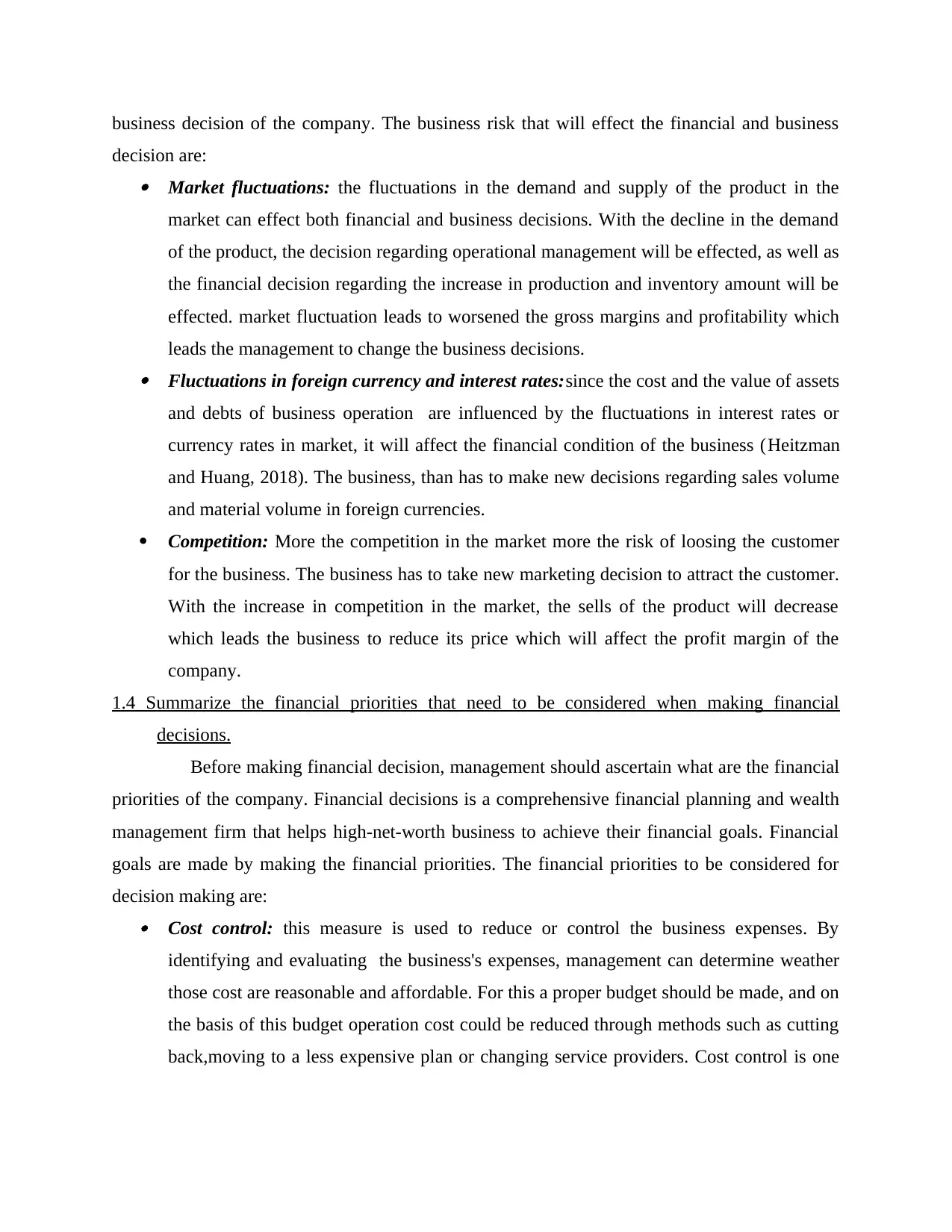
business decision of the company. The business risk that will effect the financial and business
decision are: Market fluctuations: the fluctuations in the demand and supply of the product in the
market can effect both financial and business decisions. With the decline in the demand
of the product, the decision regarding operational management will be effected, as well as
the financial decision regarding the increase in production and inventory amount will be
effected. market fluctuation leads to worsened the gross margins and profitability which
leads the management to change the business decisions. Fluctuations in foreign currency and interest rates:since the cost and the value of assets
and debts of business operation are influenced by the fluctuations in interest rates or
currency rates in market, it will affect the financial condition of the business (Heitzman
and Huang, 2018). The business, than has to make new decisions regarding sales volume
and material volume in foreign currencies.
Competition: More the competition in the market more the risk of loosing the customer
for the business. The business has to take new marketing decision to attract the customer.
With the increase in competition in the market, the sells of the product will decrease
which leads the business to reduce its price which will affect the profit margin of the
company.
1.4 Summarize the financial priorities that need to be considered when making financial
decisions.
Before making financial decision, management should ascertain what are the financial
priorities of the company. Financial decisions is a comprehensive financial planning and wealth
management firm that helps high-net-worth business to achieve their financial goals. Financial
goals are made by making the financial priorities. The financial priorities to be considered for
decision making are: Cost control: this measure is used to reduce or control the business expenses. By
identifying and evaluating the business's expenses, management can determine weather
those cost are reasonable and affordable. For this a proper budget should be made, and on
the basis of this budget operation cost could be reduced through methods such as cutting
back,moving to a less expensive plan or changing service providers. Cost control is one
decision are: Market fluctuations: the fluctuations in the demand and supply of the product in the
market can effect both financial and business decisions. With the decline in the demand
of the product, the decision regarding operational management will be effected, as well as
the financial decision regarding the increase in production and inventory amount will be
effected. market fluctuation leads to worsened the gross margins and profitability which
leads the management to change the business decisions. Fluctuations in foreign currency and interest rates:since the cost and the value of assets
and debts of business operation are influenced by the fluctuations in interest rates or
currency rates in market, it will affect the financial condition of the business (Heitzman
and Huang, 2018). The business, than has to make new decisions regarding sales volume
and material volume in foreign currencies.
Competition: More the competition in the market more the risk of loosing the customer
for the business. The business has to take new marketing decision to attract the customer.
With the increase in competition in the market, the sells of the product will decrease
which leads the business to reduce its price which will affect the profit margin of the
company.
1.4 Summarize the financial priorities that need to be considered when making financial
decisions.
Before making financial decision, management should ascertain what are the financial
priorities of the company. Financial decisions is a comprehensive financial planning and wealth
management firm that helps high-net-worth business to achieve their financial goals. Financial
goals are made by making the financial priorities. The financial priorities to be considered for
decision making are: Cost control: this measure is used to reduce or control the business expenses. By
identifying and evaluating the business's expenses, management can determine weather
those cost are reasonable and affordable. For this a proper budget should be made, and on
the basis of this budget operation cost could be reduced through methods such as cutting
back,moving to a less expensive plan or changing service providers. Cost control is one
⊘ This is a preview!⊘
Do you want full access?
Subscribe today to unlock all pages.
Trusted by 1+ million students worldwide
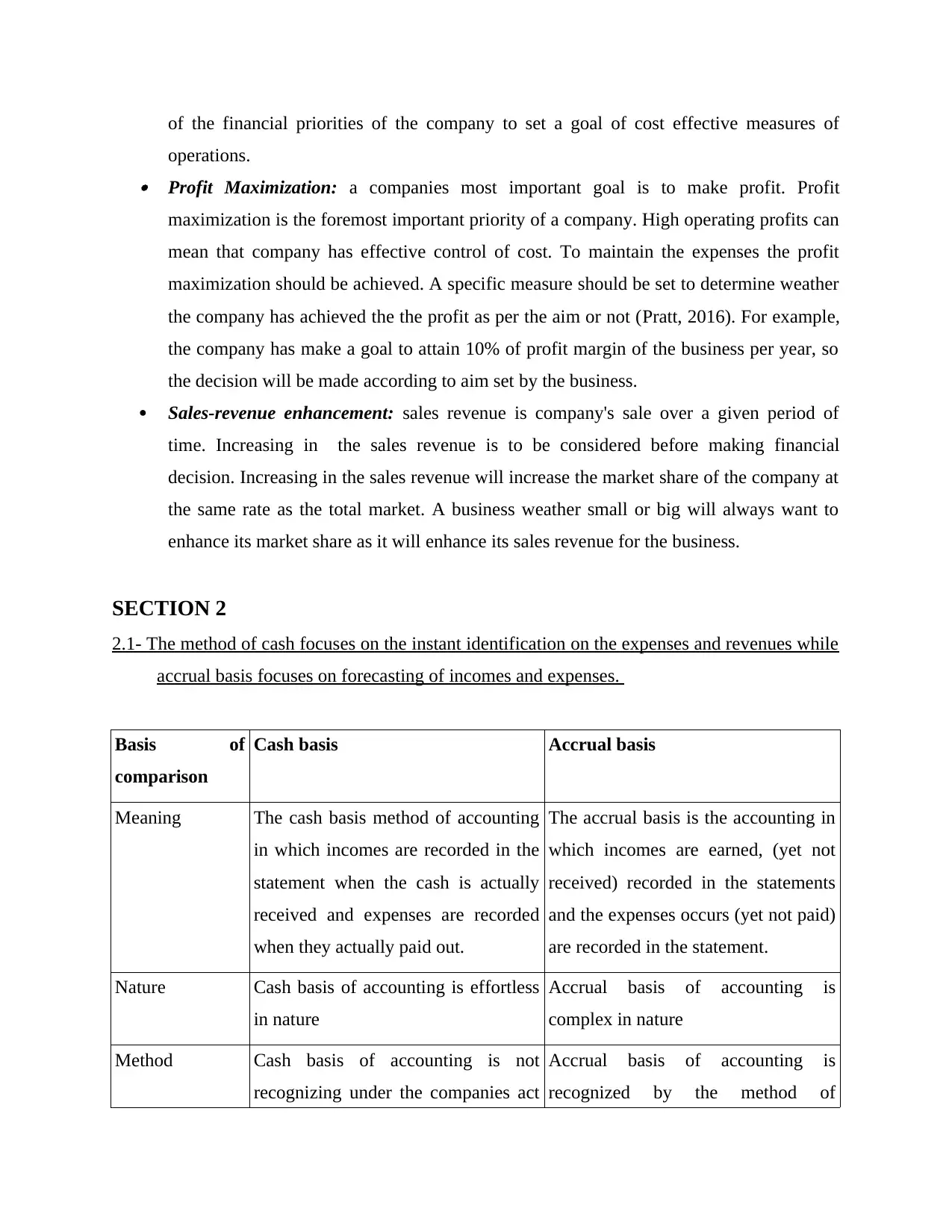
of the financial priorities of the company to set a goal of cost effective measures of
operations. Profit Maximization: a companies most important goal is to make profit. Profit
maximization is the foremost important priority of a company. High operating profits can
mean that company has effective control of cost. To maintain the expenses the profit
maximization should be achieved. A specific measure should be set to determine weather
the company has achieved the the profit as per the aim or not (Pratt, 2016). For example,
the company has make a goal to attain 10% of profit margin of the business per year, so
the decision will be made according to aim set by the business.
Sales-revenue enhancement: sales revenue is company's sale over a given period of
time. Increasing in the sales revenue is to be considered before making financial
decision. Increasing in the sales revenue will increase the market share of the company at
the same rate as the total market. A business weather small or big will always want to
enhance its market share as it will enhance its sales revenue for the business.
SECTION 2
2.1- The method of cash focuses on the instant identification on the expenses and revenues while
accrual basis focuses on forecasting of incomes and expenses.
Basis of
comparison
Cash basis Accrual basis
Meaning The cash basis method of accounting
in which incomes are recorded in the
statement when the cash is actually
received and expenses are recorded
when they actually paid out.
The accrual basis is the accounting in
which incomes are earned, (yet not
received) recorded in the statements
and the expenses occurs (yet not paid)
are recorded in the statement.
Nature Cash basis of accounting is effortless
in nature
Accrual basis of accounting is
complex in nature
Method Cash basis of accounting is not
recognizing under the companies act
Accrual basis of accounting is
recognized by the method of
operations. Profit Maximization: a companies most important goal is to make profit. Profit
maximization is the foremost important priority of a company. High operating profits can
mean that company has effective control of cost. To maintain the expenses the profit
maximization should be achieved. A specific measure should be set to determine weather
the company has achieved the the profit as per the aim or not (Pratt, 2016). For example,
the company has make a goal to attain 10% of profit margin of the business per year, so
the decision will be made according to aim set by the business.
Sales-revenue enhancement: sales revenue is company's sale over a given period of
time. Increasing in the sales revenue is to be considered before making financial
decision. Increasing in the sales revenue will increase the market share of the company at
the same rate as the total market. A business weather small or big will always want to
enhance its market share as it will enhance its sales revenue for the business.
SECTION 2
2.1- The method of cash focuses on the instant identification on the expenses and revenues while
accrual basis focuses on forecasting of incomes and expenses.
Basis of
comparison
Cash basis Accrual basis
Meaning The cash basis method of accounting
in which incomes are recorded in the
statement when the cash is actually
received and expenses are recorded
when they actually paid out.
The accrual basis is the accounting in
which incomes are earned, (yet not
received) recorded in the statements
and the expenses occurs (yet not paid)
are recorded in the statement.
Nature Cash basis of accounting is effortless
in nature
Accrual basis of accounting is
complex in nature
Method Cash basis of accounting is not
recognizing under the companies act
Accrual basis of accounting is
recognized by the method of
Paraphrase This Document
Need a fresh take? Get an instant paraphrase of this document with our AI Paraphraser
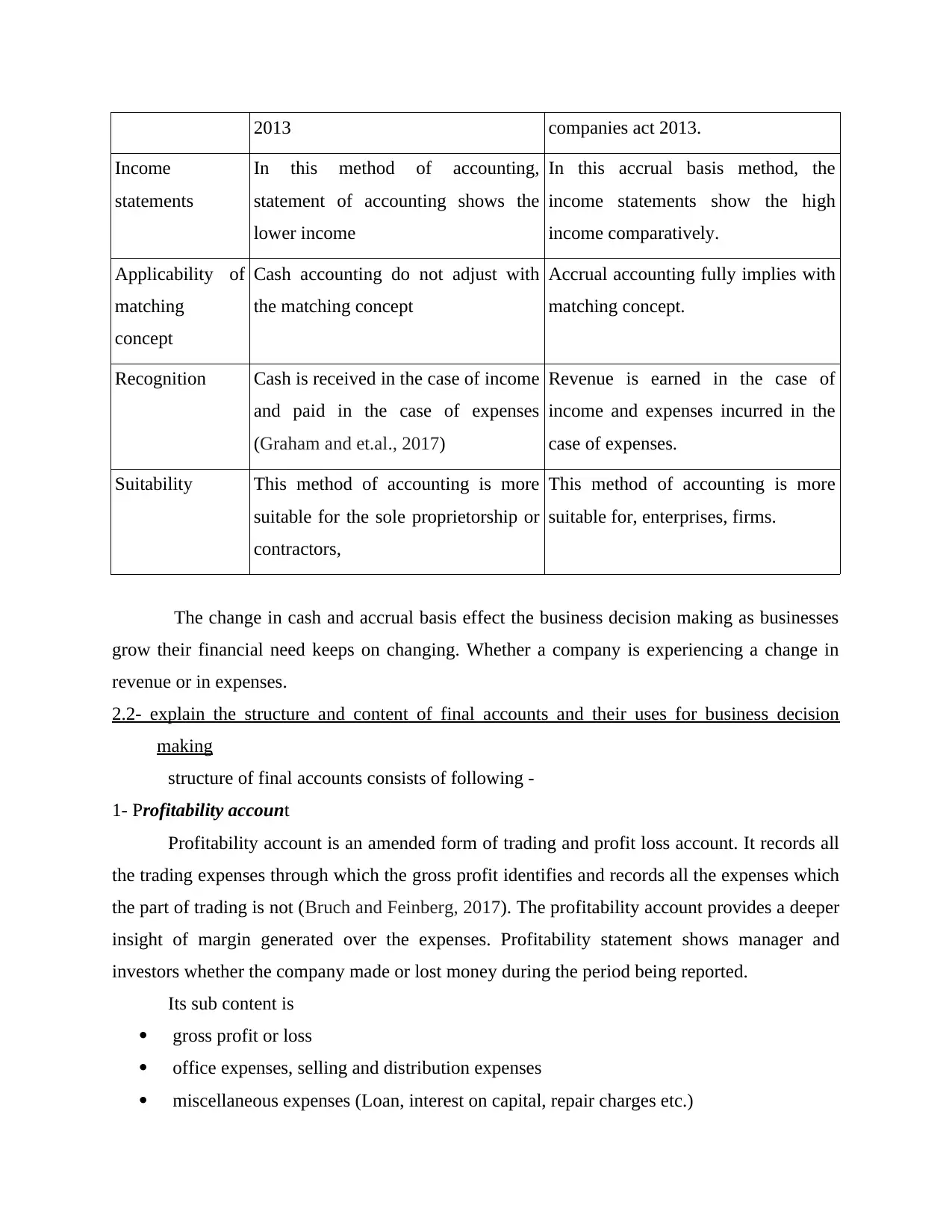
2013 companies act 2013.
Income
statements
In this method of accounting,
statement of accounting shows the
lower income
In this accrual basis method, the
income statements show the high
income comparatively.
Applicability of
matching
concept
Cash accounting do not adjust with
the matching concept
Accrual accounting fully implies with
matching concept.
Recognition Cash is received in the case of income
and paid in the case of expenses
(Graham and et.al., 2017)
Revenue is earned in the case of
income and expenses incurred in the
case of expenses.
Suitability This method of accounting is more
suitable for the sole proprietorship or
contractors,
This method of accounting is more
suitable for, enterprises, firms.
The change in cash and accrual basis effect the business decision making as businesses
grow their financial need keeps on changing. Whether a company is experiencing a change in
revenue or in expenses.
2.2- explain the structure and content of final accounts and their uses for business decision
making
structure of final accounts consists of following -
1- Profitability account
Profitability account is an amended form of trading and profit loss account. It records all
the trading expenses through which the gross profit identifies and records all the expenses which
the part of trading is not (Bruch and Feinberg, 2017). The profitability account provides a deeper
insight of margin generated over the expenses. Profitability statement shows manager and
investors whether the company made or lost money during the period being reported.
Its sub content is
gross profit or loss
office expenses, selling and distribution expenses
miscellaneous expenses (Loan, interest on capital, repair charges etc.)
Income
statements
In this method of accounting,
statement of accounting shows the
lower income
In this accrual basis method, the
income statements show the high
income comparatively.
Applicability of
matching
concept
Cash accounting do not adjust with
the matching concept
Accrual accounting fully implies with
matching concept.
Recognition Cash is received in the case of income
and paid in the case of expenses
(Graham and et.al., 2017)
Revenue is earned in the case of
income and expenses incurred in the
case of expenses.
Suitability This method of accounting is more
suitable for the sole proprietorship or
contractors,
This method of accounting is more
suitable for, enterprises, firms.
The change in cash and accrual basis effect the business decision making as businesses
grow their financial need keeps on changing. Whether a company is experiencing a change in
revenue or in expenses.
2.2- explain the structure and content of final accounts and their uses for business decision
making
structure of final accounts consists of following -
1- Profitability account
Profitability account is an amended form of trading and profit loss account. It records all
the trading expenses through which the gross profit identifies and records all the expenses which
the part of trading is not (Bruch and Feinberg, 2017). The profitability account provides a deeper
insight of margin generated over the expenses. Profitability statement shows manager and
investors whether the company made or lost money during the period being reported.
Its sub content is
gross profit or loss
office expenses, selling and distribution expenses
miscellaneous expenses (Loan, interest on capital, repair charges etc.)
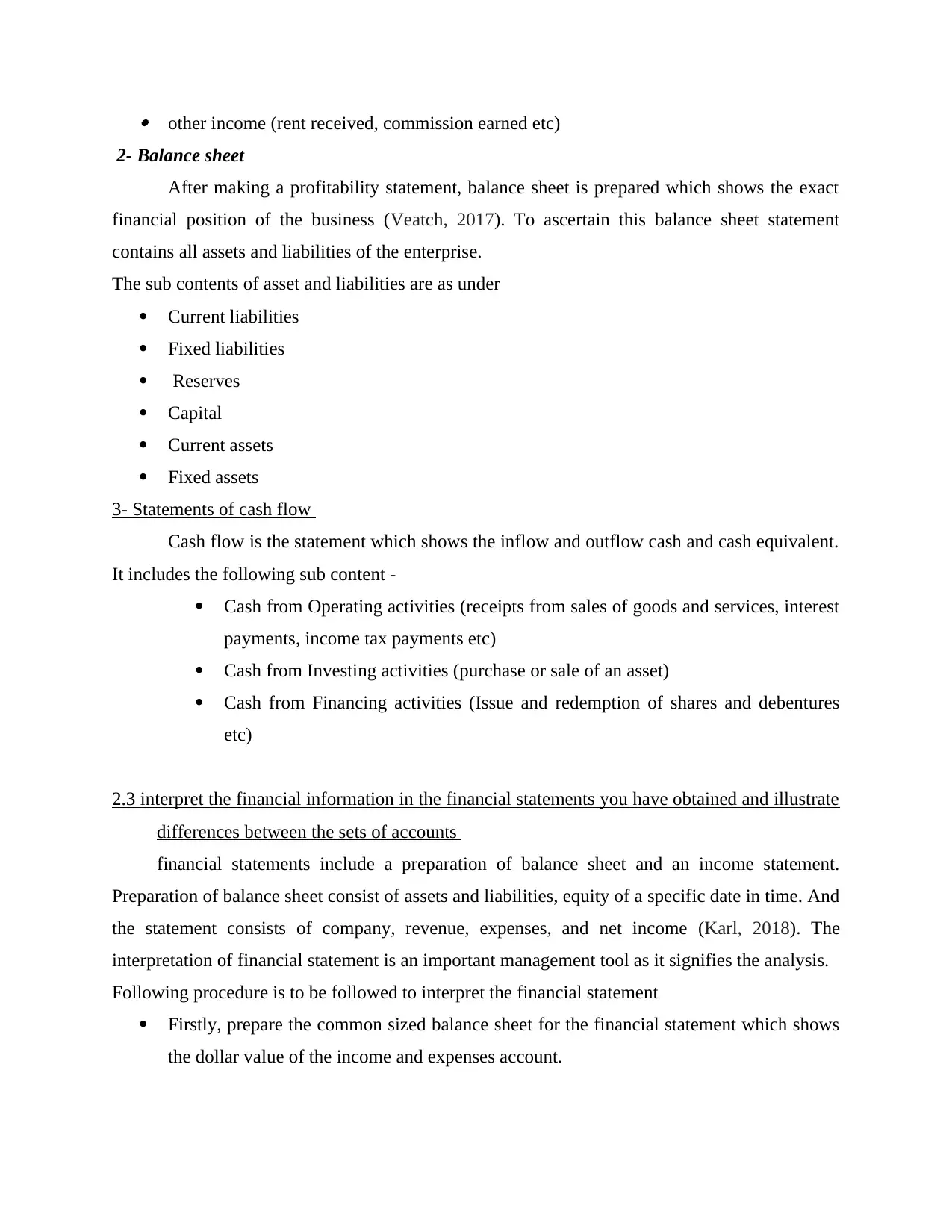
other income (rent received, commission earned etc)
2- Balance sheet
After making a profitability statement, balance sheet is prepared which shows the exact
financial position of the business (Veatch, 2017). To ascertain this balance sheet statement
contains all assets and liabilities of the enterprise.
The sub contents of asset and liabilities are as under
Current liabilities
Fixed liabilities
Reserves
Capital
Current assets
Fixed assets
3- Statements of cash flow
Cash flow is the statement which shows the inflow and outflow cash and cash equivalent.
It includes the following sub content -
Cash from Operating activities (receipts from sales of goods and services, interest
payments, income tax payments etc)
Cash from Investing activities (purchase or sale of an asset)
Cash from Financing activities (Issue and redemption of shares and debentures
etc)
2.3 interpret the financial information in the financial statements you have obtained and illustrate
differences between the sets of accounts
financial statements include a preparation of balance sheet and an income statement.
Preparation of balance sheet consist of assets and liabilities, equity of a specific date in time. And
the statement consists of company, revenue, expenses, and net income (Karl, 2018). The
interpretation of financial statement is an important management tool as it signifies the analysis.
Following procedure is to be followed to interpret the financial statement
Firstly, prepare the common sized balance sheet for the financial statement which shows
the dollar value of the income and expenses account.
2- Balance sheet
After making a profitability statement, balance sheet is prepared which shows the exact
financial position of the business (Veatch, 2017). To ascertain this balance sheet statement
contains all assets and liabilities of the enterprise.
The sub contents of asset and liabilities are as under
Current liabilities
Fixed liabilities
Reserves
Capital
Current assets
Fixed assets
3- Statements of cash flow
Cash flow is the statement which shows the inflow and outflow cash and cash equivalent.
It includes the following sub content -
Cash from Operating activities (receipts from sales of goods and services, interest
payments, income tax payments etc)
Cash from Investing activities (purchase or sale of an asset)
Cash from Financing activities (Issue and redemption of shares and debentures
etc)
2.3 interpret the financial information in the financial statements you have obtained and illustrate
differences between the sets of accounts
financial statements include a preparation of balance sheet and an income statement.
Preparation of balance sheet consist of assets and liabilities, equity of a specific date in time. And
the statement consists of company, revenue, expenses, and net income (Karl, 2018). The
interpretation of financial statement is an important management tool as it signifies the analysis.
Following procedure is to be followed to interpret the financial statement
Firstly, prepare the common sized balance sheet for the financial statement which shows
the dollar value of the income and expenses account.
⊘ This is a preview!⊘
Do you want full access?
Subscribe today to unlock all pages.
Trusted by 1+ million students worldwide
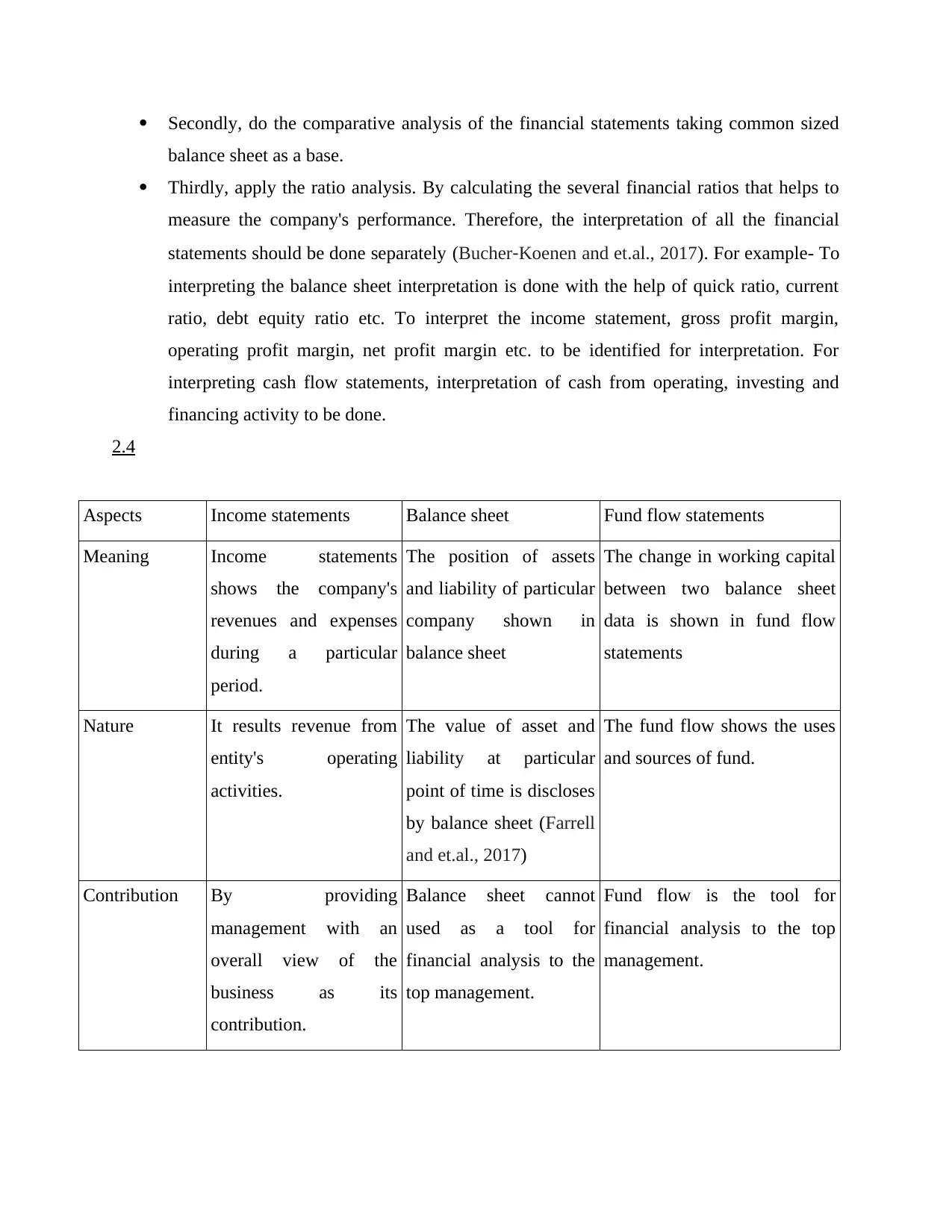
Secondly, do the comparative analysis of the financial statements taking common sized
balance sheet as a base.
Thirdly, apply the ratio analysis. By calculating the several financial ratios that helps to
measure the company's performance. Therefore, the interpretation of all the financial
statements should be done separately (Bucher‐Koenen and et.al., 2017). For example- To
interpreting the balance sheet interpretation is done with the help of quick ratio, current
ratio, debt equity ratio etc. To interpret the income statement, gross profit margin,
operating profit margin, net profit margin etc. to be identified for interpretation. For
interpreting cash flow statements, interpretation of cash from operating, investing and
financing activity to be done.
2.4
Aspects Income statements Balance sheet Fund flow statements
Meaning Income statements
shows the company's
revenues and expenses
during a particular
period.
The position of assets
and liability of particular
company shown in
balance sheet
The change in working capital
between two balance sheet
data is shown in fund flow
statements
Nature It results revenue from
entity's operating
activities.
The value of asset and
liability at particular
point of time is discloses
by balance sheet (Farrell
and et.al., 2017)
The fund flow shows the uses
and sources of fund.
Contribution By providing
management with an
overall view of the
business as its
contribution.
Balance sheet cannot
used as a tool for
financial analysis to the
top management.
Fund flow is the tool for
financial analysis to the top
management.
balance sheet as a base.
Thirdly, apply the ratio analysis. By calculating the several financial ratios that helps to
measure the company's performance. Therefore, the interpretation of all the financial
statements should be done separately (Bucher‐Koenen and et.al., 2017). For example- To
interpreting the balance sheet interpretation is done with the help of quick ratio, current
ratio, debt equity ratio etc. To interpret the income statement, gross profit margin,
operating profit margin, net profit margin etc. to be identified for interpretation. For
interpreting cash flow statements, interpretation of cash from operating, investing and
financing activity to be done.
2.4
Aspects Income statements Balance sheet Fund flow statements
Meaning Income statements
shows the company's
revenues and expenses
during a particular
period.
The position of assets
and liability of particular
company shown in
balance sheet
The change in working capital
between two balance sheet
data is shown in fund flow
statements
Nature It results revenue from
entity's operating
activities.
The value of asset and
liability at particular
point of time is discloses
by balance sheet (Farrell
and et.al., 2017)
The fund flow shows the uses
and sources of fund.
Contribution By providing
management with an
overall view of the
business as its
contribution.
Balance sheet cannot
used as a tool for
financial analysis to the
top management.
Fund flow is the tool for
financial analysis to the top
management.
Paraphrase This Document
Need a fresh take? Get an instant paraphrase of this document with our AI Paraphraser
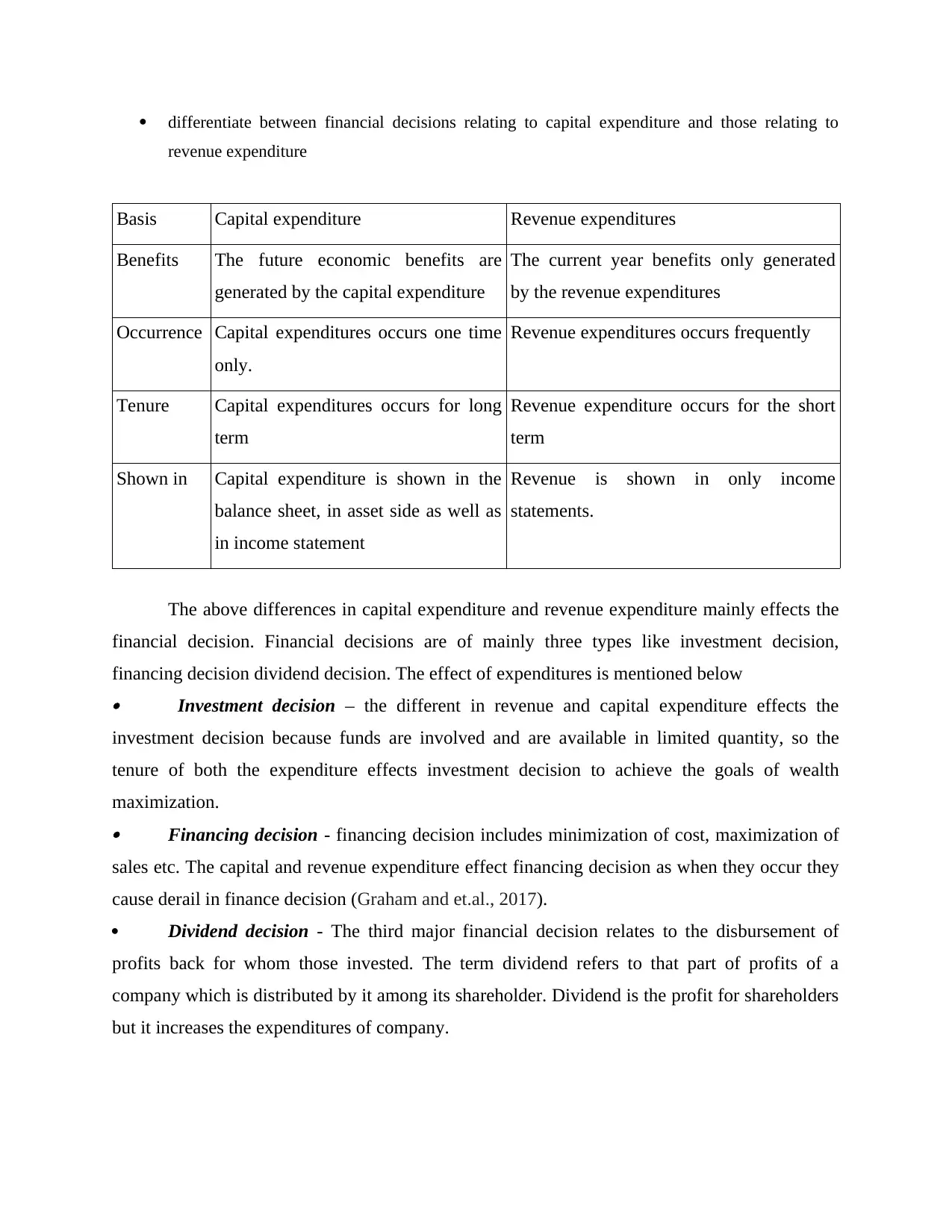
differentiate between financial decisions relating to capital expenditure and those relating to
revenue expenditure
Basis Capital expenditure Revenue expenditures
Benefits The future economic benefits are
generated by the capital expenditure
The current year benefits only generated
by the revenue expenditures
Occurrence Capital expenditures occurs one time
only.
Revenue expenditures occurs frequently
Tenure Capital expenditures occurs for long
term
Revenue expenditure occurs for the short
term
Shown in Capital expenditure is shown in the
balance sheet, in asset side as well as
in income statement
Revenue is shown in only income
statements.
The above differences in capital expenditure and revenue expenditure mainly effects the
financial decision. Financial decisions are of mainly three types like investment decision,
financing decision dividend decision. The effect of expenditures is mentioned below Investment decision – the different in revenue and capital expenditure effects the
investment decision because funds are involved and are available in limited quantity, so the
tenure of both the expenditure effects investment decision to achieve the goals of wealth
maximization. Financing decision - financing decision includes minimization of cost, maximization of
sales etc. The capital and revenue expenditure effect financing decision as when they occur they
cause derail in finance decision (Graham and et.al., 2017).
Dividend decision - The third major financial decision relates to the disbursement of
profits back for whom those invested. The term dividend refers to that part of profits of a
company which is distributed by it among its shareholder. Dividend is the profit for shareholders
but it increases the expenditures of company.
revenue expenditure
Basis Capital expenditure Revenue expenditures
Benefits The future economic benefits are
generated by the capital expenditure
The current year benefits only generated
by the revenue expenditures
Occurrence Capital expenditures occurs one time
only.
Revenue expenditures occurs frequently
Tenure Capital expenditures occurs for long
term
Revenue expenditure occurs for the short
term
Shown in Capital expenditure is shown in the
balance sheet, in asset side as well as
in income statement
Revenue is shown in only income
statements.
The above differences in capital expenditure and revenue expenditure mainly effects the
financial decision. Financial decisions are of mainly three types like investment decision,
financing decision dividend decision. The effect of expenditures is mentioned below Investment decision – the different in revenue and capital expenditure effects the
investment decision because funds are involved and are available in limited quantity, so the
tenure of both the expenditure effects investment decision to achieve the goals of wealth
maximization. Financing decision - financing decision includes minimization of cost, maximization of
sales etc. The capital and revenue expenditure effect financing decision as when they occur they
cause derail in finance decision (Graham and et.al., 2017).
Dividend decision - The third major financial decision relates to the disbursement of
profits back for whom those invested. The term dividend refers to that part of profits of a
company which is distributed by it among its shareholder. Dividend is the profit for shareholders
but it increases the expenditures of company.
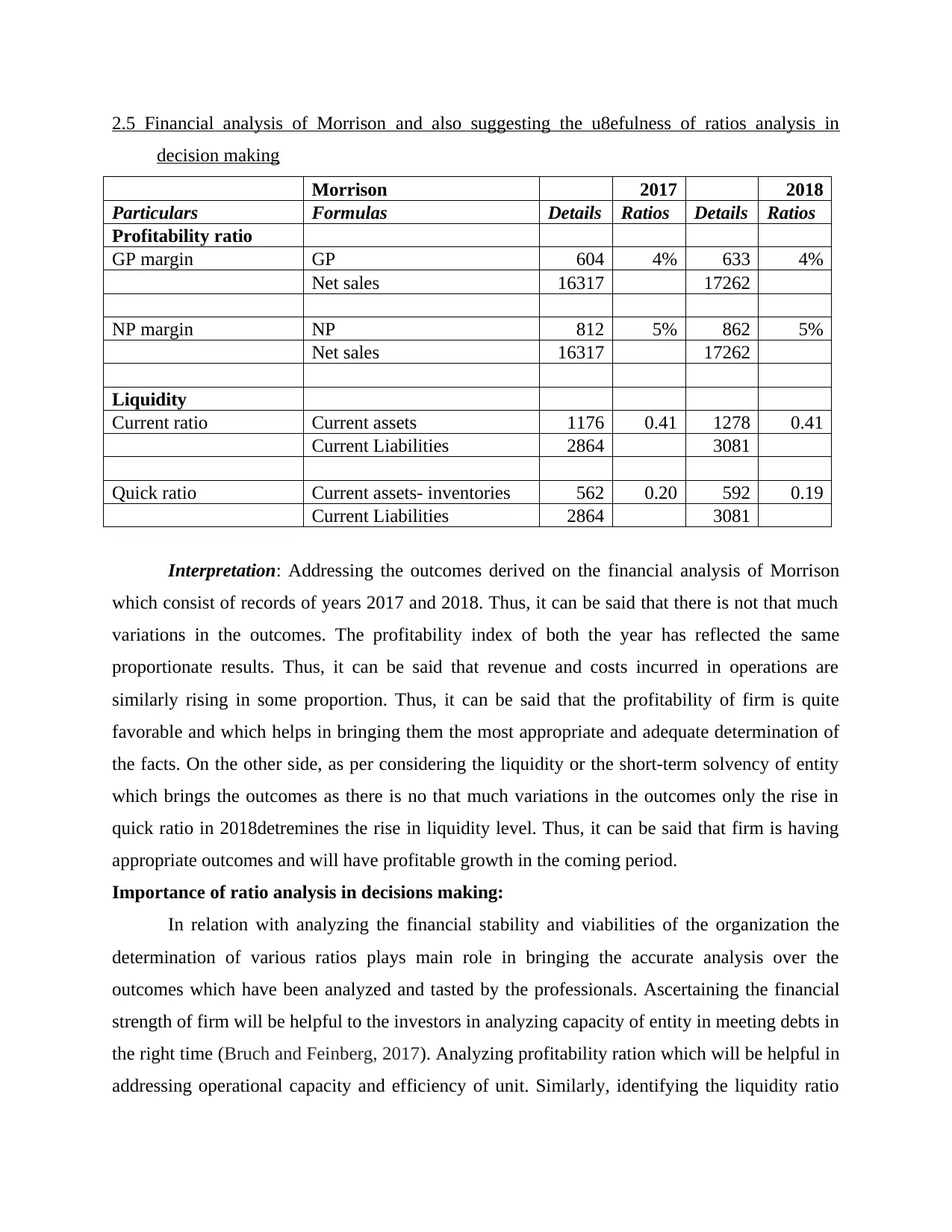
2.5 Financial analysis of Morrison and also suggesting the u8efulness of ratios analysis in
decision making
Morrison 2017 2018
Particulars Formulas Details Ratios Details Ratios
Profitability ratio
GP margin GP 604 4% 633 4%
Net sales 16317 17262
NP margin NP 812 5% 862 5%
Net sales 16317 17262
Liquidity
Current ratio Current assets 1176 0.41 1278 0.41
Current Liabilities 2864 3081
Quick ratio Current assets- inventories 562 0.20 592 0.19
Current Liabilities 2864 3081
Interpretation: Addressing the outcomes derived on the financial analysis of Morrison
which consist of records of years 2017 and 2018. Thus, it can be said that there is not that much
variations in the outcomes. The profitability index of both the year has reflected the same
proportionate results. Thus, it can be said that revenue and costs incurred in operations are
similarly rising in some proportion. Thus, it can be said that the profitability of firm is quite
favorable and which helps in bringing them the most appropriate and adequate determination of
the facts. On the other side, as per considering the liquidity or the short-term solvency of entity
which brings the outcomes as there is no that much variations in the outcomes only the rise in
quick ratio in 2018detremines the rise in liquidity level. Thus, it can be said that firm is having
appropriate outcomes and will have profitable growth in the coming period.
Importance of ratio analysis in decisions making:
In relation with analyzing the financial stability and viabilities of the organization the
determination of various ratios plays main role in bringing the accurate analysis over the
outcomes which have been analyzed and tasted by the professionals. Ascertaining the financial
strength of firm will be helpful to the investors in analyzing capacity of entity in meeting debts in
the right time (Bruch and Feinberg, 2017). Analyzing profitability ration which will be helpful in
addressing operational capacity and efficiency of unit. Similarly, identifying the liquidity ratio
decision making
Morrison 2017 2018
Particulars Formulas Details Ratios Details Ratios
Profitability ratio
GP margin GP 604 4% 633 4%
Net sales 16317 17262
NP margin NP 812 5% 862 5%
Net sales 16317 17262
Liquidity
Current ratio Current assets 1176 0.41 1278 0.41
Current Liabilities 2864 3081
Quick ratio Current assets- inventories 562 0.20 592 0.19
Current Liabilities 2864 3081
Interpretation: Addressing the outcomes derived on the financial analysis of Morrison
which consist of records of years 2017 and 2018. Thus, it can be said that there is not that much
variations in the outcomes. The profitability index of both the year has reflected the same
proportionate results. Thus, it can be said that revenue and costs incurred in operations are
similarly rising in some proportion. Thus, it can be said that the profitability of firm is quite
favorable and which helps in bringing them the most appropriate and adequate determination of
the facts. On the other side, as per considering the liquidity or the short-term solvency of entity
which brings the outcomes as there is no that much variations in the outcomes only the rise in
quick ratio in 2018detremines the rise in liquidity level. Thus, it can be said that firm is having
appropriate outcomes and will have profitable growth in the coming period.
Importance of ratio analysis in decisions making:
In relation with analyzing the financial stability and viabilities of the organization the
determination of various ratios plays main role in bringing the accurate analysis over the
outcomes which have been analyzed and tasted by the professionals. Ascertaining the financial
strength of firm will be helpful to the investors in analyzing capacity of entity in meeting debts in
the right time (Bruch and Feinberg, 2017). Analyzing profitability ration which will be helpful in
addressing operational capacity and efficiency of unit. Similarly, identifying the liquidity ratio
⊘ This is a preview!⊘
Do you want full access?
Subscribe today to unlock all pages.
Trusted by 1+ million students worldwide

1 out of 23


Related Documents


Your All-in-One AI-Powered Toolkit for Academic Success.
+13062052269
info@desklib.com
Available 24*7 on WhatsApp / Email
![[object Object]](/_next/static/media/star-bottom.7253800d.svg)
Unlock your academic potential
Copyright © 2020–2026 A2Z Services. All Rights Reserved. Developed and managed by ZUCOL.