Advance Finance for Decision Makers: Financial Decision-Making Report
VerifiedAdded on 2023/01/13
|25
|6105
|55
Report
AI Summary
This report, designed for advanced finance decision-makers, delves into the crucial financial factors that influence business choices. It examines topics such as return on investment, competition, social responsibility, and brand image. The report then compares accrual and cash flow accounting methods, analyzing their implications in financial reporting and decision-making processes. It explores the structure and content of financial statements, including income statements, balance sheets, and cash flow statements, highlighting their use in business decision-making. The report also covers accounting ethics, business ethics, corporate governance, and the roles of finance directors. Furthermore, it discusses long-term financing, working capital management, capital investment decisions, and the benefits and drawbacks of off-balance sheet financing. Finally, it analyzes the financial implications of various business ownership structures, emphasizing the significance of return on capital employed and other performance measures for long-term business sustainability. This report provides a comprehensive overview of financial decision-making principles and practices.

Advance Finance for Decision
Makers
Makers

Paraphrase This Document
Need a fresh take? Get an instant paraphrase of this document with our AI Paraphraser
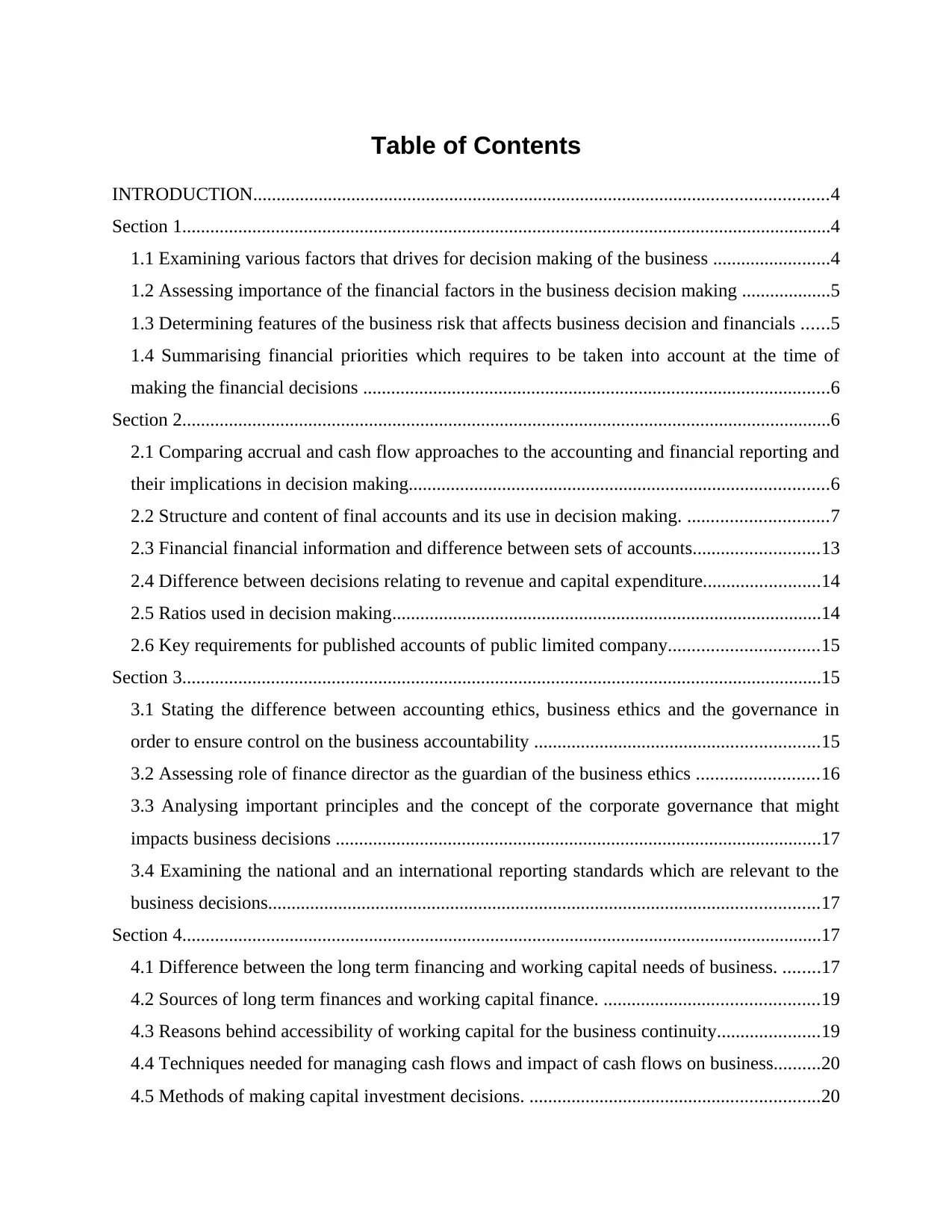
Table of Contents
INTRODUCTION...........................................................................................................................4
Section 1...........................................................................................................................................4
1.1 Examining various factors that drives for decision making of the business .........................4
1.2 Assessing importance of the financial factors in the business decision making ...................5
1.3 Determining features of the business risk that affects business decision and financials ......5
1.4 Summarising financial priorities which requires to be taken into account at the time of
making the financial decisions ....................................................................................................6
Section 2...........................................................................................................................................6
2.1 Comparing accrual and cash flow approaches to the accounting and financial reporting and
their implications in decision making..........................................................................................6
2.2 Structure and content of final accounts and its use in decision making. ..............................7
2.3 Financial financial information and difference between sets of accounts...........................13
2.4 Difference between decisions relating to revenue and capital expenditure.........................14
2.5 Ratios used in decision making............................................................................................14
2.6 Key requirements for published accounts of public limited company................................15
Section 3.........................................................................................................................................15
3.1 Stating the difference between accounting ethics, business ethics and the governance in
order to ensure control on the business accountability .............................................................15
3.2 Assessing role of finance director as the guardian of the business ethics ..........................16
3.3 Analysing important principles and the concept of the corporate governance that might
impacts business decisions ........................................................................................................17
3.4 Examining the national and an international reporting standards which are relevant to the
business decisions......................................................................................................................17
Section 4.........................................................................................................................................17
4.1 Difference between the long term financing and working capital needs of business. ........17
4.2 Sources of long term finances and working capital finance. ..............................................19
4.3 Reasons behind accessibility of working capital for the business continuity......................19
4.4 Techniques needed for managing cash flows and impact of cash flows on business..........20
4.5 Methods of making capital investment decisions. ..............................................................20
INTRODUCTION...........................................................................................................................4
Section 1...........................................................................................................................................4
1.1 Examining various factors that drives for decision making of the business .........................4
1.2 Assessing importance of the financial factors in the business decision making ...................5
1.3 Determining features of the business risk that affects business decision and financials ......5
1.4 Summarising financial priorities which requires to be taken into account at the time of
making the financial decisions ....................................................................................................6
Section 2...........................................................................................................................................6
2.1 Comparing accrual and cash flow approaches to the accounting and financial reporting and
their implications in decision making..........................................................................................6
2.2 Structure and content of final accounts and its use in decision making. ..............................7
2.3 Financial financial information and difference between sets of accounts...........................13
2.4 Difference between decisions relating to revenue and capital expenditure.........................14
2.5 Ratios used in decision making............................................................................................14
2.6 Key requirements for published accounts of public limited company................................15
Section 3.........................................................................................................................................15
3.1 Stating the difference between accounting ethics, business ethics and the governance in
order to ensure control on the business accountability .............................................................15
3.2 Assessing role of finance director as the guardian of the business ethics ..........................16
3.3 Analysing important principles and the concept of the corporate governance that might
impacts business decisions ........................................................................................................17
3.4 Examining the national and an international reporting standards which are relevant to the
business decisions......................................................................................................................17
Section 4.........................................................................................................................................17
4.1 Difference between the long term financing and working capital needs of business. ........17
4.2 Sources of long term finances and working capital finance. ..............................................19
4.3 Reasons behind accessibility of working capital for the business continuity......................19
4.4 Techniques needed for managing cash flows and impact of cash flows on business..........20
4.5 Methods of making capital investment decisions. ..............................................................20
4.6 Benefits and Drawbacks of off balance sheet financing......................................................22
Section 5 ........................................................................................................................................22
5.1 Financial implications of various business ownership structures. ......................................22
5.2 Analysing corporate governance, legal and regulatory environments of different ownership
structures of business. ...............................................................................................................23
5.3 Comparing and contrasting interests of managers and owners in decision making............23
5.4 Significance of return on capital employed and other performance measures for long term
business sustainability................................................................................................................24
5.5 Examining importance of the EPS as measure business performance................................24
CONCLUSION..............................................................................................................................24
REFERENCES................................................................................................................................1
Section 5 ........................................................................................................................................22
5.1 Financial implications of various business ownership structures. ......................................22
5.2 Analysing corporate governance, legal and regulatory environments of different ownership
structures of business. ...............................................................................................................23
5.3 Comparing and contrasting interests of managers and owners in decision making............23
5.4 Significance of return on capital employed and other performance measures for long term
business sustainability................................................................................................................24
5.5 Examining importance of the EPS as measure business performance................................24
CONCLUSION..............................................................................................................................24
REFERENCES................................................................................................................................1
⊘ This is a preview!⊘
Do you want full access?
Subscribe today to unlock all pages.

Trusted by 1+ million students worldwide
INTRODUCTION
Every business is aware of the fact that profitability of company is affected by the
decisions taken. Financial managers have a crucial role in the growth and success of business as
all the business activities run on the decisions taken. Decision making is process of gathering all
the information and facts relating to the aspect for which business is to be taken. The study
provide the understanding about the various financial factors influencing the decision making. It
will also provide about the concepts and tools used by the managers in taking financial decisions
of company. It will also cover accountability for financial reporting, sources of finance and
financial performance of different ownership structures.
Section 1
1.1 Examining various factors that drives for decision making of the business
Return on investment- It is reflected as the difference in between the money that is
invested in the things such as inventory, marketing, actual return and potential. ROI controls the
modifying risk of investment and it influences and drives both type of business decisions that
includes pre-investment and the post-investment.
Competition- This factor is said as one of the major aspect which strongly recommends
within the process of the decision making (Kumar, 2017). Today's world is seen as dynamic and
highly competitive so it is important for an organization to pay attention towards the challenges
and the operation of the business. Thus, at the time of making decisions in relation to the future
developments, business needs to consider the competitors and their respective plans for business
development.
Social responsibility- It is also a crucial factor that influences the decision making in the
business. In such concept, business needs to be acting in an interest of the society for the sake of
their common good.
Brand image- Managing brand image also influences the decision making that emphasize
on intangible gains in respect of the public perceptions (Diouf and Hebb, 2016). It concentrates
on differentiating business from the rivalry and developing faithfulness among the customers,
encourages the decisions regarding estimating, exhibiting products & the services at a standard
level.
Every business is aware of the fact that profitability of company is affected by the
decisions taken. Financial managers have a crucial role in the growth and success of business as
all the business activities run on the decisions taken. Decision making is process of gathering all
the information and facts relating to the aspect for which business is to be taken. The study
provide the understanding about the various financial factors influencing the decision making. It
will also provide about the concepts and tools used by the managers in taking financial decisions
of company. It will also cover accountability for financial reporting, sources of finance and
financial performance of different ownership structures.
Section 1
1.1 Examining various factors that drives for decision making of the business
Return on investment- It is reflected as the difference in between the money that is
invested in the things such as inventory, marketing, actual return and potential. ROI controls the
modifying risk of investment and it influences and drives both type of business decisions that
includes pre-investment and the post-investment.
Competition- This factor is said as one of the major aspect which strongly recommends
within the process of the decision making (Kumar, 2017). Today's world is seen as dynamic and
highly competitive so it is important for an organization to pay attention towards the challenges
and the operation of the business. Thus, at the time of making decisions in relation to the future
developments, business needs to consider the competitors and their respective plans for business
development.
Social responsibility- It is also a crucial factor that influences the decision making in the
business. In such concept, business needs to be acting in an interest of the society for the sake of
their common good.
Brand image- Managing brand image also influences the decision making that emphasize
on intangible gains in respect of the public perceptions (Diouf and Hebb, 2016). It concentrates
on differentiating business from the rivalry and developing faithfulness among the customers,
encourages the decisions regarding estimating, exhibiting products & the services at a standard
level.
Paraphrase This Document
Need a fresh take? Get an instant paraphrase of this document with our AI Paraphraser
1.2 Assessing importance of the financial factors in the business decision making
Accounts receivable- It is the major financial factors that leads to business growth and
requires an unanticipated bank loans. In order to run its business smoothly it is essential for the
business firm to consider at the indicators like turnover of the accounts receivable, cash
collection, credit policies and an ageing of the receivables.
Net income- This factor is counted as essential because it shows the profits earned by the
company after meeting all its expenses, costs and the tax liabilities (Rubin and Patel, 2017). This
factor helps the company in making decision relating to keeping control over the cost so and
increasing the percentage of the revenue so that higher profitability could be attained.
Working capital- It is stated as the difference between the current liabilities and the
assets. Without adequate working capital, business enterprise cannot run its business smoothly.
Thus, it acts as the most important financial factor as it helps the firm in making the decisions
regarding optimum use of the resources so that efficient and effective working capital can be
maintained for achieving objectives of the business.
Sales or operating revenue- It referred as the financial factor that shows the revenue
generated by an entity through selling its stock (Parent, Kalenkoski and Cardella, 2018). Higher
sales depicts higher profitability and growth rate of the company so it is very important for the
firm to seek appropriate measures in meeting the sales target. This in turn helps in making the
decision regarding the operational activities and in relation to demand of the customers.
1.3 Determining features of the business risk that affects business decision and financials
Time- In the present scenario, time is been characterized by an intense competition,
globalization of an economy, advanced technology. In the future periods or coming periods
business risk are tend to increase in an intensity. This affects and impacts the financial and the
business decision to great extent as for surviving in the business it is important for it to cope up
with the changes.
Nature of the business risk- In case the business is engaged in the manufacturing or
buying of the basic necessity items such as cloth, oil and the sugar. There seems to be less risk as
demand for majority of the items is counted as inelastic (Boatright, 2017). However, in case the
company is engaged in manufacturing of the luxury items are seen as exposed towards the
business risk due to the demand for the luxury items is reflected as highly elastic. In this way the
business and the financial decision of an entity are influenced.
Accounts receivable- It is the major financial factors that leads to business growth and
requires an unanticipated bank loans. In order to run its business smoothly it is essential for the
business firm to consider at the indicators like turnover of the accounts receivable, cash
collection, credit policies and an ageing of the receivables.
Net income- This factor is counted as essential because it shows the profits earned by the
company after meeting all its expenses, costs and the tax liabilities (Rubin and Patel, 2017). This
factor helps the company in making decision relating to keeping control over the cost so and
increasing the percentage of the revenue so that higher profitability could be attained.
Working capital- It is stated as the difference between the current liabilities and the
assets. Without adequate working capital, business enterprise cannot run its business smoothly.
Thus, it acts as the most important financial factor as it helps the firm in making the decisions
regarding optimum use of the resources so that efficient and effective working capital can be
maintained for achieving objectives of the business.
Sales or operating revenue- It referred as the financial factor that shows the revenue
generated by an entity through selling its stock (Parent, Kalenkoski and Cardella, 2018). Higher
sales depicts higher profitability and growth rate of the company so it is very important for the
firm to seek appropriate measures in meeting the sales target. This in turn helps in making the
decision regarding the operational activities and in relation to demand of the customers.
1.3 Determining features of the business risk that affects business decision and financials
Time- In the present scenario, time is been characterized by an intense competition,
globalization of an economy, advanced technology. In the future periods or coming periods
business risk are tend to increase in an intensity. This affects and impacts the financial and the
business decision to great extent as for surviving in the business it is important for it to cope up
with the changes.
Nature of the business risk- In case the business is engaged in the manufacturing or
buying of the basic necessity items such as cloth, oil and the sugar. There seems to be less risk as
demand for majority of the items is counted as inelastic (Boatright, 2017). However, in case the
company is engaged in manufacturing of the luxury items are seen as exposed towards the
business risk due to the demand for the luxury items is reflected as highly elastic. In this way the
business and the financial decision of an entity are influenced.
Sales term- If the business conducts its sales on the cash basis, the risk of the business are
seen as zero as possibility of the bad debts is concerned with. On the other state, an enterprise
conducting the business on the large credit sales are highly exposed with the risk regarding bad
debts.
1.4 Summarising financial priorities which requires to be taken into account at the time of
making the financial decisions
Understanding financial goals- prior to making financial decision it is important that the
company makes sets its financial goals. This helps in making suitable decisions in respect of
raising the funds and performing tasks in the common direction to achieve the financial
objectives.
Having the plan relating to debt pay-off- While making finance related decisions, an
enterprise needs to look over the debt obligation by way of preparing the pay-off plan. This
ensures prevention of the firm in taking too much of the loan amount in future periods.
Spending wisely- It is the another most important priority that could be made by effective
planning. This in turn ensures a good future in respect of generating higher profitability.
Safeguarding the financial documents- In order to keep the track record of all the final
investments in the document form is considered as cumbersome (Şahin, 2018). It is very crucial
for an enterprise to keep proper record and maintenance of its financial documents as such
documents act as evidence.
Performing for routine financial check-ups- There present a need for performing the
regular check-ups or review of an investment plans because it enables in making effective plan.
Routine review ensures that their investments directly aligned with their spending requirements.
Thus, it is critical for an organization for keeping a constant check on the financial planning.
This helps in making suitable financial decisions with regards to raising of the funds and its
allocation so that larger amount of profits can be generated.
Section 2
2.1 Comparing accrual and cash flow approaches to the accounting and financial reporting and
their implications in decision making.
Cash Basis – The accounting method only recognises the revenues when the cash is received
similarly the expenses are recorded when they are actually paid. The cash accounting method do
not records accounts payable or accounts receivable.
seen as zero as possibility of the bad debts is concerned with. On the other state, an enterprise
conducting the business on the large credit sales are highly exposed with the risk regarding bad
debts.
1.4 Summarising financial priorities which requires to be taken into account at the time of
making the financial decisions
Understanding financial goals- prior to making financial decision it is important that the
company makes sets its financial goals. This helps in making suitable decisions in respect of
raising the funds and performing tasks in the common direction to achieve the financial
objectives.
Having the plan relating to debt pay-off- While making finance related decisions, an
enterprise needs to look over the debt obligation by way of preparing the pay-off plan. This
ensures prevention of the firm in taking too much of the loan amount in future periods.
Spending wisely- It is the another most important priority that could be made by effective
planning. This in turn ensures a good future in respect of generating higher profitability.
Safeguarding the financial documents- In order to keep the track record of all the final
investments in the document form is considered as cumbersome (Şahin, 2018). It is very crucial
for an enterprise to keep proper record and maintenance of its financial documents as such
documents act as evidence.
Performing for routine financial check-ups- There present a need for performing the
regular check-ups or review of an investment plans because it enables in making effective plan.
Routine review ensures that their investments directly aligned with their spending requirements.
Thus, it is critical for an organization for keeping a constant check on the financial planning.
This helps in making suitable financial decisions with regards to raising of the funds and its
allocation so that larger amount of profits can be generated.
Section 2
2.1 Comparing accrual and cash flow approaches to the accounting and financial reporting and
their implications in decision making.
Cash Basis – The accounting method only recognises the revenues when the cash is received
similarly the expenses are recorded when they are actually paid. The cash accounting method do
not records accounts payable or accounts receivable.
⊘ This is a preview!⊘
Do you want full access?
Subscribe today to unlock all pages.
Trusted by 1+ million students worldwide
Accrual Basis – In this method expenses and revenues are recorded at the moment business has
earned them. The method do not allow company to wait till the transactions are actually paid or
received.
Both accrual and cash basis of accounting are separate methods used for recording the
accounting and financial transactions. Core underlying difference in the two methods is of
timings of recording the transactions. On aggregation results under both the approaches is same.
Timing difference among two methods is there because under cash system revenues are delayed
till the payment is received in actual from customers same is case in recording the expenses
(Minnis and Sutherland, 2017). On the other hand accrual system requires company to record
income and expenses as they are earned without depending on cash outflow.
The impact over decisions is not major as the end results under bot system is same. But
accrual systems reflects actual performance of company where the cash system do not reflect
actual position. Company may have completed a big project but is not recorded due to payments
in arrears. Therefore companies follow accrual basis of accounting to reflect true position of
company.
2.2 Structure and content of final accounts and its use in decision making.
Final accounts comprises mainly of the Income Statements, balance sheet and cash flows
statements of company.
Structure and contents of different final accounts.
Structure and contents of Income Statement
Income Statement
Year Ended April 30, 2017
Sales Revenue .($000)
Sales Revenue 117
Cost of Goods Sold 14
Gross Profit 103
earned them. The method do not allow company to wait till the transactions are actually paid or
received.
Both accrual and cash basis of accounting are separate methods used for recording the
accounting and financial transactions. Core underlying difference in the two methods is of
timings of recording the transactions. On aggregation results under both the approaches is same.
Timing difference among two methods is there because under cash system revenues are delayed
till the payment is received in actual from customers same is case in recording the expenses
(Minnis and Sutherland, 2017). On the other hand accrual system requires company to record
income and expenses as they are earned without depending on cash outflow.
The impact over decisions is not major as the end results under bot system is same. But
accrual systems reflects actual performance of company where the cash system do not reflect
actual position. Company may have completed a big project but is not recorded due to payments
in arrears. Therefore companies follow accrual basis of accounting to reflect true position of
company.
2.2 Structure and content of final accounts and its use in decision making.
Final accounts comprises mainly of the Income Statements, balance sheet and cash flows
statements of company.
Structure and contents of different final accounts.
Structure and contents of Income Statement
Income Statement
Year Ended April 30, 2017
Sales Revenue .($000)
Sales Revenue 117
Cost of Goods Sold 14
Gross Profit 103
Paraphrase This Document
Need a fresh take? Get an instant paraphrase of this document with our AI Paraphraser
Less: Expenses
Labour 25
Utilities 10
Ski Patrols 10
Depreciation 3
Marketing 4
Other 8
TOTAL EXPENSES 60
Net Profit (before interest and tax) 43
Interest Expense 2
Net Profit Before Tax 41
Tax (10%) 4.1
Net Profit AFTER Tax 36.9
Dividends 20
Retained Profit 16.9
Labour 25
Utilities 10
Ski Patrols 10
Depreciation 3
Marketing 4
Other 8
TOTAL EXPENSES 60
Net Profit (before interest and tax) 43
Interest Expense 2
Net Profit Before Tax 41
Tax (10%) 4.1
Net Profit AFTER Tax 36.9
Dividends 20
Retained Profit 16.9
Structure and content of Balance Sheet
Structure and Content of Cash Flow Statement
Structure and Content of Cash Flow Statement
⊘ This is a preview!⊘
Do you want full access?
Subscribe today to unlock all pages.
Trusted by 1+ million students worldwide
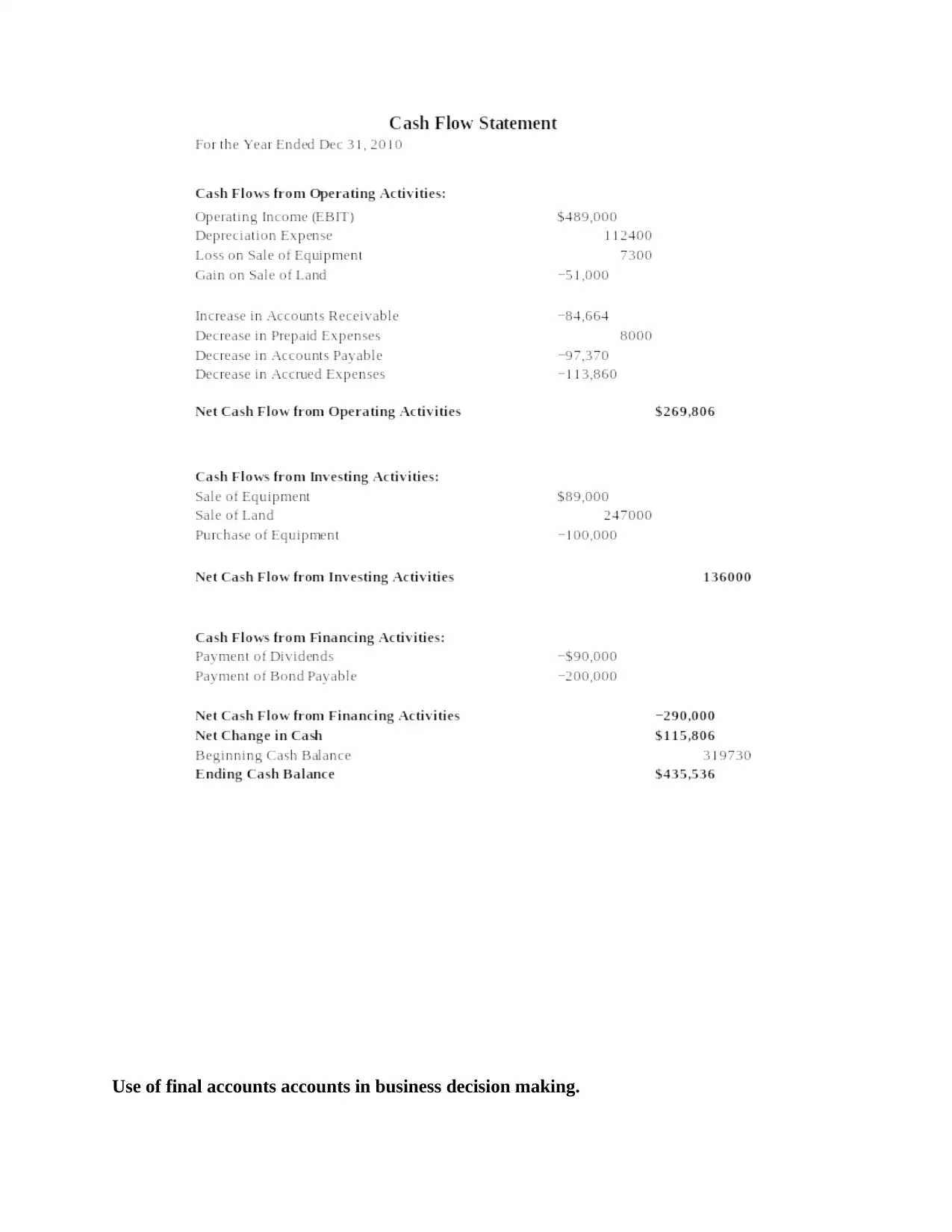
Use of final accounts accounts in business decision making.
Paraphrase This Document
Need a fresh take? Get an instant paraphrase of this document with our AI Paraphraser
Income Statements – Income statements provides the management with the profitability form
carrying on business it also provide the information related to its revenues and expenses based on
which future strategies are framed.
Balance Sheet – Balance sheet of company informs the management about the position of the
company at year end. The changes in its assets and liabilities are assessed from balance sheet.
Make decisions comparing the statements with competitors (Vanauken, Ascigil and Carraher,
2017).
Cash Flow Statements – Cash Flows helps the management in identifying the inflows and
outflows of cash from different activities. This helps management in paying attention towards
productive activities.
2.3 Financial financial information and difference between sets of accounts.
Financial information obtained from the financial statements.
Income – It shows that company is having sufficient profits after carrying out all the expenses of
company. Efficiency of the company in managing its operations is judged by it.
COGS – It could be interpreted that company has managed to control its costs. Company is
having effective strategies to control its costs.
Gross profit – Company is having high gross profits, that means company is available with
sufficient profits to carry out further operations of business.
Stock holders equity – It shows that company has not issued any share capital in the given year.
Changes in equity have essential part in decision making.
Cash and equivalents – Company is having enough funds to carry its operations smoothly. It
will not be requiring to raise short term loans to meet its working capital requirements.
Difference between different sets of accounts.
Balance sheet Income Statement Fund Flows statements
Balance sheet
represents and records
the assets and liabilities
of company
Income Statements
reflects the income
generated and
expenditures incurred
in the business.
Fund flow statement
represent the inflow
and outflow of cash
from different activities
like operating,
financing and
investment (Berger,
carrying on business it also provide the information related to its revenues and expenses based on
which future strategies are framed.
Balance Sheet – Balance sheet of company informs the management about the position of the
company at year end. The changes in its assets and liabilities are assessed from balance sheet.
Make decisions comparing the statements with competitors (Vanauken, Ascigil and Carraher,
2017).
Cash Flow Statements – Cash Flows helps the management in identifying the inflows and
outflows of cash from different activities. This helps management in paying attention towards
productive activities.
2.3 Financial financial information and difference between sets of accounts.
Financial information obtained from the financial statements.
Income – It shows that company is having sufficient profits after carrying out all the expenses of
company. Efficiency of the company in managing its operations is judged by it.
COGS – It could be interpreted that company has managed to control its costs. Company is
having effective strategies to control its costs.
Gross profit – Company is having high gross profits, that means company is available with
sufficient profits to carry out further operations of business.
Stock holders equity – It shows that company has not issued any share capital in the given year.
Changes in equity have essential part in decision making.
Cash and equivalents – Company is having enough funds to carry its operations smoothly. It
will not be requiring to raise short term loans to meet its working capital requirements.
Difference between different sets of accounts.
Balance sheet Income Statement Fund Flows statements
Balance sheet
represents and records
the assets and liabilities
of company
Income Statements
reflects the income
generated and
expenditures incurred
in the business.
Fund flow statement
represent the inflow
and outflow of cash
from different activities
like operating,
financing and
investment (Berger,
Minnis and Sutherland,
2017).
2.4 Difference between decisions relating to revenue and capital expenditure.
Capital expenditure - Capital expenditures are generally related to fixed assets. These are
productive assets over the long term period. These expenditures involves high investment of
funds.
Revenue expenditure – Revenue expenditures are related to the particular revenue transaction
for operating period. They are the operational costs incurred for running the business.
Both have influence over the decisions taken by the business. It depends on the size and
the funds involved in the expenditures. Capital expenditures have major expenditures, therefore
company is required to have adequate information for coming at informed decisions. Revenue
expenditures of company are of routine in nature and managers do not pay much focus on
making decisions about them.
2.5 Ratios used in decision making
Financial ratios are used by various experts and analysts for making an informed decisions.
Ratio Analysis
Liquidity Ratios
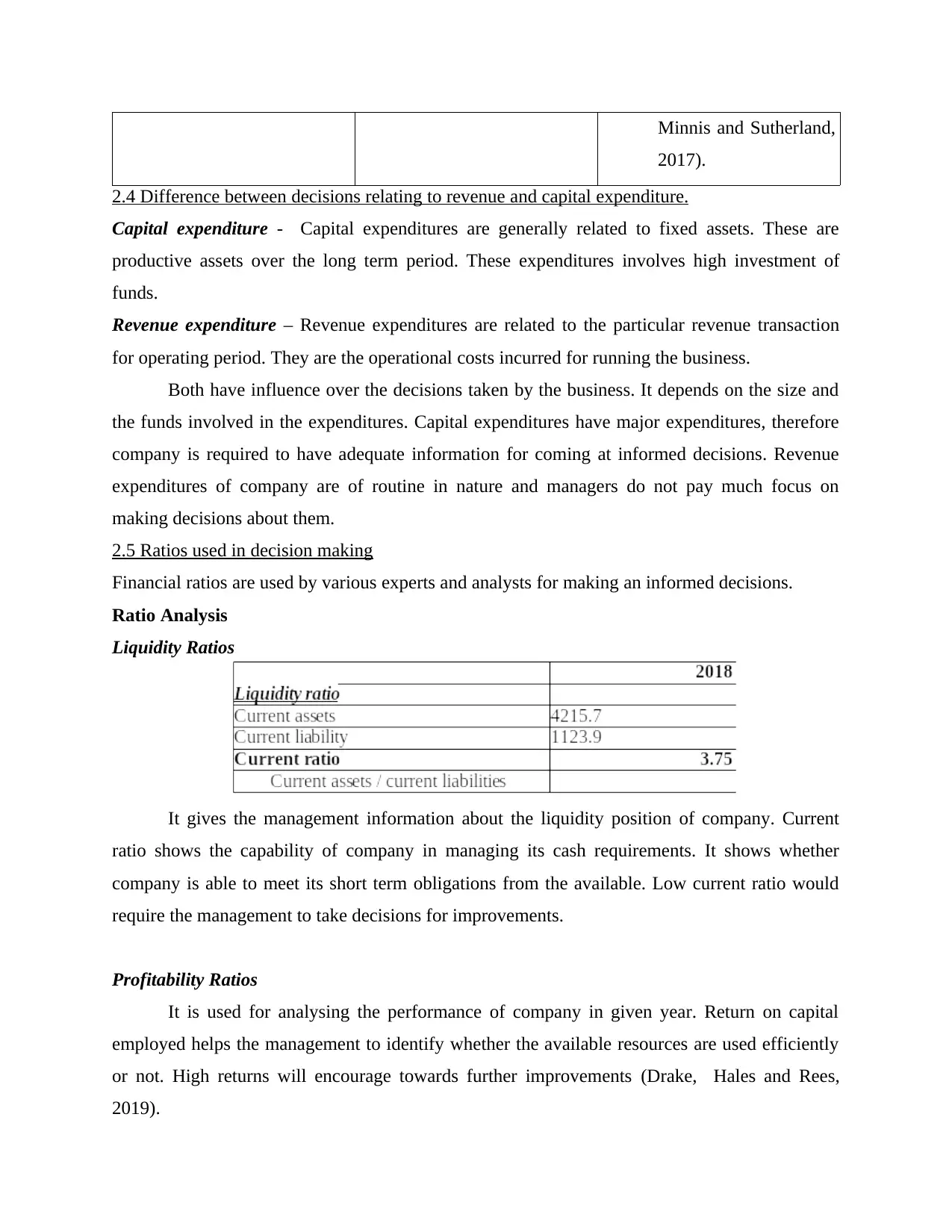
It gives the management information about the liquidity position of company. Current
ratio shows the capability of company in managing its cash requirements. It shows whether
company is able to meet its short term obligations from the available. Low current ratio would
require the management to take decisions for improvements.
Profitability Ratios
It is used for analysing the performance of company in given year. Return on capital
employed helps the management to identify whether the available resources are used efficiently
or not. High returns will encourage towards further improvements (Drake, Hales and Rees,
2019).
2017).
2.4 Difference between decisions relating to revenue and capital expenditure.
Capital expenditure - Capital expenditures are generally related to fixed assets. These are
productive assets over the long term period. These expenditures involves high investment of
funds.
Revenue expenditure – Revenue expenditures are related to the particular revenue transaction
for operating period. They are the operational costs incurred for running the business.
Both have influence over the decisions taken by the business. It depends on the size and
the funds involved in the expenditures. Capital expenditures have major expenditures, therefore
company is required to have adequate information for coming at informed decisions. Revenue
expenditures of company are of routine in nature and managers do not pay much focus on
making decisions about them.
2.5 Ratios used in decision making
Financial ratios are used by various experts and analysts for making an informed decisions.
Ratio Analysis
Liquidity Ratios
It gives the management information about the liquidity position of company. Current
ratio shows the capability of company in managing its cash requirements. It shows whether
company is able to meet its short term obligations from the available. Low current ratio would
require the management to take decisions for improvements.
Profitability Ratios
It is used for analysing the performance of company in given year. Return on capital
employed helps the management to identify whether the available resources are used efficiently
or not. High returns will encourage towards further improvements (Drake, Hales and Rees,
2019).
⊘ This is a preview!⊘
Do you want full access?
Subscribe today to unlock all pages.
Trusted by 1+ million students worldwide

1 out of 25


Related Documents


Your All-in-One AI-Powered Toolkit for Academic Success.
+13062052269
info@desklib.com
Available 24*7 on WhatsApp / Email
![[object Object]](/_next/static/media/star-bottom.7253800d.svg)
Unlock your academic potential
Copyright © 2020–2026 A2Z Services. All Rights Reserved. Developed and managed by ZUCOL.