Financial Decision Making: SKANSA PLC Ratio Analysis Report
VerifiedAdded on 2023/01/03
|11
|3788
|37
Report
AI Summary
This report provides a comprehensive analysis of financial decision-making within an organization, focusing on the essential roles of both the accounting and finance departments. It delves into the significance of financial and management accounting, tax functions, auditing, investment, financing, dividend, and working capital management. The report uses SKANSA PLC, a UK-based construction company, as a case study to illustrate these concepts. Furthermore, the report includes a detailed ratio analysis of SKANSA PLC, evaluating its financial performance through key metrics such as return on capital employed, net profit margin, current ratio, average receivable days, and average payable days, providing insights into the company's efficiency and financial health over the years 2018 and 2019. The analysis highlights the importance of these financial functions in guiding business decisions and ensuring the long-term success of the organization.

FINANCIAL DECISION
MAKING
MAKING

Paraphrase This Document
Need a fresh take? Get an instant paraphrase of this document with our AI Paraphraser
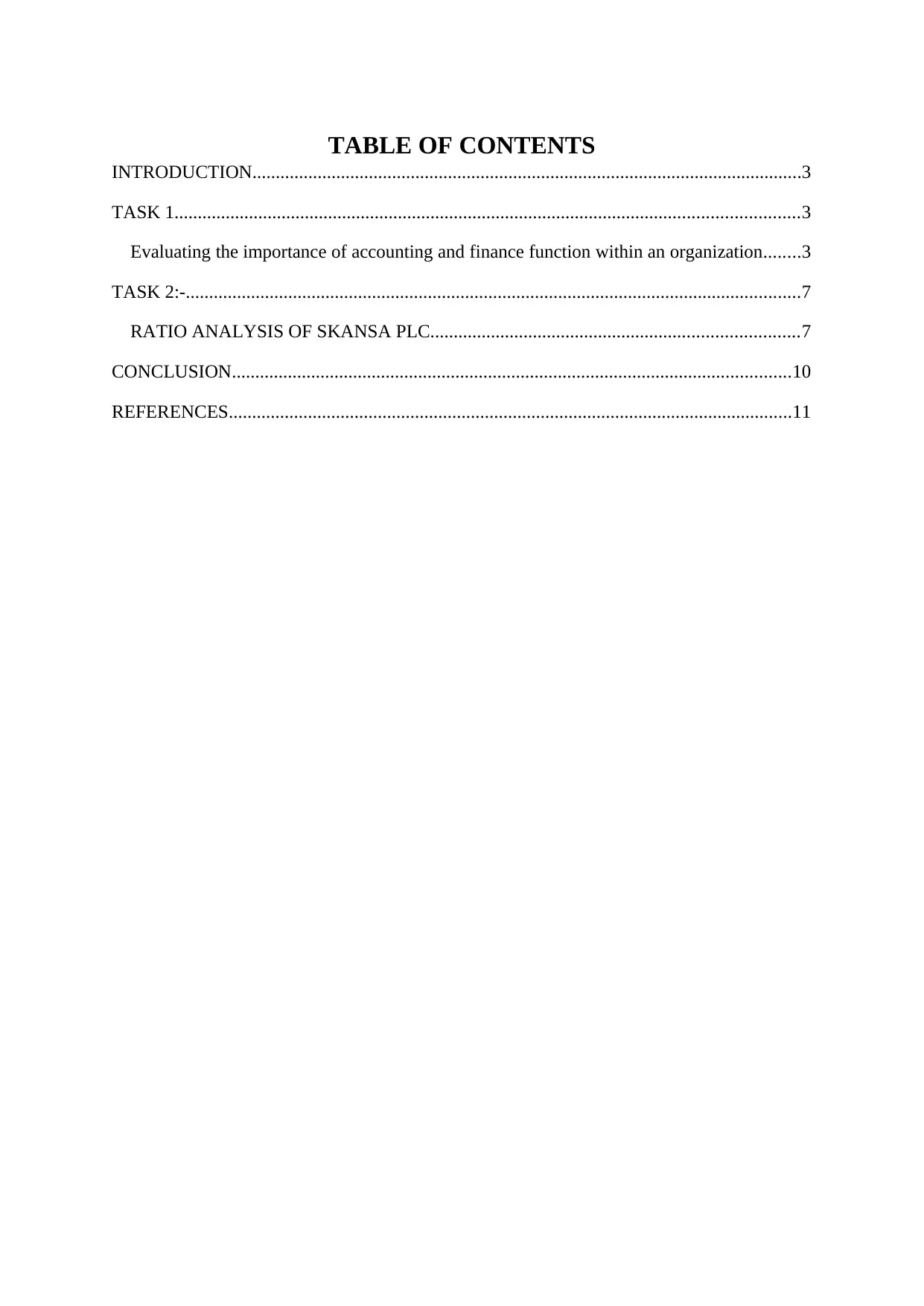
TABLE OF CONTENTS
INTRODUCTION......................................................................................................................3
TASK 1......................................................................................................................................3
Evaluating the importance of accounting and finance function within an organization........3
TASK 2:-....................................................................................................................................7
RATIO ANALYSIS OF SKANSA PLC...............................................................................7
CONCLUSION........................................................................................................................10
REFERENCES.........................................................................................................................11
INTRODUCTION......................................................................................................................3
TASK 1......................................................................................................................................3
Evaluating the importance of accounting and finance function within an organization........3
TASK 2:-....................................................................................................................................7
RATIO ANALYSIS OF SKANSA PLC...............................................................................7
CONCLUSION........................................................................................................................10
REFERENCES.........................................................................................................................11
INTRODUCTION
Every business entity in order to run smoothly with the effective and efficient
management of its financial aspects requires a professional team of accounting and financial
experts having immense knowledge in the field. This will help in monitoring and measuring
the various the business aspects which will assist in managing the performance of the
business. Each department performs its functions independently as per the stated rules,
regulations and the other statutory requirements. In this report, SKANSA PLC is taken as an
organization which is basically a construction company established in the year 1984 in UK.
The major strength of the company is the presence in most of eth European nations and is
looking for further expanding its business to the other nations in the coming 10 years. This
report provides an insight about the different function of the accounting as well as the finance
department which is helpful for the organization for the purpose of undertaking the various
business decisions. It also covers the ratio analysis of the company for evaluating and
interpreting the financial position and performance of the company.
TASK 1
Evaluating the importance of accounting and finance function within an organization
The various functions of the accounting and the finance department are stated below
along with its importance to the organization.
Accounting department:
Financial accounting
The monetary accounting has a significant role which permits the association in
monitoring its money related business transactions. This is the essential part of bookkeeping
in which monetary exchanges of the corporate is noted which is additionally exploited for
ruling out the corporate choices. For example, this branch of SKANSA PLC will make use of
it in creating different sorts of the reports which generally involves income statement,
monetary record and the cash flow statement as well of the organization (Oyewo, 2017). This
provides support in depicting about the general strength of the corporation to both internal
and outside users of it. In light of this, the clients make decision whether to put resources into
the organization or not. Alongside it, the reports arranged can be additionally utilized with the
end goal of adequately contrasting it with the different organizations inside a similar industry
to pick up an opinion in regard to the entity’s performance in comparison to its rivals.
However, it also needed workers with great information and abilities for doing financial
accounting for creating reports.
Every business entity in order to run smoothly with the effective and efficient
management of its financial aspects requires a professional team of accounting and financial
experts having immense knowledge in the field. This will help in monitoring and measuring
the various the business aspects which will assist in managing the performance of the
business. Each department performs its functions independently as per the stated rules,
regulations and the other statutory requirements. In this report, SKANSA PLC is taken as an
organization which is basically a construction company established in the year 1984 in UK.
The major strength of the company is the presence in most of eth European nations and is
looking for further expanding its business to the other nations in the coming 10 years. This
report provides an insight about the different function of the accounting as well as the finance
department which is helpful for the organization for the purpose of undertaking the various
business decisions. It also covers the ratio analysis of the company for evaluating and
interpreting the financial position and performance of the company.
TASK 1
Evaluating the importance of accounting and finance function within an organization
The various functions of the accounting and the finance department are stated below
along with its importance to the organization.
Accounting department:
Financial accounting
The monetary accounting has a significant role which permits the association in
monitoring its money related business transactions. This is the essential part of bookkeeping
in which monetary exchanges of the corporate is noted which is additionally exploited for
ruling out the corporate choices. For example, this branch of SKANSA PLC will make use of
it in creating different sorts of the reports which generally involves income statement,
monetary record and the cash flow statement as well of the organization (Oyewo, 2017). This
provides support in depicting about the general strength of the corporation to both internal
and outside users of it. In light of this, the clients make decision whether to put resources into
the organization or not. Alongside it, the reports arranged can be additionally utilized with the
end goal of adequately contrasting it with the different organizations inside a similar industry
to pick up an opinion in regard to the entity’s performance in comparison to its rivals.
However, it also needed workers with great information and abilities for doing financial
accounting for creating reports.
⊘ This is a preview!⊘
Do you want full access?
Subscribe today to unlock all pages.

Trusted by 1+ million students worldwide
Management accounting (MA)
The MA is the branch of accounting which is being used by the internal management
team for gathering information which can be further used for undertaking crucial business
decisions. It is very advantageous for the organization and is widely used. It is helpful in
carrying out the effective planning process which also involves the formulation of the
strategic plans along with implementation of the same. Along with this, it includes
preparation of various types of management accounting reports in order to collect important
business related information (Zahid and Vagif, 2020). For example, accounting department of
SKANSA PLC can effectively make use of the MA approaches through which it can in-depth
analyze the different business areas which will result into managing the business function in a
better way. The company will get a complete breakdown of the different cost being incurred
so that the management can determine the areas where it requires more focus so that
strategies can be implemented for improving it. Therefore, this function is also important
from the analytical perspective. On the flip side, it is also essential for the accounting division
for making this process simple by way of hiring the professionals having skill in this field.
Tax function
The taxation function of the association causes it in consenting it with the different
taxation guidelines. The fundamental role of the taxation division is to successfully
investigate and consent to the tax laws and regulations, for example, IT return, business
uphold and counseling, deciding the exchange taxes, properly complying with the
bookkeeping practices for deciding the annual duty obligation of the association (Luccasen
and Thomas, 2020). In a business entity such as the SKANSA PLC, the bookkeeping division
additionally makes the taxation work which involves the income tax filling and other lawful
needs which supports in assuring that the firm is performing as per the set standards and the
guidelines which will consequently help in avoiding the government involvement. Then
again, comprehend that the for assuring compelling the tax functioning, the entity needed to
have employees who are having colossal information according to the tax collection as not
every person is good in it and requires extraordinary aptitudes. Therefore, the taxation
function is significant for all types of organization which involves meeting with all the
regulatory requirements.
Auditing function
Under this function, a business organization reassures it in determining the zones in
which the corporate can set aside its time and cash through the method of inspecting the day
to day events of the commercial and determining the areas which needed additional
The MA is the branch of accounting which is being used by the internal management
team for gathering information which can be further used for undertaking crucial business
decisions. It is very advantageous for the organization and is widely used. It is helpful in
carrying out the effective planning process which also involves the formulation of the
strategic plans along with implementation of the same. Along with this, it includes
preparation of various types of management accounting reports in order to collect important
business related information (Zahid and Vagif, 2020). For example, accounting department of
SKANSA PLC can effectively make use of the MA approaches through which it can in-depth
analyze the different business areas which will result into managing the business function in a
better way. The company will get a complete breakdown of the different cost being incurred
so that the management can determine the areas where it requires more focus so that
strategies can be implemented for improving it. Therefore, this function is also important
from the analytical perspective. On the flip side, it is also essential for the accounting division
for making this process simple by way of hiring the professionals having skill in this field.
Tax function
The taxation function of the association causes it in consenting it with the different
taxation guidelines. The fundamental role of the taxation division is to successfully
investigate and consent to the tax laws and regulations, for example, IT return, business
uphold and counseling, deciding the exchange taxes, properly complying with the
bookkeeping practices for deciding the annual duty obligation of the association (Luccasen
and Thomas, 2020). In a business entity such as the SKANSA PLC, the bookkeeping division
additionally makes the taxation work which involves the income tax filling and other lawful
needs which supports in assuring that the firm is performing as per the set standards and the
guidelines which will consequently help in avoiding the government involvement. Then
again, comprehend that the for assuring compelling the tax functioning, the entity needed to
have employees who are having colossal information according to the tax collection as not
every person is good in it and requires extraordinary aptitudes. Therefore, the taxation
function is significant for all types of organization which involves meeting with all the
regulatory requirements.
Auditing function
Under this function, a business organization reassures it in determining the zones in
which the corporate can set aside its time and cash through the method of inspecting the day
to day events of the commercial and determining the areas which needed additional
Paraphrase This Document
Need a fresh take? Get an instant paraphrase of this document with our AI Paraphraser
concentration for improvement. Through examination of these zones moreover supports in
differencing the zones which is just a wastage for the corporation alongside identifying the
misappropriation of the assets and improper management of the business exchanges by the
workers. For the organization like SKANSA PLC, a formal inside review audit function will
incorporate different undertakings other than recognizing extortion (Mansor, 2018). It
fundamentally includes the approaches and strategies which are needed to be dealt with and
analyzed occasionally which helps in guaranteeing or limiting the odds of extortion or hazard
and various other misfortunes affecting an association. It will likewise measure the policies
pertaining to the credit which is being given to the clients to lessen the misfortune alongside
doing the internal review tests to guarantee consistency with the method. On the critical
aspect, it is essential for the corporation for ensuring that the body is having remarkably
qualified personnel’s who is capable for handling the review by the relevant expert affiliation.
Subsequently, this makes it significant for an corporate for observing and improving the
association's working.
Finance department:
Investment function
This function of the finance division works on measuring and evaluating the various
investment proposals which are either long term and short term. It is also called as the
investment appraisal and involves the mainly 2 aspects which is effectively evaluating the
investment projects in respect to the profitability and making a comparison of it with the cost
of borrowing (KHARITONOVICH, 2020). For example, if the SKANSA PLC is looking for
making an investment in the new opportunity then first the finance department will
implement the investment appraisal techniques for the purpose of evaluating the opportunities
from the different perspectives, like net present value, payback period, average rate of return
and so forth. It also helps in taking decision in respect to the discontinuation of the in-
progress projects or the assets which is no longer adding any value to the business. But, in
contrast to it, for doing this function requires analyzing skills for identifying the benefits
attached to the projects.
Financing function
The financing function is of immense crucial that makes a corporation in respect to
performing it. This is vital to undertake the savvy decisions pertaining to when and how
much amount should a business acquire the resource. The financial funds can be gathered
through various sources and channels (Lenartowicz, 2018). For this, there is varied sources
through which funds can be acquired like debt security, equity funds, letter of credit, loan
differencing the zones which is just a wastage for the corporation alongside identifying the
misappropriation of the assets and improper management of the business exchanges by the
workers. For the organization like SKANSA PLC, a formal inside review audit function will
incorporate different undertakings other than recognizing extortion (Mansor, 2018). It
fundamentally includes the approaches and strategies which are needed to be dealt with and
analyzed occasionally which helps in guaranteeing or limiting the odds of extortion or hazard
and various other misfortunes affecting an association. It will likewise measure the policies
pertaining to the credit which is being given to the clients to lessen the misfortune alongside
doing the internal review tests to guarantee consistency with the method. On the critical
aspect, it is essential for the corporation for ensuring that the body is having remarkably
qualified personnel’s who is capable for handling the review by the relevant expert affiliation.
Subsequently, this makes it significant for an corporate for observing and improving the
association's working.
Finance department:
Investment function
This function of the finance division works on measuring and evaluating the various
investment proposals which are either long term and short term. It is also called as the
investment appraisal and involves the mainly 2 aspects which is effectively evaluating the
investment projects in respect to the profitability and making a comparison of it with the cost
of borrowing (KHARITONOVICH, 2020). For example, if the SKANSA PLC is looking for
making an investment in the new opportunity then first the finance department will
implement the investment appraisal techniques for the purpose of evaluating the opportunities
from the different perspectives, like net present value, payback period, average rate of return
and so forth. It also helps in taking decision in respect to the discontinuation of the in-
progress projects or the assets which is no longer adding any value to the business. But, in
contrast to it, for doing this function requires analyzing skills for identifying the benefits
attached to the projects.
Financing function
The financing function is of immense crucial that makes a corporation in respect to
performing it. This is vital to undertake the savvy decisions pertaining to when and how
much amount should a business acquire the resource. The financial funds can be gathered
through various sources and channels (Lenartowicz, 2018). For this, there is varied sources
through which funds can be acquired like debt security, equity funds, letter of credit, loan
from the financial institutions like banks, venture funding and so forth, through which
organization can begin another business or extend the existing one. Thoroughly a correct
combination of a secured and unsecured funds should be kept for reducing the level of risk. A
corporation will be beneficial the most market valuation results into maximization of the
stock value which isn't solely means that improvement for the firm yet also grows financial
investors wealth. On the other hand, the use of debt securities impacts the risk and return of
the shareholders. It is more unsafe anyway it may construct the benefit for equity reserves.
Subsequently, for viably practicing this capacity, SKANSA PLC needs to have profoundly
capable staffs having inside and out information in the field of financing. The manager of the
finance department needs to timely evaluate and measure the sources through funds are
acquired so that it can undertake decision in respect to when to repay its back for reducing the
burden of financial risk. Thus, this function is very useful for all types of organizations.
Dividend function
This function of finance departments accounts for the amount that is being paid from
the earnings of the company to the investors of the organization as a dividend for the funds
they have provided to the organization. Securing gain or a positive outcome is an ordinary
purpose of a large portion of the business organizations. In any case, the key function of the
finance manager is to determine whether the excess funds should be distributed as dividend
or to be retained for the future business functioning (Trong and Nguyen, 2020). It's the
responsibility of the finance manager to pick an ideal profit technique which focuses on
boosting the market assessment of the firm. In this way an ideal dividend paying ratio is
being identified. It is a regular practice to convey standard benefits in case of efficiency
Another course is to give additional offers to existing financial specialists. Yet, alongside it,
SKANSA PLC needs to follow the authoritative and other lawful commitments like while
giving credit, the lending authority may impose certain terms as to the repayment of the funds
in the near future date. Therefore, the corporation needed assurance that the dividend
payment doesn't influence the terms and policies of the credit in any capacity.
Working capital function
The working capital requirement of the business refers to the amount which the
business entity is required to maintain in order to effectively manage the regular business
functioning. The working capital capacity of a business firm is principally centered around
guaranteeing that the organization is having adequate measure of assets to meet its regular
business needs. This is significant to maintaining the required liquidity level of the
corporation to avoid the situation of bankruptcy (Ajanaku and Ekundayo, 2017).
organization can begin another business or extend the existing one. Thoroughly a correct
combination of a secured and unsecured funds should be kept for reducing the level of risk. A
corporation will be beneficial the most market valuation results into maximization of the
stock value which isn't solely means that improvement for the firm yet also grows financial
investors wealth. On the other hand, the use of debt securities impacts the risk and return of
the shareholders. It is more unsafe anyway it may construct the benefit for equity reserves.
Subsequently, for viably practicing this capacity, SKANSA PLC needs to have profoundly
capable staffs having inside and out information in the field of financing. The manager of the
finance department needs to timely evaluate and measure the sources through funds are
acquired so that it can undertake decision in respect to when to repay its back for reducing the
burden of financial risk. Thus, this function is very useful for all types of organizations.
Dividend function
This function of finance departments accounts for the amount that is being paid from
the earnings of the company to the investors of the organization as a dividend for the funds
they have provided to the organization. Securing gain or a positive outcome is an ordinary
purpose of a large portion of the business organizations. In any case, the key function of the
finance manager is to determine whether the excess funds should be distributed as dividend
or to be retained for the future business functioning (Trong and Nguyen, 2020). It's the
responsibility of the finance manager to pick an ideal profit technique which focuses on
boosting the market assessment of the firm. In this way an ideal dividend paying ratio is
being identified. It is a regular practice to convey standard benefits in case of efficiency
Another course is to give additional offers to existing financial specialists. Yet, alongside it,
SKANSA PLC needs to follow the authoritative and other lawful commitments like while
giving credit, the lending authority may impose certain terms as to the repayment of the funds
in the near future date. Therefore, the corporation needed assurance that the dividend
payment doesn't influence the terms and policies of the credit in any capacity.
Working capital function
The working capital requirement of the business refers to the amount which the
business entity is required to maintain in order to effectively manage the regular business
functioning. The working capital capacity of a business firm is principally centered around
guaranteeing that the organization is having adequate measure of assets to meet its regular
business needs. This is significant to maintaining the required liquidity level of the
corporation to avoid the situation of bankruptcy (Ajanaku and Ekundayo, 2017).
⊘ This is a preview!⊘
Do you want full access?
Subscribe today to unlock all pages.
Trusted by 1+ million students worldwide
Organization's advantage, liquidity along with the risk all are connected with the investment
that is made by the company in its short-term assets. In order to carrying out the daily
operational activities of the business it is important to for the entity to make sure that it is
having sufficient amount of funds in its current assets along with that excess of it should be
avoided as it does not add any value to the business. Current assets should be properly
esteemed and disposed of now and again to decrease the risk as and when they become non
useful. The current assets of the association should be used amidst liquidity problems and at
the hour of obligation. Subsequently, the working capital capacity will assist SKANSA PLC
in adequately meeting with its day by day operational and business requirements.
TASK 2:-
RATIO ANALYSIS OF SKANSA PLC.
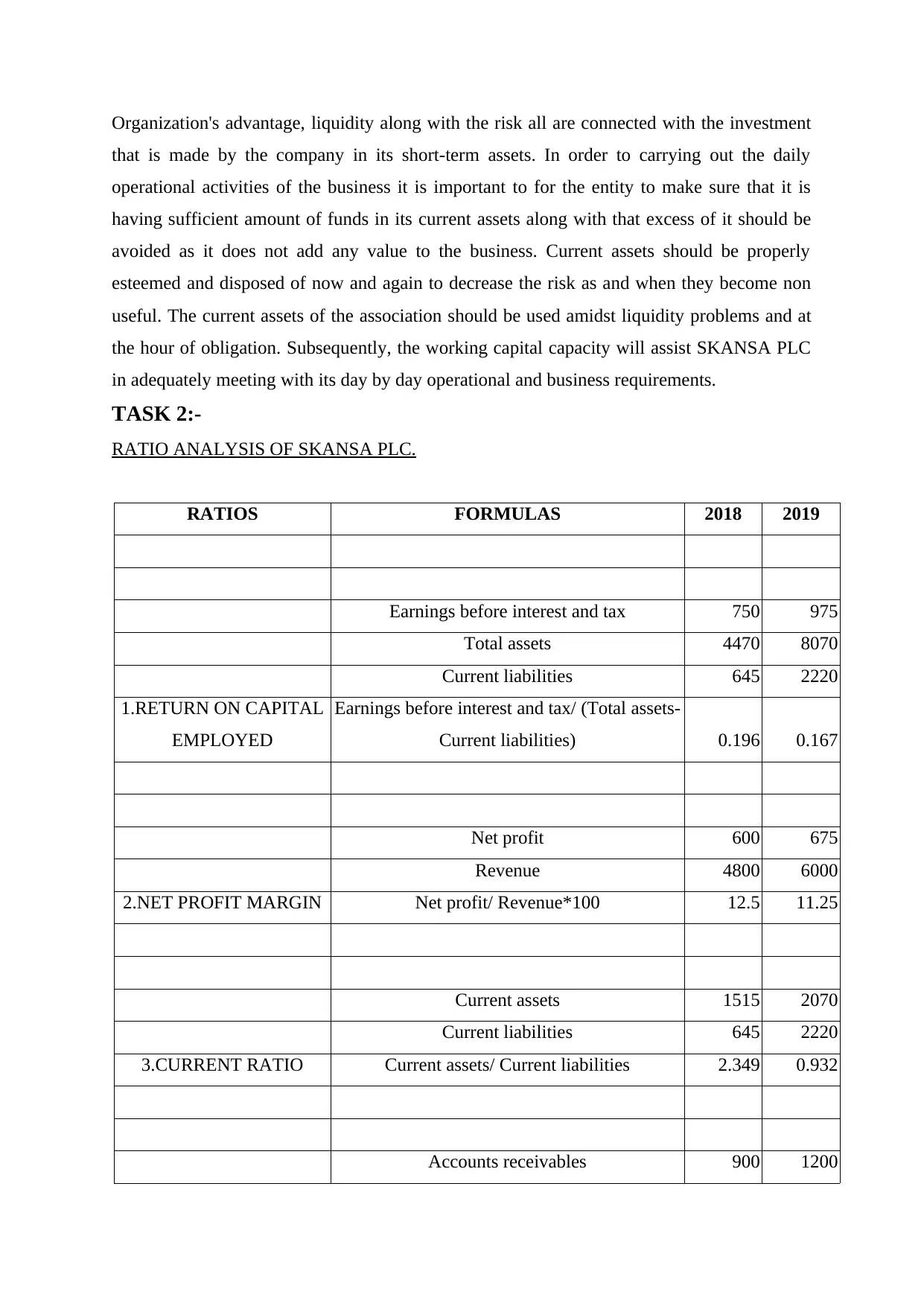
RATIOS FORMULAS 2018 2019
Earnings before interest and tax 750 975
Total assets 4470 8070
Current liabilities 645 2220
1.RETURN ON CAPITAL
EMPLOYED
Earnings before interest and tax/ (Total assets-
Current liabilities) 0.196 0.167
Net profit 600 675
Revenue 4800 6000
2.NET PROFIT MARGIN Net profit/ Revenue*100 12.5 11.25
Current assets 1515 2070
Current liabilities 645 2220
3.CURRENT RATIO Current assets/ Current liabilities 2.349 0.932
Accounts receivables 900 1200
that is made by the company in its short-term assets. In order to carrying out the daily
operational activities of the business it is important to for the entity to make sure that it is
having sufficient amount of funds in its current assets along with that excess of it should be
avoided as it does not add any value to the business. Current assets should be properly
esteemed and disposed of now and again to decrease the risk as and when they become non
useful. The current assets of the association should be used amidst liquidity problems and at
the hour of obligation. Subsequently, the working capital capacity will assist SKANSA PLC
in adequately meeting with its day by day operational and business requirements.
TASK 2:-
RATIO ANALYSIS OF SKANSA PLC.
RATIOS FORMULAS 2018 2019
Earnings before interest and tax 750 975
Total assets 4470 8070
Current liabilities 645 2220
1.RETURN ON CAPITAL
EMPLOYED
Earnings before interest and tax/ (Total assets-
Current liabilities) 0.196 0.167
Net profit 600 675
Revenue 4800 6000
2.NET PROFIT MARGIN Net profit/ Revenue*100 12.5 11.25
Current assets 1515 2070
Current liabilities 645 2220
3.CURRENT RATIO Current assets/ Current liabilities 2.349 0.932
Accounts receivables 900 1200
Paraphrase This Document
Need a fresh take? Get an instant paraphrase of this document with our AI Paraphraser
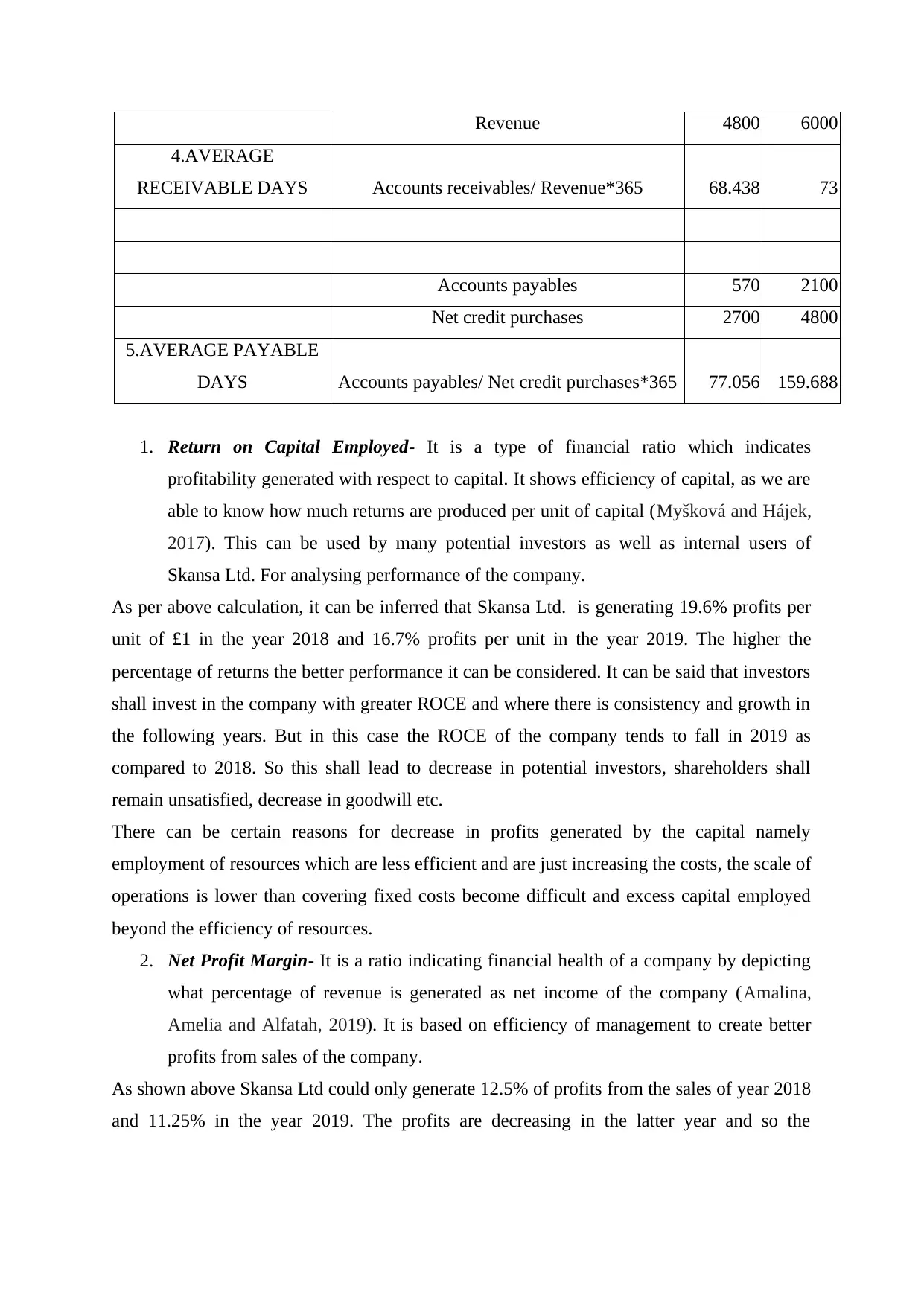
Revenue 4800 6000
4.AVERAGE
RECEIVABLE DAYS Accounts receivables/ Revenue*365 68.438 73
Accounts payables 570 2100
Net credit purchases 2700 4800
5.AVERAGE PAYABLE
DAYS Accounts payables/ Net credit purchases*365 77.056 159.688
1. Return on Capital Employed- It is a type of financial ratio which indicates
profitability generated with respect to capital. It shows efficiency of capital, as we are
able to know how much returns are produced per unit of capital (Myšková and Hájek,
2017). This can be used by many potential investors as well as internal users of
Skansa Ltd. For analysing performance of the company.
As per above calculation, it can be inferred that Skansa Ltd. is generating 19.6% profits per
unit of £1 in the year 2018 and 16.7% profits per unit in the year 2019. The higher the
percentage of returns the better performance it can be considered. It can be said that investors
shall invest in the company with greater ROCE and where there is consistency and growth in
the following years. But in this case the ROCE of the company tends to fall in 2019 as
compared to 2018. So this shall lead to decrease in potential investors, shareholders shall
remain unsatisfied, decrease in goodwill etc.
There can be certain reasons for decrease in profits generated by the capital namely
employment of resources which are less efficient and are just increasing the costs, the scale of
operations is lower than covering fixed costs become difficult and excess capital employed
beyond the efficiency of resources.
2. Net Profit Margin- It is a ratio indicating financial health of a company by depicting
what percentage of revenue is generated as net income of the company (Amalina,
Amelia and Alfatah, 2019). It is based on efficiency of management to create better
profits from sales of the company.
As shown above Skansa Ltd could only generate 12.5% of profits from the sales of year 2018
and 11.25% in the year 2019. The profits are decreasing in the latter year and so the
4.AVERAGE
RECEIVABLE DAYS Accounts receivables/ Revenue*365 68.438 73
Accounts payables 570 2100
Net credit purchases 2700 4800
5.AVERAGE PAYABLE
DAYS Accounts payables/ Net credit purchases*365 77.056 159.688
1. Return on Capital Employed- It is a type of financial ratio which indicates
profitability generated with respect to capital. It shows efficiency of capital, as we are
able to know how much returns are produced per unit of capital (Myšková and Hájek,
2017). This can be used by many potential investors as well as internal users of
Skansa Ltd. For analysing performance of the company.
As per above calculation, it can be inferred that Skansa Ltd. is generating 19.6% profits per
unit of £1 in the year 2018 and 16.7% profits per unit in the year 2019. The higher the
percentage of returns the better performance it can be considered. It can be said that investors
shall invest in the company with greater ROCE and where there is consistency and growth in
the following years. But in this case the ROCE of the company tends to fall in 2019 as
compared to 2018. So this shall lead to decrease in potential investors, shareholders shall
remain unsatisfied, decrease in goodwill etc.
There can be certain reasons for decrease in profits generated by the capital namely
employment of resources which are less efficient and are just increasing the costs, the scale of
operations is lower than covering fixed costs become difficult and excess capital employed
beyond the efficiency of resources.
2. Net Profit Margin- It is a ratio indicating financial health of a company by depicting
what percentage of revenue is generated as net income of the company (Amalina,
Amelia and Alfatah, 2019). It is based on efficiency of management to create better
profits from sales of the company.
As shown above Skansa Ltd could only generate 12.5% of profits from the sales of year 2018
and 11.25% in the year 2019. The profits are decreasing in the latter year and so the
performance can be said to be degraded. The shareholders shall receive lower returns on their
investments.
The main reason behind such fall is increase in the finance cost, which has doubled as
compared to the previous year as seen in the financial statements of Skansa Ltd. Another
important cause for the same shall be increase in costs due to decrease in the efficiency level.
3. Current Ratio- It can also be called as working capital ratio determining the level of
liquidity in the company. It shows the ability that Skansa Ltd possess to pay its short
term liabilities (Vintilă and Nenu, 2016). The company must at least have sufficient
liquidity to meet up its obligations arising within a year.
The ratios calculated above reflects that Skansa Ltd has more than double liquidity in 2018 to
meet its liabilities which is 2.3 and even less than 1 in the year 2019 which is 0.93. The
current ratio of 2019 is alarming as it does have even enough to meet obligations in that year.
It shall suffer shortfall of liquidity and will have to make borrowings to pay the debts.
The reasons for such a poor current ratio can be poor management of cash flows, poor
investment decision as majority of investments are long term and so the company should plan
investing in marketable securities, also the company may be having improper collection team
who are not recovering debts on time etc. by working on such causes company can improve
its current ratio.
4. Average Receivables days- This represents the average number of days a company
takes to convert its credit sales into cash. The time taken by the recovering team to
collect payments from the debtors after the sales accrue (Accounts receivable days.
2020). It is a complete cycle which runs as soon as the payment is received like
purchase of raw material and its conversion. The sooner the company recovers
payment the better it is as it has the opportunity to employ that excess amount and can
generate higher returns. It can also be used as a benchmark to interpret the cash flows
of the company.
The figures indicate that in the year 2018 the company averagely takes 68 days to recover
after making sales and comparatively in the year 2019 it takes 73 days for the same. Through
this it can be collected that efficiency of the recovery team is decreasing and because of
which the complete operating cycle shall be postponed.
The reasons for such delay could be possibly lack of efficient negotiation with the customers
and poor market conditions. Sometimes such delay is with respect to type of business or
goods sold.
investments.
The main reason behind such fall is increase in the finance cost, which has doubled as
compared to the previous year as seen in the financial statements of Skansa Ltd. Another
important cause for the same shall be increase in costs due to decrease in the efficiency level.
3. Current Ratio- It can also be called as working capital ratio determining the level of
liquidity in the company. It shows the ability that Skansa Ltd possess to pay its short
term liabilities (Vintilă and Nenu, 2016). The company must at least have sufficient
liquidity to meet up its obligations arising within a year.
The ratios calculated above reflects that Skansa Ltd has more than double liquidity in 2018 to
meet its liabilities which is 2.3 and even less than 1 in the year 2019 which is 0.93. The
current ratio of 2019 is alarming as it does have even enough to meet obligations in that year.
It shall suffer shortfall of liquidity and will have to make borrowings to pay the debts.
The reasons for such a poor current ratio can be poor management of cash flows, poor
investment decision as majority of investments are long term and so the company should plan
investing in marketable securities, also the company may be having improper collection team
who are not recovering debts on time etc. by working on such causes company can improve
its current ratio.
4. Average Receivables days- This represents the average number of days a company
takes to convert its credit sales into cash. The time taken by the recovering team to
collect payments from the debtors after the sales accrue (Accounts receivable days.
2020). It is a complete cycle which runs as soon as the payment is received like
purchase of raw material and its conversion. The sooner the company recovers
payment the better it is as it has the opportunity to employ that excess amount and can
generate higher returns. It can also be used as a benchmark to interpret the cash flows
of the company.
The figures indicate that in the year 2018 the company averagely takes 68 days to recover
after making sales and comparatively in the year 2019 it takes 73 days for the same. Through
this it can be collected that efficiency of the recovery team is decreasing and because of
which the complete operating cycle shall be postponed.
The reasons for such delay could be possibly lack of efficient negotiation with the customers
and poor market conditions. Sometimes such delay is with respect to type of business or
goods sold.
⊘ This is a preview!⊘
Do you want full access?
Subscribe today to unlock all pages.
Trusted by 1+ million students worldwide
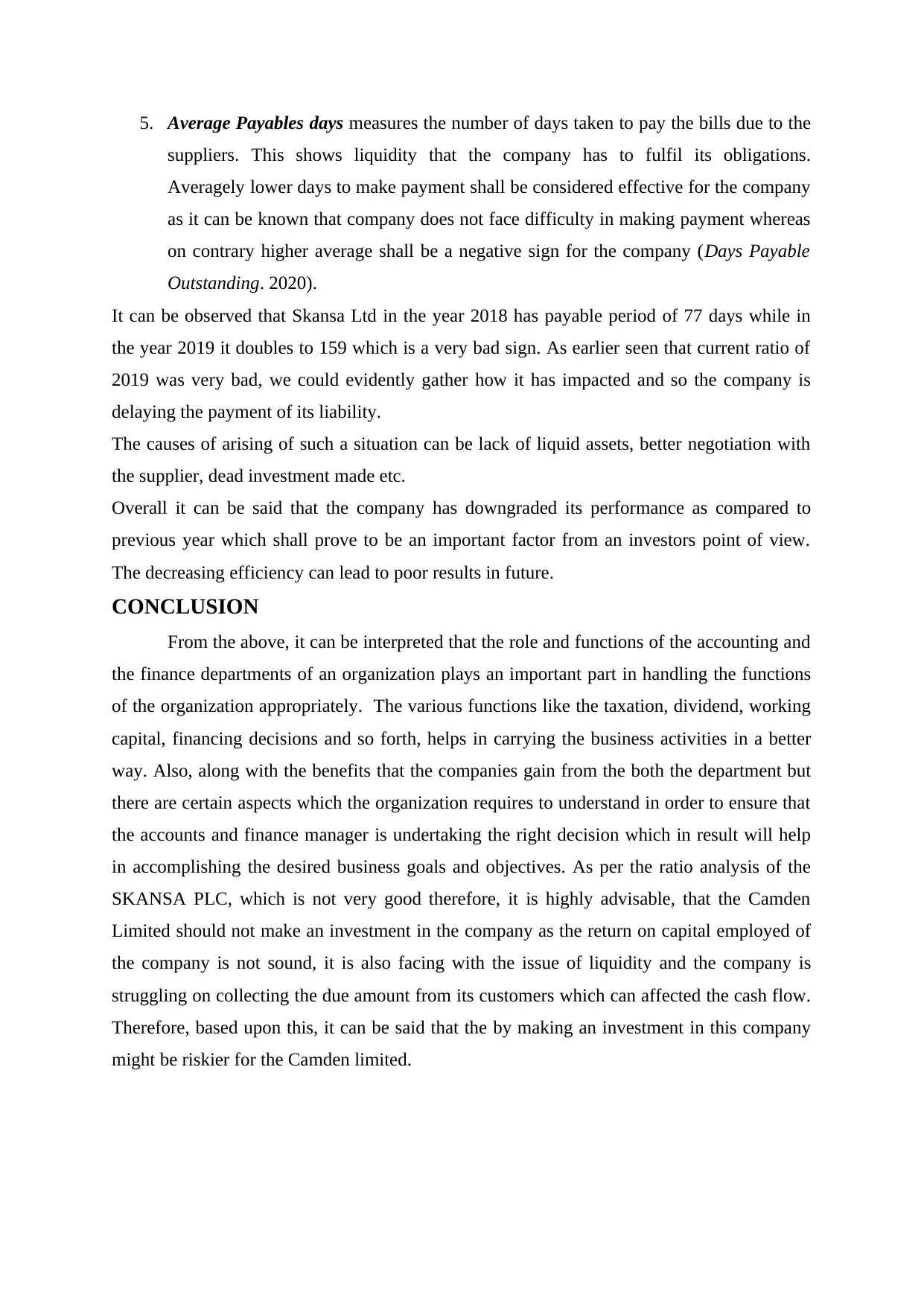
5. Average Payables days measures the number of days taken to pay the bills due to the
suppliers. This shows liquidity that the company has to fulfil its obligations.
Averagely lower days to make payment shall be considered effective for the company
as it can be known that company does not face difficulty in making payment whereas
on contrary higher average shall be a negative sign for the company (Days Payable
Outstanding. 2020).
It can be observed that Skansa Ltd in the year 2018 has payable period of 77 days while in
the year 2019 it doubles to 159 which is a very bad sign. As earlier seen that current ratio of
2019 was very bad, we could evidently gather how it has impacted and so the company is
delaying the payment of its liability.
The causes of arising of such a situation can be lack of liquid assets, better negotiation with
the supplier, dead investment made etc.
Overall it can be said that the company has downgraded its performance as compared to
previous year which shall prove to be an important factor from an investors point of view.
The decreasing efficiency can lead to poor results in future.
CONCLUSION
From the above, it can be interpreted that the role and functions of the accounting and
the finance departments of an organization plays an important part in handling the functions
of the organization appropriately. The various functions like the taxation, dividend, working
capital, financing decisions and so forth, helps in carrying the business activities in a better
way. Also, along with the benefits that the companies gain from the both the department but
there are certain aspects which the organization requires to understand in order to ensure that
the accounts and finance manager is undertaking the right decision which in result will help
in accomplishing the desired business goals and objectives. As per the ratio analysis of the
SKANSA PLC, which is not very good therefore, it is highly advisable, that the Camden
Limited should not make an investment in the company as the return on capital employed of
the company is not sound, it is also facing with the issue of liquidity and the company is
struggling on collecting the due amount from its customers which can affected the cash flow.
Therefore, based upon this, it can be said that the by making an investment in this company
might be riskier for the Camden limited.
suppliers. This shows liquidity that the company has to fulfil its obligations.
Averagely lower days to make payment shall be considered effective for the company
as it can be known that company does not face difficulty in making payment whereas
on contrary higher average shall be a negative sign for the company (Days Payable
Outstanding. 2020).
It can be observed that Skansa Ltd in the year 2018 has payable period of 77 days while in
the year 2019 it doubles to 159 which is a very bad sign. As earlier seen that current ratio of
2019 was very bad, we could evidently gather how it has impacted and so the company is
delaying the payment of its liability.
The causes of arising of such a situation can be lack of liquid assets, better negotiation with
the supplier, dead investment made etc.
Overall it can be said that the company has downgraded its performance as compared to
previous year which shall prove to be an important factor from an investors point of view.
The decreasing efficiency can lead to poor results in future.
CONCLUSION
From the above, it can be interpreted that the role and functions of the accounting and
the finance departments of an organization plays an important part in handling the functions
of the organization appropriately. The various functions like the taxation, dividend, working
capital, financing decisions and so forth, helps in carrying the business activities in a better
way. Also, along with the benefits that the companies gain from the both the department but
there are certain aspects which the organization requires to understand in order to ensure that
the accounts and finance manager is undertaking the right decision which in result will help
in accomplishing the desired business goals and objectives. As per the ratio analysis of the
SKANSA PLC, which is not very good therefore, it is highly advisable, that the Camden
Limited should not make an investment in the company as the return on capital employed of
the company is not sound, it is also facing with the issue of liquidity and the company is
struggling on collecting the due amount from its customers which can affected the cash flow.
Therefore, based upon this, it can be said that the by making an investment in this company
might be riskier for the Camden limited.
Paraphrase This Document
Need a fresh take? Get an instant paraphrase of this document with our AI Paraphraser
REFERENCES
Books and Journals
Ajanaku, E. A. and Ekundayo, O. A., 2017. WORKING CAPITAL MANAGEMENT AND
ORGANIZATION PERFORMANCE: THE RELATIONSHIP BETWEEN
WORKING CAPITAL MANAGEMENT AND ACCOUNT RECEIVABLE.
Amalina, N., Amelia, F. and Alfatah, W., 2019. Analysis Effect of Profitability Ratio,
Leverage Ratio, Audit Committee and Public Accounting Firm Size on Audit
Delay. Indonesian Management and Accounting Research. 17(1). pp.36-52.
KHARITONOVICH, A.V., 2020. Management functions of the investment and construction
complex. Management. 41(08). p.16.
Lenartowicz, M., 2018. Financing organizational changes from without. Journal of
Accounting & Organizational Change.
Luccasen, R. A. and Thomas, M. K., 2020. Voluntary taxation and the arts. Journal of
Cultural Economics. pp.1-16.
Mansor, M., 2018. Integrated internal audit model for effective internal auditing performance
in Nigerian tax administration. Asian Journal of Economics, Business and
Accounting. pp.1-7.
Myšková, R. and Hájek, P., 2017. Comprehensive assessment of firm financial performance
using financial ratios and linguistic analysis of annual reports. Journal of
International Studies, volume 10, issue: 4.
Oyewo, B., 2017. Predictors of the effectiveness of management accounting function in
Nigerian firms. Scientific Annals of Economics and Business. 64(4). pp.487-512.
Trong, N. N. and Nguyen, C. T., 2020. Firm performance: the moderation impact of debt and
dividend policies on overinvestment. Journal of Asian Business and Economic
Studies.
Vintilă, G. and Nenu, E. A., 2016. Liquidity and profitability analysis on the Romanian listed
companies. Journal of Eastern Europe research in business & economics, 2016,
pp.1-8.
Zahid, N. A. and Vagif, L. M., 2020. ROLE OF MANAGEMENT ACCOUNTING IN THE
ORGANIZATION. Economic and Social Development: Book of Proceedings. 3.
pp.367-372.
Online
Accounts receivable days. 2020. [Online]. Available Through:<
https://www.accountingtools.com/articles/what-is-accounts-receivable-days.html>.
Days Payable Outstanding. 2020. [Online]. Available Through:<
https://www.wallstreetmojo.com/days-payable-outstanding/>.
Books and Journals
Ajanaku, E. A. and Ekundayo, O. A., 2017. WORKING CAPITAL MANAGEMENT AND
ORGANIZATION PERFORMANCE: THE RELATIONSHIP BETWEEN
WORKING CAPITAL MANAGEMENT AND ACCOUNT RECEIVABLE.
Amalina, N., Amelia, F. and Alfatah, W., 2019. Analysis Effect of Profitability Ratio,
Leverage Ratio, Audit Committee and Public Accounting Firm Size on Audit
Delay. Indonesian Management and Accounting Research. 17(1). pp.36-52.
KHARITONOVICH, A.V., 2020. Management functions of the investment and construction
complex. Management. 41(08). p.16.
Lenartowicz, M., 2018. Financing organizational changes from without. Journal of
Accounting & Organizational Change.
Luccasen, R. A. and Thomas, M. K., 2020. Voluntary taxation and the arts. Journal of
Cultural Economics. pp.1-16.
Mansor, M., 2018. Integrated internal audit model for effective internal auditing performance
in Nigerian tax administration. Asian Journal of Economics, Business and
Accounting. pp.1-7.
Myšková, R. and Hájek, P., 2017. Comprehensive assessment of firm financial performance
using financial ratios and linguistic analysis of annual reports. Journal of
International Studies, volume 10, issue: 4.
Oyewo, B., 2017. Predictors of the effectiveness of management accounting function in
Nigerian firms. Scientific Annals of Economics and Business. 64(4). pp.487-512.
Trong, N. N. and Nguyen, C. T., 2020. Firm performance: the moderation impact of debt and
dividend policies on overinvestment. Journal of Asian Business and Economic
Studies.
Vintilă, G. and Nenu, E. A., 2016. Liquidity and profitability analysis on the Romanian listed
companies. Journal of Eastern Europe research in business & economics, 2016,
pp.1-8.
Zahid, N. A. and Vagif, L. M., 2020. ROLE OF MANAGEMENT ACCOUNTING IN THE
ORGANIZATION. Economic and Social Development: Book of Proceedings. 3.
pp.367-372.
Online
Accounts receivable days. 2020. [Online]. Available Through:<
https://www.accountingtools.com/articles/what-is-accounts-receivable-days.html>.
Days Payable Outstanding. 2020. [Online]. Available Through:<
https://www.wallstreetmojo.com/days-payable-outstanding/>.

1 out of 11


Related Documents


Your All-in-One AI-Powered Toolkit for Academic Success.
+13062052269
info@desklib.com
Available 24*7 on WhatsApp / Email
![[object Object]](/_next/static/media/star-bottom.7253800d.svg)
Unlock your academic potential
Copyright © 2020–2026 A2Z Services. All Rights Reserved. Developed and managed by ZUCOL.