Financial Decision Making Report: Accounting Techniques at Tesco
VerifiedAdded on 2023/01/12
|14
|4128
|31
Report
AI Summary
This report delves into the realm of financial decision-making, emphasizing the crucial role of management accounting techniques within organizations. Using Tesco as a case study, the report evaluates the application of techniques such as financial planning, budgetary control, margin analysis, and cash flow statement analysis in the context of organizational planning, control, and decision-making processes. It explores how these techniques facilitate effective management and contribute to achieving organizational objectives. The analysis includes an assessment of how these techniques can be strategically applied to enhance business practices, ultimately leading to improved financial outcomes and sustainable growth. The report also touches on the importance of skilled personnel for the successful implementation of these techniques. The report concludes by highlighting the significance of financial decision-making and management accounting techniques in driving organizational success.

Financial Decision Making

Paraphrase This Document
Need a fresh take? Get an instant paraphrase of this document with our AI Paraphraser
TABLE OF CONTENTS
INTRODUCTION......................................................................................................................3
MAIN BODY.............................................................................................................................3
Role of management accounting techniques..........................................................................3
EVALUATION..........................................................................................................................5
CONCLUSION..........................................................................................................................6
REFERENCES...........................................................................................................................7
INTRODUCTION......................................................................................................................3
MAIN BODY.............................................................................................................................3
Role of management accounting techniques..........................................................................3
EVALUATION..........................................................................................................................5
CONCLUSION..........................................................................................................................6
REFERENCES...........................................................................................................................7
INTRODUCTION
Financial decision making is the process in which decisions are made with respect to the
managing finance of the business. Management accounting plays a key role in taking various financial
decisions of the business which are based on the information mainly available to the internal
management team. This information is not disclosed to outsiders. There are different roles of
accounting and finance which has great importance in the businesses. It does not have its own theory
but is borrowed from the other fields like economics and sociology. As per the agency theory, which
is a branch of finance economics whose main objective is to look into the conflicts between
shareholders and managers and works with the purpose to align goals in such a way that no conflict
arises (KOPP, 2019). Also, according to positive accounting theory, derived from contracting
literature in economics, which explains the consequences of interest of managers and financial
accounting and reporting (Kaya, 2017). It translates the predictions of real-world events into
accounting terms. In this, the firms can maximize their prospects for future survival by efficiently
organizing themselves. All this makes the role of accounting and finance very important and crucial.
In this report, Tesco is taken as an organization. It is the British multinational retailer,
headquartered in UK. It was founded in 1919. It has diversified its products into books, clothing,
furniture, software, financial services, internet services etc. Tesco has effectively implemented
management accounting techniques which helps it in effective management of its business (Palermo,
2017). The key management accounting techniques implemented by Tesco are capital budgeting,
margin analysis, cash flow statement analysis and financial planning. This report is about evaluating
the role of management accounting techniques in the process of organizational planning, controlling
and decision-making process. Also, critically evaluating how it can be applied for enhancing the
organization’s practices.
MAIN BODY
Role of management accounting techniques
There are different management accounting techniques that are used by the organizations with
the sole purpose to do effective planning, controlling and decision making (Nespeca and Chiucchi,
2018). It is very much required to analyse the various events and operational metrics for converting
data into useful information which can be used by the management for better decision making. Some
of the techniques are stated below.
Financial planning
Financial planning helps in determining the capital required for accomplishing the business
plan. It is the process in which a complete plan is formulated for achieving the required objective after
taking into consideration the market and competitor analysis, resources required and available both
Financial decision making is the process in which decisions are made with respect to the
managing finance of the business. Management accounting plays a key role in taking various financial
decisions of the business which are based on the information mainly available to the internal
management team. This information is not disclosed to outsiders. There are different roles of
accounting and finance which has great importance in the businesses. It does not have its own theory
but is borrowed from the other fields like economics and sociology. As per the agency theory, which
is a branch of finance economics whose main objective is to look into the conflicts between
shareholders and managers and works with the purpose to align goals in such a way that no conflict
arises (KOPP, 2019). Also, according to positive accounting theory, derived from contracting
literature in economics, which explains the consequences of interest of managers and financial
accounting and reporting (Kaya, 2017). It translates the predictions of real-world events into
accounting terms. In this, the firms can maximize their prospects for future survival by efficiently
organizing themselves. All this makes the role of accounting and finance very important and crucial.
In this report, Tesco is taken as an organization. It is the British multinational retailer,
headquartered in UK. It was founded in 1919. It has diversified its products into books, clothing,
furniture, software, financial services, internet services etc. Tesco has effectively implemented
management accounting techniques which helps it in effective management of its business (Palermo,
2017). The key management accounting techniques implemented by Tesco are capital budgeting,
margin analysis, cash flow statement analysis and financial planning. This report is about evaluating
the role of management accounting techniques in the process of organizational planning, controlling
and decision-making process. Also, critically evaluating how it can be applied for enhancing the
organization’s practices.
MAIN BODY
Role of management accounting techniques
There are different management accounting techniques that are used by the organizations with
the sole purpose to do effective planning, controlling and decision making (Nespeca and Chiucchi,
2018). It is very much required to analyse the various events and operational metrics for converting
data into useful information which can be used by the management for better decision making. Some
of the techniques are stated below.
Financial planning
Financial planning helps in determining the capital required for accomplishing the business
plan. It is the process in which a complete plan is formulated for achieving the required objective after
taking into consideration the market and competitor analysis, resources required and available both
⊘ This is a preview!⊘
Do you want full access?
Subscribe today to unlock all pages.

Trusted by 1+ million students worldwide
financial and non-financial (Pradhan, Swain and Dash, 2018). This technique is implemented by
Tesco which helps in reducing the impact of uncertainty and also helps in ensuring stability and
profitability of the organization. The financial plan has the complete details about the different
sources of finance from where funds can be arranged for effective implementation of business plan for
achieving growth and success.
Budgetary control
This technique is mainly concerned with the all the relevant information which are required
for taking necessary decisions with respect to capital and revenue expenditure. It is the way to control
the organization where multiple budgets are made as per the requirement. Tesco uses budgetary
control which helps it in identifying its weak points so that correction actions can be taken
(Miyazhdenovna and et.al, 2020). It mostly uses variance analysis for managing its performance and
productivity. These budgets are prepared based on trend analysis and forecasting which helps
identifying the changing market trends based on which budgets are set.
Margin analysis
This analysis is mostly concerned with the additional or incremental benefits that is arising
from the increased production. This technique is the most essential in management accounting as it
analyses the complexities present in the system and tries to find a way to maximize profits ( Yassin
and Guindy, 2017). Tesco uses this technique because it includes break even point analysis and cost
volume profit which provides information which assist in taking better decisions. It is used as a profit
maximization tool which performs cost benefit analysis for every marginal change in the number of
products produced. It shows how an increment in production can impact the business operation.
Cash flow statement analysis
This technique is very helped for the business entities as it will indicate from where the cash
is generated and the application of it over a specific period. It is important for analysing the liquidity
and solvency position of the business. It is segmented into operating activities, investing activities and
financing activities (Golyagina and Valuckas, 2016). Tesco uses this as it helps it in identifying the
various sources of cash and also how much cash flow it is having from it operating activities which is
very important. This helps in knowing the cash flow position of the business in respect to the ability
of the business carry out its day to day business activities and meeting its short-term obligations.
Tesco which helps in reducing the impact of uncertainty and also helps in ensuring stability and
profitability of the organization. The financial plan has the complete details about the different
sources of finance from where funds can be arranged for effective implementation of business plan for
achieving growth and success.
Budgetary control
This technique is mainly concerned with the all the relevant information which are required
for taking necessary decisions with respect to capital and revenue expenditure. It is the way to control
the organization where multiple budgets are made as per the requirement. Tesco uses budgetary
control which helps it in identifying its weak points so that correction actions can be taken
(Miyazhdenovna and et.al, 2020). It mostly uses variance analysis for managing its performance and
productivity. These budgets are prepared based on trend analysis and forecasting which helps
identifying the changing market trends based on which budgets are set.
Margin analysis
This analysis is mostly concerned with the additional or incremental benefits that is arising
from the increased production. This technique is the most essential in management accounting as it
analyses the complexities present in the system and tries to find a way to maximize profits ( Yassin
and Guindy, 2017). Tesco uses this technique because it includes break even point analysis and cost
volume profit which provides information which assist in taking better decisions. It is used as a profit
maximization tool which performs cost benefit analysis for every marginal change in the number of
products produced. It shows how an increment in production can impact the business operation.
Cash flow statement analysis
This technique is very helped for the business entities as it will indicate from where the cash
is generated and the application of it over a specific period. It is important for analysing the liquidity
and solvency position of the business. It is segmented into operating activities, investing activities and
financing activities (Golyagina and Valuckas, 2016). Tesco uses this as it helps it in identifying the
various sources of cash and also how much cash flow it is having from it operating activities which is
very important. This helps in knowing the cash flow position of the business in respect to the ability
of the business carry out its day to day business activities and meeting its short-term obligations.
Paraphrase This Document
Need a fresh take? Get an instant paraphrase of this document with our AI Paraphraser
All these techniques play an important role in organization’s planning, controlling and
decision-making process.
EVALUATION
Planning, controlling and decision making all these three are very important part of the
management process. All these together enables the employees to work towards achieving the
objectives of the organization (KÖSE and AĞDENİZ, 2019). Planning has an essential role in the
growth and sustainability of the entity which requires the manager to understand the current position
of the business and identify the areas of important. Tesco Group conducts an annual strategic planning
process which includes complete assessment of its objectives and evaluation of long-term
opportunities. The Chief Operating Decision Maker (CODM) monitors and evaluates the performance
based on which it takes decisions (Annual Report and Financial Statements. 2019). Management
accounting (MA) techniques is very significant as it provides important information based on the past
performance which play a critical role in planning process for the future performance. MA helps in
establishing the budget essential in planning. The Board of the company is the main decision taking
body and has taken into consideration financial performance and budgets, long term planning and
annual budget which has helped it in attaining its objectives. The margin analysis, financial planning
and budgetary controls are very effective in formulating plan, exercising control and taking better
decisions (Taylor, 2018). The company was able to effectively reach its gross operating margin of
3.45% in 2019. The cash flow analysis is also very useful in effective planning as it will provide
details about the cash available with the company to meet its daily requirement and also the minimum
cash it required to run the business smoothly for specific period. MA is also useful in control process
as based on the budgets prepared actual results are compared which helps in determining any
variances in the result. If there are any difference, the reason for the same is identified and relevant
and corrective actions are taken to reduce the variance. These techniques established certain control
parameters which warns the managers about the uncertain activities or events which were not earlier
included in the plan (TUOVILA, 2020). Identification of these events are critical in ensuring the
objective of the organization will be achieved or not.
Different MA techniques are used by the organization which helps in taking proper decisions
such as what should be sold, whether to invest in machinery or not. These techniques help in
determining the optimum activities required for effective production. It helps in gathering various
relevant information considering the different aspects of the business which helps in undertaking
proper evaluation based on which decision is taken. This decision is for the achieving the
organizational objectives as per the plan and within the budget set. It helps in growth and
sustainability of the business (El-Shishini, 2017). But, in order to execute and implement these
techniques requires highly skilled personnel having experience in planning, control and effective
decision making. Thus, it can be said that management accounting techniques have a very important
decision-making process.
EVALUATION
Planning, controlling and decision making all these three are very important part of the
management process. All these together enables the employees to work towards achieving the
objectives of the organization (KÖSE and AĞDENİZ, 2019). Planning has an essential role in the
growth and sustainability of the entity which requires the manager to understand the current position
of the business and identify the areas of important. Tesco Group conducts an annual strategic planning
process which includes complete assessment of its objectives and evaluation of long-term
opportunities. The Chief Operating Decision Maker (CODM) monitors and evaluates the performance
based on which it takes decisions (Annual Report and Financial Statements. 2019). Management
accounting (MA) techniques is very significant as it provides important information based on the past
performance which play a critical role in planning process for the future performance. MA helps in
establishing the budget essential in planning. The Board of the company is the main decision taking
body and has taken into consideration financial performance and budgets, long term planning and
annual budget which has helped it in attaining its objectives. The margin analysis, financial planning
and budgetary controls are very effective in formulating plan, exercising control and taking better
decisions (Taylor, 2018). The company was able to effectively reach its gross operating margin of
3.45% in 2019. The cash flow analysis is also very useful in effective planning as it will provide
details about the cash available with the company to meet its daily requirement and also the minimum
cash it required to run the business smoothly for specific period. MA is also useful in control process
as based on the budgets prepared actual results are compared which helps in determining any
variances in the result. If there are any difference, the reason for the same is identified and relevant
and corrective actions are taken to reduce the variance. These techniques established certain control
parameters which warns the managers about the uncertain activities or events which were not earlier
included in the plan (TUOVILA, 2020). Identification of these events are critical in ensuring the
objective of the organization will be achieved or not.
Different MA techniques are used by the organization which helps in taking proper decisions
such as what should be sold, whether to invest in machinery or not. These techniques help in
determining the optimum activities required for effective production. It helps in gathering various
relevant information considering the different aspects of the business which helps in undertaking
proper evaluation based on which decision is taken. This decision is for the achieving the
organizational objectives as per the plan and within the budget set. It helps in growth and
sustainability of the business (El-Shishini, 2017). But, in order to execute and implement these
techniques requires highly skilled personnel having experience in planning, control and effective
decision making. Thus, it can be said that management accounting techniques have a very important
and crucial role to play in for effectively managing the planning, controlling and decision making of
the organization.
These MA techniques can be effectively applied as per the business requirement like in Tesco
margin analysis, budgetary control, cashflow statement analysis are used. Margin analysis can eb
applied when the business is looking for expanding its business or introducing new product in the
market (Jarwal, 2018). Budgetary control can be used to achieve the estimated target based on the
market research and past performance. Cash flow statement analysis will be used for knowing the
liquidity position of the business and funds available to meet the short term needs before investing
into new project or plan. Thus, in this way it can be applied for enhancing the business practice.
CONCLUSION
From the above it can be concluded that management accounting techniques has an important
part to play in the business. It provides complete assistance to the organization in varied ways for
meeting the organizational needs. These techniques help in effective management of the business
activities with respect to the plan set up by the organization. These techniques have clearly shown the
role of account and finance in an organization. The benefits associated with financial planning,
budgetary control, margin analysis etc. is extremely high and can be effectively and actively used by
the businesses with further enhancing their practices. It can result into accomplishing the
organizational goals and objective in an efficient and rightly and reduces any loss that may arise
because of uncertainty. Thus, it can be said that financial decision making is the crucial part for very
organization as each and every aspect is required to be studied before taking any decision. For making
it right, the various management accounting techniques are developed which has an important role to
play in planning, controlling and in taking effective decisions. Therefore, financial decision making
along with management accounting techniques is very essential.
the organization.
These MA techniques can be effectively applied as per the business requirement like in Tesco
margin analysis, budgetary control, cashflow statement analysis are used. Margin analysis can eb
applied when the business is looking for expanding its business or introducing new product in the
market (Jarwal, 2018). Budgetary control can be used to achieve the estimated target based on the
market research and past performance. Cash flow statement analysis will be used for knowing the
liquidity position of the business and funds available to meet the short term needs before investing
into new project or plan. Thus, in this way it can be applied for enhancing the business practice.
CONCLUSION
From the above it can be concluded that management accounting techniques has an important
part to play in the business. It provides complete assistance to the organization in varied ways for
meeting the organizational needs. These techniques help in effective management of the business
activities with respect to the plan set up by the organization. These techniques have clearly shown the
role of account and finance in an organization. The benefits associated with financial planning,
budgetary control, margin analysis etc. is extremely high and can be effectively and actively used by
the businesses with further enhancing their practices. It can result into accomplishing the
organizational goals and objective in an efficient and rightly and reduces any loss that may arise
because of uncertainty. Thus, it can be said that financial decision making is the crucial part for very
organization as each and every aspect is required to be studied before taking any decision. For making
it right, the various management accounting techniques are developed which has an important role to
play in planning, controlling and in taking effective decisions. Therefore, financial decision making
along with management accounting techniques is very essential.
⊘ This is a preview!⊘
Do you want full access?
Subscribe today to unlock all pages.
Trusted by 1+ million students worldwide
REFERENCES
Books and Journals
El-Shishini, H. M., 2017. The use of management accounting techniques at hotels in Bahrain. Review
of Integrative Business and Economics Research. 6(2). p.78.
Golyagina, A. and Valuckas, D., 2016. Representation of knowledge on some management
accounting techniques in textbooks. Accounting Education. 25(5). pp.479-501.
Jarwal, C. S., 2018. Management Accounting: A Tool to Achieve Entrepreneurial Goals. IUP Journal
of Accounting Research & Audit Practices. 17(4).
KÖSE, T. and AĞDENİZ, Ş., 2019. The Role of Management Accounting in Risk
Management. Journal of Accounting & Finance.
Miyazhdenovna, N. and et.al, 2020. The role of management accounting techniques in determining
the relationship between purchasing and supplier management: A case study of retail firms in
Kazakhstan. Uncertain Supply Chain Management. 8(1). pp.149-164.
Nespeca, A. and Chiucchi, M. S., 2018. The impact of business intelligence systems on management
accounting systems: The consultant’s perspective. In Network, smart and open (pp. 283-297).
Springer, Cham.
Pradhan, D., Swain, P. K. and Dash, M., 2018. Effect of management accounting techniques on
supply chain and firm performance: An empirical study. International Journal of Mechanical
Engineering and Technology. 9(5). pp.1049-1057.
Yassin, M. and Guindy, M. E., 2017. Management Accounting Change and the Contemporary
Business Environment: An Article Review. Journal of Empirical Research in Accounting &
Auditing. 4(01). pp.7-22.
Kaya, İ., 2017. Accounting Choices in Corporate Financial Reporting: A Literature Review of
Positive Accounting Theory. Accounting and Corporate Reporting. p.129.
Palermo, T., 2017. Risk and performance management. The Routledge Companion to Accounting and
Risk, p.137.
Online
TUOVILA, A., 2020. Managerial Accounting. [Online]. Available Through:<
https://www.investopedia.com/terms/m/managerialaccounting.asp>. Thur. 30 Jan. 2020.
Taylor, J., 2018. Planning, Control and Decision making. [Online]. Available Through:<
https://www.essaytyping.com/planning-control-and-decision-making/>. Tue. 5 Nov. 2018.
KOPP, C., 2019. Agency Theory. [Online]. Available Through:<
https://www.investopedia.com/terms/a/agencytheory.asp>. Sat.18 April. 2019.
Annual Report and Financial Statements. 2019. [Online]. Available Through:<
https://www.tescoplc.com/media/476422/tesco_ara2019_full_report_web.pdf>. Sat. 23
Feb. 2019.
Books and Journals
El-Shishini, H. M., 2017. The use of management accounting techniques at hotels in Bahrain. Review
of Integrative Business and Economics Research. 6(2). p.78.
Golyagina, A. and Valuckas, D., 2016. Representation of knowledge on some management
accounting techniques in textbooks. Accounting Education. 25(5). pp.479-501.
Jarwal, C. S., 2018. Management Accounting: A Tool to Achieve Entrepreneurial Goals. IUP Journal
of Accounting Research & Audit Practices. 17(4).
KÖSE, T. and AĞDENİZ, Ş., 2019. The Role of Management Accounting in Risk
Management. Journal of Accounting & Finance.
Miyazhdenovna, N. and et.al, 2020. The role of management accounting techniques in determining
the relationship between purchasing and supplier management: A case study of retail firms in
Kazakhstan. Uncertain Supply Chain Management. 8(1). pp.149-164.
Nespeca, A. and Chiucchi, M. S., 2018. The impact of business intelligence systems on management
accounting systems: The consultant’s perspective. In Network, smart and open (pp. 283-297).
Springer, Cham.
Pradhan, D., Swain, P. K. and Dash, M., 2018. Effect of management accounting techniques on
supply chain and firm performance: An empirical study. International Journal of Mechanical
Engineering and Technology. 9(5). pp.1049-1057.
Yassin, M. and Guindy, M. E., 2017. Management Accounting Change and the Contemporary
Business Environment: An Article Review. Journal of Empirical Research in Accounting &
Auditing. 4(01). pp.7-22.
Kaya, İ., 2017. Accounting Choices in Corporate Financial Reporting: A Literature Review of
Positive Accounting Theory. Accounting and Corporate Reporting. p.129.
Palermo, T., 2017. Risk and performance management. The Routledge Companion to Accounting and
Risk, p.137.
Online
TUOVILA, A., 2020. Managerial Accounting. [Online]. Available Through:<
https://www.investopedia.com/terms/m/managerialaccounting.asp>. Thur. 30 Jan. 2020.
Taylor, J., 2018. Planning, Control and Decision making. [Online]. Available Through:<
https://www.essaytyping.com/planning-control-and-decision-making/>. Tue. 5 Nov. 2018.
KOPP, C., 2019. Agency Theory. [Online]. Available Through:<
https://www.investopedia.com/terms/a/agencytheory.asp>. Sat.18 April. 2019.
Annual Report and Financial Statements. 2019. [Online]. Available Through:<
https://www.tescoplc.com/media/476422/tesco_ara2019_full_report_web.pdf>. Sat. 23
Feb. 2019.
Paraphrase This Document
Need a fresh take? Get an instant paraphrase of this document with our AI Paraphraser

TABLE OF CONTENTS
INTRODUCTION....................................................................................................................10
Calculation of ratios.............................................................................................................10
Performance of the ratios.....................................................................................................12
CONCLUSION........................................................................................................................14
REFERENCES.........................................................................................................................15
INTRODUCTION....................................................................................................................10
Calculation of ratios.............................................................................................................10
Performance of the ratios.....................................................................................................12
CONCLUSION........................................................................................................................14
REFERENCES.........................................................................................................................15
INTRODUCTION
Financial decision making is referred to as the decision taken by the analysis and
evaluation of the financial information of the company (Hirshleifer, Jian and Zhang, 2018).
These decision impact the working of the company to a great extent as this will help the
company in increasing the profitability of the company. The current report is based on the
company Alpha Ltd and it will analyse the financial position. The current report will
calculate some of the ratios and then it will outline the performance of the company in
accordance of the calculated ratios.
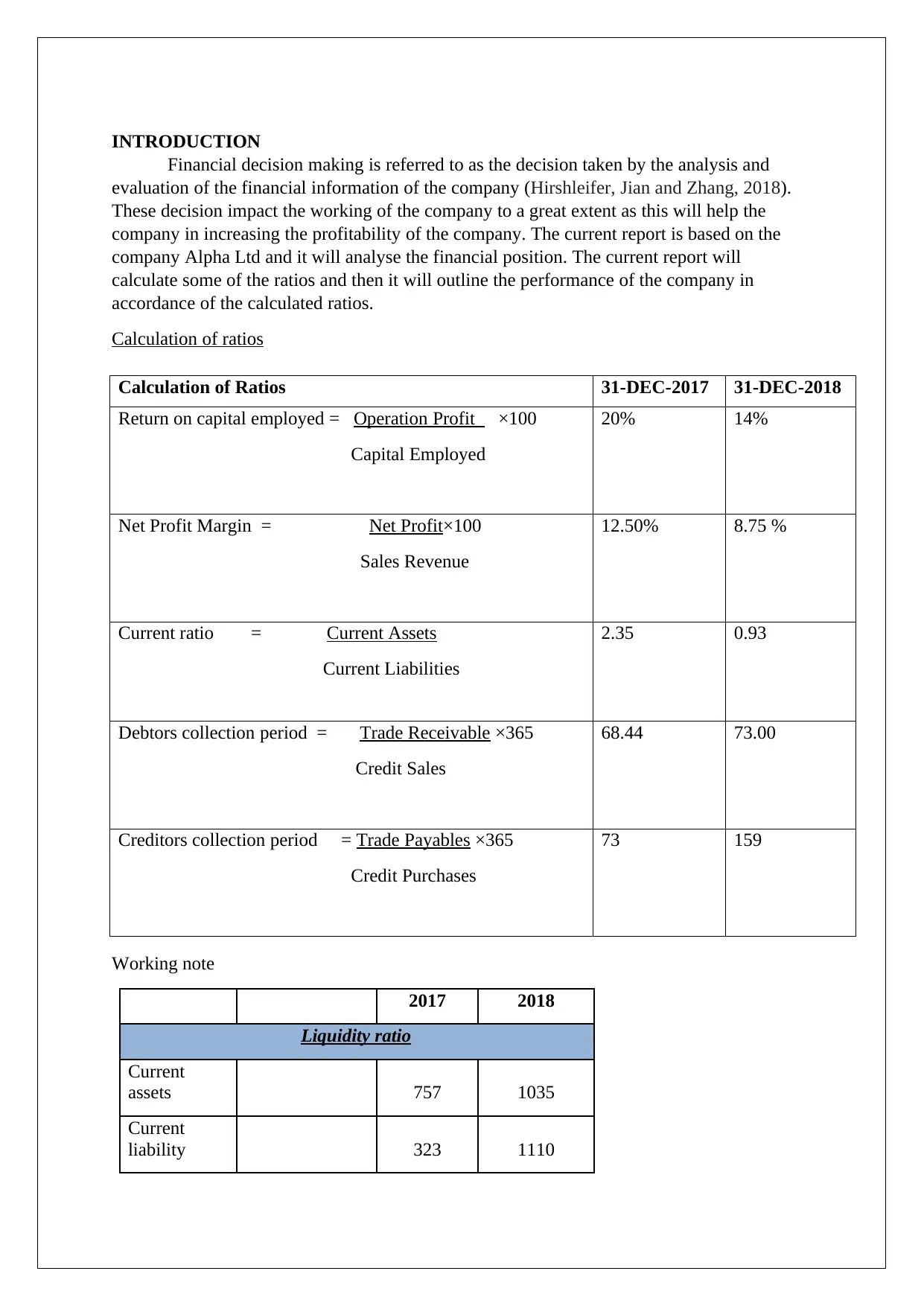
Calculation of ratios
Working note
2017 2018
Liquidity ratio
Current
assets 757 1035
Current
liability 323 1110
Calculation of Ratios 31-DEC-2017 31-DEC-2018
Return on capital employed = Operation Profit ×100
Capital Employed
20% 14%
Net Profit Margin = Net Profit×100
Sales Revenue
12.50% 8.75 %
Current ratio = Current Assets
Current Liabilities
2.35 0.93
Debtors collection period = Trade Receivable ×365
Credit Sales
68.44 73.00
Creditors collection period = Trade Payables ×365
Credit Purchases
73 159
Financial decision making is referred to as the decision taken by the analysis and
evaluation of the financial information of the company (Hirshleifer, Jian and Zhang, 2018).
These decision impact the working of the company to a great extent as this will help the
company in increasing the profitability of the company. The current report is based on the
company Alpha Ltd and it will analyse the financial position. The current report will
calculate some of the ratios and then it will outline the performance of the company in
accordance of the calculated ratios.
Calculation of ratios
Working note
2017 2018
Liquidity ratio
Current
assets 757 1035
Current
liability 323 1110
Calculation of Ratios 31-DEC-2017 31-DEC-2018
Return on capital employed = Operation Profit ×100
Capital Employed
20% 14%
Net Profit Margin = Net Profit×100
Sales Revenue
12.50% 8.75 %
Current ratio = Current Assets
Current Liabilities
2.35 0.93
Debtors collection period = Trade Receivable ×365
Credit Sales
68.44 73.00
Creditors collection period = Trade Payables ×365
Credit Purchases
73 159
⊘ This is a preview!⊘
Do you want full access?
Subscribe today to unlock all pages.
Trusted by 1+ million students worldwide
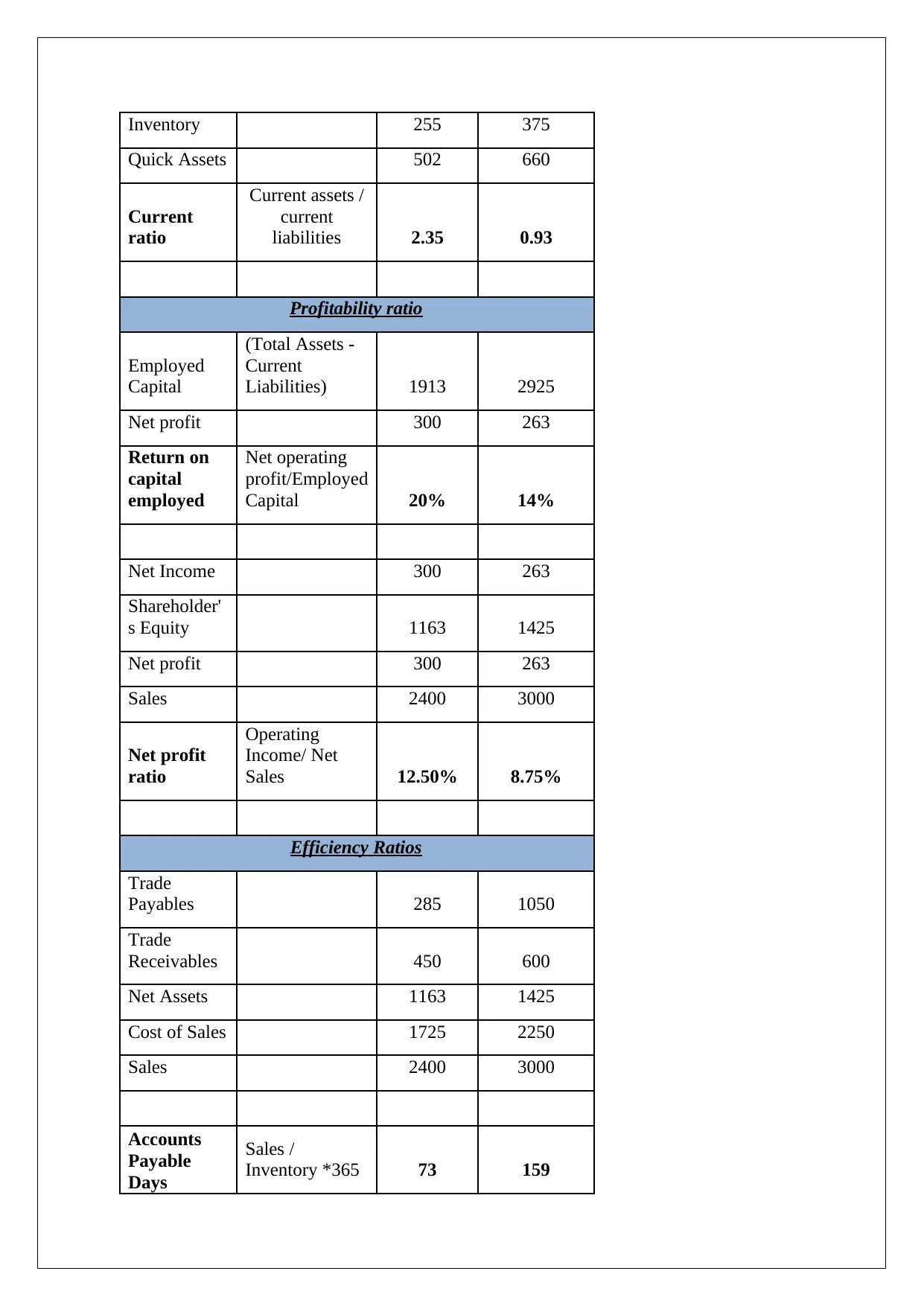
Inventory 255 375
Quick Assets 502 660
Current
ratio
Current assets /
current
liabilities 2.35 0.93
Profitability ratio
Employed
Capital
(Total Assets -
Current
Liabilities) 1913 2925
Net profit 300 263
Return on
capital
employed
Net operating
profit/Employed
Capital 20% 14%
Net Income 300 263
Shareholder'
s Equity 1163 1425
Net profit 300 263
Sales 2400 3000
Net profit
ratio
Operating
Income/ Net
Sales 12.50% 8.75%
Efficiency Ratios
Trade
Payables 285 1050
Trade
Receivables 450 600
Net Assets 1163 1425
Cost of Sales 1725 2250
Sales 2400 3000
Accounts
Payable
Days
Sales /
Inventory *365 73 159
Quick Assets 502 660
Current
ratio
Current assets /
current
liabilities 2.35 0.93
Profitability ratio
Employed
Capital
(Total Assets -
Current
Liabilities) 1913 2925
Net profit 300 263
Return on
capital
employed
Net operating
profit/Employed
Capital 20% 14%
Net Income 300 263
Shareholder'
s Equity 1163 1425
Net profit 300 263
Sales 2400 3000
Net profit
ratio
Operating
Income/ Net
Sales 12.50% 8.75%
Efficiency Ratios
Trade
Payables 285 1050
Trade
Receivables 450 600
Net Assets 1163 1425
Cost of Sales 1725 2250
Sales 2400 3000
Accounts
Payable
Days
Sales /
Inventory *365 73 159
Paraphrase This Document
Need a fresh take? Get an instant paraphrase of this document with our AI Paraphraser
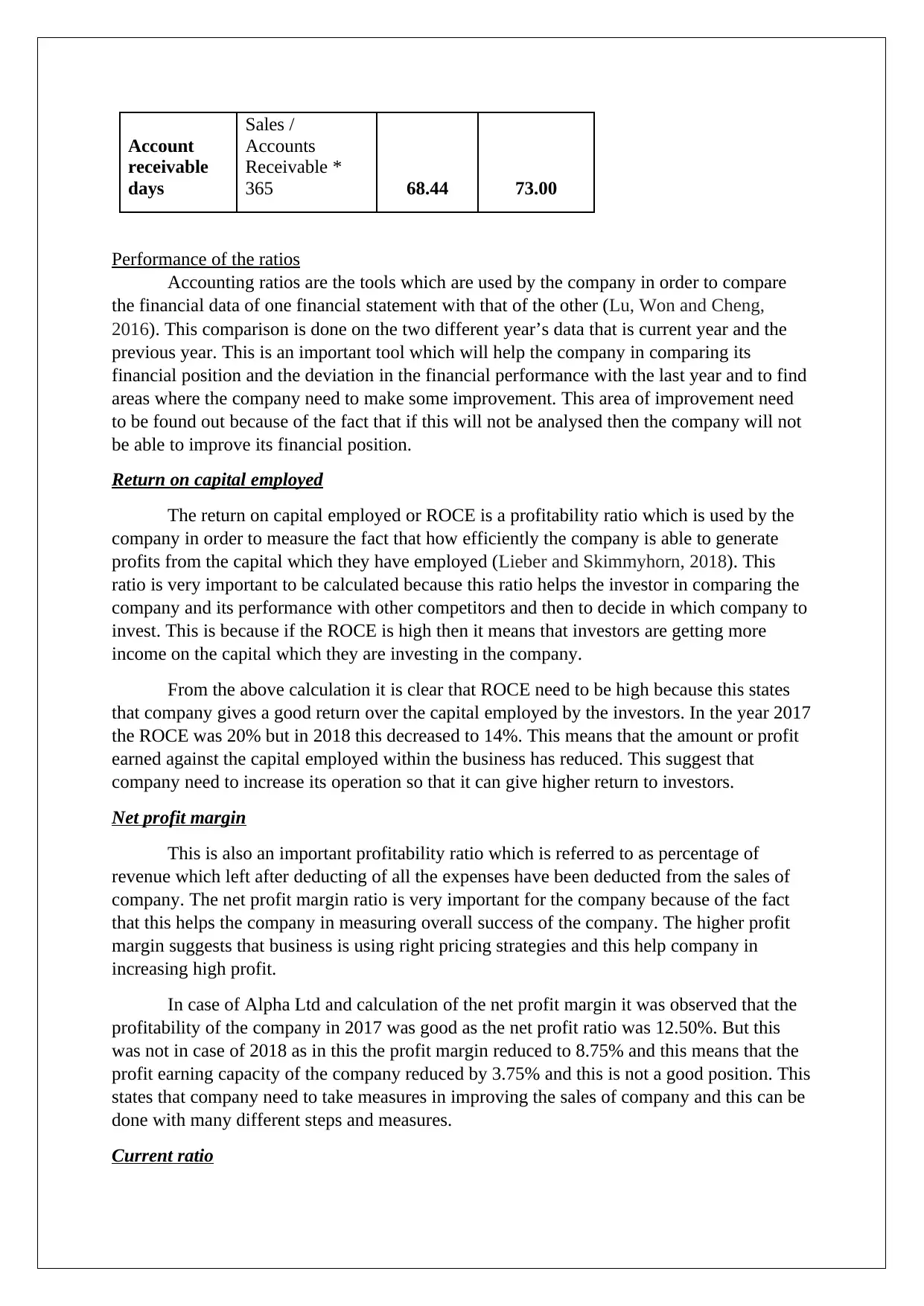
Account
receivable
days
Sales /
Accounts
Receivable *
365 68.44 73.00
Performance of the ratios
Accounting ratios are the tools which are used by the company in order to compare
the financial data of one financial statement with that of the other (Lu, Won and Cheng,
2016). This comparison is done on the two different year’s data that is current year and the
previous year. This is an important tool which will help the company in comparing its
financial position and the deviation in the financial performance with the last year and to find
areas where the company need to make some improvement. This area of improvement need
to be found out because of the fact that if this will not be analysed then the company will not
be able to improve its financial position.
Return on capital employed
The return on capital employed or ROCE is a profitability ratio which is used by the
company in order to measure the fact that how efficiently the company is able to generate
profits from the capital which they have employed (Lieber and Skimmyhorn, 2018). This
ratio is very important to be calculated because this ratio helps the investor in comparing the
company and its performance with other competitors and then to decide in which company to
invest. This is because if the ROCE is high then it means that investors are getting more
income on the capital which they are investing in the company.
From the above calculation it is clear that ROCE need to be high because this states
that company gives a good return over the capital employed by the investors. In the year 2017
the ROCE was 20% but in 2018 this decreased to 14%. This means that the amount or profit
earned against the capital employed within the business has reduced. This suggest that
company need to increase its operation so that it can give higher return to investors.
Net profit margin
This is also an important profitability ratio which is referred to as percentage of
revenue which left after deducting of all the expenses have been deducted from the sales of
company. The net profit margin ratio is very important for the company because of the fact
that this helps the company in measuring overall success of the company. The higher profit
margin suggests that business is using right pricing strategies and this help company in
increasing high profit.
In case of Alpha Ltd and calculation of the net profit margin it was observed that the
profitability of the company in 2017 was good as the net profit ratio was 12.50%. But this
was not in case of 2018 as in this the profit margin reduced to 8.75% and this means that the
profit earning capacity of the company reduced by 3.75% and this is not a good position. This
states that company need to take measures in improving the sales of company and this can be
done with many different steps and measures.
Current ratio
receivable
days
Sales /
Accounts
Receivable *
365 68.44 73.00
Performance of the ratios
Accounting ratios are the tools which are used by the company in order to compare
the financial data of one financial statement with that of the other (Lu, Won and Cheng,
2016). This comparison is done on the two different year’s data that is current year and the
previous year. This is an important tool which will help the company in comparing its
financial position and the deviation in the financial performance with the last year and to find
areas where the company need to make some improvement. This area of improvement need
to be found out because of the fact that if this will not be analysed then the company will not
be able to improve its financial position.
Return on capital employed
The return on capital employed or ROCE is a profitability ratio which is used by the
company in order to measure the fact that how efficiently the company is able to generate
profits from the capital which they have employed (Lieber and Skimmyhorn, 2018). This
ratio is very important to be calculated because this ratio helps the investor in comparing the
company and its performance with other competitors and then to decide in which company to
invest. This is because if the ROCE is high then it means that investors are getting more
income on the capital which they are investing in the company.
From the above calculation it is clear that ROCE need to be high because this states
that company gives a good return over the capital employed by the investors. In the year 2017
the ROCE was 20% but in 2018 this decreased to 14%. This means that the amount or profit
earned against the capital employed within the business has reduced. This suggest that
company need to increase its operation so that it can give higher return to investors.
Net profit margin
This is also an important profitability ratio which is referred to as percentage of
revenue which left after deducting of all the expenses have been deducted from the sales of
company. The net profit margin ratio is very important for the company because of the fact
that this helps the company in measuring overall success of the company. The higher profit
margin suggests that business is using right pricing strategies and this help company in
increasing high profit.
In case of Alpha Ltd and calculation of the net profit margin it was observed that the
profitability of the company in 2017 was good as the net profit ratio was 12.50%. But this
was not in case of 2018 as in this the profit margin reduced to 8.75% and this means that the
profit earning capacity of the company reduced by 3.75% and this is not a good position. This
states that company need to take measures in improving the sales of company and this can be
done with many different steps and measures.
Current ratio
Current ratio is referred to as the liquidity ratio which is helpful for the company in
measuring the ability of the company to pay its current liabilities with the cash being made
from the current asset (Kim, Gutter and Spangler, 2017). The current ratio measurement is
important for the company because this outline the capacity of company to meet its short
term liabilities with the given current asset and cash for a period of financial year. This is
calculated by deducting the current liabilities from the current assets of the companies.
From the assessment and evaluation of the above calculation and its interpretation it is
clear that if the current ratio of the company is good then it means that company is in position
of paying of the current liabilities with their current asset only. This is in case of year 2017
wherein the current ratio is 2.35 this means that the current assets are 2.35 times more than
the current liabilities. On the contrary in the year 2018 the current ratio decreased to 0.93 and
this states that the company has only 0.93 times the current asset more than the current
liabilities. If the liabilities are more than the company had to take loans from other people to
pay off their current liabilities.
Average collection period/ debtor collection period
The average collection period is referred to as a ratio which is calculated as the
average of the balance of account receivable by the total credit sales for a period of financial
year. This is the most important ratio for the company who rely majorly on the credit sales
and the receivables (Valaskova, Bartosova and Kubala, 2019). The major importance of this
ratio for the company is that these ratios help the company in predicting the time in which the
company is able to recover all its payment.
At time of calculation and its interpretation it was seen that the debtor collection
period in 2017 was 68.44 but in 2018 it was 73.00. This data suggest that in the year 2017 the
speed of collecting the receivables was fast as compared to the period of 2018. But in the year
2018 it increased to 73 which means that the speed or the time taken in receiving the due
amount reduced by 4.56 times. Hence, the performance of Alpha ltd reduced as now the
company is able to recover its money at a slow pace. Also, it is suggested to the company that
as they are not able to recover the more amount so they must stop the credit sales. This is
because if credit sales will not be done then no money needs to be recovered by the company.
Average payable days/ creditors collection period
This is an efficiency ratio which helps the company in calculating the average
payment which the company has to do for all the credit purchases they have made during the
financial period (Greenberg and Hershfield, 2019). Also, known as creditor turnover ratio this
indicates the time involved during the credit sales which is make the current liabilities
outstanding fir the company and this need to be paid. This ratio is important as this indicates
the time when the company is able to pay off all its debts and is in pure liquid position.
With help of calculation of the average payable days it was seen that in 2017 this was
70 but in the year 2018 it was 159. This suggest that in the year 2017 it was good but in the
year 2018 it increased drastically which is not at all good for the company. Having this higher
collection period in 2018 suggest that the company is not able to pay off its current asset on
time and in proper manner that is full. Also, this higher number of creditor collection period
suggests that the company is not having proper communication with the consumer and
because of this the sales of company is reducing and for this the company need to take loans
measuring the ability of the company to pay its current liabilities with the cash being made
from the current asset (Kim, Gutter and Spangler, 2017). The current ratio measurement is
important for the company because this outline the capacity of company to meet its short
term liabilities with the given current asset and cash for a period of financial year. This is
calculated by deducting the current liabilities from the current assets of the companies.
From the assessment and evaluation of the above calculation and its interpretation it is
clear that if the current ratio of the company is good then it means that company is in position
of paying of the current liabilities with their current asset only. This is in case of year 2017
wherein the current ratio is 2.35 this means that the current assets are 2.35 times more than
the current liabilities. On the contrary in the year 2018 the current ratio decreased to 0.93 and
this states that the company has only 0.93 times the current asset more than the current
liabilities. If the liabilities are more than the company had to take loans from other people to
pay off their current liabilities.
Average collection period/ debtor collection period
The average collection period is referred to as a ratio which is calculated as the
average of the balance of account receivable by the total credit sales for a period of financial
year. This is the most important ratio for the company who rely majorly on the credit sales
and the receivables (Valaskova, Bartosova and Kubala, 2019). The major importance of this
ratio for the company is that these ratios help the company in predicting the time in which the
company is able to recover all its payment.
At time of calculation and its interpretation it was seen that the debtor collection
period in 2017 was 68.44 but in 2018 it was 73.00. This data suggest that in the year 2017 the
speed of collecting the receivables was fast as compared to the period of 2018. But in the year
2018 it increased to 73 which means that the speed or the time taken in receiving the due
amount reduced by 4.56 times. Hence, the performance of Alpha ltd reduced as now the
company is able to recover its money at a slow pace. Also, it is suggested to the company that
as they are not able to recover the more amount so they must stop the credit sales. This is
because if credit sales will not be done then no money needs to be recovered by the company.
Average payable days/ creditors collection period
This is an efficiency ratio which helps the company in calculating the average
payment which the company has to do for all the credit purchases they have made during the
financial period (Greenberg and Hershfield, 2019). Also, known as creditor turnover ratio this
indicates the time involved during the credit sales which is make the current liabilities
outstanding fir the company and this need to be paid. This ratio is important as this indicates
the time when the company is able to pay off all its debts and is in pure liquid position.
With help of calculation of the average payable days it was seen that in 2017 this was
70 but in the year 2018 it was 159. This suggest that in the year 2017 it was good but in the
year 2018 it increased drastically which is not at all good for the company. Having this higher
collection period in 2018 suggest that the company is not able to pay off its current asset on
time and in proper manner that is full. Also, this higher number of creditor collection period
suggests that the company is not having proper communication with the consumer and
because of this the sales of company is reducing and for this the company need to take loans
⊘ This is a preview!⊘
Do you want full access?
Subscribe today to unlock all pages.
Trusted by 1+ million students worldwide

1 out of 14


Related Documents


Your All-in-One AI-Powered Toolkit for Academic Success.
+13062052269
info@desklib.com
Available 24*7 on WhatsApp / Email
![[object Object]](/_next/static/media/star-bottom.7253800d.svg)
Unlock your academic potential
Copyright © 2020–2026 A2Z Services. All Rights Reserved. Developed and managed by ZUCOL.