Financial Analysis: Decision Making & Ratios of Panini Limited
VerifiedAdded on 2023/06/10
|11
|3072
|383
Report
AI Summary
This report provides a financial decision-making analysis of Panini Limited, a bread-making company, by examining its financial data and key ratios. It covers various functions of the accounting and finance departments, including financial accounting, tax management, investment strategies, dividend policies, and working capital management. The analysis includes calculations and interpretations of financial ratios such as net profit margin, gross profit margin, and current ratio to assess the company's operational performance. The report also discusses potential sources of finance for Panini Limited, such as term loans, share capital, and debentures, and evaluates the company's gross profit margin, operating profit margin, return on capital employed, and current ratio for the years 2018 and 2019, providing insights into the company's profitability, efficiency, and liquidity.

FINANCIAL DECISION
MAKING
MAKING

Paraphrase This Document
Need a fresh take? Get an instant paraphrase of this document with our AI Paraphraser
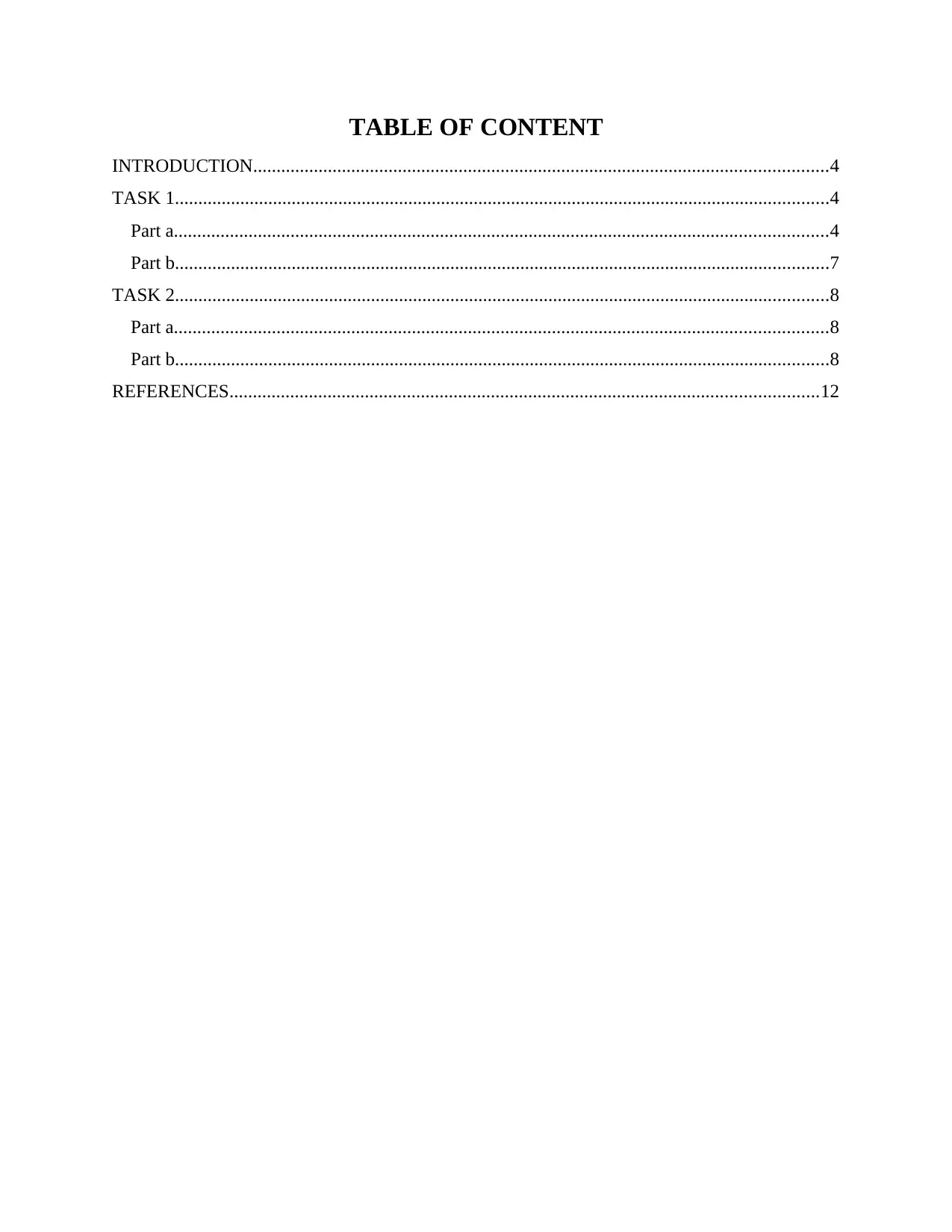
TABLE OF CONTENT
INTRODUCTION...........................................................................................................................4
TASK 1............................................................................................................................................4
Part a............................................................................................................................................4
Part b............................................................................................................................................7
TASK 2............................................................................................................................................8
Part a............................................................................................................................................8
Part b............................................................................................................................................8
REFERENCES..............................................................................................................................12
INTRODUCTION...........................................................................................................................4
TASK 1............................................................................................................................................4
Part a............................................................................................................................................4
Part b............................................................................................................................................7
TASK 2............................................................................................................................................8
Part a............................................................................................................................................8
Part b............................................................................................................................................8
REFERENCES..............................................................................................................................12
INTRODUCTION
Financial Decision Making involves analysis of various financial data including financial
ratios to arrive at a decision whether to invest in the given company or not. It shall be analysed
that whether the company is showing favourable results and is yielding highest conceivable
returns. Below report is in respect of Panini Limited which is a bread making company and thus
can be called a manufacturing company. The below formed report will involve discussion of
various functions of accounting department and finance department like financial accounting
function, tax function, investment function, dividend function, etc. Also, various ratio will be
calculated like net profit margin, gross profit margin, current ratio, etc. and thereafter will be
interpreted for better understanding of the operations of the company.
TASK 1
Part a
1. Accounting Department:
1. Financial Accounting Function – Financial accounting function involves functions
related to storing, recording, analysing, summarizing and reporting of financial
information of an entity. Such function is responsible for accurate processing and
analysis of financial information to render useful financial statements for its intended
users (Greenberg and Hershfield, 2019). Responsibilities of this function involves to
check whether the financial statements are prepared as per applicable laws, rules and
regulations, whether all errors apparent on records are corrected, whether all the
applicable accounting adjustments are done and whether accounting standards as
applicable are followed in preparation and disclosure.
2. Management Accounting Function – Management Accounting information is
utilized by the managers to be able to make efficient operational business decisions.
Panini Limited being a manufacturing company may use the information from
management accounting function in costing and management of the processes. Also,
such functions may vary from industry to industry as processes and requirement of
Financial Decision Making involves analysis of various financial data including financial
ratios to arrive at a decision whether to invest in the given company or not. It shall be analysed
that whether the company is showing favourable results and is yielding highest conceivable
returns. Below report is in respect of Panini Limited which is a bread making company and thus
can be called a manufacturing company. The below formed report will involve discussion of
various functions of accounting department and finance department like financial accounting
function, tax function, investment function, dividend function, etc. Also, various ratio will be
calculated like net profit margin, gross profit margin, current ratio, etc. and thereafter will be
interpreted for better understanding of the operations of the company.
TASK 1
Part a
1. Accounting Department:
1. Financial Accounting Function – Financial accounting function involves functions
related to storing, recording, analysing, summarizing and reporting of financial
information of an entity. Such function is responsible for accurate processing and
analysis of financial information to render useful financial statements for its intended
users (Greenberg and Hershfield, 2019). Responsibilities of this function involves to
check whether the financial statements are prepared as per applicable laws, rules and
regulations, whether all errors apparent on records are corrected, whether all the
applicable accounting adjustments are done and whether accounting standards as
applicable are followed in preparation and disclosure.
2. Management Accounting Function – Management Accounting information is
utilized by the managers to be able to make efficient operational business decisions.
Panini Limited being a manufacturing company may use the information from
management accounting function in costing and management of the processes. Also,
such functions may vary from industry to industry as processes and requirement of
⊘ This is a preview!⊘
Do you want full access?
Subscribe today to unlock all pages.

Trusted by 1+ million students worldwide
each industry is different. It can also be called as cost accounting which assists the
entity to achieve business goals by identifying, analysing and interpretation of the
information. It includes analysis of both financial and non-financial data to allow
effective decision-making by the management to provide effective management.
3. Tax Function - Tax function basically involves identification and calculation of
taxable income, calculation of taxes thereon, setting aside funds to pay the taxes on a
timely and efficient manner. It includes various categories of taxes namely sales tax,
goods and service tax, income tax, property taxes, etc. The function involves
assessing the impacts of changes in any of the tax regulations on the company. It
involves tax planning for savings in payment of taxes and to come up with the
strategies for such savings (Yue, Gizem Korkmaz and Zhou, 2020). Panini Limited
being a bread making company needs to comply with tax obligations related to
processing activities, selling of its products, tax laws on the expenditures of the
general nature and company specific expenditures according to any rules, regulations
and laws being formulated.
4. Auditing Function - Auditing function as the name suggests involves analysis of the
financial statements, records, documents of the company to look for any errors or
mistakes appearing prima facie on the records or in detail with a view to render
accurate financial information for the intended users like management, shareholders,
creditors, government, etc. It may also include the internal audit function which is
being conducted by an internal auditor who may or may not be an employee of the
entity but works with an objective to advice company on the reliability and
effectiveness of its financial statements and relevant financial records. Panini Limited
being a limited company is also required to meet the legal obligations, test the going
concern, etc. which are covered in auditing function of the entity. Such a function will
involve reporting to the board of directors or audit committee of the entity regarding
financial statements and internal controls of the company.
2. Finance Department:
1. Investment Functions - Investment function basically involves all the functions
related to investments of a company. Be it investing in the investments, managing of
entity to achieve business goals by identifying, analysing and interpretation of the
information. It includes analysis of both financial and non-financial data to allow
effective decision-making by the management to provide effective management.
3. Tax Function - Tax function basically involves identification and calculation of
taxable income, calculation of taxes thereon, setting aside funds to pay the taxes on a
timely and efficient manner. It includes various categories of taxes namely sales tax,
goods and service tax, income tax, property taxes, etc. The function involves
assessing the impacts of changes in any of the tax regulations on the company. It
involves tax planning for savings in payment of taxes and to come up with the
strategies for such savings (Yue, Gizem Korkmaz and Zhou, 2020). Panini Limited
being a bread making company needs to comply with tax obligations related to
processing activities, selling of its products, tax laws on the expenditures of the
general nature and company specific expenditures according to any rules, regulations
and laws being formulated.
4. Auditing Function - Auditing function as the name suggests involves analysis of the
financial statements, records, documents of the company to look for any errors or
mistakes appearing prima facie on the records or in detail with a view to render
accurate financial information for the intended users like management, shareholders,
creditors, government, etc. It may also include the internal audit function which is
being conducted by an internal auditor who may or may not be an employee of the
entity but works with an objective to advice company on the reliability and
effectiveness of its financial statements and relevant financial records. Panini Limited
being a limited company is also required to meet the legal obligations, test the going
concern, etc. which are covered in auditing function of the entity. Such a function will
involve reporting to the board of directors or audit committee of the entity regarding
financial statements and internal controls of the company.
2. Finance Department:
1. Investment Functions - Investment function basically involves all the functions
related to investments of a company. Be it investing in the investments, managing of
Paraphrase This Document
Need a fresh take? Get an instant paraphrase of this document with our AI Paraphraser
the investments, selling of the investments, valuation of the investments. An
important decision involves deciding the types of investments in which a company
wants to invest like equity, debt, tangible, etc. (Eberhardt, de Bruin and Strough,
2019). The rate of return is the most important criteria to be regularly evaluated by
the investment function because the interest rates payable by the company should be
compensated by the rate of return on investments earned by it and also shall be able to
earn surplus profits for growth and development of the entity. Panini limited being a
limited company also needs to manage its investments as per the relevant accounting
laws and regulations like valuation at the year-end reporting date, treatment of such
changes in the valuation, concept of present value and NPV for long term investments
and treatment of any income earned on such investments in the statements of profit
and loss or other comprehensive income.
2. Financing Function - Being a very important part of any entity, financing functions
involves acquiring, managing and payment of finances for the running of operations
efficiently as acquired by the entity. Finance costs are also a crucial part of finance
function as these will be substantial expenditures in the entity. Financing can be long
term (for time period of at least 3 years), medium term (for time period of more than
equal to 1 year but less than 3 years) and short term (for time period of less than a
year). Sources of finances may include issuing own shares, own debentures, bank
loans, trade credits, bank overdrafts, letter of credits, commercial papers, etc. Panini
limited like any other company also requires finances for its operations and shall
assess the opportunities to raise finances and shall keep in mind the related finance
costs which it can afford to incur.
3. Dividend Function - Decisions regarding distribution of surplus profits to
shareholders falls under this category. How much dividend to be paid, when such a
dividend is to be paid, in what form such a dividend paid is to be are some crucial
decisions to be taken under dividend function. Certain factors are to be evaluated like
rate of return earned on such dividend amount by the shareholders themselves, rate of
return earned on such dividend amount by the company if dividends were not
distributed, etc. Board of directors are to decide the rate of dividend to be declared
and such a rate is to be approved by the shareholders in the general meeting of the
important decision involves deciding the types of investments in which a company
wants to invest like equity, debt, tangible, etc. (Eberhardt, de Bruin and Strough,
2019). The rate of return is the most important criteria to be regularly evaluated by
the investment function because the interest rates payable by the company should be
compensated by the rate of return on investments earned by it and also shall be able to
earn surplus profits for growth and development of the entity. Panini limited being a
limited company also needs to manage its investments as per the relevant accounting
laws and regulations like valuation at the year-end reporting date, treatment of such
changes in the valuation, concept of present value and NPV for long term investments
and treatment of any income earned on such investments in the statements of profit
and loss or other comprehensive income.
2. Financing Function - Being a very important part of any entity, financing functions
involves acquiring, managing and payment of finances for the running of operations
efficiently as acquired by the entity. Finance costs are also a crucial part of finance
function as these will be substantial expenditures in the entity. Financing can be long
term (for time period of at least 3 years), medium term (for time period of more than
equal to 1 year but less than 3 years) and short term (for time period of less than a
year). Sources of finances may include issuing own shares, own debentures, bank
loans, trade credits, bank overdrafts, letter of credits, commercial papers, etc. Panini
limited like any other company also requires finances for its operations and shall
assess the opportunities to raise finances and shall keep in mind the related finance
costs which it can afford to incur.
3. Dividend Function - Decisions regarding distribution of surplus profits to
shareholders falls under this category. How much dividend to be paid, when such a
dividend is to be paid, in what form such a dividend paid is to be are some crucial
decisions to be taken under dividend function. Certain factors are to be evaluated like
rate of return earned on such dividend amount by the shareholders themselves, rate of
return earned on such dividend amount by the company if dividends were not
distributed, etc. Board of directors are to decide the rate of dividend to be declared
and such a rate is to be approved by the shareholders in the general meeting of the
company (Balasubramnian and Sargent, 2020). Panini Limited also needs to analyse
whether to declare dividends or not or if to declare then how much to declare.
Dividend can be interim or after the year-end. Dividend payout ratio depends upon
the profits or losses earned or incurred in the current year as well as previous year.
4. Working Capital Function - Working capital as the name suggests, is capital
required to meet the working of the company or operations of the company. It
includes purchasing of inventory, day-to-day operations, paying short term debts,
paying administrative expenses, etc. like payment to vendors, payment to employees,
payment to short term money lenders, payment of interest obligations on loans, etc.
For such a function, financing functions of short term nature and medium term nature
are most appropriate. Working capital function is responsible for efficient operations
of the entity. Panini Limited being a bread making company will be requiring the
working capital for purchasing its raw materials, payment to its raw material
suppliers, payment to its employees and workers.
Part b
Sources of finance:
1. Term Loans – It is the most common and most popular source of finance from
commercial banks, government and financial institutes. Main requirement is that the
finances and accounts shall be updated and properly disclosed and the entity shall have a
clear intention of paying back.
2. Share Capital – Share Capital or Equity shares are issued by entity to raise funds from
its members, and they are considered equity instead of liabilities. There is no obligation
of repayment in this case except in the case of liquidation or winding up.
3. Debentures/Bonds – Issue of debentures or bonds to the instrument holders to raise
funds from public on which there is an obligation to pay interest compulsorily called as
finance cost (Fong and et.al., 2021). Such debenture holders and bond holders are
liability of the entity as there is mandatory payment of interest along with repayment of
principal amount at the end of the tenure of debentures and bonds.
whether to declare dividends or not or if to declare then how much to declare.
Dividend can be interim or after the year-end. Dividend payout ratio depends upon
the profits or losses earned or incurred in the current year as well as previous year.
4. Working Capital Function - Working capital as the name suggests, is capital
required to meet the working of the company or operations of the company. It
includes purchasing of inventory, day-to-day operations, paying short term debts,
paying administrative expenses, etc. like payment to vendors, payment to employees,
payment to short term money lenders, payment of interest obligations on loans, etc.
For such a function, financing functions of short term nature and medium term nature
are most appropriate. Working capital function is responsible for efficient operations
of the entity. Panini Limited being a bread making company will be requiring the
working capital for purchasing its raw materials, payment to its raw material
suppliers, payment to its employees and workers.
Part b
Sources of finance:
1. Term Loans – It is the most common and most popular source of finance from
commercial banks, government and financial institutes. Main requirement is that the
finances and accounts shall be updated and properly disclosed and the entity shall have a
clear intention of paying back.
2. Share Capital – Share Capital or Equity shares are issued by entity to raise funds from
its members, and they are considered equity instead of liabilities. There is no obligation
of repayment in this case except in the case of liquidation or winding up.
3. Debentures/Bonds – Issue of debentures or bonds to the instrument holders to raise
funds from public on which there is an obligation to pay interest compulsorily called as
finance cost (Fong and et.al., 2021). Such debenture holders and bond holders are
liability of the entity as there is mandatory payment of interest along with repayment of
principal amount at the end of the tenure of debentures and bonds.
⊘ This is a preview!⊘
Do you want full access?
Subscribe today to unlock all pages.
Trusted by 1+ million students worldwide
TASK 2
Part a
Part b
Ratio Analysis of Panini Limited for the year December 2018 & December 2019:
1. Gross Profit Margin-
Gross Profit Margin called as gross margin ratio, it shows gross profitability of an entity
with respect to its net sales of a specific period. Higher the ratio the better it is. Gross Profit
Margin shows how much money is with the entity after charging the cost of goods being sold. As
per the data given Gross Profit Margin of the Panini Limited as on December 2018 is 35%
whereas as of December 2019 is 28.39%. Although the net sales increased in current year as
compared to previous year but gross profit decreased due to increase in cost of goods sold which
caused the gross profit margin to fall in the current year as compared to previous year ( Siegrist
and et.al., 2020). The decrease in cost of goods sold can be combated by decreasing or
discontinuing the sales of products not getting revenue or decreasing the cost of acquisition of
materials.
2. Operating Profit Margin-
Operating profit margin show operating profitability of an entity as a ratio to net sales.
Higher the ratio the better it is. Operating profit margin shows how efficient a company is in its
operations. As per the data given Operating Profit Margin of the Panini Limiited as on December
2018 is 27.65% whereas as of December 2019 is 20.04%. Although the net sales increased in
current year as compared to previous year but operating profit decreased due to increase in cost
of goods sold and operating expenses in the current year as compared to previous year. The
increase in cost of goods sold and operating expenses can be combated by discontinuing the sales
of products not getting revenue, decreasing the cost of acquisition of materials, outsourcing the
tasks, review expenses regularly, etc.
3. Return on Capital Employed-
Return on Capital Employed is a type of profitability ratios which shows how an entity is
generating profits out of its capital employed. Return on Capital Employed is mostly used by the
potential investors to analyse company's profitability and efficiency of its capital to generate
profits. As per the data given Return on Capital Employed of the Panini Limited as on December
2018 is 31.58% whereas as of December 2019 is 22.57%. Although the capital employed
Part a
Part b
Ratio Analysis of Panini Limited for the year December 2018 & December 2019:
1. Gross Profit Margin-
Gross Profit Margin called as gross margin ratio, it shows gross profitability of an entity
with respect to its net sales of a specific period. Higher the ratio the better it is. Gross Profit
Margin shows how much money is with the entity after charging the cost of goods being sold. As
per the data given Gross Profit Margin of the Panini Limited as on December 2018 is 35%
whereas as of December 2019 is 28.39%. Although the net sales increased in current year as
compared to previous year but gross profit decreased due to increase in cost of goods sold which
caused the gross profit margin to fall in the current year as compared to previous year ( Siegrist
and et.al., 2020). The decrease in cost of goods sold can be combated by decreasing or
discontinuing the sales of products not getting revenue or decreasing the cost of acquisition of
materials.
2. Operating Profit Margin-
Operating profit margin show operating profitability of an entity as a ratio to net sales.
Higher the ratio the better it is. Operating profit margin shows how efficient a company is in its
operations. As per the data given Operating Profit Margin of the Panini Limiited as on December
2018 is 27.65% whereas as of December 2019 is 20.04%. Although the net sales increased in
current year as compared to previous year but operating profit decreased due to increase in cost
of goods sold and operating expenses in the current year as compared to previous year. The
increase in cost of goods sold and operating expenses can be combated by discontinuing the sales
of products not getting revenue, decreasing the cost of acquisition of materials, outsourcing the
tasks, review expenses regularly, etc.
3. Return on Capital Employed-
Return on Capital Employed is a type of profitability ratios which shows how an entity is
generating profits out of its capital employed. Return on Capital Employed is mostly used by the
potential investors to analyse company's profitability and efficiency of its capital to generate
profits. As per the data given Return on Capital Employed of the Panini Limited as on December
2018 is 31.58% whereas as of December 2019 is 22.57%. Although the capital employed
Paraphrase This Document
Need a fresh take? Get an instant paraphrase of this document with our AI Paraphraser
increased in current year as compared to previous year but earnings before interest and tax
decreased due to increase in cost of goods sold and operating expenses in the current year as
compared to previous year. The increase in cost of goods sold and operating expenses can be
combated by discontinuing the sales of products not getting revenue, decreasing the cost of
acquisition of materials, outsourcing the tasks, review expenses regularly, etc.
4. Current Ratio-
Current Ratio is a type of liquidity ratio that shows ability of its current assets to pay off
its current liabilities. Current Ratio also called Working Capital Ratio shows the ability of an
entity to pay off its short term liabilities maturing in less than a year. As per the data given the
Current Ratio of the Panini Limited as on December 2018 is 1.21 whereas as of December 2019
is 4.12. Current Ratio increased from 1.21 to 4.12 due to increase in current assets in current year
as compared to previous year as well as decrease in current liabilities in the current year as
compared to previous year (Hall and et.al., 2022). Current Ratio has increased in the current year
which is a favourable indication and shall be kept as such.
5. Quick Ratio-
Quick Ratio shows how an entity is able to pay off short term obligations through its
most liquid assets. Quick ratio also known as acid test ratio show ability of an entity how to
effectively utilize its liquid assets. As per the data given the Quick Ratio of the Panini Limited as
on December 2018 is 0.85 whereas as of December 2019 is 2.80. Quick Ratio increased from
0.85 to 2.80 due to increase in quick assets in current year as compared to previous year as well
as decrease in current liabilities in the current year as compared to previous year. Quick Ratio
has increased in the current year which is a favourable indication and shall be kept as such.
6. Inventory Turnover Days-
Inventory turnover days shows how the inventory is sold and current inventory is
replaced for a specific period. Inventory turnover days shows the ability of the entity to sell the
inventory in hand in days. As per the data given the Inventory Turnover days of the Panini
Limited as on December 2018 is 20 days whereas as of December 2019 is 30 days. Inventory at
the end increased in the current year as compared to previous year as well as COGS increased in
current year which resulted in increase in inventory days. Inventory turnover ratio has increased
but it should be decreased by efficient forecasting, better pricing and costing of inventory and
better management of orders,
decreased due to increase in cost of goods sold and operating expenses in the current year as
compared to previous year. The increase in cost of goods sold and operating expenses can be
combated by discontinuing the sales of products not getting revenue, decreasing the cost of
acquisition of materials, outsourcing the tasks, review expenses regularly, etc.
4. Current Ratio-
Current Ratio is a type of liquidity ratio that shows ability of its current assets to pay off
its current liabilities. Current Ratio also called Working Capital Ratio shows the ability of an
entity to pay off its short term liabilities maturing in less than a year. As per the data given the
Current Ratio of the Panini Limited as on December 2018 is 1.21 whereas as of December 2019
is 4.12. Current Ratio increased from 1.21 to 4.12 due to increase in current assets in current year
as compared to previous year as well as decrease in current liabilities in the current year as
compared to previous year (Hall and et.al., 2022). Current Ratio has increased in the current year
which is a favourable indication and shall be kept as such.
5. Quick Ratio-
Quick Ratio shows how an entity is able to pay off short term obligations through its
most liquid assets. Quick ratio also known as acid test ratio show ability of an entity how to
effectively utilize its liquid assets. As per the data given the Quick Ratio of the Panini Limited as
on December 2018 is 0.85 whereas as of December 2019 is 2.80. Quick Ratio increased from
0.85 to 2.80 due to increase in quick assets in current year as compared to previous year as well
as decrease in current liabilities in the current year as compared to previous year. Quick Ratio
has increased in the current year which is a favourable indication and shall be kept as such.
6. Inventory Turnover Days-
Inventory turnover days shows how the inventory is sold and current inventory is
replaced for a specific period. Inventory turnover days shows the ability of the entity to sell the
inventory in hand in days. As per the data given the Inventory Turnover days of the Panini
Limited as on December 2018 is 20 days whereas as of December 2019 is 30 days. Inventory at
the end increased in the current year as compared to previous year as well as COGS increased in
current year which resulted in increase in inventory days. Inventory turnover ratio has increased
but it should be decreased by efficient forecasting, better pricing and costing of inventory and
better management of orders,
7. Debtor's Collection Period-
Receivable collection period show the effectiveness of an entity in recovering the
accounts receivable from its customer. Receivable collection period shows corporate's collection
policy and its effectiveness (Stewart and et.al., 2018). As per the data given ratio of the Panini
Limited as on December 2018 is 28 days whereas as of December 2019 is 43 days. Although net
sales increased in the current year but account receivables increased as a significant rate as
compared to previous year which led to increase in debtor's collection period. Increase in debtor's
collection period is an unfavourable sign which can be combated by better communication with
the debtors with regard to their outstanding debts and the entity's expected time of payment.
8. Payable Payment Period-
Payable payment period shows the ability of a business to pay its credits in the given
average number of days. Payable payment period shows how efficient the system of cash
management is to pay its credits. As per the data given payable payment period of Panini
Limited as on December 2018 is 52 days whereas as on December 2019 is 22 days. Although
COGS increased as compared to previous year in the current year but account payables
decreased at more considerable rate therefore resulting in decrease in payable payment period
(Mousavi and Lin, 2020). Decrease in payable payment period shows that business is able to pay
its credits in a shorter span of days as compared to previous year which is a favourable sign.
Receivable collection period show the effectiveness of an entity in recovering the
accounts receivable from its customer. Receivable collection period shows corporate's collection
policy and its effectiveness (Stewart and et.al., 2018). As per the data given ratio of the Panini
Limited as on December 2018 is 28 days whereas as of December 2019 is 43 days. Although net
sales increased in the current year but account receivables increased as a significant rate as
compared to previous year which led to increase in debtor's collection period. Increase in debtor's
collection period is an unfavourable sign which can be combated by better communication with
the debtors with regard to their outstanding debts and the entity's expected time of payment.
8. Payable Payment Period-
Payable payment period shows the ability of a business to pay its credits in the given
average number of days. Payable payment period shows how efficient the system of cash
management is to pay its credits. As per the data given payable payment period of Panini
Limited as on December 2018 is 52 days whereas as on December 2019 is 22 days. Although
COGS increased as compared to previous year in the current year but account payables
decreased at more considerable rate therefore resulting in decrease in payable payment period
(Mousavi and Lin, 2020). Decrease in payable payment period shows that business is able to pay
its credits in a shorter span of days as compared to previous year which is a favourable sign.
⊘ This is a preview!⊘
Do you want full access?
Subscribe today to unlock all pages.
Trusted by 1+ million students worldwide

Paraphrase This Document
Need a fresh take? Get an instant paraphrase of this document with our AI Paraphraser
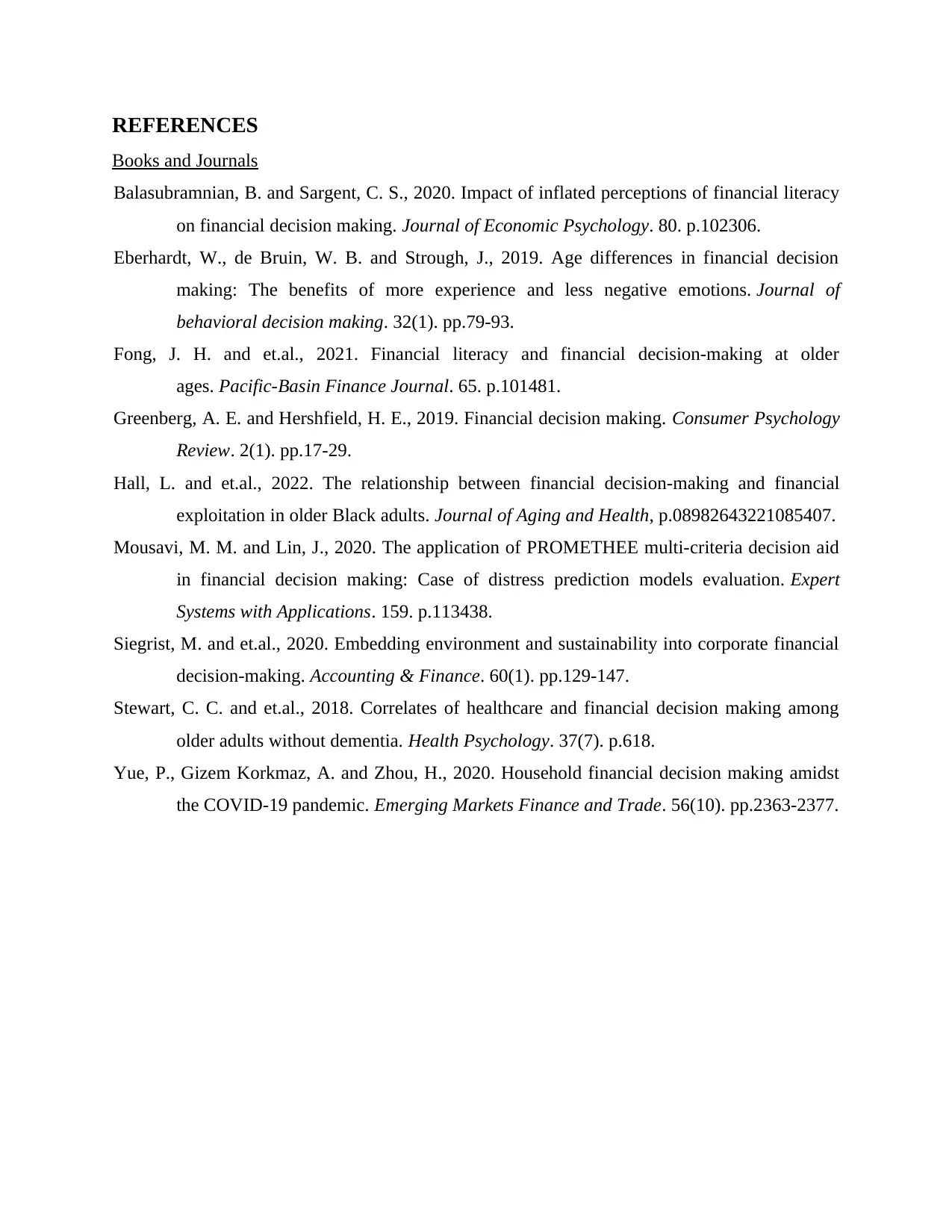
REFERENCES
Books and Journals
Balasubramnian, B. and Sargent, C. S., 2020. Impact of inflated perceptions of financial literacy
on financial decision making. Journal of Economic Psychology. 80. p.102306.
Eberhardt, W., de Bruin, W. B. and Strough, J., 2019. Age differences in financial decision
making: The benefits of more experience and less negative emotions. Journal of
behavioral decision making. 32(1). pp.79-93.
Fong, J. H. and et.al., 2021. Financial literacy and financial decision-making at older
ages. Pacific-Basin Finance Journal. 65. p.101481.
Greenberg, A. E. and Hershfield, H. E., 2019. Financial decision making. Consumer Psychology
Review. 2(1). pp.17-29.
Hall, L. and et.al., 2022. The relationship between financial decision-making and financial
exploitation in older Black adults. Journal of Aging and Health, p.08982643221085407.
Mousavi, M. M. and Lin, J., 2020. The application of PROMETHEE multi-criteria decision aid
in financial decision making: Case of distress prediction models evaluation. Expert
Systems with Applications. 159. p.113438.
Siegrist, M. and et.al., 2020. Embedding environment and sustainability into corporate financial
decision‐making. Accounting & Finance. 60(1). pp.129-147.
Stewart, C. C. and et.al., 2018. Correlates of healthcare and financial decision making among
older adults without dementia. Health Psychology. 37(7). p.618.
Yue, P., Gizem Korkmaz, A. and Zhou, H., 2020. Household financial decision making amidst
the COVID-19 pandemic. Emerging Markets Finance and Trade. 56(10). pp.2363-2377.
Books and Journals
Balasubramnian, B. and Sargent, C. S., 2020. Impact of inflated perceptions of financial literacy
on financial decision making. Journal of Economic Psychology. 80. p.102306.
Eberhardt, W., de Bruin, W. B. and Strough, J., 2019. Age differences in financial decision
making: The benefits of more experience and less negative emotions. Journal of
behavioral decision making. 32(1). pp.79-93.
Fong, J. H. and et.al., 2021. Financial literacy and financial decision-making at older
ages. Pacific-Basin Finance Journal. 65. p.101481.
Greenberg, A. E. and Hershfield, H. E., 2019. Financial decision making. Consumer Psychology
Review. 2(1). pp.17-29.
Hall, L. and et.al., 2022. The relationship between financial decision-making and financial
exploitation in older Black adults. Journal of Aging and Health, p.08982643221085407.
Mousavi, M. M. and Lin, J., 2020. The application of PROMETHEE multi-criteria decision aid
in financial decision making: Case of distress prediction models evaluation. Expert
Systems with Applications. 159. p.113438.
Siegrist, M. and et.al., 2020. Embedding environment and sustainability into corporate financial
decision‐making. Accounting & Finance. 60(1). pp.129-147.
Stewart, C. C. and et.al., 2018. Correlates of healthcare and financial decision making among
older adults without dementia. Health Psychology. 37(7). p.618.
Yue, P., Gizem Korkmaz, A. and Zhou, H., 2020. Household financial decision making amidst
the COVID-19 pandemic. Emerging Markets Finance and Trade. 56(10). pp.2363-2377.

1 out of 11


Related Documents


Your All-in-One AI-Powered Toolkit for Academic Success.
+13062052269
info@desklib.com
Available 24*7 on WhatsApp / Email
![[object Object]](/_next/static/media/star-bottom.7253800d.svg)
Unlock your academic potential
Copyright © 2020–2026 A2Z Services. All Rights Reserved. Developed and managed by ZUCOL.