Financial and Economic Literacy for Managers: Comprehensive Report
VerifiedAdded on 2020/01/28
|16
|3542
|490
Report
AI Summary
This report delves into the critical aspects of financial and economic literacy for managers, encompassing a range of topics essential for sound decision-making. It begins by examining the impact of globalization on economic literacy in the UK, considering factors such as global economic cycles and migration. The report then explores strategic analysis, identifying key issues like complexity and information overload. It further differentiates between normal and inferior goods, analyzes consumer behavior under risk and uncertainty using theories like the Bernoulli and Friedman-Savage hypotheses, and explains cross-elasticity of demand. The second task covers various market types (monopolistic competition, oligopoly, monopoly, and perfect competition) and the concept of public goods. It also explains the business cycle, its phases, and the concept of inflation. The third task focuses on financial statements (income statement, balance sheet, statement of cash flow, and statement of retained earnings) and ratio analysis, providing example calculations. The report concludes with a discussion of management decisions and the phases of the business life cycle. Finally, the report addresses risk and return, capital structure, amortization schedules, interest calculations, and project selection.

Financial and Economic Literacy
for Managers
for Managers

Paraphrase This Document
Need a fresh take? Get an instant paraphrase of this document with our AI Paraphraser
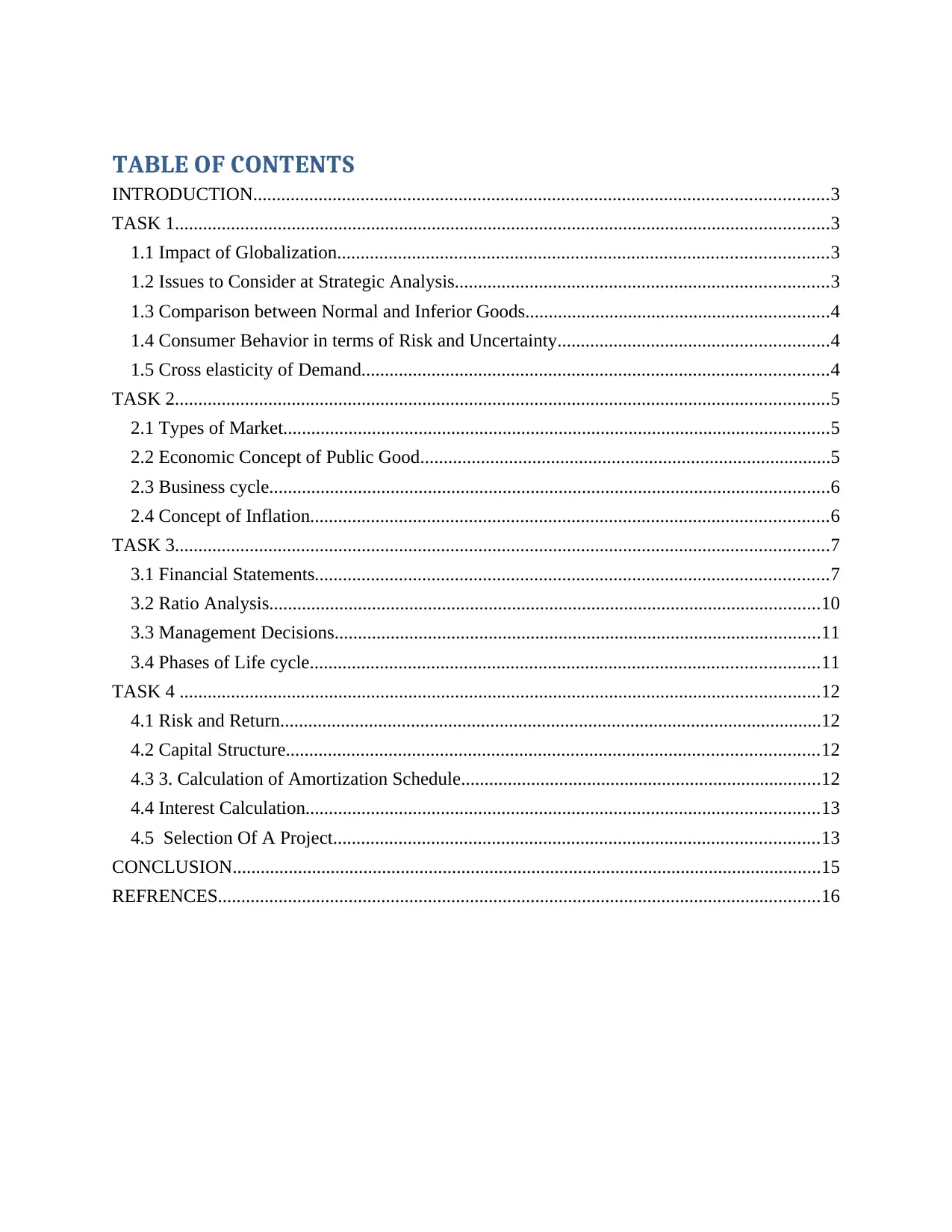
TABLE OF CONTENTS
INTRODUCTION...........................................................................................................................3
TASK 1............................................................................................................................................3
1.1 Impact of Globalization.........................................................................................................3
1.2 Issues to Consider at Strategic Analysis................................................................................3
1.3 Comparison between Normal and Inferior Goods.................................................................4
1.4 Consumer Behavior in terms of Risk and Uncertainty..........................................................4
1.5 Cross elasticity of Demand....................................................................................................4
TASK 2............................................................................................................................................5
2.1 Types of Market.....................................................................................................................5
2.2 Economic Concept of Public Good........................................................................................5
2.3 Business cycle........................................................................................................................6
2.4 Concept of Inflation...............................................................................................................6
TASK 3............................................................................................................................................7
3.1 Financial Statements..............................................................................................................7
3.2 Ratio Analysis......................................................................................................................10
3.3 Management Decisions........................................................................................................11
3.4 Phases of Life cycle.............................................................................................................11
TASK 4 .........................................................................................................................................12
4.1 Risk and Return....................................................................................................................12
4.2 Capital Structure..................................................................................................................12
4.3 3. Calculation of Amortization Schedule.............................................................................12
4.4 Interest Calculation..............................................................................................................13
4.5 Selection Of A Project........................................................................................................13
CONCLUSION..............................................................................................................................15
REFRENCES.................................................................................................................................16
INTRODUCTION...........................................................................................................................3
TASK 1............................................................................................................................................3
1.1 Impact of Globalization.........................................................................................................3
1.2 Issues to Consider at Strategic Analysis................................................................................3
1.3 Comparison between Normal and Inferior Goods.................................................................4
1.4 Consumer Behavior in terms of Risk and Uncertainty..........................................................4
1.5 Cross elasticity of Demand....................................................................................................4
TASK 2............................................................................................................................................5
2.1 Types of Market.....................................................................................................................5
2.2 Economic Concept of Public Good........................................................................................5
2.3 Business cycle........................................................................................................................6
2.4 Concept of Inflation...............................................................................................................6
TASK 3............................................................................................................................................7
3.1 Financial Statements..............................................................................................................7
3.2 Ratio Analysis......................................................................................................................10
3.3 Management Decisions........................................................................................................11
3.4 Phases of Life cycle.............................................................................................................11
TASK 4 .........................................................................................................................................12
4.1 Risk and Return....................................................................................................................12
4.2 Capital Structure..................................................................................................................12
4.3 3. Calculation of Amortization Schedule.............................................................................12
4.4 Interest Calculation..............................................................................................................13
4.5 Selection Of A Project........................................................................................................13
CONCLUSION..............................................................................................................................15
REFRENCES.................................................................................................................................16
INTRODUCTION
In today's world, it is highly recommended that financial and economic literacy is
essential for a sustainable economic and financial growth for an individual and for the company.
Economic literacy deals with the concept of earning, spending, sharing and saving money. On
the other hand financial literacy is the ability to understand how money is working, means how
the money is earned or how to make it(Cheema and Skultety, 2016). The interest in financial
literacy is increasing, and most of the programs, whether they are related to economic literacy or
financial literacy, are initiated by the financial sectors. Here, we are observing the abc company's
impact of globalization on UK, the types of market, they are dealing with, and their basic
financial statement.
TASK 1
1.1 Impact of Globalization
Globalization is a process by which the organizations develop international trades.
Globalization deals with the increased interdependence, and integration of global economy, that
will further increase in trades, movement of labor and money/capital. Some of the effects which
will be having on the economic literacy in UK are
i) Global economic cycle: UK will be more affected by this, because they majorly rely on
EU's export and imports. So if there is recession in Eu's export that will be having direct impact
on UK's economy.
ii) Migration: Globalization will make it very simple for migrants to work in UK, thus it
will fill up the vacant positions but at the same time it will affect the housing board and public
service as there will be a rise in migrant population(Kramin and et.al., 2014).
1.2 Issues to Consider at Strategic Analysis
Strategic Analysis is basically a method to identify the company's strenght, weakness,
opportunity, and threats. A strategic analysis represents a firm's core competencies at the same
time identifying opportunities, and the current threats to the firm from the market(Luke, 2014).
Certain issues the firm consider while undertaking strategic analysis are as follows:
In today's world, it is highly recommended that financial and economic literacy is
essential for a sustainable economic and financial growth for an individual and for the company.
Economic literacy deals with the concept of earning, spending, sharing and saving money. On
the other hand financial literacy is the ability to understand how money is working, means how
the money is earned or how to make it(Cheema and Skultety, 2016). The interest in financial
literacy is increasing, and most of the programs, whether they are related to economic literacy or
financial literacy, are initiated by the financial sectors. Here, we are observing the abc company's
impact of globalization on UK, the types of market, they are dealing with, and their basic
financial statement.
TASK 1
1.1 Impact of Globalization
Globalization is a process by which the organizations develop international trades.
Globalization deals with the increased interdependence, and integration of global economy, that
will further increase in trades, movement of labor and money/capital. Some of the effects which
will be having on the economic literacy in UK are
i) Global economic cycle: UK will be more affected by this, because they majorly rely on
EU's export and imports. So if there is recession in Eu's export that will be having direct impact
on UK's economy.
ii) Migration: Globalization will make it very simple for migrants to work in UK, thus it
will fill up the vacant positions but at the same time it will affect the housing board and public
service as there will be a rise in migrant population(Kramin and et.al., 2014).
1.2 Issues to Consider at Strategic Analysis
Strategic Analysis is basically a method to identify the company's strenght, weakness,
opportunity, and threats. A strategic analysis represents a firm's core competencies at the same
time identifying opportunities, and the current threats to the firm from the market(Luke, 2014).
Certain issues the firm consider while undertaking strategic analysis are as follows:
⊘ This is a preview!⊘
Do you want full access?
Subscribe today to unlock all pages.

Trusted by 1+ million students worldwide
- Complexity: all the managers, must take this into account while making any strategy,
that upto which extent this can get complex.
- Information Overload: while doing the planning, it might be possible that due to various
number of sources, the information can get overloaded(Choi and et.al., 2014).
Company's team must find out all the possible threats and the competition from the market,
otherwise the analysis can go wrong and this will reduce the company's reputation in the market.
1.3 Comparison between Normal and Inferior Goods
An inferior good is the type of goods, that decreases in demand when its income rises. At
the same time, if the income is reduced then the demand will increase. In contrast to inferior
goods are normal goods. Normal good is the good that increases in demand when income rises.
Its to keep in mind that inferior goods are depend on the behavior and affordability of goods. It
doesnt mean that it lacks quality, or the waste of money(Prete, 2013). For example, the used
books and noodles, the more income you are having, the less you buy used books or instant
noodles, These are inferior good. Normal goods are like clothes, the more your income is, the
more number of clothes you buy.
1.4 Consumer Behavior in terms of Risk and Uncertainty
There are certain theories by which we can easily analyses the behavior of the consumer
in the risk and uncertainty conditions, they are
- The Bernoulli Hypothesis: this is based on the flip of a coin. This theory was used
earlier as it has 50-50 side, one can flip the coin, if heads come first, he will get some money and
game stops, then if heads comes in the second time, he will get the money and game stops and so
on. But there are chances of the other person loosing more money, if a person put 100rs on stake
on 10rs loosing, than he will not play this game, because of the uncertainty of loosing the
money(Reder, 2015).
- friedman savage hypothesis: this is based on the expected values of utilities and doesn't
refer whether the marginal utility increases or decreases. When a person gets an insurance policy,
he pays to escape or avoid risk, but when he buys a lottery he gets a small chance of large gain.
1.5 Cross elasticity of Demand
Cross elasticity of demand measures the responsiveness in the demand quantity of one
good when a change in price takes place in another good. The cross elasticity demand for a
that upto which extent this can get complex.
- Information Overload: while doing the planning, it might be possible that due to various
number of sources, the information can get overloaded(Choi and et.al., 2014).
Company's team must find out all the possible threats and the competition from the market,
otherwise the analysis can go wrong and this will reduce the company's reputation in the market.
1.3 Comparison between Normal and Inferior Goods
An inferior good is the type of goods, that decreases in demand when its income rises. At
the same time, if the income is reduced then the demand will increase. In contrast to inferior
goods are normal goods. Normal good is the good that increases in demand when income rises.
Its to keep in mind that inferior goods are depend on the behavior and affordability of goods. It
doesnt mean that it lacks quality, or the waste of money(Prete, 2013). For example, the used
books and noodles, the more income you are having, the less you buy used books or instant
noodles, These are inferior good. Normal goods are like clothes, the more your income is, the
more number of clothes you buy.
1.4 Consumer Behavior in terms of Risk and Uncertainty
There are certain theories by which we can easily analyses the behavior of the consumer
in the risk and uncertainty conditions, they are
- The Bernoulli Hypothesis: this is based on the flip of a coin. This theory was used
earlier as it has 50-50 side, one can flip the coin, if heads come first, he will get some money and
game stops, then if heads comes in the second time, he will get the money and game stops and so
on. But there are chances of the other person loosing more money, if a person put 100rs on stake
on 10rs loosing, than he will not play this game, because of the uncertainty of loosing the
money(Reder, 2015).
- friedman savage hypothesis: this is based on the expected values of utilities and doesn't
refer whether the marginal utility increases or decreases. When a person gets an insurance policy,
he pays to escape or avoid risk, but when he buys a lottery he gets a small chance of large gain.
1.5 Cross elasticity of Demand
Cross elasticity of demand measures the responsiveness in the demand quantity of one
good when a change in price takes place in another good. The cross elasticity demand for a
Paraphrase This Document
Need a fresh take? Get an instant paraphrase of this document with our AI Paraphraser
substitute good is always positive. Because the demand of one good increases, if the price for
other good increases. For example: as the price of milk shakes increases, the quantity demanded
for milk shakes decreases, because consumer prefer to drink less milk shakes and prefer juice,
which is less expensive and good substitute(Babiarz and Robb, 2014). This is reflected in the
cross elasticity of demand formula, as both numerator and denominator shows positive increases
so it will result in positive cross elasticity.
TASK 2
2.1 Types of Market
Monopolistic competition: its also known as imperfect competition where many seller sells
many products which are different form each other, so they are not perfect substitute.
Oligopoly: a limited competition where the market is shared by small number of producers or
sellers.
Monopoly: it exists when a particular organization is the only supplier of that product in the
particular commodity.
Perfect competition: this is defined by various market conditions, collectively known as perfect
competition. There will be large number of buyers as well as large number of sellers. Perfect
competition is the opposite of monopoly. This is used as a bench mark to which the real life
market are compared. Example: Agricultural market(Babiarz and Robb, 2014). In this market,
there are various farmers, selling the same kind of product, and many buyers are there, so its easy
to compare the prices, therefore it often termed as the perfect competition.
2.2 Economic Concept of Public Good
public good is the type of product, if one person is consuming it or buying it, then the
availability of that product is not reducing to other individual. A public good is consumed by the
society, and it wont be reduced to any individual(Rowlands and et.al., 2015). Economist refer
public good as nonexchangeable. Public goods can be used by society but there is a problem
called free rider problem. If a person is using the public goods, without paying taxes, than that
will be a problem for government. Example: A dam is an example of public goods, its
nonexcludable, all the people from society can get benefit from that, without reducing it.
other good increases. For example: as the price of milk shakes increases, the quantity demanded
for milk shakes decreases, because consumer prefer to drink less milk shakes and prefer juice,
which is less expensive and good substitute(Babiarz and Robb, 2014). This is reflected in the
cross elasticity of demand formula, as both numerator and denominator shows positive increases
so it will result in positive cross elasticity.
TASK 2
2.1 Types of Market
Monopolistic competition: its also known as imperfect competition where many seller sells
many products which are different form each other, so they are not perfect substitute.
Oligopoly: a limited competition where the market is shared by small number of producers or
sellers.
Monopoly: it exists when a particular organization is the only supplier of that product in the
particular commodity.
Perfect competition: this is defined by various market conditions, collectively known as perfect
competition. There will be large number of buyers as well as large number of sellers. Perfect
competition is the opposite of monopoly. This is used as a bench mark to which the real life
market are compared. Example: Agricultural market(Babiarz and Robb, 2014). In this market,
there are various farmers, selling the same kind of product, and many buyers are there, so its easy
to compare the prices, therefore it often termed as the perfect competition.
2.2 Economic Concept of Public Good
public good is the type of product, if one person is consuming it or buying it, then the
availability of that product is not reducing to other individual. A public good is consumed by the
society, and it wont be reduced to any individual(Rowlands and et.al., 2015). Economist refer
public good as nonexchangeable. Public goods can be used by society but there is a problem
called free rider problem. If a person is using the public goods, without paying taxes, than that
will be a problem for government. Example: A dam is an example of public goods, its
nonexcludable, all the people from society can get benefit from that, without reducing it.
2.3 Business cycle
Business cycle is the natural upward and downward movement of economic growth that
occurs over the period of time. This cycle is very useful for economist in analyzing the economy
and also helps in making better financial decisions. Each business cycle will have fur stages, they
are expansion, peak, contraction and through. But they don't occur on the regular time intervals.
Expansion: this usually occurs between peak and through. That's when the economy is
growing. The growth rate GDP is around 2-3. The expansion reaches its end when GDP will be
higher than 3, and the economy overheats(Wise and Nutbeam, 2015).
Peak: this is the second phase, when the expansion is turning into contraction phase.
Contraction: this is the third phase, it starts at peak and ends at through. Here economic
growth is weak and GDP falls below 2%.
Through: this is the final phase, when the economy transists from expansion to
contraction phase.
Inflation is the process, when the general price for goods are increasing, and at the same time the
purchasing power of the currency is falling. The business cycle and inflation are usually in sharp
contracts with one another. Commodity investors need to make sure that the prices of goods
don't rise too much so that people stop purchasing their products(Webber and Johnston, 2014).
They have to make sure that currency will not fall too much, and keep the GDP rates healthy.
2.4 Concept of Inflation
Inflation: it is termed as the rate at which the general level of prices for goods or services are
increasing and consequently the purchasing power of currency is falling. Two causes of inflation
are:
i) Demand pull inflation: when the employment is full or close to full, then the increase in
AD lead to increase in price level. We tend to get this when economic growth is above the long
run trend of growth.
ii) Cost pull inflation: if the cost increases of the firms, the business will pass on to consumers.
This is due to rising wages, import prices, raw material prices, high taxes, declining productivity
etc.
Business cycle is the natural upward and downward movement of economic growth that
occurs over the period of time. This cycle is very useful for economist in analyzing the economy
and also helps in making better financial decisions. Each business cycle will have fur stages, they
are expansion, peak, contraction and through. But they don't occur on the regular time intervals.
Expansion: this usually occurs between peak and through. That's when the economy is
growing. The growth rate GDP is around 2-3. The expansion reaches its end when GDP will be
higher than 3, and the economy overheats(Wise and Nutbeam, 2015).
Peak: this is the second phase, when the expansion is turning into contraction phase.
Contraction: this is the third phase, it starts at peak and ends at through. Here economic
growth is weak and GDP falls below 2%.
Through: this is the final phase, when the economy transists from expansion to
contraction phase.
Inflation is the process, when the general price for goods are increasing, and at the same time the
purchasing power of the currency is falling. The business cycle and inflation are usually in sharp
contracts with one another. Commodity investors need to make sure that the prices of goods
don't rise too much so that people stop purchasing their products(Webber and Johnston, 2014).
They have to make sure that currency will not fall too much, and keep the GDP rates healthy.
2.4 Concept of Inflation
Inflation: it is termed as the rate at which the general level of prices for goods or services are
increasing and consequently the purchasing power of currency is falling. Two causes of inflation
are:
i) Demand pull inflation: when the employment is full or close to full, then the increase in
AD lead to increase in price level. We tend to get this when economic growth is above the long
run trend of growth.
ii) Cost pull inflation: if the cost increases of the firms, the business will pass on to consumers.
This is due to rising wages, import prices, raw material prices, high taxes, declining productivity
etc.
⊘ This is a preview!⊘
Do you want full access?
Subscribe today to unlock all pages.
Trusted by 1+ million students worldwide
Example: if you go to a shop to buy a candy, and its 50cents and after a year you go to the same
shop to buy a candy and its 55 cents, but you are having only 50cents, the price is increased, and
the value of currency is decreased, thats inflation(Verma and Bhardwaj, 2014).
TASK 3
3.1 Financial Statements
The four basic financial statements are
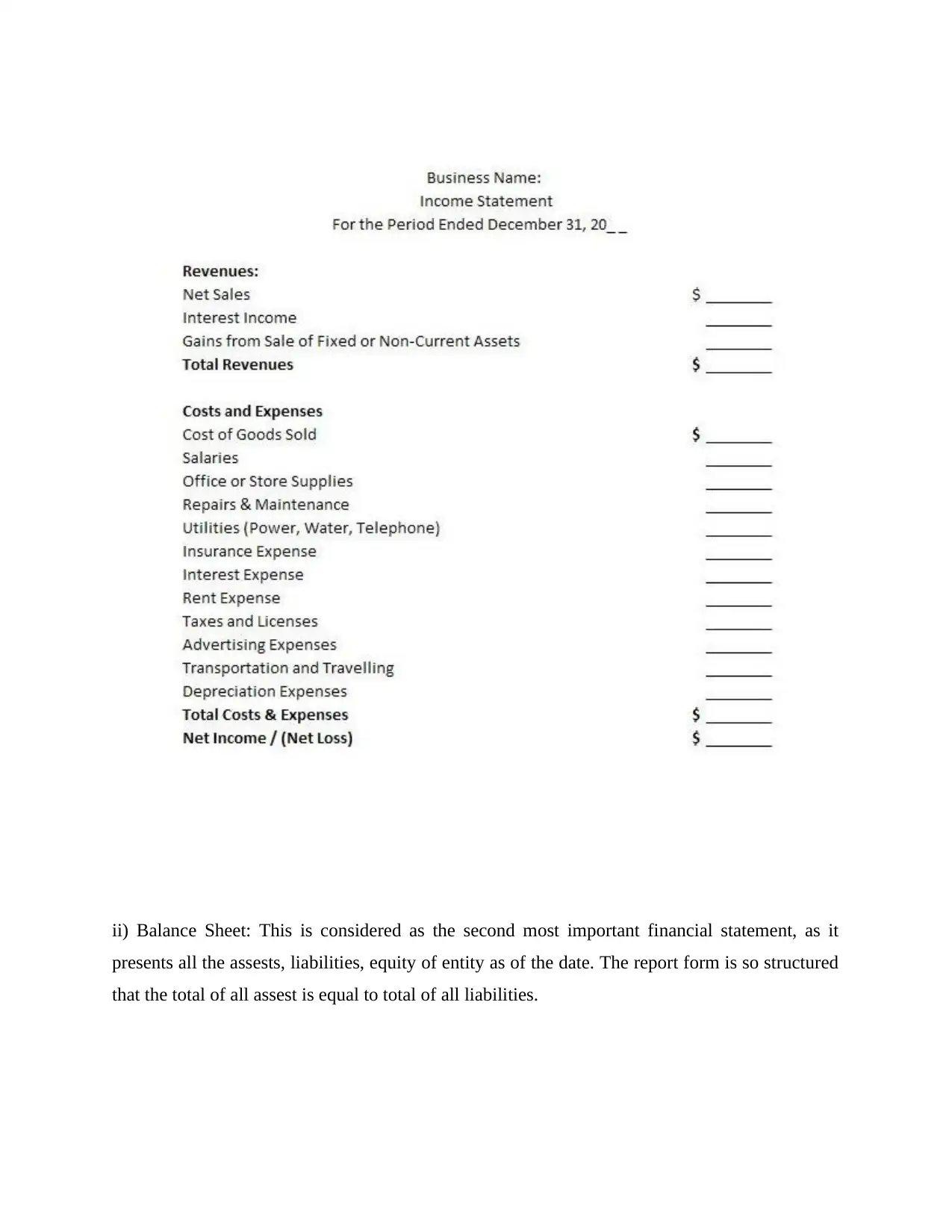
i) Income statement: this is considered as the most financial statement as it presents the revenues,
expenses, profit/losses generated during that period of time.
shop to buy a candy and its 55 cents, but you are having only 50cents, the price is increased, and
the value of currency is decreased, thats inflation(Verma and Bhardwaj, 2014).
TASK 3
3.1 Financial Statements
The four basic financial statements are
i) Income statement: this is considered as the most financial statement as it presents the revenues,
expenses, profit/losses generated during that period of time.
Paraphrase This Document
Need a fresh take? Get an instant paraphrase of this document with our AI Paraphraser
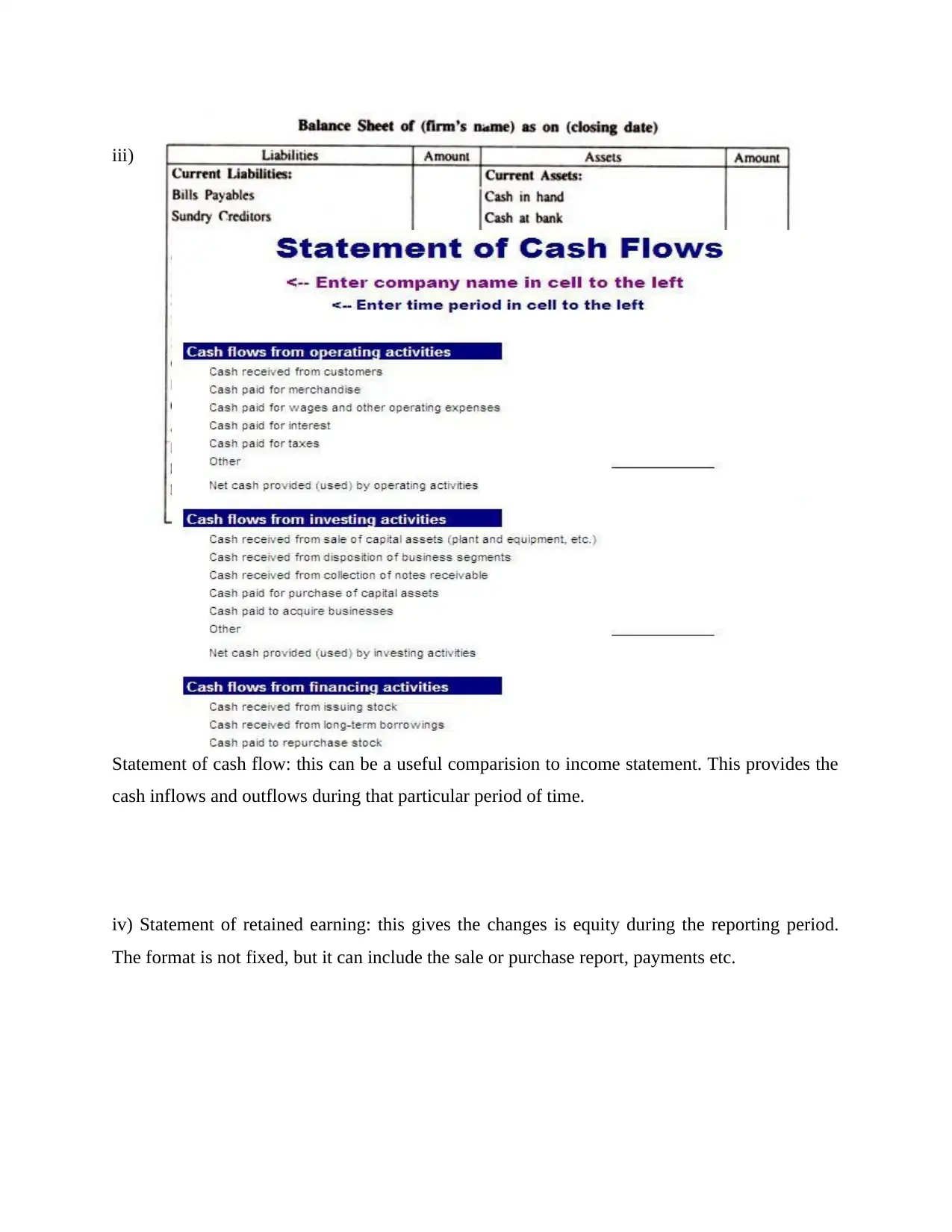
ii) Balance Sheet: This is considered as the second most important financial statement, as it
presents all the assests, liabilities, equity of entity as of the date. The report form is so structured
that the total of all assest is equal to total of all liabilities.
presents all the assests, liabilities, equity of entity as of the date. The report form is so structured
that the total of all assest is equal to total of all liabilities.
iii)
Statement of cash flow: this can be a useful comparision to income statement. This provides the
cash inflows and outflows during that particular period of time.
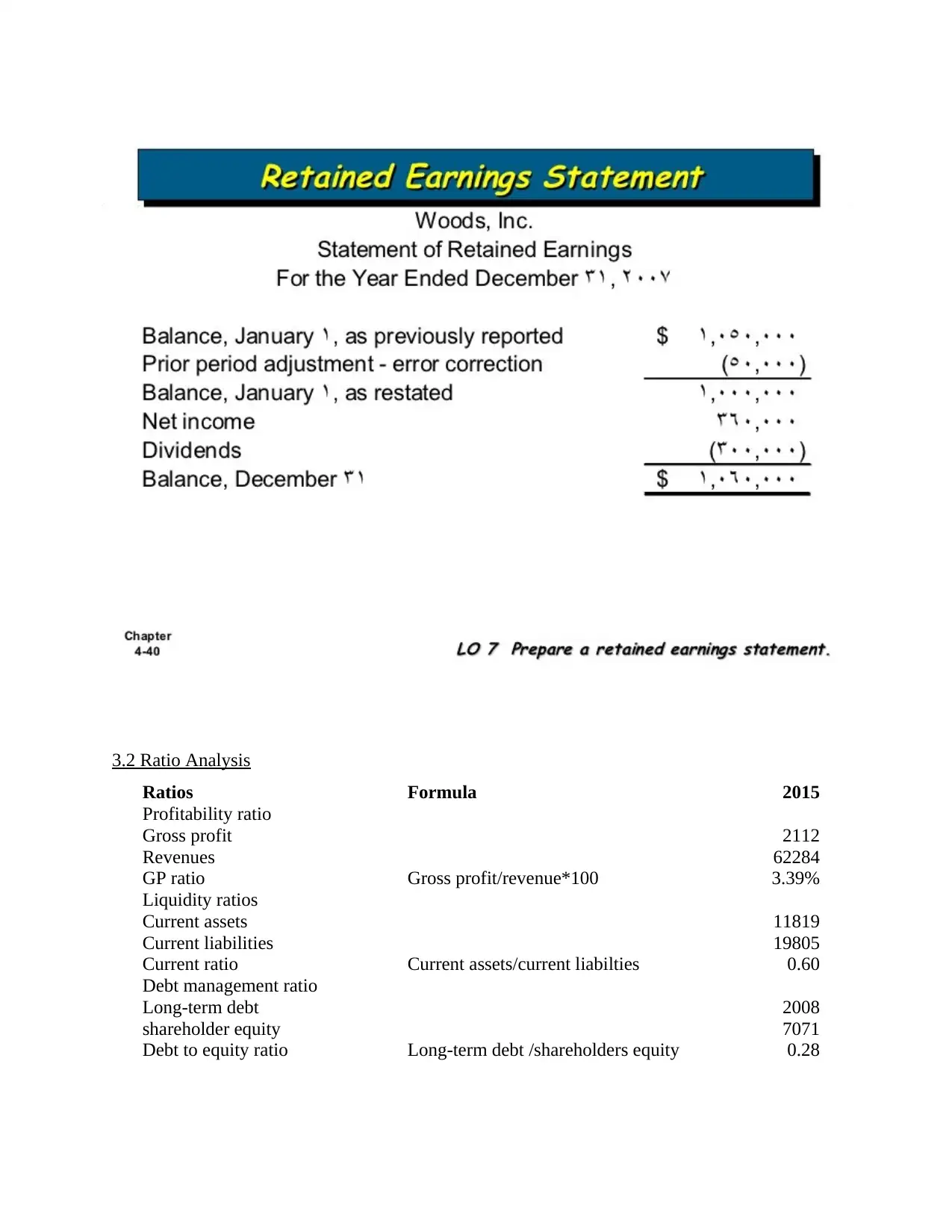
iv) Statement of retained earning: this gives the changes is equity during the reporting period.
The format is not fixed, but it can include the sale or purchase report, payments etc.
Statement of cash flow: this can be a useful comparision to income statement. This provides the
cash inflows and outflows during that particular period of time.
iv) Statement of retained earning: this gives the changes is equity during the reporting period.
The format is not fixed, but it can include the sale or purchase report, payments etc.
⊘ This is a preview!⊘
Do you want full access?
Subscribe today to unlock all pages.
Trusted by 1+ million students worldwide
3.2 Ratio Analysis
Ratios Formula 2015
Profitability ratio
Gross profit 2112
Revenues 62284
GP ratio Gross profit/revenue*100 3.39%
Liquidity ratios
Current assets 11819
Current liabilities 19805
Current ratio Current assets/current liabilties 0.60
Debt management ratio
Long-term debt 2008
shareholder equity 7071
Debt to equity ratio Long-term debt /shareholders equity 0.28
Ratios Formula 2015
Profitability ratio
Gross profit 2112
Revenues 62284
GP ratio Gross profit/revenue*100 3.39%
Liquidity ratios
Current assets 11819
Current liabilities 19805
Current ratio Current assets/current liabilties 0.60
Debt management ratio
Long-term debt 2008
shareholder equity 7071
Debt to equity ratio Long-term debt /shareholders equity 0.28
Paraphrase This Document
Need a fresh take? Get an instant paraphrase of this document with our AI Paraphraser
Assets mangement ratio
Turnover 62284
Total assets 44214
Assets turnover ratio Turnover/total assets 1.41
Market value ratio
Net profit -5766
Number of shares outstanding
(million) 2702
Earning per share
Net profit/number of share
outstanding -2.1339748335
3.3 Management Decisions
Management decisions always required the management accounting information. Accounting
provides the necessary date to the management to know that whether the business is at profit or
at loss, how much business owes to others, how much the debtors wants, and all other financial
information. Basically we can say that accounting is a major tool by which the management can
rely and it helps in making the sound and correct decisions on a correct time. By 8using the
information from accounting the manager thinks that its the trend to reduce the sale, so they can
take the precautions to stop that(Verma and Bhardwaj, 2014). May be they need to vary their
prices according to the market, so they can do that. The main thing is that accounting gives them
the clue that something is not going according to the pla, which needs to be changed so the
management can take correct decisions on that.
3.4 Phases of Life cycle
Product life cycle (PLC): there are 4 very clearly defined stages of PLC, they are
i) Introduction stage: this is the first and most expensive stage of the product while
launching it. All the costs like research, advertisements, consumer testing, all are included in
this. The product is new so the sales are not very high, althogh they will increase after sometime.
ii) Growth stage: This is the stage where the product start selling and the company starts
earning from the product.
iii) Maturity stage: during this stage the product established itself, and now the aim is to
maintain the sales rate. At this stage they need to consider any product modification is needed or
not, so they can do that and keep the product well updated according to the market requirements.
iv) Decline: eventually the sales of the product will start to reduce. This could be because
the market become more saturated or the consumers start switching to some other product.
Turnover 62284
Total assets 44214
Assets turnover ratio Turnover/total assets 1.41
Market value ratio
Net profit -5766
Number of shares outstanding
(million) 2702
Earning per share
Net profit/number of share
outstanding -2.1339748335
3.3 Management Decisions
Management decisions always required the management accounting information. Accounting
provides the necessary date to the management to know that whether the business is at profit or
at loss, how much business owes to others, how much the debtors wants, and all other financial
information. Basically we can say that accounting is a major tool by which the management can
rely and it helps in making the sound and correct decisions on a correct time. By 8using the
information from accounting the manager thinks that its the trend to reduce the sale, so they can
take the precautions to stop that(Verma and Bhardwaj, 2014). May be they need to vary their
prices according to the market, so they can do that. The main thing is that accounting gives them
the clue that something is not going according to the pla, which needs to be changed so the
management can take correct decisions on that.
3.4 Phases of Life cycle
Product life cycle (PLC): there are 4 very clearly defined stages of PLC, they are
i) Introduction stage: this is the first and most expensive stage of the product while
launching it. All the costs like research, advertisements, consumer testing, all are included in
this. The product is new so the sales are not very high, althogh they will increase after sometime.
ii) Growth stage: This is the stage where the product start selling and the company starts
earning from the product.
iii) Maturity stage: during this stage the product established itself, and now the aim is to
maintain the sales rate. At this stage they need to consider any product modification is needed or
not, so they can do that and keep the product well updated according to the market requirements.
iv) Decline: eventually the sales of the product will start to reduce. This could be because
the market become more saturated or the consumers start switching to some other product.
TASK 4
4.1 Risk and Return
Risk and Return are inter-related terms. Whenever someone takes name of risk
automatically Return also spells out. Cash flows from any project undertaken, are nothing but the
Return generated from project. It is uncertain to have those Returns, a project can give the cash
flows and it may not. So, the uncertainty talked here is known as Risk. Higher the risk better is
the return. People who invest more in the funds which have higher risk is assumed to be getting
higher returns. Risk and return are directly proportional to each other(Almenberg and Dreber,
2015). Risk is a non-dependent variable and Return is dependent variable. Since risk comes first
and through the degree of risk it is measured that how much return we will be getting.
4.2 Capital Structure
Capital structure is dividing the financial portfolio of a company into two main
components that is Equity capital and other is Debt capital. Capital structure relates to long-term
sources of financing. Capital structure of a company is a combination of debt and equity funds
which comprise the financing of assets. Each component of capital structure defines different
cost of the firm. Capital structure is a combination of long term funds, equity funds and
preference share capital(Almenberg and Dreber, 2015). It is important in making decisions
related to financing of the firm. It helps in making decision about the firms optimum mix of
equity and debt funds. Capital structure is usually designed to serve the interest of the equity
shareholders. Through optimum capital structure a firms achieve cost minimization, value
maximization, increase in share price, investment opportunities and growth of country.
4.3 3. Calculation of Amortization Schedule
Amortization is that process in which people tends to have the reduce amount of loan. In
this process the amount of loan is reduced by paying the periodic installments. In amortization
payment amount consist of both principal and interest. Principal is that amount which is not
being paid yet. As principal is paid as per the periods then the interest is gets reduced. It is also
called as periodic reduction in the valuation of the asset.
Borrowed amount : £25,000
Period : 3 years
Interest rate : @9%
4.1 Risk and Return
Risk and Return are inter-related terms. Whenever someone takes name of risk
automatically Return also spells out. Cash flows from any project undertaken, are nothing but the
Return generated from project. It is uncertain to have those Returns, a project can give the cash
flows and it may not. So, the uncertainty talked here is known as Risk. Higher the risk better is
the return. People who invest more in the funds which have higher risk is assumed to be getting
higher returns. Risk and return are directly proportional to each other(Almenberg and Dreber,
2015). Risk is a non-dependent variable and Return is dependent variable. Since risk comes first
and through the degree of risk it is measured that how much return we will be getting.
4.2 Capital Structure
Capital structure is dividing the financial portfolio of a company into two main
components that is Equity capital and other is Debt capital. Capital structure relates to long-term
sources of financing. Capital structure of a company is a combination of debt and equity funds
which comprise the financing of assets. Each component of capital structure defines different
cost of the firm. Capital structure is a combination of long term funds, equity funds and
preference share capital(Almenberg and Dreber, 2015). It is important in making decisions
related to financing of the firm. It helps in making decision about the firms optimum mix of
equity and debt funds. Capital structure is usually designed to serve the interest of the equity
shareholders. Through optimum capital structure a firms achieve cost minimization, value
maximization, increase in share price, investment opportunities and growth of country.
4.3 3. Calculation of Amortization Schedule
Amortization is that process in which people tends to have the reduce amount of loan. In
this process the amount of loan is reduced by paying the periodic installments. In amortization
payment amount consist of both principal and interest. Principal is that amount which is not
being paid yet. As principal is paid as per the periods then the interest is gets reduced. It is also
called as periodic reduction in the valuation of the asset.
Borrowed amount : £25,000
Period : 3 years
Interest rate : @9%
⊘ This is a preview!⊘
Do you want full access?
Subscribe today to unlock all pages.
Trusted by 1+ million students worldwide

1 out of 16


Related Documents


Your All-in-One AI-Powered Toolkit for Academic Success.
+13062052269
info@desklib.com
Available 24*7 on WhatsApp / Email
![[object Object]](/_next/static/media/star-bottom.7253800d.svg)
Unlock your academic potential
Copyright © 2020–2026 A2Z Services. All Rights Reserved. Developed and managed by ZUCOL.