Comprehensive Report on NBFIs, Customer Accounts, and Regulations
VerifiedAdded on 2023/05/27
|19
|6130
|282
Report
AI Summary
This report provides a detailed overview of Non-Banking Financial Institutions (NBFIs) in Bangladesh, their functions, importance, problems, and prospects, along with necessary steps for improvement. It discusses the Financial Institutions Act of 1993 and the roles NBFIs play in financing various sectors. The report also covers essential aspects of customer accounts, including the importance of opening an account, different account types, and precautions for opening a current account. Key topics such as KYC (Know Your Customer) compliance, customer identification profiles, and specific considerations for opening accounts for minors, married women, illiterate persons, and various organizations like joint stock companies and partnerships are also discussed. The report concludes by highlighting the need for diversification and regulatory support to enhance the effectiveness of NBFIs in the financial system.
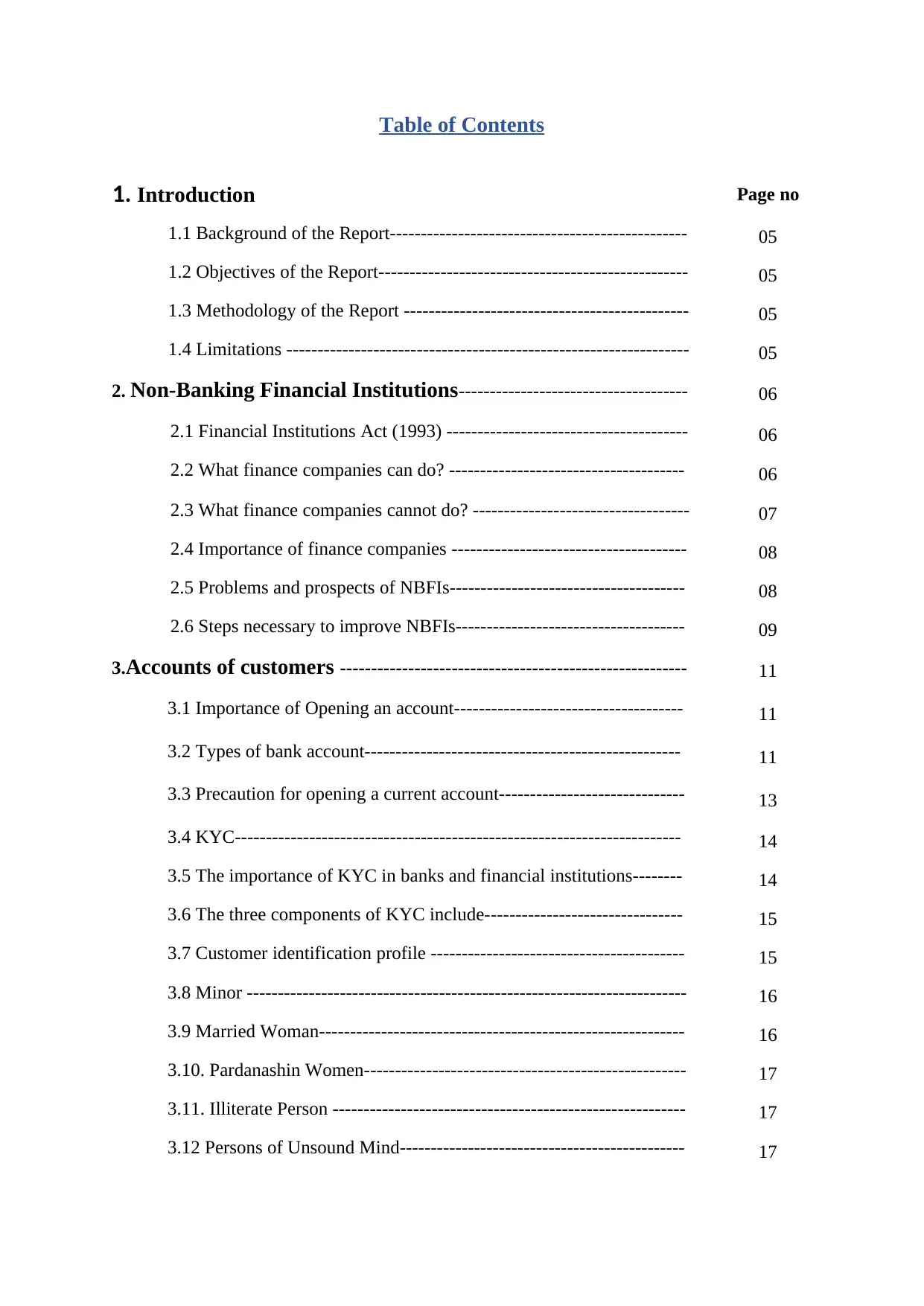
Table of Contents
1. Introduction Page no
1.1 Background of the Report------------------------------------------------ 05
1.2 Objectives of the Report-------------------------------------------------- 05
1.3 Methodology of the Report ---------------------------------------------- 05
1.4 Limitations ----------------------------------------------------------------- 05
2. Non-Banking Financial Institutions------------------------------------- 06
2.1 Financial Institutions Act (1993) --------------------------------------- 06
2.2 What finance companies can do? -------------------------------------- 06
2.3 What finance companies cannot do? ----------------------------------- 07
2.4 Importance of finance companies -------------------------------------- 08
2.5 Problems and prospects of NBFIs-------------------------------------- 08
2.6 Steps necessary to improve NBFIs------------------------------------- 09
3.Accounts of customers -------------------------------------------------------- 11
3.1 Importance of Opening an account------------------------------------- 11
3.2 Types of bank account--------------------------------------------------- 11
3.3 Precaution for opening a current account------------------------------ 13
3.4 KYC------------------------------------------------------------------------ 14
3.5 The importance of KYC in banks and financial institutions-------- 14
3.6 The three components of KYC include-------------------------------- 15
3.7 Customer identification profile ----------------------------------------- 15
3.8 Minor ----------------------------------------------------------------------- 16
3.9 Married Woman----------------------------------------------------------- 16
3.10. Pardanashin Women---------------------------------------------------- 17
3.11. Illiterate Person --------------------------------------------------------- 17
3.12 Persons of Unsound Mind---------------------------------------------- 17
1. Introduction Page no
1.1 Background of the Report------------------------------------------------ 05
1.2 Objectives of the Report-------------------------------------------------- 05
1.3 Methodology of the Report ---------------------------------------------- 05
1.4 Limitations ----------------------------------------------------------------- 05
2. Non-Banking Financial Institutions------------------------------------- 06
2.1 Financial Institutions Act (1993) --------------------------------------- 06
2.2 What finance companies can do? -------------------------------------- 06
2.3 What finance companies cannot do? ----------------------------------- 07
2.4 Importance of finance companies -------------------------------------- 08
2.5 Problems and prospects of NBFIs-------------------------------------- 08
2.6 Steps necessary to improve NBFIs------------------------------------- 09
3.Accounts of customers -------------------------------------------------------- 11
3.1 Importance of Opening an account------------------------------------- 11
3.2 Types of bank account--------------------------------------------------- 11
3.3 Precaution for opening a current account------------------------------ 13
3.4 KYC------------------------------------------------------------------------ 14
3.5 The importance of KYC in banks and financial institutions-------- 14
3.6 The three components of KYC include-------------------------------- 15
3.7 Customer identification profile ----------------------------------------- 15
3.8 Minor ----------------------------------------------------------------------- 16
3.9 Married Woman----------------------------------------------------------- 16
3.10. Pardanashin Women---------------------------------------------------- 17
3.11. Illiterate Person --------------------------------------------------------- 17
3.12 Persons of Unsound Mind---------------------------------------------- 17

Paraphrase This Document
Need a fresh take? Get an instant paraphrase of this document with our AI Paraphraser

2
3.13 Joint account------------------------------------------------------------- 18
3.14 Joint Stock Company--------------------------------------------------- 19
3.15 Partnership Account ---------------------------------------------------- 20
3.16 Trust ---------------------------------------------------------------------- 20
5. References ------------------------------------------------------------------------ 21
3.13 Joint account------------------------------------------------------------- 18
3.14 Joint Stock Company--------------------------------------------------- 19
3.15 Partnership Account ---------------------------------------------------- 20
3.16 Trust ---------------------------------------------------------------------- 20
5. References ------------------------------------------------------------------------ 21
3
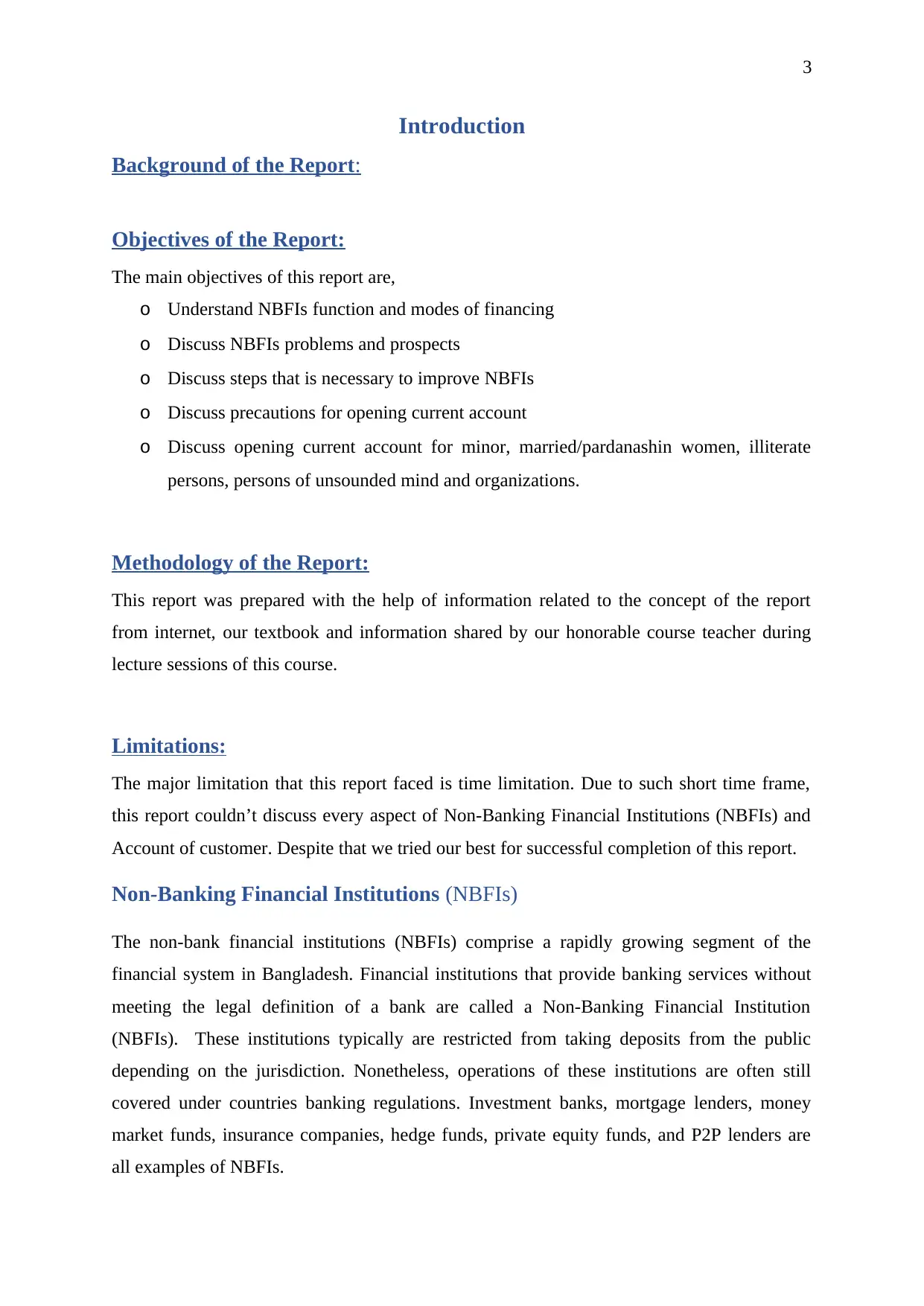
Introduction
Background of the Report:
Objectives of the Report:
The main objectives of this report are,
o Understand NBFIs function and modes of financing
o Discuss NBFIs problems and prospects
o Discuss steps that is necessary to improve NBFIs
o Discuss precautions for opening current account
o Discuss opening current account for minor, married/pardanashin women, illiterate
persons, persons of unsounded mind and organizations.
Methodology of the Report:
This report was prepared with the help of information related to the concept of the report
from internet, our textbook and information shared by our honorable course teacher during
lecture sessions of this course.
Limitations:
The major limitation that this report faced is time limitation. Due to such short time frame,
this report couldn’t discuss every aspect of Non-Banking Financial Institutions (NBFIs) and
Account of customer. Despite that we tried our best for successful completion of this report.
Non-Banking Financial Institutions (NBFIs)
The non-bank financial institutions (NBFIs) comprise a rapidly growing segment of the
financial system in Bangladesh. Financial institutions that provide banking services without
meeting the legal definition of a bank are called a Non-Banking Financial Institution
(NBFIs). These institutions typically are restricted from taking deposits from the public
depending on the jurisdiction. Nonetheless, operations of these institutions are often still
covered under countries banking regulations. Investment banks, mortgage lenders, money
market funds, insurance companies, hedge funds, private equity funds, and P2P lenders are
all examples of NBFIs.
Introduction
Background of the Report:
Objectives of the Report:
The main objectives of this report are,
o Understand NBFIs function and modes of financing
o Discuss NBFIs problems and prospects
o Discuss steps that is necessary to improve NBFIs
o Discuss precautions for opening current account
o Discuss opening current account for minor, married/pardanashin women, illiterate
persons, persons of unsounded mind and organizations.
Methodology of the Report:
This report was prepared with the help of information related to the concept of the report
from internet, our textbook and information shared by our honorable course teacher during
lecture sessions of this course.
Limitations:
The major limitation that this report faced is time limitation. Due to such short time frame,
this report couldn’t discuss every aspect of Non-Banking Financial Institutions (NBFIs) and
Account of customer. Despite that we tried our best for successful completion of this report.
Non-Banking Financial Institutions (NBFIs)
The non-bank financial institutions (NBFIs) comprise a rapidly growing segment of the
financial system in Bangladesh. Financial institutions that provide banking services without
meeting the legal definition of a bank are called a Non-Banking Financial Institution
(NBFIs). These institutions typically are restricted from taking deposits from the public
depending on the jurisdiction. Nonetheless, operations of these institutions are often still
covered under countries banking regulations. Investment banks, mortgage lenders, money
market funds, insurance companies, hedge funds, private equity funds, and P2P lenders are
all examples of NBFIs.
⊘ This is a preview!⊘
Do you want full access?
Subscribe today to unlock all pages.

Trusted by 1+ million students worldwide

4
The NBFIs have been contributing toward increasing both the quality and quantity of
financial services and thus mitigating the lapses of existing financial intermediation to meet
the growing needs of different types of investment in the country. At present, 29 NBFIs are
operating their business across the country of which one is government owned, 15 are
privately owned local companies, and the remaining 13 are established under joint venture
with foreign participation. Non-banking financial institutions (NBFIs) plays very significant
role in economic and infrastructure development of Bangladesh.
Financial Institutions Act (1993)
A regular enactment for setting up and regulating the activities of the finance companies was
made through the Financial Institutions Act 1993. The act defines the functions a finance
company can undertake. Under this act:
What the finance companies can do?
1) grant of loans or advances for financing industry, commerce, agriculture or housing.
2) underwriting and investment in shares, stock, bonds, debentures or debenture stock or
securities issued by the government or any local authority.
3) hire purchase transactions including leasing of machinery or equipment.
4) provide finance for venture capital. And,
5) undertake the business of a merchant Bank, investment company, mutual association,
and mutual company, leasing company or building society.
What do finance companies cannot do?
1) accept any deposit which can be withdrawn by cheque, draft or order drawn by the
depositor.
2) deal in gold or foreign exchange.
3) grant unsecured advances unsecured loans or unsecured credit facilities which in the
aggregate and outstanding at any one time exceed 10% of the paid-up share capital
and reserves of the financial institution to any farm in which any of its directors has
any interest.
4) give any loans or advances against the security of its own share.
The NBFIs have been contributing toward increasing both the quality and quantity of
financial services and thus mitigating the lapses of existing financial intermediation to meet
the growing needs of different types of investment in the country. At present, 29 NBFIs are
operating their business across the country of which one is government owned, 15 are
privately owned local companies, and the remaining 13 are established under joint venture
with foreign participation. Non-banking financial institutions (NBFIs) plays very significant
role in economic and infrastructure development of Bangladesh.
Financial Institutions Act (1993)
A regular enactment for setting up and regulating the activities of the finance companies was
made through the Financial Institutions Act 1993. The act defines the functions a finance
company can undertake. Under this act:
What the finance companies can do?
1) grant of loans or advances for financing industry, commerce, agriculture or housing.
2) underwriting and investment in shares, stock, bonds, debentures or debenture stock or
securities issued by the government or any local authority.
3) hire purchase transactions including leasing of machinery or equipment.
4) provide finance for venture capital. And,
5) undertake the business of a merchant Bank, investment company, mutual association,
and mutual company, leasing company or building society.
What do finance companies cannot do?
1) accept any deposit which can be withdrawn by cheque, draft or order drawn by the
depositor.
2) deal in gold or foreign exchange.
3) grant unsecured advances unsecured loans or unsecured credit facilities which in the
aggregate and outstanding at any one time exceed 10% of the paid-up share capital
and reserves of the financial institution to any farm in which any of its directors has
any interest.
4) give any loans or advances against the security of its own share.
Paraphrase This Document
Need a fresh take? Get an instant paraphrase of this document with our AI Paraphraser
5
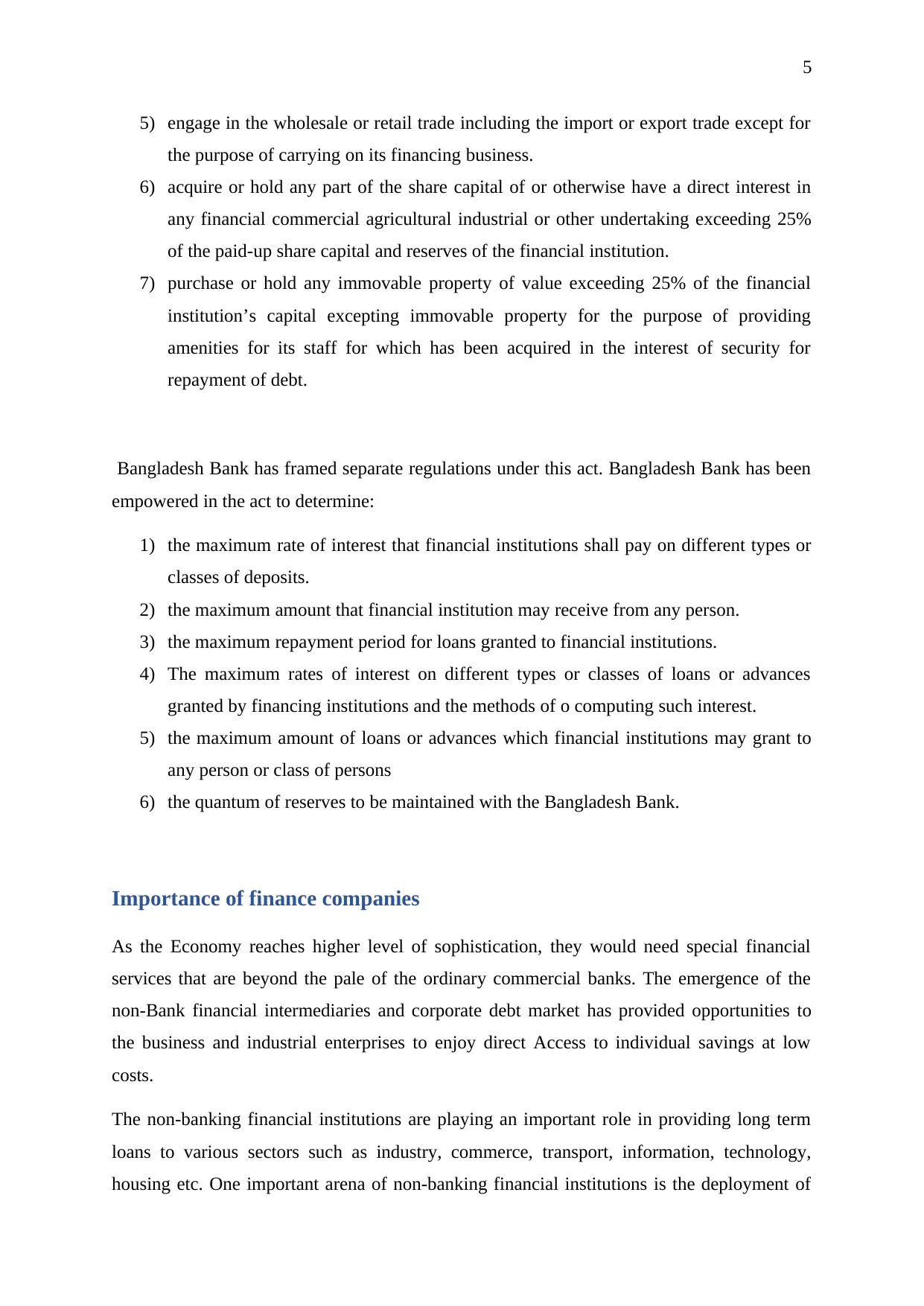
5) engage in the wholesale or retail trade including the import or export trade except for
the purpose of carrying on its financing business.
6) acquire or hold any part of the share capital of or otherwise have a direct interest in
any financial commercial agricultural industrial or other undertaking exceeding 25%
of the paid-up share capital and reserves of the financial institution.
7) purchase or hold any immovable property of value exceeding 25% of the financial
institution’s capital excepting immovable property for the purpose of providing
amenities for its staff for which has been acquired in the interest of security for
repayment of debt.
Bangladesh Bank has framed separate regulations under this act. Bangladesh Bank has been
empowered in the act to determine:
1) the maximum rate of interest that financial institutions shall pay on different types or
classes of deposits.
2) the maximum amount that financial institution may receive from any person.
3) the maximum repayment period for loans granted to financial institutions.
4) The maximum rates of interest on different types or classes of loans or advances
granted by financing institutions and the methods of o computing such interest.
5) the maximum amount of loans or advances which financial institutions may grant to
any person or class of persons
6) the quantum of reserves to be maintained with the Bangladesh Bank.
Importance of finance companies
As the Economy reaches higher level of sophistication, they would need special financial
services that are beyond the pale of the ordinary commercial banks. The emergence of the
non-Bank financial intermediaries and corporate debt market has provided opportunities to
the business and industrial enterprises to enjoy direct Access to individual savings at low
costs.
The non-banking financial institutions are playing an important role in providing long term
loans to various sectors such as industry, commerce, transport, information, technology,
housing etc. One important arena of non-banking financial institutions is the deployment of
5) engage in the wholesale or retail trade including the import or export trade except for
the purpose of carrying on its financing business.
6) acquire or hold any part of the share capital of or otherwise have a direct interest in
any financial commercial agricultural industrial or other undertaking exceeding 25%
of the paid-up share capital and reserves of the financial institution.
7) purchase or hold any immovable property of value exceeding 25% of the financial
institution’s capital excepting immovable property for the purpose of providing
amenities for its staff for which has been acquired in the interest of security for
repayment of debt.
Bangladesh Bank has framed separate regulations under this act. Bangladesh Bank has been
empowered in the act to determine:
1) the maximum rate of interest that financial institutions shall pay on different types or
classes of deposits.
2) the maximum amount that financial institution may receive from any person.
3) the maximum repayment period for loans granted to financial institutions.
4) The maximum rates of interest on different types or classes of loans or advances
granted by financing institutions and the methods of o computing such interest.
5) the maximum amount of loans or advances which financial institutions may grant to
any person or class of persons
6) the quantum of reserves to be maintained with the Bangladesh Bank.
Importance of finance companies
As the Economy reaches higher level of sophistication, they would need special financial
services that are beyond the pale of the ordinary commercial banks. The emergence of the
non-Bank financial intermediaries and corporate debt market has provided opportunities to
the business and industrial enterprises to enjoy direct Access to individual savings at low
costs.
The non-banking financial institutions are playing an important role in providing long term
loans to various sectors such as industry, commerce, transport, information, technology,
housing etc. One important arena of non-banking financial institutions is the deployment of
6
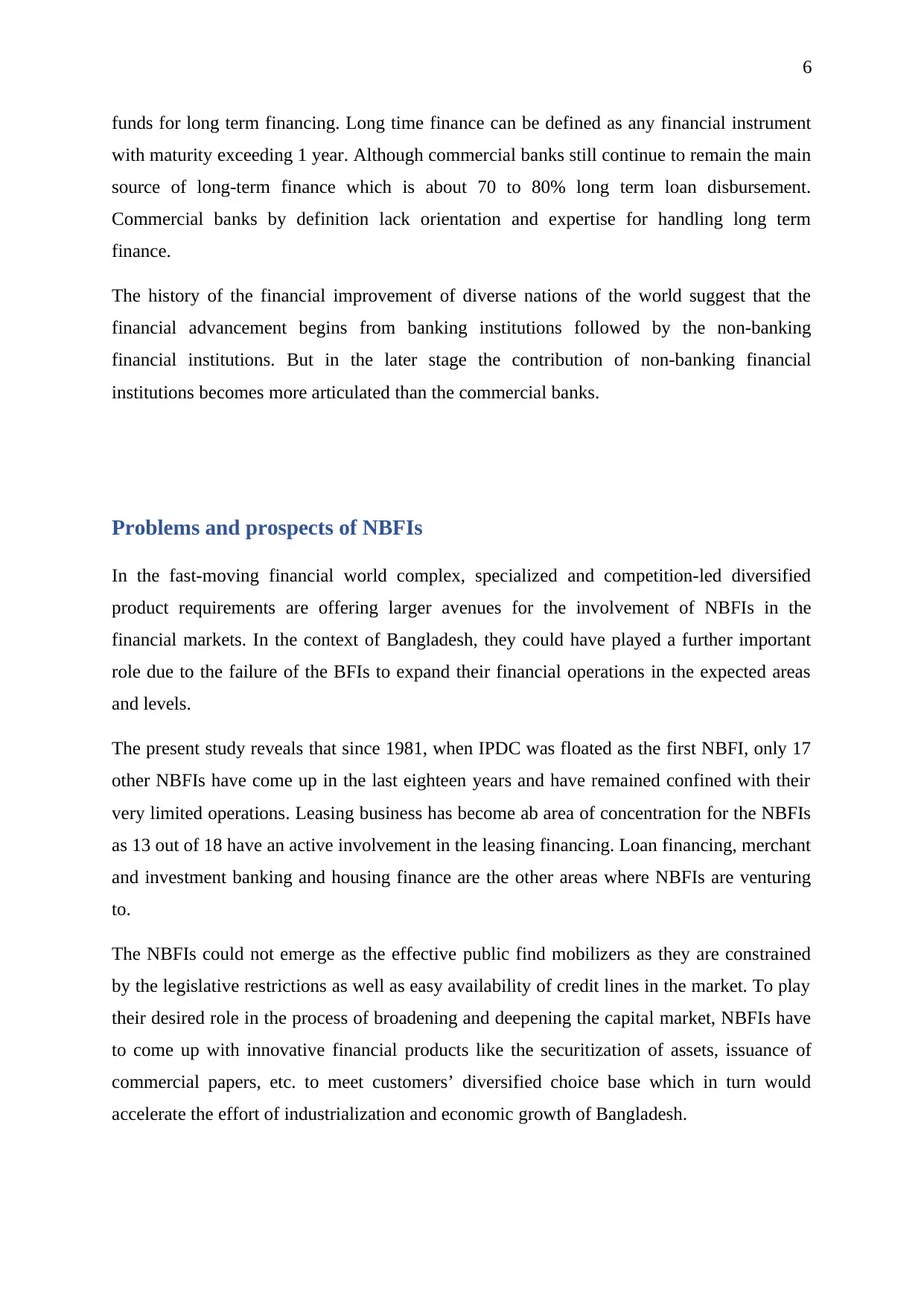
funds for long term financing. Long time finance can be defined as any financial instrument
with maturity exceeding 1 year. Although commercial banks still continue to remain the main
source of long-term finance which is about 70 to 80% long term loan disbursement.
Commercial banks by definition lack orientation and expertise for handling long term
finance.
The history of the financial improvement of diverse nations of the world suggest that the
financial advancement begins from banking institutions followed by the non-banking
financial institutions. But in the later stage the contribution of non-banking financial
institutions becomes more articulated than the commercial banks.
Problems and prospects of NBFIs
In the fast-moving financial world complex, specialized and competition-led diversified
product requirements are offering larger avenues for the involvement of NBFIs in the
financial markets. In the context of Bangladesh, they could have played a further important
role due to the failure of the BFIs to expand their financial operations in the expected areas
and levels.
The present study reveals that since 1981, when IPDC was floated as the first NBFI, only 17
other NBFIs have come up in the last eighteen years and have remained confined with their
very limited operations. Leasing business has become ab area of concentration for the NBFIs
as 13 out of 18 have an active involvement in the leasing financing. Loan financing, merchant
and investment banking and housing finance are the other areas where NBFIs are venturing
to.
The NBFIs could not emerge as the effective public find mobilizers as they are constrained
by the legislative restrictions as well as easy availability of credit lines in the market. To play
their desired role in the process of broadening and deepening the capital market, NBFIs have
to come up with innovative financial products like the securitization of assets, issuance of
commercial papers, etc. to meet customers’ diversified choice base which in turn would
accelerate the effort of industrialization and economic growth of Bangladesh.
funds for long term financing. Long time finance can be defined as any financial instrument
with maturity exceeding 1 year. Although commercial banks still continue to remain the main
source of long-term finance which is about 70 to 80% long term loan disbursement.
Commercial banks by definition lack orientation and expertise for handling long term
finance.
The history of the financial improvement of diverse nations of the world suggest that the
financial advancement begins from banking institutions followed by the non-banking
financial institutions. But in the later stage the contribution of non-banking financial
institutions becomes more articulated than the commercial banks.
Problems and prospects of NBFIs
In the fast-moving financial world complex, specialized and competition-led diversified
product requirements are offering larger avenues for the involvement of NBFIs in the
financial markets. In the context of Bangladesh, they could have played a further important
role due to the failure of the BFIs to expand their financial operations in the expected areas
and levels.
The present study reveals that since 1981, when IPDC was floated as the first NBFI, only 17
other NBFIs have come up in the last eighteen years and have remained confined with their
very limited operations. Leasing business has become ab area of concentration for the NBFIs
as 13 out of 18 have an active involvement in the leasing financing. Loan financing, merchant
and investment banking and housing finance are the other areas where NBFIs are venturing
to.
The NBFIs could not emerge as the effective public find mobilizers as they are constrained
by the legislative restrictions as well as easy availability of credit lines in the market. To play
their desired role in the process of broadening and deepening the capital market, NBFIs have
to come up with innovative financial products like the securitization of assets, issuance of
commercial papers, etc. to meet customers’ diversified choice base which in turn would
accelerate the effort of industrialization and economic growth of Bangladesh.
⊘ This is a preview!⊘
Do you want full access?
Subscribe today to unlock all pages.
Trusted by 1+ million students worldwide
7
Bangladesh Bank has to play an anchor role to provide an enabling environment for the
growth and development of NBFIs through prudential regulations and supervision. Finally,
the study has come up with a number of recommendations for the smooth operation of the
NBFIs in which the authorities can fall back upon.
Steps necessary to improve NBFIs
In the fast-changing financial world, the contribution of NBFIs cannot be undermined. NBFIs
have opened a new Vista in the countries traditional financial system by providing loans
through leasing and other Windows. They however suffer from several constraints. It is
important they are allowed to play their roles properly so that the commercial banks are freed
from the complexities of supplying long-term finance. To restore the health of the banking
sector it is important that the job of providing long term loans is assigned to where they
belong- the non-banking financial institution sector.
They are already playing an increasingly important role and an enabling environment could
be created to step up their activities. Traditional banks should concentrate on doing what they
should be doing lending short-term for working capital, bill financing etc. However, despite
the above-mentioned problems the NBFIs I have the promising future in Bangladesh provided
they gets paid deserving attention in the right frame. The following steps are put forward to
development of the NBFIs sector:
1) NBFIs I should endeavor to diversify their product base both in terms of accessing to new
sources of funds as well as new areas of deployment of funds to evade concentration and
minimize intra industry competition.
2) development of secondary market for treasury bills and reduction of interest rate on
government savings schemes may be considered by the government to ease the environment
for investment.
Some steps have been taken to help the non-banking financial institutions to tide over the
fund problems. International development agency (IDA) offered a long-term credit line under
its financial institutions development project (FIDP) to the government of Bangladesh. IDA
funding is placed to develop the capability of the financial institutions to raise medium long-
term resources.
Bangladesh Bank has to play an anchor role to provide an enabling environment for the
growth and development of NBFIs through prudential regulations and supervision. Finally,
the study has come up with a number of recommendations for the smooth operation of the
NBFIs in which the authorities can fall back upon.
Steps necessary to improve NBFIs
In the fast-changing financial world, the contribution of NBFIs cannot be undermined. NBFIs
have opened a new Vista in the countries traditional financial system by providing loans
through leasing and other Windows. They however suffer from several constraints. It is
important they are allowed to play their roles properly so that the commercial banks are freed
from the complexities of supplying long-term finance. To restore the health of the banking
sector it is important that the job of providing long term loans is assigned to where they
belong- the non-banking financial institution sector.
They are already playing an increasingly important role and an enabling environment could
be created to step up their activities. Traditional banks should concentrate on doing what they
should be doing lending short-term for working capital, bill financing etc. However, despite
the above-mentioned problems the NBFIs I have the promising future in Bangladesh provided
they gets paid deserving attention in the right frame. The following steps are put forward to
development of the NBFIs sector:
1) NBFIs I should endeavor to diversify their product base both in terms of accessing to new
sources of funds as well as new areas of deployment of funds to evade concentration and
minimize intra industry competition.
2) development of secondary market for treasury bills and reduction of interest rate on
government savings schemes may be considered by the government to ease the environment
for investment.
Some steps have been taken to help the non-banking financial institutions to tide over the
fund problems. International development agency (IDA) offered a long-term credit line under
its financial institutions development project (FIDP) to the government of Bangladesh. IDA
funding is placed to develop the capability of the financial institutions to raise medium long-
term resources.
Paraphrase This Document
Need a fresh take? Get an instant paraphrase of this document with our AI Paraphraser
8
Bangladesh bank has also taken several steps in reducing the costs of non-banking financial
institutions. The statutory liquidity ratio (SLR) of the financial institutions was lowered from
10 % to 5% of which 2.5% was to be kept as reserve requirement (CRR) with the Bangladesh
Bank and remaining 2.5% would be kept in cash or other liquid assets.
These steps are too small compared to the enormity of the fund problem of the NBFIs
characterized by high cost and security of funds. They can therefore lend money only at high
interest rates. Due to their anxiety to secure businesses, they are forced to compete with the
banks and often end up to risky ventures. Commercial banks may be encouraged to lend
money to the non-banking financial institutions on reasonable terms. Bangladesh Bank may
also open a refinance window even for a limited period of time.
Bangladesh bank has also taken several steps in reducing the costs of non-banking financial
institutions. The statutory liquidity ratio (SLR) of the financial institutions was lowered from
10 % to 5% of which 2.5% was to be kept as reserve requirement (CRR) with the Bangladesh
Bank and remaining 2.5% would be kept in cash or other liquid assets.
These steps are too small compared to the enormity of the fund problem of the NBFIs
characterized by high cost and security of funds. They can therefore lend money only at high
interest rates. Due to their anxiety to secure businesses, they are forced to compete with the
banks and often end up to risky ventures. Commercial banks may be encouraged to lend
money to the non-banking financial institutions on reasonable terms. Bangladesh Bank may
also open a refinance window even for a limited period of time.
9
Accounts of Customer
Bank account is a contractual agreement between a bank and its customer, allowing the
customer to use bank service for a fee. Accounts may be established in the name of
individuals or firms. There must be some recognizable course or habit of dealing between the
customer and the banker. The transactions must be made in the form of regular
banking business. The obligation of a banker to maintain secrecy of the account holder. The
bank collects the proceeds of the account holder on his behalf.
Bank gives reasonable notice before closing the account. A person who has a bank account in
his name and for whom the banker undertakes to provide the facilities as a banker is
considered to be customer. It not essential that the account must have been operated upon for
some time. Even a single deposit in the account will be sufficient to designate a person as
customer of the banker. Though emphasis is not being laid on the habit of dealing with the
banker in the past but such habit may be expected to be developed and continued in future.
Importance of Opening an account
Bangladesh is a small country. Many kinds of industries are situated in our country. All
industries of Bangladesh complete their transaction by account. Now industries of
Bangladesh give salary to employees by cheque. Many kinds of businessman like cheque for
payment. Besides when a sale proprietor opens an account in bank. Then he or she takes loan
from that bank. It is very important for a sale proprietor. Banks of our country give salary to
employees by cheque. Besides universities of Bangladesh give salary to teachers by cheque.
So, account’s opening essential for us. Accounts opening are also important for student. A
student pays their tuition fee to university by cheque. It is a good for a student.
Types of bank account
Current Account
Current account is an account in which there is no limit on the number of transactions that
can be done in a day and are therefore also referred to as Transactional Accounts. These types
of accounts are held neither for the purpose of Investment nor for the purpose of Savings but
only for the convenience of the business as these accounts are the most liquid type of
Accounts of Customer
Bank account is a contractual agreement between a bank and its customer, allowing the
customer to use bank service for a fee. Accounts may be established in the name of
individuals or firms. There must be some recognizable course or habit of dealing between the
customer and the banker. The transactions must be made in the form of regular
banking business. The obligation of a banker to maintain secrecy of the account holder. The
bank collects the proceeds of the account holder on his behalf.
Bank gives reasonable notice before closing the account. A person who has a bank account in
his name and for whom the banker undertakes to provide the facilities as a banker is
considered to be customer. It not essential that the account must have been operated upon for
some time. Even a single deposit in the account will be sufficient to designate a person as
customer of the banker. Though emphasis is not being laid on the habit of dealing with the
banker in the past but such habit may be expected to be developed and continued in future.
Importance of Opening an account
Bangladesh is a small country. Many kinds of industries are situated in our country. All
industries of Bangladesh complete their transaction by account. Now industries of
Bangladesh give salary to employees by cheque. Many kinds of businessman like cheque for
payment. Besides when a sale proprietor opens an account in bank. Then he or she takes loan
from that bank. It is very important for a sale proprietor. Banks of our country give salary to
employees by cheque. Besides universities of Bangladesh give salary to teachers by cheque.
So, account’s opening essential for us. Accounts opening are also important for student. A
student pays their tuition fee to university by cheque. It is a good for a student.
Types of bank account
Current Account
Current account is an account in which there is no limit on the number of transactions that
can be done in a day and are therefore also referred to as Transactional Accounts. These types
of accounts are held neither for the purpose of Investment nor for the purpose of Savings but
only for the convenience of the business as these accounts are the most liquid type of
⊘ This is a preview!⊘
Do you want full access?
Subscribe today to unlock all pages.
Trusted by 1+ million students worldwide
10
accounts. Current account is one type of account that is basically opened a business person.
Business person frequently transact with the bank. That's why the nature of a current account
support the needs of a business man. Banks don’t pay any interest on the amount lying in
these accounts and in some cases also charge a small fee for the services they provide.
Benefits of a Current Account:
1. Allows for promote business transactions.
2. No limit on withdrawals.
3. No limit on deposits in the home branch.
4. Enables businessmen to make direct payments using cheques, demand drafts, or pay
orders.
5. Provides overdraft facility.
6. Provides internet banking and mobile banking facilities.
Savings account:
A savings account is an interest-bearing deposit account held at a banker or other financial
institution. Savings account is meant for savings purposes. Any individual either single or
jointly can open a savings account. Most of salaried persons, pensioners and students use
savings account. Banks pay interest for the savings. The savings account holder is allowed to
withdraw money from the account and when required. There is no restriction on the number
and amount of deposit. But withdrawals are subjected to certain restriction.
Benefits of a savings account:
1. No monthly maintenance fees.
2. A competitive interest rate.
3. Minimum balance requirements.
4. Easy to open and access.
5. FDIC insurance and security.
accounts. Current account is one type of account that is basically opened a business person.
Business person frequently transact with the bank. That's why the nature of a current account
support the needs of a business man. Banks don’t pay any interest on the amount lying in
these accounts and in some cases also charge a small fee for the services they provide.
Benefits of a Current Account:
1. Allows for promote business transactions.
2. No limit on withdrawals.
3. No limit on deposits in the home branch.
4. Enables businessmen to make direct payments using cheques, demand drafts, or pay
orders.
5. Provides overdraft facility.
6. Provides internet banking and mobile banking facilities.
Savings account:
A savings account is an interest-bearing deposit account held at a banker or other financial
institution. Savings account is meant for savings purposes. Any individual either single or
jointly can open a savings account. Most of salaried persons, pensioners and students use
savings account. Banks pay interest for the savings. The savings account holder is allowed to
withdraw money from the account and when required. There is no restriction on the number
and amount of deposit. But withdrawals are subjected to certain restriction.
Benefits of a savings account:
1. No monthly maintenance fees.
2. A competitive interest rate.
3. Minimum balance requirements.
4. Easy to open and access.
5. FDIC insurance and security.
Paraphrase This Document
Need a fresh take? Get an instant paraphrase of this document with our AI Paraphraser
11
Recurring Deposit account:
Recurring deposit account or RD account is opened by those who want to save certain
amount of money regularly foe a certain period of time and earn a higher interest rate. In RD
account a fixed amount is deposited every month for a specified period and the total amount
is repaid with interest at the end of the particular fixed period. The period of deposit is
minimum six months and maximum ten years. The interest rates vary for different plans
based on the amount on saves and the period of time and also on banks. No withdrawals are
allowed from the RD account. However, the bank may allow to close the account before the
maturity period.
These accounts can be opened is single or joint names. Banks are also providing the
Nomination facility to the RD account.
Fixed Deposit Account:
In Fixed Deposit Account a particular some of money is deposited in a bank for specific
period of time.it is one time deposit and one time take away account. The money deposited in
this account cannot be withdrawn before the expiry date. However, in case of need, the
depositor can ask for closing the fixed deposit prematurely by paying a penalty.
A higher interest rate is paid on fixed deposits. The rate of interest paid for fixed deposit vary
according to amount, period and also from bank to bank.
Precaution for opening a current account
For opening an account, the banker has to follow some rule for the account will not go for
wrong person and the business person will not misuse the account.
a) Proper introduction of the customer is essential. The manager should verify whether
the new customer is a person with integrity and reputation to be a "desirable
customer", to open the account. This is to prevent any fraud.
b) The bank manager may make enquiries from references given by the customer or
banks about the status of the customer. He should make 'reasonable enquiry' as is
necessary in the circumstances, to convince himself that the person is bonafide
Recurring Deposit account:
Recurring deposit account or RD account is opened by those who want to save certain
amount of money regularly foe a certain period of time and earn a higher interest rate. In RD
account a fixed amount is deposited every month for a specified period and the total amount
is repaid with interest at the end of the particular fixed period. The period of deposit is
minimum six months and maximum ten years. The interest rates vary for different plans
based on the amount on saves and the period of time and also on banks. No withdrawals are
allowed from the RD account. However, the bank may allow to close the account before the
maturity period.
These accounts can be opened is single or joint names. Banks are also providing the
Nomination facility to the RD account.
Fixed Deposit Account:
In Fixed Deposit Account a particular some of money is deposited in a bank for specific
period of time.it is one time deposit and one time take away account. The money deposited in
this account cannot be withdrawn before the expiry date. However, in case of need, the
depositor can ask for closing the fixed deposit prematurely by paying a penalty.
A higher interest rate is paid on fixed deposits. The rate of interest paid for fixed deposit vary
according to amount, period and also from bank to bank.
Precaution for opening a current account
For opening an account, the banker has to follow some rule for the account will not go for
wrong person and the business person will not misuse the account.
a) Proper introduction of the customer is essential. The manager should verify whether
the new customer is a person with integrity and reputation to be a "desirable
customer", to open the account. This is to prevent any fraud.
b) The bank manager may make enquiries from references given by the customer or
banks about the status of the customer. He should make 'reasonable enquiry' as is
necessary in the circumstances, to convince himself that the person is bonafide
12
customer. He need not act like a master detective and put the new customer to serious
cross examination.
c) The manager should not act negligently in making enquiries;
KYC:
KYC stands for “Know Your Customer.” It is a process where banks obtain information
about their customers’ identity thereby ensuring that bank services and government
regulations not misused. The KYC procedure is used when bank customers open accounts.
Banks are also required to periodically update their customers’ KYC details.
The purpose of KYC is to reduce the risk of identify theft, money laundering, financial fraud,
and the financing of criminal organizations. KYC helps manage risks and helps to understand
customer behaviors. This importance of the KYC process requires banks to collect and verify
basic details of customers which includes their name and authorized signatures, legal status
of an entity or person, the identity of owners on the account and other information depending
on FI risk approach.
The importance of KYC in banks and financial institutions
The importance of KYC in banks and other financial institutions have strong KYC
procedures in place so they can ensure that their clients are not involved in money laundering
or the financing of criminal organizations. The KYC process helps avoid severe reputational
and financial penalties imposed by regulators. Banking is an industry with inherent risk
of financial frauds and money laundering so it is extremely important to perform background
screening procedures on customers to mitigate fraudulent activities.
1) 1.Identity Theft: KYC helps financial institutions establish proof of a customer’s legal
identity. This can prevent fake accounts and identity thefts from forged documents or
stolen identity documents.
2) 2.Money Laundering: Both organized and unorganized criminal sectors use dummy
accounts in banks to store funding for narcotics, human trafficking, smuggling,
racketeering, and more. By spreading the money out across a long list of accounts,
these criminal sectors seek to avoid suspicion.
customer. He need not act like a master detective and put the new customer to serious
cross examination.
c) The manager should not act negligently in making enquiries;
KYC:
KYC stands for “Know Your Customer.” It is a process where banks obtain information
about their customers’ identity thereby ensuring that bank services and government
regulations not misused. The KYC procedure is used when bank customers open accounts.
Banks are also required to periodically update their customers’ KYC details.
The purpose of KYC is to reduce the risk of identify theft, money laundering, financial fraud,
and the financing of criminal organizations. KYC helps manage risks and helps to understand
customer behaviors. This importance of the KYC process requires banks to collect and verify
basic details of customers which includes their name and authorized signatures, legal status
of an entity or person, the identity of owners on the account and other information depending
on FI risk approach.
The importance of KYC in banks and financial institutions
The importance of KYC in banks and other financial institutions have strong KYC
procedures in place so they can ensure that their clients are not involved in money laundering
or the financing of criminal organizations. The KYC process helps avoid severe reputational
and financial penalties imposed by regulators. Banking is an industry with inherent risk
of financial frauds and money laundering so it is extremely important to perform background
screening procedures on customers to mitigate fraudulent activities.
1) 1.Identity Theft: KYC helps financial institutions establish proof of a customer’s legal
identity. This can prevent fake accounts and identity thefts from forged documents or
stolen identity documents.
2) 2.Money Laundering: Both organized and unorganized criminal sectors use dummy
accounts in banks to store funding for narcotics, human trafficking, smuggling,
racketeering, and more. By spreading the money out across a long list of accounts,
these criminal sectors seek to avoid suspicion.
⊘ This is a preview!⊘
Do you want full access?
Subscribe today to unlock all pages.
Trusted by 1+ million students worldwide

1 out of 19


Your All-in-One AI-Powered Toolkit for Academic Success.
+13062052269
info@desklib.com
Available 24*7 on WhatsApp / Email
![[object Object]](/_next/static/media/star-bottom.7253800d.svg)
Unlock your academic potential
Copyright © 2020–2026 A2Z Services. All Rights Reserved. Developed and managed by ZUCOL.