A Study on Financial Instruments to Promote Solar Energy in Australia

Verified

Added on  2021/05/31

|33
|8969
|106
Project
AI Summary
This research project, prepared by Kinjalkumar Patel, examines financial instruments as a means to promote solar energy within the housing sector in Australia. The study, conducted for Asia Pacific International College's SBM 1300 Research Project, explores the rationale and efficiency of financial instruments as management interventions. It investigates the motivations behind the research, the significance of the study within the context of energy policy, and the research questions and objectives. The project employs a mixed methodology, combining qualitative and quantitative research approaches, to analyze the role of financial instruments in shaping policy and strategy development. The thesis is structured into five chapters, covering the introduction, literature review, research design, data analysis, and conclusions, including findings, implications, and recommendations for further research. The literature review focuses on financial instruments in the renewable energy sector in Australia, examining the barriers to sustainable energy adoption and the importance of policy in promoting its use. The research aims to provide insights for researchers, managers, investors, and consumers concerning policy development, financial instruments, and solar energy in housing.
Document Page
SBM 1300
Research Project
Kinjalkumar Patel
(201700607)
A study on the financial instruments to promote solar energy for
housing sector in Australia
Prepared By
Kinjalkumar Patel
Student Id: 201700607
1
tabler-icon-diamond-filled.svg

Paraphrase This Document

Need a fresh take? Get an instant paraphrase of this document with our AI Paraphraser
Document Page
SBM 1300
Research Project
Kinjalkumar Patel
(201700607)
Asia Pacific International College
SBM 1300 Research Project
Supervisor: Dr. Sara Shirowzhan
ASIA PACIFIC INTERNATIONAL COLLEGE
ASSIGNMENTS 1 COVER SHEET
STUDENT DETAILS
Student name: Kinjalkumar Patel Student ID number: 201700607
UNIT DETAILS
Unit name: Research Project Unit number: SBM1300
Course name: MBPM Class day and time: Thursday, 9 A.M
Lecturer and/or Tutor name: Dr. Venkatesh Mahadevan
ASSIGNMENT DETAILS
Title: Assignment 1
2
Document Page
SBM 1300
Research Project
Kinjalkumar Patel
(201700607)
Word
count: 7300 Due date: 01/04/2018 Date submitted: 01/04/2018
Campus (where you are enrolled): Sydney
DECLARATION
I/we hold a copy of this assignment if the original is lost or damaged.
I/we hereby certify that no part of this assignment has been copied from any other student’s
work or from any other source except where due acknowledgement is made in the assignment.
I/we hereby certify that no part of this assignment has been submitted by me in any other
(previous or current) assessment, except where appropriately referenced, and with prior
permission from the Lecturer/Tutor for this unit.
No part of the assignment has been written/produced for me/us by any other person except
where collaboration has been authorized by the Lecturer/Tutor concerned.
I/we am/are aware that this work will be reproduced and submitted to plagiarism detection
software programs for the purpose of detecting possible plagiarism (which may retain a copy
on its database for future plagiarism checking).
Student’s full
name: Kinjalkumar Patel
3
Document Page
SBM 1300
Research Project
Kinjalkumar Patel
(201700607)
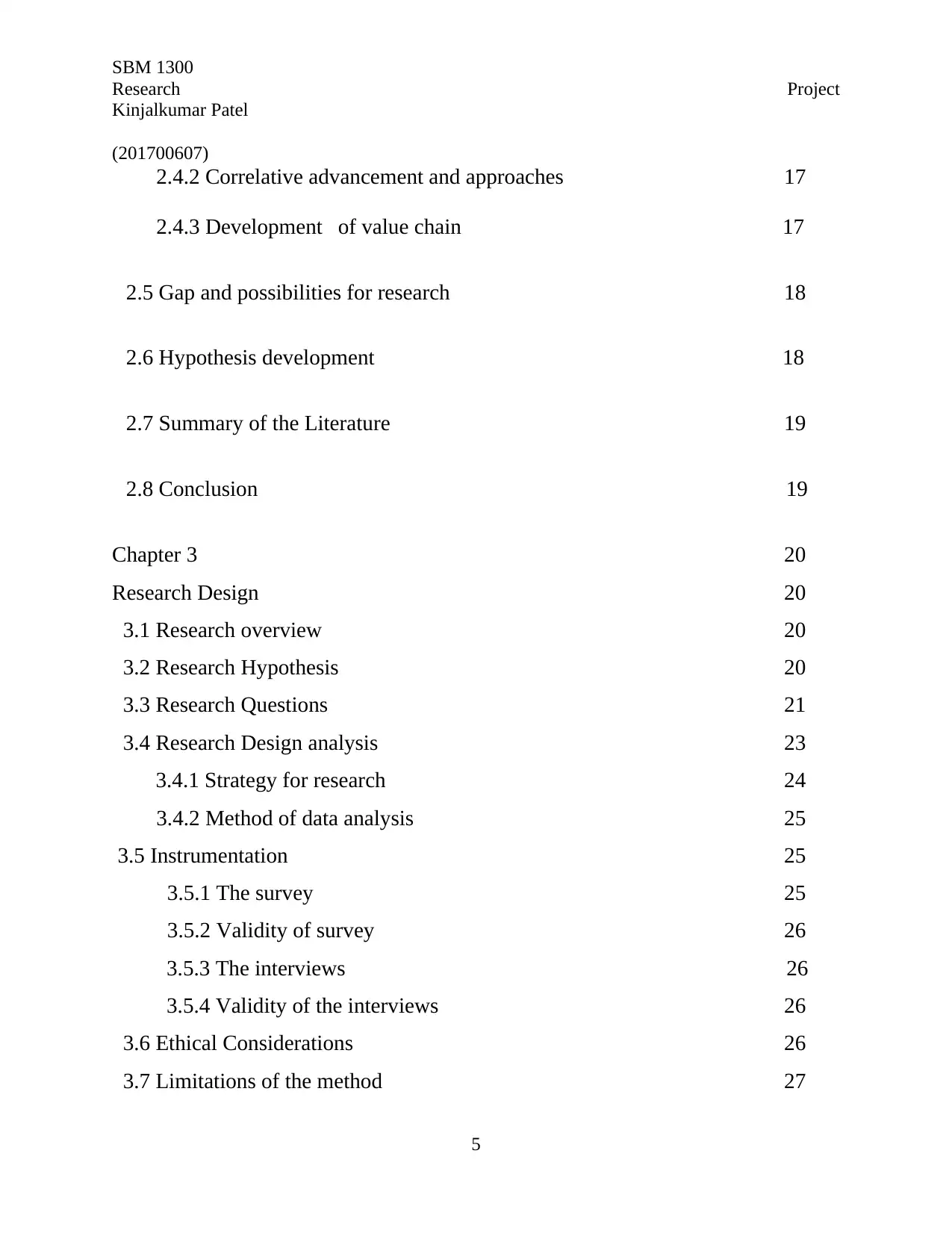
Table of Contents
Chapter 1 5
Introduction
5
1.1 Recommendation of the study 5
1.2 Motivation of research 5
1.3 The signification of study 6
1.4 Research Question 7
1.5 Research Objectives 8
1.6 Research Design 8
1.7 Theoretical Orientation 8
1.8 Finding and Applications 9
1.9 Structure of Thesis 9
1.10 Conclusion 10
Chapter 2 11
Literature Review 11
2.1 Introduction 11
2.2 Review of research 12
2.3 Insurance as a financial instrument 14
2.4 Basic of comparing financial instruments 16
2.4.1 Increasing returns in arrangements 16
4
tabler-icon-diamond-filled.svg

Paraphrase This Document

Need a fresh take? Get an instant paraphrase of this document with our AI Paraphraser
Document Page
SBM 1300
Research Project
Kinjalkumar Patel
(201700607)
2.4.2 Correlative advancement and approaches 17
2.4.3 Development of value chain 17
2.5 Gap and possibilities for research 18
2.6 Hypothesis development 18
2.7 Summary of the Literature 19
2.8 Conclusion 19
Chapter 3 20
Research Design 20
3.1 Research overview 20
3.2 Research Hypothesis 20
3.3 Research Questions 21
3.4 Research Design analysis 23
3.4.1 Strategy for research 24
3.4.2 Method of data analysis 25
3.5 Instrumentation 25
3.5.1 The survey 25
3.5.2 Validity of survey 26
3.5.3 The interviews 26
3.5.4 Validity of the interviews 26
3.6 Ethical Considerations 26
3.7 Limitations of the method 27
5
Document Page
SBM 1300
Research Project
Kinjalkumar Patel
(201700607)
3.8 Conclusion 27
References 28
List of Tables and Figure
Table 1 Research Design Analysis 22
6
Document Page
SBM 1300
Research Project
Kinjalkumar Patel
(201700607)
Chapter 1
Introduction
1.1. Recommendation of study
Financial instruments play a very important role in the delivery of the policy objectives within a
country. Not only do they offer financial support but also address specific policy objectives.
While there are not forms of innovation, financial instruments serve as well-established practices
for the promotion and implementation of projects. However, the importance and the rationale
behind the use of the financial instruments have been a point of confusion. This has led to poorly
implemented projects. Given this, understanding the rationale and efficiency of efficiency of
financial instruments as a management intervention is critical in understanding the
implementation of the solar energy project within Australia.
1.2 Motivation of the Research
The primary motivation of the research is to contribute to the energy debate on how best
to reach consumers with sustainable solar energy. Various investigations have shown that the
infiltration of energy-sufficient equipment is far beneath the level that is financially effective for
energy buyers (Green et al., 2017: Hua et al., 2016; Moore et al., 2016). Policies targeted at
energy efficiency try to close this gap by recognizing and tending to the boundaries that keep
shoppers from putting resources into energy proficient equipment. These boundaries are various,
including absence of data, split motivations (for instance, amongst proprietors and tenants), high
exchange costs (expenses of taking an interest in a market), absence of specialized ability, and
absence of energy proficient equipment available (Moore et al., 2016). One of the most
7
tabler-icon-diamond-filled.svg

Paraphrase This Document

Need a fresh take? Get an instant paraphrase of this document with our AI Paraphraser
Document Page
SBM 1300
Research Project
Kinjalkumar Patel
(201700607)
noteworthy obstructions that strategy developers recognize to the buy of energy effective
equipment is the moderately higher in advance expenses of productive items. In numerous
occasions, these expenses deflect potential buyers notwithstanding when speculations have all
the earmarks of being to shoppers' greatest advantage (i.e., when ventures are financially
efficient over the equipment's lifetime). Consumers put incredible incentive on quick investment
funds and vigorously rebate future reserve funds (Green et al., 2017). Besides, because they will
be unable to effectively assess future funds, shoppers have a tendency to have a low level of trust
in expected paybacks. Subsequently, shoppers regularly buy the least expensive alternatives
accessible.
1.3 Significance of the Study
The study is significant because the financial instruments play a critical role in the
development of the energy policy context and conditions for the domestic framework, which
found decisions to do with policy and their efficiency. In the broader context, the energy policy
is in consideration of the international commitments and standards concerning climate change.
the priorities in Europe and other countries is to improve of the security and sustainability of the
energy supplies while putting significant effort into addressing the objectives of global climate
change. Allouhi et al.,(2015) emphasized the need to fundamentally rethink the energy
efficiency and treat each energy source with its own reserved right. This, however, goes against
ideas presented by others, which focus on the scaling up of investment in energy efficiency.
However, the need to put energy efficiency fast is based on the cleanest and cheapest source of
energy, solar energy that does not require to be used or produced. In consideration of this, the
main energy consumptions in homes is variant in different reactions depending on the climate,
8
Document Page
SBM 1300
Research Project
Kinjalkumar Patel
(201700607)
the demography, the quality of housing and the sectorial patterns among other reasons (Hua et
al., 2016). Notably energy consumption in hosing is representative of the greatest potential area
that needs to be addressed in order to achieve energy efficiency. With the key drives being
provision of clean renewable energy, the financial instruments, which are integral in the policy
development, must be evaluated and identified.
1.4 Research Questions
Current literature shows an existing change that the use of solar energy is a plausible idea
and can be achieved. However, there is a lack of adequate analysis on the role of financial
instruments and policy as a management intervention play in the promotion of solar energy for
housing sector in Australia. Understanding the role of the financial instruments helps to
understand the critical areas to be addressed in policy in order to successfully implement the
management intervention, which will promotion of solar energy for housing sector in Australia.
The aim of the research is to ‘analyze the efficiency of management interventions that include
financial instruments and policy in the promotion of the use of solar energy in Australia’. Given
this, the following research question is proposed.
Can financial instruments as a management intervention play an active roles in shaping policy
and strategy development aimed at implementing incentives that will promote the use of solar
energy in the housing sector?’
In addition, the research has come up with the following sub question aligned to the main
research question:
9
Document Page
SBM 1300
Research Project
Kinjalkumar Patel
(201700607)
Does the use of financial instrument serve to increase the mechanism of income
subsidies?
Does the use of financial instruments serve development of finance-based policy
positively?
Does the use of financial instrument serve to increase the annuity capital when using
renewable energy?
o
1.5 Research Objectives
The objectives of the research are:
o To define the rationale that will trigger the use of financial instruments as a
management intervention for the promotion of solar energy for housing sector in
Australia
o To analyse the efficiency of management interventions that include financial
instruments and policy in the promotion of the use of solar energy in Australia.
1.6 Research design
The design of the research involves the choice of topic under investigation. Not only does
it align itself with the examination of the research data but also the selection of appropriate
methodology. The research applies a positivity approach through the implementation of a mixed
methodology of research. The methodology applies the use of both qualitative and quantitative
research data.
1.7 Theoretical Orientation
10
tabler-icon-diamond-filled.svg

Paraphrase This Document

Need a fresh take? Get an instant paraphrase of this document with our AI Paraphraser
Document Page
SBM 1300
Research Project
Kinjalkumar Patel
(201700607)
The study focuses on the institutions’ theory in which it applies the framework as a basis
for practice and research. The research establishes the institutional theory the foundation of the
hypothesis.
1.8 Findings and implications
The thesis will provide important findings, which will benefit researcher, managers,
investors and customers, in a research study concerning policy development, financial
instruments, solar energy in housing and policy creation. The findings will provide a greater
understanding on the effect of the financial instruments in the development of policy about solar
energy in housing and policy creation in support of the endeavors.
1.9 Structure of the Thesis
The study will include five chapters outlined briefly as follows:
a. First section- this Chapter discusses the background of the study and provides an
overview of the research topic including the statement of the problem, the research
hypothesis, goals and objectives.
b. Second section - This chapter discusses the literature review of the study. The chapter
provides a background of effect of the financial instruments in the development of policy
concerning solar energy in housing. The chapter discusses these issues in detail and will
introduce the hypothesis and propositions for the study.
11
Document Page
SBM 1300
Research Project
Kinjalkumar Patel
(201700607)
c. Third section - This chapter outlines the methodology used in the research. It discusses
the mixed methodology, which will be used in the proving of the propositions, and the
hypothesis made.
d. Fourth section - This chapter provides a discussion and analysis of the data based on the
application of the research methodology to address the research question. It discusses the
key outcomes of the research.
e. Fifth section - This chapter discusses the findings of the research as well as the summary
and conclusion of the thesis. It identifies the implication of the study as well as
recommendation and limitation for additional research.
1.10 Conclusion
The chapter provides the recommendation of the research for the thesis and presents the
research questions. In addition, it provides an explanation of the importance of the financial
instruments in the development of policy about solar energy in housing in Australia. The chapter
outlines the motivation of the research, significance of the study and the research question. It
also includes the design of the research and theoretical frameworks, which provide the structure
for the discussion.
12
chevron_up_icon
1 out of 33
circle_padding
hide_on_mobile
zoom_out_icon
[object Object]