Analysis of Financial Lease Accounting and Impairment Loss

Verified

Added on  2023/04/25

|6
|1499
|442
Homework Assignment
AI Summary
This assignment solution provides a comprehensive analysis of financial lease accounting, focusing on the application of IAS 17 and the accounting treatment of impairment losses. Part A delves into the specifics of financial leases, defining key terms like lessor and lessee, and explaining the historical context of off-balance sheet financing. It elaborates on the accounting procedures for dealer lessors, including the recognition of finance lease receivables, the calculation of present values of minimum lease payments, and the impact on financial statements. Part B presents a practical calculation of impairment loss, detailing the allocation of losses across various assets such as equipment, goodwill, brand, fittings, and inventory. The solution includes journal entries to reflect the impairment loss and provides references to relevant accounting standards and literature. This assignment is a valuable resource for students studying financial accounting, offering a clear understanding of complex lease accounting principles and their practical application.

Document Page
qwertyuiopasdfghjklzxcvbnmqwerty
uiopasdfghjklzxcvbnmqwertyuiopasd
fghjklzxcvbnmqwertyuiopasdfghjklzx
cvbnmqwertyuiopasdfghjklzxcvbnmq
wertyuiopasdfghjklzxcvbnmqwertyui
opasdfghjklzxcvbnmqwertyuiopasdfg
hjklzxcvbnmqwertyuiopasdfghjklzxc
vbnmqwertyuiopasdfghjklzxcvbnmq
wertyuiopasdfghjklzxcvbnmqwertyui
opasdfghjklzxcvbnmqwertyuiopasdfg
hjklzxcvbnmqwertyuiopasdfghjklzxc
vbnmqwertyuiopasdfghjklzxcvbnmq
wertyuiopasdfghjklzxcvbnmqwertyui
opasdfghjklzxcvbnmqwertyuiopasdfg
hjklzxcvbnmrtyuiopasdfghjklzxcvbn
mqwertyuiopasdfghjklzxcvbnmqwert
yuiopasdfghjklzxcvbnmqwertyuiopas
ACCOUNTING
tabler-icon-diamond-filled.svg

Paraphrase This Document

Need a fresh take? Get an instant paraphrase of this document with our AI Paraphraser
Document Page
Financial lease
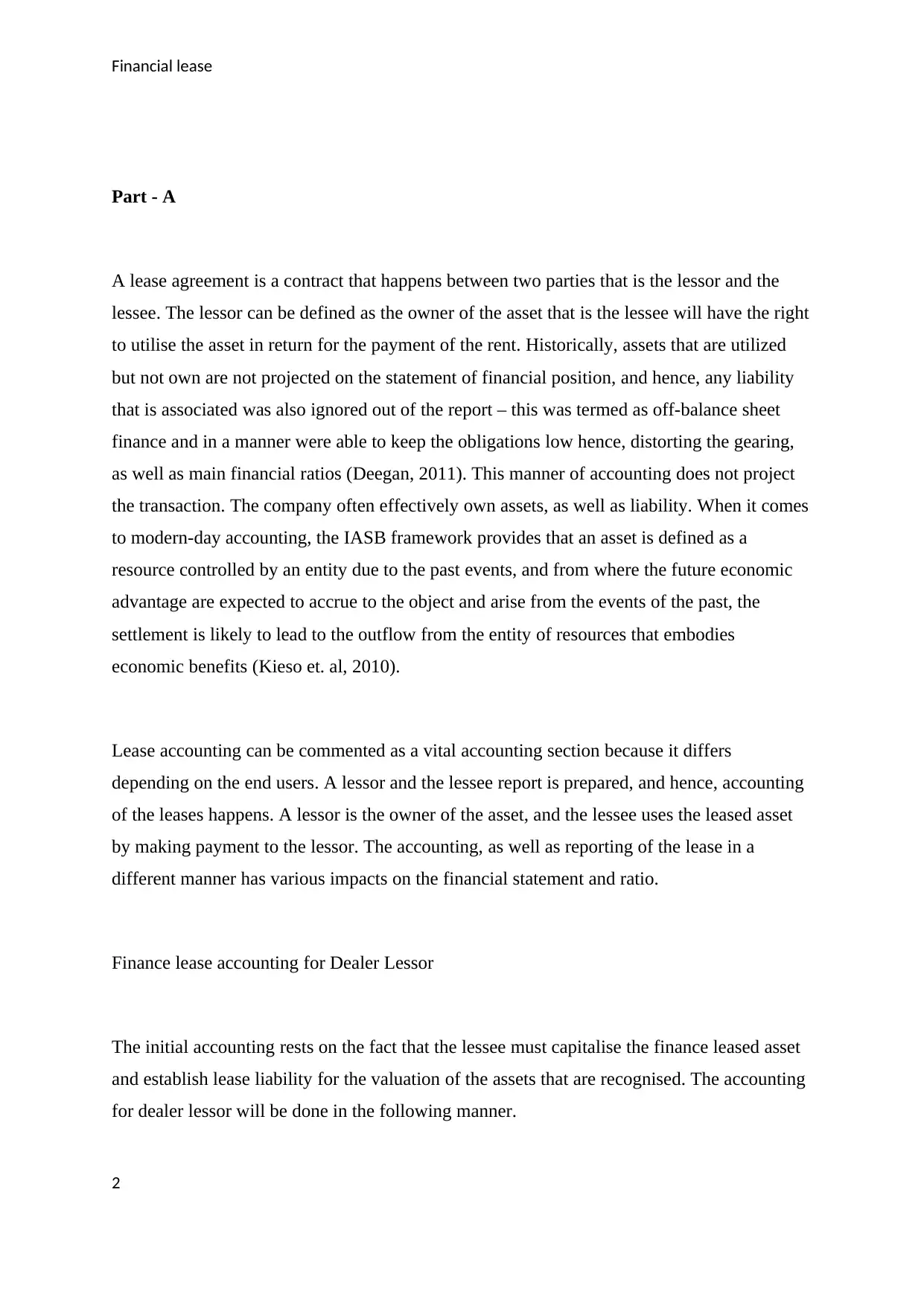
Part - A
A lease agreement is a contract that happens between two parties that is the lessor and the
lessee. The lessor can be defined as the owner of the asset that is the lessee will have the right
to utilise the asset in return for the payment of the rent. Historically, assets that are utilized
but not own are not projected on the statement of financial position, and hence, any liability
that is associated was also ignored out of the report – this was termed as off-balance sheet
finance and in a manner were able to keep the obligations low hence, distorting the gearing,
as well as main financial ratios (Deegan, 2011). This manner of accounting does not project
the transaction. The company often effectively own assets, as well as liability. When it comes
to modern-day accounting, the IASB framework provides that an asset is defined as a
resource controlled by an entity due to the past events, and from where the future economic
advantage are expected to accrue to the object and arise from the events of the past, the
settlement is likely to lead to the outflow from the entity of resources that embodies
economic benefits (Kieso et. al, 2010).
Lease accounting can be commented as a vital accounting section because it differs
depending on the end users. A lessor and the lessee report is prepared, and hence, accounting
of the leases happens. A lessor is the owner of the asset, and the lessee uses the leased asset
by making payment to the lessor. The accounting, as well as reporting of the lease in a
different manner has various impacts on the financial statement and ratio.
Finance lease accounting for Dealer Lessor
The initial accounting rests on the fact that the lessee must capitalise the finance leased asset
and establish lease liability for the valuation of the assets that are recognised. The accounting
for dealer lessor will be done in the following manner.
2
Document Page
Financial lease
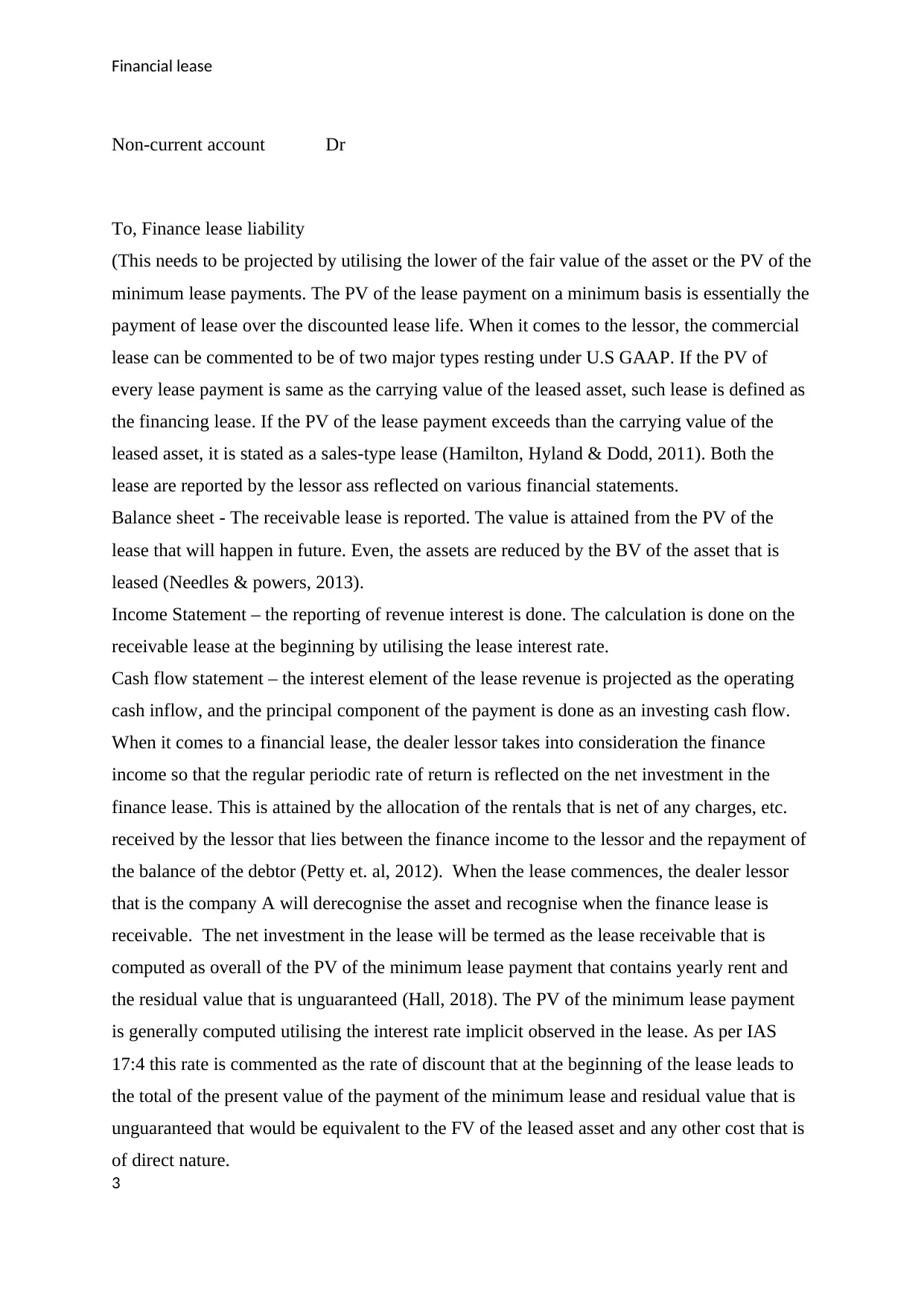
Non-current account Dr
To, Finance lease liability
(This needs to be projected by utilising the lower of the fair value of the asset or the PV of the
minimum lease payments. The PV of the lease payment on a minimum basis is essentially the
payment of lease over the discounted lease life. When it comes to the lessor, the commercial
lease can be commented to be of two major types resting under U.S GAAP. If the PV of
every lease payment is same as the carrying value of the leased asset, such lease is defined as
the financing lease. If the PV of the lease payment exceeds than the carrying value of the
leased asset, it is stated as a sales-type lease (Hamilton, Hyland & Dodd, 2011). Both the
lease are reported by the lessor ass reflected on various financial statements.
Balance sheet - The receivable lease is reported. The value is attained from the PV of the
lease that will happen in future. Even, the assets are reduced by the BV of the asset that is
leased (Needles & powers, 2013).
Income Statement – the reporting of revenue interest is done. The calculation is done on the
receivable lease at the beginning by utilising the lease interest rate.
Cash flow statement – the interest element of the lease revenue is projected as the operating
cash inflow, and the principal component of the payment is done as an investing cash flow.
When it comes to a financial lease, the dealer lessor takes into consideration the finance
income so that the regular periodic rate of return is reflected on the net investment in the
finance lease. This is attained by the allocation of the rentals that is net of any charges, etc.
received by the lessor that lies between the finance income to the lessor and the repayment of
the balance of the debtor (Petty et. al, 2012). When the lease commences, the dealer lessor
that is the company A will derecognise the asset and recognise when the finance lease is
receivable. The net investment in the lease will be termed as the lease receivable that is
computed as overall of the PV of the minimum lease payment that contains yearly rent and
the residual value that is unguaranteed (Hall, 2018). The PV of the minimum lease payment
is generally computed utilising the interest rate implicit observed in the lease. As per IAS
17:4 this rate is commented as the rate of discount that at the beginning of the lease leads to
the total of the present value of the payment of the minimum lease and residual value that is
unguaranteed that would be equivalent to the FV of the leased asset and any other cost that is
of direct nature.
3
Document Page
Financial lease
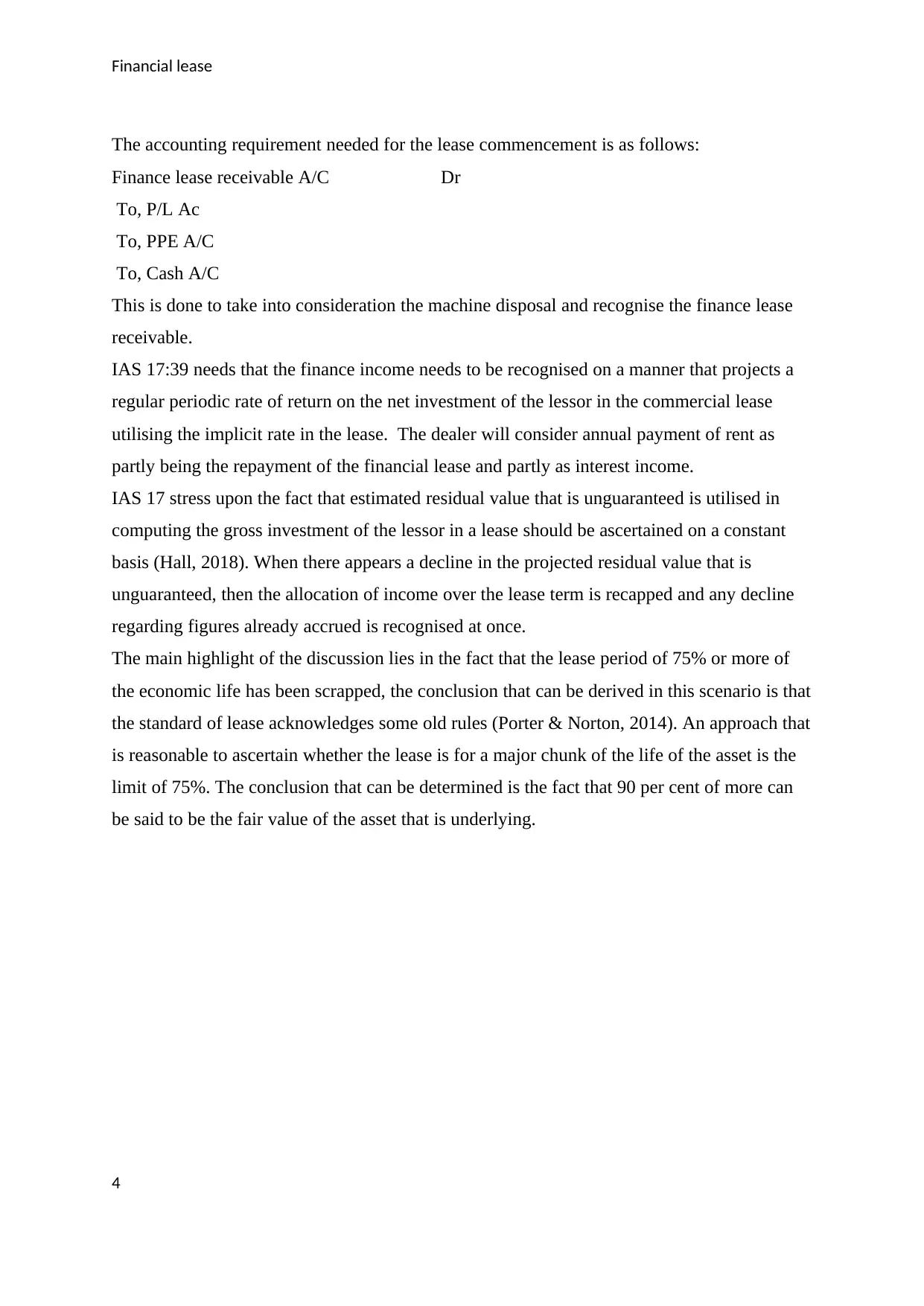
The accounting requirement needed for the lease commencement is as follows:
Finance lease receivable A/C Dr
To, P/L Ac
To, PPE A/C
To, Cash A/C
This is done to take into consideration the machine disposal and recognise the finance lease
receivable.
IAS 17:39 needs that the finance income needs to be recognised on a manner that projects a
regular periodic rate of return on the net investment of the lessor in the commercial lease
utilising the implicit rate in the lease. The dealer will consider annual payment of rent as
partly being the repayment of the financial lease and partly as interest income.
IAS 17 stress upon the fact that estimated residual value that is unguaranteed is utilised in
computing the gross investment of the lessor in a lease should be ascertained on a constant
basis (Hall, 2018). When there appears a decline in the projected residual value that is
unguaranteed, then the allocation of income over the lease term is recapped and any decline
regarding figures already accrued is recognised at once.
The main highlight of the discussion lies in the fact that the lease period of 75% or more of
the economic life has been scrapped, the conclusion that can be derived in this scenario is that
the standard of lease acknowledges some old rules (Porter & Norton, 2014). An approach that
is reasonable to ascertain whether the lease is for a major chunk of the life of the asset is the
limit of 75%. The conclusion that can be determined is the fact that 90 per cent of more can
be said to be the fair value of the asset that is underlying.
4
tabler-icon-diamond-filled.svg

Paraphrase This Document

Need a fresh take? Get an instant paraphrase of this document with our AI Paraphraser
Document Page
Financial lease
Part – B
Calculation
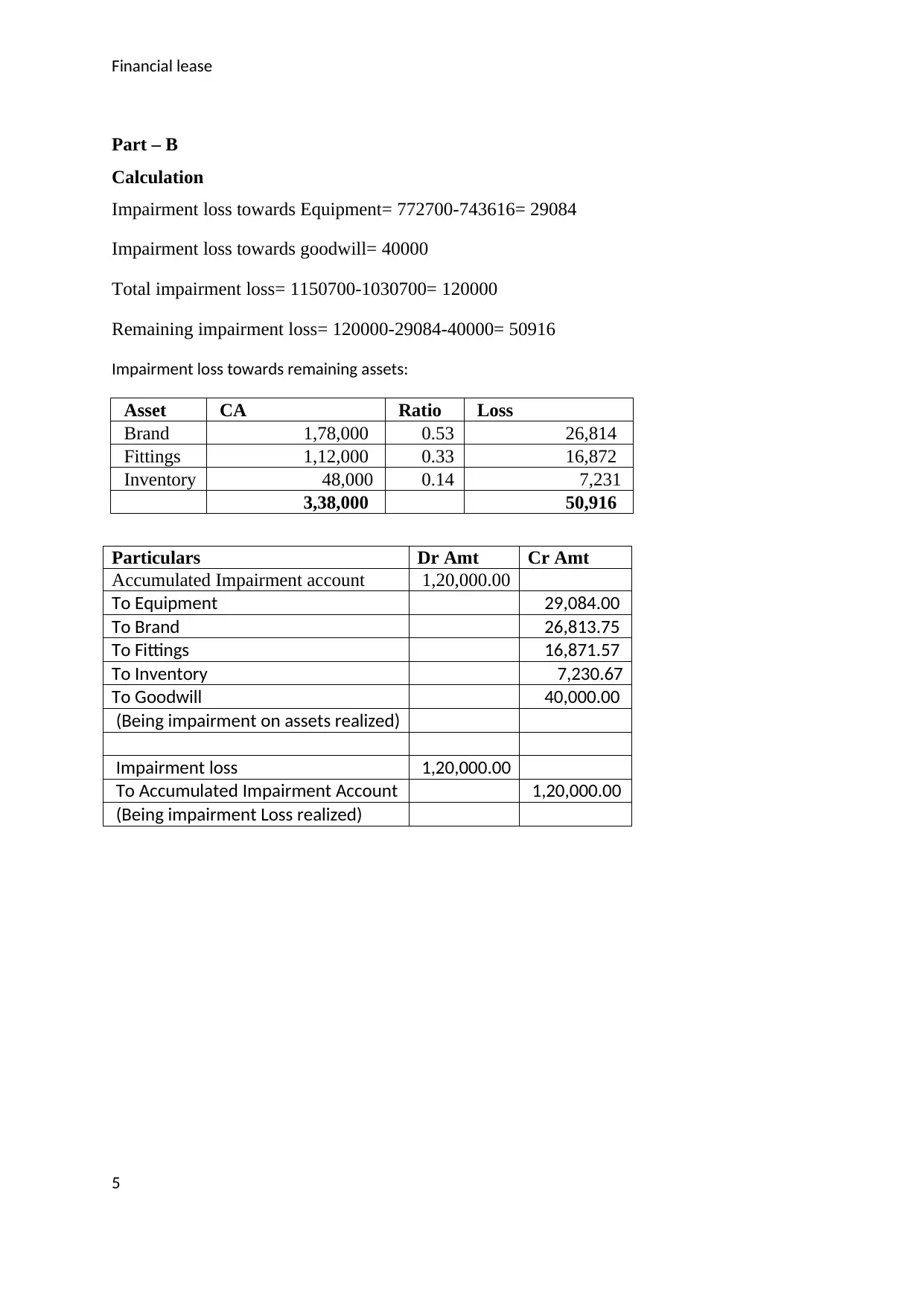
Impairment loss towards Equipment= 772700-743616= 29084
Impairment loss towards goodwill= 40000
Total impairment loss= 1150700-1030700= 120000
Remaining impairment loss= 120000-29084-40000= 50916
Impairment loss towards remaining assets:
Asset CA Ratio Loss
Brand 1,78,000 0.53 26,814
Fittings 1,12,000 0.33 16,872
Inventory 48,000 0.14 7,231
3,38,000 50,916
Particulars Dr Amt Cr Amt
Accumulated Impairment account 1,20,000.00
To Equipment 29,084.00
To Brand 26,813.75
To Fittings 16,871.57
To Inventory 7,230.67
To Goodwill 40,000.00
(Being impairment on assets realized)
Impairment loss 1,20,000.00
To Accumulated Impairment Account 1,20,000.00
(Being impairment Loss realized)
5
Document Page
Financial lease
References
Deegan, C. M. (2011) In Financial accounting theory. North Ryde, N.S.W: McGraw-Hill
Hamilton, K., Hyland, B. and Dodd, J. L. (2011) Impairment: IASB-FASB Comparison.
Drake Management Review. [online]. 1(1), p. 55–67. Available from:
https://pdfs.semanticscholar.org/8d8f/5fd070193d6fa52e79d1dee9cc6632159d8a.pdf
[Accessed 26 January 2019]
Hall, C. (2018) Accounting. Available from: https://cpahalltalk.com/account-finance-
operating-leases/ [Accessed 26 January 2019]
Kieso, D., Weygandt, J., Warfield, T; Young, N. and Wiecek, I . (2010) Intermediate
accounting. Toronto: John Wiley & Sons Canada.
Needles, B.E., & Powers, M. (2013) Principles of Financial Accounting. Financial
Accounting Series: Cengage Learning.
Petty, J. W, Titman, S., Keown, A. J., Martin, J. D., Burrow, M. and Nguyen, H. (2012)
Financial Management: Principles and Applications, 6th ed. Australia: Pearson Education
Australia.
Porter, G. and Norton, C. (2014) Financial Accounting: The Impact on Decision Maker.
Texas: Cengage Learning
6
chevron_up_icon
1 out of 6
circle_padding
hide_on_mobile
zoom_out_icon
[object Object]