Financial Literacy: Probability Analysis, Applications & Connection

Verified

Added on  2023/05/31

|4
|545
|225
Homework Assignment
AI Summary
This assignment delves into the application of probability within the context of financial literacy. It begins with a coin-toss experiment, comparing empirical and theoretical probabilities and explaining the importance of increasing data points for convergence. The assignment then connects probability to real-world scenarios, analyzing probabilities related to casino games and highlighting potential misinterpretations. Finally, it reflects on the personal application of probability in investment decisions, specifically using empirical data from stock market performance, while also acknowledging the limitations of relying solely on past performance. Desklib offers a wealth of similar assignments and study resources for students.

Document Page
FINANCIAL LITERACY
PROBABILITY
STUDENT ID:
[Pick the date]
tabler-icon-diamond-filled.svg

Paraphrase This Document

Need a fresh take? Get an instant paraphrase of this document with our AI Paraphraser
Document Page
Part1: Coin-Toss Experiment
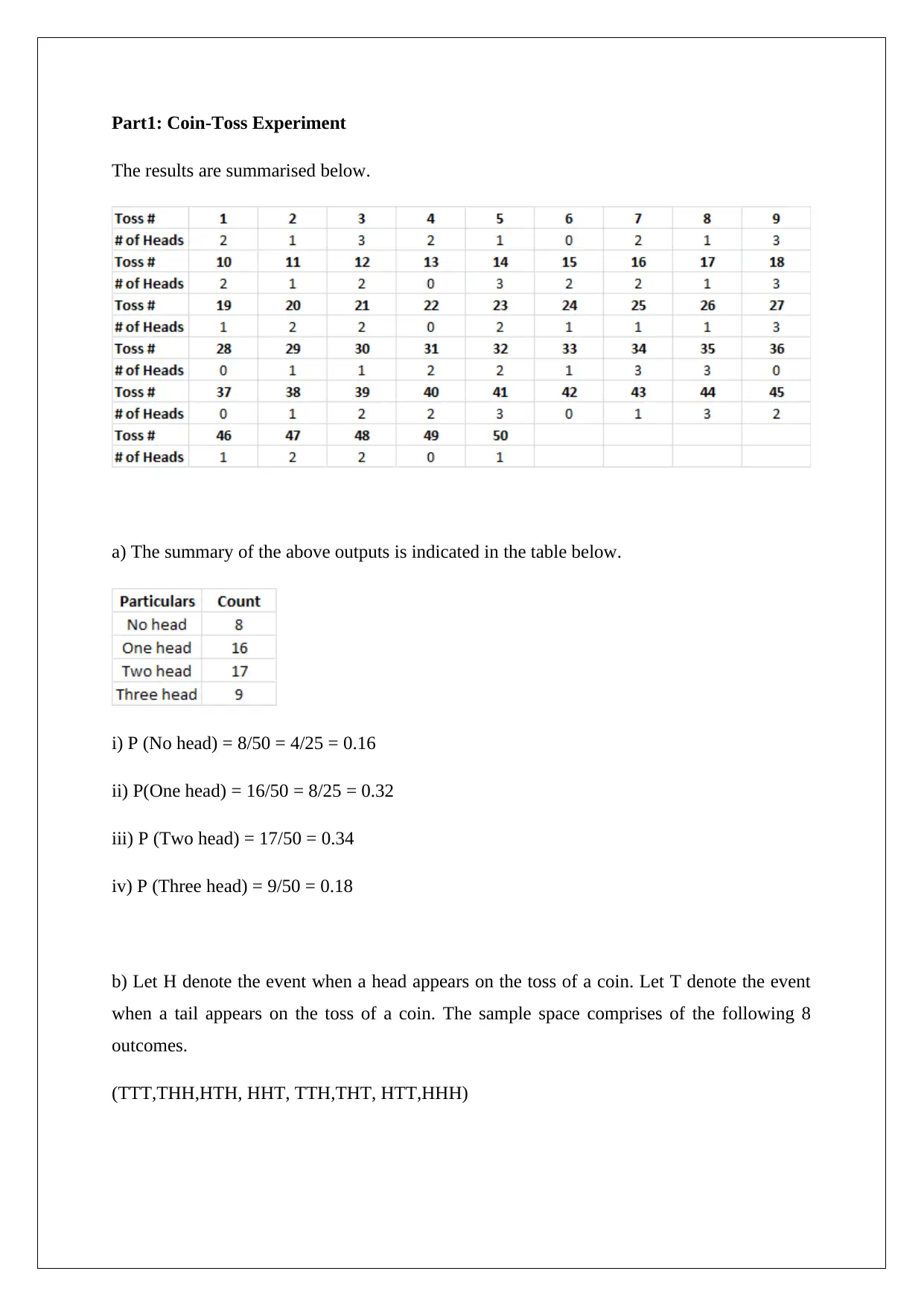
The results are summarised below.
a) The summary of the above outputs is indicated in the table below.
i) P (No head) = 8/50 = 4/25 = 0.16
ii) P(One head) = 16/50 = 8/25 = 0.32
iii) P (Two head) = 17/50 = 0.34
iv) P (Three head) = 9/50 = 0.18
b) Let H denote the event when a head appears on the toss of a coin. Let T denote the event
when a tail appears on the toss of a coin. The sample space comprises of the following 8
outcomes.
(TTT,THH,HTH, HHT, TTH,THT, HTT,HHH)
Document Page
c) The theoretical probability for various events is as computed below.
i) P(No head) = 1/8 = 0.125
ii) P(one head) = 3/8 = 0.375
iii) P(two head) = 3/8 = 0.375
iv) P(three head) = 1/8 =0.125
d) It is apparent that there is some deviation between the theoretical results and the empirical
results and hence the two do not match. In order to cause convergence between the theoretical
and empirical results, it is essential to increase the number of data points recorded because as
the number of times the given experiment would be repeated, the empirical probability would
head towards the theoretical probability. This is because in lesser number of repetitions, it is
possible that a certain outcome may have disproportionate representation but in the long run,
this is highly unlikely.
PART II: Society Connection
The selected article highlights various probabilities relating to winning in different games in a
casino. For instance, the article states that probability of winning one roll in poker is 54.00
percent. This probability is subjective in nature as it is not based on past observation over
which the data has been collected. Also, it is not theoretical as it is not based on the number
of outcomes alone. This probability is slightly misleading considering the fact that winning in
poker is also dependent on the individual skill level and hence the probability is not expected
to be same for every player.
Article Link: https://www.gamblingsites.org/blog/double-your-way-million-casino/
PART III: Connection to Life
Recently, I took an investment decision to invest in a particular share in the stock market. In
order to make the decision, I relied on the concept of probability. I looked at the recent one
Document Page
month performance of the stock and based on the empirical returns made by the stock and the
underlying probability of stock price increased, I decided to invest in the stock. This was an
example of using empirical probability based on the past one month performance of the
stock. It did not help me much in the decision considering the fact that stock performance in
the present does not necessarily mirror the past performance.
chevron_up_icon
1 out of 4
circle_padding
hide_on_mobile
zoom_out_icon
[object Object]