Financial and Management Accounting Report for See It Now Ltd.
VerifiedAdded on 2023/01/18
|18
|3482
|98
Report
AI Summary
This report delves into the realms of financial and management accounting, offering a comprehensive analysis of their principles and applications. Section A1 meticulously details journal entries, ledger postings, and the creation of an unadjusted trial balance, culminating in the preparation of income statements, owner's equity statements, and balance sheets for See It Now Ltd. Section A2 then contrasts financial and management accounting, highlighting their differing scopes, regulatory requirements, and time horizons, while also identifying characteristics of high-quality financial information crucial for management decision-making. Section B transitions to management accounting, calculating total cost per unit under a traditional costing system, analyzing under or over absorption, and comparing profits under marginal and absorption costing. The report concludes by summarizing the key findings and emphasizing the importance of both financial and management accounting in organizational success.
ACCOUNTING

Paraphrase This Document
Need a fresh take? Get an instant paraphrase of this document with our AI Paraphraser
ABSTRACT
Report will provide understanding about the financial and management accounting. How they
are used in the organisation and their relevant importance for the organisations. It will cover
different sections for providing and understanding about the management and financial
accounting procedures. It will also cover the differences between management accounting and
financial accounting.
Report will provide understanding about the financial and management accounting. How they
are used in the organisation and their relevant importance for the organisations. It will cover
different sections for providing and understanding about the management and financial
accounting procedures. It will also cover the differences between management accounting and
financial accounting.
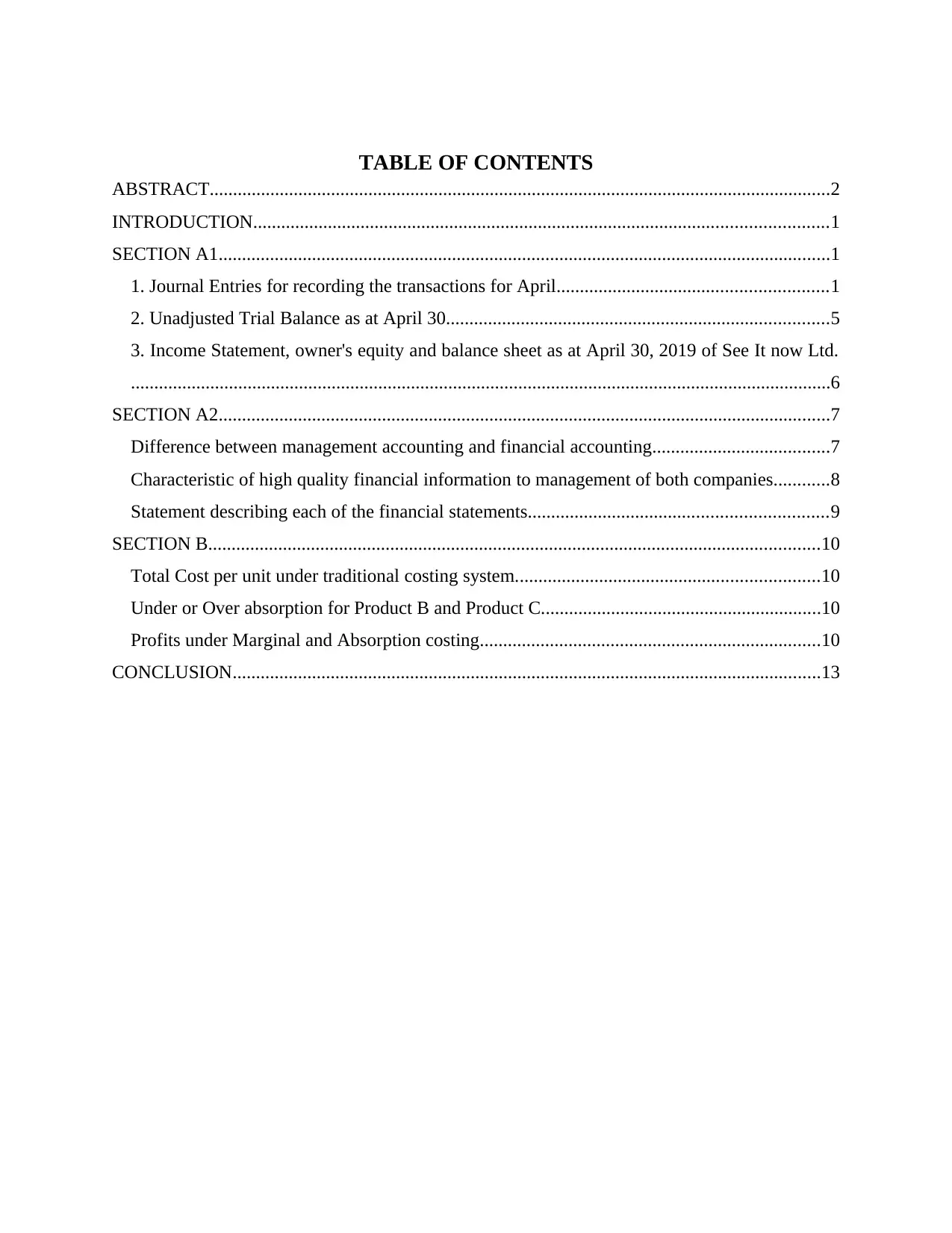
TABLE OF CONTENTS
ABSTRACT.....................................................................................................................................2
INTRODUCTION...........................................................................................................................1
SECTION A1...................................................................................................................................1
1. Journal Entries for recording the transactions for April..........................................................1
2. Unadjusted Trial Balance as at April 30..................................................................................5
3. Income Statement, owner's equity and balance sheet as at April 30, 2019 of See It now Ltd.
......................................................................................................................................................6
SECTION A2...................................................................................................................................7
Difference between management accounting and financial accounting......................................7
Characteristic of high quality financial information to management of both companies............8
Statement describing each of the financial statements................................................................9
SECTION B...................................................................................................................................10
Total Cost per unit under traditional costing system.................................................................10
Under or Over absorption for Product B and Product C............................................................10
Profits under Marginal and Absorption costing.........................................................................10
CONCLUSION..............................................................................................................................13
ABSTRACT.....................................................................................................................................2
INTRODUCTION...........................................................................................................................1
SECTION A1...................................................................................................................................1
1. Journal Entries for recording the transactions for April..........................................................1
2. Unadjusted Trial Balance as at April 30..................................................................................5
3. Income Statement, owner's equity and balance sheet as at April 30, 2019 of See It now Ltd.
......................................................................................................................................................6
SECTION A2...................................................................................................................................7
Difference between management accounting and financial accounting......................................7
Characteristic of high quality financial information to management of both companies............8
Statement describing each of the financial statements................................................................9
SECTION B...................................................................................................................................10
Total Cost per unit under traditional costing system.................................................................10
Under or Over absorption for Product B and Product C............................................................10
Profits under Marginal and Absorption costing.........................................................................10
CONCLUSION..............................................................................................................................13
⊘ This is a preview!⊘
Do you want full access?
Subscribe today to unlock all pages.

Trusted by 1+ million students worldwide
INTRODUCTION
Financial accounting refers to the specialised accounting branch that keep the track
record of each and every financial transaction of the company. Financial accounting uses
standard guidelines for recording, summarizing and presenting in financial statements or
financial reports like income statements or balance sheet (Chan, 2015). Management accounting
refers to process of providing the financial informations and resources for decision making to the
managers of the company (Bailey and Samuels, 2018). Both the accounting are different from
each other. The study will include the process followed in financial accounting and techniques
used in management costing. It will also cover the differences between the management and
financial accounting. It will be providing the characteristics of qualitative financial statement and
their importance to the management of the company. Report is divided into two sections ;
Section A covers Financial accounting and Section B covers Management accounting.
SECTION A1
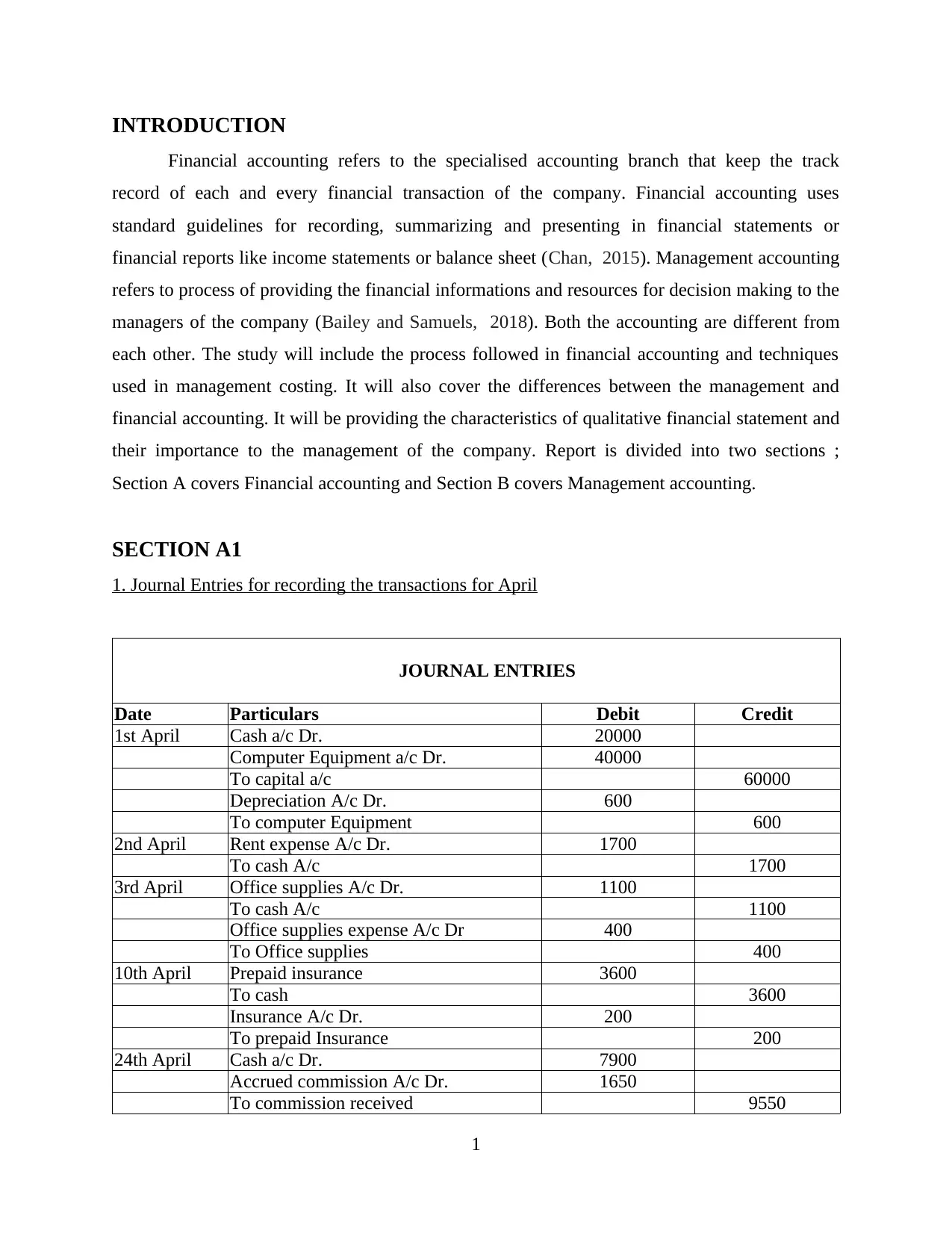
1. Journal Entries for recording the transactions for April
JOURNAL ENTRIES
Date Particulars Debit Credit
1st April Cash a/c Dr. 20000
Computer Equipment a/c Dr. 40000
To capital a/c 60000
Depreciation A/c Dr. 600
To computer Equipment 600
2nd April Rent expense A/c Dr. 1700
To cash A/c 1700
3rd April Office supplies A/c Dr. 1100
To cash A/c 1100
Office supplies expense A/c Dr 400
To Office supplies 400
10th April Prepaid insurance 3600
To cash 3600
Insurance A/c Dr. 200
To prepaid Insurance 200
24th April Cash a/c Dr. 7900
Accrued commission A/c Dr. 1650
To commission received 9550
1
Financial accounting refers to the specialised accounting branch that keep the track
record of each and every financial transaction of the company. Financial accounting uses
standard guidelines for recording, summarizing and presenting in financial statements or
financial reports like income statements or balance sheet (Chan, 2015). Management accounting
refers to process of providing the financial informations and resources for decision making to the
managers of the company (Bailey and Samuels, 2018). Both the accounting are different from
each other. The study will include the process followed in financial accounting and techniques
used in management costing. It will also cover the differences between the management and
financial accounting. It will be providing the characteristics of qualitative financial statement and
their importance to the management of the company. Report is divided into two sections ;
Section A covers Financial accounting and Section B covers Management accounting.
SECTION A1
1. Journal Entries for recording the transactions for April
JOURNAL ENTRIES
Date Particulars Debit Credit
1st April Cash a/c Dr. 20000
Computer Equipment a/c Dr. 40000
To capital a/c 60000
Depreciation A/c Dr. 600
To computer Equipment 600
2nd April Rent expense A/c Dr. 1700
To cash A/c 1700
3rd April Office supplies A/c Dr. 1100
To cash A/c 1100
Office supplies expense A/c Dr 400
To Office supplies 400
10th April Prepaid insurance 3600
To cash 3600
Insurance A/c Dr. 200
To prepaid Insurance 200
24th April Cash a/c Dr. 7900
Accrued commission A/c Dr. 1650
To commission received 9550
1
Paraphrase This Document
Need a fresh take? Get an instant paraphrase of this document with our AI Paraphraser
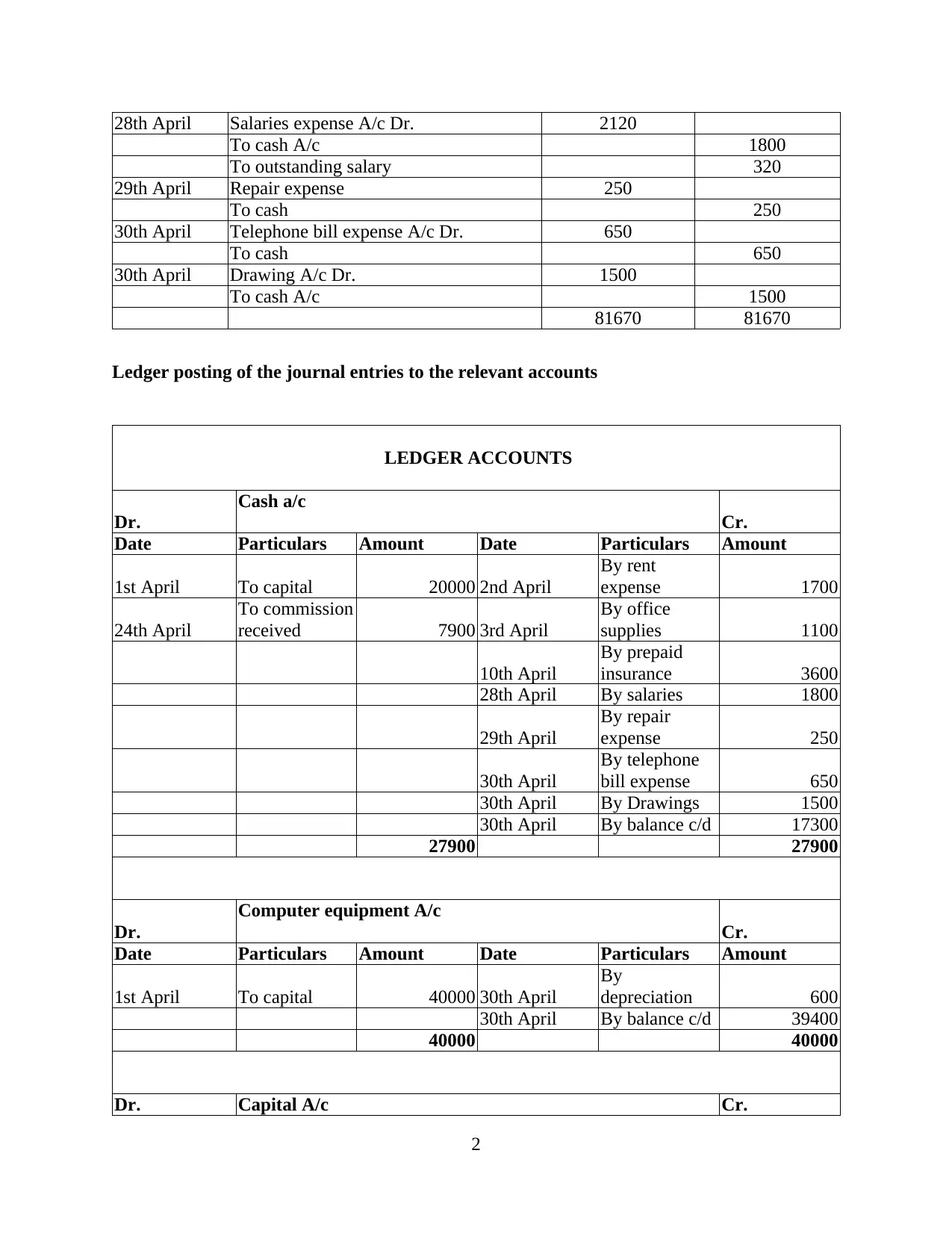
28th April Salaries expense A/c Dr. 2120
To cash A/c 1800
To outstanding salary 320
29th April Repair expense 250
To cash 250
30th April Telephone bill expense A/c Dr. 650
To cash 650
30th April Drawing A/c Dr. 1500
To cash A/c 1500
81670 81670
Ledger posting of the journal entries to the relevant accounts
LEDGER ACCOUNTS
Dr.
Cash a/c
Cr.
Date Particulars Amount Date Particulars Amount
1st April To capital 20000 2nd April
By rent
expense 1700
24th April
To commission
received 7900 3rd April
By office
supplies 1100
10th April
By prepaid
insurance 3600
28th April By salaries 1800
29th April
By repair
expense 250
30th April
By telephone
bill expense 650
30th April By Drawings 1500
30th April By balance c/d 17300
27900 27900
Dr.
Computer equipment A/c
Cr.
Date Particulars Amount Date Particulars Amount
1st April To capital 40000 30th April
By
depreciation 600
30th April By balance c/d 39400
40000 40000
Dr. Capital A/c Cr.
2
To cash A/c 1800
To outstanding salary 320
29th April Repair expense 250
To cash 250
30th April Telephone bill expense A/c Dr. 650
To cash 650
30th April Drawing A/c Dr. 1500
To cash A/c 1500
81670 81670
Ledger posting of the journal entries to the relevant accounts
LEDGER ACCOUNTS
Dr.
Cash a/c
Cr.
Date Particulars Amount Date Particulars Amount
1st April To capital 20000 2nd April
By rent
expense 1700
24th April
To commission
received 7900 3rd April
By office
supplies 1100
10th April
By prepaid
insurance 3600
28th April By salaries 1800
29th April
By repair
expense 250
30th April
By telephone
bill expense 650
30th April By Drawings 1500
30th April By balance c/d 17300
27900 27900
Dr.
Computer equipment A/c
Cr.
Date Particulars Amount Date Particulars Amount
1st April To capital 40000 30th April
By
depreciation 600
30th April By balance c/d 39400
40000 40000
Dr. Capital A/c Cr.
2
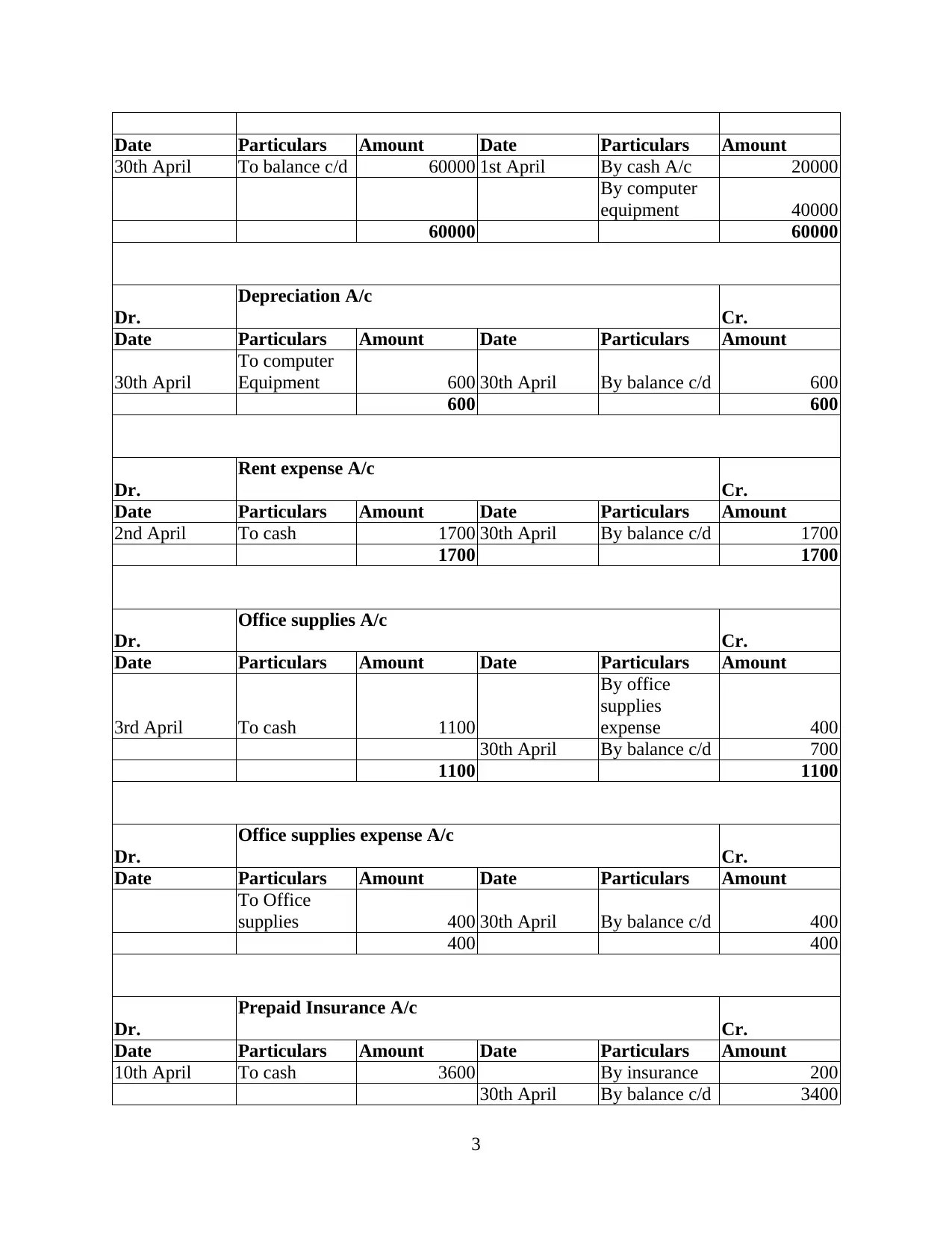
Date Particulars Amount Date Particulars Amount
30th April To balance c/d 60000 1st April By cash A/c 20000
By computer
equipment 40000
60000 60000
Dr.
Depreciation A/c
Cr.
Date Particulars Amount Date Particulars Amount
30th April
To computer
Equipment 600 30th April By balance c/d 600
600 600
Dr.
Rent expense A/c
Cr.
Date Particulars Amount Date Particulars Amount
2nd April To cash 1700 30th April By balance c/d 1700
1700 1700
Dr.
Office supplies A/c
Cr.
Date Particulars Amount Date Particulars Amount
3rd April To cash 1100
By office
supplies
expense 400
30th April By balance c/d 700
1100 1100
Dr.
Office supplies expense A/c
Cr.
Date Particulars Amount Date Particulars Amount
To Office
supplies 400 30th April By balance c/d 400
400 400
Dr.
Prepaid Insurance A/c
Cr.
Date Particulars Amount Date Particulars Amount
10th April To cash 3600 By insurance 200
30th April By balance c/d 3400
3
30th April To balance c/d 60000 1st April By cash A/c 20000
By computer
equipment 40000
60000 60000
Dr.
Depreciation A/c
Cr.
Date Particulars Amount Date Particulars Amount
30th April
To computer
Equipment 600 30th April By balance c/d 600
600 600
Dr.
Rent expense A/c
Cr.
Date Particulars Amount Date Particulars Amount
2nd April To cash 1700 30th April By balance c/d 1700
1700 1700
Dr.
Office supplies A/c
Cr.
Date Particulars Amount Date Particulars Amount
3rd April To cash 1100
By office
supplies
expense 400
30th April By balance c/d 700
1100 1100
Dr.
Office supplies expense A/c
Cr.
Date Particulars Amount Date Particulars Amount
To Office
supplies 400 30th April By balance c/d 400
400 400
Dr.
Prepaid Insurance A/c
Cr.
Date Particulars Amount Date Particulars Amount
10th April To cash 3600 By insurance 200
30th April By balance c/d 3400
3
⊘ This is a preview!⊘
Do you want full access?
Subscribe today to unlock all pages.
Trusted by 1+ million students worldwide
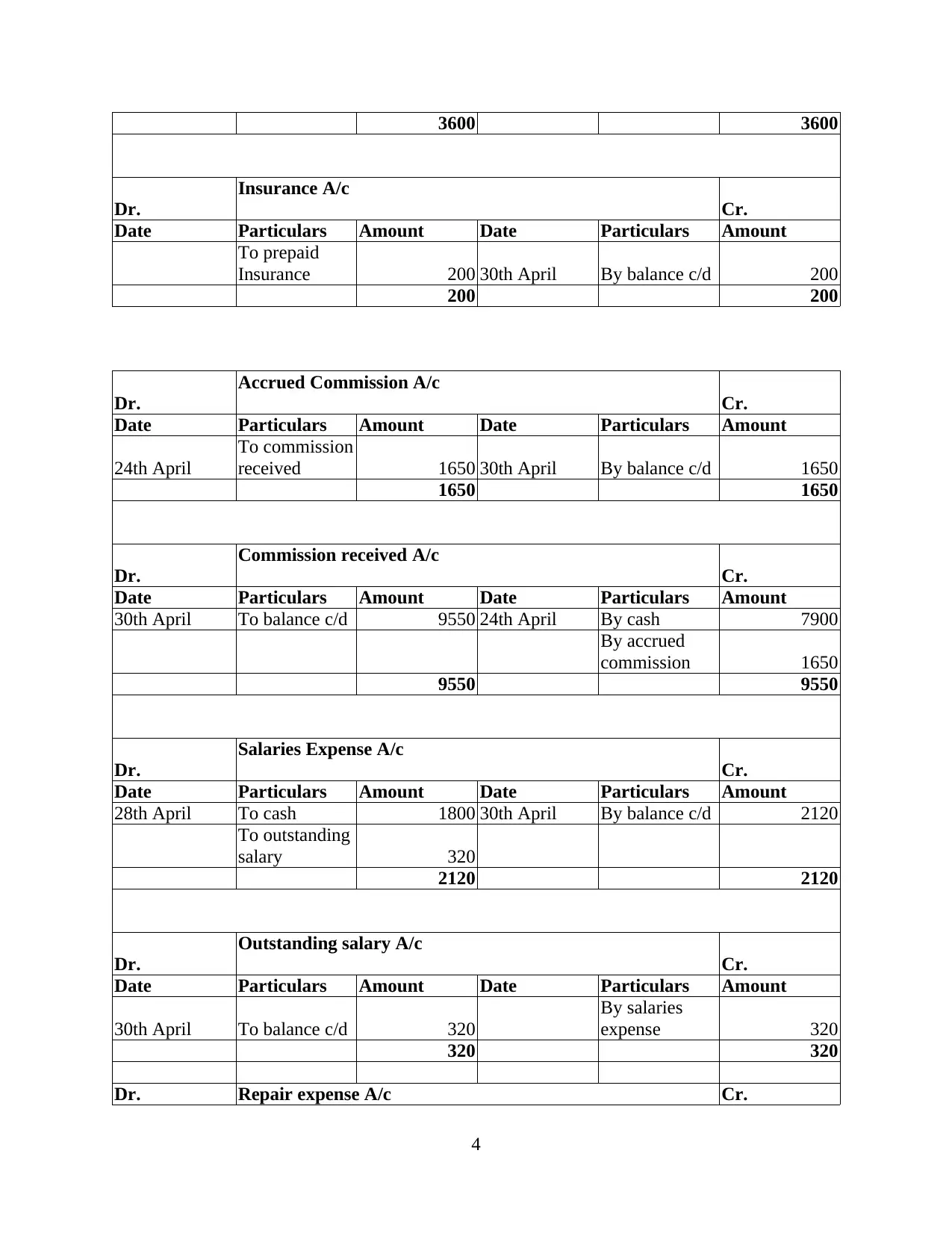
3600 3600
Dr.
Insurance A/c
Cr.
Date Particulars Amount Date Particulars Amount
To prepaid
Insurance 200 30th April By balance c/d 200
200 200
Dr.
Accrued Commission A/c
Cr.
Date Particulars Amount Date Particulars Amount
24th April
To commission
received 1650 30th April By balance c/d 1650
1650 1650
Dr.
Commission received A/c
Cr.
Date Particulars Amount Date Particulars Amount
30th April To balance c/d 9550 24th April By cash 7900
By accrued
commission 1650
9550 9550
Dr.
Salaries Expense A/c
Cr.
Date Particulars Amount Date Particulars Amount
28th April To cash 1800 30th April By balance c/d 2120
To outstanding
salary 320
2120 2120
Dr.
Outstanding salary A/c
Cr.
Date Particulars Amount Date Particulars Amount
30th April To balance c/d 320
By salaries
expense 320
320 320
Dr. Repair expense A/c Cr.
4
Dr.
Insurance A/c
Cr.
Date Particulars Amount Date Particulars Amount
To prepaid
Insurance 200 30th April By balance c/d 200
200 200
Dr.
Accrued Commission A/c
Cr.
Date Particulars Amount Date Particulars Amount
24th April
To commission
received 1650 30th April By balance c/d 1650
1650 1650
Dr.
Commission received A/c
Cr.
Date Particulars Amount Date Particulars Amount
30th April To balance c/d 9550 24th April By cash 7900
By accrued
commission 1650
9550 9550
Dr.
Salaries Expense A/c
Cr.
Date Particulars Amount Date Particulars Amount
28th April To cash 1800 30th April By balance c/d 2120
To outstanding
salary 320
2120 2120
Dr.
Outstanding salary A/c
Cr.
Date Particulars Amount Date Particulars Amount
30th April To balance c/d 320
By salaries
expense 320
320 320
Dr. Repair expense A/c Cr.
4
Paraphrase This Document
Need a fresh take? Get an instant paraphrase of this document with our AI Paraphraser
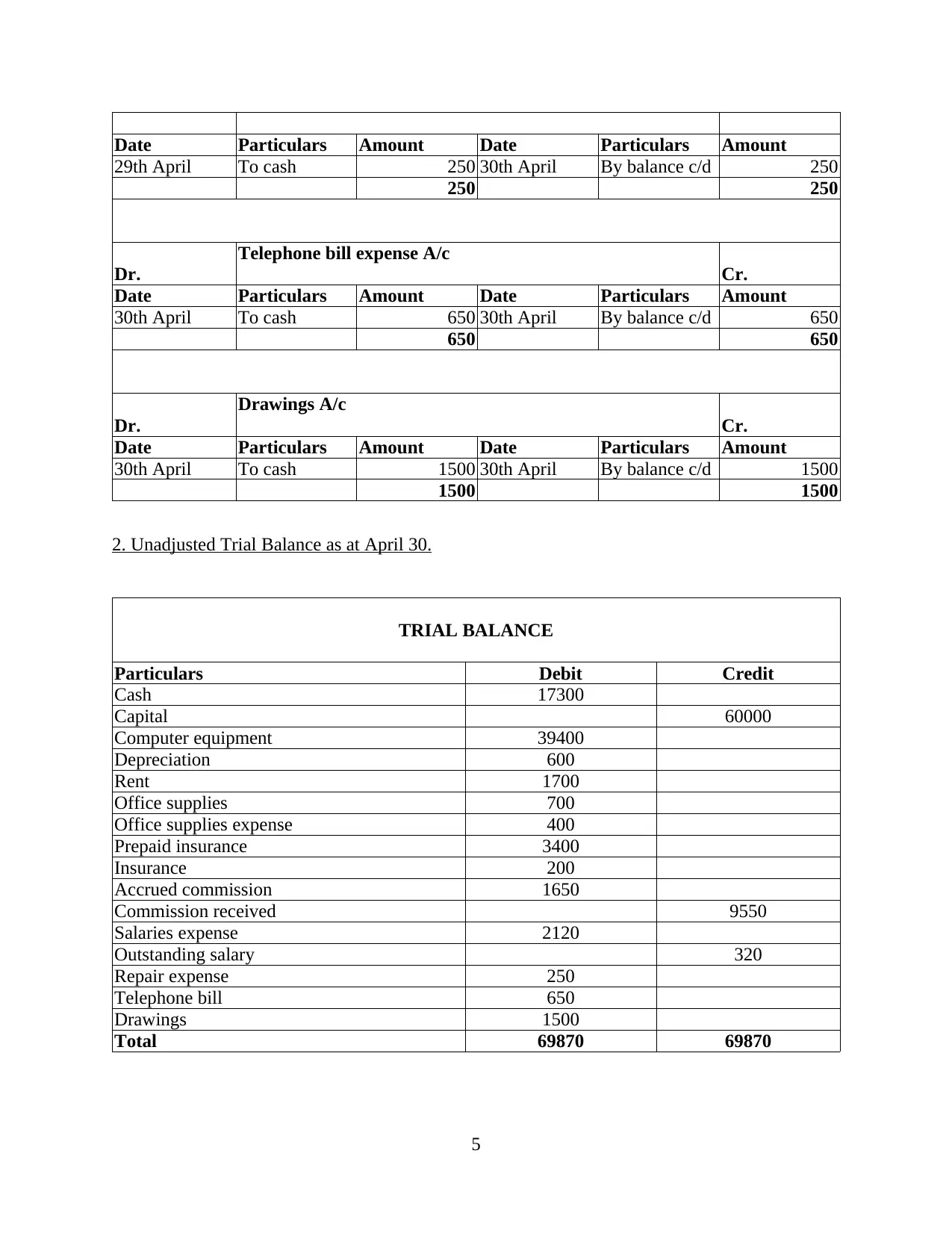
Date Particulars Amount Date Particulars Amount
29th April To cash 250 30th April By balance c/d 250
250 250
Dr.
Telephone bill expense A/c
Cr.
Date Particulars Amount Date Particulars Amount
30th April To cash 650 30th April By balance c/d 650
650 650
Dr.
Drawings A/c
Cr.
Date Particulars Amount Date Particulars Amount
30th April To cash 1500 30th April By balance c/d 1500
1500 1500
2. Unadjusted Trial Balance as at April 30.
TRIAL BALANCE
Particulars Debit Credit
Cash 17300
Capital 60000
Computer equipment 39400
Depreciation 600
Rent 1700
Office supplies 700
Office supplies expense 400
Prepaid insurance 3400
Insurance 200
Accrued commission 1650
Commission received 9550
Salaries expense 2120
Outstanding salary 320
Repair expense 250
Telephone bill 650
Drawings 1500
Total 69870 69870
5
29th April To cash 250 30th April By balance c/d 250
250 250
Dr.
Telephone bill expense A/c
Cr.
Date Particulars Amount Date Particulars Amount
30th April To cash 650 30th April By balance c/d 650
650 650
Dr.
Drawings A/c
Cr.
Date Particulars Amount Date Particulars Amount
30th April To cash 1500 30th April By balance c/d 1500
1500 1500
2. Unadjusted Trial Balance as at April 30.
TRIAL BALANCE
Particulars Debit Credit
Cash 17300
Capital 60000
Computer equipment 39400
Depreciation 600
Rent 1700
Office supplies 700
Office supplies expense 400
Prepaid insurance 3400
Insurance 200
Accrued commission 1650
Commission received 9550
Salaries expense 2120
Outstanding salary 320
Repair expense 250
Telephone bill 650
Drawings 1500
Total 69870 69870
5
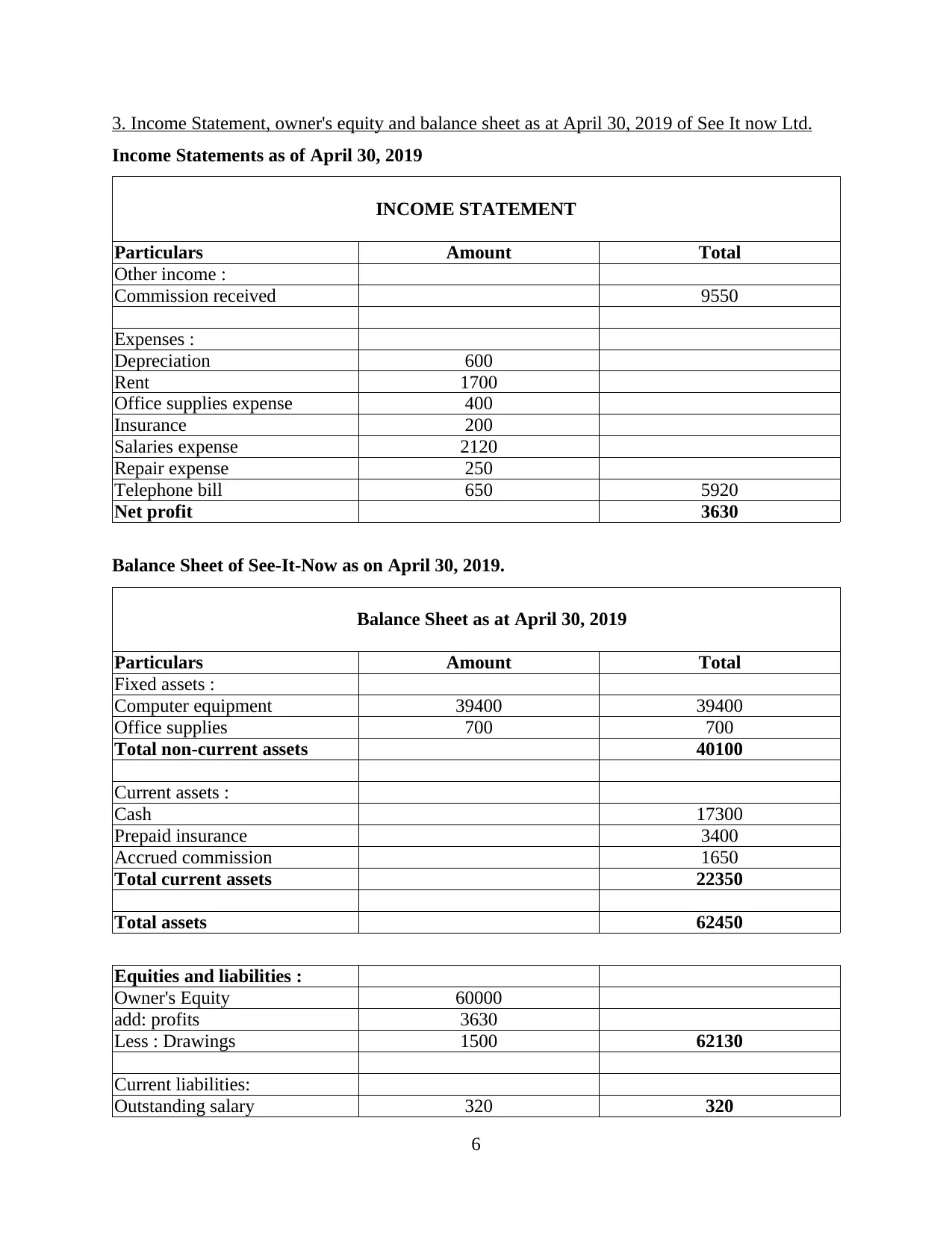
3. Income Statement, owner's equity and balance sheet as at April 30, 2019 of See It now Ltd.
Income Statements as of April 30, 2019
INCOME STATEMENT
Particulars Amount Total
Other income :
Commission received 9550
Expenses :
Depreciation 600
Rent 1700
Office supplies expense 400
Insurance 200
Salaries expense 2120
Repair expense 250
Telephone bill 650 5920
Net profit 3630
Balance Sheet of See-It-Now as on April 30, 2019.
Balance Sheet as at April 30, 2019
Particulars Amount Total
Fixed assets :
Computer equipment 39400 39400
Office supplies 700 700
Total non-current assets 40100
Current assets :
Cash 17300
Prepaid insurance 3400
Accrued commission 1650
Total current assets 22350
Total assets 62450
Equities and liabilities :
Owner's Equity 60000
add: profits 3630
Less : Drawings 1500 62130
Current liabilities:
Outstanding salary 320 320
6
Income Statements as of April 30, 2019
INCOME STATEMENT
Particulars Amount Total
Other income :
Commission received 9550
Expenses :
Depreciation 600
Rent 1700
Office supplies expense 400
Insurance 200
Salaries expense 2120
Repair expense 250
Telephone bill 650 5920
Net profit 3630
Balance Sheet of See-It-Now as on April 30, 2019.
Balance Sheet as at April 30, 2019
Particulars Amount Total
Fixed assets :
Computer equipment 39400 39400
Office supplies 700 700
Total non-current assets 40100
Current assets :
Cash 17300
Prepaid insurance 3400
Accrued commission 1650
Total current assets 22350
Total assets 62450
Equities and liabilities :
Owner's Equity 60000
add: profits 3630
Less : Drawings 1500 62130
Current liabilities:
Outstanding salary 320 320
6
⊘ This is a preview!⊘
Do you want full access?
Subscribe today to unlock all pages.
Trusted by 1+ million students worldwide
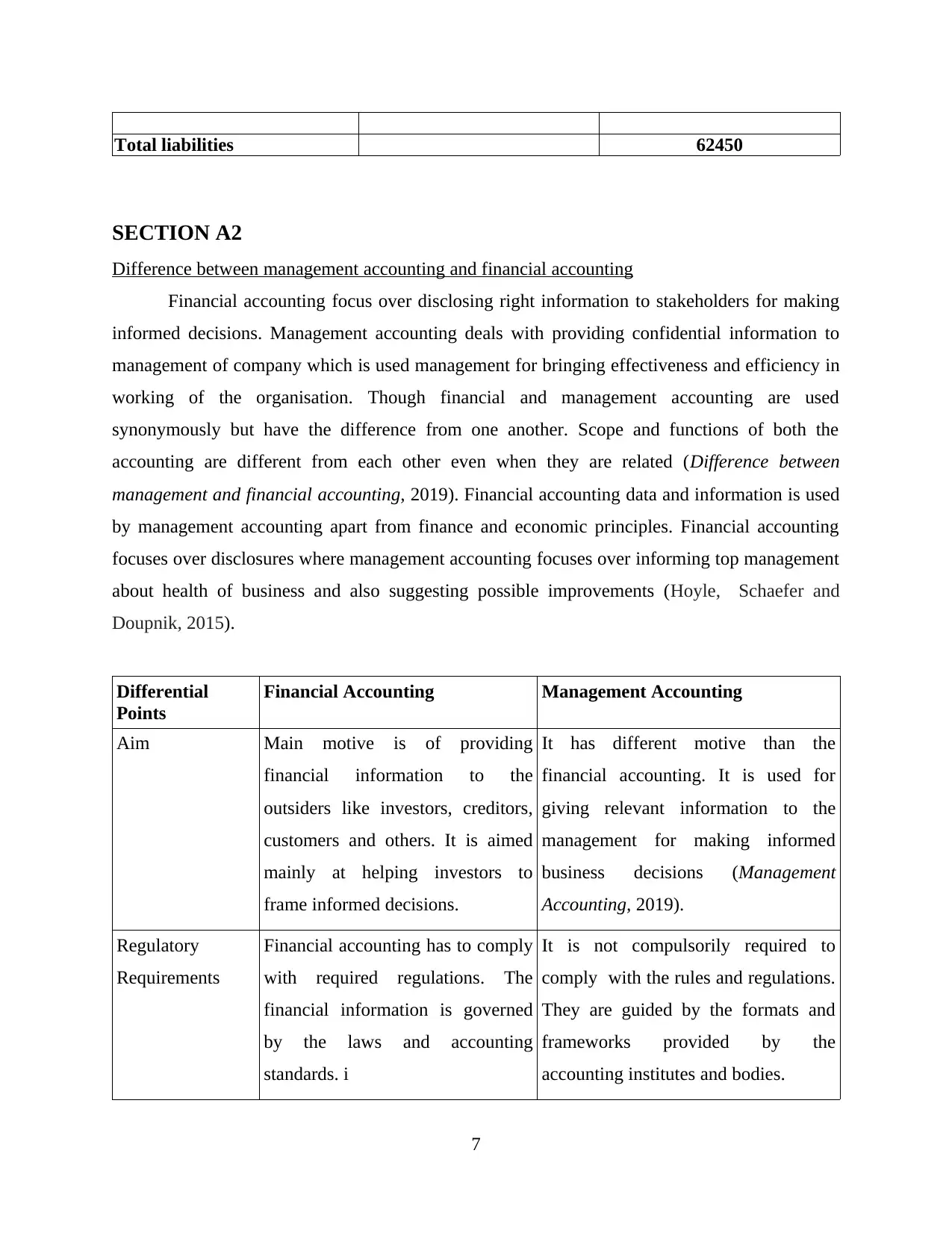
Total liabilities 62450
SECTION A2
Difference between management accounting and financial accounting
Financial accounting focus over disclosing right information to stakeholders for making
informed decisions. Management accounting deals with providing confidential information to
management of company which is used management for bringing effectiveness and efficiency in
working of the organisation. Though financial and management accounting are used
synonymously but have the difference from one another. Scope and functions of both the
accounting are different from each other even when they are related (Difference between
management and financial accounting, 2019). Financial accounting data and information is used
by management accounting apart from finance and economic principles. Financial accounting
focuses over disclosures where management accounting focuses over informing top management
about health of business and also suggesting possible improvements (Hoyle, Schaefer and
Doupnik, 2015).
Differential
Points
Financial Accounting Management Accounting
Aim Main motive is of providing
financial information to the
outsiders like investors, creditors,
customers and others. It is aimed
mainly at helping investors to
frame informed decisions.
It has different motive than the
financial accounting. It is used for
giving relevant information to the
management for making informed
business decisions (Management
Accounting, 2019).
Regulatory
Requirements
Financial accounting has to comply
with required regulations. The
financial information is governed
by the laws and accounting
standards. i
It is not compulsorily required to
comply with the rules and regulations.
They are guided by the formats and
frameworks provided by the
accounting institutes and bodies.
7
SECTION A2
Difference between management accounting and financial accounting
Financial accounting focus over disclosing right information to stakeholders for making
informed decisions. Management accounting deals with providing confidential information to
management of company which is used management for bringing effectiveness and efficiency in
working of the organisation. Though financial and management accounting are used
synonymously but have the difference from one another. Scope and functions of both the
accounting are different from each other even when they are related (Difference between
management and financial accounting, 2019). Financial accounting data and information is used
by management accounting apart from finance and economic principles. Financial accounting
focuses over disclosures where management accounting focuses over informing top management
about health of business and also suggesting possible improvements (Hoyle, Schaefer and
Doupnik, 2015).
Differential
Points
Financial Accounting Management Accounting
Aim Main motive is of providing
financial information to the
outsiders like investors, creditors,
customers and others. It is aimed
mainly at helping investors to
frame informed decisions.
It has different motive than the
financial accounting. It is used for
giving relevant information to the
management for making informed
business decisions (Management
Accounting, 2019).
Regulatory
Requirements
Financial accounting has to comply
with required regulations. The
financial information is governed
by the laws and accounting
standards. i
It is not compulsorily required to
comply with the rules and regulations.
They are guided by the formats and
frameworks provided by the
accounting institutes and bodies.
7
Paraphrase This Document
Need a fresh take? Get an instant paraphrase of this document with our AI Paraphraser
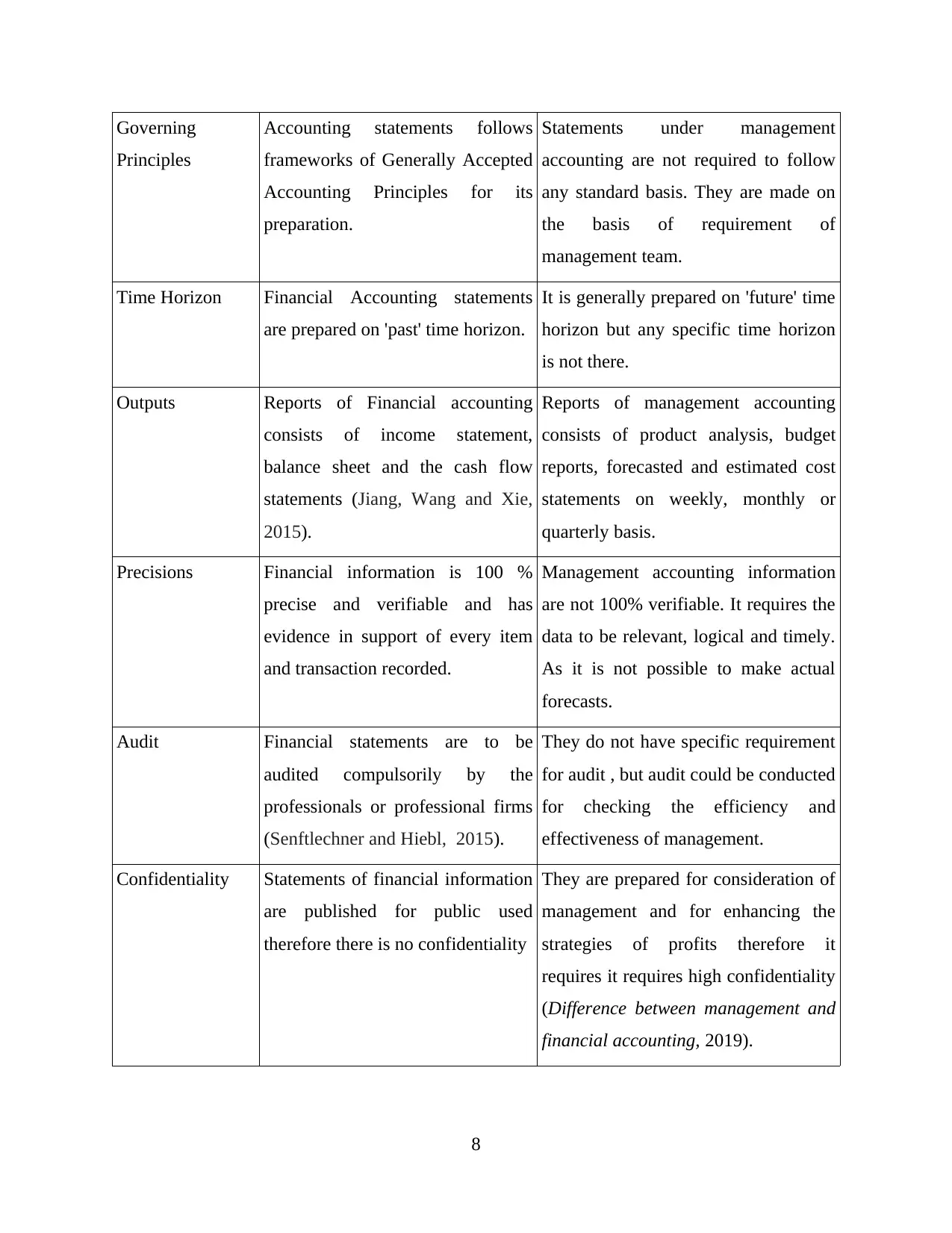
Governing
Principles
Accounting statements follows
frameworks of Generally Accepted
Accounting Principles for its
preparation.
Statements under management
accounting are not required to follow
any standard basis. They are made on
the basis of requirement of
management team.
Time Horizon Financial Accounting statements
are prepared on 'past' time horizon.
It is generally prepared on 'future' time
horizon but any specific time horizon
is not there.
Outputs Reports of Financial accounting
consists of income statement,
balance sheet and the cash flow
statements (Jiang, Wang and Xie,
2015).
Reports of management accounting
consists of product analysis, budget
reports, forecasted and estimated cost
statements on weekly, monthly or
quarterly basis.
Precisions Financial information is 100 %
precise and verifiable and has
evidence in support of every item
and transaction recorded.
Management accounting information
are not 100% verifiable. It requires the
data to be relevant, logical and timely.
As it is not possible to make actual
forecasts.
Audit Financial statements are to be
audited compulsorily by the
professionals or professional firms
(Senftlechner and Hiebl, 2015).
They do not have specific requirement
for audit , but audit could be conducted
for checking the efficiency and
effectiveness of management.
Confidentiality Statements of financial information
are published for public used
therefore there is no confidentiality
They are prepared for consideration of
management and for enhancing the
strategies of profits therefore it
requires it requires high confidentiality
(Difference between management and
financial accounting, 2019).
8
Principles
Accounting statements follows
frameworks of Generally Accepted
Accounting Principles for its
preparation.
Statements under management
accounting are not required to follow
any standard basis. They are made on
the basis of requirement of
management team.
Time Horizon Financial Accounting statements
are prepared on 'past' time horizon.
It is generally prepared on 'future' time
horizon but any specific time horizon
is not there.
Outputs Reports of Financial accounting
consists of income statement,
balance sheet and the cash flow
statements (Jiang, Wang and Xie,
2015).
Reports of management accounting
consists of product analysis, budget
reports, forecasted and estimated cost
statements on weekly, monthly or
quarterly basis.
Precisions Financial information is 100 %
precise and verifiable and has
evidence in support of every item
and transaction recorded.
Management accounting information
are not 100% verifiable. It requires the
data to be relevant, logical and timely.
As it is not possible to make actual
forecasts.
Audit Financial statements are to be
audited compulsorily by the
professionals or professional firms
(Senftlechner and Hiebl, 2015).
They do not have specific requirement
for audit , but audit could be conducted
for checking the efficiency and
effectiveness of management.
Confidentiality Statements of financial information
are published for public used
therefore there is no confidentiality
They are prepared for consideration of
management and for enhancing the
strategies of profits therefore it
requires it requires high confidentiality
(Difference between management and
financial accounting, 2019).
8
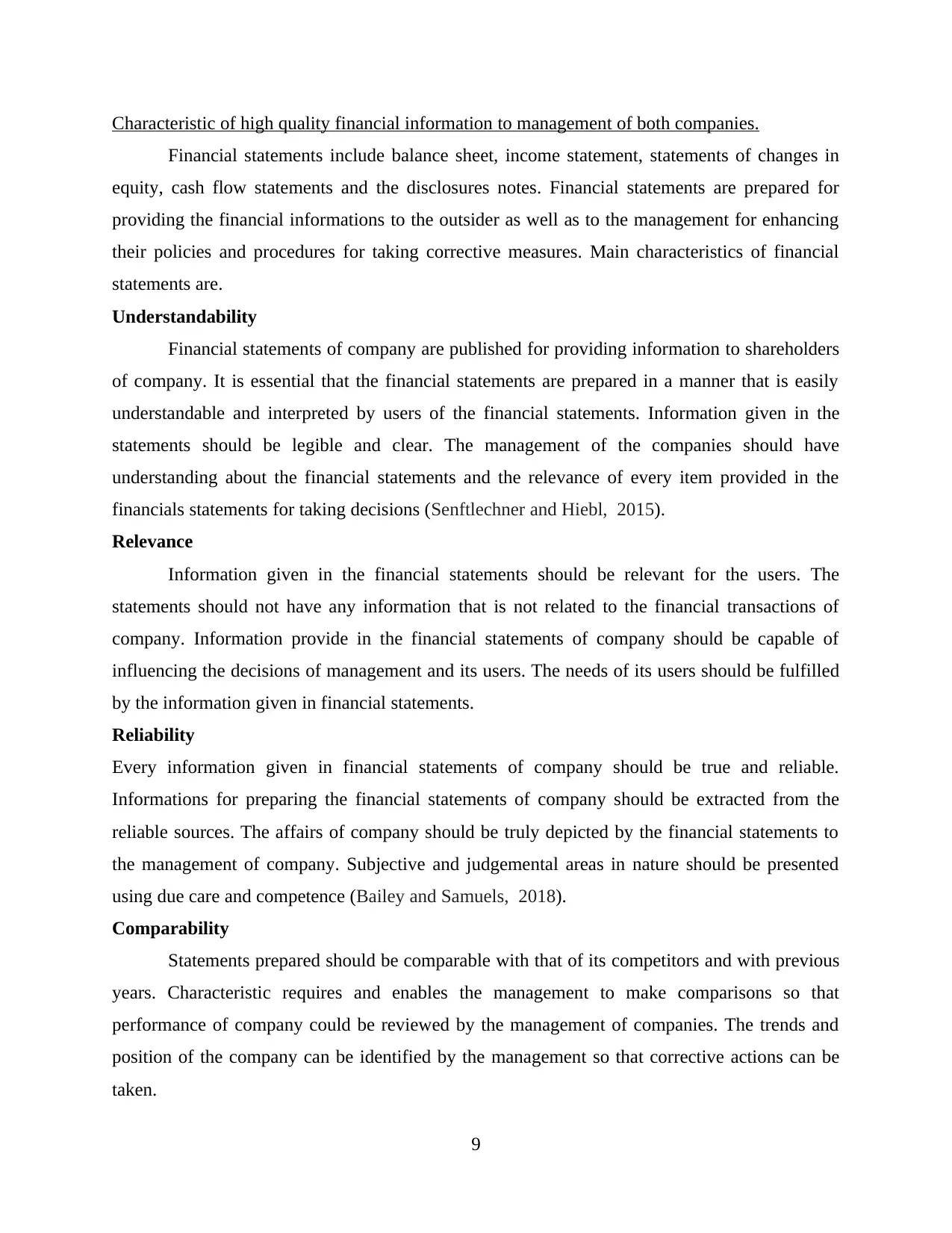
Characteristic of high quality financial information to management of both companies.
Financial statements include balance sheet, income statement, statements of changes in
equity, cash flow statements and the disclosures notes. Financial statements are prepared for
providing the financial informations to the outsider as well as to the management for enhancing
their policies and procedures for taking corrective measures. Main characteristics of financial
statements are.
Understandability
Financial statements of company are published for providing information to shareholders
of company. It is essential that the financial statements are prepared in a manner that is easily
understandable and interpreted by users of the financial statements. Information given in the
statements should be legible and clear. The management of the companies should have
understanding about the financial statements and the relevance of every item provided in the
financials statements for taking decisions (Senftlechner and Hiebl, 2015).
Relevance
Information given in the financial statements should be relevant for the users. The
statements should not have any information that is not related to the financial transactions of
company. Information provide in the financial statements of company should be capable of
influencing the decisions of management and its users. The needs of its users should be fulfilled
by the information given in financial statements.
Reliability
Every information given in financial statements of company should be true and reliable.
Informations for preparing the financial statements of company should be extracted from the
reliable sources. The affairs of company should be truly depicted by the financial statements to
the management of company. Subjective and judgemental areas in nature should be presented
using due care and competence (Bailey and Samuels, 2018).
Comparability
Statements prepared should be comparable with that of its competitors and with previous
years. Characteristic requires and enables the management to make comparisons so that
performance of company could be reviewed by the management of companies. The trends and
position of the company can be identified by the management so that corrective actions can be
taken.
9
Financial statements include balance sheet, income statement, statements of changes in
equity, cash flow statements and the disclosures notes. Financial statements are prepared for
providing the financial informations to the outsider as well as to the management for enhancing
their policies and procedures for taking corrective measures. Main characteristics of financial
statements are.
Understandability
Financial statements of company are published for providing information to shareholders
of company. It is essential that the financial statements are prepared in a manner that is easily
understandable and interpreted by users of the financial statements. Information given in the
statements should be legible and clear. The management of the companies should have
understanding about the financial statements and the relevance of every item provided in the
financials statements for taking decisions (Senftlechner and Hiebl, 2015).
Relevance
Information given in the financial statements should be relevant for the users. The
statements should not have any information that is not related to the financial transactions of
company. Information provide in the financial statements of company should be capable of
influencing the decisions of management and its users. The needs of its users should be fulfilled
by the information given in financial statements.
Reliability
Every information given in financial statements of company should be true and reliable.
Informations for preparing the financial statements of company should be extracted from the
reliable sources. The affairs of company should be truly depicted by the financial statements to
the management of company. Subjective and judgemental areas in nature should be presented
using due care and competence (Bailey and Samuels, 2018).
Comparability
Statements prepared should be comparable with that of its competitors and with previous
years. Characteristic requires and enables the management to make comparisons so that
performance of company could be reviewed by the management of companies. The trends and
position of the company can be identified by the management so that corrective actions can be
taken.
9
⊘ This is a preview!⊘
Do you want full access?
Subscribe today to unlock all pages.
Trusted by 1+ million students worldwide

1 out of 18


Related Documents


Your All-in-One AI-Powered Toolkit for Academic Success.
+13062052269
info@desklib.com
Available 24*7 on WhatsApp / Email
![[object Object]](/_next/static/media/star-bottom.7253800d.svg)
Unlock your academic potential
Copyright © 2020–2026 A2Z Services. All Rights Reserved. Developed and managed by ZUCOL.