Financial Management Report: Principles of Financial Management - HND
VerifiedAdded on 2023/01/11
|22
|6086
|33
Report
AI Summary
This report delves into the core principles of financial management, exploring various methods to support successful movements and decision-making processes, differentiating between formal and informal approaches, and analyzing their advantages and disadvantages. It examines the governance standards essential for powerful budget systems, emphasizing financial stability and strategic planning. Furthermore, the report evaluates the crucial roles of management accountants and accounting control systems within an integrated business framework, focusing on ethical financial management. Finally, it assesses how financial decision-making supports sustainable performance, offering insights into long-term financial strategies.

FINANCIAL MANAGEMENT

Paraphrase This Document
Need a fresh take? Get an instant paraphrase of this document with our AI Paraphraser
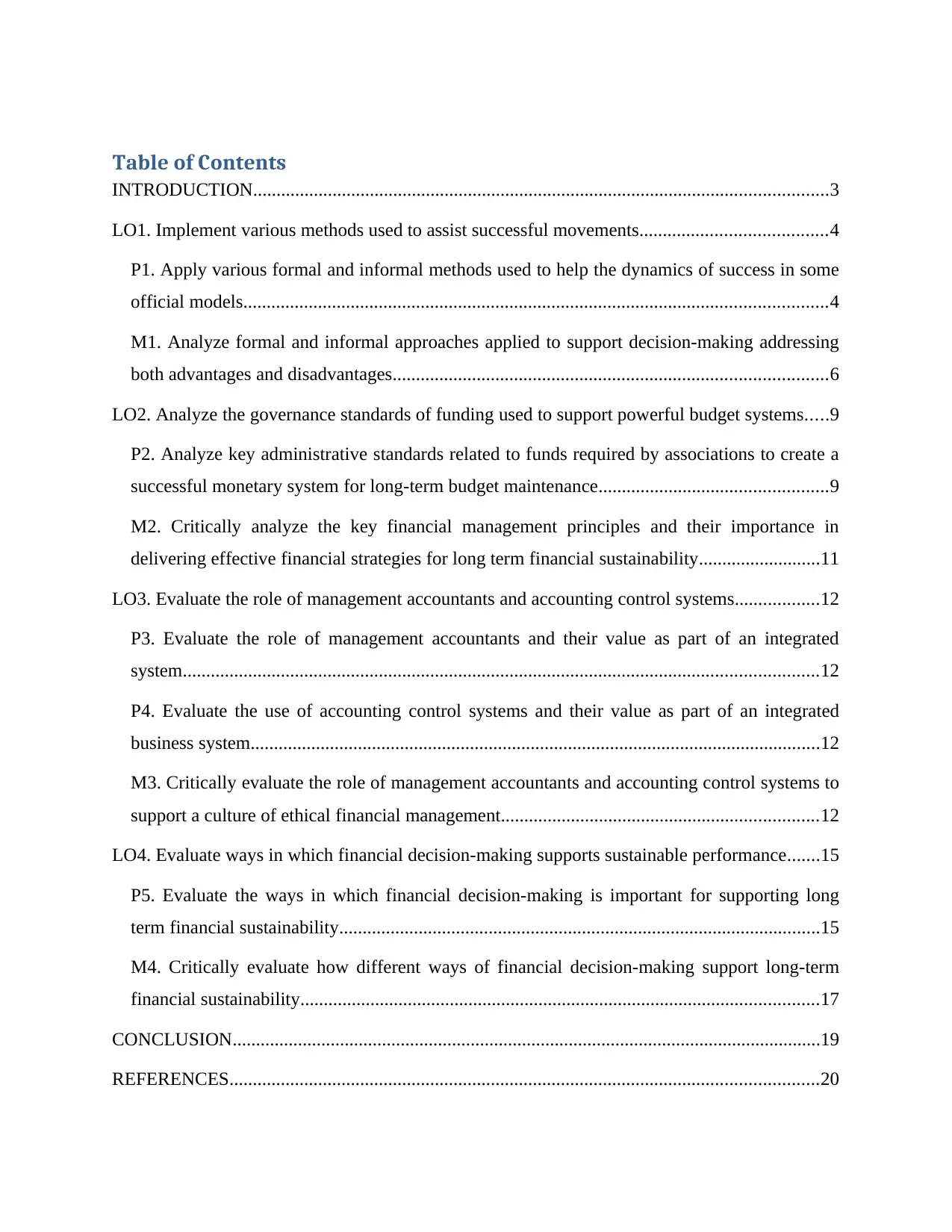
Table of Contents
INTRODUCTION...........................................................................................................................3
LO1. Implement various methods used to assist successful movements........................................4
P1. Apply various formal and informal methods used to help the dynamics of success in some
official models.............................................................................................................................4
M1. Analyze formal and informal approaches applied to support decision-making addressing
both advantages and disadvantages.............................................................................................6
LO2. Analyze the governance standards of funding used to support powerful budget systems.....9
P2. Analyze key administrative standards related to funds required by associations to create a
successful monetary system for long-term budget maintenance.................................................9
M2. Critically analyze the key financial management principles and their importance in
delivering effective financial strategies for long term financial sustainability..........................11
LO3. Evaluate the role of management accountants and accounting control systems..................12
P3. Evaluate the role of management accountants and their value as part of an integrated
system........................................................................................................................................12
P4. Evaluate the use of accounting control systems and their value as part of an integrated
business system..........................................................................................................................12
M3. Critically evaluate the role of management accountants and accounting control systems to
support a culture of ethical financial management....................................................................12
LO4. Evaluate ways in which financial decision-making supports sustainable performance.......15
P5. Evaluate the ways in which financial decision-making is important for supporting long
term financial sustainability.......................................................................................................15
M4. Critically evaluate how different ways of financial decision-making support long-term
financial sustainability...............................................................................................................17
CONCLUSION..............................................................................................................................19
REFERENCES..............................................................................................................................20
INTRODUCTION...........................................................................................................................3
LO1. Implement various methods used to assist successful movements........................................4
P1. Apply various formal and informal methods used to help the dynamics of success in some
official models.............................................................................................................................4
M1. Analyze formal and informal approaches applied to support decision-making addressing
both advantages and disadvantages.............................................................................................6
LO2. Analyze the governance standards of funding used to support powerful budget systems.....9
P2. Analyze key administrative standards related to funds required by associations to create a
successful monetary system for long-term budget maintenance.................................................9
M2. Critically analyze the key financial management principles and their importance in
delivering effective financial strategies for long term financial sustainability..........................11
LO3. Evaluate the role of management accountants and accounting control systems..................12
P3. Evaluate the role of management accountants and their value as part of an integrated
system........................................................................................................................................12
P4. Evaluate the use of accounting control systems and their value as part of an integrated
business system..........................................................................................................................12
M3. Critically evaluate the role of management accountants and accounting control systems to
support a culture of ethical financial management....................................................................12
LO4. Evaluate ways in which financial decision-making supports sustainable performance.......15
P5. Evaluate the ways in which financial decision-making is important for supporting long
term financial sustainability.......................................................................................................15
M4. Critically evaluate how different ways of financial decision-making support long-term
financial sustainability...............................................................................................................17
CONCLUSION..............................................................................................................................19
REFERENCES..............................................................................................................................20

⊘ This is a preview!⊘
Do you want full access?
Subscribe today to unlock all pages.

Trusted by 1+ million students worldwide
INTRODUCTION
The essential execution of a procedure is based on three basic factors: the association of an
external situation, a reasonable internal vision of the capabilities of the center and the support
hands and careful performance and observation. This article discusses the role of money in vital,
dynamic, interpretation, execution and observation reconciliation.
Reasonable rationalization implies dimensions that define the vision and a specific strategic
focus. This is crucial because the agreements are ultimately fundamental for the distribution of
the activities and would not be appropriate if the activities were unlimited. This article aims to
clarify how money, budget objectives and monetary performance can play increasingly critical
roles in the critical configuration and dynamic approach, especially in the point of use and
observation.
The long-term financial planning strategy provides the regional council with a tool to help
determine options for strategies, administrations and other diversionary issues by using
standardized agreements according to an understanding constrained by nine standard budgets to
help the peel region become fairly resilient. The strategy provides the Council with better long-
term data when considering numerous negotiated options that affect administrations, such as
affordable long-term housing strategy, affordable transport and energy from residual resources. It
ensures that the elements, for example, the impact of the cost / convenience rate on the resident,
the liability and retention rates and the incentives for the money will be considered as
determinants of these options.
The essential execution of a procedure is based on three basic factors: the association of an
external situation, a reasonable internal vision of the capabilities of the center and the support
hands and careful performance and observation. This article discusses the role of money in vital,
dynamic, interpretation, execution and observation reconciliation.
Reasonable rationalization implies dimensions that define the vision and a specific strategic
focus. This is crucial because the agreements are ultimately fundamental for the distribution of
the activities and would not be appropriate if the activities were unlimited. This article aims to
clarify how money, budget objectives and monetary performance can play increasingly critical
roles in the critical configuration and dynamic approach, especially in the point of use and
observation.
The long-term financial planning strategy provides the regional council with a tool to help
determine options for strategies, administrations and other diversionary issues by using
standardized agreements according to an understanding constrained by nine standard budgets to
help the peel region become fairly resilient. The strategy provides the Council with better long-
term data when considering numerous negotiated options that affect administrations, such as
affordable long-term housing strategy, affordable transport and energy from residual resources. It
ensures that the elements, for example, the impact of the cost / convenience rate on the resident,
the liability and retention rates and the incentives for the money will be considered as
determinants of these options.
Paraphrase This Document
Need a fresh take? Get an instant paraphrase of this document with our AI Paraphraser
LO1. Implement various methods used to assist successful movements
P1. Apply various formal and informal methods used to help the dynamics of
success in some official models
Decision making is not an easy task for any organization; lot of analysis and critical thinking
requires before reach to a particular conclusion. There are certain approaches which are preferred
by organizations to support their effective decision making process:
Formal Approach:
In this approach; companies take support of their internal sources and formal authorities to take
decision. Here Unilever has been taken as example to understand how firms use formal approach
to support effective decisions. Some of the methods of formal approach have been discussed
below:
Structure: Each specific unit is led by its own leader, who, in theory, is better prepared to
understand the requirements and issues of that particular unit. This allows for the consolidation
of implementation data at the administrative level where the official level can directly access the
most relevant data for objective and management purposes. This defines the content of the
organizational activities and only feeds the consequences of tasks that make the stools go up to
the officers and the governing body (M.E. Porter, 1996).
The structures of the corporate authorities emerged to separate the dynamic movement. The
execution of the mill association chart reveals a number of important powers begin with the
administrator, the CEO and other official officials at the top while the official officers set the
goals and influence of the organization. Supervisor ranks below the official level are responsible
for implementing these goals in their areas of responsibility or departments, which are organized
by an adequate flow of data from the directors.
A hierarchical structure that separates agency functions into specific offices allows
administrators of these departments to manage problems and create procedural and wording
efficiencies incorporated into their specific offices. It likewise makes the level of business
administration where effort information is created, tested and saved for the efficient future
P1. Apply various formal and informal methods used to help the dynamics of
success in some official models
Decision making is not an easy task for any organization; lot of analysis and critical thinking
requires before reach to a particular conclusion. There are certain approaches which are preferred
by organizations to support their effective decision making process:
Formal Approach:
In this approach; companies take support of their internal sources and formal authorities to take
decision. Here Unilever has been taken as example to understand how firms use formal approach
to support effective decisions. Some of the methods of formal approach have been discussed
below:
Structure: Each specific unit is led by its own leader, who, in theory, is better prepared to
understand the requirements and issues of that particular unit. This allows for the consolidation
of implementation data at the administrative level where the official level can directly access the
most relevant data for objective and management purposes. This defines the content of the
organizational activities and only feeds the consequences of tasks that make the stools go up to
the officers and the governing body (M.E. Porter, 1996).
The structures of the corporate authorities emerged to separate the dynamic movement. The
execution of the mill association chart reveals a number of important powers begin with the
administrator, the CEO and other official officials at the top while the official officers set the
goals and influence of the organization. Supervisor ranks below the official level are responsible
for implementing these goals in their areas of responsibility or departments, which are organized
by an adequate flow of data from the directors.
A hierarchical structure that separates agency functions into specific offices allows
administrators of these departments to manage problems and create procedural and wording
efficiencies incorporated into their specific offices. It likewise makes the level of business
administration where effort information is created, tested and saved for the efficient future
operation of the department, just as open as those in higher management than accused of
organizing a large enterprise (M.E. Porter, 1996).
Processes: The steps suggest easy. More broadly, they can be classified as assortments of
commissions and joint exercises - and only together - that modify return contributions. Within
organizations, these sources and data products can be managed as resources, data, and
individuals. Common application scenarios include the development of new products,
application for satisfaction and customer support; Investors are extremely smart but also the
same in terms of distribution of resources and energy.
Systems: Managers must quickly access the data to draw conclusions on key issues related to
revenue, advertising and operations. Organizations collect a variety of data processes, including
customer records, process information, statistical research, financial accounting records, data
collection and inventory information and personal property records. However, most of this
information is stored in idle department problems, making it difficult for leaders to get
information quickly (M.E. Porter, 1996).
The control information system improves and accelerates data processing by placing the
information in a single position open with the system. The result is a quick and well-managed
election.
Informal approach:
This approach supports decision making by considering the facts other than formal approach. It
focuses on non organizational outcomes with effect of taking decision. Some of the methods of
informal approach are discussed below:
Relationships: When two people enter into a relationship, the amount of choices they should
make about their killings is basically due to the fact that their respective circles of choice cover.
This is not necessarily based on the fact that these choices have to be made together, but simply
because you see someone influencing the other person on all the choices you make
independently (M.E. Porter, 1996). In order to maintain a good relationship, each facilitator
should think of his partner in any situation. Whether you are deciding on options together or
organizing a large enterprise (M.E. Porter, 1996).
Processes: The steps suggest easy. More broadly, they can be classified as assortments of
commissions and joint exercises - and only together - that modify return contributions. Within
organizations, these sources and data products can be managed as resources, data, and
individuals. Common application scenarios include the development of new products,
application for satisfaction and customer support; Investors are extremely smart but also the
same in terms of distribution of resources and energy.
Systems: Managers must quickly access the data to draw conclusions on key issues related to
revenue, advertising and operations. Organizations collect a variety of data processes, including
customer records, process information, statistical research, financial accounting records, data
collection and inventory information and personal property records. However, most of this
information is stored in idle department problems, making it difficult for leaders to get
information quickly (M.E. Porter, 1996).
The control information system improves and accelerates data processing by placing the
information in a single position open with the system. The result is a quick and well-managed
election.
Informal approach:
This approach supports decision making by considering the facts other than formal approach. It
focuses on non organizational outcomes with effect of taking decision. Some of the methods of
informal approach are discussed below:
Relationships: When two people enter into a relationship, the amount of choices they should
make about their killings is basically due to the fact that their respective circles of choice cover.
This is not necessarily based on the fact that these choices have to be made together, but simply
because you see someone influencing the other person on all the choices you make
independently (M.E. Porter, 1996). In order to maintain a good relationship, each facilitator
should think of his partner in any situation. Whether you are deciding on options together or
⊘ This is a preview!⊘
Do you want full access?
Subscribe today to unlock all pages.
Trusted by 1+ million students worldwide
considering each other in your individual choices, there is generally not much that should be
done entirely on your own.
Be that as it may, the extent to which your two-choice cycle depends entirely on you and your
performance, and is unique to each couple. In any case, the more options a couple can share or
provide without a doubt, the better. In the event that one or two patrons settle on one-sided, one-
sided choices, at that point, sometimes, the relationship will last.
Networks: The decision-making process to introduce new antibodies into national immunization
programs is often astounding, involving many participants who provide specific data, prepare an
account, and fill in data, implement projects and gain political assistance. Participants can have a
variety of levels of knowledge, information and motivation to demonstrate new approaches. The
lack of compatibility with the need, the value of general well-being or the ability to introduce an
alternative strategy for Unilever can diminish the approach choices (M.E. Porter, 1996).
Efforts to assist a nationwide dynamic have largely focused on building increases worldwide and
providing delegates with data on the approach. There has been less consideration of
understanding the synergies of the characters on the screen and how affective circulation affects
strategy and dynamic approach.
Unwritten rules: Politics, firmness and favors have a strong influence on dynamic methodology.
At best, organizations put 80% of their choice to death and 20% on government connections and
problems. Many people influence choices and, from time to time, legislative matters are the best.
Try not to assume that someone's situation means that person has power (M.E. Porter, 1996).
M1. Analyze formal and informal approaches applied to support decision-
making addressing both advantages and disadvantages
Advantages of formal approach to support decision making:
1. Procedural approach:
The formal structure of the company provides a detailed and regular functioning of a company.
2. Achievement of organizational decisions:
A formal classification structure is established to achieve authoritative goals.
done entirely on your own.
Be that as it may, the extent to which your two-choice cycle depends entirely on you and your
performance, and is unique to each couple. In any case, the more options a couple can share or
provide without a doubt, the better. In the event that one or two patrons settle on one-sided, one-
sided choices, at that point, sometimes, the relationship will last.
Networks: The decision-making process to introduce new antibodies into national immunization
programs is often astounding, involving many participants who provide specific data, prepare an
account, and fill in data, implement projects and gain political assistance. Participants can have a
variety of levels of knowledge, information and motivation to demonstrate new approaches. The
lack of compatibility with the need, the value of general well-being or the ability to introduce an
alternative strategy for Unilever can diminish the approach choices (M.E. Porter, 1996).
Efforts to assist a nationwide dynamic have largely focused on building increases worldwide and
providing delegates with data on the approach. There has been less consideration of
understanding the synergies of the characters on the screen and how affective circulation affects
strategy and dynamic approach.
Unwritten rules: Politics, firmness and favors have a strong influence on dynamic methodology.
At best, organizations put 80% of their choice to death and 20% on government connections and
problems. Many people influence choices and, from time to time, legislative matters are the best.
Try not to assume that someone's situation means that person has power (M.E. Porter, 1996).
M1. Analyze formal and informal approaches applied to support decision-
making addressing both advantages and disadvantages
Advantages of formal approach to support decision making:
1. Procedural approach:
The formal structure of the company provides a detailed and regular functioning of a company.
2. Achievement of organizational decisions:
A formal classification structure is established to achieve authoritative goals.
Paraphrase This Document
Need a fresh take? Get an instant paraphrase of this document with our AI Paraphraser
3. Don't go beyond ideas:
In the formal structure of a company, work is freely divided between different offices and
representatives. So there is no possibility of duplication or overlap of work (M.E. Porter, 1996).
4. Location:
A formal hierarchical structure produces various office exercises.
5. Manufacturing of the chain of command:
A formal authoritative structure clearly reflects a common sub-sexual relationship, i.e. who
reports to whom (M.E. Porter, 1996).
6. Greater emphasis on decisions related to company growth:
A formal authoritative structure allows for greater emphasis on work than relationship
relationships.
Disadvantages:
1. Referral in real life:
When you follow an intelligent chain and a hierarchy of leadership activities, they are liquidated
into a formal structure.
2. Avoid employee social needs:
A formal authoritative structure does not make sense of the mental and social needs of
employees who can motivate agents (M.E. Porter, 1996).
3. Only accentuation of the work:
The formal structure of the classification offers meaning for direct work; neglect human
relationships, innovation, gifts and so on.
Advantages of Informal approach
1. Quick outcome:
In the formal structure of a company, work is freely divided between different offices and
representatives. So there is no possibility of duplication or overlap of work (M.E. Porter, 1996).
4. Location:
A formal hierarchical structure produces various office exercises.
5. Manufacturing of the chain of command:
A formal authoritative structure clearly reflects a common sub-sexual relationship, i.e. who
reports to whom (M.E. Porter, 1996).
6. Greater emphasis on decisions related to company growth:
A formal authoritative structure allows for greater emphasis on work than relationship
relationships.
Disadvantages:
1. Referral in real life:
When you follow an intelligent chain and a hierarchy of leadership activities, they are liquidated
into a formal structure.
2. Avoid employee social needs:
A formal authoritative structure does not make sense of the mental and social needs of
employees who can motivate agents (M.E. Porter, 1996).
3. Only accentuation of the work:
The formal structure of the classification offers meaning for direct work; neglect human
relationships, innovation, gifts and so on.
Advantages of Informal approach
1. Quick outcome:
Casual structure doesn't follow scalar chain so there can be quicker spread of correspondence.
⊘ This is a preview!⊘
Do you want full access?
Subscribe today to unlock all pages.
Trusted by 1+ million students worldwide
LO2. Analyze the governance standards of funding used to support
powerful budget systems
P2. Analyze key administrative standards related to funds required by
associations to create a successful monetary system for long-term budget
maintenance
Financial Stability: Financial stability as the ability to start, develop and maintain your business
with short and long-term budget stability. In any case, the number of intelligent staff
administrators who rely solely on their offers or human resources skills to develop their business,
and generally do not know where they are or where they are going, is not surprising (R.K.
Johnson, 2006).
While short-staffed entrepreneurs provide a series of explanations behind the beginning of their
commitment - working for themselves, fulfilling individuals ’circumstances upon landing,
fulfilling a need in the fraud - you won't be good at moving on without benefits and feasible
development (that word still exists).
Financial management principles required by organizations to achieve effective financial
strategies for long term financial sustainability:
Financial sustainability principles have been established as the guiding considerations against
which financial strategies and decisions will be deliberated. One wonders how many
administrators of wise employees rely directly on contracts or human resources skills to develop
their business, and generally do not know where they are or where they are going (R.K. Johnson,
2006).
While short-term employees will provide an explanation for their commitment - working for
them, fulfilling people's roles, satisfying a need in the mall - you won't go far without the strong
and feasible benefits of development (there is new that word). Some of the principles include:
1. STRATEGIC PLAN AND CORPORATE PRIORITIES
powerful budget systems
P2. Analyze key administrative standards related to funds required by
associations to create a successful monetary system for long-term budget
maintenance
Financial Stability: Financial stability as the ability to start, develop and maintain your business
with short and long-term budget stability. In any case, the number of intelligent staff
administrators who rely solely on their offers or human resources skills to develop their business,
and generally do not know where they are or where they are going, is not surprising (R.K.
Johnson, 2006).
While short-staffed entrepreneurs provide a series of explanations behind the beginning of their
commitment - working for themselves, fulfilling individuals ’circumstances upon landing,
fulfilling a need in the fraud - you won't be good at moving on without benefits and feasible
development (that word still exists).
Financial management principles required by organizations to achieve effective financial
strategies for long term financial sustainability:
Financial sustainability principles have been established as the guiding considerations against
which financial strategies and decisions will be deliberated. One wonders how many
administrators of wise employees rely directly on contracts or human resources skills to develop
their business, and generally do not know where they are or where they are going (R.K. Johnson,
2006).
While short-term employees will provide an explanation for their commitment - working for
them, fulfilling people's roles, satisfying a need in the mall - you won't go far without the strong
and feasible benefits of development (there is new that word). Some of the principles include:
1. STRATEGIC PLAN AND CORPORATE PRIORITIES
Paraphrase This Document
Need a fresh take? Get an instant paraphrase of this document with our AI Paraphraser
Strategic planning is an administrative tool. It is used to allow a society to define its future - to
centralize its vitality and to help individuals in the society move towards similar goals. The
organization’s approach changes the direction of the society according to a growing situation.
Organizing life is a limited attempt to help the key choices and actions that shape and guide what
a society is, what it does and why it does it, with an emphasis on where it should go and how to
get there (R.K. Johnson, 2006).
2. PROVIDE SERVICES IN AN EFFICIENT MANNER
In the modern scene of Internet-based life, customer care needs must be met through
interpersonal communication and must be done quickly. 42% of customers expect to receive a
response via web-based network media within 60 minutes. To give you an idea of how this will
happen from time to time, most organizations on Twitter simply send a response to that request
for each day (R.K. Johnson, 2006).
3. PROVIDE SERVICES AT AN EQUITABLE (FAIR) AMOUNT
With data sharing points and updating letters with performance groups, we hold quality meetings
before or after peak times twice a year. Nearby, by sharing the problems and creating a system in
these peak times, a quality manual is used and agreed to guarantee quality control. For returning
investors, our essential approach is to pay stable and consistent profits, considering an in-depth
assessment of business performance and working conditions. At a basic level, the percentage of
profit margins is set at 30% or more (R.K. Johnson, 2006).
4. TRANSPARENT WITH KEY STAKEHOLDERS
Stakeholders can influence the outcome of the battle because they will have regular access to the
information and goods you need. Regardless of whether it helps you identify campaign
characteristics or support a bid for more funding, participants influence the effectiveness of any
action or battle.
Stakeholders can describe your organization's colleagues, business managers or battle leaders,
group administrators, campaign sponsors, messengers and finalists of what you expect from
work (R.K. Johnson, 2006).
centralize its vitality and to help individuals in the society move towards similar goals. The
organization’s approach changes the direction of the society according to a growing situation.
Organizing life is a limited attempt to help the key choices and actions that shape and guide what
a society is, what it does and why it does it, with an emphasis on where it should go and how to
get there (R.K. Johnson, 2006).
2. PROVIDE SERVICES IN AN EFFICIENT MANNER
In the modern scene of Internet-based life, customer care needs must be met through
interpersonal communication and must be done quickly. 42% of customers expect to receive a
response via web-based network media within 60 minutes. To give you an idea of how this will
happen from time to time, most organizations on Twitter simply send a response to that request
for each day (R.K. Johnson, 2006).
3. PROVIDE SERVICES AT AN EQUITABLE (FAIR) AMOUNT
With data sharing points and updating letters with performance groups, we hold quality meetings
before or after peak times twice a year. Nearby, by sharing the problems and creating a system in
these peak times, a quality manual is used and agreed to guarantee quality control. For returning
investors, our essential approach is to pay stable and consistent profits, considering an in-depth
assessment of business performance and working conditions. At a basic level, the percentage of
profit margins is set at 30% or more (R.K. Johnson, 2006).
4. TRANSPARENT WITH KEY STAKEHOLDERS
Stakeholders can influence the outcome of the battle because they will have regular access to the
information and goods you need. Regardless of whether it helps you identify campaign
characteristics or support a bid for more funding, participants influence the effectiveness of any
action or battle.
Stakeholders can describe your organization's colleagues, business managers or battle leaders,
group administrators, campaign sponsors, messengers and finalists of what you expect from
work (R.K. Johnson, 2006).
M2. Critically analyze the key financial management principles and their
importance in delivering effective financial strategies for long term financial
sustainability
Long term financial sustainability techniques are used as sensible practices and strategies that are
used to achieve a specific purpose or that can be reasonable and ensure how strong a currency is
relative to the world. -State. The existing cash systems are consolidated and provided in the
structure and used as a source of perspective in the movement of money. In addition, significant
standards of financial support and reflection are applied to all money management strategies
(R.K. Johnson, 2006).
Be that as it may, a formal budget financing process is needed. As there are several methods of
monetary reconciliation, a collaborative approach will help determine which methods should be
created and initially redefined to meet needs and provide assistance in investigating problems.
The approach involves the creation of gas and longer-term budget scenarios to take into account
the factors related to real money in the future and the long-term prospects for directors. The
hypotheses and scenarios that are developed, related to the joint effort with key partners, control
the technical aspects that should be created and further updated. Likewise, the procedure takes
place as a clock to differentiate and address changing needs and conditions, new issues and
potential risks and their impact on gases, plans, procedures and practices. Once a model of the
procedure is completed, the system will be examined to merge changes in standards, procedures
and procedures, where appropriate (R.K. Johnson, 2006).
The long-term financial sustainability framework (LTFSF) was created to reflect future budget
limits through its standards, procedures and methodology. Use of the system will guide the
company in determining important options to help understand the county's goals and withdrawal
goals. The fabrication of the structure represents an important advance in preparing the
sustainability of the budget, to help achieve the key provision (R.K. Johnson, 2006).
importance in delivering effective financial strategies for long term financial
sustainability
Long term financial sustainability techniques are used as sensible practices and strategies that are
used to achieve a specific purpose or that can be reasonable and ensure how strong a currency is
relative to the world. -State. The existing cash systems are consolidated and provided in the
structure and used as a source of perspective in the movement of money. In addition, significant
standards of financial support and reflection are applied to all money management strategies
(R.K. Johnson, 2006).
Be that as it may, a formal budget financing process is needed. As there are several methods of
monetary reconciliation, a collaborative approach will help determine which methods should be
created and initially redefined to meet needs and provide assistance in investigating problems.
The approach involves the creation of gas and longer-term budget scenarios to take into account
the factors related to real money in the future and the long-term prospects for directors. The
hypotheses and scenarios that are developed, related to the joint effort with key partners, control
the technical aspects that should be created and further updated. Likewise, the procedure takes
place as a clock to differentiate and address changing needs and conditions, new issues and
potential risks and their impact on gases, plans, procedures and practices. Once a model of the
procedure is completed, the system will be examined to merge changes in standards, procedures
and procedures, where appropriate (R.K. Johnson, 2006).
The long-term financial sustainability framework (LTFSF) was created to reflect future budget
limits through its standards, procedures and methodology. Use of the system will guide the
company in determining important options to help understand the county's goals and withdrawal
goals. The fabrication of the structure represents an important advance in preparing the
sustainability of the budget, to help achieve the key provision (R.K. Johnson, 2006).
⊘ This is a preview!⊘
Do you want full access?
Subscribe today to unlock all pages.
Trusted by 1+ million students worldwide

1 out of 22


Related Documents


Your All-in-One AI-Powered Toolkit for Academic Success.
+13062052269
info@desklib.com
Available 24*7 on WhatsApp / Email
![[object Object]](/_next/static/media/star-bottom.7253800d.svg)
Unlock your academic potential
Copyright © 2020–2026 A2Z Services. All Rights Reserved. Developed and managed by ZUCOL.