Financial Management Assignment - SBS MBA/MSc Abu Dhabi 2018
VerifiedAdded on 2023/06/10
|11
|2864
|331
Homework Assignment
AI Summary
This document presents a comprehensive solution to a Financial Management assignment, covering various aspects of corporate finance. The solution begins with the calculation of a corporation's tax liability, followed by an explanation of the government's need for taxation and the progressive tax system. It delves into investment analysis, computing mean returns and standard deviations for common stocks, and evaluating risk. The assignment further explores financial statement analysis, including calculations of ratios like current ratio, inventory turnover, and debt ratio, along with an analysis of the company's liquidity, efficiency, and profitability. Capital budgeting techniques, such as payback period, accounting rate of return (ARR), net present value (NPV), and profitability index, are applied to evaluate project feasibility. Additional topics addressed include inventory management in inflationary environments, and explanations of key financial concepts such as the risk-return trade-off, time value of money, and incremental cash flows. The agency problem and the impact of taxes on business decisions are also discussed.

FINANCIAL MANAGEMENT
STUDENT ID:
[Pick the date]
STUDENT ID:
[Pick the date]

Paraphrase This Document
Need a fresh take? Get an instant paraphrase of this document with our AI Paraphraser
Question 1
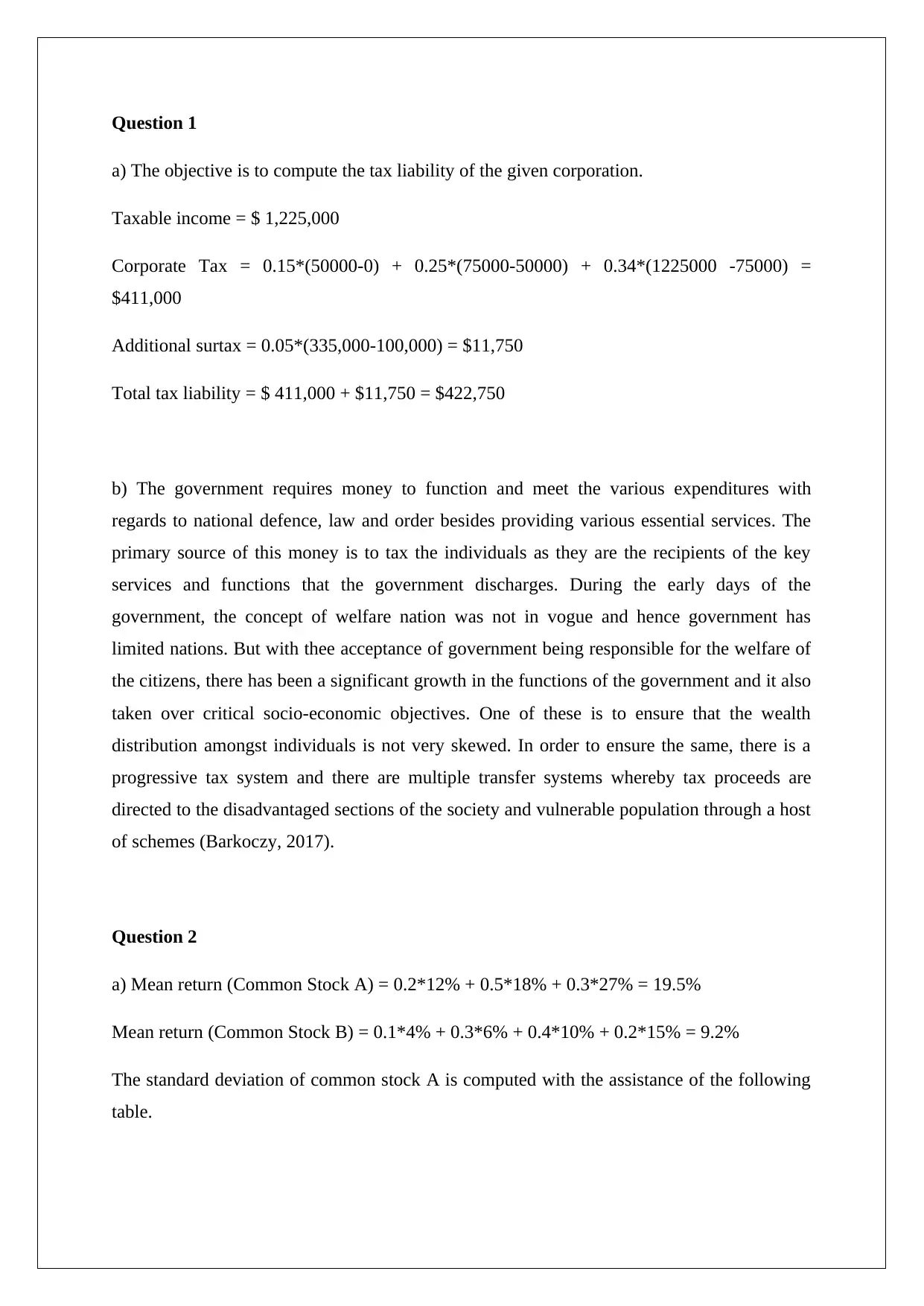
a) The objective is to compute the tax liability of the given corporation.
Taxable income = $ 1,225,000
Corporate Tax = 0.15*(50000-0) + 0.25*(75000-50000) + 0.34*(1225000 -75000) =
$411,000
Additional surtax = 0.05*(335,000-100,000) = $11,750
Total tax liability = $ 411,000 + $11,750 = $422,750
b) The government requires money to function and meet the various expenditures with
regards to national defence, law and order besides providing various essential services. The
primary source of this money is to tax the individuals as they are the recipients of the key
services and functions that the government discharges. During the early days of the
government, the concept of welfare nation was not in vogue and hence government has
limited nations. But with thee acceptance of government being responsible for the welfare of
the citizens, there has been a significant growth in the functions of the government and it also
taken over critical socio-economic objectives. One of these is to ensure that the wealth
distribution amongst individuals is not very skewed. In order to ensure the same, there is a
progressive tax system and there are multiple transfer systems whereby tax proceeds are
directed to the disadvantaged sections of the society and vulnerable population through a host
of schemes (Barkoczy, 2017).
Question 2
a) Mean return (Common Stock A) = 0.2*12% + 0.5*18% + 0.3*27% = 19.5%
Mean return (Common Stock B) = 0.1*4% + 0.3*6% + 0.4*10% + 0.2*15% = 9.2%
The standard deviation of common stock A is computed with the assistance of the following
table.
a) The objective is to compute the tax liability of the given corporation.
Taxable income = $ 1,225,000
Corporate Tax = 0.15*(50000-0) + 0.25*(75000-50000) + 0.34*(1225000 -75000) =
$411,000
Additional surtax = 0.05*(335,000-100,000) = $11,750
Total tax liability = $ 411,000 + $11,750 = $422,750
b) The government requires money to function and meet the various expenditures with
regards to national defence, law and order besides providing various essential services. The
primary source of this money is to tax the individuals as they are the recipients of the key
services and functions that the government discharges. During the early days of the
government, the concept of welfare nation was not in vogue and hence government has
limited nations. But with thee acceptance of government being responsible for the welfare of
the citizens, there has been a significant growth in the functions of the government and it also
taken over critical socio-economic objectives. One of these is to ensure that the wealth
distribution amongst individuals is not very skewed. In order to ensure the same, there is a
progressive tax system and there are multiple transfer systems whereby tax proceeds are
directed to the disadvantaged sections of the society and vulnerable population through a host
of schemes (Barkoczy, 2017).
Question 2
a) Mean return (Common Stock A) = 0.2*12% + 0.5*18% + 0.3*27% = 19.5%
Mean return (Common Stock B) = 0.1*4% + 0.3*6% + 0.4*10% + 0.2*15% = 9.2%
The standard deviation of common stock A is computed with the assistance of the following
table.
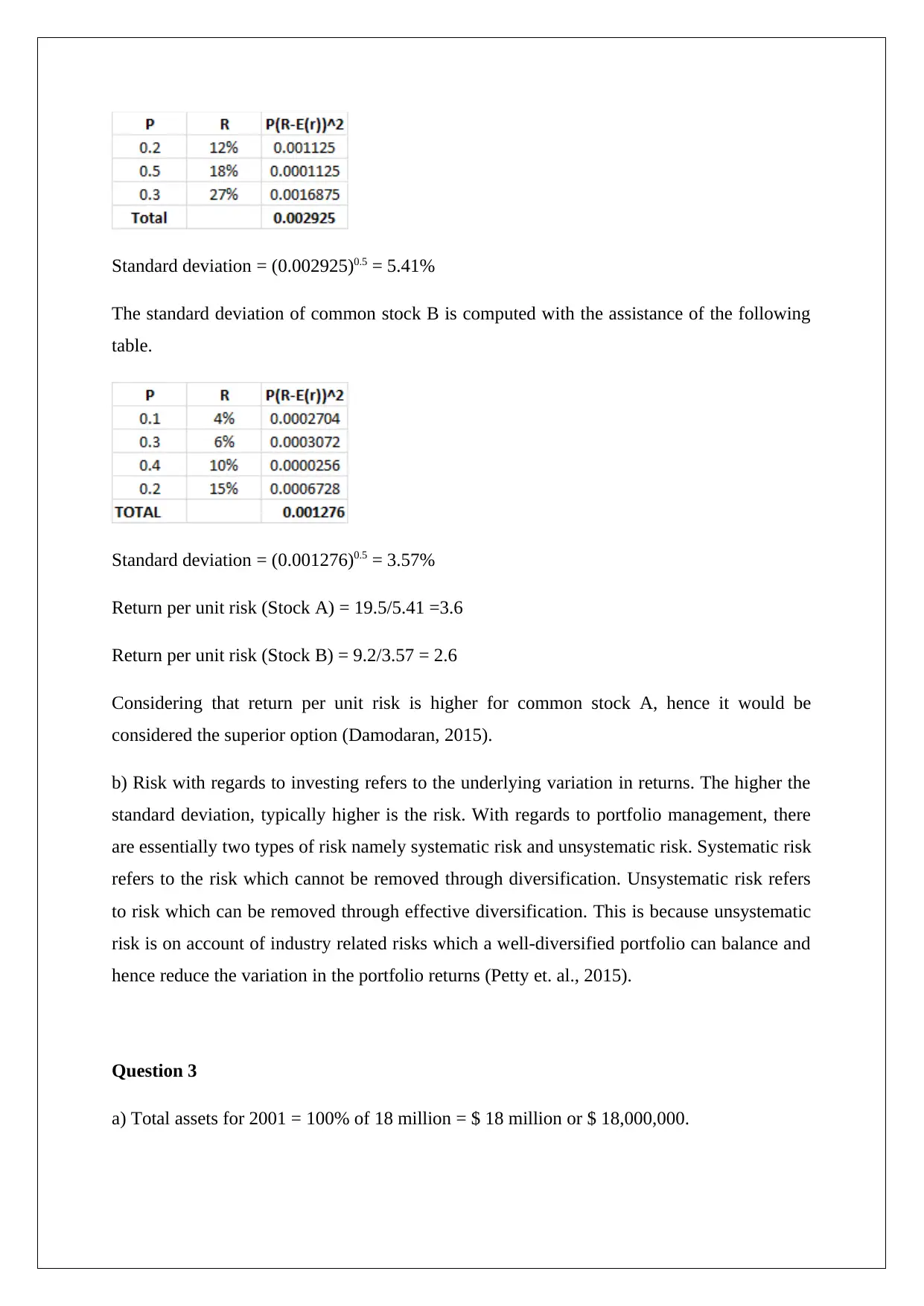
Standard deviation = (0.002925)0.5 = 5.41%
The standard deviation of common stock B is computed with the assistance of the following
table.
Standard deviation = (0.001276)0.5 = 3.57%
Return per unit risk (Stock A) = 19.5/5.41 =3.6
Return per unit risk (Stock B) = 9.2/3.57 = 2.6
Considering that return per unit risk is higher for common stock A, hence it would be
considered the superior option (Damodaran, 2015).
b) Risk with regards to investing refers to the underlying variation in returns. The higher the
standard deviation, typically higher is the risk. With regards to portfolio management, there
are essentially two types of risk namely systematic risk and unsystematic risk. Systematic risk
refers to the risk which cannot be removed through diversification. Unsystematic risk refers
to risk which can be removed through effective diversification. This is because unsystematic
risk is on account of industry related risks which a well-diversified portfolio can balance and
hence reduce the variation in the portfolio returns (Petty et. al., 2015).
Question 3
a) Total assets for 2001 = 100% of 18 million = $ 18 million or $ 18,000,000.
The standard deviation of common stock B is computed with the assistance of the following
table.
Standard deviation = (0.001276)0.5 = 3.57%
Return per unit risk (Stock A) = 19.5/5.41 =3.6
Return per unit risk (Stock B) = 9.2/3.57 = 2.6
Considering that return per unit risk is higher for common stock A, hence it would be
considered the superior option (Damodaran, 2015).
b) Risk with regards to investing refers to the underlying variation in returns. The higher the
standard deviation, typically higher is the risk. With regards to portfolio management, there
are essentially two types of risk namely systematic risk and unsystematic risk. Systematic risk
refers to the risk which cannot be removed through diversification. Unsystematic risk refers
to risk which can be removed through effective diversification. This is because unsystematic
risk is on account of industry related risks which a well-diversified portfolio can balance and
hence reduce the variation in the portfolio returns (Petty et. al., 2015).
Question 3
a) Total assets for 2001 = 100% of 18 million = $ 18 million or $ 18,000,000.
⊘ This is a preview!⊘
Do you want full access?
Subscribe today to unlock all pages.

Trusted by 1+ million students worldwide
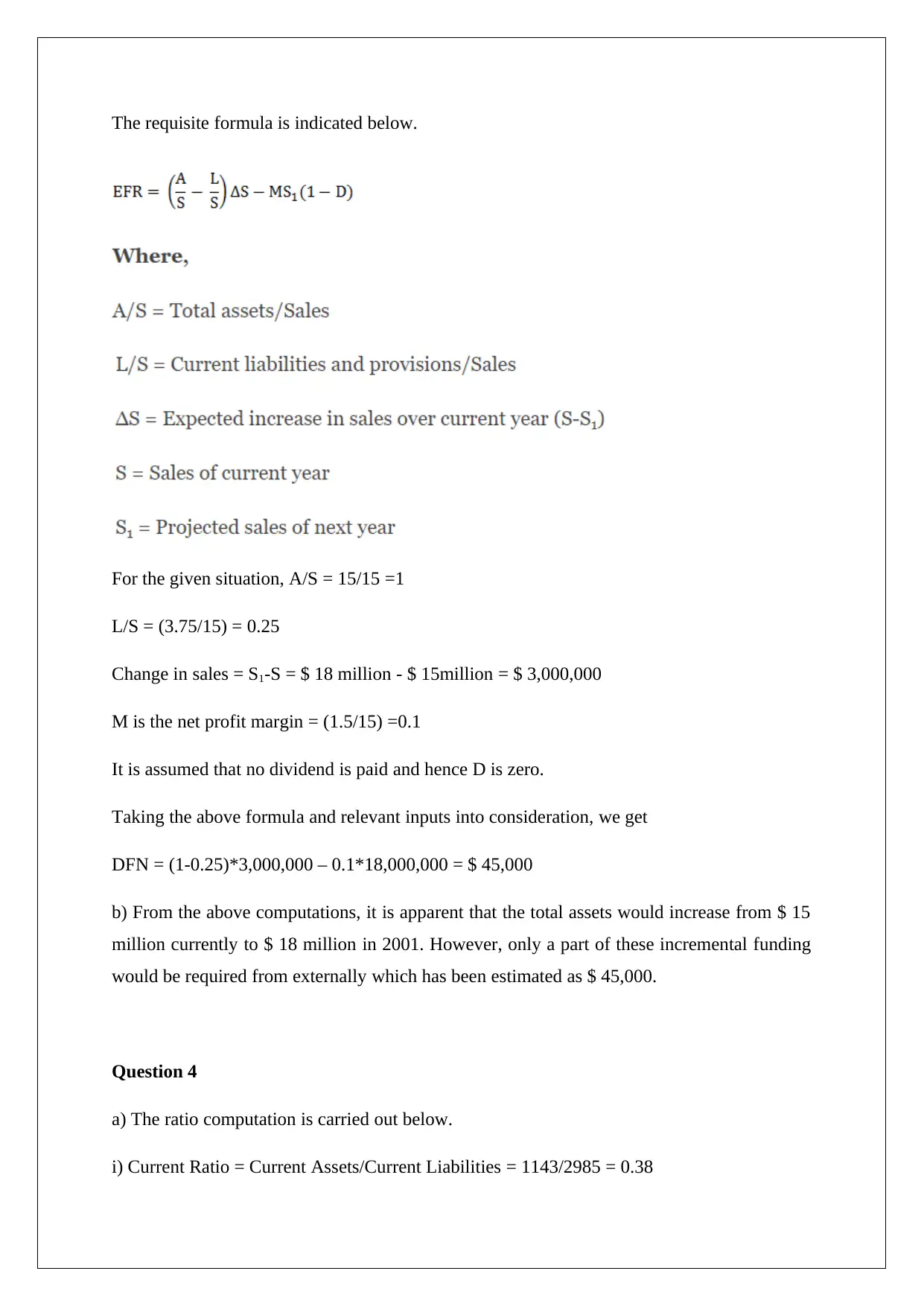
The requisite formula is indicated below.
For the given situation, A/S = 15/15 =1
L/S = (3.75/15) = 0.25
Change in sales = S1-S = $ 18 million - $ 15million = $ 3,000,000
M is the net profit margin = (1.5/15) =0.1
It is assumed that no dividend is paid and hence D is zero.
Taking the above formula and relevant inputs into consideration, we get
DFN = (1-0.25)*3,000,000 – 0.1*18,000,000 = $ 45,000
b) From the above computations, it is apparent that the total assets would increase from $ 15
million currently to $ 18 million in 2001. However, only a part of these incremental funding
would be required from externally which has been estimated as $ 45,000.
Question 4
a) The ratio computation is carried out below.
i) Current Ratio = Current Assets/Current Liabilities = 1143/2985 = 0.38
For the given situation, A/S = 15/15 =1
L/S = (3.75/15) = 0.25
Change in sales = S1-S = $ 18 million - $ 15million = $ 3,000,000
M is the net profit margin = (1.5/15) =0.1
It is assumed that no dividend is paid and hence D is zero.
Taking the above formula and relevant inputs into consideration, we get
DFN = (1-0.25)*3,000,000 – 0.1*18,000,000 = $ 45,000
b) From the above computations, it is apparent that the total assets would increase from $ 15
million currently to $ 18 million in 2001. However, only a part of these incremental funding
would be required from externally which has been estimated as $ 45,000.
Question 4
a) The ratio computation is carried out below.
i) Current Ratio = Current Assets/Current Liabilities = 1143/2985 = 0.38
Paraphrase This Document
Need a fresh take? Get an instant paraphrase of this document with our AI Paraphraser
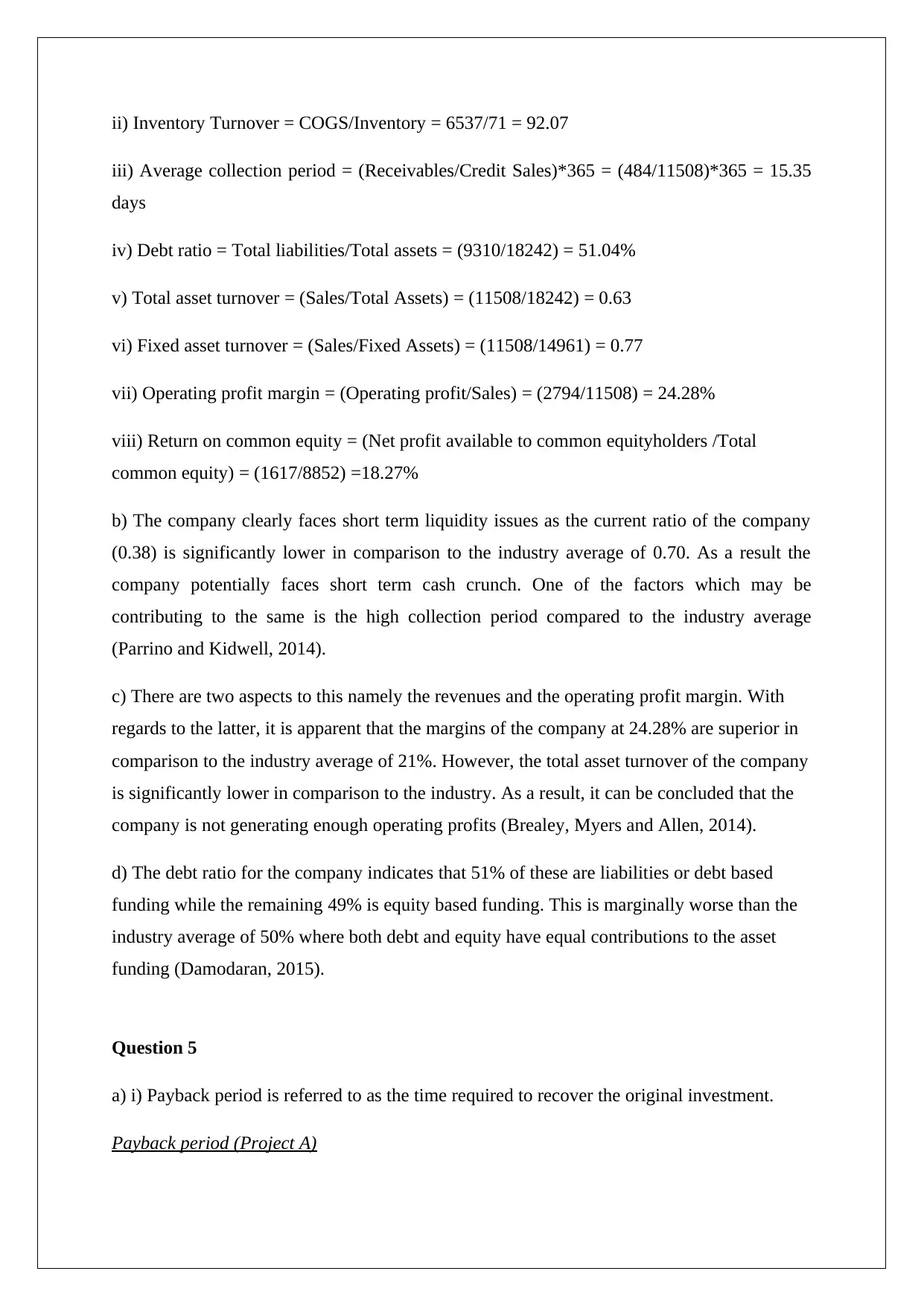
ii) Inventory Turnover = COGS/Inventory = 6537/71 = 92.07
iii) Average collection period = (Receivables/Credit Sales)*365 = (484/11508)*365 = 15.35
days
iv) Debt ratio = Total liabilities/Total assets = (9310/18242) = 51.04%
v) Total asset turnover = (Sales/Total Assets) = (11508/18242) = 0.63
vi) Fixed asset turnover = (Sales/Fixed Assets) = (11508/14961) = 0.77
vii) Operating profit margin = (Operating profit/Sales) = (2794/11508) = 24.28%
viii) Return on common equity = (Net profit available to common equityholders /Total
common equity) = (1617/8852) =18.27%
b) The company clearly faces short term liquidity issues as the current ratio of the company
(0.38) is significantly lower in comparison to the industry average of 0.70. As a result the
company potentially faces short term cash crunch. One of the factors which may be
contributing to the same is the high collection period compared to the industry average
(Parrino and Kidwell, 2014).
c) There are two aspects to this namely the revenues and the operating profit margin. With
regards to the latter, it is apparent that the margins of the company at 24.28% are superior in
comparison to the industry average of 21%. However, the total asset turnover of the company
is significantly lower in comparison to the industry. As a result, it can be concluded that the
company is not generating enough operating profits (Brealey, Myers and Allen, 2014).
d) The debt ratio for the company indicates that 51% of these are liabilities or debt based
funding while the remaining 49% is equity based funding. This is marginally worse than the
industry average of 50% where both debt and equity have equal contributions to the asset
funding (Damodaran, 2015).
Question 5
a) i) Payback period is referred to as the time required to recover the original investment.
Payback period (Project A)
iii) Average collection period = (Receivables/Credit Sales)*365 = (484/11508)*365 = 15.35
days
iv) Debt ratio = Total liabilities/Total assets = (9310/18242) = 51.04%
v) Total asset turnover = (Sales/Total Assets) = (11508/18242) = 0.63
vi) Fixed asset turnover = (Sales/Fixed Assets) = (11508/14961) = 0.77
vii) Operating profit margin = (Operating profit/Sales) = (2794/11508) = 24.28%
viii) Return on common equity = (Net profit available to common equityholders /Total
common equity) = (1617/8852) =18.27%
b) The company clearly faces short term liquidity issues as the current ratio of the company
(0.38) is significantly lower in comparison to the industry average of 0.70. As a result the
company potentially faces short term cash crunch. One of the factors which may be
contributing to the same is the high collection period compared to the industry average
(Parrino and Kidwell, 2014).
c) There are two aspects to this namely the revenues and the operating profit margin. With
regards to the latter, it is apparent that the margins of the company at 24.28% are superior in
comparison to the industry average of 21%. However, the total asset turnover of the company
is significantly lower in comparison to the industry. As a result, it can be concluded that the
company is not generating enough operating profits (Brealey, Myers and Allen, 2014).
d) The debt ratio for the company indicates that 51% of these are liabilities or debt based
funding while the remaining 49% is equity based funding. This is marginally worse than the
industry average of 50% where both debt and equity have equal contributions to the asset
funding (Damodaran, 2015).
Question 5
a) i) Payback period is referred to as the time required to recover the original investment.
Payback period (Project A)
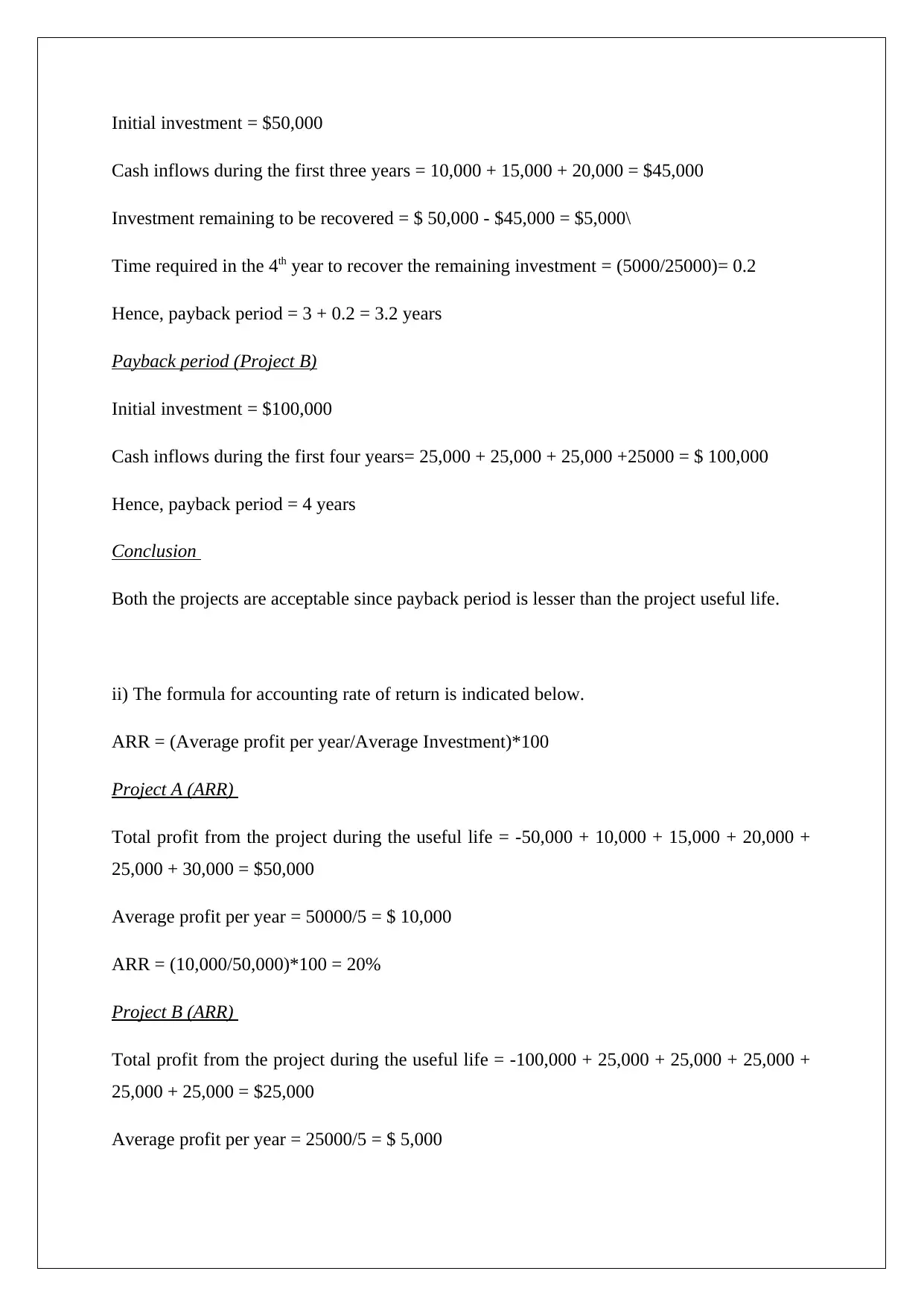
Initial investment = $50,000
Cash inflows during the first three years = 10,000 + 15,000 + 20,000 = $45,000
Investment remaining to be recovered = $ 50,000 - $45,000 = $5,000\
Time required in the 4th year to recover the remaining investment = (5000/25000)= 0.2
Hence, payback period = 3 + 0.2 = 3.2 years
Payback period (Project B)
Initial investment = $100,000
Cash inflows during the first four years= 25,000 + 25,000 + 25,000 +25000 = $ 100,000
Hence, payback period = 4 years
Conclusion
Both the projects are acceptable since payback period is lesser than the project useful life.
ii) The formula for accounting rate of return is indicated below.
ARR = (Average profit per year/Average Investment)*100
Project A (ARR)
Total profit from the project during the useful life = -50,000 + 10,000 + 15,000 + 20,000 +
25,000 + 30,000 = $50,000
Average profit per year = 50000/5 = $ 10,000
ARR = (10,000/50,000)*100 = 20%
Project B (ARR)
Total profit from the project during the useful life = -100,000 + 25,000 + 25,000 + 25,000 +
25,000 + 25,000 = $25,000
Average profit per year = 25000/5 = $ 5,000
Cash inflows during the first three years = 10,000 + 15,000 + 20,000 = $45,000
Investment remaining to be recovered = $ 50,000 - $45,000 = $5,000\
Time required in the 4th year to recover the remaining investment = (5000/25000)= 0.2
Hence, payback period = 3 + 0.2 = 3.2 years
Payback period (Project B)
Initial investment = $100,000
Cash inflows during the first four years= 25,000 + 25,000 + 25,000 +25000 = $ 100,000
Hence, payback period = 4 years
Conclusion
Both the projects are acceptable since payback period is lesser than the project useful life.
ii) The formula for accounting rate of return is indicated below.
ARR = (Average profit per year/Average Investment)*100
Project A (ARR)
Total profit from the project during the useful life = -50,000 + 10,000 + 15,000 + 20,000 +
25,000 + 30,000 = $50,000
Average profit per year = 50000/5 = $ 10,000
ARR = (10,000/50,000)*100 = 20%
Project B (ARR)
Total profit from the project during the useful life = -100,000 + 25,000 + 25,000 + 25,000 +
25,000 + 25,000 = $25,000
Average profit per year = 25000/5 = $ 5,000
⊘ This is a preview!⊘
Do you want full access?
Subscribe today to unlock all pages.
Trusted by 1+ million students worldwide
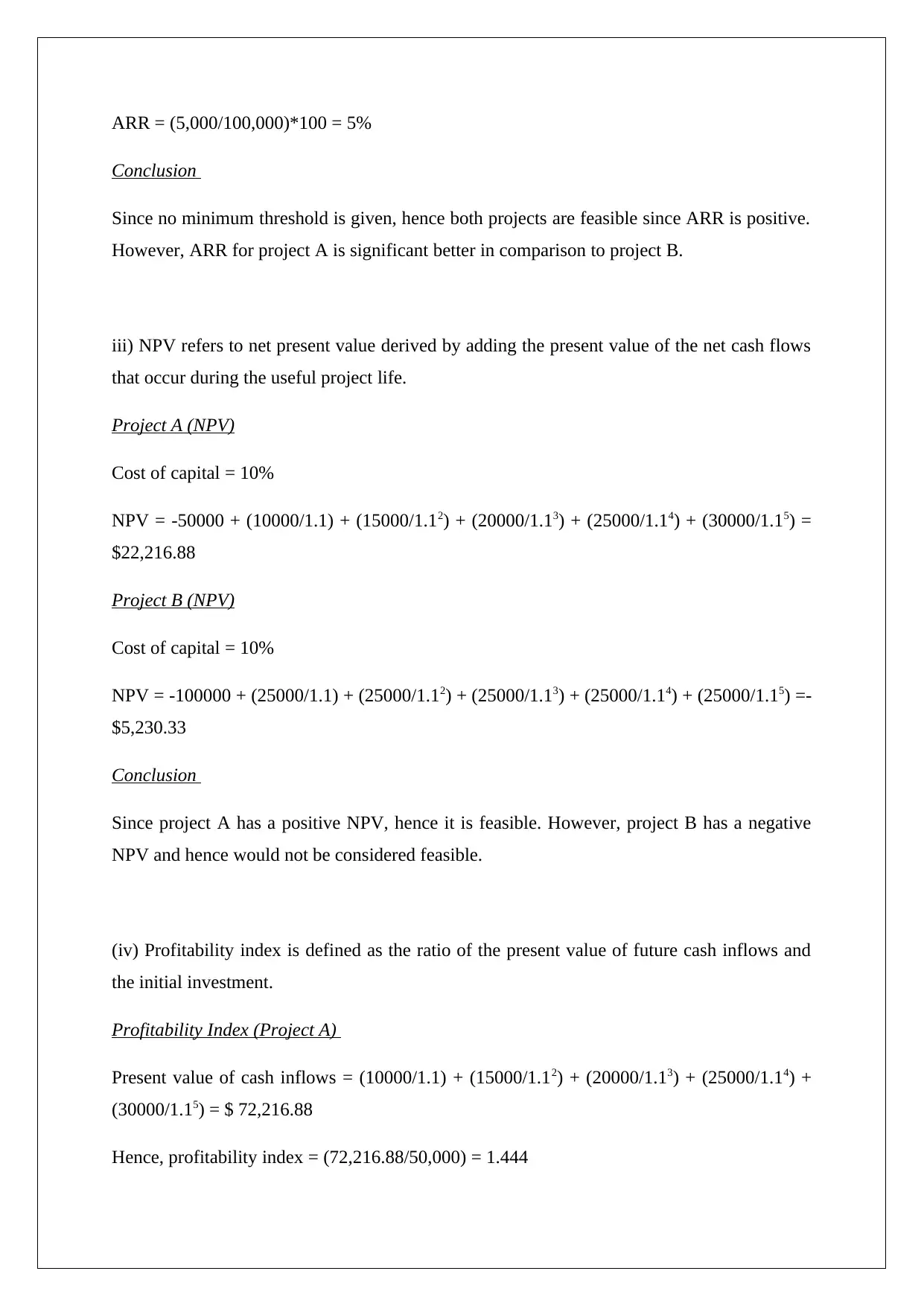
ARR = (5,000/100,000)*100 = 5%
Conclusion
Since no minimum threshold is given, hence both projects are feasible since ARR is positive.
However, ARR for project A is significant better in comparison to project B.
iii) NPV refers to net present value derived by adding the present value of the net cash flows
that occur during the useful project life.
Project A (NPV)
Cost of capital = 10%
NPV = -50000 + (10000/1.1) + (15000/1.12) + (20000/1.13) + (25000/1.14) + (30000/1.15) =
$22,216.88
Project B (NPV)
Cost of capital = 10%
NPV = -100000 + (25000/1.1) + (25000/1.12) + (25000/1.13) + (25000/1.14) + (25000/1.15) =-
$5,230.33
Conclusion
Since project A has a positive NPV, hence it is feasible. However, project B has a negative
NPV and hence would not be considered feasible.
(iv) Profitability index is defined as the ratio of the present value of future cash inflows and
the initial investment.
Profitability Index (Project A)
Present value of cash inflows = (10000/1.1) + (15000/1.12) + (20000/1.13) + (25000/1.14) +
(30000/1.15) = $ 72,216.88
Hence, profitability index = (72,216.88/50,000) = 1.444
Conclusion
Since no minimum threshold is given, hence both projects are feasible since ARR is positive.
However, ARR for project A is significant better in comparison to project B.
iii) NPV refers to net present value derived by adding the present value of the net cash flows
that occur during the useful project life.
Project A (NPV)
Cost of capital = 10%
NPV = -50000 + (10000/1.1) + (15000/1.12) + (20000/1.13) + (25000/1.14) + (30000/1.15) =
$22,216.88
Project B (NPV)
Cost of capital = 10%
NPV = -100000 + (25000/1.1) + (25000/1.12) + (25000/1.13) + (25000/1.14) + (25000/1.15) =-
$5,230.33
Conclusion
Since project A has a positive NPV, hence it is feasible. However, project B has a negative
NPV and hence would not be considered feasible.
(iv) Profitability index is defined as the ratio of the present value of future cash inflows and
the initial investment.
Profitability Index (Project A)
Present value of cash inflows = (10000/1.1) + (15000/1.12) + (20000/1.13) + (25000/1.14) +
(30000/1.15) = $ 72,216.88
Hence, profitability index = (72,216.88/50,000) = 1.444
Paraphrase This Document
Need a fresh take? Get an instant paraphrase of this document with our AI Paraphraser
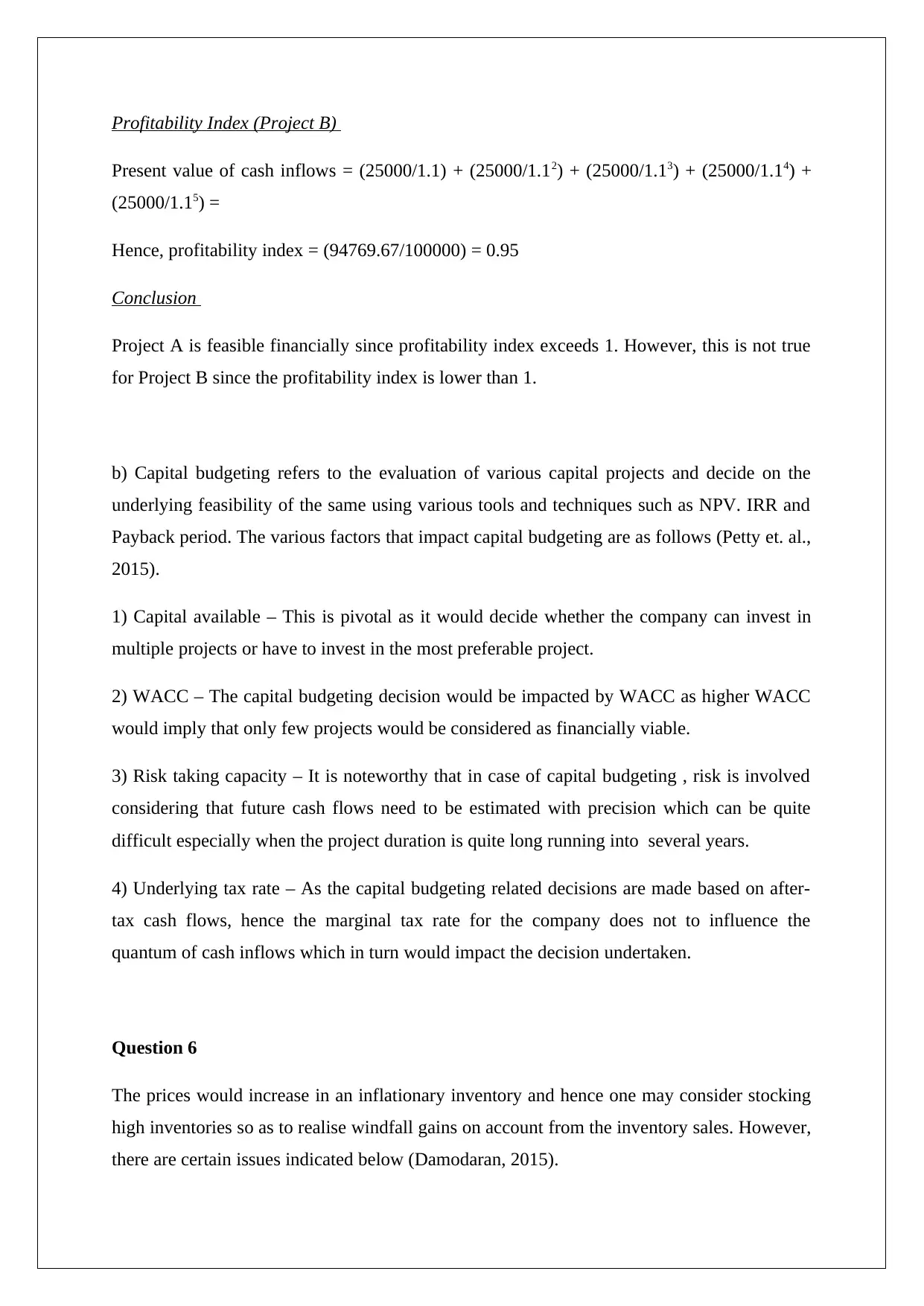
Profitability Index (Project B)
Present value of cash inflows = (25000/1.1) + (25000/1.12) + (25000/1.13) + (25000/1.14) +
(25000/1.15) =
Hence, profitability index = (94769.67/100000) = 0.95
Conclusion
Project A is feasible financially since profitability index exceeds 1. However, this is not true
for Project B since the profitability index is lower than 1.
b) Capital budgeting refers to the evaluation of various capital projects and decide on the
underlying feasibility of the same using various tools and techniques such as NPV. IRR and
Payback period. The various factors that impact capital budgeting are as follows (Petty et. al.,
2015).
1) Capital available – This is pivotal as it would decide whether the company can invest in
multiple projects or have to invest in the most preferable project.
2) WACC – The capital budgeting decision would be impacted by WACC as higher WACC
would imply that only few projects would be considered as financially viable.
3) Risk taking capacity – It is noteworthy that in case of capital budgeting , risk is involved
considering that future cash flows need to be estimated with precision which can be quite
difficult especially when the project duration is quite long running into several years.
4) Underlying tax rate – As the capital budgeting related decisions are made based on after-
tax cash flows, hence the marginal tax rate for the company does not to influence the
quantum of cash inflows which in turn would impact the decision undertaken.
Question 6
The prices would increase in an inflationary inventory and hence one may consider stocking
high inventories so as to realise windfall gains on account from the inventory sales. However,
there are certain issues indicated below (Damodaran, 2015).
Present value of cash inflows = (25000/1.1) + (25000/1.12) + (25000/1.13) + (25000/1.14) +
(25000/1.15) =
Hence, profitability index = (94769.67/100000) = 0.95
Conclusion
Project A is feasible financially since profitability index exceeds 1. However, this is not true
for Project B since the profitability index is lower than 1.
b) Capital budgeting refers to the evaluation of various capital projects and decide on the
underlying feasibility of the same using various tools and techniques such as NPV. IRR and
Payback period. The various factors that impact capital budgeting are as follows (Petty et. al.,
2015).
1) Capital available – This is pivotal as it would decide whether the company can invest in
multiple projects or have to invest in the most preferable project.
2) WACC – The capital budgeting decision would be impacted by WACC as higher WACC
would imply that only few projects would be considered as financially viable.
3) Risk taking capacity – It is noteworthy that in case of capital budgeting , risk is involved
considering that future cash flows need to be estimated with precision which can be quite
difficult especially when the project duration is quite long running into several years.
4) Underlying tax rate – As the capital budgeting related decisions are made based on after-
tax cash flows, hence the marginal tax rate for the company does not to influence the
quantum of cash inflows which in turn would impact the decision undertaken.
Question 6
The prices would increase in an inflationary inventory and hence one may consider stocking
high inventories so as to realise windfall gains on account from the inventory sales. However,
there are certain issues indicated below (Damodaran, 2015).
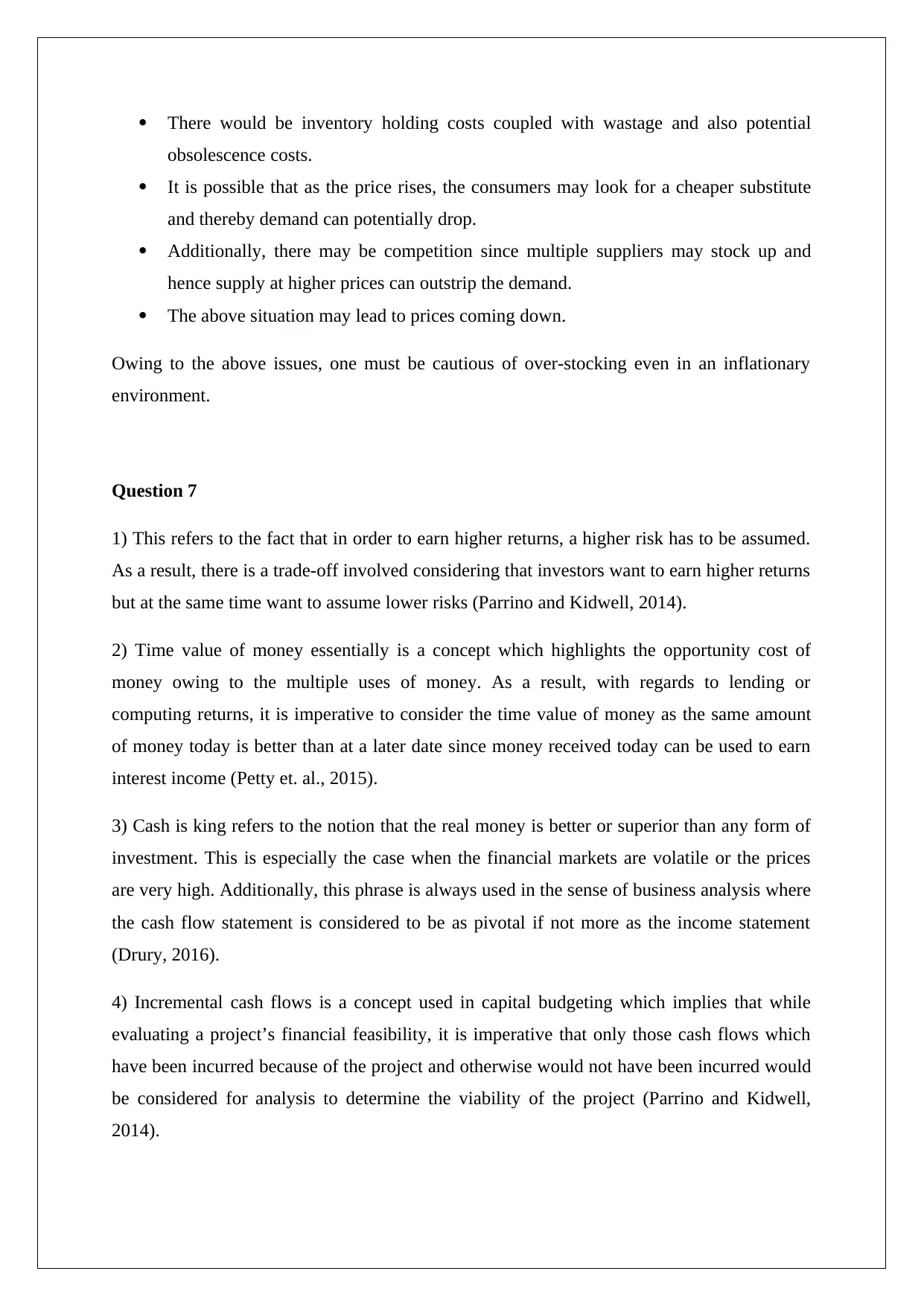
There would be inventory holding costs coupled with wastage and also potential
obsolescence costs.
It is possible that as the price rises, the consumers may look for a cheaper substitute
and thereby demand can potentially drop.
Additionally, there may be competition since multiple suppliers may stock up and
hence supply at higher prices can outstrip the demand.
The above situation may lead to prices coming down.
Owing to the above issues, one must be cautious of over-stocking even in an inflationary
environment.
Question 7
1) This refers to the fact that in order to earn higher returns, a higher risk has to be assumed.
As a result, there is a trade-off involved considering that investors want to earn higher returns
but at the same time want to assume lower risks (Parrino and Kidwell, 2014).
2) Time value of money essentially is a concept which highlights the opportunity cost of
money owing to the multiple uses of money. As a result, with regards to lending or
computing returns, it is imperative to consider the time value of money as the same amount
of money today is better than at a later date since money received today can be used to earn
interest income (Petty et. al., 2015).
3) Cash is king refers to the notion that the real money is better or superior than any form of
investment. This is especially the case when the financial markets are volatile or the prices
are very high. Additionally, this phrase is always used in the sense of business analysis where
the cash flow statement is considered to be as pivotal if not more as the income statement
(Drury, 2016).
4) Incremental cash flows is a concept used in capital budgeting which implies that while
evaluating a project’s financial feasibility, it is imperative that only those cash flows which
have been incurred because of the project and otherwise would not have been incurred would
be considered for analysis to determine the viability of the project (Parrino and Kidwell,
2014).
obsolescence costs.
It is possible that as the price rises, the consumers may look for a cheaper substitute
and thereby demand can potentially drop.
Additionally, there may be competition since multiple suppliers may stock up and
hence supply at higher prices can outstrip the demand.
The above situation may lead to prices coming down.
Owing to the above issues, one must be cautious of over-stocking even in an inflationary
environment.
Question 7
1) This refers to the fact that in order to earn higher returns, a higher risk has to be assumed.
As a result, there is a trade-off involved considering that investors want to earn higher returns
but at the same time want to assume lower risks (Parrino and Kidwell, 2014).
2) Time value of money essentially is a concept which highlights the opportunity cost of
money owing to the multiple uses of money. As a result, with regards to lending or
computing returns, it is imperative to consider the time value of money as the same amount
of money today is better than at a later date since money received today can be used to earn
interest income (Petty et. al., 2015).
3) Cash is king refers to the notion that the real money is better or superior than any form of
investment. This is especially the case when the financial markets are volatile or the prices
are very high. Additionally, this phrase is always used in the sense of business analysis where
the cash flow statement is considered to be as pivotal if not more as the income statement
(Drury, 2016).
4) Incremental cash flows is a concept used in capital budgeting which implies that while
evaluating a project’s financial feasibility, it is imperative that only those cash flows which
have been incurred because of the project and otherwise would not have been incurred would
be considered for analysis to determine the viability of the project (Parrino and Kidwell,
2014).
⊘ This is a preview!⊘
Do you want full access?
Subscribe today to unlock all pages.
Trusted by 1+ million students worldwide
5) The agency problem tends to refer to the difference in the interests of the shareholders and
those of the managers. This happens when ownership and management tend to be different.
As a result, there is fear that the management may serve their own interest at the cost of
company and shareholders and hence agency costs are incurred so as to lower this problem
(Brealey, Myers and Allen, 2014).
6) One of the key considerations with regards to business decisions tends to be taxes. A lot of
projects and activities are undertaken by the firms in order to minimise their tax outflow. A
key example of this is establishing of new manufacturing facility in states where lucrative
income tax rebate or tax holiday is available (Barkoczy, 2017).
7) This is essentially in the context of portfolio theory where it is possible to diversify the
diversifiable risk through the formation of a diversified portfolio. However, undiversifiable
risk would still remain with regards to the financial market. As a result, it would be incorrect
to assume each risk as the same as some of these may be mitigated while the others cannot
(Petty et. al., 2015).
8) There are dilemmas as doing the right thing may not lead to profit maximisation. Thus,
there is a need for code of ethics so as to focus on the means and not only the output. It is
imperative to highlight that only the output (higher profits) produced through proper means
would be rewarded and considered superior performance (Parrino and Kidwell, 2014).
9) The curse of the competitive markets is that in the long term the firm cannot earn profits
and profit earning is only possible in the short run. As a result, when a new player enters
when there is supply shortage, then profit is earned but with time, this is eroded as the firm
cannot differentiate from others despite being more experienced.
10) This concept was given by E. Fama who highlighted three forms of market efficiency i.e.
weak, semi-strong and strong. In an efficient market, the prices of financial instruments tend
to equal their intrinsic value. Also, the fundamental and technical analyses are not useful in
such a market. Besides, no market participant can consistently beat the efficient market in
returns (Damodarab, 2014).
those of the managers. This happens when ownership and management tend to be different.
As a result, there is fear that the management may serve their own interest at the cost of
company and shareholders and hence agency costs are incurred so as to lower this problem
(Brealey, Myers and Allen, 2014).
6) One of the key considerations with regards to business decisions tends to be taxes. A lot of
projects and activities are undertaken by the firms in order to minimise their tax outflow. A
key example of this is establishing of new manufacturing facility in states where lucrative
income tax rebate or tax holiday is available (Barkoczy, 2017).
7) This is essentially in the context of portfolio theory where it is possible to diversify the
diversifiable risk through the formation of a diversified portfolio. However, undiversifiable
risk would still remain with regards to the financial market. As a result, it would be incorrect
to assume each risk as the same as some of these may be mitigated while the others cannot
(Petty et. al., 2015).
8) There are dilemmas as doing the right thing may not lead to profit maximisation. Thus,
there is a need for code of ethics so as to focus on the means and not only the output. It is
imperative to highlight that only the output (higher profits) produced through proper means
would be rewarded and considered superior performance (Parrino and Kidwell, 2014).
9) The curse of the competitive markets is that in the long term the firm cannot earn profits
and profit earning is only possible in the short run. As a result, when a new player enters
when there is supply shortage, then profit is earned but with time, this is eroded as the firm
cannot differentiate from others despite being more experienced.
10) This concept was given by E. Fama who highlighted three forms of market efficiency i.e.
weak, semi-strong and strong. In an efficient market, the prices of financial instruments tend
to equal their intrinsic value. Also, the fundamental and technical analyses are not useful in
such a market. Besides, no market participant can consistently beat the efficient market in
returns (Damodarab, 2014).
Paraphrase This Document
Need a fresh take? Get an instant paraphrase of this document with our AI Paraphraser
References
Barkoczy, S. (2017) Foundation of Taxation Law 2017. 9th ed. Sydney: Oxford University
Press.
Brealey, R. A., Myers, S. C. and Allen, F. (2014) Principles of corporate finance, 6th ed. New
York: McGraw-Hill Publications
Damodaran, A. (2015). Applied corporate finance: A user’s manual 3rd ed. New York:
Wiley, John & Sons.
Drury, C. (2016) Cost and Management Accounting: An Introduction. 6th ed. New York:
Cengage Learning
Parrino, R. and Kidwell, D. (2014) Fundamentals of Corporate Finance, 3rd ed. London:
Wiley Publications
Petty, J.W., Titman, S., Keown, A., Martin, J.D., Martin, P., Burrow, M. and Nguyen, H. (2015).
Financial Management, Principles and Applications, 6th ed.. NSW: Pearson Education, French
Forest Australia
Barkoczy, S. (2017) Foundation of Taxation Law 2017. 9th ed. Sydney: Oxford University
Press.
Brealey, R. A., Myers, S. C. and Allen, F. (2014) Principles of corporate finance, 6th ed. New
York: McGraw-Hill Publications
Damodaran, A. (2015). Applied corporate finance: A user’s manual 3rd ed. New York:
Wiley, John & Sons.
Drury, C. (2016) Cost and Management Accounting: An Introduction. 6th ed. New York:
Cengage Learning
Parrino, R. and Kidwell, D. (2014) Fundamentals of Corporate Finance, 3rd ed. London:
Wiley Publications
Petty, J.W., Titman, S., Keown, A., Martin, J.D., Martin, P., Burrow, M. and Nguyen, H. (2015).
Financial Management, Principles and Applications, 6th ed.. NSW: Pearson Education, French
Forest Australia

1 out of 11


Related Documents


Your All-in-One AI-Powered Toolkit for Academic Success.
+13062052269
info@desklib.com
Available 24*7 on WhatsApp / Email
![[object Object]](/_next/static/media/star-bottom.7253800d.svg)
Unlock your academic potential
Copyright © 2020–2026 A2Z Services. All Rights Reserved. Developed and managed by ZUCOL.