BSBFIM501: Comprehensive Analysis of Financial Management Strategies
VerifiedAdded on 2022/12/15
|19
|4269
|28
Homework Assignment
AI Summary
This document presents a comprehensive solution to an assignment focused on financial management and budgeting, specifically addressing the unit BSBFIM501. The assignment encompasses several key areas of financial planning and analysis. It begins with a detailed overview of fundamental accounting principles, including double-entry accounting, the accounting entity convention, and the accrual principle. It then explores the accounting equation, relevant Australian legislation such as the Income Tax Assessment Act and the Superannuation Act, and the roles of various entities in relation to taxation, including BAS submissions and record-keeping requirements. Furthermore, the solution provides insights into budgeting processes, including budget development steps, cash flow management techniques, and the use of spreadsheets for financial record-keeping. The document also delves into the application of GST, the relationship between journals and ledgers, and the interpretation of financial statements such as the balance sheet, income statement, and cash flow statement. It includes a review of financial documents like profit and loss statements and cash flow statements, and provides a revised marketing budget. Finally, the assignment includes a risk assessment, identifying potential business risks like data security breaches and the inability to meet customization demands, along with mitigation strategies and contingency plans.
BSBFIM501 MANAGE
BUDGETS AND
FINANCIAL PLANS
BUDGETS AND
FINANCIAL PLANS

Paraphrase This Document
Need a fresh take? Get an instant paraphrase of this document with our AI Paraphraser
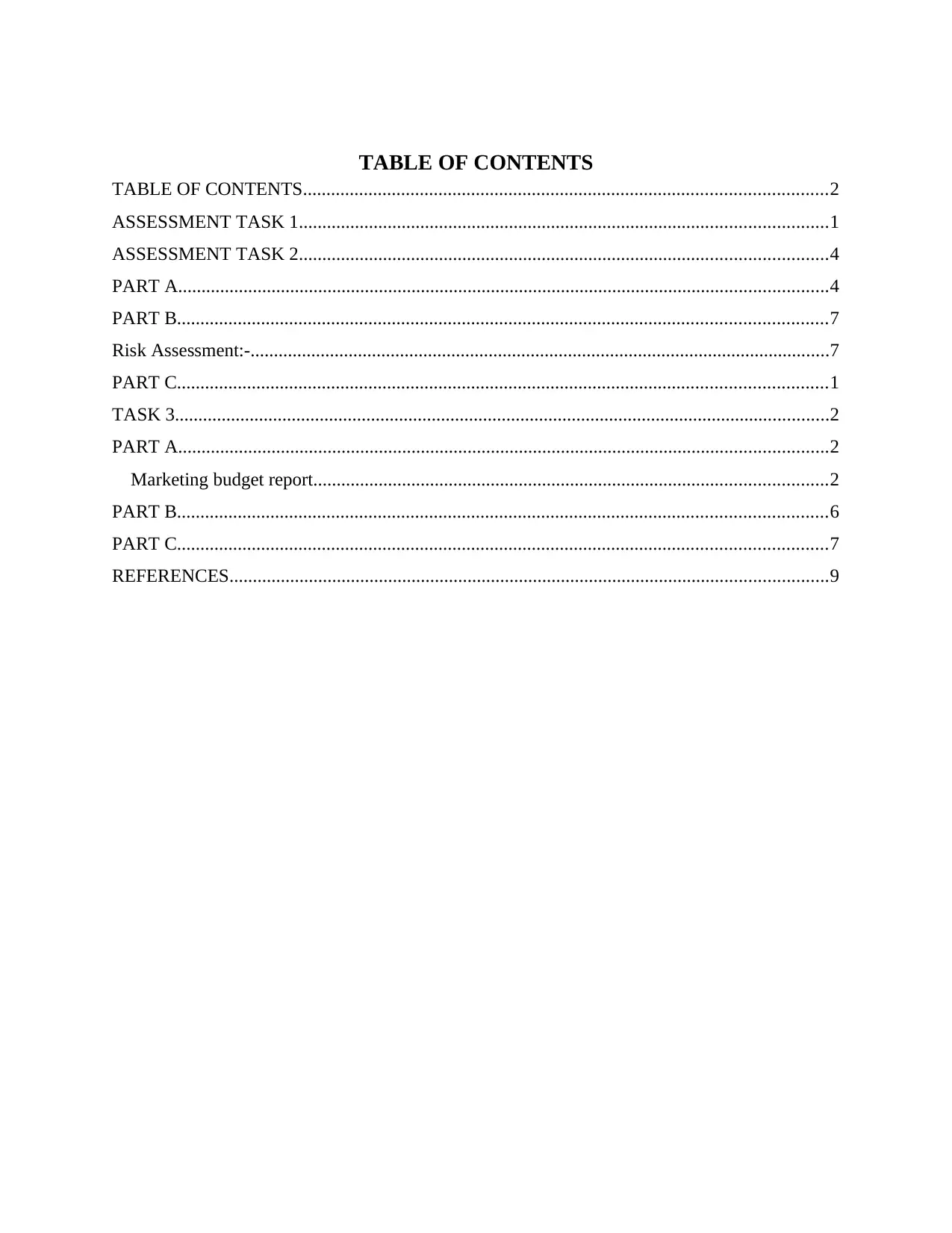
TABLE OF CONTENTS
TABLE OF CONTENTS................................................................................................................2
ASSESSMENT TASK 1.................................................................................................................1
ASSESSMENT TASK 2.................................................................................................................4
PART A...........................................................................................................................................4
PART B...........................................................................................................................................7
Risk Assessment:-............................................................................................................................7
PART C...........................................................................................................................................1
TASK 3............................................................................................................................................2
PART A...........................................................................................................................................2
Marketing budget report..............................................................................................................2
PART B...........................................................................................................................................6
PART C...........................................................................................................................................7
REFERENCES................................................................................................................................9
TABLE OF CONTENTS................................................................................................................2
ASSESSMENT TASK 1.................................................................................................................1
ASSESSMENT TASK 2.................................................................................................................4
PART A...........................................................................................................................................4
PART B...........................................................................................................................................7
Risk Assessment:-............................................................................................................................7
PART C...........................................................................................................................................1
TASK 3............................................................................................................................................2
PART A...........................................................................................................................................2
Marketing budget report..............................................................................................................2
PART B...........................................................................................................................................6
PART C...........................................................................................................................................7
REFERENCES................................................................................................................................9
ASSESSMENT TASK 1
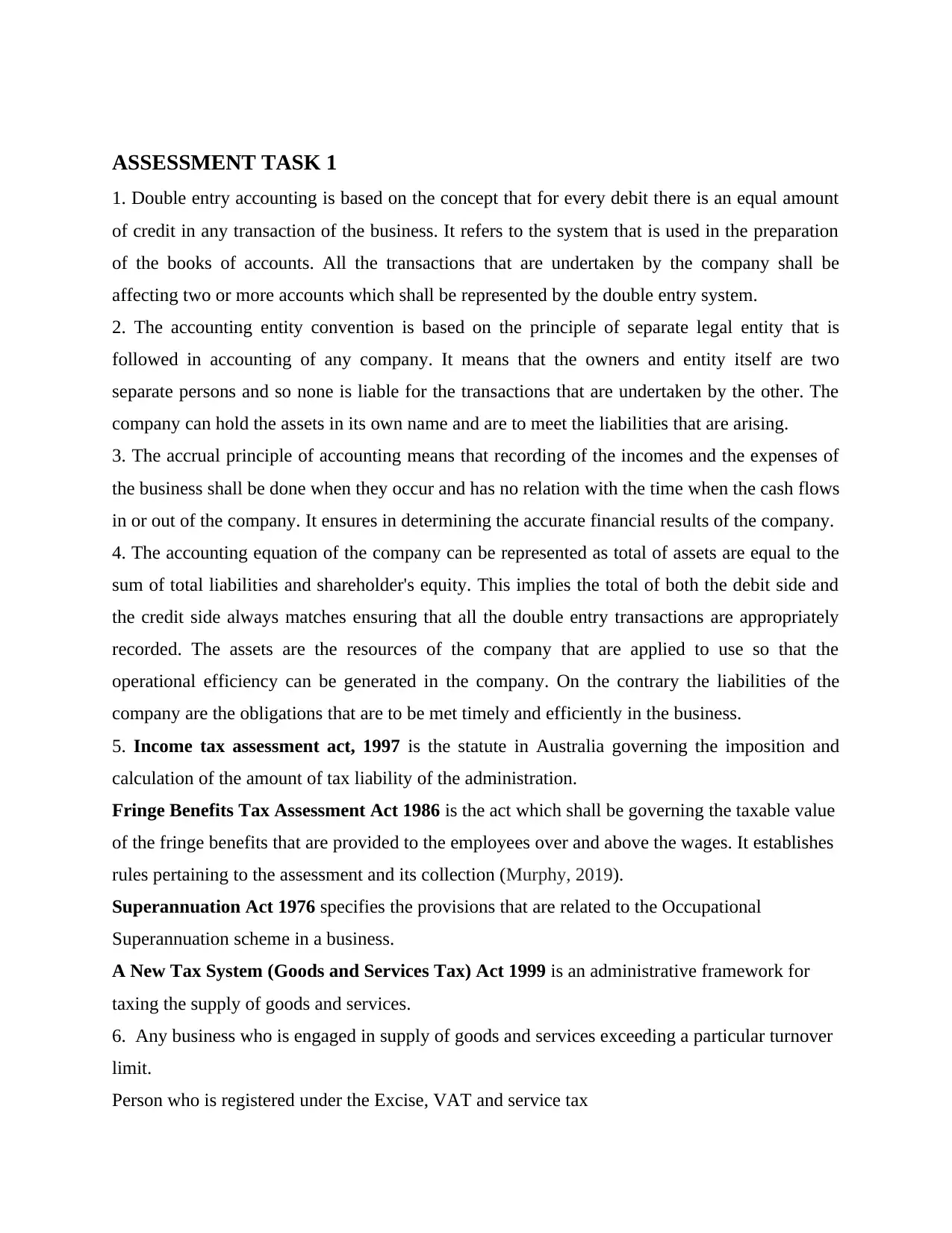
1. Double entry accounting is based on the concept that for every debit there is an equal amount
of credit in any transaction of the business. It refers to the system that is used in the preparation
of the books of accounts. All the transactions that are undertaken by the company shall be
affecting two or more accounts which shall be represented by the double entry system.
2. The accounting entity convention is based on the principle of separate legal entity that is
followed in accounting of any company. It means that the owners and entity itself are two
separate persons and so none is liable for the transactions that are undertaken by the other. The
company can hold the assets in its own name and are to meet the liabilities that are arising.
3. The accrual principle of accounting means that recording of the incomes and the expenses of
the business shall be done when they occur and has no relation with the time when the cash flows
in or out of the company. It ensures in determining the accurate financial results of the company.
4. The accounting equation of the company can be represented as total of assets are equal to the
sum of total liabilities and shareholder's equity. This implies the total of both the debit side and
the credit side always matches ensuring that all the double entry transactions are appropriately
recorded. The assets are the resources of the company that are applied to use so that the
operational efficiency can be generated in the company. On the contrary the liabilities of the
company are the obligations that are to be met timely and efficiently in the business.
5. Income tax assessment act, 1997 is the statute in Australia governing the imposition and
calculation of the amount of tax liability of the administration.
Fringe Benefits Tax Assessment Act 1986 is the act which shall be governing the taxable value
of the fringe benefits that are provided to the employees over and above the wages. It establishes
rules pertaining to the assessment and its collection (Murphy, 2019).
Superannuation Act 1976 specifies the provisions that are related to the Occupational
Superannuation scheme in a business.
A New Tax System (Goods and Services Tax) Act 1999 is an administrative framework for
taxing the supply of goods and services.
6. Any business who is engaged in supply of goods and services exceeding a particular turnover
limit.
Person who is registered under the Excise, VAT and service tax
1. Double entry accounting is based on the concept that for every debit there is an equal amount
of credit in any transaction of the business. It refers to the system that is used in the preparation
of the books of accounts. All the transactions that are undertaken by the company shall be
affecting two or more accounts which shall be represented by the double entry system.
2. The accounting entity convention is based on the principle of separate legal entity that is
followed in accounting of any company. It means that the owners and entity itself are two
separate persons and so none is liable for the transactions that are undertaken by the other. The
company can hold the assets in its own name and are to meet the liabilities that are arising.
3. The accrual principle of accounting means that recording of the incomes and the expenses of
the business shall be done when they occur and has no relation with the time when the cash flows
in or out of the company. It ensures in determining the accurate financial results of the company.
4. The accounting equation of the company can be represented as total of assets are equal to the
sum of total liabilities and shareholder's equity. This implies the total of both the debit side and
the credit side always matches ensuring that all the double entry transactions are appropriately
recorded. The assets are the resources of the company that are applied to use so that the
operational efficiency can be generated in the company. On the contrary the liabilities of the
company are the obligations that are to be met timely and efficiently in the business.
5. Income tax assessment act, 1997 is the statute in Australia governing the imposition and
calculation of the amount of tax liability of the administration.
Fringe Benefits Tax Assessment Act 1986 is the act which shall be governing the taxable value
of the fringe benefits that are provided to the employees over and above the wages. It establishes
rules pertaining to the assessment and its collection (Murphy, 2019).
Superannuation Act 1976 specifies the provisions that are related to the Occupational
Superannuation scheme in a business.
A New Tax System (Goods and Services Tax) Act 1999 is an administrative framework for
taxing the supply of goods and services.
6. Any business who is engaged in supply of goods and services exceeding a particular turnover
limit.
Person who is registered under the Excise, VAT and service tax
⊘ This is a preview!⊘
Do you want full access?
Subscribe today to unlock all pages.

Trusted by 1+ million students worldwide
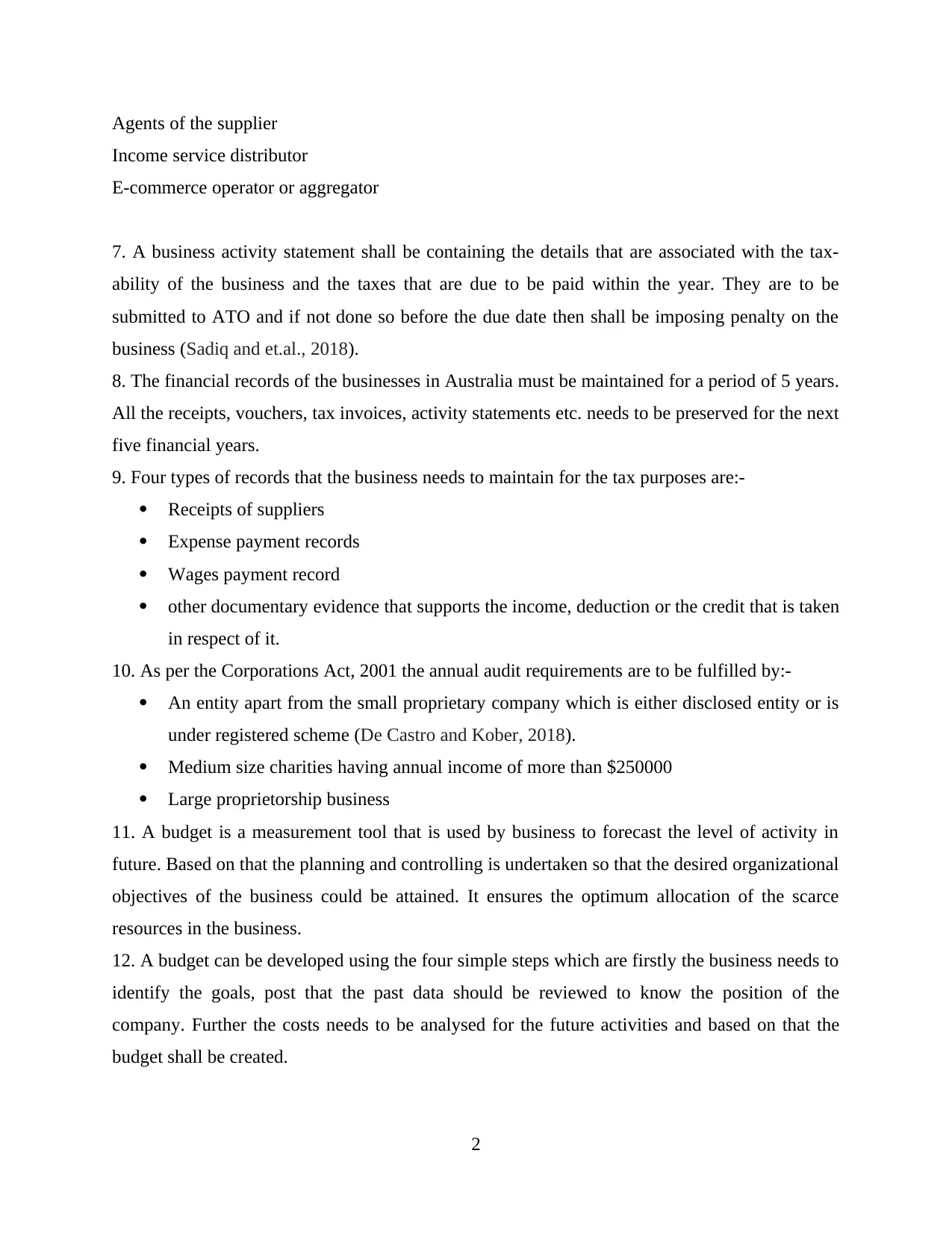
Agents of the supplier
Income service distributor
E-commerce operator or aggregator
7. A business activity statement shall be containing the details that are associated with the tax-
ability of the business and the taxes that are due to be paid within the year. They are to be
submitted to ATO and if not done so before the due date then shall be imposing penalty on the
business (Sadiq and et.al., 2018).
8. The financial records of the businesses in Australia must be maintained for a period of 5 years.
All the receipts, vouchers, tax invoices, activity statements etc. needs to be preserved for the next
five financial years.
9. Four types of records that the business needs to maintain for the tax purposes are:-
Receipts of suppliers
Expense payment records
Wages payment record
other documentary evidence that supports the income, deduction or the credit that is taken
in respect of it.
10. As per the Corporations Act, 2001 the annual audit requirements are to be fulfilled by:-
An entity apart from the small proprietary company which is either disclosed entity or is
under registered scheme (De Castro and Kober, 2018).
Medium size charities having annual income of more than $250000
Large proprietorship business
11. A budget is a measurement tool that is used by business to forecast the level of activity in
future. Based on that the planning and controlling is undertaken so that the desired organizational
objectives of the business could be attained. It ensures the optimum allocation of the scarce
resources in the business.
12. A budget can be developed using the four simple steps which are firstly the business needs to
identify the goals, post that the past data should be reviewed to know the position of the
company. Further the costs needs to be analysed for the future activities and based on that the
budget shall be created.
2
Income service distributor
E-commerce operator or aggregator
7. A business activity statement shall be containing the details that are associated with the tax-
ability of the business and the taxes that are due to be paid within the year. They are to be
submitted to ATO and if not done so before the due date then shall be imposing penalty on the
business (Sadiq and et.al., 2018).
8. The financial records of the businesses in Australia must be maintained for a period of 5 years.
All the receipts, vouchers, tax invoices, activity statements etc. needs to be preserved for the next
five financial years.
9. Four types of records that the business needs to maintain for the tax purposes are:-
Receipts of suppliers
Expense payment records
Wages payment record
other documentary evidence that supports the income, deduction or the credit that is taken
in respect of it.
10. As per the Corporations Act, 2001 the annual audit requirements are to be fulfilled by:-
An entity apart from the small proprietary company which is either disclosed entity or is
under registered scheme (De Castro and Kober, 2018).
Medium size charities having annual income of more than $250000
Large proprietorship business
11. A budget is a measurement tool that is used by business to forecast the level of activity in
future. Based on that the planning and controlling is undertaken so that the desired organizational
objectives of the business could be attained. It ensures the optimum allocation of the scarce
resources in the business.
12. A budget can be developed using the four simple steps which are firstly the business needs to
identify the goals, post that the past data should be reviewed to know the position of the
company. Further the costs needs to be analysed for the future activities and based on that the
budget shall be created.
2
Paraphrase This Document
Need a fresh take? Get an instant paraphrase of this document with our AI Paraphraser
13. A cash flow statement is a financial statement that is used to represent the amount of cash
inflow and outflow during the year. It shows the liquidity position of the business and the
availability of cash balances to meet the short term liabilities and obligations of the business.
They consider all the transactions that either increase or decrease the cash and cash equivalents
in the company.
14. Three techniques to improve the cash flow of the business:-
Through providing discounts to the customers in order to receive early payments.
Improve the inventory levels of the company and not blocking the funds in maintaining
the excess inventory.
Extend the credit period from the suppliers of the company.
15. Spreadsheets also known as the excel worksheet is a computerized analogs that is used to
manage the financial records of the company. The data is entered in the unit called cells and
formulas are entered to perform the numerical functions in the sheet. It has automatic
calculations which helps in the preparation of the financial statements in the company (Killaly,
2017).
16. The GST rate of 10% is applicable on all the goods and services that are sold or consumed in
Australia. It implies that the supplier has to collect one-eleventh amount from the customers that
shall be paid to the Australian Taxation office (ATO).
17. The journal and ledger are the primary books of accounts where journal is prepared prior
where all the entries are recorded. It is the original source of information for the company. From
the journal the data is posted into the ledger accounts. These are the individual accounts whose
balance shall be used in the preparation of the income statement and the balance sheet.
18. Balance sheet of the company is used to represent the financial position for a particular
financial year. It accounts for all the assets that are held and the liabilities that are to be
undertaken by the company.
Income statement of the company shall be showing the profitability of the business by stating all
the incomes and expenses that are undertaken by the company in a particular financial year.
Cash flow statement of the company shall be showing the inflows and the outflows of the cash
during the financial year. It shall be showing the liquidity position of the company and the ability
to meet the short term obligations of the company.
3
inflow and outflow during the year. It shows the liquidity position of the business and the
availability of cash balances to meet the short term liabilities and obligations of the business.
They consider all the transactions that either increase or decrease the cash and cash equivalents
in the company.
14. Three techniques to improve the cash flow of the business:-
Through providing discounts to the customers in order to receive early payments.
Improve the inventory levels of the company and not blocking the funds in maintaining
the excess inventory.
Extend the credit period from the suppliers of the company.
15. Spreadsheets also known as the excel worksheet is a computerized analogs that is used to
manage the financial records of the company. The data is entered in the unit called cells and
formulas are entered to perform the numerical functions in the sheet. It has automatic
calculations which helps in the preparation of the financial statements in the company (Killaly,
2017).
16. The GST rate of 10% is applicable on all the goods and services that are sold or consumed in
Australia. It implies that the supplier has to collect one-eleventh amount from the customers that
shall be paid to the Australian Taxation office (ATO).
17. The journal and ledger are the primary books of accounts where journal is prepared prior
where all the entries are recorded. It is the original source of information for the company. From
the journal the data is posted into the ledger accounts. These are the individual accounts whose
balance shall be used in the preparation of the income statement and the balance sheet.
18. Balance sheet of the company is used to represent the financial position for a particular
financial year. It accounts for all the assets that are held and the liabilities that are to be
undertaken by the company.
Income statement of the company shall be showing the profitability of the business by stating all
the incomes and expenses that are undertaken by the company in a particular financial year.
Cash flow statement of the company shall be showing the inflows and the outflows of the cash
during the financial year. It shall be showing the liquidity position of the company and the ability
to meet the short term obligations of the company.
3
19. The cost of goods sold is calculated by the business by adding up the opening stock and the
amount of purchases. From that the closing inventory level is subtracted which derives the
amount of cost of goods sold by the company. The figure is represented in the profit and loss
account of the company.
ASSESSMENT TASK 2
PART A
Review of Financial Documents:
1. Profit and Loss Statement (Yearly)
From the profit and loss statement, the yearly income, cost of goods sold, expenses and
net income of the business are $3585000, $20,000, $3,565,000 and $2,851,000 respectively. In
addition, the over budget of the yearly marketing budget of $39,230 is significant reducing
expenses in order to attain greater net income as the current expenses made up more than half of
the income. Through the way of implementation of the right and effective strategy will help in
minimizing the business expenses along with the marketing expenditure resulting into
minimizing the marketing budget and increasing the net income of the business. The profit and
loss statement estimates an organization's monetary presentation, like incomes, costs, benefits, or
misfortunes throughout a particular timeframe. This monetary archive is now and then called a
proclamation of monetary execution. The profit and loss statement shows whether an
organization made a benefit, and an income articulation shows whether an organization created
cash.
2. Cash Flow Statement
The ending balance of the cash flow statement indicates that the company would be
generating sufficient amount of cash for supporting its business operations. The cash inflows
mainly come from the cash receipt from the debtors, which can be unstable due to different
payment terms and payment habits of the customers (Cash Flow Statement vs. Income Statement:
What's the Difference? 2020). A marketing strategy can make successive leads and convey more
noteworthy change for individuals requiring your administrations or items. This first and
foremost requires a comprehension of your business' outer partners practices, necessities,
objectives and insights. With a more full comprehension of your computerized advertising
methodology, a steady brand message can build transformations on the web and disconnected.
4
amount of purchases. From that the closing inventory level is subtracted which derives the
amount of cost of goods sold by the company. The figure is represented in the profit and loss
account of the company.
ASSESSMENT TASK 2
PART A
Review of Financial Documents:
1. Profit and Loss Statement (Yearly)
From the profit and loss statement, the yearly income, cost of goods sold, expenses and
net income of the business are $3585000, $20,000, $3,565,000 and $2,851,000 respectively. In
addition, the over budget of the yearly marketing budget of $39,230 is significant reducing
expenses in order to attain greater net income as the current expenses made up more than half of
the income. Through the way of implementation of the right and effective strategy will help in
minimizing the business expenses along with the marketing expenditure resulting into
minimizing the marketing budget and increasing the net income of the business. The profit and
loss statement estimates an organization's monetary presentation, like incomes, costs, benefits, or
misfortunes throughout a particular timeframe. This monetary archive is now and then called a
proclamation of monetary execution. The profit and loss statement shows whether an
organization made a benefit, and an income articulation shows whether an organization created
cash.
2. Cash Flow Statement
The ending balance of the cash flow statement indicates that the company would be
generating sufficient amount of cash for supporting its business operations. The cash inflows
mainly come from the cash receipt from the debtors, which can be unstable due to different
payment terms and payment habits of the customers (Cash Flow Statement vs. Income Statement:
What's the Difference? 2020). A marketing strategy can make successive leads and convey more
noteworthy change for individuals requiring your administrations or items. This first and
foremost requires a comprehension of your business' outer partners practices, necessities,
objectives and insights. With a more full comprehension of your computerized advertising
methodology, a steady brand message can build transformations on the web and disconnected.
4
⊘ This is a preview!⊘
Do you want full access?
Subscribe today to unlock all pages.
Trusted by 1+ million students worldwide
Therefore, marketing expenses on budget is essential in helping the organisation to main healthy
cash flow. The cash flow statement shows the specific measure of an organization's money
inflows and outpourings, either month to month, quarterly, or every year. It catches the current
working outcomes and changes on the monetary record, for example, increments or diminishes
in money due or creditor liabilities, and does exclude noncash bookkeeping things like
devaluation and amortization.
The profit and loss statement and cash flow statement are fundamental pieces of a
corporate asset report. The income proclamation or explanation of incomes estimates the
wellsprings of an organization's money and its employments of money throughout a particular
timeframe.
Revision of Marketing Budget Based on Negotiations:
After negotiating, following is the change in the marketing budget which is being done in order
to reduce the marketing budget to $100,000. It can be clearly seen in the below budget, there has
been a change in the price of the various marketing techniques and approach which will help cost
effectively meeting with the desired outcome of the company. This change in amount can be
compared with the budgeted one in order to measure the change in terms of amount or
percentage and its impact over the expenditure and net income of the company. This will result
into betterment and enhancement in the performance of the company leading to implementing
better and effective marketing strategies.
Marketing Budget
Complete Business Solutions Australia (CBSA) Pty Ltd
For the year ending 2020, accrual basis
Campaign type
Advertising
Website banner ads $2,500.00
Newspaper $3,000.00
Radio $10,000.00
Television $30,000.00
5
cash flow. The cash flow statement shows the specific measure of an organization's money
inflows and outpourings, either month to month, quarterly, or every year. It catches the current
working outcomes and changes on the monetary record, for example, increments or diminishes
in money due or creditor liabilities, and does exclude noncash bookkeeping things like
devaluation and amortization.
The profit and loss statement and cash flow statement are fundamental pieces of a
corporate asset report. The income proclamation or explanation of incomes estimates the
wellsprings of an organization's money and its employments of money throughout a particular
timeframe.
Revision of Marketing Budget Based on Negotiations:
After negotiating, following is the change in the marketing budget which is being done in order
to reduce the marketing budget to $100,000. It can be clearly seen in the below budget, there has
been a change in the price of the various marketing techniques and approach which will help cost
effectively meeting with the desired outcome of the company. This change in amount can be
compared with the budgeted one in order to measure the change in terms of amount or
percentage and its impact over the expenditure and net income of the company. This will result
into betterment and enhancement in the performance of the company leading to implementing
better and effective marketing strategies.
Marketing Budget
Complete Business Solutions Australia (CBSA) Pty Ltd
For the year ending 2020, accrual basis
Campaign type
Advertising
Website banner ads $2,500.00
Newspaper $3,000.00
Radio $10,000.00
Television $30,000.00
5
Paraphrase This Document
Need a fresh take? Get an instant paraphrase of this document with our AI Paraphraser
Sub-total: $45,500.00
Web
Website $8,000.00
Email newsletter $800.00
Sub-total: $8,800.00
Social media
Facebook $600.00
Twitter $280.00
Instagram $300.00
LinkedIn $450.00
Sub-total: $1,630.00
Public relations
Sponsorship $8,500.00
Public events $14,070.00
Sub-total: $22,570.00
Sales campaign
Winter campaign $12,000.00
Summer campaign $9,500.00
Sub-total: $21,500.00
Marketing budget total: $100,000.00
6
Web
Website $8,000.00
Email newsletter $800.00
Sub-total: $8,800.00
Social media
Facebook $600.00
Twitter $280.00
Instagram $300.00
LinkedIn $450.00
Sub-total: $1,630.00
Public relations
Sponsorship $8,500.00
Public events $14,070.00
Sub-total: $22,570.00
Sales campaign
Winter campaign $12,000.00
Summer campaign $9,500.00
Sub-total: $21,500.00
Marketing budget total: $100,000.00
6
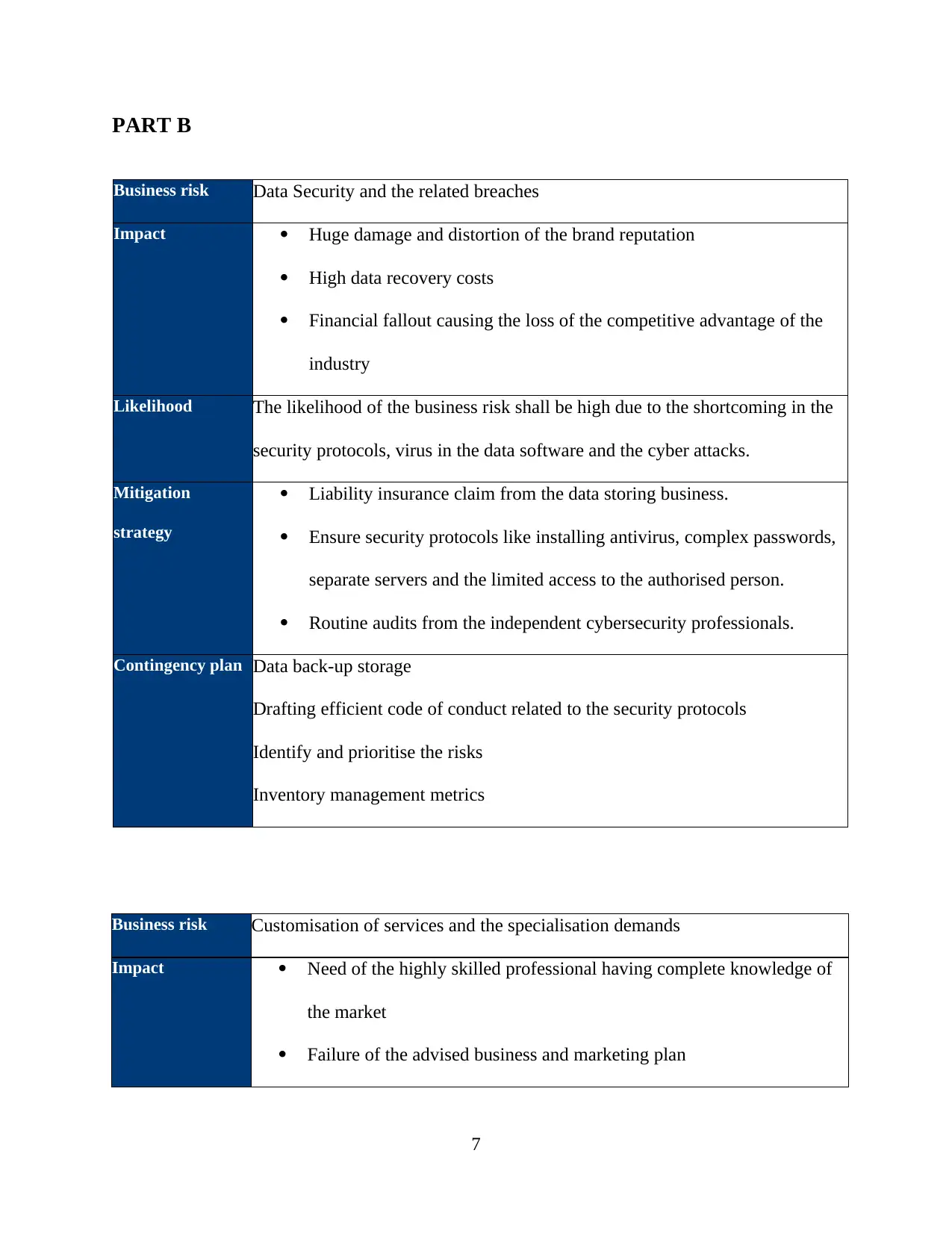
PART B
Risk Assessment:-
Business risk Data Security and the related breaches
Impact Huge damage and distortion of the brand reputation
High data recovery costs
Financial fallout causing the loss of the competitive advantage of the
industry
Likelihood The likelihood of the business risk shall be high due to the shortcoming in the
security protocols, virus in the data software and the cyber attacks.
Mitigation
strategy
Liability insurance claim from the data storing business.
Ensure security protocols like installing antivirus, complex passwords,
separate servers and the limited access to the authorised person.
Routine audits from the independent cybersecurity professionals.
Contingency plan Data back-up storage
Drafting efficient code of conduct related to the security protocols
Identify and prioritise the risks
Inventory management metrics
Business risk Customisation of services and the specialisation demands
Impact Need of the highly skilled professional having complete knowledge of
the market
Failure of the advised business and marketing plan
7
Risk Assessment:-
Business risk Data Security and the related breaches
Impact Huge damage and distortion of the brand reputation
High data recovery costs
Financial fallout causing the loss of the competitive advantage of the
industry
Likelihood The likelihood of the business risk shall be high due to the shortcoming in the
security protocols, virus in the data software and the cyber attacks.
Mitigation
strategy
Liability insurance claim from the data storing business.
Ensure security protocols like installing antivirus, complex passwords,
separate servers and the limited access to the authorised person.
Routine audits from the independent cybersecurity professionals.
Contingency plan Data back-up storage
Drafting efficient code of conduct related to the security protocols
Identify and prioritise the risks
Inventory management metrics
Business risk Customisation of services and the specialisation demands
Impact Need of the highly skilled professional having complete knowledge of
the market
Failure of the advised business and marketing plan
7
⊘ This is a preview!⊘
Do you want full access?
Subscribe today to unlock all pages.
Trusted by 1+ million students worldwide
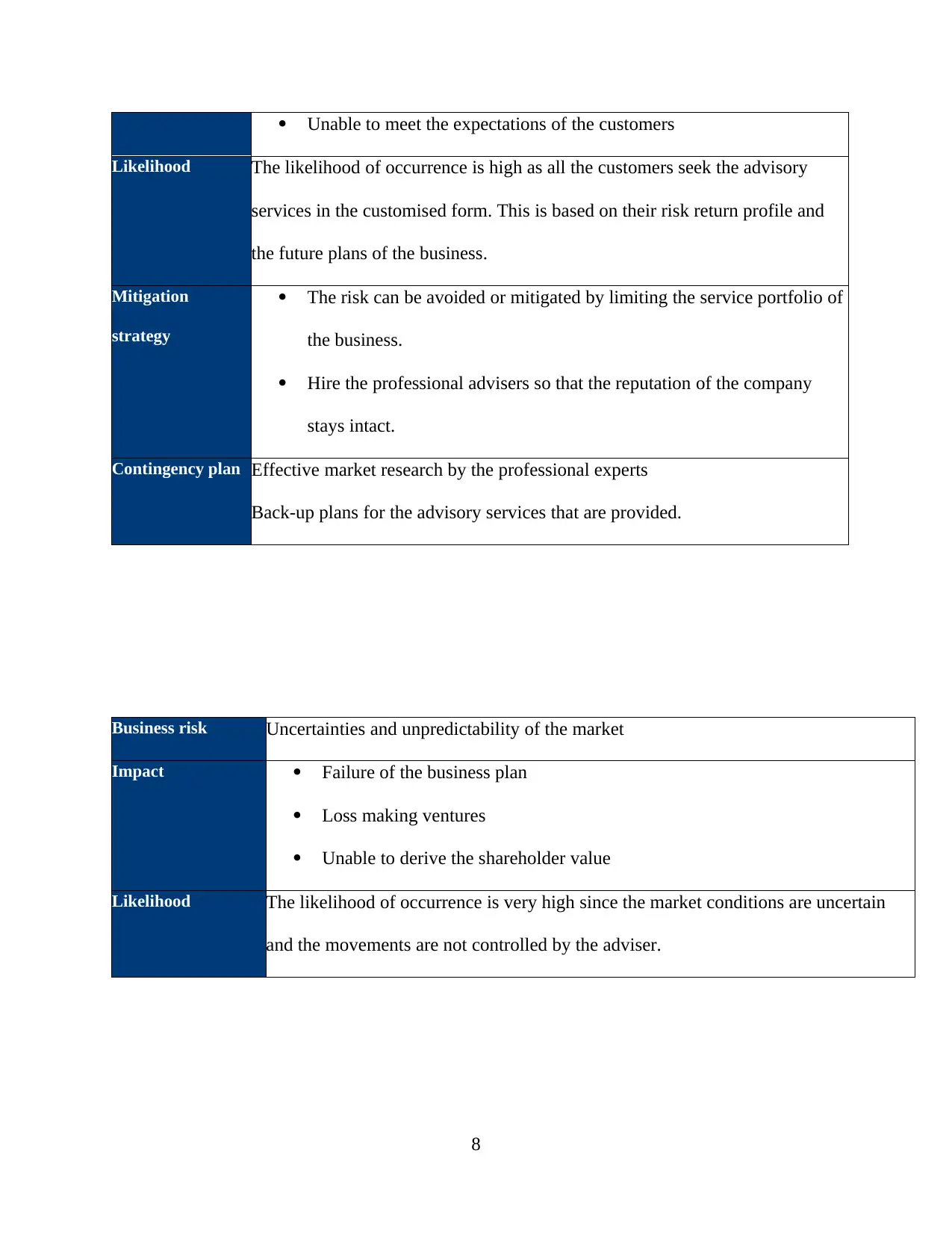
Unable to meet the expectations of the customers
Likelihood The likelihood of occurrence is high as all the customers seek the advisory
services in the customised form. This is based on their risk return profile and
the future plans of the business.
Mitigation
strategy
The risk can be avoided or mitigated by limiting the service portfolio of
the business.
Hire the professional advisers so that the reputation of the company
stays intact.
Contingency plan Effective market research by the professional experts
Back-up plans for the advisory services that are provided.
Business risk Uncertainties and unpredictability of the market
Impact Failure of the business plan
Loss making ventures
Unable to derive the shareholder value
Likelihood The likelihood of occurrence is very high since the market conditions are uncertain
and the movements are not controlled by the adviser.
8
Likelihood The likelihood of occurrence is high as all the customers seek the advisory
services in the customised form. This is based on their risk return profile and
the future plans of the business.
Mitigation
strategy
The risk can be avoided or mitigated by limiting the service portfolio of
the business.
Hire the professional advisers so that the reputation of the company
stays intact.
Contingency plan Effective market research by the professional experts
Back-up plans for the advisory services that are provided.
Business risk Uncertainties and unpredictability of the market
Impact Failure of the business plan
Loss making ventures
Unable to derive the shareholder value
Likelihood The likelihood of occurrence is very high since the market conditions are uncertain
and the movements are not controlled by the adviser.
8
Paraphrase This Document
Need a fresh take? Get an instant paraphrase of this document with our AI Paraphraser
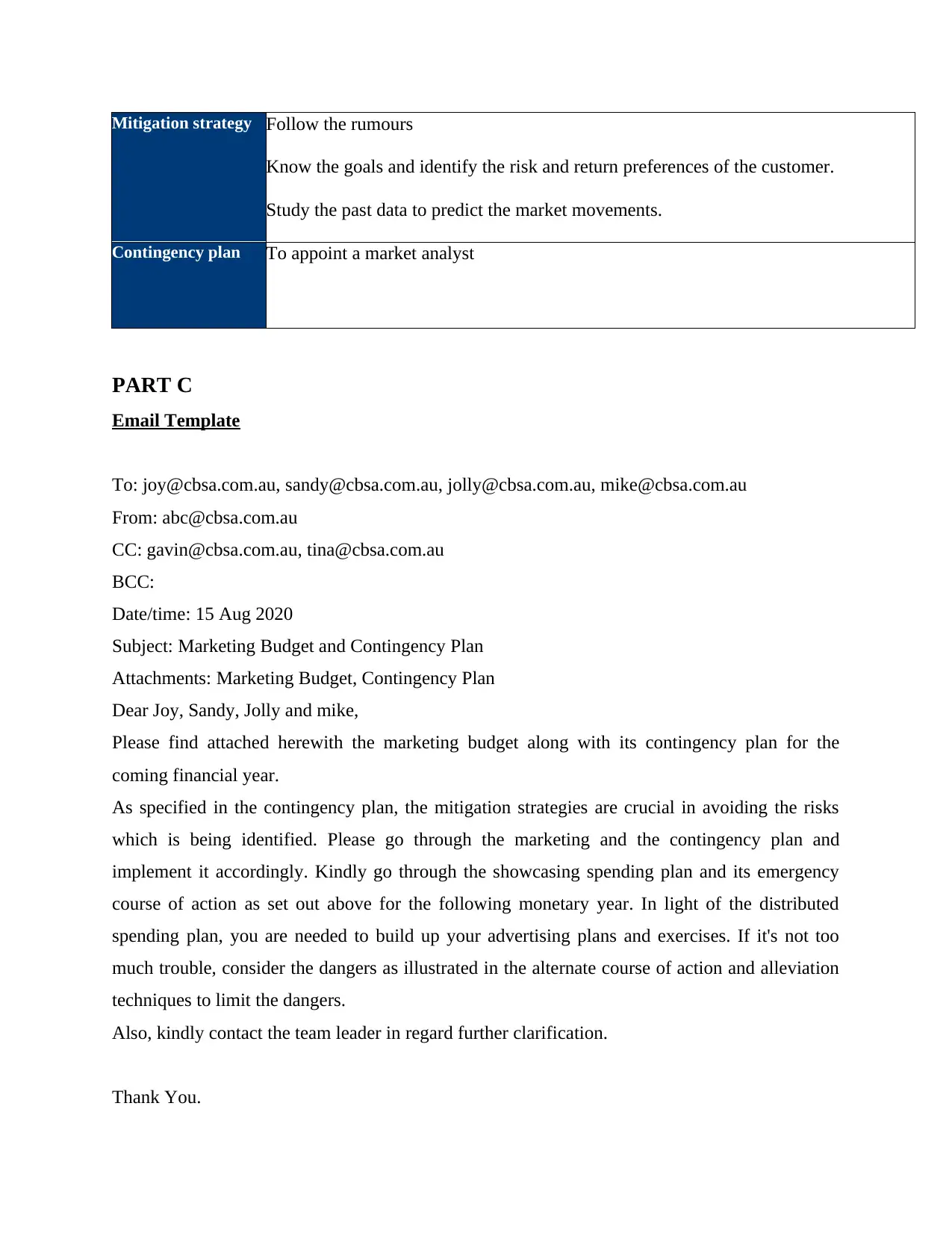
Mitigation strategy Follow the rumours
Know the goals and identify the risk and return preferences of the customer.
Study the past data to predict the market movements.
Contingency plan To appoint a market analyst
PART C
Email Template
To: joy@cbsa.com.au, sandy@cbsa.com.au, jolly@cbsa.com.au, mike@cbsa.com.au
From: abc@cbsa.com.au
CC: gavin@cbsa.com.au, tina@cbsa.com.au
BCC:
Date/time: 15 Aug 2020
Subject: Marketing Budget and Contingency Plan
Attachments: Marketing Budget, Contingency Plan
Dear Joy, Sandy, Jolly and mike,
Please find attached herewith the marketing budget along with its contingency plan for the
coming financial year.
As specified in the contingency plan, the mitigation strategies are crucial in avoiding the risks
which is being identified. Please go through the marketing and the contingency plan and
implement it accordingly. Kindly go through the showcasing spending plan and its emergency
course of action as set out above for the following monetary year. In light of the distributed
spending plan, you are needed to build up your advertising plans and exercises. If it's not too
much trouble, consider the dangers as illustrated in the alternate course of action and alleviation
techniques to limit the dangers.
Also, kindly contact the team leader in regard further clarification.
Thank You.
Know the goals and identify the risk and return preferences of the customer.
Study the past data to predict the market movements.
Contingency plan To appoint a market analyst
PART C
Email Template
To: joy@cbsa.com.au, sandy@cbsa.com.au, jolly@cbsa.com.au, mike@cbsa.com.au
From: abc@cbsa.com.au
CC: gavin@cbsa.com.au, tina@cbsa.com.au
BCC:
Date/time: 15 Aug 2020
Subject: Marketing Budget and Contingency Plan
Attachments: Marketing Budget, Contingency Plan
Dear Joy, Sandy, Jolly and mike,
Please find attached herewith the marketing budget along with its contingency plan for the
coming financial year.
As specified in the contingency plan, the mitigation strategies are crucial in avoiding the risks
which is being identified. Please go through the marketing and the contingency plan and
implement it accordingly. Kindly go through the showcasing spending plan and its emergency
course of action as set out above for the following monetary year. In light of the distributed
spending plan, you are needed to build up your advertising plans and exercises. If it's not too
much trouble, consider the dangers as illustrated in the alternate course of action and alleviation
techniques to limit the dangers.
Also, kindly contact the team leader in regard further clarification.
Thank You.
Kind Regards
Abc
TASK 3
PART A
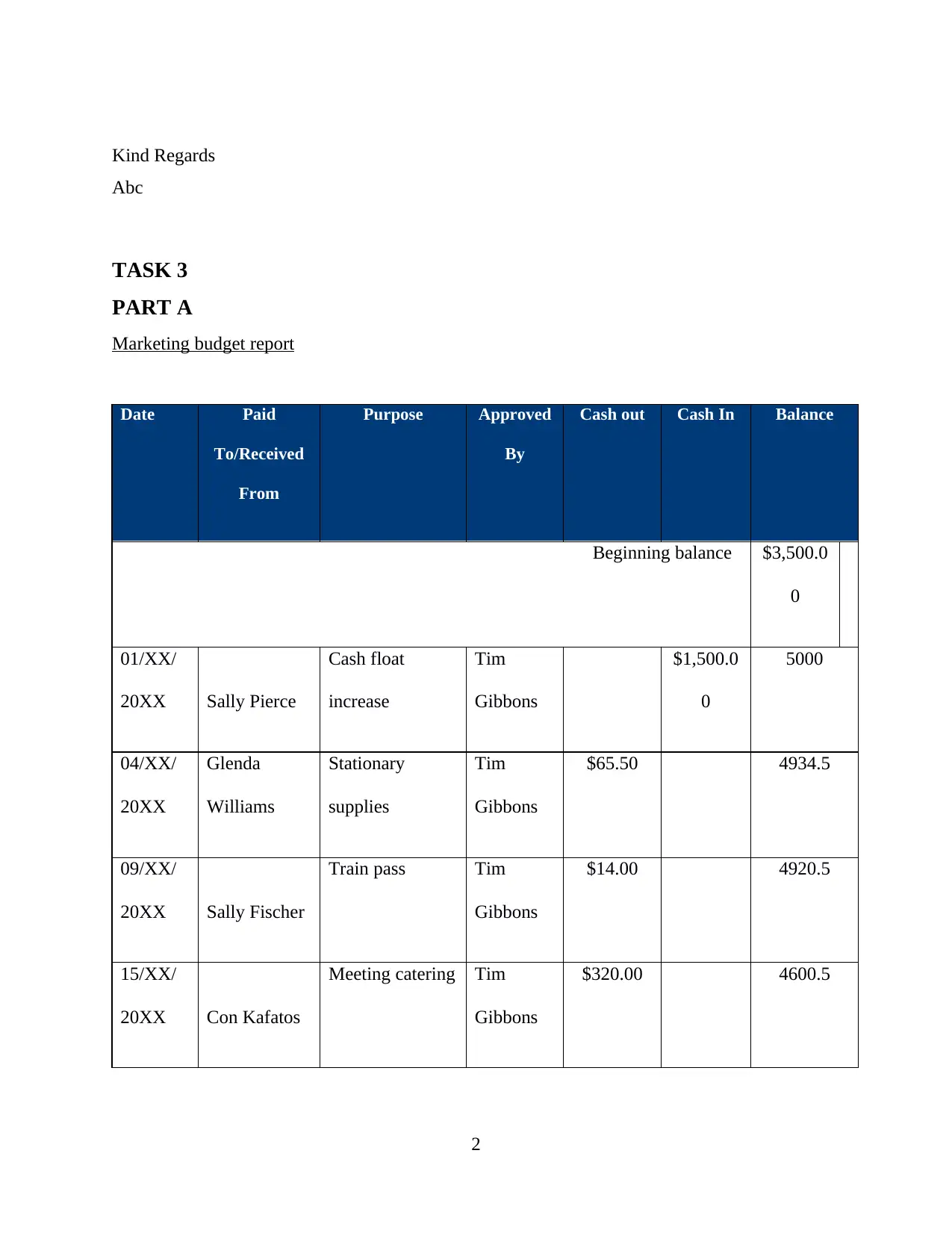
Marketing budget report
Petty cash
Date Paid
To/Received
From
Purpose Approved
By
Cash out Cash In Balance
Beginning balance $3,500.0
0
01/XX/
20XX Sally Pierce
Cash float
increase
Tim
Gibbons
$1,500.0
0
5000
04/XX/
20XX
Glenda
Williams
Stationary
supplies
Tim
Gibbons
$65.50 4934.5
09/XX/
20XX Sally Fischer
Train pass Tim
Gibbons
$14.00 4920.5
15/XX/
20XX Con Kafatos
Meeting catering Tim
Gibbons
$320.00 4600.5
2
Abc
TASK 3
PART A
Marketing budget report
Petty cash
Date Paid
To/Received
From
Purpose Approved
By
Cash out Cash In Balance
Beginning balance $3,500.0
0
01/XX/
20XX Sally Pierce
Cash float
increase
Tim
Gibbons
$1,500.0
0
5000
04/XX/
20XX
Glenda
Williams
Stationary
supplies
Tim
Gibbons
$65.50 4934.5
09/XX/
20XX Sally Fischer
Train pass Tim
Gibbons
$14.00 4920.5
15/XX/
20XX Con Kafatos
Meeting catering Tim
Gibbons
$320.00 4600.5
2
⊘ This is a preview!⊘
Do you want full access?
Subscribe today to unlock all pages.
Trusted by 1+ million students worldwide

1 out of 19


Related Documents


Your All-in-One AI-Powered Toolkit for Academic Success.
+13062052269
info@desklib.com
Available 24*7 on WhatsApp / Email
![[object Object]](/_next/static/media/star-bottom.7253800d.svg)
Unlock your academic potential
Copyright © 2020–2026 A2Z Services. All Rights Reserved. Developed and managed by ZUCOL.