BSBFIM601 Financial Management: Budgeting, Analysis, and Debtor Review
VerifiedAdded on 2023/03/31
|11
|1944
|430
Report
AI Summary
This report provides a comprehensive analysis of financial management, focusing on budgeting, variance analysis, and debtor management. It includes a sales budget, profit budget, cash flow budget, and debtor aging summary, all divided into quarterly periods. The report identifies key issues such as high costs, inaccurate discount records, and the need for regular debtor balance reconciliation. Variances between budgeted estimates and actual performance are analyzed, revealing lower sales and unfavorable gross and net margins. The report also assesses the company's performance within the retail industry and offers recommendations for improving cost management and financial practices. The importance of compliance with the Corporation Act 2001 and the implementation of accounting software like MYOB are also discussed. Desklib offers this document and many more to aid students in their studies.

Running head: MANAGE FINANCES
Manage Finances
Name of the Student:
Name of the University:
Author’s Note:
Manage Finances
Name of the Student:
Name of the University:
Author’s Note:

Paraphrase This Document
Need a fresh take? Get an instant paraphrase of this document with our AI Paraphraser
1
MANAGE FINANCES
Table of Contents
Task 1................................................................................................................................2
Part 1..............................................................................................................................2
Budget Analysis.............................................................................................................5
Part 2..............................................................................................................................6
Assessment 2....................................................................................................................7
Variance Report.............................................................................................................7
Debtor Analysis..............................................................................................................8
Issues which Can be Identified......................................................................................8
Analysis of variances in Different Budgets....................................................................8
Performance Analysis....................................................................................................8
Recommendation...............................................................................................................9
Reference........................................................................................................................10
MANAGE FINANCES
Table of Contents
Task 1................................................................................................................................2
Part 1..............................................................................................................................2
Budget Analysis.............................................................................................................5
Part 2..............................................................................................................................6
Assessment 2....................................................................................................................7
Variance Report.............................................................................................................7
Debtor Analysis..............................................................................................................8
Issues which Can be Identified......................................................................................8
Analysis of variances in Different Budgets....................................................................8
Performance Analysis....................................................................................................8
Recommendation...............................................................................................................9
Reference........................................................................................................................10
2
MANAGE FINANCES
Task 1
Part 1
MANAGE FINANCES
Task 1
Part 1
⊘ This is a preview!⊘
Do you want full access?
Subscribe today to unlock all pages.

Trusted by 1+ million students worldwide
3
MANAGE FINANCES
MANAGE FINANCES
Paraphrase This Document
Need a fresh take? Get an instant paraphrase of this document with our AI Paraphraser
4
MANAGE FINANCES
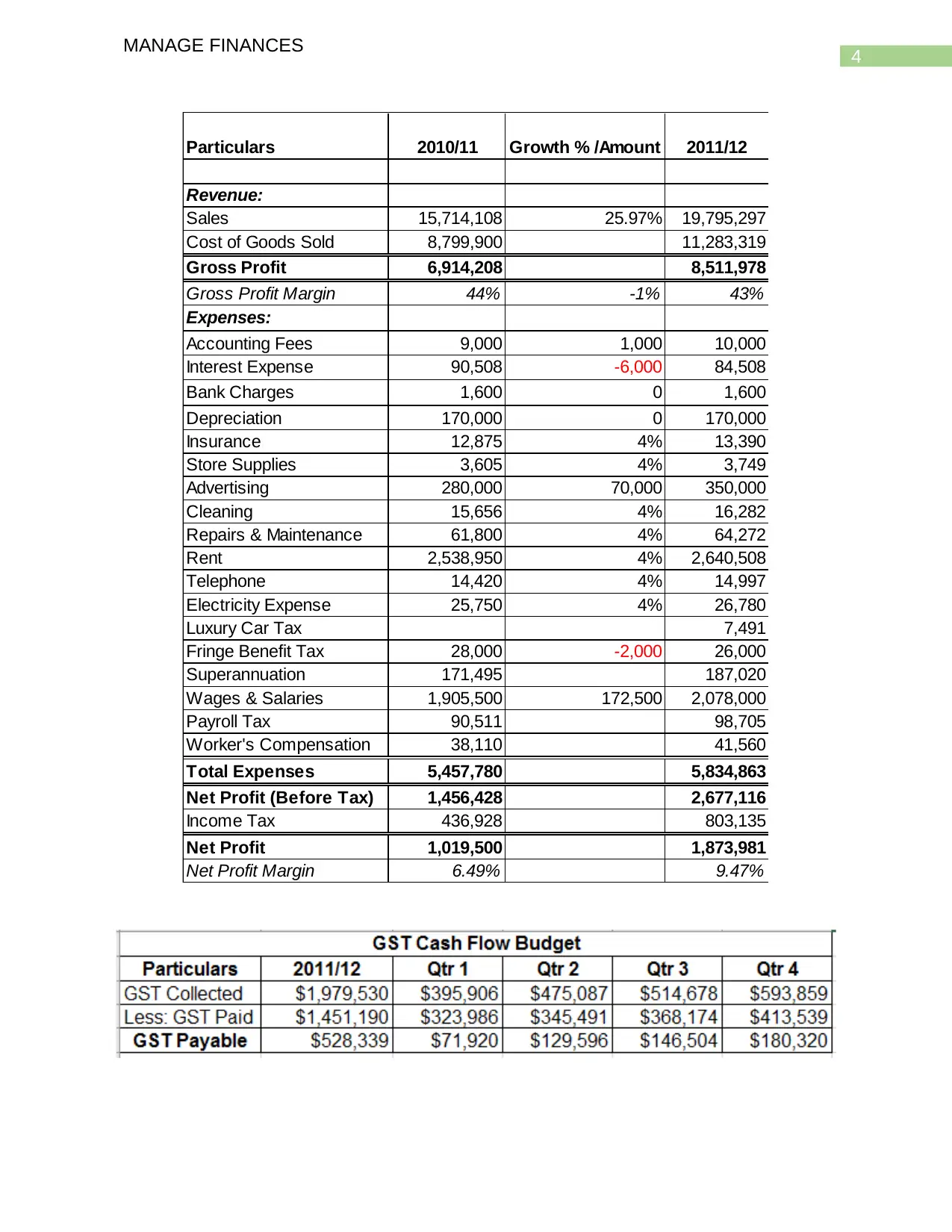
Particulars 2010/11 Growth % /Amount 2011/12
Revenue:
Sales 15,714,108 25.97% 19,795,297
Cost of Goods Sold 8,799,900 11,283,319
Gross Profit 6,914,208 8,511,978
Gross Profit Margin 44% -1% 43%
Expenses:
Accounting Fees 9,000 1,000 10,000
Interest Expense 90,508 -6,000 84,508
Bank Charges 1,600 0 1,600
Depreciation 170,000 0 170,000
Insurance 12,875 4% 13,390
Store Supplies 3,605 4% 3,749
Advertising 280,000 70,000 350,000
Cleaning 15,656 4% 16,282
Repairs & Maintenance 61,800 4% 64,272
Rent 2,538,950 4% 2,640,508
Telephone 14,420 4% 14,997
Electricity Expense 25,750 4% 26,780
Luxury Car Tax 7,491
Fringe Benefit Tax 28,000 -2,000 26,000
Superannuation 171,495 187,020
Wages & Salaries 1,905,500 172,500 2,078,000
Payroll Tax 90,511 98,705
Worker's Compensation 38,110 41,560
Total Expenses 5,457,780 5,834,863
Net Profit (Before Tax) 1,456,428 2,677,116
Income Tax 436,928 803,135
Net Profit 1,019,500 1,873,981
Net Profit Margin 6.49% 9.47%
MANAGE FINANCES
Particulars 2010/11 Growth % /Amount 2011/12
Revenue:
Sales 15,714,108 25.97% 19,795,297
Cost of Goods Sold 8,799,900 11,283,319
Gross Profit 6,914,208 8,511,978
Gross Profit Margin 44% -1% 43%
Expenses:
Accounting Fees 9,000 1,000 10,000
Interest Expense 90,508 -6,000 84,508
Bank Charges 1,600 0 1,600
Depreciation 170,000 0 170,000
Insurance 12,875 4% 13,390
Store Supplies 3,605 4% 3,749
Advertising 280,000 70,000 350,000
Cleaning 15,656 4% 16,282
Repairs & Maintenance 61,800 4% 64,272
Rent 2,538,950 4% 2,640,508
Telephone 14,420 4% 14,997
Electricity Expense 25,750 4% 26,780
Luxury Car Tax 7,491
Fringe Benefit Tax 28,000 -2,000 26,000
Superannuation 171,495 187,020
Wages & Salaries 1,905,500 172,500 2,078,000
Payroll Tax 90,511 98,705
Worker's Compensation 38,110 41,560
Total Expenses 5,457,780 5,834,863
Net Profit (Before Tax) 1,456,428 2,677,116
Income Tax 436,928 803,135
Net Profit 1,019,500 1,873,981
Net Profit Margin 6.49% 9.47%
5
MANAGE FINANCES
Budget Analysis
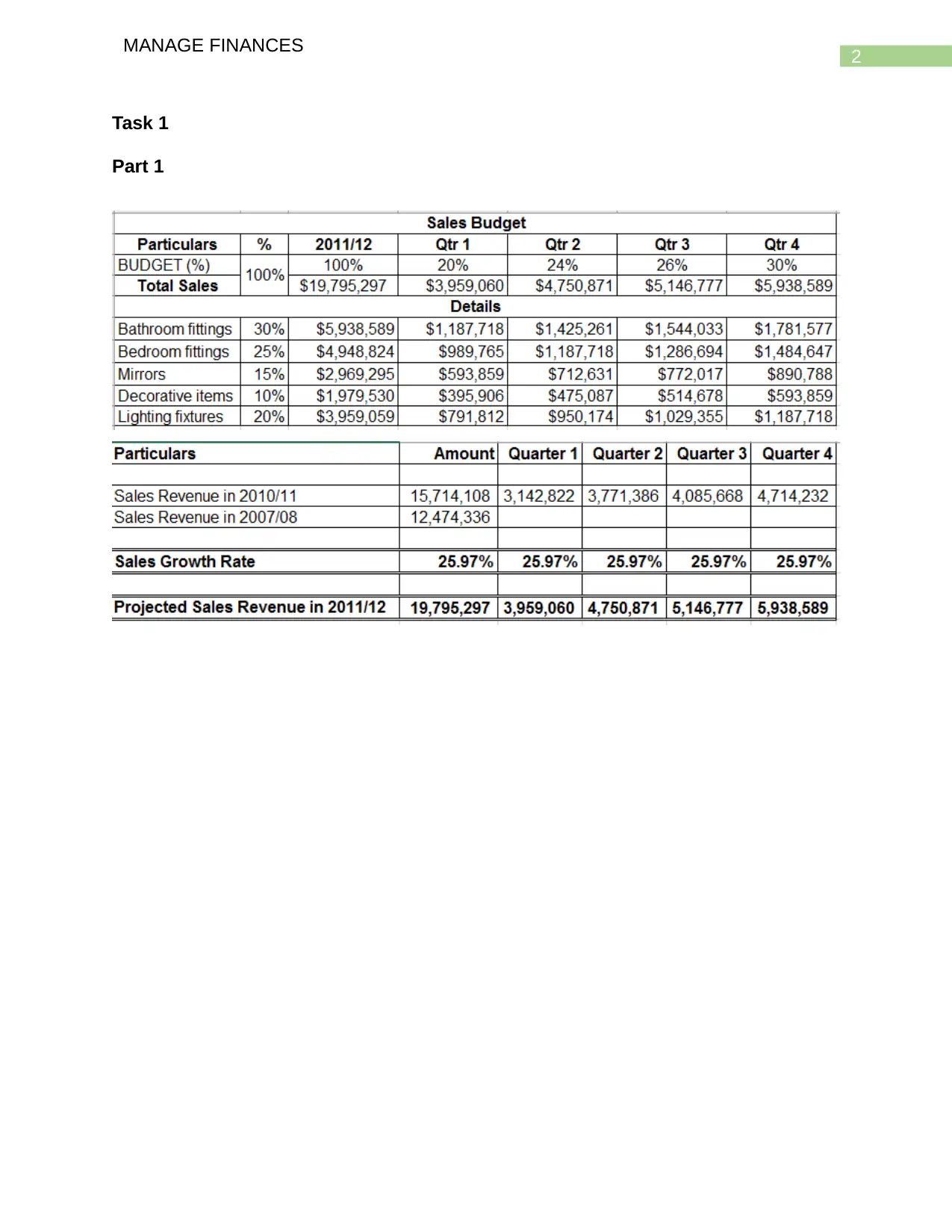
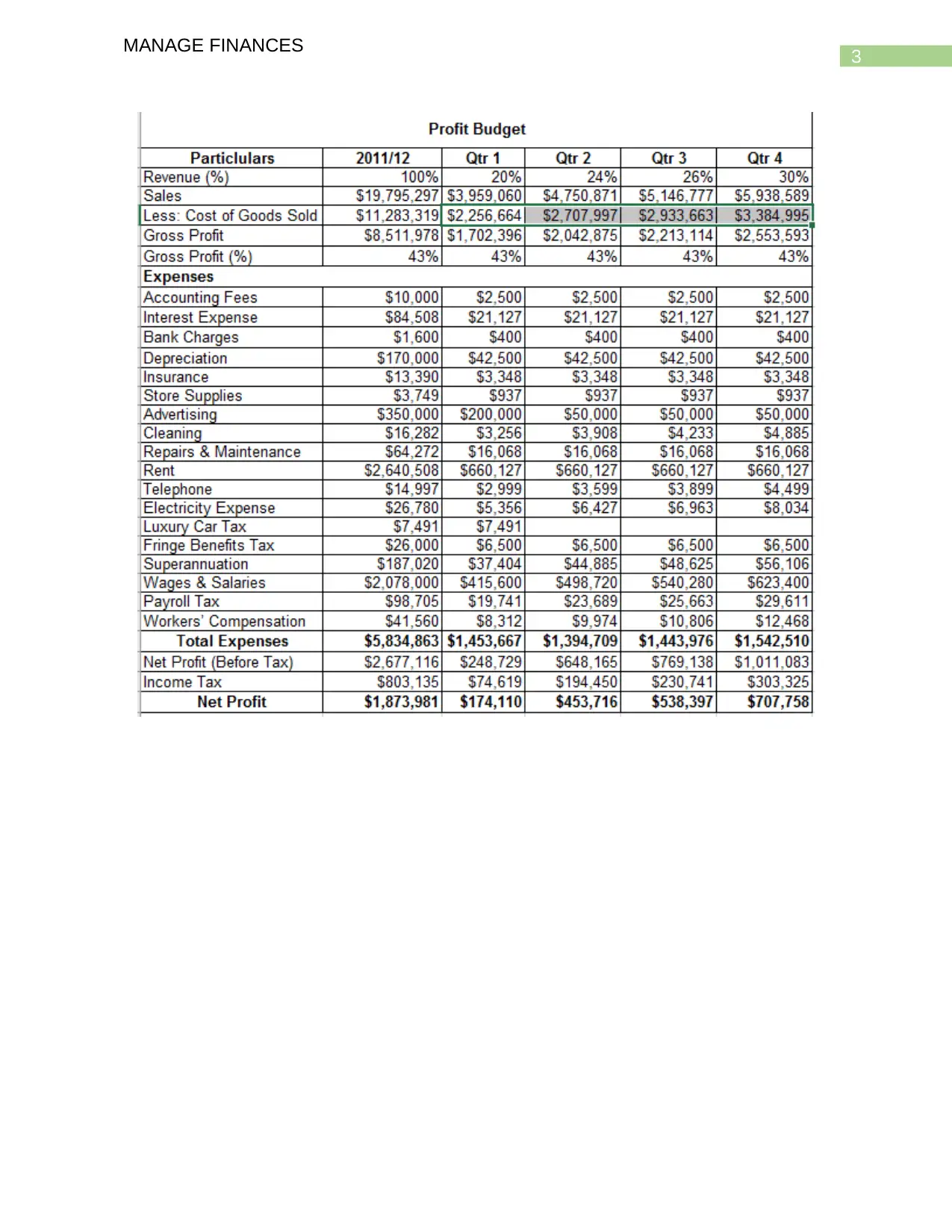
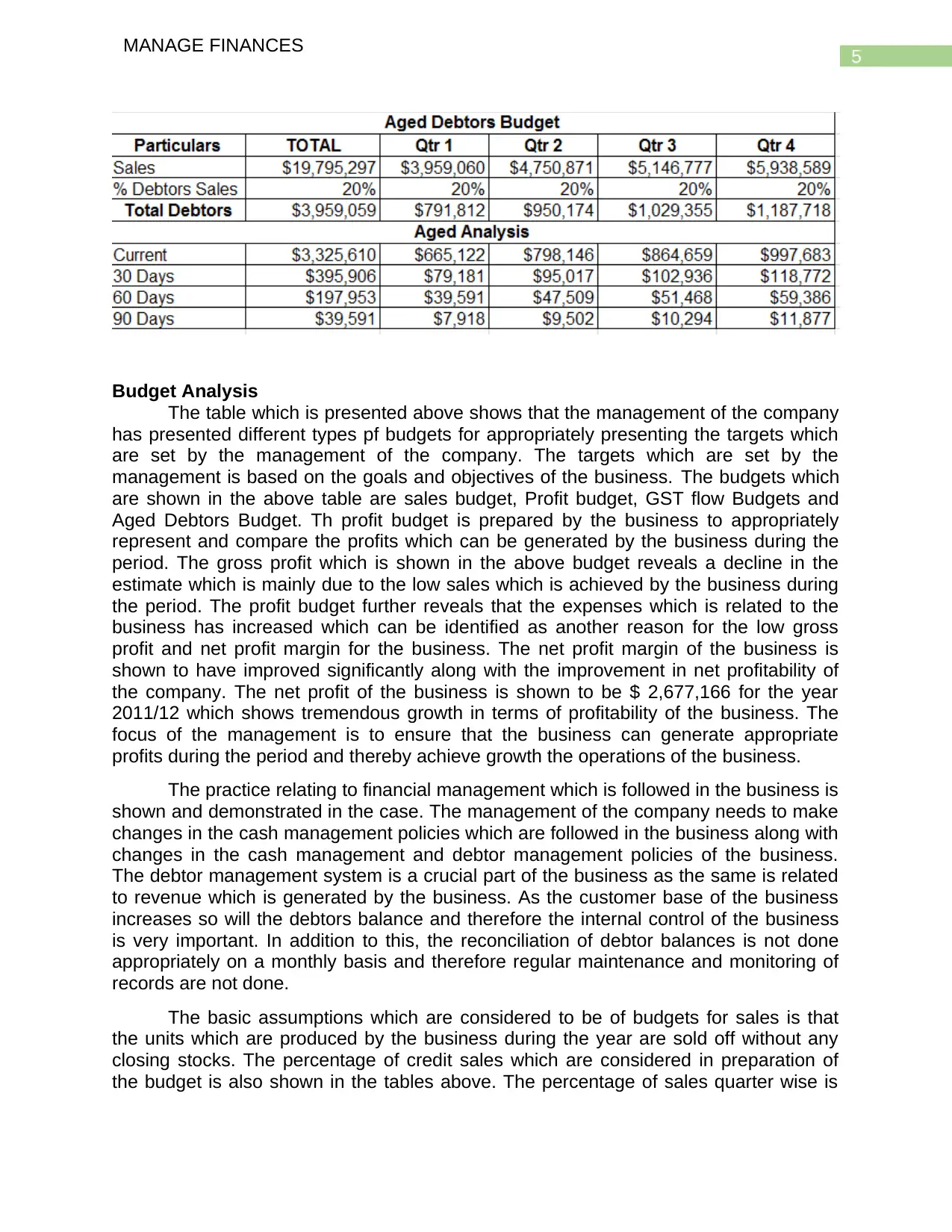
The table which is presented above shows that the management of the company
has presented different types pf budgets for appropriately presenting the targets which
are set by the management of the company. The targets which are set by the
management is based on the goals and objectives of the business. The budgets which
are shown in the above table are sales budget, Profit budget, GST flow Budgets and
Aged Debtors Budget. Th profit budget is prepared by the business to appropriately
represent and compare the profits which can be generated by the business during the
period. The gross profit which is shown in the above budget reveals a decline in the
estimate which is mainly due to the low sales which is achieved by the business during
the period. The profit budget further reveals that the expenses which is related to the
business has increased which can be identified as another reason for the low gross
profit and net profit margin for the business. The net profit margin of the business is
shown to have improved significantly along with the improvement in net profitability of
the company. The net profit of the business is shown to be $ 2,677,166 for the year
2011/12 which shows tremendous growth in terms of profitability of the business. The
focus of the management is to ensure that the business can generate appropriate
profits during the period and thereby achieve growth the operations of the business.
The practice relating to financial management which is followed in the business is
shown and demonstrated in the case. The management of the company needs to make
changes in the cash management policies which are followed in the business along with
changes in the cash management and debtor management policies of the business.
The debtor management system is a crucial part of the business as the same is related
to revenue which is generated by the business. As the customer base of the business
increases so will the debtors balance and therefore the internal control of the business
is very important. In addition to this, the reconciliation of debtor balances is not done
appropriately on a monthly basis and therefore regular maintenance and monitoring of
records are not done.
The basic assumptions which are considered to be of budgets for sales is that
the units which are produced by the business during the year are sold off without any
closing stocks. The percentage of credit sales which are considered in preparation of
the budget is also shown in the tables above. The percentage of sales quarter wise is
MANAGE FINANCES
Budget Analysis
The table which is presented above shows that the management of the company
has presented different types pf budgets for appropriately presenting the targets which
are set by the management of the company. The targets which are set by the
management is based on the goals and objectives of the business. The budgets which
are shown in the above table are sales budget, Profit budget, GST flow Budgets and
Aged Debtors Budget. Th profit budget is prepared by the business to appropriately
represent and compare the profits which can be generated by the business during the
period. The gross profit which is shown in the above budget reveals a decline in the
estimate which is mainly due to the low sales which is achieved by the business during
the period. The profit budget further reveals that the expenses which is related to the
business has increased which can be identified as another reason for the low gross
profit and net profit margin for the business. The net profit margin of the business is
shown to have improved significantly along with the improvement in net profitability of
the company. The net profit of the business is shown to be $ 2,677,166 for the year
2011/12 which shows tremendous growth in terms of profitability of the business. The
focus of the management is to ensure that the business can generate appropriate
profits during the period and thereby achieve growth the operations of the business.
The practice relating to financial management which is followed in the business is
shown and demonstrated in the case. The management of the company needs to make
changes in the cash management policies which are followed in the business along with
changes in the cash management and debtor management policies of the business.
The debtor management system is a crucial part of the business as the same is related
to revenue which is generated by the business. As the customer base of the business
increases so will the debtors balance and therefore the internal control of the business
is very important. In addition to this, the reconciliation of debtor balances is not done
appropriately on a monthly basis and therefore regular maintenance and monitoring of
records are not done.
The basic assumptions which are considered to be of budgets for sales is that
the units which are produced by the business during the year are sold off without any
closing stocks. The percentage of credit sales which are considered in preparation of
the budget is also shown in the tables above. The percentage of sales quarter wise is
⊘ This is a preview!⊘
Do you want full access?
Subscribe today to unlock all pages.
Trusted by 1+ million students worldwide
6
MANAGE FINANCES
also portrayed in the tables which is provided above. The fluctuations in sales figures
and the respective GST amounts are also shown in the figure above.
The monitoring and implementation of the budget is to be carried out by the
senior management of the business. The senior management sets the standards which
the business needs to follow and implement the plans by ensuring proper supervision is
maintained in the business.
Part 2
The different taxes which can be related to the business of Houzit are GST
provision, income tax provision and different types of taxes which are applicable on the
business as per the Federal law which is applicable in the business.
The management of Houzit needs to focus on the rules and regulations which
are set in Corporation Act 2001. The management of the company needs to comply with
section 111AA and division 2 and division 3 for the purpose of appropriate compliance
which is related to relevant regulations.
The management of Houzit is planning to bring about change in the operational
structure of the business and make appropriate changes to the business. The
management of the company needs to ensure that the revenues and expenses which
are recorded in the annual reports are accurate in nature. The management can
implement MYOB Software or Sage Accounting software in order to maintain and
improve the reporting structure of the business (Wyslocka, and Jelonek 2015). The
adoption of MYOB Software would be most appropriate as the same will provide the
option to the management to record, maintain and analyse the financial information to
the company.
The matching principle explains that the revenue and expenses should match in
the financial statements of the business. The management needs to consider the
estimated revenue which the business plans to achieve and on the basis of the revenue
the costs of the business (Borowczyk-Martins, Jolivet and Postel-Vinay 2013). Account
groups are different accounts which are considered while preparing the mater records.
The account groups are integral when a business is preparing a budget of the company.
The timeline of a budget refers to the minimum time which the management will be
requiring to achieve the goals of the business which can be short term in nature.
The principle of probity is to ensure the policies of honesty, decency and moral
principles are followed while preparing and implementing budgeting practices. This is to
be done in order to ensure that the budget is showing true and fair view and accurate
information reflecting the current capability of the business.
The critical dates which are to be considered are the quarterly target dates on
which the performance of the business is to be monitored and also the timeline in which
the project is to be completed.
The management needs to identify more costs which are associated with day to
day operations of the business. The management also needs to identify the source of
different costs which can be direct nature or indirect nature.
MANAGE FINANCES
also portrayed in the tables which is provided above. The fluctuations in sales figures
and the respective GST amounts are also shown in the figure above.
The monitoring and implementation of the budget is to be carried out by the
senior management of the business. The senior management sets the standards which
the business needs to follow and implement the plans by ensuring proper supervision is
maintained in the business.
Part 2
The different taxes which can be related to the business of Houzit are GST
provision, income tax provision and different types of taxes which are applicable on the
business as per the Federal law which is applicable in the business.
The management of Houzit needs to focus on the rules and regulations which
are set in Corporation Act 2001. The management of the company needs to comply with
section 111AA and division 2 and division 3 for the purpose of appropriate compliance
which is related to relevant regulations.
The management of Houzit is planning to bring about change in the operational
structure of the business and make appropriate changes to the business. The
management of the company needs to ensure that the revenues and expenses which
are recorded in the annual reports are accurate in nature. The management can
implement MYOB Software or Sage Accounting software in order to maintain and
improve the reporting structure of the business (Wyslocka, and Jelonek 2015). The
adoption of MYOB Software would be most appropriate as the same will provide the
option to the management to record, maintain and analyse the financial information to
the company.
The matching principle explains that the revenue and expenses should match in
the financial statements of the business. The management needs to consider the
estimated revenue which the business plans to achieve and on the basis of the revenue
the costs of the business (Borowczyk-Martins, Jolivet and Postel-Vinay 2013). Account
groups are different accounts which are considered while preparing the mater records.
The account groups are integral when a business is preparing a budget of the company.
The timeline of a budget refers to the minimum time which the management will be
requiring to achieve the goals of the business which can be short term in nature.
The principle of probity is to ensure the policies of honesty, decency and moral
principles are followed while preparing and implementing budgeting practices. This is to
be done in order to ensure that the budget is showing true and fair view and accurate
information reflecting the current capability of the business.
The critical dates which are to be considered are the quarterly target dates on
which the performance of the business is to be monitored and also the timeline in which
the project is to be completed.
The management needs to identify more costs which are associated with day to
day operations of the business. The management also needs to identify the source of
different costs which can be direct nature or indirect nature.
Paraphrase This Document
Need a fresh take? Get an instant paraphrase of this document with our AI Paraphraser
7
MANAGE FINANCES
In order to bring about appropriate improvements in the process and procedures
the internal control system of the business needs to be improved. The introduction of
new accounting information system will bring about significant improvement in the
reporting framework of the business.
Assessment 2
Variance Report
MANAGE FINANCES
In order to bring about appropriate improvements in the process and procedures
the internal control system of the business needs to be improved. The introduction of
new accounting information system will bring about significant improvement in the
reporting framework of the business.
Assessment 2
Variance Report
8
MANAGE FINANCES
Debtor Analysis
Issues which Can be Identified
The issues of the business which can be identified from the budgets are listed
below so that the same can be used by the management of the company for taking
appropriate decisions for the business.
The costs which are estimated for the business are shown to be considerably high which
is much more that the average sales which is generated by the business.
The discount amount records are not properly represented in the annual records of the
business which can affect other balances of the business.
The cash register of the business does not show accurate balances of the business.
The reconciliation of debtor’s balance should be done on a regular basis in the business
so that it can be insured that proper internal control of the business is possible.
Analysis of variances in Different Budgets
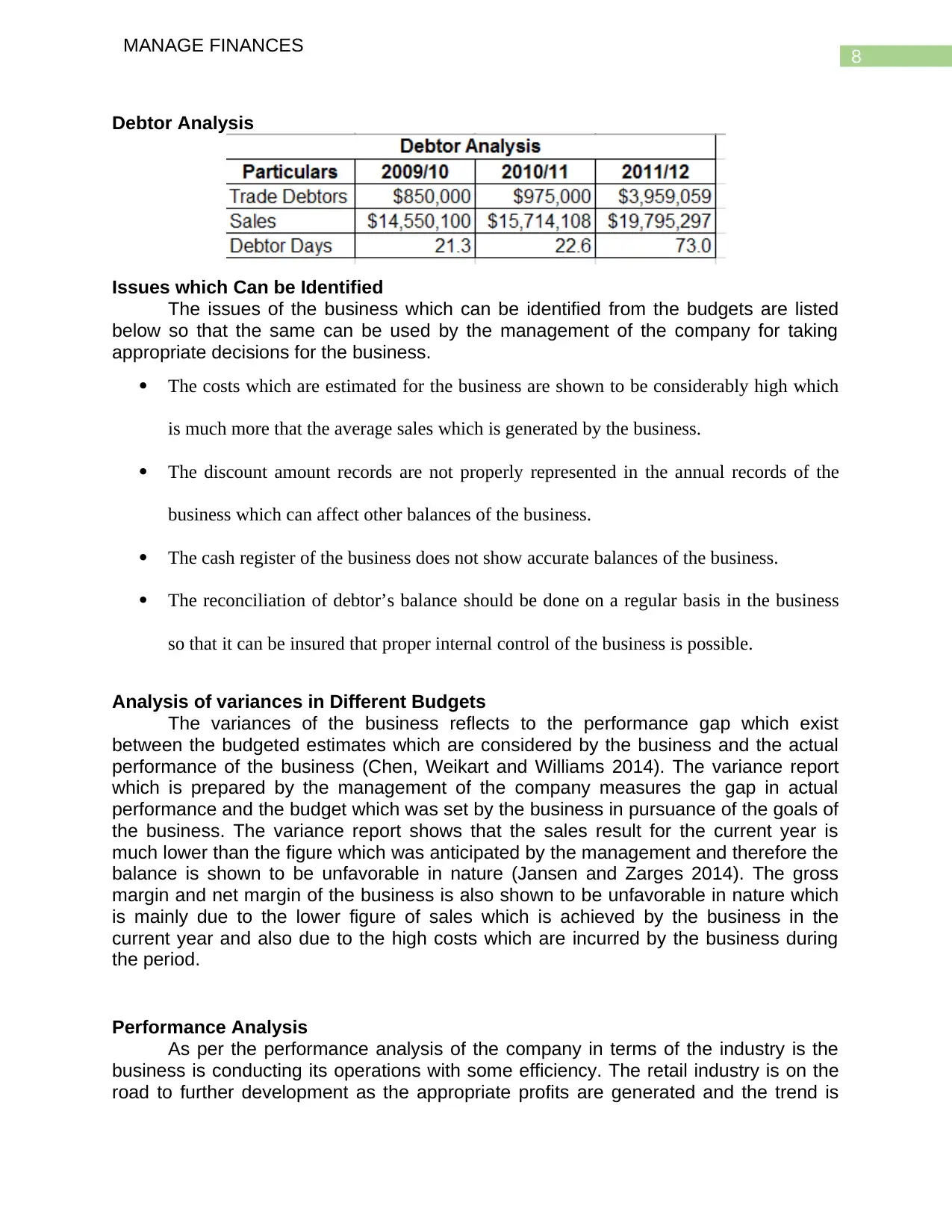
The variances of the business reflects to the performance gap which exist
between the budgeted estimates which are considered by the business and the actual
performance of the business (Chen, Weikart and Williams 2014). The variance report
which is prepared by the management of the company measures the gap in actual
performance and the budget which was set by the business in pursuance of the goals of
the business. The variance report shows that the sales result for the current year is
much lower than the figure which was anticipated by the management and therefore the
balance is shown to be unfavorable in nature (Jansen and Zarges 2014). The gross
margin and net margin of the business is also shown to be unfavorable in nature which
is mainly due to the lower figure of sales which is achieved by the business in the
current year and also due to the high costs which are incurred by the business during
the period.
Performance Analysis
As per the performance analysis of the company in terms of the industry is the
business is conducting its operations with some efficiency. The retail industry is on the
road to further development as the appropriate profits are generated and the trend is
MANAGE FINANCES
Debtor Analysis
Issues which Can be Identified
The issues of the business which can be identified from the budgets are listed
below so that the same can be used by the management of the company for taking
appropriate decisions for the business.
The costs which are estimated for the business are shown to be considerably high which
is much more that the average sales which is generated by the business.
The discount amount records are not properly represented in the annual records of the
business which can affect other balances of the business.
The cash register of the business does not show accurate balances of the business.
The reconciliation of debtor’s balance should be done on a regular basis in the business
so that it can be insured that proper internal control of the business is possible.
Analysis of variances in Different Budgets
The variances of the business reflects to the performance gap which exist
between the budgeted estimates which are considered by the business and the actual
performance of the business (Chen, Weikart and Williams 2014). The variance report
which is prepared by the management of the company measures the gap in actual
performance and the budget which was set by the business in pursuance of the goals of
the business. The variance report shows that the sales result for the current year is
much lower than the figure which was anticipated by the management and therefore the
balance is shown to be unfavorable in nature (Jansen and Zarges 2014). The gross
margin and net margin of the business is also shown to be unfavorable in nature which
is mainly due to the lower figure of sales which is achieved by the business in the
current year and also due to the high costs which are incurred by the business during
the period.
Performance Analysis
As per the performance analysis of the company in terms of the industry is the
business is conducting its operations with some efficiency. The retail industry is on the
road to further development as the appropriate profits are generated and the trend is
⊘ This is a preview!⊘
Do you want full access?
Subscribe today to unlock all pages.
Trusted by 1+ million students worldwide
9
MANAGE FINANCES
also showing positive results. In addition to this, the level of competition is also very
high in such an industry which can also be one of the reason for the high costs as the
costs of the resources are also high. More improvement can be brought about in the
business as the sales can be improved further.
As per the debtor’s policy of the business, the management of the company is
increasing the credit period which is allowed to such debtors. The overall debtors of the
business have improved significantly over the years which is mainly due to credit sales
undertaken by the business. The debtor analysis demonstrated in the above case
reveals that the credit sales of the business has increased exponentially in 2011/12
which is due to the improvement in credit policy. However, it is to be noted that the
increase in credit period will also block the funds of the business for a longer period and
thereby affecting the liquidity of the business.
Recommendation
The recommendation which can be provided to the management of Houzit are
discussed below in details:
The management of the company needs to be improve the costs of the business so that
appropriate costs structure can be developed. The profits of the business can be affected
with the rise in the costs of the business.
The management of the business also needs to make improvements in financial
management practices of the business to improve the financial structure of the company.
MANAGE FINANCES
also showing positive results. In addition to this, the level of competition is also very
high in such an industry which can also be one of the reason for the high costs as the
costs of the resources are also high. More improvement can be brought about in the
business as the sales can be improved further.
As per the debtor’s policy of the business, the management of the company is
increasing the credit period which is allowed to such debtors. The overall debtors of the
business have improved significantly over the years which is mainly due to credit sales
undertaken by the business. The debtor analysis demonstrated in the above case
reveals that the credit sales of the business has increased exponentially in 2011/12
which is due to the improvement in credit policy. However, it is to be noted that the
increase in credit period will also block the funds of the business for a longer period and
thereby affecting the liquidity of the business.
Recommendation
The recommendation which can be provided to the management of Houzit are
discussed below in details:
The management of the company needs to be improve the costs of the business so that
appropriate costs structure can be developed. The profits of the business can be affected
with the rise in the costs of the business.
The management of the business also needs to make improvements in financial
management practices of the business to improve the financial structure of the company.
Paraphrase This Document
Need a fresh take? Get an instant paraphrase of this document with our AI Paraphraser
10
MANAGE FINANCES
Reference
Bourmistrov, A. and Kaarbøe, K., 2013. From comfort to stretch zones: A field study of
two multinational companies applying “beyond budgeting” ideas. Management
Accounting Research, 24(3), pp.196-211.
Chen, G.G., Weikart, L.A. and Williams, D.W., 2014. Budget tools: Financial methods in
the public sector. CQ Press.
Gorgotskaya, E.A. and Selyutina, L.G., 2013. Budgeting as the innovative finance
management method of a building company in the conditions of business scale
growth. Of beaming and organization of effective functioning of innovation sphere of
economy enterprise, industry, the complex: proceedings of the International сonference,
28-30 April, 2013, p.92.
Jansen, T. and Zarges, C., 2014. Performance analysis of randomised search heuristics
operating with a fixed budget. Theoretical Computer Science, 545, pp.39-58.
Lueg, R. and Lu, S., 2013. How to improve efficiency in budgeting-The case of business
intelligence in SMEs.
Wyslocka, E. and Jelonek, D., 2015. Accounting in the Cloud Computing. Turkish
Online Journal of Science & Technology, 5(4).
MANAGE FINANCES
Reference
Bourmistrov, A. and Kaarbøe, K., 2013. From comfort to stretch zones: A field study of
two multinational companies applying “beyond budgeting” ideas. Management
Accounting Research, 24(3), pp.196-211.
Chen, G.G., Weikart, L.A. and Williams, D.W., 2014. Budget tools: Financial methods in
the public sector. CQ Press.
Gorgotskaya, E.A. and Selyutina, L.G., 2013. Budgeting as the innovative finance
management method of a building company in the conditions of business scale
growth. Of beaming and organization of effective functioning of innovation sphere of
economy enterprise, industry, the complex: proceedings of the International сonference,
28-30 April, 2013, p.92.
Jansen, T. and Zarges, C., 2014. Performance analysis of randomised search heuristics
operating with a fixed budget. Theoretical Computer Science, 545, pp.39-58.
Lueg, R. and Lu, S., 2013. How to improve efficiency in budgeting-The case of business
intelligence in SMEs.
Wyslocka, E. and Jelonek, D., 2015. Accounting in the Cloud Computing. Turkish
Online Journal of Science & Technology, 5(4).

1 out of 11


Related Documents


Your All-in-One AI-Powered Toolkit for Academic Success.
+13062052269
info@desklib.com
Available 24*7 on WhatsApp / Email
![[object Object]](/_next/static/media/star-bottom.7253800d.svg)
Unlock your academic potential
Copyright © 2020–2026 A2Z Services. All Rights Reserved. Developed and managed by ZUCOL.