Financial Management: A Comprehensive Report on Key Aspects
VerifiedAdded on 2023/01/11
|7
|1454
|23
Report
AI Summary
This report provides a comprehensive overview of financial management, exploring its critical aspects within an organizational context. It begins by defining financial management as the process of preparing, coordinating, managing, and tracking financial resources to achieve corporate goals. The report then delves into the objectives of financial management, including ensuring adequate and consistent funds, providing returns to investors, optimizing fund utilization, ensuring investment stability, and designing a sustainable capital structure. The main body further examines the various functions of financial management, such as capital estimation, capital composition, money allocation, cash management, and financial controls. It also discusses the advantages and disadvantages of financial management, highlighting its role in enhancing insight, promoting sound decision-making, and the potential for rigidity and the challenges of adapting to rapid business changes. The report concludes by emphasizing the crucial role of financial management in business, particularly in accounting, bookkeeping, reporting, risk management, and identifying investment opportunities. The report is supported by references to relevant books, journals, and online resources.

TASK 4
Paraphrase This Document
Need a fresh take? Get an instant paraphrase of this document with our AI Paraphraser

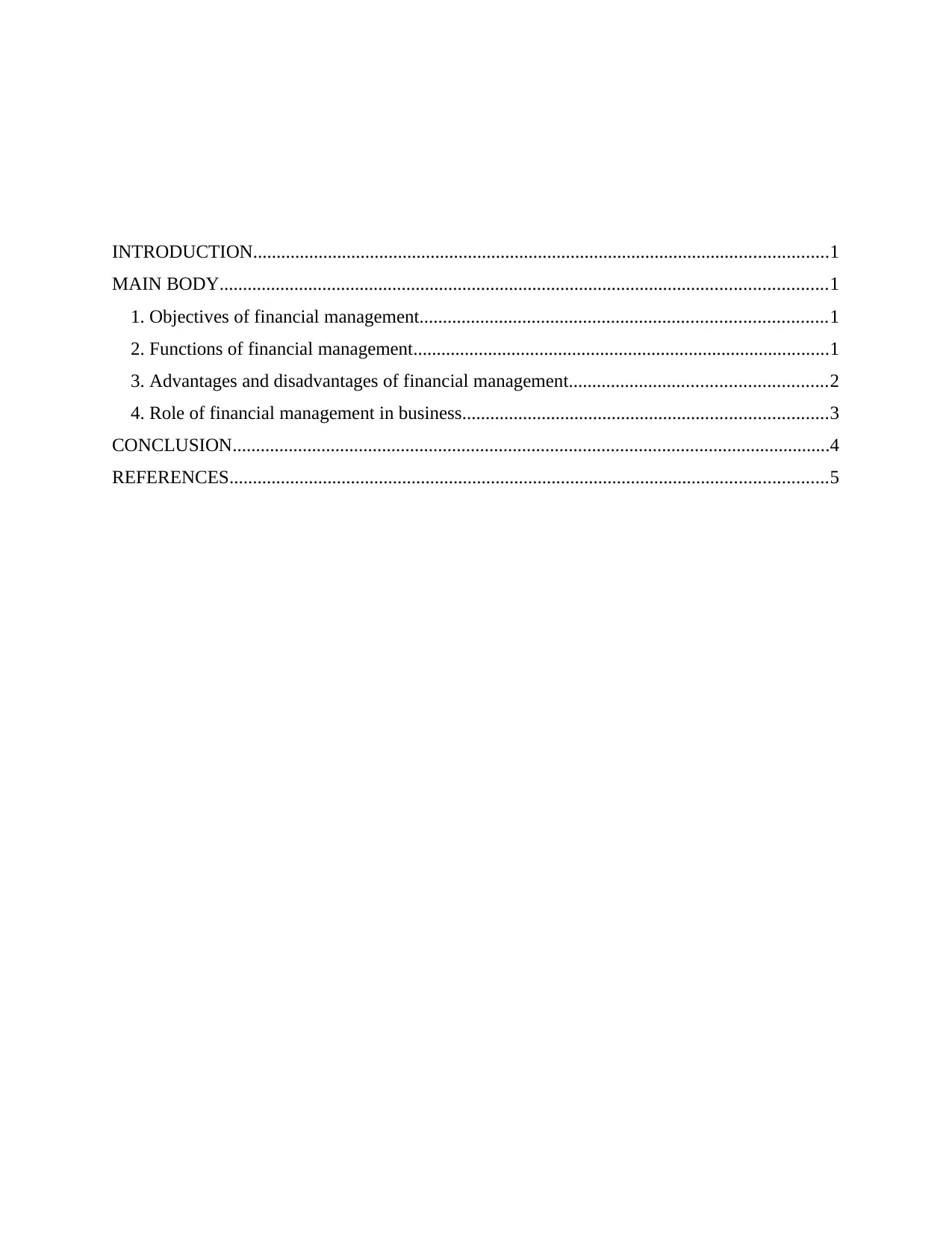
INTRODUCTION...........................................................................................................................1
MAIN BODY..................................................................................................................................1
1. Objectives of financial management.......................................................................................1
2. Functions of financial management.........................................................................................1
3. Advantages and disadvantages of financial management.......................................................2
4. Role of financial management in business..............................................................................3
CONCLUSION................................................................................................................................4
REFERENCES................................................................................................................................5
MAIN BODY..................................................................................................................................1
1. Objectives of financial management.......................................................................................1
2. Functions of financial management.........................................................................................1
3. Advantages and disadvantages of financial management.......................................................2
4. Role of financial management in business..............................................................................3
CONCLUSION................................................................................................................................4
REFERENCES................................................................................................................................5

INTRODUCTION
Financial management of every organization is a critical task. To accomplish corporate
priorities and targets, it is the method of preparing, coordinating, managing and tracking
financial resources (Chand, 2019). This is an excellent method for monitoring an organization's
financial operations such as budget acquisition, fund management, payroll, transfers, risk
evaluation and everything else relevant to revenue. This report is all about the financial
management, its role, its benefits and drawbacks, objectives etc. An accountant should know
about all the aspects of financial management to implement it effectively.
MAIN BODY
1. Objectives of financial management
In an organizational point of view, financial management is concern about the financial
resources which they have to allocate, manage or control over the period (Chandra, 2011).
Objectives are as follow:
To assure that funds are received consistently and adequately for the consideration.
To provide sufficient return to investors based on earning power, share market price,
shareholders' expectations.
To ensure better use of the funds. After the funds have been procured, they will be used
at least cost in the best possible manner.
To establish investment stability where funds should be spent in secure projects in order
to obtain an acceptable rates of return.
To design a sustainable capital structure, safe and equal capital allocation will be in order
such that a compromise of debt and equity capital is preserved.
2. Functions of financial management
There are several functions which performed by the financial management and it is
beneficial for the organizations (Functions of financial management, 2020). Some of them are as
follow:
Capital estimation: A financial officer will make an assessment of the firm's capital
needs. This would rely on a concern's projected expenses and income, and future services and
policies. Estimates must be made in an appropriate manner which improves the enterprise's
earning potential.
1
Financial management of every organization is a critical task. To accomplish corporate
priorities and targets, it is the method of preparing, coordinating, managing and tracking
financial resources (Chand, 2019). This is an excellent method for monitoring an organization's
financial operations such as budget acquisition, fund management, payroll, transfers, risk
evaluation and everything else relevant to revenue. This report is all about the financial
management, its role, its benefits and drawbacks, objectives etc. An accountant should know
about all the aspects of financial management to implement it effectively.
MAIN BODY
1. Objectives of financial management
In an organizational point of view, financial management is concern about the financial
resources which they have to allocate, manage or control over the period (Chandra, 2011).
Objectives are as follow:
To assure that funds are received consistently and adequately for the consideration.
To provide sufficient return to investors based on earning power, share market price,
shareholders' expectations.
To ensure better use of the funds. After the funds have been procured, they will be used
at least cost in the best possible manner.
To establish investment stability where funds should be spent in secure projects in order
to obtain an acceptable rates of return.
To design a sustainable capital structure, safe and equal capital allocation will be in order
such that a compromise of debt and equity capital is preserved.
2. Functions of financial management
There are several functions which performed by the financial management and it is
beneficial for the organizations (Functions of financial management, 2020). Some of them are as
follow:
Capital estimation: A financial officer will make an assessment of the firm's capital
needs. This would rely on a concern's projected expenses and income, and future services and
policies. Estimates must be made in an appropriate manner which improves the enterprise's
earning potential.
1
⊘ This is a preview!⊘
Do you want full access?
Subscribe today to unlock all pages.

Trusted by 1+ million students worldwide

Capital composition: The capital structure needs to be agreed upon after the calculation
has been made. This includes evaluating debt financing in the short and long term (Brigham and
Ehrhardt, 2013). This will focus on a company's share of equity funding and potential funds to be
received by outside parties.
Money allocation: The financial manager must agree to assign money to successful
projects so there is allocation stability and it is possible to generate daily returns (Cornett and
Saunders, 2003).
Money Management: Financial director needs to make money allocation decisions. Cash
is necessary for many reasons, such as paying salaries and pensions, payment of power and water
bills, payment to creditors, fulfilment of existing commitments, maintenance of adequate stock,
purchasing of raw materials, etc.
Financial controls: Not only does the financial planner have to prepare, obtain and use the
money, but financial officer also needs to maintain budgetary discipline. This can be achieved by
many methods such as ratio analysis, financial modeling, management of costs and income, etc.
3. Advantages and disadvantages of financial management
There are several advantages and disadvantages which help the organization as well as
individual to understand better and build strategies accordingly to expand their operations
(Higgins and Reimers, 2015). Some of them are discussed below:
Advantages:
Financial management contributes to greater insight of the processes and helps to
recognize the statistics at each stage of the company or organization.
Stakeholders are often keen to discover signs of stability in company activities. Good
financial management looks for the right balance between optimizing risk and benefit
(Block, Hirt and Danielsen, 2014).
Financial management promotes sound decision-making too, with the help of digitization
and organisation making the pertinent information readily available; it is harder to find
solutions depending on the circumstances of the case.
Disadvantages:
One of financial management's essential drawbacks is the rigidity it maintains within
companies (Yuniningsih, Pertiwi and Purwanto, 2019).
2
has been made. This includes evaluating debt financing in the short and long term (Brigham and
Ehrhardt, 2013). This will focus on a company's share of equity funding and potential funds to be
received by outside parties.
Money allocation: The financial manager must agree to assign money to successful
projects so there is allocation stability and it is possible to generate daily returns (Cornett and
Saunders, 2003).
Money Management: Financial director needs to make money allocation decisions. Cash
is necessary for many reasons, such as paying salaries and pensions, payment of power and water
bills, payment to creditors, fulfilment of existing commitments, maintenance of adequate stock,
purchasing of raw materials, etc.
Financial controls: Not only does the financial planner have to prepare, obtain and use the
money, but financial officer also needs to maintain budgetary discipline. This can be achieved by
many methods such as ratio analysis, financial modeling, management of costs and income, etc.
3. Advantages and disadvantages of financial management
There are several advantages and disadvantages which help the organization as well as
individual to understand better and build strategies accordingly to expand their operations
(Higgins and Reimers, 2015). Some of them are discussed below:
Advantages:
Financial management contributes to greater insight of the processes and helps to
recognize the statistics at each stage of the company or organization.
Stakeholders are often keen to discover signs of stability in company activities. Good
financial management looks for the right balance between optimizing risk and benefit
(Block, Hirt and Danielsen, 2014).
Financial management promotes sound decision-making too, with the help of digitization
and organisation making the pertinent information readily available; it is harder to find
solutions depending on the circumstances of the case.
Disadvantages:
One of financial management's essential drawbacks is the rigidity it maintains within
companies (Yuniningsih, Pertiwi and Purwanto, 2019).
2
Paraphrase This Document
Need a fresh take? Get an instant paraphrase of this document with our AI Paraphraser

Operating criteria are defined by adding specific accounting parameters; however, the
circumstances can vary from the original situation until the tasks are completed.
The laws can't keep pace with the rapid shifts in the business climate, leading to
corruption and lack of sales.
Similarly, it comes at expense to enforce practicum requirements within a company or an
institution.
For the whole team, it needs both hardware and software integration and configuration,
so they can adapt smoothly to the new program.
4. Role of financial management in business
In an organization, financial management plays essential roles and these are discussed
below:
Accounting and bookkeeping: Measuring, recognizing and tracking all the organisation's
financial details are quite necessary (Alkaraan, 2018). What's going in, what's coming out?
Financial management consists of an effective accountability which gives the firm's overall
financial image. From the other side, there has been bookkeeping, which documents the day-to-
day corporate activity and sits at the centre of the information system.
Reporting: Several stakeholders depend on the annual statements of the organization to
make the main decisions (Role of Financial management, 2020). In all situations, reliable data
from the financial statements is essential for making important decisions
Risk: The goal of any company is to minimum risk with full benefit. A stable structure of
financial accounting is a requirement for reducing unexpected costs and counteracting liabilities.
Successful finance project would provide appropriate funding for essential operating
components, budgeting for working capital, debt management and optimizing financial
efficiency if the company faces cash flow problems.
Investment opportunities: Finance gives the ability to save at the right moment in the best
prospects. The corporation can only capitalize on the best prospects by assessing the financial
stability of the firm and evaluating its capacity to invest.
Above discussed roles help the management to operate their operational functions
effectively or maximise their efficiency which further helps in improving production as well as
performance in the market.
3
circumstances can vary from the original situation until the tasks are completed.
The laws can't keep pace with the rapid shifts in the business climate, leading to
corruption and lack of sales.
Similarly, it comes at expense to enforce practicum requirements within a company or an
institution.
For the whole team, it needs both hardware and software integration and configuration,
so they can adapt smoothly to the new program.
4. Role of financial management in business
In an organization, financial management plays essential roles and these are discussed
below:
Accounting and bookkeeping: Measuring, recognizing and tracking all the organisation's
financial details are quite necessary (Alkaraan, 2018). What's going in, what's coming out?
Financial management consists of an effective accountability which gives the firm's overall
financial image. From the other side, there has been bookkeeping, which documents the day-to-
day corporate activity and sits at the centre of the information system.
Reporting: Several stakeholders depend on the annual statements of the organization to
make the main decisions (Role of Financial management, 2020). In all situations, reliable data
from the financial statements is essential for making important decisions
Risk: The goal of any company is to minimum risk with full benefit. A stable structure of
financial accounting is a requirement for reducing unexpected costs and counteracting liabilities.
Successful finance project would provide appropriate funding for essential operating
components, budgeting for working capital, debt management and optimizing financial
efficiency if the company faces cash flow problems.
Investment opportunities: Finance gives the ability to save at the right moment in the best
prospects. The corporation can only capitalize on the best prospects by assessing the financial
stability of the firm and evaluating its capacity to invest.
Above discussed roles help the management to operate their operational functions
effectively or maximise their efficiency which further helps in improving production as well as
performance in the market.
3

CONCLUSION
From the above discussion it has been concluded that, financial management is very
essential for the organizations because it provide several benefits and its functions helps in
improving overall operational efficiency as well as effectiveness. It plays major role to minimise
the risk, evaluate more profitable projects to invest and maintain daily basis records for accurate
results or input or outputs.
4
From the above discussion it has been concluded that, financial management is very
essential for the organizations because it provide several benefits and its functions helps in
improving overall operational efficiency as well as effectiveness. It plays major role to minimise
the risk, evaluate more profitable projects to invest and maintain daily basis records for accurate
results or input or outputs.
4
⊘ This is a preview!⊘
Do you want full access?
Subscribe today to unlock all pages.

Trusted by 1+ million students worldwide

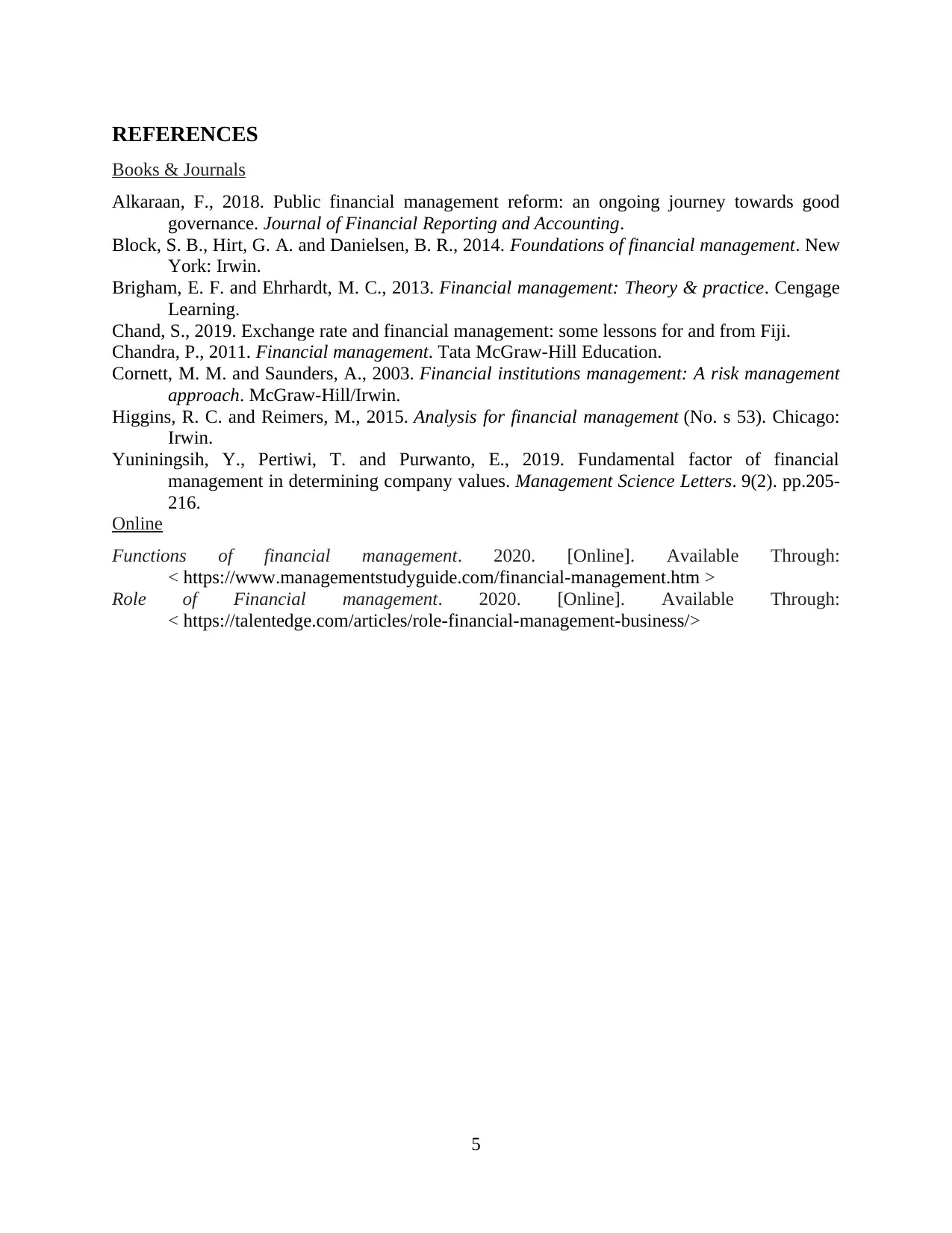
REFERENCES
Books & Journals
Alkaraan, F., 2018. Public financial management reform: an ongoing journey towards good
governance. Journal of Financial Reporting and Accounting.
Block, S. B., Hirt, G. A. and Danielsen, B. R., 2014. Foundations of financial management. New
York: Irwin.
Brigham, E. F. and Ehrhardt, M. C., 2013. Financial management: Theory & practice. Cengage
Learning.
Chand, S., 2019. Exchange rate and financial management: some lessons for and from Fiji.
Chandra, P., 2011. Financial management. Tata McGraw-Hill Education.
Cornett, M. M. and Saunders, A., 2003. Financial institutions management: A risk management
approach. McGraw-Hill/Irwin.
Higgins, R. C. and Reimers, M., 2015. Analysis for financial management (No. s 53). Chicago:
Irwin.
Yuniningsih, Y., Pertiwi, T. and Purwanto, E., 2019. Fundamental factor of financial
management in determining company values. Management Science Letters. 9(2). pp.205-
216.
Online
Functions of financial management. 2020. [Online]. Available Through:
< https://www.managementstudyguide.com/financial-management.htm >
Role of Financial management. 2020. [Online]. Available Through:
< https://talentedge.com/articles/role-financial-management-business/>
5
Books & Journals
Alkaraan, F., 2018. Public financial management reform: an ongoing journey towards good
governance. Journal of Financial Reporting and Accounting.
Block, S. B., Hirt, G. A. and Danielsen, B. R., 2014. Foundations of financial management. New
York: Irwin.
Brigham, E. F. and Ehrhardt, M. C., 2013. Financial management: Theory & practice. Cengage
Learning.
Chand, S., 2019. Exchange rate and financial management: some lessons for and from Fiji.
Chandra, P., 2011. Financial management. Tata McGraw-Hill Education.
Cornett, M. M. and Saunders, A., 2003. Financial institutions management: A risk management
approach. McGraw-Hill/Irwin.
Higgins, R. C. and Reimers, M., 2015. Analysis for financial management (No. s 53). Chicago:
Irwin.
Yuniningsih, Y., Pertiwi, T. and Purwanto, E., 2019. Fundamental factor of financial
management in determining company values. Management Science Letters. 9(2). pp.205-
216.
Online
Functions of financial management. 2020. [Online]. Available Through:
< https://www.managementstudyguide.com/financial-management.htm >
Role of Financial management. 2020. [Online]. Available Through:
< https://talentedge.com/articles/role-financial-management-business/>
5
1 out of 7
Related Documents
Your All-in-One AI-Powered Toolkit for Academic Success.
+13062052269
info@desklib.com
Available 24*7 on WhatsApp / Email
Unlock your academic potential
Copyright © 2020–2026 A2Z Services. All Rights Reserved. Developed and managed by ZUCOL.