University of Chester: Financial Management BU6066 Report
VerifiedAdded on 2023/01/11
|6
|1264
|89
Report
AI Summary
This report delves into the core concepts of financial management, emphasizing the acquisition and optimal utilization of financial resources to achieve organizational goals. It explores the agency theory and its application in understanding the relationships between different stakeholder groups within an organization. The report critically examines the role of management in meeting stakeholder objectives, highlighting the importance of balancing the needs of various stakeholders to avoid conflicts. It also discusses the connection between corporate strategy and financial objectives, and analyzes the key financial decisions including investment, finance, and dividend decisions. Furthermore, the report addresses the role of managerial reward schemes and corporate governance codes in aligning management actions with stakeholder interests. The report concludes by summarizing the key aspects of financial management and the impact of agency theory on meeting stakeholder objectives.

Financial management
Paraphrase This Document
Need a fresh take? Get an instant paraphrase of this document with our AI Paraphraser

TABLE OF CONTENTS
INTRODUCTION...........................................................................................................................................3
MAIN BODY.................................................................................................................................................3
CONCLUSION...............................................................................................................................................5
REFERENCES................................................................................................................................................6
INTRODUCTION...........................................................................................................................................3
MAIN BODY.................................................................................................................................................3
CONCLUSION...............................................................................................................................................5
REFERENCES................................................................................................................................................6

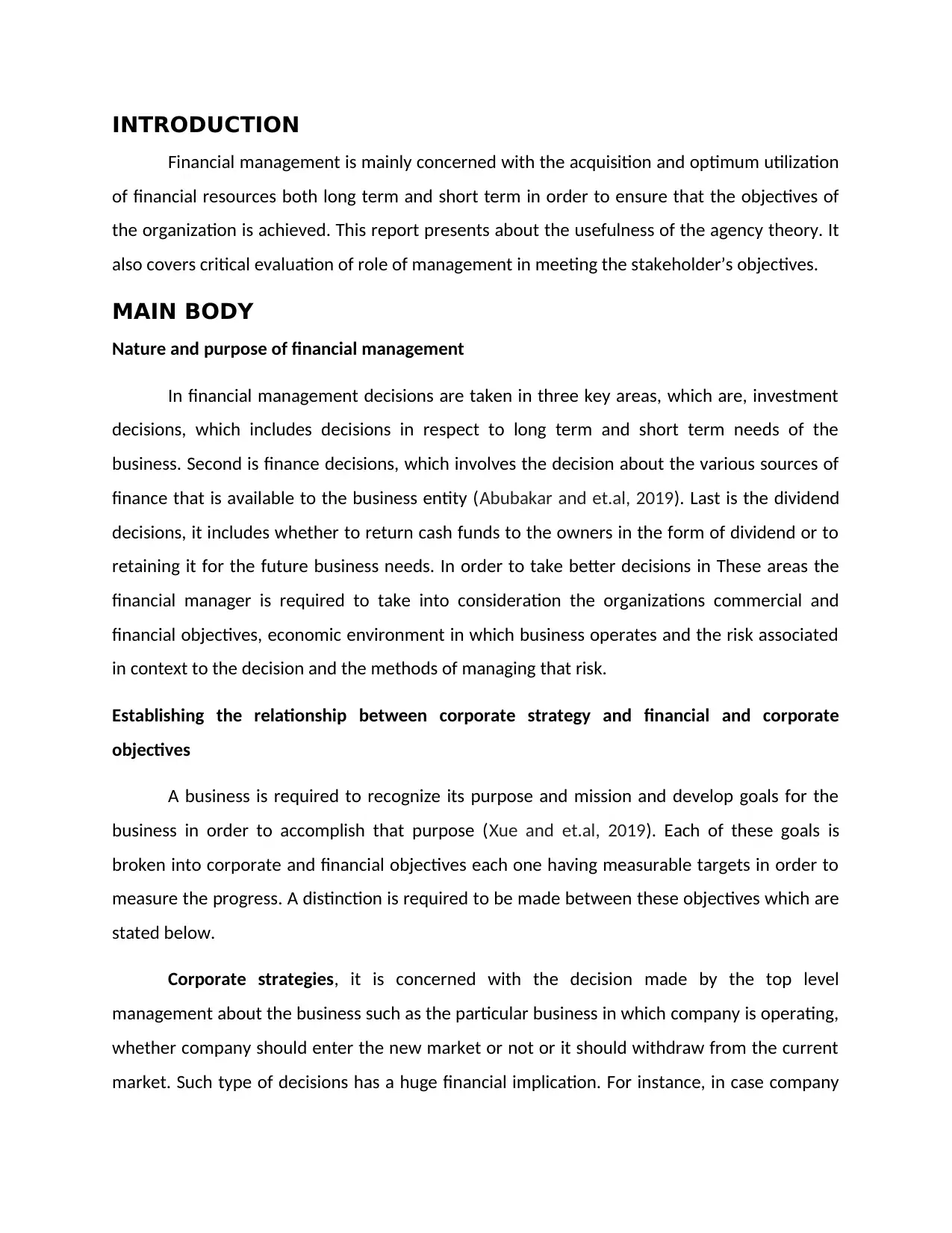
INTRODUCTION
Financial management is mainly concerned with the acquisition and optimum utilization
of financial resources both long term and short term in order to ensure that the objectives of
the organization is achieved. This report presents about the usefulness of the agency theory. It
also covers critical evaluation of role of management in meeting the stakeholder’s objectives.
MAIN BODY
Nature and purpose of financial management
In financial management decisions are taken in three key areas, which are, investment
decisions, which includes decisions in respect to long term and short term needs of the
business. Second is finance decisions, which involves the decision about the various sources of
finance that is available to the business entity (Abubakar and et.al, 2019). Last is the dividend
decisions, it includes whether to return cash funds to the owners in the form of dividend or to
retaining it for the future business needs. In order to take better decisions in These areas the
financial manager is required to take into consideration the organizations commercial and
financial objectives, economic environment in which business operates and the risk associated
in context to the decision and the methods of managing that risk.
Establishing the relationship between corporate strategy and financial and corporate
objectives
A business is required to recognize its purpose and mission and develop goals for the
business in order to accomplish that purpose (Xue and et.al, 2019). Each of these goals is
broken into corporate and financial objectives each one having measurable targets in order to
measure the progress. A distinction is required to be made between these objectives which are
stated below.
Corporate strategies, it is concerned with the decision made by the top level
management about the business such as the particular business in which company is operating,
whether company should enter the new market or not or it should withdraw from the current
market. Such type of decisions has a huge financial implication. For instance, in case company
Financial management is mainly concerned with the acquisition and optimum utilization
of financial resources both long term and short term in order to ensure that the objectives of
the organization is achieved. This report presents about the usefulness of the agency theory. It
also covers critical evaluation of role of management in meeting the stakeholder’s objectives.
MAIN BODY
Nature and purpose of financial management
In financial management decisions are taken in three key areas, which are, investment
decisions, which includes decisions in respect to long term and short term needs of the
business. Second is finance decisions, which involves the decision about the various sources of
finance that is available to the business entity (Abubakar and et.al, 2019). Last is the dividend
decisions, it includes whether to return cash funds to the owners in the form of dividend or to
retaining it for the future business needs. In order to take better decisions in These areas the
financial manager is required to take into consideration the organizations commercial and
financial objectives, economic environment in which business operates and the risk associated
in context to the decision and the methods of managing that risk.
Establishing the relationship between corporate strategy and financial and corporate
objectives
A business is required to recognize its purpose and mission and develop goals for the
business in order to accomplish that purpose (Xue and et.al, 2019). Each of these goals is
broken into corporate and financial objectives each one having measurable targets in order to
measure the progress. A distinction is required to be made between these objectives which are
stated below.
Corporate strategies, it is concerned with the decision made by the top level
management about the business such as the particular business in which company is operating,
whether company should enter the new market or not or it should withdraw from the current
market. Such type of decisions has a huge financial implication. For instance, in case company
⊘ This is a preview!⊘
Do you want full access?
Subscribe today to unlock all pages.

Trusted by 1+ million students worldwide

makes a decision to enter the new market, the company can take either of the one decision,
that is, it can purchase the existing company in that market or start a new company.
Corporate objectives, just like the corporate strategy, its objectives are also set by top
management of the company such as to improve the brand awareness for which it has to take
various marketing decisions.
Financial objectives, these are the objective which are set by the company in measuring
its performance. It includes objectives such as to improve the profitability by 5% from previous
year. But the major financial objective is to maximize the shareholders wealth.
Role of management in meeting stakeholders’ objectives
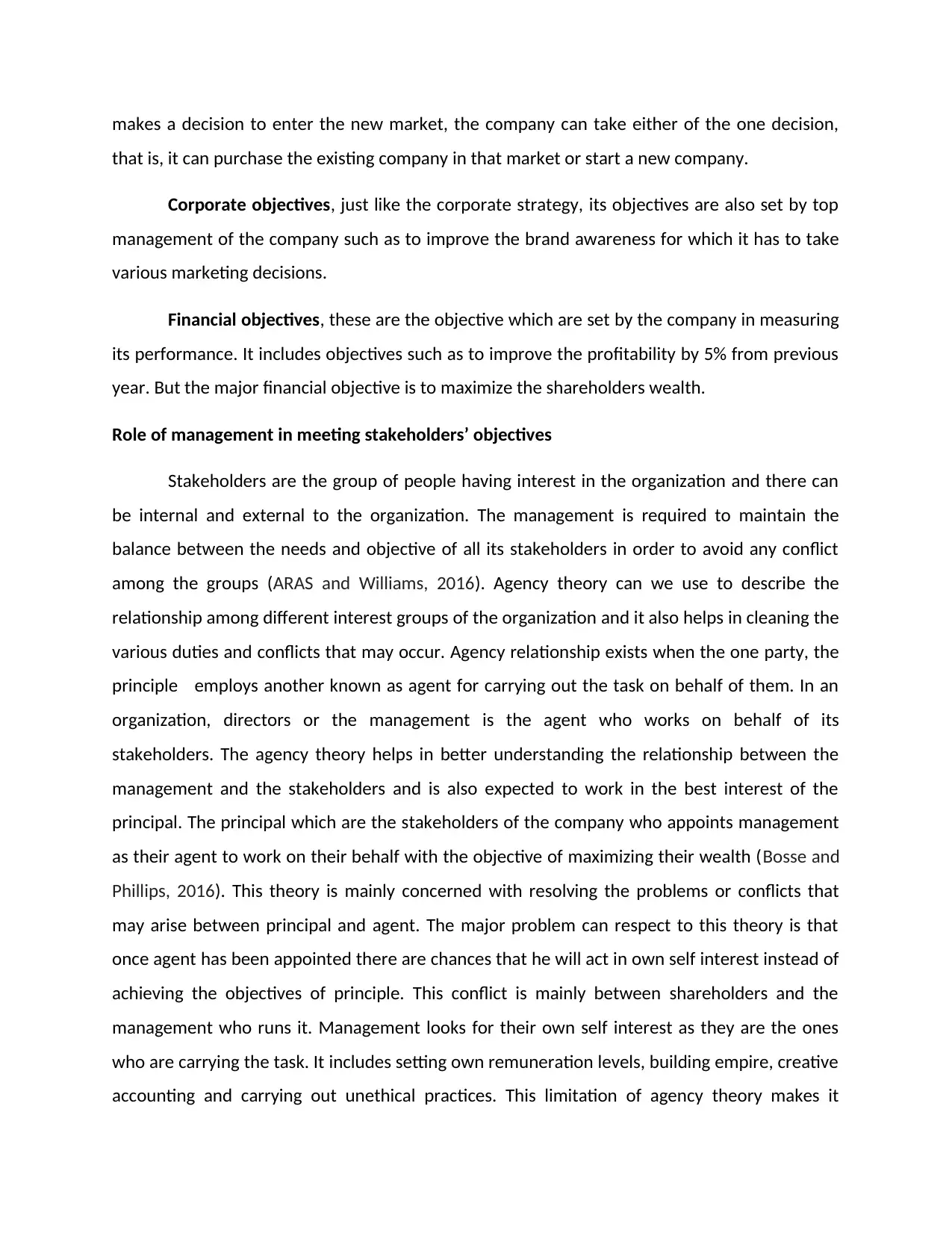
Stakeholders are the group of people having interest in the organization and there can
be internal and external to the organization. The management is required to maintain the
balance between the needs and objective of all its stakeholders in order to avoid any conflict
among the groups (ARAS and Williams, 2016). Agency theory can we use to describe the
relationship among different interest groups of the organization and it also helps in cleaning the
various duties and conflicts that may occur. Agency relationship exists when the one party, the
principle employs another known as agent for carrying out the task on behalf of them. In an
organization, directors or the management is the agent who works on behalf of its
stakeholders. The agency theory helps in better understanding the relationship between the
management and the stakeholders and is also expected to work in the best interest of the
principal. The principal which are the stakeholders of the company who appoints management
as their agent to work on their behalf with the objective of maximizing their wealth (Bosse and
Phillips, 2016). This theory is mainly concerned with resolving the problems or conflicts that
may arise between principal and agent. The major problem can respect to this theory is that
once agent has been appointed there are chances that he will act in own self interest instead of
achieving the objectives of principle. This conflict is mainly between shareholders and the
management who runs it. Management looks for their own self interest as they are the ones
who are carrying the task. It includes setting own remuneration levels, building empire, creative
accounting and carrying out unethical practices. This limitation of agency theory makes it
that is, it can purchase the existing company in that market or start a new company.
Corporate objectives, just like the corporate strategy, its objectives are also set by top
management of the company such as to improve the brand awareness for which it has to take
various marketing decisions.
Financial objectives, these are the objective which are set by the company in measuring
its performance. It includes objectives such as to improve the profitability by 5% from previous
year. But the major financial objective is to maximize the shareholders wealth.
Role of management in meeting stakeholders’ objectives
Stakeholders are the group of people having interest in the organization and there can
be internal and external to the organization. The management is required to maintain the
balance between the needs and objective of all its stakeholders in order to avoid any conflict
among the groups (ARAS and Williams, 2016). Agency theory can we use to describe the
relationship among different interest groups of the organization and it also helps in cleaning the
various duties and conflicts that may occur. Agency relationship exists when the one party, the
principle employs another known as agent for carrying out the task on behalf of them. In an
organization, directors or the management is the agent who works on behalf of its
stakeholders. The agency theory helps in better understanding the relationship between the
management and the stakeholders and is also expected to work in the best interest of the
principal. The principal which are the stakeholders of the company who appoints management
as their agent to work on their behalf with the objective of maximizing their wealth (Bosse and
Phillips, 2016). This theory is mainly concerned with resolving the problems or conflicts that
may arise between principal and agent. The major problem can respect to this theory is that
once agent has been appointed there are chances that he will act in own self interest instead of
achieving the objectives of principle. This conflict is mainly between shareholders and the
management who runs it. Management looks for their own self interest as they are the ones
who are carrying the task. It includes setting own remuneration levels, building empire, creative
accounting and carrying out unethical practices. This limitation of agency theory makes it
Paraphrase This Document
Need a fresh take? Get an instant paraphrase of this document with our AI Paraphraser

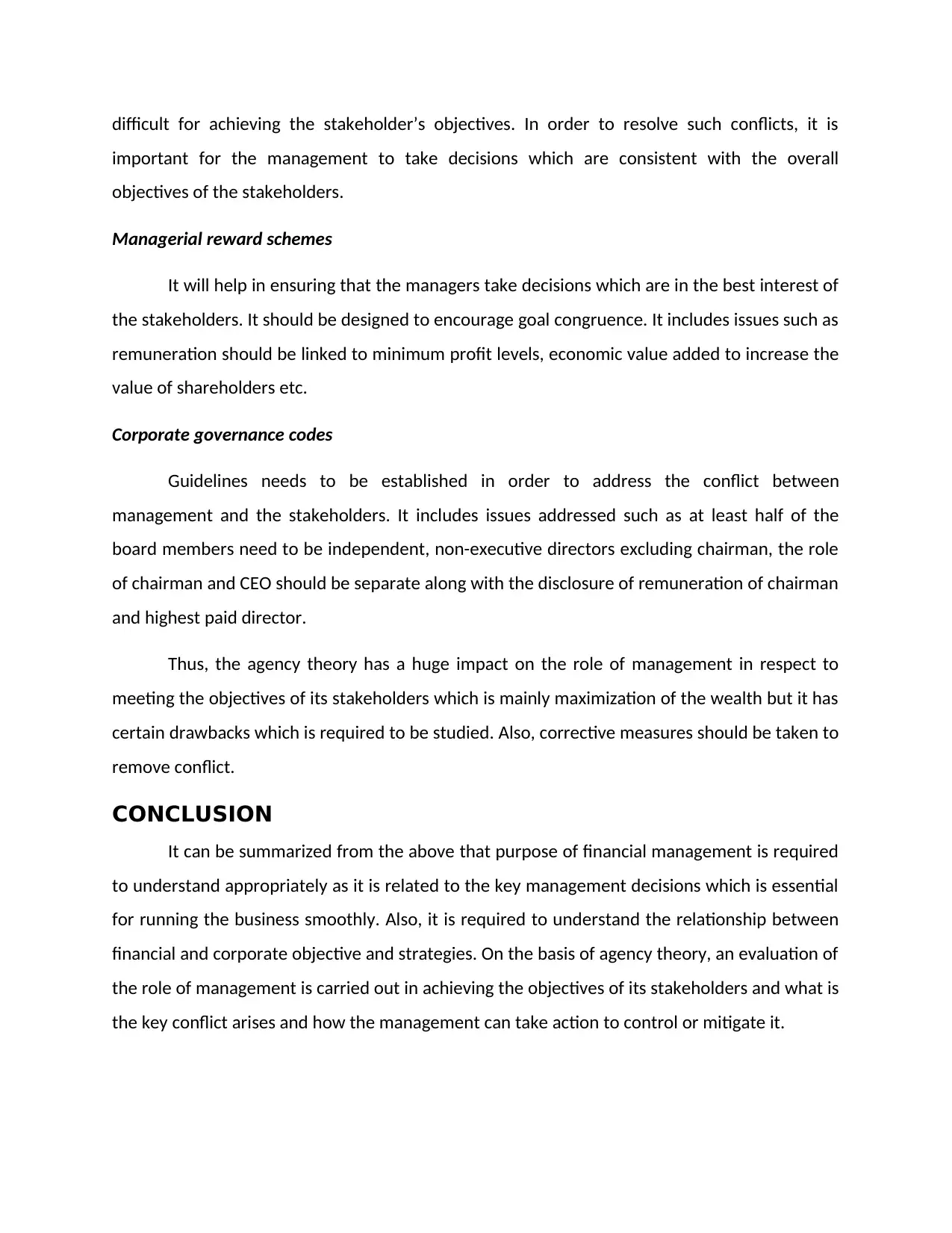
difficult for achieving the stakeholder’s objectives. In order to resolve such conflicts, it is
important for the management to take decisions which are consistent with the overall
objectives of the stakeholders.
Managerial reward schemes
It will help in ensuring that the managers take decisions which are in the best interest of
the stakeholders. It should be designed to encourage goal congruence. It includes issues such as
remuneration should be linked to minimum profit levels, economic value added to increase the
value of shareholders etc.
Corporate governance codes
Guidelines needs to be established in order to address the conflict between
management and the stakeholders. It includes issues addressed such as at least half of the
board members need to be independent, non-executive directors excluding chairman, the role
of chairman and CEO should be separate along with the disclosure of remuneration of chairman
and highest paid director.
Thus, the agency theory has a huge impact on the role of management in respect to
meeting the objectives of its stakeholders which is mainly maximization of the wealth but it has
certain drawbacks which is required to be studied. Also, corrective measures should be taken to
remove conflict.
CONCLUSION
It can be summarized from the above that purpose of financial management is required
to understand appropriately as it is related to the key management decisions which is essential
for running the business smoothly. Also, it is required to understand the relationship between
financial and corporate objective and strategies. On the basis of agency theory, an evaluation of
the role of management is carried out in achieving the objectives of its stakeholders and what is
the key conflict arises and how the management can take action to control or mitigate it.
important for the management to take decisions which are consistent with the overall
objectives of the stakeholders.
Managerial reward schemes
It will help in ensuring that the managers take decisions which are in the best interest of
the stakeholders. It should be designed to encourage goal congruence. It includes issues such as
remuneration should be linked to minimum profit levels, economic value added to increase the
value of shareholders etc.
Corporate governance codes
Guidelines needs to be established in order to address the conflict between
management and the stakeholders. It includes issues addressed such as at least half of the
board members need to be independent, non-executive directors excluding chairman, the role
of chairman and CEO should be separate along with the disclosure of remuneration of chairman
and highest paid director.
Thus, the agency theory has a huge impact on the role of management in respect to
meeting the objectives of its stakeholders which is mainly maximization of the wealth but it has
certain drawbacks which is required to be studied. Also, corrective measures should be taken to
remove conflict.
CONCLUSION
It can be summarized from the above that purpose of financial management is required
to understand appropriately as it is related to the key management decisions which is essential
for running the business smoothly. Also, it is required to understand the relationship between
financial and corporate objective and strategies. On the basis of agency theory, an evaluation of
the role of management is carried out in achieving the objectives of its stakeholders and what is
the key conflict arises and how the management can take action to control or mitigate it.

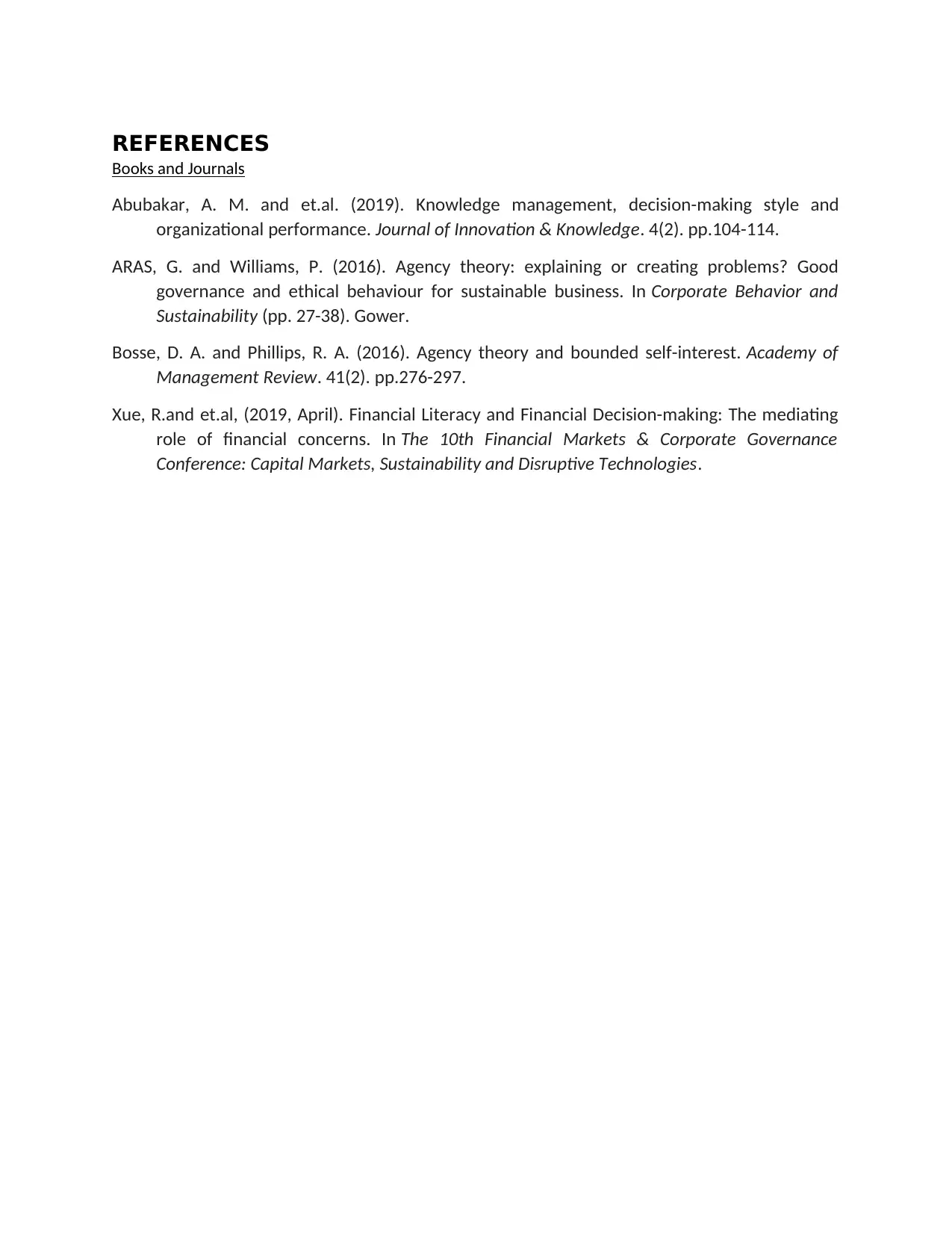
REFERENCES
Books and Journals
Abubakar, A. M. and et.al. (2019). Knowledge management, decision-making style and
organizational performance. Journal of Innovation & Knowledge. 4(2). pp.104-114.
ARAS, G. and Williams, P. (2016). Agency theory: explaining or creating problems? Good
governance and ethical behaviour for sustainable business. In Corporate Behavior and
Sustainability (pp. 27-38). Gower.
Bosse, D. A. and Phillips, R. A. (2016). Agency theory and bounded self-interest. Academy of
Management Review. 41(2). pp.276-297.
Xue, R.and et.al, (2019, April). Financial Literacy and Financial Decision-making: The mediating
role of financial concerns. In The 10th Financial Markets & Corporate Governance
Conference: Capital Markets, Sustainability and Disruptive Technologies.
Books and Journals
Abubakar, A. M. and et.al. (2019). Knowledge management, decision-making style and
organizational performance. Journal of Innovation & Knowledge. 4(2). pp.104-114.
ARAS, G. and Williams, P. (2016). Agency theory: explaining or creating problems? Good
governance and ethical behaviour for sustainable business. In Corporate Behavior and
Sustainability (pp. 27-38). Gower.
Bosse, D. A. and Phillips, R. A. (2016). Agency theory and bounded self-interest. Academy of
Management Review. 41(2). pp.276-297.
Xue, R.and et.al, (2019, April). Financial Literacy and Financial Decision-making: The mediating
role of financial concerns. In The 10th Financial Markets & Corporate Governance
Conference: Capital Markets, Sustainability and Disruptive Technologies.
⊘ This is a preview!⊘
Do you want full access?
Subscribe today to unlock all pages.

Trusted by 1+ million students worldwide
1 out of 6
Related Documents
Your All-in-One AI-Powered Toolkit for Academic Success.
+13062052269
info@desklib.com
Available 24*7 on WhatsApp / Email
Unlock your academic potential
Copyright © 2020–2026 A2Z Services. All Rights Reserved. Developed and managed by ZUCOL.