Financial Management Report: Analysis of Hillside Industries Expansion
VerifiedAdded on 2022/08/11
|12
|2919
|19
Report
AI Summary
This financial management report analyzes the proposed plant expansion of Hillside Industries, a public listed company. It examines the impact on working capital, including the cash conversion cycle and the need for additional working capital due to an increased average collection period. The report further evaluates the expansion's effect on productivity by comparing accounting and cash break-even points before and after the expansion. Finally, the report employs the Net Present Value (NPV) method to assess the project's feasibility, calculating the Weighted Average Cost of Capital (WACC) and determining a positive NPV, supporting the project's acceptance. The analysis highlights the multi-dimensional approach required in financial decision-making, considering various business areas simultaneously.
FINANCIAL MANAGEMENT
REPORT
TO THE BOARD OF
DIRECTORS OF
HILLSIDE
INDUSTRIES
REPORT
TO THE BOARD OF
DIRECTORS OF
HILLSIDE
INDUSTRIES

Paraphrase This Document
Need a fresh take? Get an instant paraphrase of this document with our AI Paraphraser

Executive Summary
Financial management in an organisation involves various decisions and evaluations that are
focussed on the various business areas. The following report highlights the financial
management aspects at the Hillside Industries. As the company is considering the expansion
of the business operations, with the investments in the plant extensions, the related areas such
as the working capital, capital structure are evaluated. Further, the capital budgeting
technique of Net Present Value is employed to assess the feasibility of the project proposal,
based on the forecast of the future cash flows, arising out of expansion. Thus, it has been
concluded that a single financial decision involves multi-dimensional financial management
approach on the part of the top management because of the simultaneous impact on the varied
business areas.
Financial management in an organisation involves various decisions and evaluations that are
focussed on the various business areas. The following report highlights the financial
management aspects at the Hillside Industries. As the company is considering the expansion
of the business operations, with the investments in the plant extensions, the related areas such
as the working capital, capital structure are evaluated. Further, the capital budgeting
technique of Net Present Value is employed to assess the feasibility of the project proposal,
based on the forecast of the future cash flows, arising out of expansion. Thus, it has been
concluded that a single financial decision involves multi-dimensional financial management
approach on the part of the top management because of the simultaneous impact on the varied
business areas.

Contents
Introduction...........................................................................................................................................3
Impact on the working capital...............................................................................................................3
Impact on the productivity.....................................................................................................................5
Project proposal evaluation....................................................................................................................7
Financing decisions...............................................................................................................................9
Conclusion...........................................................................................................................................10
Introduction...........................................................................................................................................3
Impact on the working capital...............................................................................................................3
Impact on the productivity.....................................................................................................................5
Project proposal evaluation....................................................................................................................7
Financing decisions...............................................................................................................................9
Conclusion...........................................................................................................................................10
⊘ This is a preview!⊘
Do you want full access?
Subscribe today to unlock all pages.

Trusted by 1+ million students worldwide
Introduction
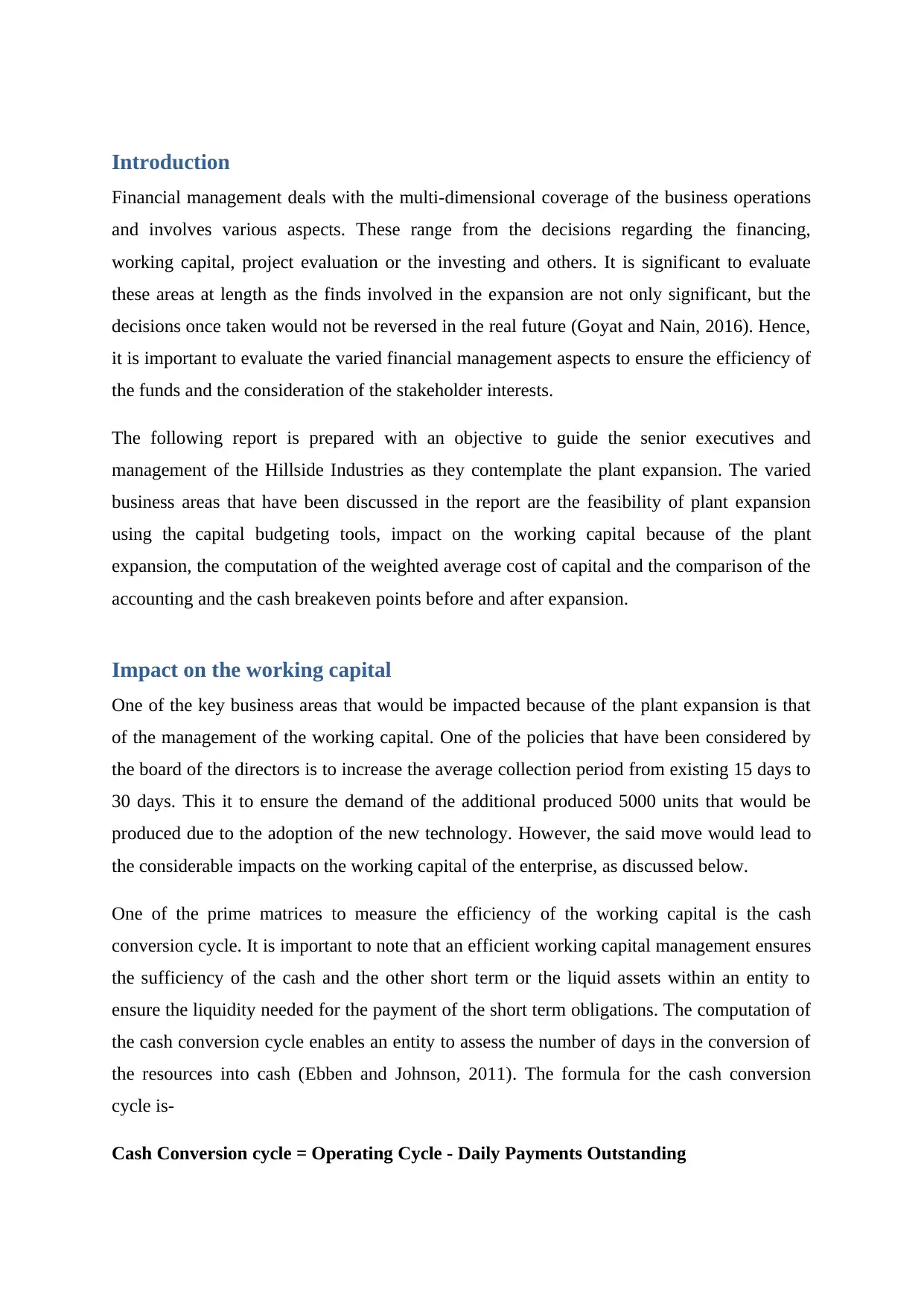
Financial management deals with the multi-dimensional coverage of the business operations
and involves various aspects. These range from the decisions regarding the financing,
working capital, project evaluation or the investing and others. It is significant to evaluate
these areas at length as the finds involved in the expansion are not only significant, but the
decisions once taken would not be reversed in the real future (Goyat and Nain, 2016). Hence,
it is important to evaluate the varied financial management aspects to ensure the efficiency of
the funds and the consideration of the stakeholder interests.
The following report is prepared with an objective to guide the senior executives and
management of the Hillside Industries as they contemplate the plant expansion. The varied
business areas that have been discussed in the report are the feasibility of plant expansion
using the capital budgeting tools, impact on the working capital because of the plant
expansion, the computation of the weighted average cost of capital and the comparison of the
accounting and the cash breakeven points before and after expansion.
Impact on the working capital
One of the key business areas that would be impacted because of the plant expansion is that
of the management of the working capital. One of the policies that have been considered by
the board of the directors is to increase the average collection period from existing 15 days to
30 days. This it to ensure the demand of the additional produced 5000 units that would be
produced due to the adoption of the new technology. However, the said move would lead to
the considerable impacts on the working capital of the enterprise, as discussed below.
One of the prime matrices to measure the efficiency of the working capital is the cash
conversion cycle. It is important to note that an efficient working capital management ensures
the sufficiency of the cash and the other short term or the liquid assets within an entity to
ensure the liquidity needed for the payment of the short term obligations. The computation of
the cash conversion cycle enables an entity to assess the number of days in the conversion of
the resources into cash (Ebben and Johnson, 2011). The formula for the cash conversion
cycle is-
Cash Conversion cycle = Operating Cycle - Daily Payments Outstanding
Financial management deals with the multi-dimensional coverage of the business operations
and involves various aspects. These range from the decisions regarding the financing,
working capital, project evaluation or the investing and others. It is significant to evaluate
these areas at length as the finds involved in the expansion are not only significant, but the
decisions once taken would not be reversed in the real future (Goyat and Nain, 2016). Hence,
it is important to evaluate the varied financial management aspects to ensure the efficiency of
the funds and the consideration of the stakeholder interests.
The following report is prepared with an objective to guide the senior executives and
management of the Hillside Industries as they contemplate the plant expansion. The varied
business areas that have been discussed in the report are the feasibility of plant expansion
using the capital budgeting tools, impact on the working capital because of the plant
expansion, the computation of the weighted average cost of capital and the comparison of the
accounting and the cash breakeven points before and after expansion.
Impact on the working capital
One of the key business areas that would be impacted because of the plant expansion is that
of the management of the working capital. One of the policies that have been considered by
the board of the directors is to increase the average collection period from existing 15 days to
30 days. This it to ensure the demand of the additional produced 5000 units that would be
produced due to the adoption of the new technology. However, the said move would lead to
the considerable impacts on the working capital of the enterprise, as discussed below.
One of the prime matrices to measure the efficiency of the working capital is the cash
conversion cycle. It is important to note that an efficient working capital management ensures
the sufficiency of the cash and the other short term or the liquid assets within an entity to
ensure the liquidity needed for the payment of the short term obligations. The computation of
the cash conversion cycle enables an entity to assess the number of days in the conversion of
the resources into cash (Ebben and Johnson, 2011). The formula for the cash conversion
cycle is-
Cash Conversion cycle = Operating Cycle - Daily Payments Outstanding
Paraphrase This Document
Need a fresh take? Get an instant paraphrase of this document with our AI Paraphraser
Where,
Operating cycle = Daily Sales Outstanding + Daily Inventory Outstanding
The Daily Sales Outstanding or the Average Collection Period refers to the time taken by the
debtors to be converted into cash (Pogue, 2010). The Daily Payments Outstanding or the
Average Payment Period refers to the time taken by the entity to release the payments to the
creditors.
Thus, it is desired by the entities to keep the cash conversion cycle low, so as to ensure the
availability of the cash within the organisation (Attari and Raza, 2012). In addition, as per the
concept of the time value of money, the money in hand today is of more value than the one to
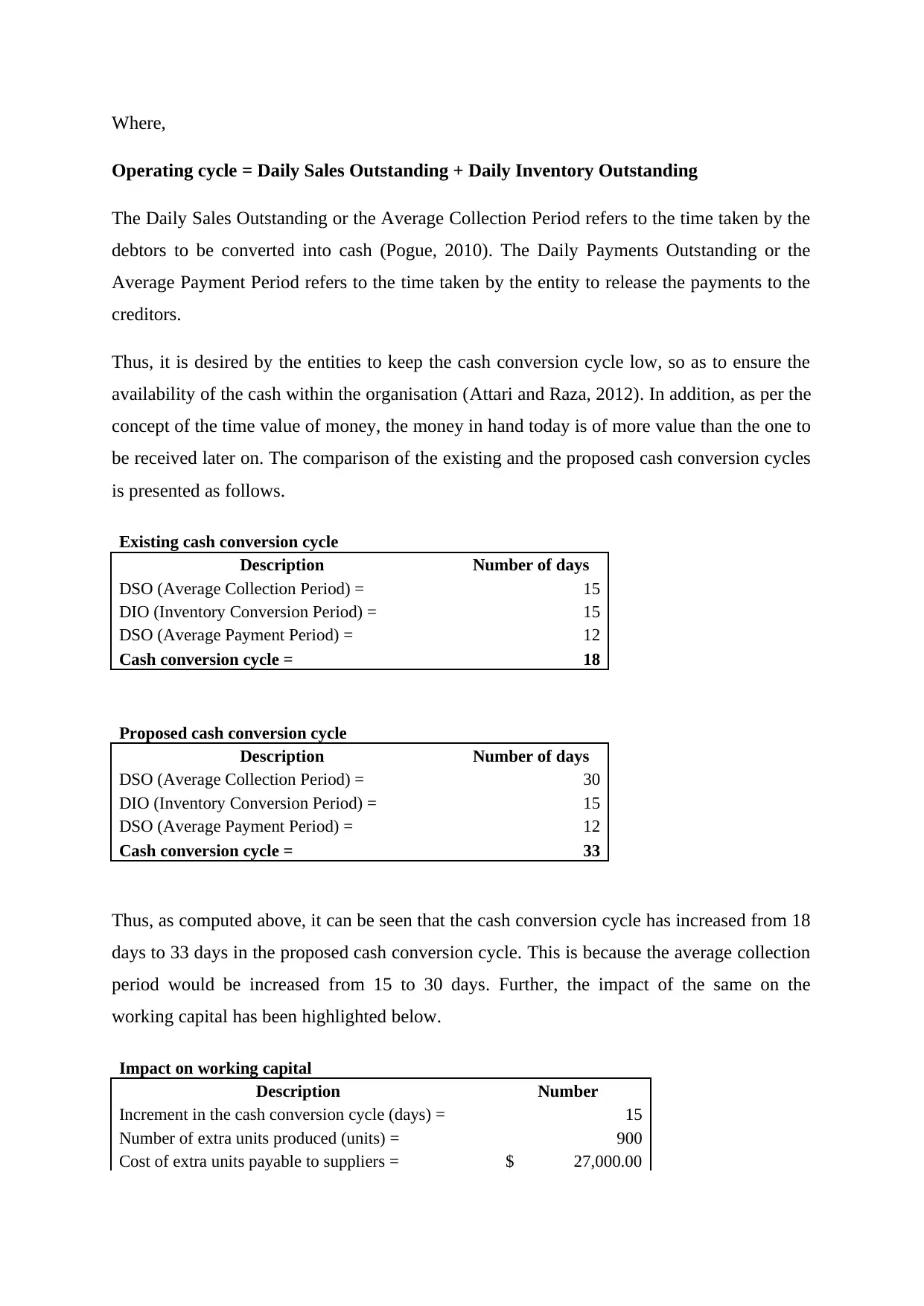
be received later on. The comparison of the existing and the proposed cash conversion cycles
is presented as follows.
Existing cash conversion cycle
Description Number of days
DSO (Average Collection Period) = 15
DIO (Inventory Conversion Period) = 15
DSO (Average Payment Period) = 12
Cash conversion cycle = 18
Proposed cash conversion cycle
Description Number of days
DSO (Average Collection Period) = 30
DIO (Inventory Conversion Period) = 15
DSO (Average Payment Period) = 12
Cash conversion cycle = 33
Thus, as computed above, it can be seen that the cash conversion cycle has increased from 18
days to 33 days in the proposed cash conversion cycle. This is because the average collection
period would be increased from 15 to 30 days. Further, the impact of the same on the
working capital has been highlighted below.
Impact on working capital
Description Number
Increment in the cash conversion cycle (days) = 15
Number of extra units produced (units) = 900
Cost of extra units payable to suppliers = $ 27,000.00
Operating cycle = Daily Sales Outstanding + Daily Inventory Outstanding
The Daily Sales Outstanding or the Average Collection Period refers to the time taken by the
debtors to be converted into cash (Pogue, 2010). The Daily Payments Outstanding or the
Average Payment Period refers to the time taken by the entity to release the payments to the
creditors.
Thus, it is desired by the entities to keep the cash conversion cycle low, so as to ensure the
availability of the cash within the organisation (Attari and Raza, 2012). In addition, as per the
concept of the time value of money, the money in hand today is of more value than the one to
be received later on. The comparison of the existing and the proposed cash conversion cycles
is presented as follows.
Existing cash conversion cycle
Description Number of days
DSO (Average Collection Period) = 15
DIO (Inventory Conversion Period) = 15
DSO (Average Payment Period) = 12
Cash conversion cycle = 18
Proposed cash conversion cycle
Description Number of days
DSO (Average Collection Period) = 30
DIO (Inventory Conversion Period) = 15
DSO (Average Payment Period) = 12
Cash conversion cycle = 33
Thus, as computed above, it can be seen that the cash conversion cycle has increased from 18
days to 33 days in the proposed cash conversion cycle. This is because the average collection
period would be increased from 15 to 30 days. Further, the impact of the same on the
working capital has been highlighted below.
Impact on working capital
Description Number
Increment in the cash conversion cycle (days) = 15
Number of extra units produced (units) = 900
Cost of extra units payable to suppliers = $ 27,000.00
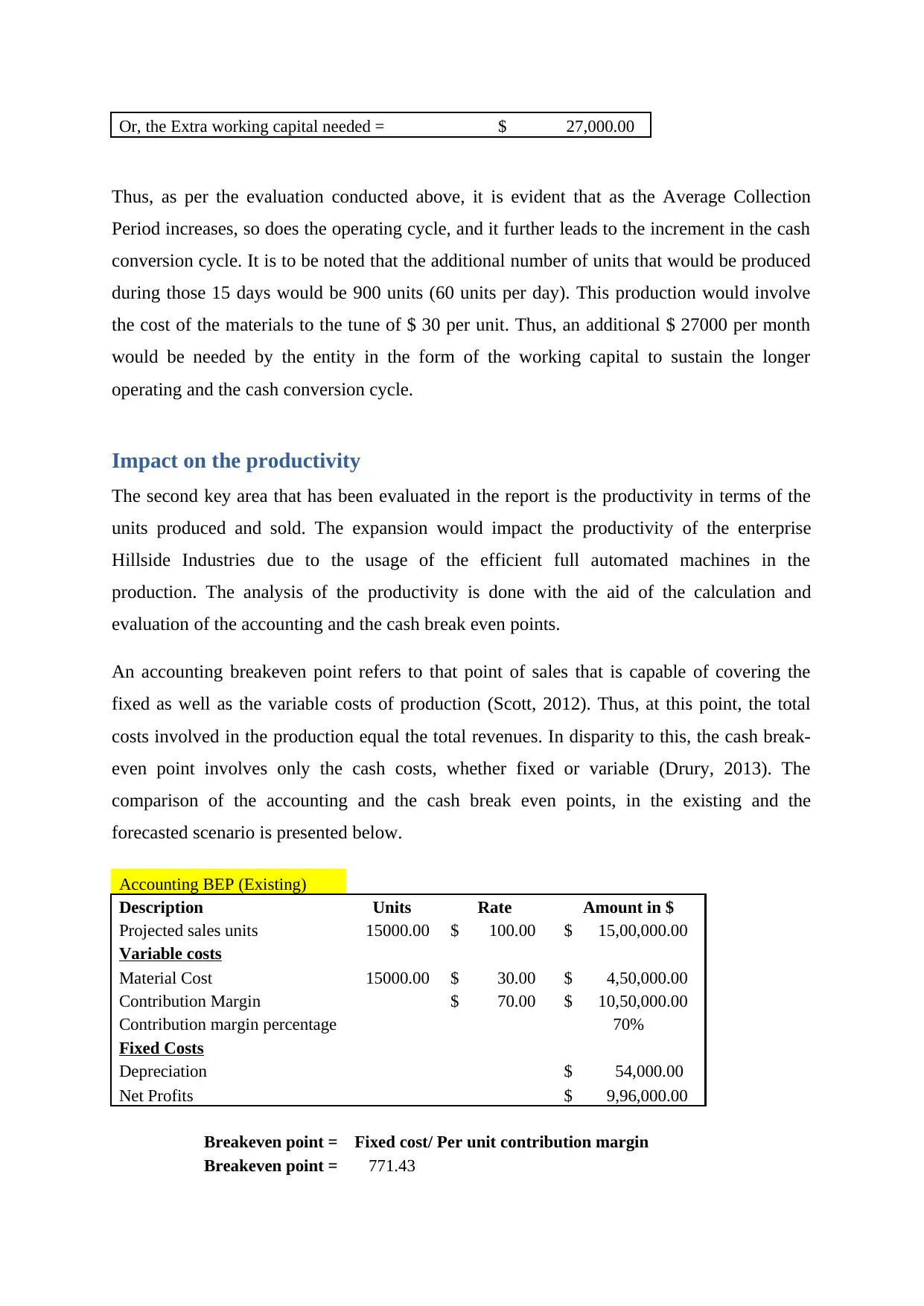
Or, the Extra working capital needed = $ 27,000.00
Thus, as per the evaluation conducted above, it is evident that as the Average Collection
Period increases, so does the operating cycle, and it further leads to the increment in the cash
conversion cycle. It is to be noted that the additional number of units that would be produced
during those 15 days would be 900 units (60 units per day). This production would involve
the cost of the materials to the tune of $ 30 per unit. Thus, an additional $ 27000 per month
would be needed by the entity in the form of the working capital to sustain the longer
operating and the cash conversion cycle.
Impact on the productivity
The second key area that has been evaluated in the report is the productivity in terms of the
units produced and sold. The expansion would impact the productivity of the enterprise
Hillside Industries due to the usage of the efficient full automated machines in the
production. The analysis of the productivity is done with the aid of the calculation and
evaluation of the accounting and the cash break even points.
An accounting breakeven point refers to that point of sales that is capable of covering the
fixed as well as the variable costs of production (Scott, 2012). Thus, at this point, the total
costs involved in the production equal the total revenues. In disparity to this, the cash break-
even point involves only the cash costs, whether fixed or variable (Drury, 2013). The
comparison of the accounting and the cash break even points, in the existing and the
forecasted scenario is presented below.
Accounting BEP (Existing)
Description Units Rate Amount in $
Projected sales units 15000.00 $ 100.00 $ 15,00,000.00
Variable costs
Material Cost 15000.00 $ 30.00 $ 4,50,000.00
Contribution Margin $ 70.00 $ 10,50,000.00
Contribution margin percentage 70%
Fixed Costs
Depreciation $ 54,000.00
Net Profits $ 9,96,000.00
Breakeven point = Fixed cost/ Per unit contribution margin
Breakeven point = 771.43
Thus, as per the evaluation conducted above, it is evident that as the Average Collection
Period increases, so does the operating cycle, and it further leads to the increment in the cash
conversion cycle. It is to be noted that the additional number of units that would be produced
during those 15 days would be 900 units (60 units per day). This production would involve
the cost of the materials to the tune of $ 30 per unit. Thus, an additional $ 27000 per month
would be needed by the entity in the form of the working capital to sustain the longer
operating and the cash conversion cycle.
Impact on the productivity
The second key area that has been evaluated in the report is the productivity in terms of the
units produced and sold. The expansion would impact the productivity of the enterprise
Hillside Industries due to the usage of the efficient full automated machines in the
production. The analysis of the productivity is done with the aid of the calculation and
evaluation of the accounting and the cash break even points.
An accounting breakeven point refers to that point of sales that is capable of covering the
fixed as well as the variable costs of production (Scott, 2012). Thus, at this point, the total
costs involved in the production equal the total revenues. In disparity to this, the cash break-
even point involves only the cash costs, whether fixed or variable (Drury, 2013). The
comparison of the accounting and the cash break even points, in the existing and the
forecasted scenario is presented below.
Accounting BEP (Existing)
Description Units Rate Amount in $
Projected sales units 15000.00 $ 100.00 $ 15,00,000.00
Variable costs
Material Cost 15000.00 $ 30.00 $ 4,50,000.00
Contribution Margin $ 70.00 $ 10,50,000.00
Contribution margin percentage 70%
Fixed Costs
Depreciation $ 54,000.00
Net Profits $ 9,96,000.00
Breakeven point = Fixed cost/ Per unit contribution margin
Breakeven point = 771.43
⊘ This is a preview!⊘
Do you want full access?
Subscribe today to unlock all pages.
Trusted by 1+ million students worldwide
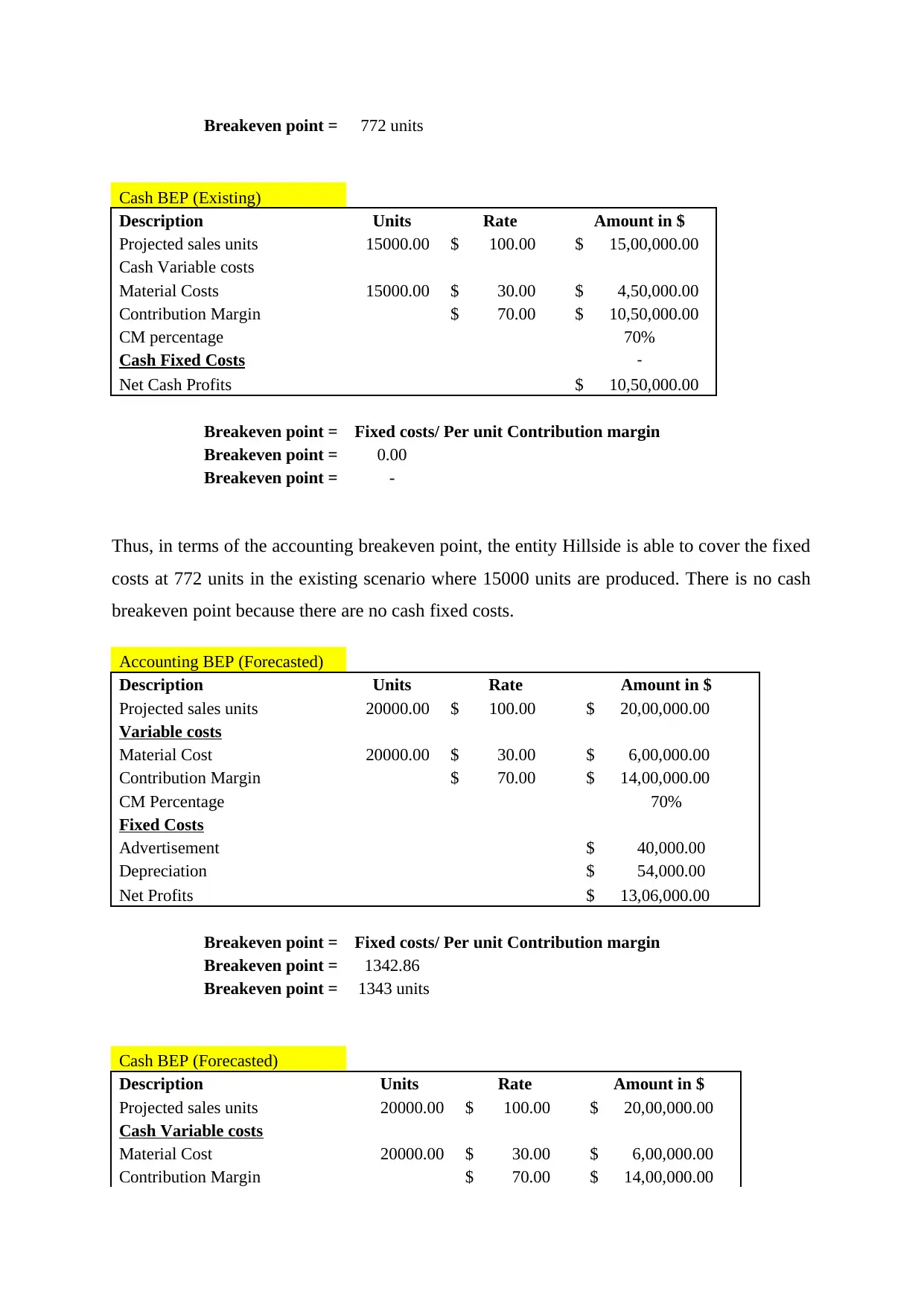
Breakeven point = 772 units
Cash BEP (Existing)
Description Units Rate Amount in $
Projected sales units 15000.00 $ 100.00 $ 15,00,000.00
Cash Variable costs
Material Costs 15000.00 $ 30.00 $ 4,50,000.00
Contribution Margin $ 70.00 $ 10,50,000.00
CM percentage 70%
Cash Fixed Costs -
Net Cash Profits $ 10,50,000.00
Breakeven point = Fixed costs/ Per unit Contribution margin
Breakeven point = 0.00
Breakeven point = -
Thus, in terms of the accounting breakeven point, the entity Hillside is able to cover the fixed
costs at 772 units in the existing scenario where 15000 units are produced. There is no cash
breakeven point because there are no cash fixed costs.
Accounting BEP (Forecasted)
Description Units Rate Amount in $
Projected sales units 20000.00 $ 100.00 $ 20,00,000.00
Variable costs
Material Cost 20000.00 $ 30.00 $ 6,00,000.00
Contribution Margin $ 70.00 $ 14,00,000.00
CM Percentage 70%
Fixed Costs
Advertisement $ 40,000.00
Depreciation $ 54,000.00
Net Profits $ 13,06,000.00
Breakeven point = Fixed costs/ Per unit Contribution margin
Breakeven point = 1342.86
Breakeven point = 1343 units
Cash BEP (Forecasted)
Description Units Rate Amount in $
Projected sales units 20000.00 $ 100.00 $ 20,00,000.00
Cash Variable costs
Material Cost 20000.00 $ 30.00 $ 6,00,000.00
Contribution Margin $ 70.00 $ 14,00,000.00
Cash BEP (Existing)
Description Units Rate Amount in $
Projected sales units 15000.00 $ 100.00 $ 15,00,000.00
Cash Variable costs
Material Costs 15000.00 $ 30.00 $ 4,50,000.00
Contribution Margin $ 70.00 $ 10,50,000.00
CM percentage 70%
Cash Fixed Costs -
Net Cash Profits $ 10,50,000.00
Breakeven point = Fixed costs/ Per unit Contribution margin
Breakeven point = 0.00
Breakeven point = -
Thus, in terms of the accounting breakeven point, the entity Hillside is able to cover the fixed
costs at 772 units in the existing scenario where 15000 units are produced. There is no cash
breakeven point because there are no cash fixed costs.
Accounting BEP (Forecasted)
Description Units Rate Amount in $
Projected sales units 20000.00 $ 100.00 $ 20,00,000.00
Variable costs
Material Cost 20000.00 $ 30.00 $ 6,00,000.00
Contribution Margin $ 70.00 $ 14,00,000.00
CM Percentage 70%
Fixed Costs
Advertisement $ 40,000.00
Depreciation $ 54,000.00
Net Profits $ 13,06,000.00
Breakeven point = Fixed costs/ Per unit Contribution margin
Breakeven point = 1342.86
Breakeven point = 1343 units
Cash BEP (Forecasted)
Description Units Rate Amount in $
Projected sales units 20000.00 $ 100.00 $ 20,00,000.00
Cash Variable costs
Material Cost 20000.00 $ 30.00 $ 6,00,000.00
Contribution Margin $ 70.00 $ 14,00,000.00
Paraphrase This Document
Need a fresh take? Get an instant paraphrase of this document with our AI Paraphraser
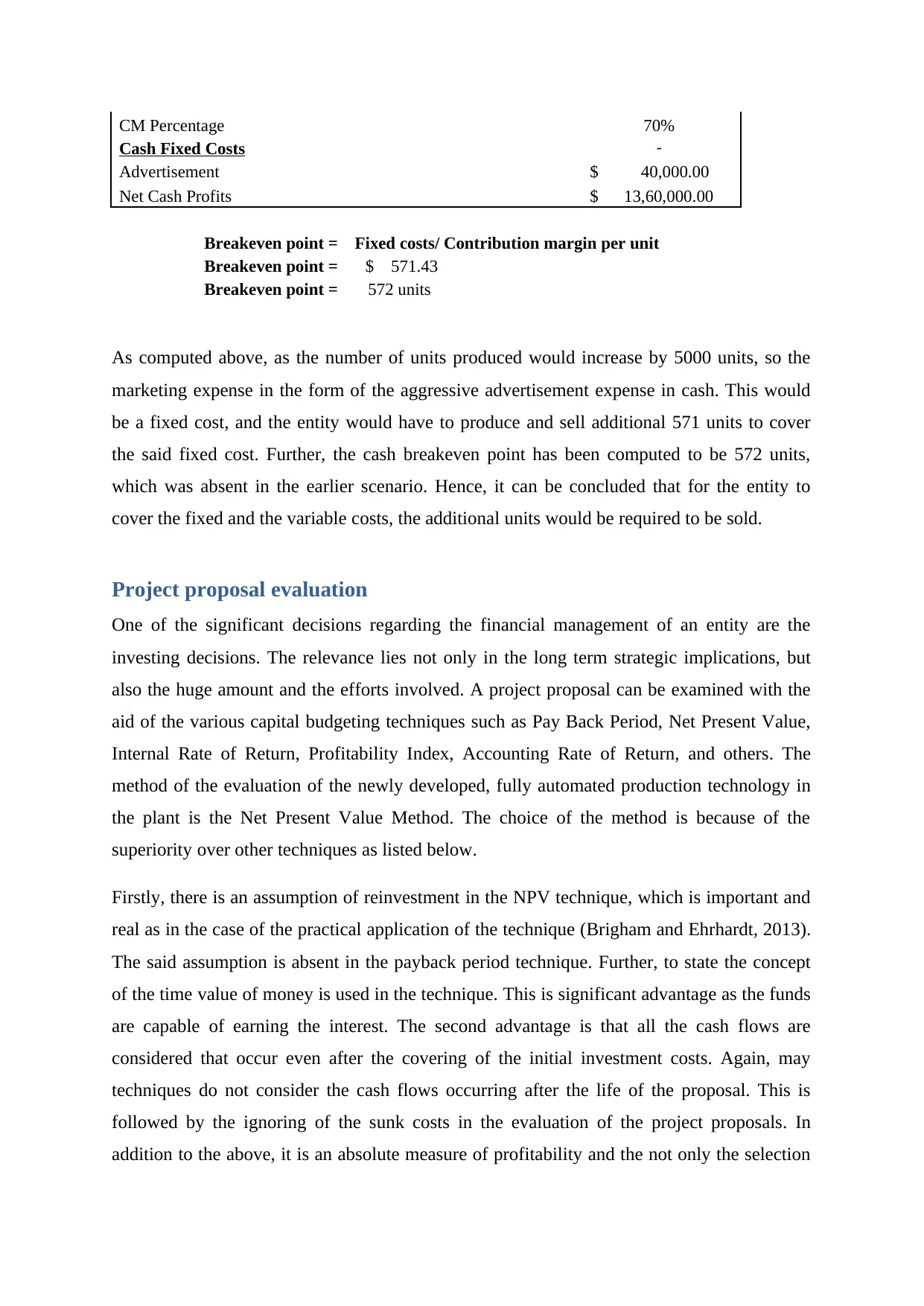
CM Percentage 70%
Cash Fixed Costs -
Advertisement $ 40,000.00
Net Cash Profits $ 13,60,000.00
Breakeven point = Fixed costs/ Contribution margin per unit
Breakeven point = $ 571.43
Breakeven point = 572 units
As computed above, as the number of units produced would increase by 5000 units, so the
marketing expense in the form of the aggressive advertisement expense in cash. This would
be a fixed cost, and the entity would have to produce and sell additional 571 units to cover
the said fixed cost. Further, the cash breakeven point has been computed to be 572 units,
which was absent in the earlier scenario. Hence, it can be concluded that for the entity to
cover the fixed and the variable costs, the additional units would be required to be sold.
Project proposal evaluation
One of the significant decisions regarding the financial management of an entity are the
investing decisions. The relevance lies not only in the long term strategic implications, but
also the huge amount and the efforts involved. A project proposal can be examined with the
aid of the various capital budgeting techniques such as Pay Back Period, Net Present Value,
Internal Rate of Return, Profitability Index, Accounting Rate of Return, and others. The
method of the evaluation of the newly developed, fully automated production technology in
the plant is the Net Present Value Method. The choice of the method is because of the
superiority over other techniques as listed below.
Firstly, there is an assumption of reinvestment in the NPV technique, which is important and
real as in the case of the practical application of the technique (Brigham and Ehrhardt, 2013).
The said assumption is absent in the payback period technique. Further, to state the concept
of the time value of money is used in the technique. This is significant advantage as the funds
are capable of earning the interest. The second advantage is that all the cash flows are
considered that occur even after the covering of the initial investment costs. Again, may
techniques do not consider the cash flows occurring after the life of the proposal. This is
followed by the ignoring of the sunk costs in the evaluation of the project proposals. In
addition to the above, it is an absolute measure of profitability and the not only the selection
Cash Fixed Costs -
Advertisement $ 40,000.00
Net Cash Profits $ 13,60,000.00
Breakeven point = Fixed costs/ Contribution margin per unit
Breakeven point = $ 571.43
Breakeven point = 572 units
As computed above, as the number of units produced would increase by 5000 units, so the
marketing expense in the form of the aggressive advertisement expense in cash. This would
be a fixed cost, and the entity would have to produce and sell additional 571 units to cover
the said fixed cost. Further, the cash breakeven point has been computed to be 572 units,
which was absent in the earlier scenario. Hence, it can be concluded that for the entity to
cover the fixed and the variable costs, the additional units would be required to be sold.
Project proposal evaluation
One of the significant decisions regarding the financial management of an entity are the
investing decisions. The relevance lies not only in the long term strategic implications, but
also the huge amount and the efforts involved. A project proposal can be examined with the
aid of the various capital budgeting techniques such as Pay Back Period, Net Present Value,
Internal Rate of Return, Profitability Index, Accounting Rate of Return, and others. The
method of the evaluation of the newly developed, fully automated production technology in
the plant is the Net Present Value Method. The choice of the method is because of the
superiority over other techniques as listed below.
Firstly, there is an assumption of reinvestment in the NPV technique, which is important and
real as in the case of the practical application of the technique (Brigham and Ehrhardt, 2013).
The said assumption is absent in the payback period technique. Further, to state the concept
of the time value of money is used in the technique. This is significant advantage as the funds
are capable of earning the interest. The second advantage is that all the cash flows are
considered that occur even after the covering of the initial investment costs. Again, may
techniques do not consider the cash flows occurring after the life of the proposal. This is
followed by the ignoring of the sunk costs in the evaluation of the project proposals. In
addition to the above, it is an absolute measure of profitability and the not only the selection
or the rejection of the proposal is suggested, but also the exact profits are determined (Gὂtze,
Northcott and Schuster, 2015).
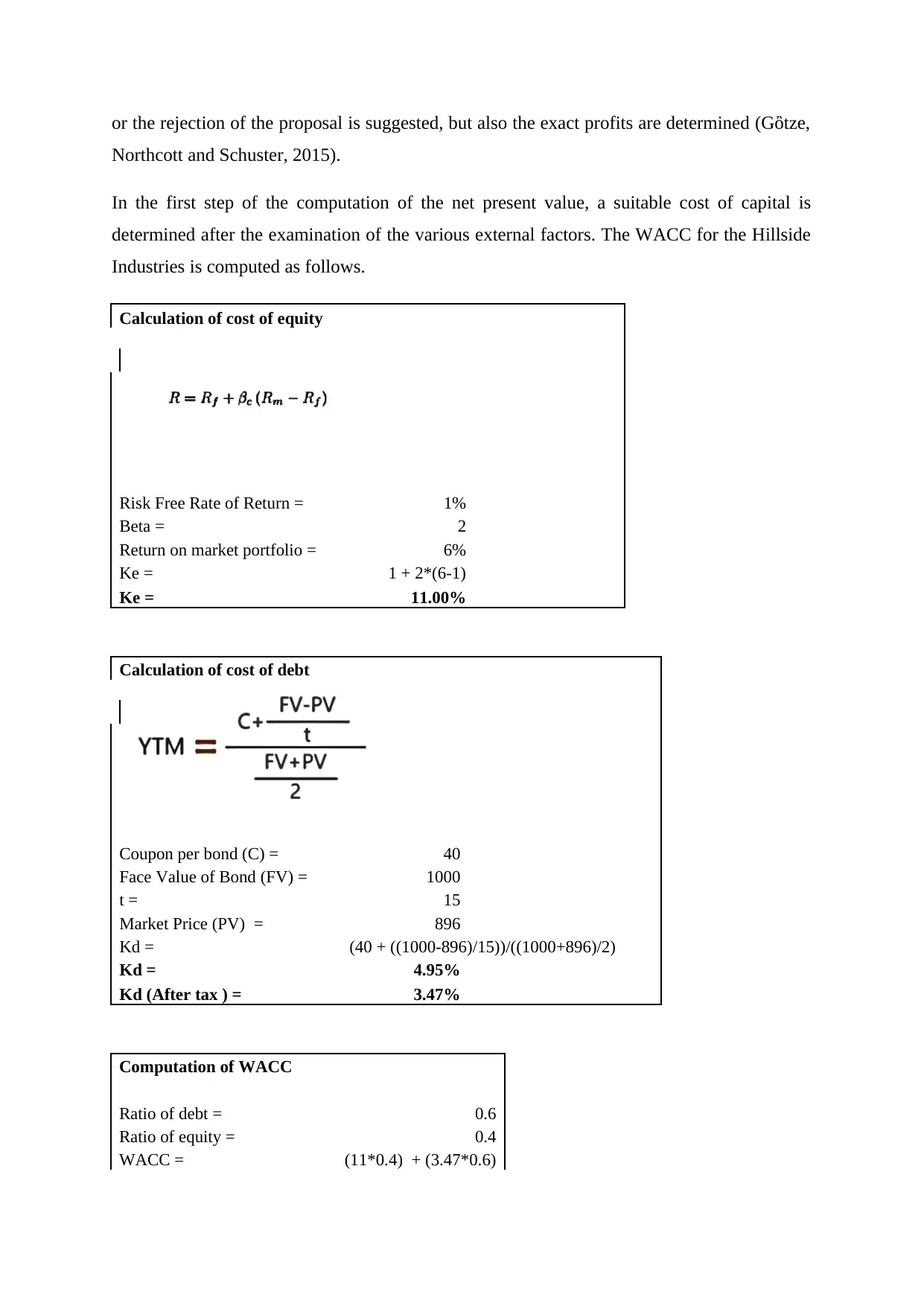
In the first step of the computation of the net present value, a suitable cost of capital is
determined after the examination of the various external factors. The WACC for the Hillside
Industries is computed as follows.
Calculation of cost of equity
Risk Free Rate of Return = 1%
Beta = 2
Return on market portfolio = 6%
Ke = 1 + 2*(6-1)
Ke = 11.00%
Calculation of cost of debt
Coupon per bond (C) = 40
Face Value of Bond (FV) = 1000
t = 15
Market Price (PV) = 896
Kd = (40 + ((1000-896)/15))/((1000+896)/2)
Kd = 4.95%
Kd (After tax ) = 3.47%
Computation of WACC
Ratio of debt = 0.6
Ratio of equity = 0.4
WACC = (11*0.4) + (3.47*0.6)
Northcott and Schuster, 2015).
In the first step of the computation of the net present value, a suitable cost of capital is
determined after the examination of the various external factors. The WACC for the Hillside
Industries is computed as follows.
Calculation of cost of equity
Risk Free Rate of Return = 1%
Beta = 2
Return on market portfolio = 6%
Ke = 1 + 2*(6-1)
Ke = 11.00%
Calculation of cost of debt
Coupon per bond (C) = 40
Face Value of Bond (FV) = 1000
t = 15
Market Price (PV) = 896
Kd = (40 + ((1000-896)/15))/((1000+896)/2)
Kd = 4.95%
Kd (After tax ) = 3.47%
Computation of WACC
Ratio of debt = 0.6
Ratio of equity = 0.4
WACC = (11*0.4) + (3.47*0.6)
⊘ This is a preview!⊘
Do you want full access?
Subscribe today to unlock all pages.
Trusted by 1+ million students worldwide
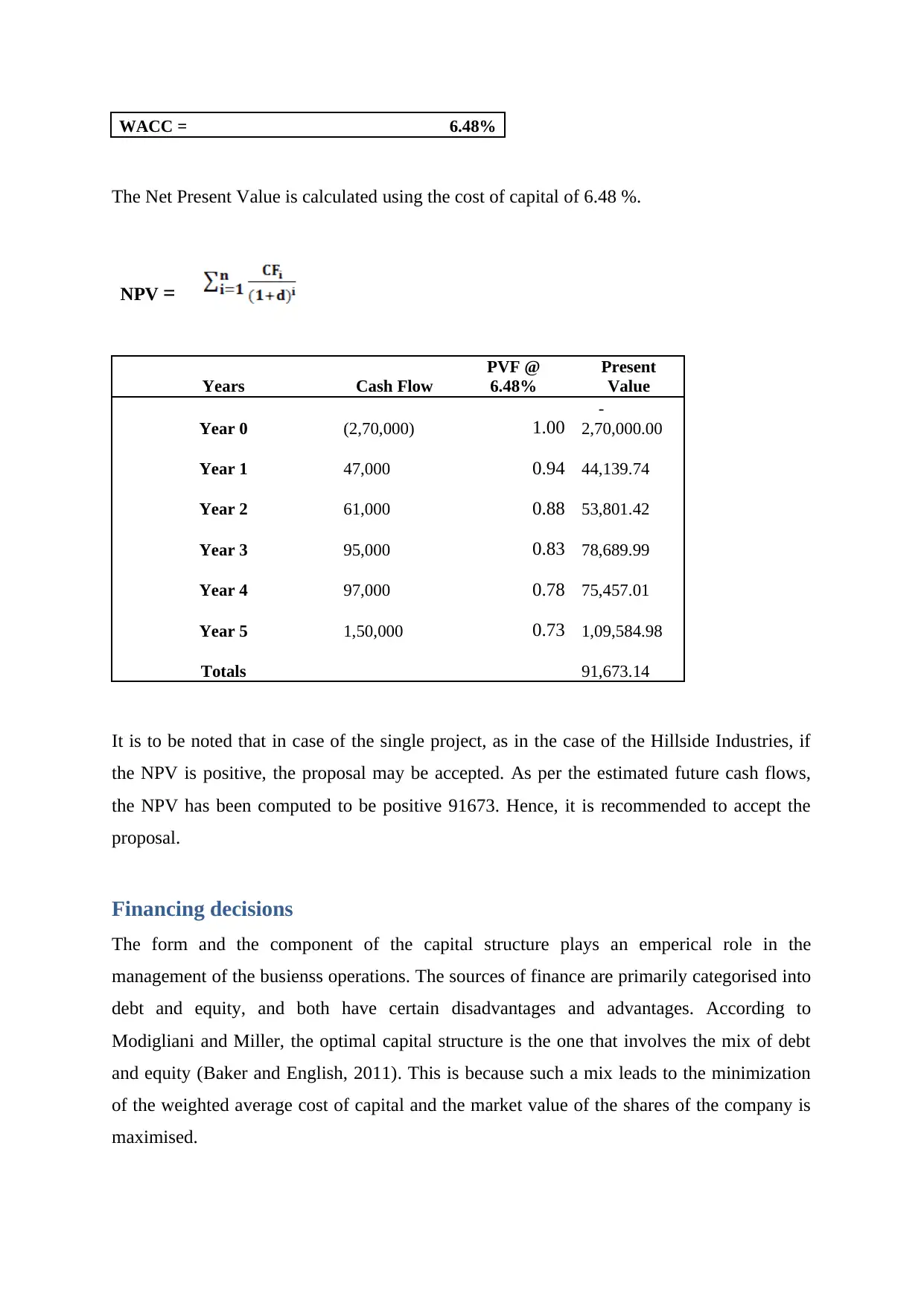
WACC = 6.48%
The Net Present Value is calculated using the cost of capital of 6.48 %.
NPV =
Years Cash Flow
PVF @
6.48%
Present
Value
Year 0 (2,70,000) 1.00
-
2,70,000.00
Year 1 47,000 0.94 44,139.74
Year 2 61,000 0.88 53,801.42
Year 3 95,000 0.83 78,689.99
Year 4 97,000 0.78 75,457.01
Year 5 1,50,000 0.73 1,09,584.98
Totals 91,673.14
It is to be noted that in case of the single project, as in the case of the Hillside Industries, if
the NPV is positive, the proposal may be accepted. As per the estimated future cash flows,
the NPV has been computed to be positive 91673. Hence, it is recommended to accept the
proposal.
Financing decisions
The form and the component of the capital structure plays an emperical role in the
management of the busienss operations. The sources of finance are primarily categorised into
debt and equity, and both have certain disadvantages and advantages. According to
Modigliani and Miller, the optimal capital structure is the one that involves the mix of debt
and equity (Baker and English, 2011). This is because such a mix leads to the minimization
of the weighted average cost of capital and the market value of the shares of the company is
maximised.
The Net Present Value is calculated using the cost of capital of 6.48 %.
NPV =
Years Cash Flow
PVF @
6.48%
Present
Value
Year 0 (2,70,000) 1.00
-
2,70,000.00
Year 1 47,000 0.94 44,139.74
Year 2 61,000 0.88 53,801.42
Year 3 95,000 0.83 78,689.99
Year 4 97,000 0.78 75,457.01
Year 5 1,50,000 0.73 1,09,584.98
Totals 91,673.14
It is to be noted that in case of the single project, as in the case of the Hillside Industries, if
the NPV is positive, the proposal may be accepted. As per the estimated future cash flows,
the NPV has been computed to be positive 91673. Hence, it is recommended to accept the
proposal.
Financing decisions
The form and the component of the capital structure plays an emperical role in the
management of the busienss operations. The sources of finance are primarily categorised into
debt and equity, and both have certain disadvantages and advantages. According to
Modigliani and Miller, the optimal capital structure is the one that involves the mix of debt
and equity (Baker and English, 2011). This is because such a mix leads to the minimization
of the weighted average cost of capital and the market value of the shares of the company is
maximised.
Paraphrase This Document
Need a fresh take? Get an instant paraphrase of this document with our AI Paraphraser
As stated in the previous parts, the overall cost of capital of the company was calculated to be
6.48 %. The advantage of taxation in the cost of debt led to the reduction in the overall cost
of captial while the cost of equity was much higher than the cost of debt. Accordingly, it has
been recommended to the board of directors to raise the additional funds for the expansion
through the debt mode itself, to create a tax shelter on the increased earnings of the company.
The benefits of the debt financing are highlighted in brief as follows.
The debt financing does not leads to the dilution of the control of the existing owners, and
thus reduces the conflicting decisions in the management of the enterprise. This is followed
by the leverage effect on the cost of capital. Further, apart from the regular interest payments,
there is no burdern of sharing of the profits, and the market value is not affected.
Conclusion
The previous parts of the report highighted the evaluation of varius areas that woud be
impacted with the new project proposal into consideration, that are the workin capital,
productivity, and the captial structure. Based on the qualitative and the quantitavive factors as
analysed in the report, it has been recommended to the management to accept the project
proposal and carry on the expansion of the enterprise with the new automated technology.
The said proposal is efficient from the NPV point of view, and must be financed by debt.
Additionally the working capital changes are manageable and board must ensure to maintain
the liquidity in the financing.
6.48 %. The advantage of taxation in the cost of debt led to the reduction in the overall cost
of captial while the cost of equity was much higher than the cost of debt. Accordingly, it has
been recommended to the board of directors to raise the additional funds for the expansion
through the debt mode itself, to create a tax shelter on the increased earnings of the company.
The benefits of the debt financing are highlighted in brief as follows.
The debt financing does not leads to the dilution of the control of the existing owners, and
thus reduces the conflicting decisions in the management of the enterprise. This is followed
by the leverage effect on the cost of capital. Further, apart from the regular interest payments,
there is no burdern of sharing of the profits, and the market value is not affected.
Conclusion
The previous parts of the report highighted the evaluation of varius areas that woud be
impacted with the new project proposal into consideration, that are the workin capital,
productivity, and the captial structure. Based on the qualitative and the quantitavive factors as
analysed in the report, it has been recommended to the management to accept the project
proposal and carry on the expansion of the enterprise with the new automated technology.
The said proposal is efficient from the NPV point of view, and must be financed by debt.
Additionally the working capital changes are manageable and board must ensure to maintain
the liquidity in the financing.

References
Attari, M.A. and Raza, K., (2012) The optimal relationship of cash conversion cycle with
firm size and profitability. International Journal of Academic Research in Business and
Social Sciences, 2(4), p. 189.
Baker, H. K., and English, P. (2011) Capital Budgeting Valuation: Financial Analysis for
Today's Investment Projects. New Jersey: John Wiley & Sons Inc.
Brigham, E. F. and Ehrhardt, M. C. (2013) Financial management: Theory & practice.
Boston MA: Cengage Learning.
Drury, C. M. (2013) Management and cost accounting. UK: Springer.
Ebben, J. J. and Johnson, A. C. (2011) Cash conversion cycle management in small firms:
Relationships with liquidity, invested capital, and firm performance. Journal of Small
Business & Entrepreneurship, 24(3), pp. 381-396.
Goyat, S., and Nain, A. (2016) Methods of Evaluating Investment Proposals. International
Journal of Engineering and Management Research (IJEMR), 6(5), p. 279.
Gὂtze, U., Northcott, D., and Schuster, P. (2015) Investment Appraisal: Methods and Models.
2nd ed. London: Springer, p. 63.
Pogue, M. (2010) Corporate Investment Decisions: Principles and Practice. New York:
Business Expert Press, p. 53.
Scott, P. (2012) Accounting for Business: An Integrated Print and Online Solution. Oxford:
Oxford University Press, p. 342.
Attari, M.A. and Raza, K., (2012) The optimal relationship of cash conversion cycle with
firm size and profitability. International Journal of Academic Research in Business and
Social Sciences, 2(4), p. 189.
Baker, H. K., and English, P. (2011) Capital Budgeting Valuation: Financial Analysis for
Today's Investment Projects. New Jersey: John Wiley & Sons Inc.
Brigham, E. F. and Ehrhardt, M. C. (2013) Financial management: Theory & practice.
Boston MA: Cengage Learning.
Drury, C. M. (2013) Management and cost accounting. UK: Springer.
Ebben, J. J. and Johnson, A. C. (2011) Cash conversion cycle management in small firms:
Relationships with liquidity, invested capital, and firm performance. Journal of Small
Business & Entrepreneurship, 24(3), pp. 381-396.
Goyat, S., and Nain, A. (2016) Methods of Evaluating Investment Proposals. International
Journal of Engineering and Management Research (IJEMR), 6(5), p. 279.
Gὂtze, U., Northcott, D., and Schuster, P. (2015) Investment Appraisal: Methods and Models.
2nd ed. London: Springer, p. 63.
Pogue, M. (2010) Corporate Investment Decisions: Principles and Practice. New York:
Business Expert Press, p. 53.
Scott, P. (2012) Accounting for Business: An Integrated Print and Online Solution. Oxford:
Oxford University Press, p. 342.
⊘ This is a preview!⊘
Do you want full access?
Subscribe today to unlock all pages.
Trusted by 1+ million students worldwide

1 out of 12


Related Documents


Your All-in-One AI-Powered Toolkit for Academic Success.
+13062052269
info@desklib.com
Available 24*7 on WhatsApp / Email
![[object Object]](/_next/static/media/star-bottom.7253800d.svg)
Unlock your academic potential
Copyright © 2020–2026 A2Z Services. All Rights Reserved. Developed and managed by ZUCOL.