Financial and Managerial Accounting (ACC202) Tutor-Marked Assignment

Verified

Added on  2022/08/20

|11
|1659
|7
Homework Assignment
AI Summary
This document presents a comprehensive solution to a Financial and Managerial Accounting (ACC202) Tutor-Marked Assignment (TMA). The assignment explores several key aspects of financial accounting, including the analysis of annual reports, which encompasses the presentation of financial information to stakeholders, and the evaluation of a company's performance. The solution provides detailed adjustment entries and financial statements, including an income statement, balance sheet, and statement of changes in equity for DIY Pte Ltd. It also includes a worksheet demonstrating unadjusted and adjusted trial balances. Furthermore, the assignment delves into inventory management, comparing the FIFO and weighted average methods for calculating gross profit and ending inventory costs. Finally, the solution discusses perpetual and periodic inventory systems, evaluating their suitability for a trading business.
Document Page
Running head: FINANCIAL AND MANAGERIAL ACCOUNTING
FINANCIAL AND MANAGERIAL ACCOUNTING
Name of the Student
Name of the University
Author’s Note:
tabler-icon-diamond-filled.svg

Paraphrase This Document

Need a fresh take? Get an instant paraphrase of this document with our AI Paraphraser
Document Page
1FINANCIAL AND MANAGERIAL ACCOUNTING
Table of Contents
Answer 1..........................................................................................................................................2
Answer 2..........................................................................................................................................3
Answer 3..........................................................................................................................................7
References......................................................................................................................................10
Bibliography..................................................................................................................................10
Document Page
2FINANCIAL AND MANAGERIAL ACCOUNTING
Answer 1
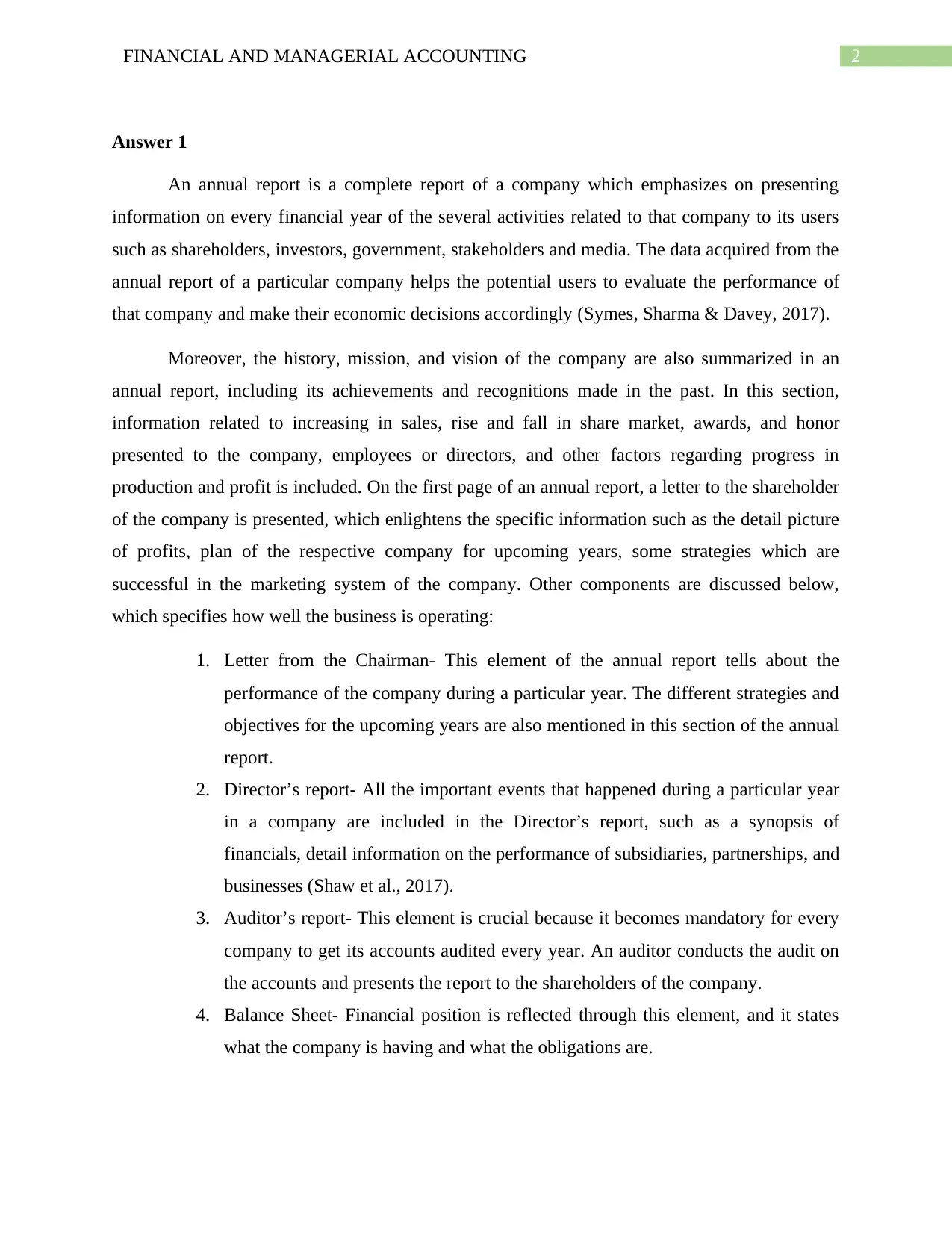
An annual report is a complete report of a company which emphasizes on presenting
information on every financial year of the several activities related to that company to its users
such as shareholders, investors, government, stakeholders and media. The data acquired from the
annual report of a particular company helps the potential users to evaluate the performance of
that company and make their economic decisions accordingly (Symes, Sharma & Davey, 2017).
Moreover, the history, mission, and vision of the company are also summarized in an
annual report, including its achievements and recognitions made in the past. In this section,
information related to increasing in sales, rise and fall in share market, awards, and honor
presented to the company, employees or directors, and other factors regarding progress in
production and profit is included. On the first page of an annual report, a letter to the shareholder
of the company is presented, which enlightens the specific information such as the detail picture
of profits, plan of the respective company for upcoming years, some strategies which are
successful in the marketing system of the company. Other components are discussed below,
which specifies how well the business is operating:
1. Letter from the Chairman- This element of the annual report tells about the
performance of the company during a particular year. The different strategies and
objectives for the upcoming years are also mentioned in this section of the annual
report.
2. Director’s report- All the important events that happened during a particular year
in a company are included in the Director’s report, such as a synopsis of
financials, detail information on the performance of subsidiaries, partnerships, and
businesses (Shaw et al., 2017).
3. Auditor’s report- This element is crucial because it becomes mandatory for every
company to get its accounts audited every year. An auditor conducts the audit on
the accounts and presents the report to the shareholders of the company.
4. Balance Sheet- Financial position is reflected through this element, and it states
what the company is having and what the obligations are.
Document Page
3FINANCIAL AND MANAGERIAL ACCOUNTING
5. Profit and loss Account- It tells about the net profit of a company that is earned
during the current financial year.
6. Cash flow Statement- This statement is used to give details about how much cash
is earned by the company and are used during a particular period.
7. Schedules- Details of the operational performance of a company during the
reporting period are included in this section, along with the footnotes that are not
covered anywhere else in the report.
8. Accounts of subsidiary- In this section of the report, the information regarding the
geographical location of the company, contact, a brand name is provided.
9. Corporate governance- Information of directors and management of the company,
including their remuneration, is given in this section of the report.
10. Accounting policies- Disclosure of accounting policies that are followed by the
company while preparing their financial statement are included in this.
Answer 2
a)
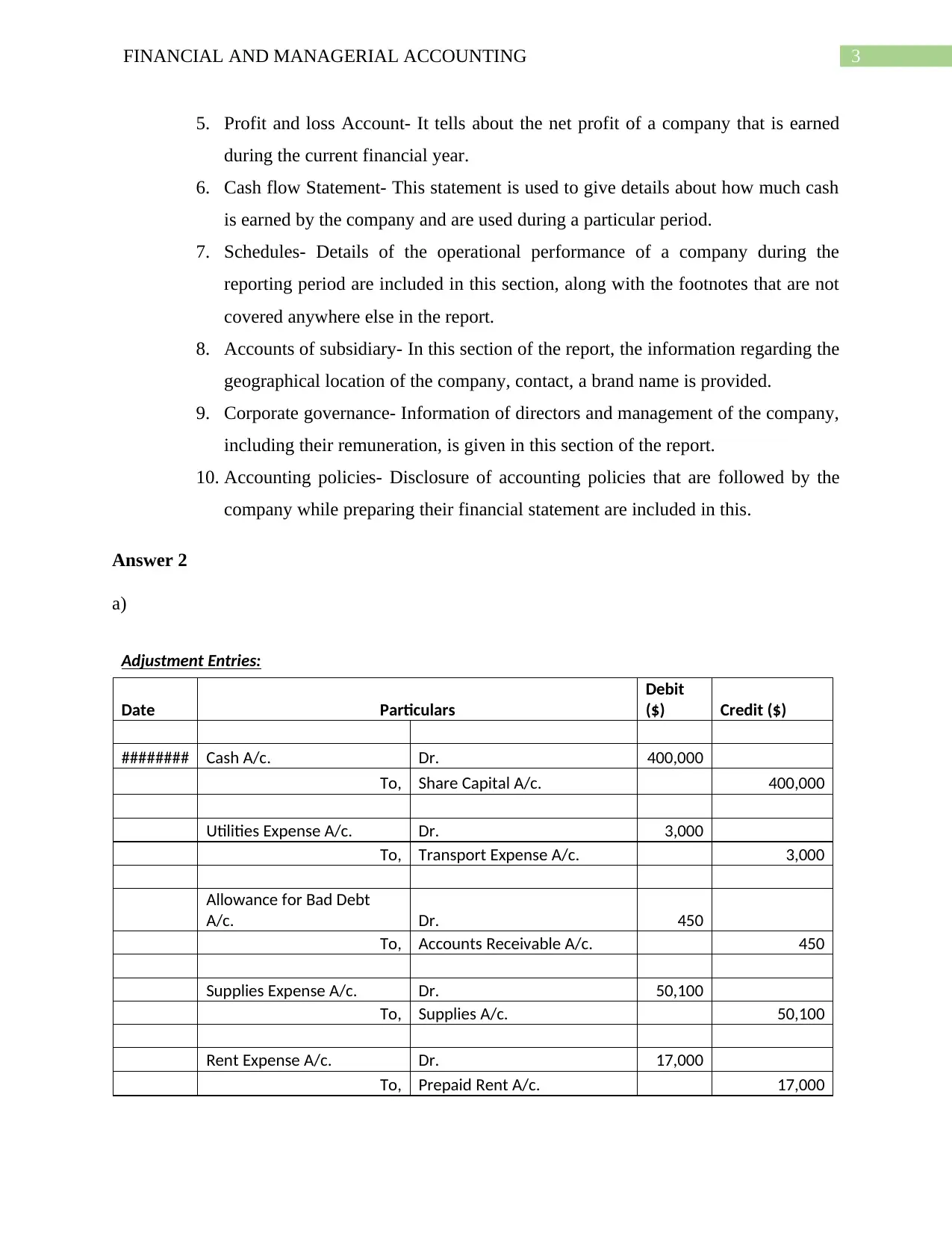
Adjustment Entries:
Date Particulars
Debit
($) Credit ($)
######## Cash A/c. Dr. 400,000
To, Share Capital A/c. 400,000
Utilities Expense A/c. Dr. 3,000
To, Transport Expense A/c. 3,000
Allowance for Bad Debt
A/c. Dr. 450
To, Accounts Receivable A/c. 450
Supplies Expense A/c. Dr. 50,100
To, Supplies A/c. 50,100
Rent Expense A/c. Dr. 17,000
To, Prepaid Rent A/c. 17,000
tabler-icon-diamond-filled.svg

Paraphrase This Document

Need a fresh take? Get an instant paraphrase of this document with our AI Paraphraser
Document Page
4FINANCIAL AND MANAGERIAL ACCOUNTING
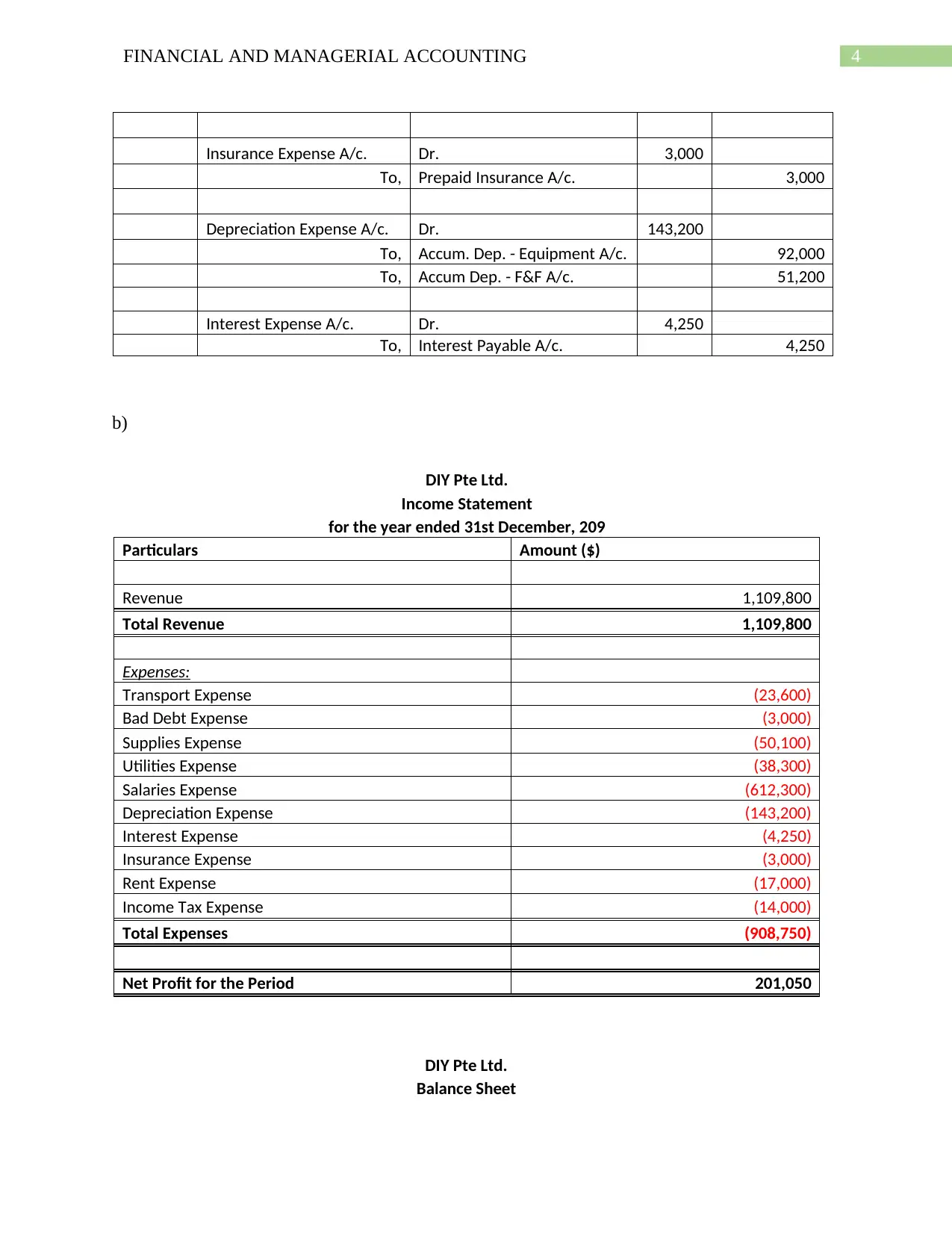
Insurance Expense A/c. Dr. 3,000
To, Prepaid Insurance A/c. 3,000
Depreciation Expense A/c. Dr. 143,200
To, Accum. Dep. - Equipment A/c. 92,000
To, Accum Dep. - F&F A/c. 51,200
Interest Expense A/c. Dr. 4,250
To, Interest Payable A/c. 4,250
b)
DIY Pte Ltd.
Income Statement
for the year ended 31st December, 209
Particulars Amount ($)
Revenue 1,109,800
Total Revenue 1,109,800
Expenses:
Transport Expense (23,600)
Bad Debt Expense (3,000)
Supplies Expense (50,100)
Utilities Expense (38,300)
Salaries Expense (612,300)
Depreciation Expense (143,200)
Interest Expense (4,250)
Insurance Expense (3,000)
Rent Expense (17,000)
Income Tax Expense (14,000)
Total Expenses (908,750)
Net Profit for the Period 201,050
DIY Pte Ltd.
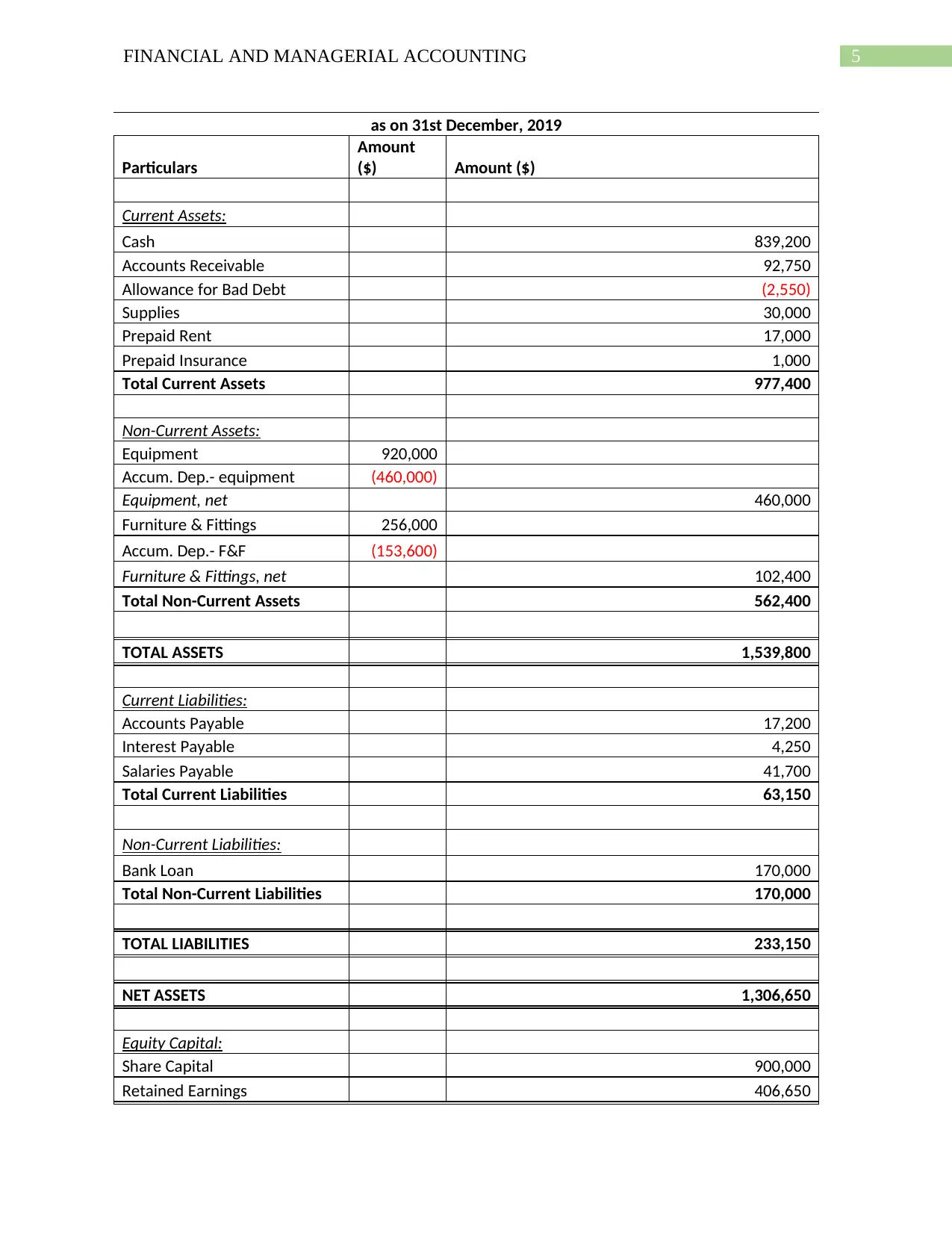
Balance Sheet
Document Page
5FINANCIAL AND MANAGERIAL ACCOUNTING
as on 31st December, 2019
Particulars
Amount
($) Amount ($)
Current Assets:
Cash 839,200
Accounts Receivable 92,750
Allowance for Bad Debt (2,550)
Supplies 30,000
Prepaid Rent 17,000
Prepaid Insurance 1,000
Total Current Assets 977,400
Non-Current Assets:
Equipment 920,000
Accum. Dep.- equipment (460,000)
Equipment, net 460,000
Furniture & Fittings 256,000
Accum. Dep.- F&F (153,600)
Furniture & Fittings, net 102,400
Total Non-Current Assets 562,400
TOTAL ASSETS 1,539,800
Current Liabilities:
Accounts Payable 17,200
Interest Payable 4,250
Salaries Payable 41,700
Total Current Liabilities 63,150
Non-Current Liabilities:
Bank Loan 170,000
Total Non-Current Liabilities 170,000
TOTAL LIABILITIES 233,150
NET ASSETS 1,306,650
Equity Capital:
Share Capital 900,000
Retained Earnings 406,650
Document Page
6FINANCIAL AND MANAGERIAL ACCOUNTING
TOTAL EQUITY 1,306,650
DIY Pte. Ltd.
Statement of Change in Equity
for the year ended 31st December, 2019
Particulars Share Capital Retained Earnings Total
Opening Balance 500,000 205,600 705,600
Add: Issue of New Shares 400,000 400,000
Add: Net Profit for the year 201,050 201,050
Closing Balance 900,000 406,650 1,306,650
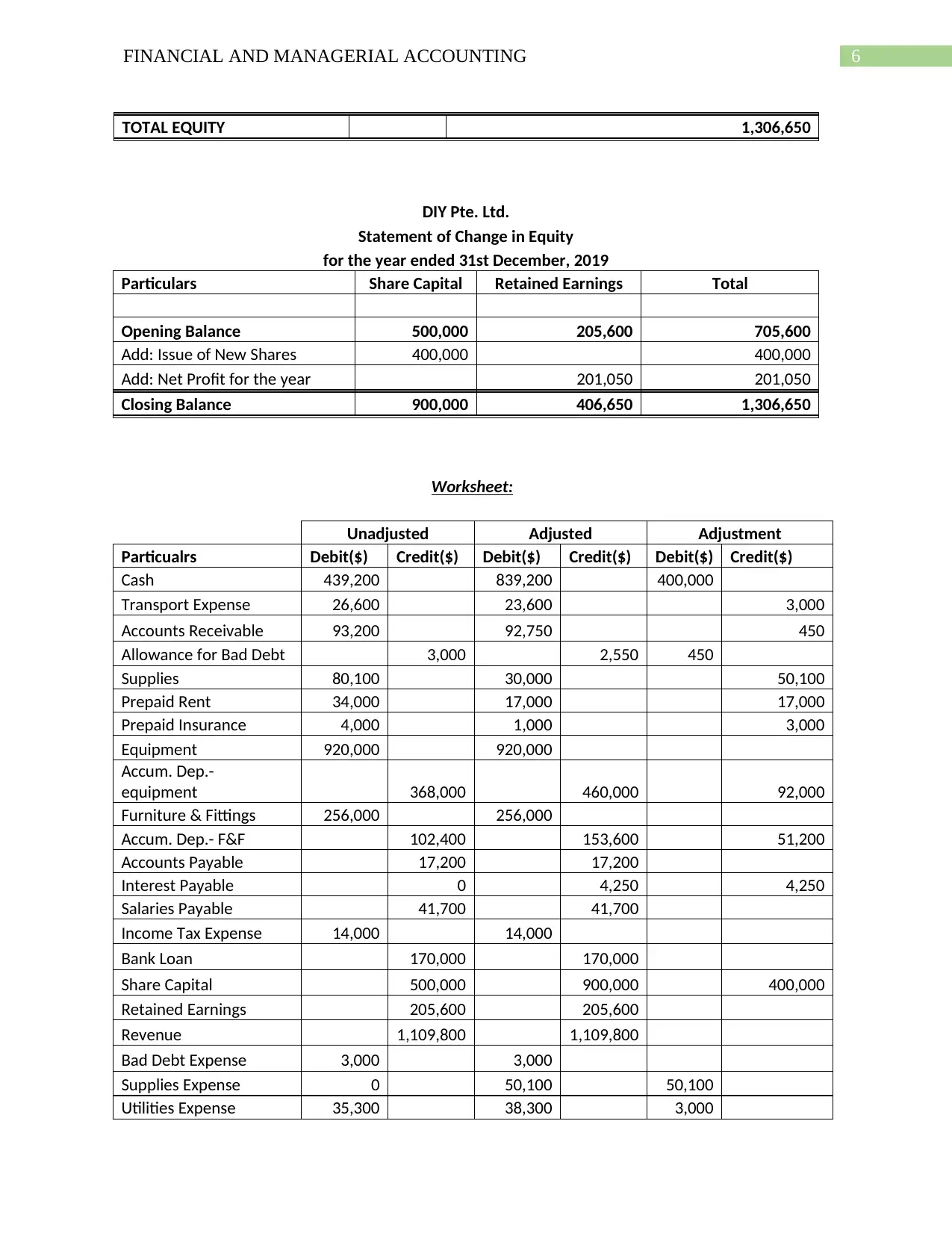
Worksheet:
Unadjusted Adjusted Adjustment
Particualrs Debit($) Credit($) Debit($) Credit($) Debit($) Credit($)
Cash 439,200 839,200 400,000
Transport Expense 26,600 23,600 3,000
Accounts Receivable 93,200 92,750 450
Allowance for Bad Debt 3,000 2,550 450
Supplies 80,100 30,000 50,100
Prepaid Rent 34,000 17,000 17,000
Prepaid Insurance 4,000 1,000 3,000
Equipment 920,000 920,000
Accum. Dep.-
equipment 368,000 460,000 92,000
Furniture & Fittings 256,000 256,000
Accum. Dep.- F&F 102,400 153,600 51,200
Accounts Payable 17,200 17,200
Interest Payable 0 4,250 4,250
Salaries Payable 41,700 41,700
Income Tax Expense 14,000 14,000
Bank Loan 170,000 170,000
Share Capital 500,000 900,000 400,000
Retained Earnings 205,600 205,600
Revenue 1,109,800 1,109,800
Bad Debt Expense 3,000 3,000
Supplies Expense 0 50,100 50,100
Utilities Expense 35,300 38,300 3,000
tabler-icon-diamond-filled.svg

Paraphrase This Document

Need a fresh take? Get an instant paraphrase of this document with our AI Paraphraser
Document Page
7FINANCIAL AND MANAGERIAL ACCOUNTING
Salaries Expense 612,300 612,300
Depreciation Expense 0 143,200 143,200
Interest Expense 0 4,250 4,250
Insurance Expense 0 3,000 3,000
Rent Expense 0 17,000 17,000
2,517,700
2,517,70
0 3,064,700 3,064,700 621,000 621,000
Answer 3
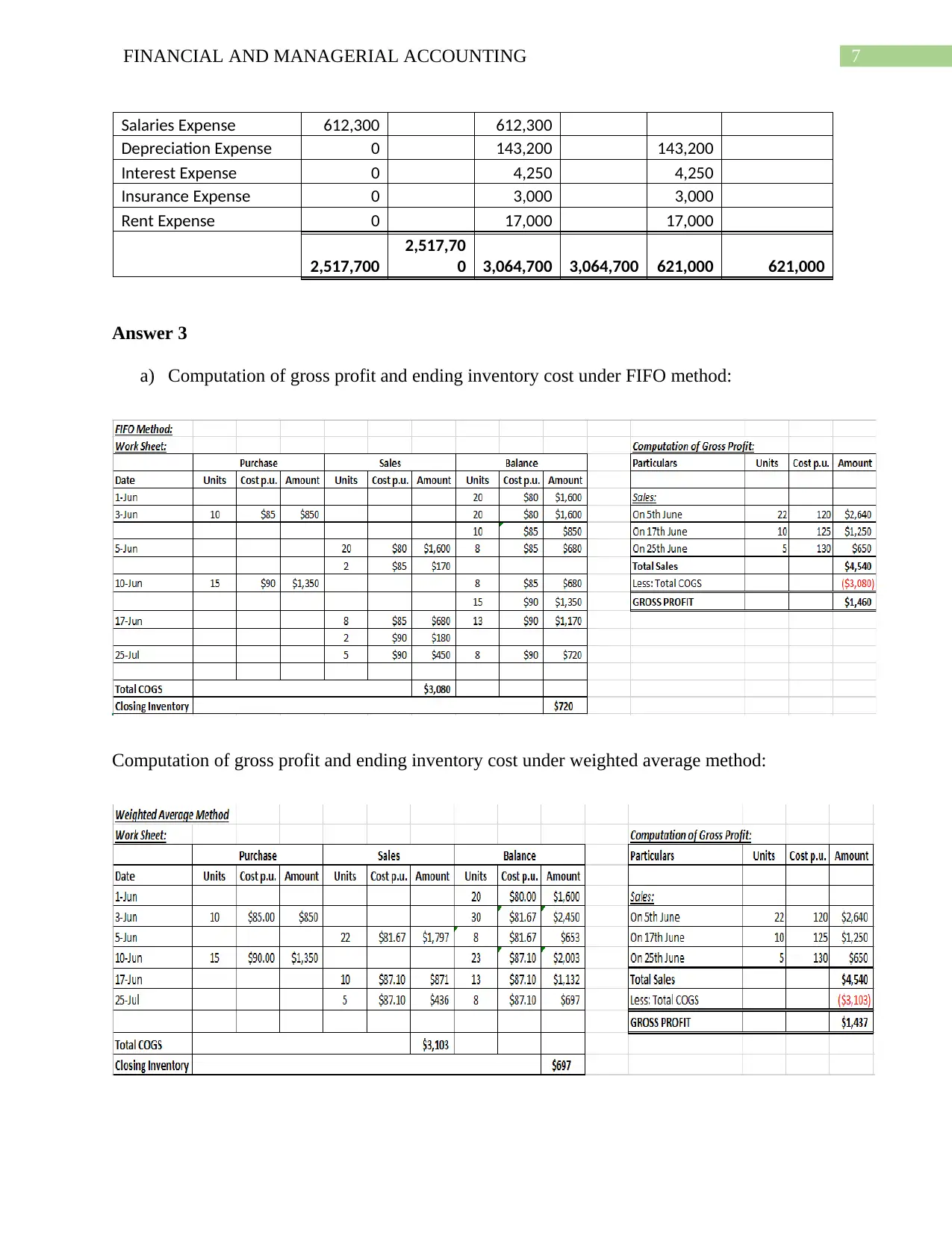
a) Computation of gross profit and ending inventory cost under FIFO method:
Computation of gross profit and ending inventory cost under weighted average method:
Document Page
8FINANCIAL AND MANAGERIAL ACCOUNTING
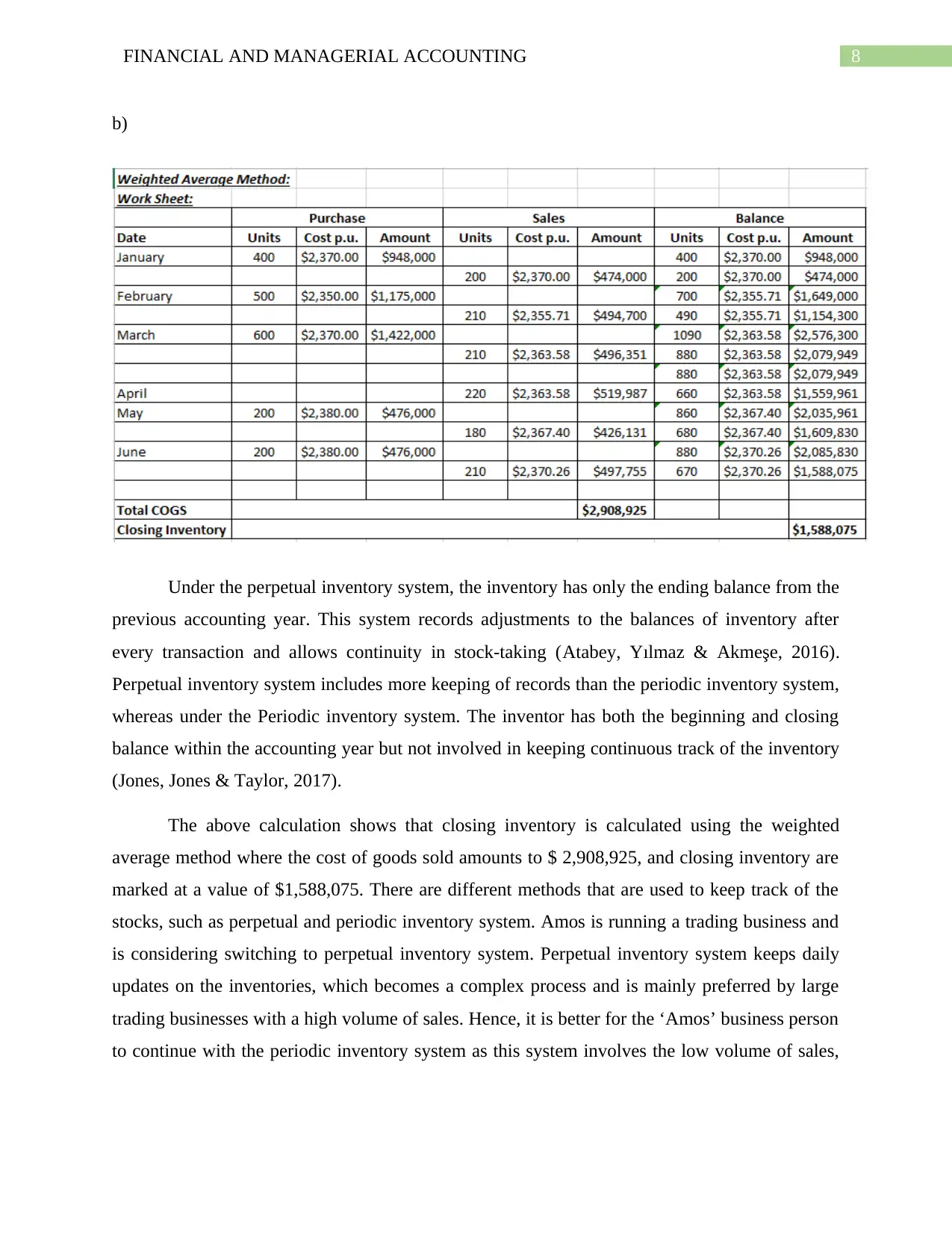
b)
Under the perpetual inventory system, the inventory has only the ending balance from the
previous accounting year. This system records adjustments to the balances of inventory after
every transaction and allows continuity in stock-taking (Atabey, Yılmaz & Akmeşe, 2016).
Perpetual inventory system includes more keeping of records than the periodic inventory system,
whereas under the Periodic inventory system. The inventor has both the beginning and closing
balance within the accounting year but not involved in keeping continuous track of the inventory
(Jones, Jones & Taylor, 2017).
The above calculation shows that closing inventory is calculated using the weighted
average method where the cost of goods sold amounts to $ 2,908,925, and closing inventory are
marked at a value of $1,588,075. There are different methods that are used to keep track of the
stocks, such as perpetual and periodic inventory system. Amos is running a trading business and
is considering switching to perpetual inventory system. Perpetual inventory system keeps daily
updates on the inventories, which becomes a complex process and is mainly preferred by large
trading businesses with a high volume of sales. Hence, it is better for the ‘Amos’ business person
to continue with the periodic inventory system as this system involves the low volume of sales,
Document Page
9FINANCIAL AND MANAGERIAL ACCOUNTING
and physical counting of inventory exists. In addition, the cost of goods sold is computed at the
end of the accounting period.
tabler-icon-diamond-filled.svg

Paraphrase This Document

Need a fresh take? Get an instant paraphrase of this document with our AI Paraphraser
Document Page
10FINANCIAL AND MANAGERIAL ACCOUNTING
References
Atabey, N. A., Yılmaz, H., & Akmeşe, H. (2016). The Study of Inventory Valuation in
Manufacturing Companies from the Perspective of Tax Procedure Law and Accounting
Standards1. In 2nd Multidisciplinary Conference, Madrid, Spain, 2-4 November.
Jones, M. A., Jones, N. A., & Taylor, R. J. (2017). U.S. Patent Application No. 15/366,701.
Shaw, J. M. M., Chandavarkar, A. S., Shaw, K. M., Wee, P. S., & Chi, T. J. (2017). Directors
Report.
Symes, H., Sharma, U., & Davey, H. (2017). The impact of accounting regulations on annual
report length. International Journal of Economics and Accounting, 8(3-4), 275-302.
Bibliography
Brooks, C. C., Enssle, B. D., Brightwell, D. B., Shields, D. R., Bryan, G. A., & Jones, M. A.
(2019). U.S. Patent Application No. 16/438,990.
chevron_up_icon
1 out of 11
circle_padding
hide_on_mobile
zoom_out_icon
[object Object]