Financial Markets and Monetary Policy: Analyzing Interest Rate Trends
VerifiedAdded on 2021/05/31
|16
|3199
|348
Homework Assignment
AI Summary
This assignment delves into the analysis of financial markets and monetary policy, focusing on interest rate trends in the USA. It begins by exploring the Keynesian theory of liquidity preference and the bond market theory, deriving insights from loanable funds. The analysis examines the impact of economic growth, inflation, and government spending on interest rates, utilizing diagrams to illustrate these effects. It then compares fixed and floating interest rates, discussing their advantages and disadvantages for businesses. The assignment further analyzes the impact of stagnant economic growth and stable inflation on interest rates using Keynesian and bond market concepts. The conclusion emphasizes the application of these theories to predict future interest rate movements. The document also discusses the factors influencing the choice between fixed and floating interest rates for businesses. Overall, the assignment provides a comprehensive understanding of financial markets and monetary policy with a focus on the USA's economic context.
Running head: FINANCIAL MARKETS AND MONITORY POLICY
Financial markets and monitory policy
Name of the university
Name of the student
Author Note
Financial markets and monitory policy
Name of the university
Name of the student
Author Note

Paraphrase This Document
Need a fresh take? Get an instant paraphrase of this document with our AI Paraphraser
1FINANCIAL MARKETS AND MONITORY POLICY
Table of Contents
Answer 1:...................................................................................................................................2
Answer 2:...................................................................................................................................9
Answer 3:.................................................................................................................................10
References:...............................................................................................................................14
Table of Contents
Answer 1:...................................................................................................................................2
Answer 2:...................................................................................................................................9
Answer 3:.................................................................................................................................10
References:...............................................................................................................................14
2FINANCIAL MARKETS AND MONITORY POLICY
Answer 1:
Under macro economy, economists use two concepts to determine interest rate of a
country. Those concepts are bond market theory, which can be derived from loanable theory
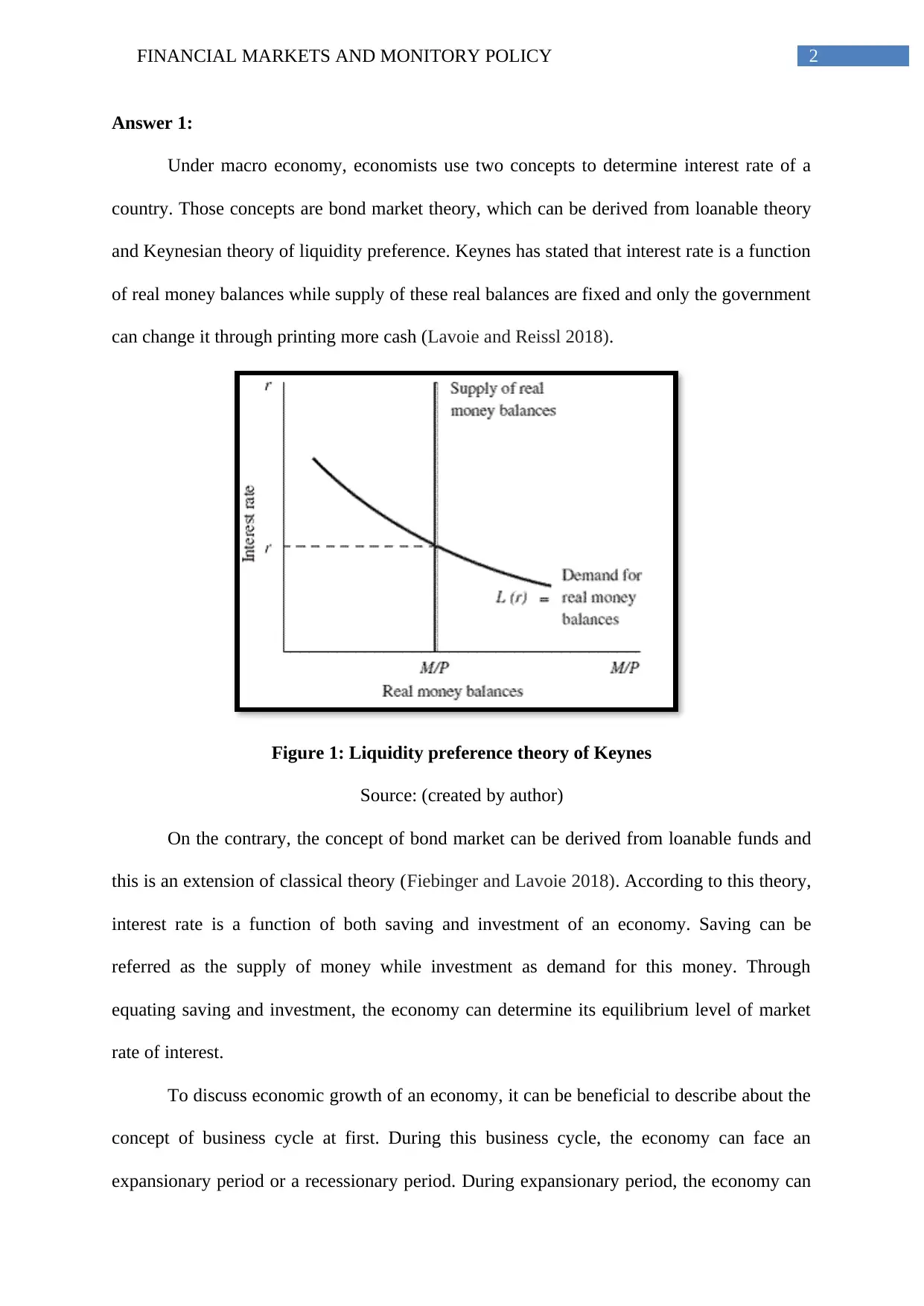
and Keynesian theory of liquidity preference. Keynes has stated that interest rate is a function
of real money balances while supply of these real balances are fixed and only the government
can change it through printing more cash (Lavoie and Reissl 2018).
Figure 1: Liquidity preference theory of Keynes
Source: (created by author)
On the contrary, the concept of bond market can be derived from loanable funds and
this is an extension of classical theory (Fiebinger and Lavoie 2018). According to this theory,
interest rate is a function of both saving and investment of an economy. Saving can be
referred as the supply of money while investment as demand for this money. Through
equating saving and investment, the economy can determine its equilibrium level of market
rate of interest.
To discuss economic growth of an economy, it can be beneficial to describe about the
concept of business cycle at first. During this business cycle, the economy can face an
expansionary period or a recessionary period. During expansionary period, the economy can
Answer 1:
Under macro economy, economists use two concepts to determine interest rate of a
country. Those concepts are bond market theory, which can be derived from loanable theory
and Keynesian theory of liquidity preference. Keynes has stated that interest rate is a function
of real money balances while supply of these real balances are fixed and only the government
can change it through printing more cash (Lavoie and Reissl 2018).
Figure 1: Liquidity preference theory of Keynes
Source: (created by author)
On the contrary, the concept of bond market can be derived from loanable funds and
this is an extension of classical theory (Fiebinger and Lavoie 2018). According to this theory,
interest rate is a function of both saving and investment of an economy. Saving can be
referred as the supply of money while investment as demand for this money. Through
equating saving and investment, the economy can determine its equilibrium level of market
rate of interest.
To discuss economic growth of an economy, it can be beneficial to describe about the
concept of business cycle at first. During this business cycle, the economy can face an
expansionary period or a recessionary period. During expansionary period, the economy can
⊘ This is a preview!⊘
Do you want full access?
Subscribe today to unlock all pages.

Trusted by 1+ million students worldwide
3FINANCIAL MARKETS AND MONITORY POLICY
experience a growth when the country can increase its national income while the amount of
unemployment and inflation go down (Garin, Pries and Sims 2018). On the other side, during
recession, the economy experiences an opposite situation.
The question has assumed various economic situations to determine future interest
rate of the U.S.A. Those assumptions can be analysed with the help of liquidity preference
concept of Keynes or by the concept of bond market. According to the first assumption,
economic growth in the U.S.A has remained high for the last two years. However, this
growth rate may become stagnant in next year. This situation implies that the country can
experience recession in next year. Consequently, investment can decrease as well. On the
other side, decrease in supply of bonds and increase in demand for it can lead the bond price
to increase further. Reducing supply curve forces the curve to shift leftward. Increase in bond
price influences the rate of interest to decrease. Moreover, lower interest rate helps influences
the quantity of investment demanded to increase. However, during stagnant economic growth
of the U.S.A, profitability of this country can decrease further and this phenomenon
consequently can influence the total investment of this county to decrease further. This
economic phenomenon is shown in the below diagram.
experience a growth when the country can increase its national income while the amount of
unemployment and inflation go down (Garin, Pries and Sims 2018). On the other side, during
recession, the economy experiences an opposite situation.
The question has assumed various economic situations to determine future interest
rate of the U.S.A. Those assumptions can be analysed with the help of liquidity preference
concept of Keynes or by the concept of bond market. According to the first assumption,
economic growth in the U.S.A has remained high for the last two years. However, this
growth rate may become stagnant in next year. This situation implies that the country can
experience recession in next year. Consequently, investment can decrease as well. On the
other side, decrease in supply of bonds and increase in demand for it can lead the bond price
to increase further. Reducing supply curve forces the curve to shift leftward. Increase in bond
price influences the rate of interest to decrease. Moreover, lower interest rate helps influences
the quantity of investment demanded to increase. However, during stagnant economic growth
of the U.S.A, profitability of this country can decrease further and this phenomenon
consequently can influence the total investment of this county to decrease further. This
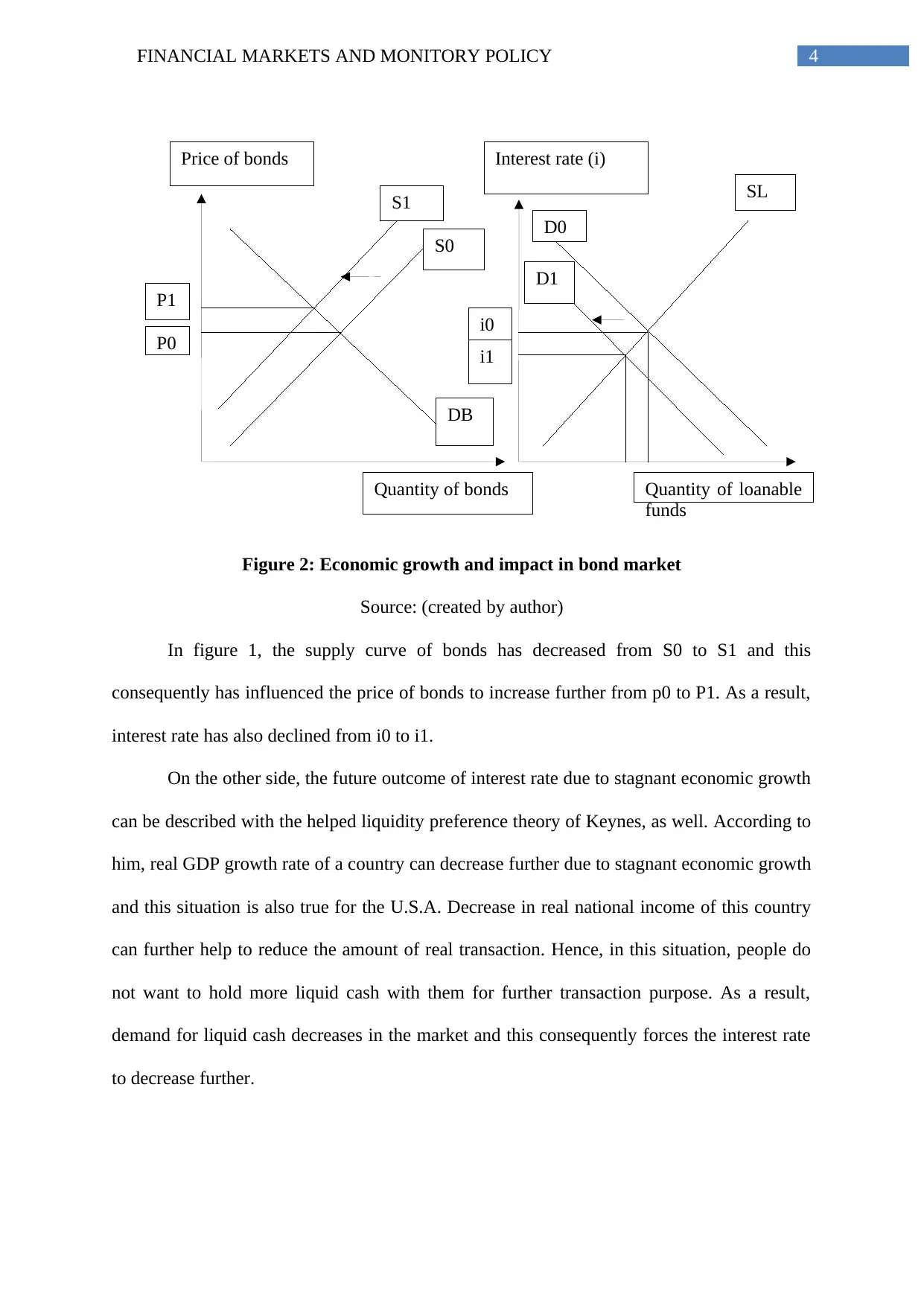
economic phenomenon is shown in the below diagram.
Paraphrase This Document
Need a fresh take? Get an instant paraphrase of this document with our AI Paraphraser
4FINANCIAL MARKETS AND MONITORY POLICY
Price of bonds
Quantity of bonds
Interest rate (i)
Quantity of loanable
funds
S1
S0
DB
D0
D1
SL
P0
P1
i0
i1
Figure 2: Economic growth and impact in bond market
Source: (created by author)
In figure 1, the supply curve of bonds has decreased from S0 to S1 and this
consequently has influenced the price of bonds to increase further from p0 to P1. As a result,
interest rate has also declined from i0 to i1.
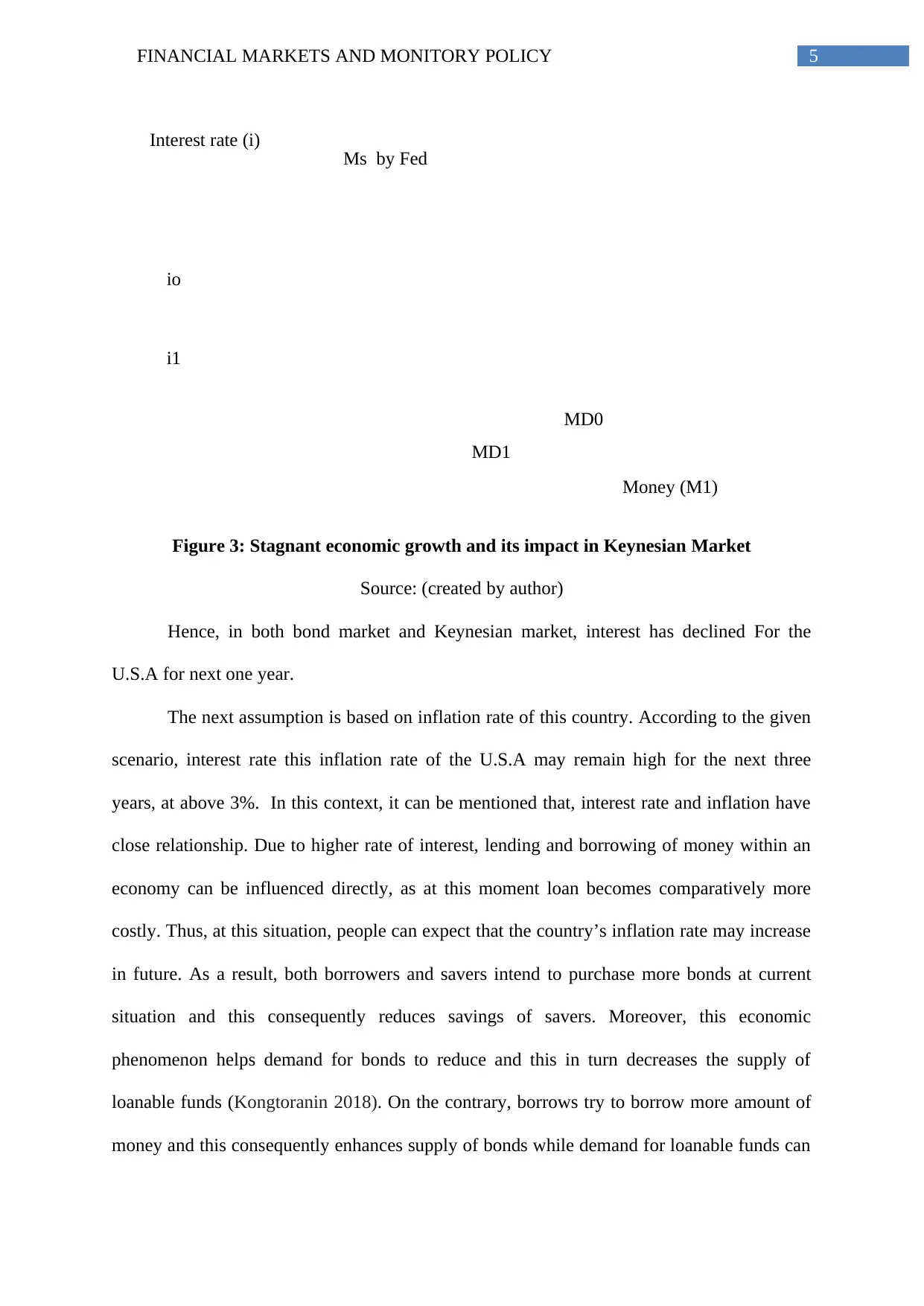
On the other side, the future outcome of interest rate due to stagnant economic growth
can be described with the helped liquidity preference theory of Keynes, as well. According to
him, real GDP growth rate of a country can decrease further due to stagnant economic growth
and this situation is also true for the U.S.A. Decrease in real national income of this country
can further help to reduce the amount of real transaction. Hence, in this situation, people do
not want to hold more liquid cash with them for further transaction purpose. As a result,
demand for liquid cash decreases in the market and this consequently forces the interest rate
to decrease further.
Price of bonds
Quantity of bonds
Interest rate (i)
Quantity of loanable
funds
S1
S0
DB
D0
D1
SL
P0
P1
i0
i1
Figure 2: Economic growth and impact in bond market
Source: (created by author)
In figure 1, the supply curve of bonds has decreased from S0 to S1 and this
consequently has influenced the price of bonds to increase further from p0 to P1. As a result,
interest rate has also declined from i0 to i1.
On the other side, the future outcome of interest rate due to stagnant economic growth
can be described with the helped liquidity preference theory of Keynes, as well. According to
him, real GDP growth rate of a country can decrease further due to stagnant economic growth
and this situation is also true for the U.S.A. Decrease in real national income of this country
can further help to reduce the amount of real transaction. Hence, in this situation, people do
not want to hold more liquid cash with them for further transaction purpose. As a result,
demand for liquid cash decreases in the market and this consequently forces the interest rate
to decrease further.
5FINANCIAL MARKETS AND MONITORY POLICY
MD0
MD1
Ms by Fed
Interest rate (i)
Money (M1)
io
i1
Figure 3: Stagnant economic growth and its impact in Keynesian Market
Source: (created by author)
Hence, in both bond market and Keynesian market, interest has declined For the
U.S.A for next one year.
The next assumption is based on inflation rate of this country. According to the given
scenario, interest rate this inflation rate of the U.S.A may remain high for the next three
years, at above 3%. In this context, it can be mentioned that, interest rate and inflation have
close relationship. Due to higher rate of interest, lending and borrowing of money within an
economy can be influenced directly, as at this moment loan becomes comparatively more
costly. Thus, at this situation, people can expect that the country’s inflation rate may increase
in future. As a result, both borrowers and savers intend to purchase more bonds at current
situation and this consequently reduces savings of savers. Moreover, this economic
phenomenon helps demand for bonds to reduce and this in turn decreases the supply of
loanable funds (Kongtoranin 2018). On the contrary, borrows try to borrow more amount of
money and this consequently enhances supply of bonds while demand for loanable funds can
MD0
MD1
Ms by Fed
Interest rate (i)
Money (M1)
io
i1
Figure 3: Stagnant economic growth and its impact in Keynesian Market
Source: (created by author)
Hence, in both bond market and Keynesian market, interest has declined For the
U.S.A for next one year.
The next assumption is based on inflation rate of this country. According to the given
scenario, interest rate this inflation rate of the U.S.A may remain high for the next three
years, at above 3%. In this context, it can be mentioned that, interest rate and inflation have
close relationship. Due to higher rate of interest, lending and borrowing of money within an
economy can be influenced directly, as at this moment loan becomes comparatively more
costly. Thus, at this situation, people can expect that the country’s inflation rate may increase
in future. As a result, both borrowers and savers intend to purchase more bonds at current
situation and this consequently reduces savings of savers. Moreover, this economic
phenomenon helps demand for bonds to reduce and this in turn decreases the supply of
loanable funds (Kongtoranin 2018). On the contrary, borrows try to borrow more amount of
money and this consequently enhances supply of bonds while demand for loanable funds can
⊘ This is a preview!⊘
Do you want full access?
Subscribe today to unlock all pages.
Trusted by 1+ million students worldwide
6FINANCIAL MARKETS AND MONITORY POLICY
increase further. However, this is not the situation that can be taken under consideration in
this context. As inflation rate may remain unchanged for in next year, this cannot influence
the country’s interest rate anymore. This outcome is same for the liquidity preference theory
of Keynes, as well. According to this concept of unchanged inflation rate, business
originations and consumers of the U.S.A can remain unaffected for holding liquid money. As
a result, due to stable demand for money along with fixed supply of it, interest rate in market
may remain unchanged. Thus, with the help of these two concepts, it can be said that stable
inflation rate of a country cannot influence the market interest rate to change further.
The other factor is reduction of government expenditure of the U.S.A to reduce
budget deficit within economy. Thus, from this assumption, it can be said that the Federal
Government of the U.S.A has spent more amount of compare to its tax revenue. However,
through considering future scenario, it can be said that the government can earn surplus in its
budget in next year and consequently can earn purchase its bond from the market
again(Kaufman and Hopewell 2017). As a result, the supply of bonds in market can reduce
further and thus in turn can help to increase the price of it in market. Thus, this increasing
price can force the rate of interest to decrease through lowering the market demand for bonds.
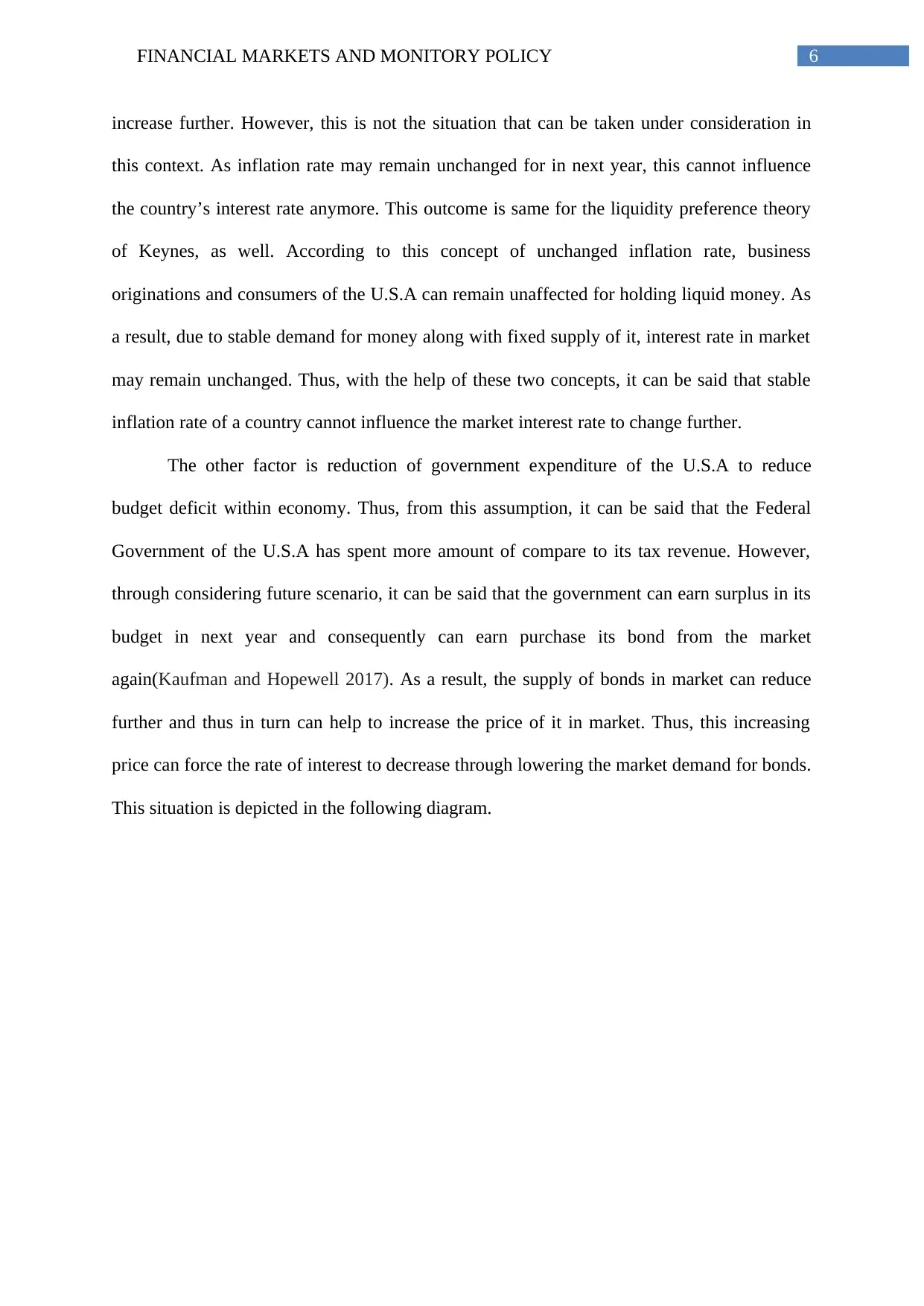
This situation is depicted in the following diagram.
increase further. However, this is not the situation that can be taken under consideration in
this context. As inflation rate may remain unchanged for in next year, this cannot influence
the country’s interest rate anymore. This outcome is same for the liquidity preference theory
of Keynes, as well. According to this concept of unchanged inflation rate, business
originations and consumers of the U.S.A can remain unaffected for holding liquid money. As
a result, due to stable demand for money along with fixed supply of it, interest rate in market
may remain unchanged. Thus, with the help of these two concepts, it can be said that stable
inflation rate of a country cannot influence the market interest rate to change further.
The other factor is reduction of government expenditure of the U.S.A to reduce
budget deficit within economy. Thus, from this assumption, it can be said that the Federal
Government of the U.S.A has spent more amount of compare to its tax revenue. However,
through considering future scenario, it can be said that the government can earn surplus in its
budget in next year and consequently can earn purchase its bond from the market
again(Kaufman and Hopewell 2017). As a result, the supply of bonds in market can reduce
further and thus in turn can help to increase the price of it in market. Thus, this increasing
price can force the rate of interest to decrease through lowering the market demand for bonds.
This situation is depicted in the following diagram.
Paraphrase This Document
Need a fresh take? Get an instant paraphrase of this document with our AI Paraphraser
7FINANCIAL MARKETS AND MONITORY POLICY
P0
P1
Price of bonds
Quantity of bonds
Interest rate (i)
Quantity of loanable funds
i0
i1
S0
S1
DB D0
SL
D1
Figure 4: Reduction in government spending and impact in bond market
Source: (created by author)
According to the above phenomenon, the supply of bond in market has decreased and
consequently the supply curve has shifted to the left from S0 to S1, S price of bonds in
market has increased from P0 to P1. As a result, market interest rate of the U.S.A as
decreased from i0 to i1.
On the other side, as the total money supply within the economy of the U.S.A is not
going to change further, it cannot influence the supply of loanable funds in next year. Hence,
due to this decision, the supply of and demand for loanable funds will remain the same. On
the other side, according to the liquidity preference theory, the interest rate in the USA can
decrease further if the Fed tries to increase its supply of money through considering other
factors as constant. However, based on the given assumption, the interest rate under this
concept has also remained unchanged.
For the next assumption, it can be said that saving of an economy can also influence
the rate of interest. Under bond market, the largest sources of supply and demand for bonds
P0
P1
Price of bonds
Quantity of bonds
Interest rate (i)
Quantity of loanable funds
i0
i1
S0
S1
DB D0
SL
D1
Figure 4: Reduction in government spending and impact in bond market
Source: (created by author)
According to the above phenomenon, the supply of bond in market has decreased and
consequently the supply curve has shifted to the left from S0 to S1, S price of bonds in
market has increased from P0 to P1. As a result, market interest rate of the U.S.A as
decreased from i0 to i1.
On the other side, as the total money supply within the economy of the U.S.A is not
going to change further, it cannot influence the supply of loanable funds in next year. Hence,
due to this decision, the supply of and demand for loanable funds will remain the same. On
the other side, according to the liquidity preference theory, the interest rate in the USA can
decrease further if the Fed tries to increase its supply of money through considering other
factors as constant. However, based on the given assumption, the interest rate under this
concept has also remained unchanged.
For the next assumption, it can be said that saving of an economy can also influence
the rate of interest. Under bond market, the largest sources of supply and demand for bonds
8FINANCIAL MARKETS AND MONITORY POLICY
Interest rate
Loanable funds
O
DLF0
SLF0
DLF1
I0
I1
SLF1
are coming from savings and investment of individuals (Kaufman and Hopewell 2017).
Moreover, it is considered that saving is interest inelastic though according to neoclassical
economists, both savings and investment are functions of interest rate at a given income level.
Thus, due to increasing amount of savings, the bond price in the USA marker can fall further
and this in turn can increase the interest rate. This concept is not applicable in given scenario,
as savings will remain stable in future. Thus, it cannot influence the rate of interest any more.
Thus, through considering entire loanable fund market, it can be said that the interest
rate of the U.S.A is going to reduce in future by I0I1 amount, which is represented in the
following diagram.
Figure 5: Demand and supply of loanable funds in the U.S.A
Source: (created by author)
Thus, based on the above discussion, it can be seen that in the U.S.A, the interest rate
is going to fall further. This phenomenon has been obtained, based on the given assumptions
with the help of liquidity preference theory of Keynes and the bond market theory.
Interest rate
Loanable funds
O
DLF0
SLF0
DLF1
I0
I1
SLF1
are coming from savings and investment of individuals (Kaufman and Hopewell 2017).
Moreover, it is considered that saving is interest inelastic though according to neoclassical
economists, both savings and investment are functions of interest rate at a given income level.
Thus, due to increasing amount of savings, the bond price in the USA marker can fall further
and this in turn can increase the interest rate. This concept is not applicable in given scenario,
as savings will remain stable in future. Thus, it cannot influence the rate of interest any more.
Thus, through considering entire loanable fund market, it can be said that the interest
rate of the U.S.A is going to reduce in future by I0I1 amount, which is represented in the
following diagram.
Figure 5: Demand and supply of loanable funds in the U.S.A
Source: (created by author)
Thus, based on the above discussion, it can be seen that in the U.S.A, the interest rate
is going to fall further. This phenomenon has been obtained, based on the given assumptions
with the help of liquidity preference theory of Keynes and the bond market theory.
⊘ This is a preview!⊘
Do you want full access?
Subscribe today to unlock all pages.
Trusted by 1+ million students worldwide
9FINANCIAL MARKETS AND MONITORY POLICY
Answer 2:
Based on the given scenario, both fixed interest rate and floating interest rate have
remained at 8% at the time of taking loans. The fixed interest rate does not change over a
fixed period while floating interest rate can be adjusted each month by bank. Thus, it is
impossible for a business organisation to predict that whether it can take loan under fixed
interest rate or under the floating interest rate. In this context, it is important to know the
process of measuring floating interest rate of a bank.
The bank, who lends loan to a business organisation based on floating interest rate,
adjusts this rate of interest with the help of adjustable-rate mortgages (ARMs). The current
margin and major mortgage index help the bank to adjust this rate. Some of the major
mortgage indices are the monetary treasure average (MTA), London Inter-bank Offered Rate
(LIBOR) and the Cost of Funds Index (COFI). The process of setting floating interest rate
can be described with the help of a suitable example. Suppose, a business organisation has
taken an ARM on the basis of LIBOR while the rate of margin is 2% and the rate of LIBOR
is 3% (Huang et al. 2017). Thus, the rate of interest will be 5% at the time of rate adjustment
of the mortgage.
After discussing about the floating interest rate adjustment procedure of a bank, it is
essential to know about some advantages and disadvantages of both fixed and floating
interest rates.
It is possible for a business organisation to estimate its interest rate at time of
repayment if it takes loan under fixed interest rate (Kiley and Roberts 2017). During short-
run, it can be beneficial for an organisation to take loan under this fixed interest rate while
this prediction is not possible if the bank charges floating interest rate.
Answer 2:
Based on the given scenario, both fixed interest rate and floating interest rate have
remained at 8% at the time of taking loans. The fixed interest rate does not change over a
fixed period while floating interest rate can be adjusted each month by bank. Thus, it is
impossible for a business organisation to predict that whether it can take loan under fixed
interest rate or under the floating interest rate. In this context, it is important to know the
process of measuring floating interest rate of a bank.
The bank, who lends loan to a business organisation based on floating interest rate,
adjusts this rate of interest with the help of adjustable-rate mortgages (ARMs). The current
margin and major mortgage index help the bank to adjust this rate. Some of the major
mortgage indices are the monetary treasure average (MTA), London Inter-bank Offered Rate
(LIBOR) and the Cost of Funds Index (COFI). The process of setting floating interest rate
can be described with the help of a suitable example. Suppose, a business organisation has
taken an ARM on the basis of LIBOR while the rate of margin is 2% and the rate of LIBOR
is 3% (Huang et al. 2017). Thus, the rate of interest will be 5% at the time of rate adjustment
of the mortgage.
After discussing about the floating interest rate adjustment procedure of a bank, it is
essential to know about some advantages and disadvantages of both fixed and floating
interest rates.
It is possible for a business organisation to estimate its interest rate at time of
repayment if it takes loan under fixed interest rate (Kiley and Roberts 2017). During short-
run, it can be beneficial for an organisation to take loan under this fixed interest rate while
this prediction is not possible if the bank charges floating interest rate.
Paraphrase This Document
Need a fresh take? Get an instant paraphrase of this document with our AI Paraphraser
10FINANCIAL MARKETS AND MONITORY POLICY
However, for some small size business organisations, this fixed rate of interest can
bring negative impacts, as well. During long-term, this fixed interest rate can generate huge
costs for a loan compare to that under a fixed interest rate.
The floating interest rate, on the contrary has some advantages and disadvantages, as
well. During long term, this floating interest rate can be decreased compare to the fixed
interest rate, as this floating interest rate depends of some macroeconomic variables that can
be changed further (Ji and Ke 2017). However, the chief disadvantage of this type of interest
rate is that it cannot be predicted in and thus business organisations can bear interest rate
risks.
After discussing both advantages and disadvantages of fixed and floating interest
rates, it can be predicted that it is quiet impossible for an organisation to decide the type of
interest rate for taking a loan. However, the interest rate of the U.S.A is going to decrease
further and for this it can be beneficial for a business organisation to take loan based on
floating interest rate. Moreover, the organisation is taking loan for one year only and
according to above discussion it can be said that floating interest rate is better to chose for
this short period.
Answer 3:
The entire concept is based on cash flow between the U.S.A and the U.K. This capital
flows occur due to change in inflation, national income and rate of interest between two
economies (Wang, Wen and Xu 2017). In this given situation, interest rate has differed
between the U.S.A and the U.K. The interest rate of the U.K increases further and
consequently the investors of the U.S.A can intend to invest their money in banks and other
financial institutions of the U.K. However, during this situation, investors can face exchange
rate risks. However, at this, moment it is essential to assume that inflation rate of both
countries is stable. This is because, based on Fisher it can be said that inflation has an
However, for some small size business organisations, this fixed rate of interest can
bring negative impacts, as well. During long-term, this fixed interest rate can generate huge
costs for a loan compare to that under a fixed interest rate.
The floating interest rate, on the contrary has some advantages and disadvantages, as
well. During long term, this floating interest rate can be decreased compare to the fixed
interest rate, as this floating interest rate depends of some macroeconomic variables that can
be changed further (Ji and Ke 2017). However, the chief disadvantage of this type of interest
rate is that it cannot be predicted in and thus business organisations can bear interest rate
risks.
After discussing both advantages and disadvantages of fixed and floating interest
rates, it can be predicted that it is quiet impossible for an organisation to decide the type of
interest rate for taking a loan. However, the interest rate of the U.S.A is going to decrease
further and for this it can be beneficial for a business organisation to take loan based on
floating interest rate. Moreover, the organisation is taking loan for one year only and
according to above discussion it can be said that floating interest rate is better to chose for
this short period.
Answer 3:
The entire concept is based on cash flow between the U.S.A and the U.K. This capital
flows occur due to change in inflation, national income and rate of interest between two
economies (Wang, Wen and Xu 2017). In this given situation, interest rate has differed
between the U.S.A and the U.K. The interest rate of the U.K increases further and
consequently the investors of the U.S.A can intend to invest their money in banks and other
financial institutions of the U.K. However, during this situation, investors can face exchange
rate risks. However, at this, moment it is essential to assume that inflation rate of both
countries is stable. This is because, based on Fisher it can be said that inflation has an
11FINANCIAL MARKETS AND MONITORY POLICY
important role to make the difference between real exchange rate and nominal exchange rate
(Fiebinger and Lavoie 2018). Thus, trough considering inflation rate of the U.K and U.S.A as
stable, it can be said that both exchange rates for these two countries can be equal and this
further can influence U.S.A investors to invest more money in the U.K. If investors decide to
withdraw their money from the financial institutions of the U.S.A, then the country can
experience both short run and long run consequences.
important role to make the difference between real exchange rate and nominal exchange rate
(Fiebinger and Lavoie 2018). Thus, trough considering inflation rate of the U.K and U.S.A as
stable, it can be said that both exchange rates for these two countries can be equal and this
further can influence U.S.A investors to invest more money in the U.K. If investors decide to
withdraw their money from the financial institutions of the U.S.A, then the country can
experience both short run and long run consequences.
⊘ This is a preview!⊘
Do you want full access?
Subscribe today to unlock all pages.
Trusted by 1+ million students worldwide

1 out of 16


Related Documents


Your All-in-One AI-Powered Toolkit for Academic Success.
+13062052269
info@desklib.com
Available 24*7 on WhatsApp / Email
![[object Object]](/_next/static/media/star-bottom.7253800d.svg)
Unlock your academic potential
Copyright © 2020–2026 A2Z Services. All Rights Reserved. Developed and managed by ZUCOL.