Financial and Non-Financial Dimensions in Management Accounting
VerifiedAdded on 2023/06/10
|11
|1754
|297
Report
AI Summary
This management accounting report provides a comprehensive analysis of various financial and non-financial aspects of a business. It covers topics such as cost-benefit analysis of expanding product lines, the importance of financial and non-financial information for decision-making, and the calculation of the cost of goods manufactured using different costing methods like weighted average and FIFO. Additionally, it discusses the characteristics of services, including intangibility, inseparability, variability, and perishability, and how these factors affect industries like electricity, telecommunications, and education. The report includes detailed calculations of manufacturing costs, income statements, and cost of goods sold schedules, offering a thorough understanding of management accounting principles and their practical applications.
Running Head: MANAGEMENT ACCOUNTING 0
Management Accounting
Paraphrase This Document
Need a fresh take? Get an instant paraphrase of this document with our AI Paraphraser

MANAGEMENT ACCOUNTING 1
Table of Contents
Question 1..................................................................................................................................2
Advantages of implementing the process...............................................................................2
Question 2..................................................................................................................................4
Question 3..................................................................................................................................5
Question 4..................................................................................................................................6
References..................................................................................................................................9
Table of Contents
Question 1..................................................................................................................................2
Advantages of implementing the process...............................................................................2
Question 2..................................................................................................................................4
Question 3..................................................................................................................................5
Question 4..................................................................................................................................6
References..................................................................................................................................9

MANAGEMENT ACCOUNTING 2
Question 1
Advantages of implementing the process
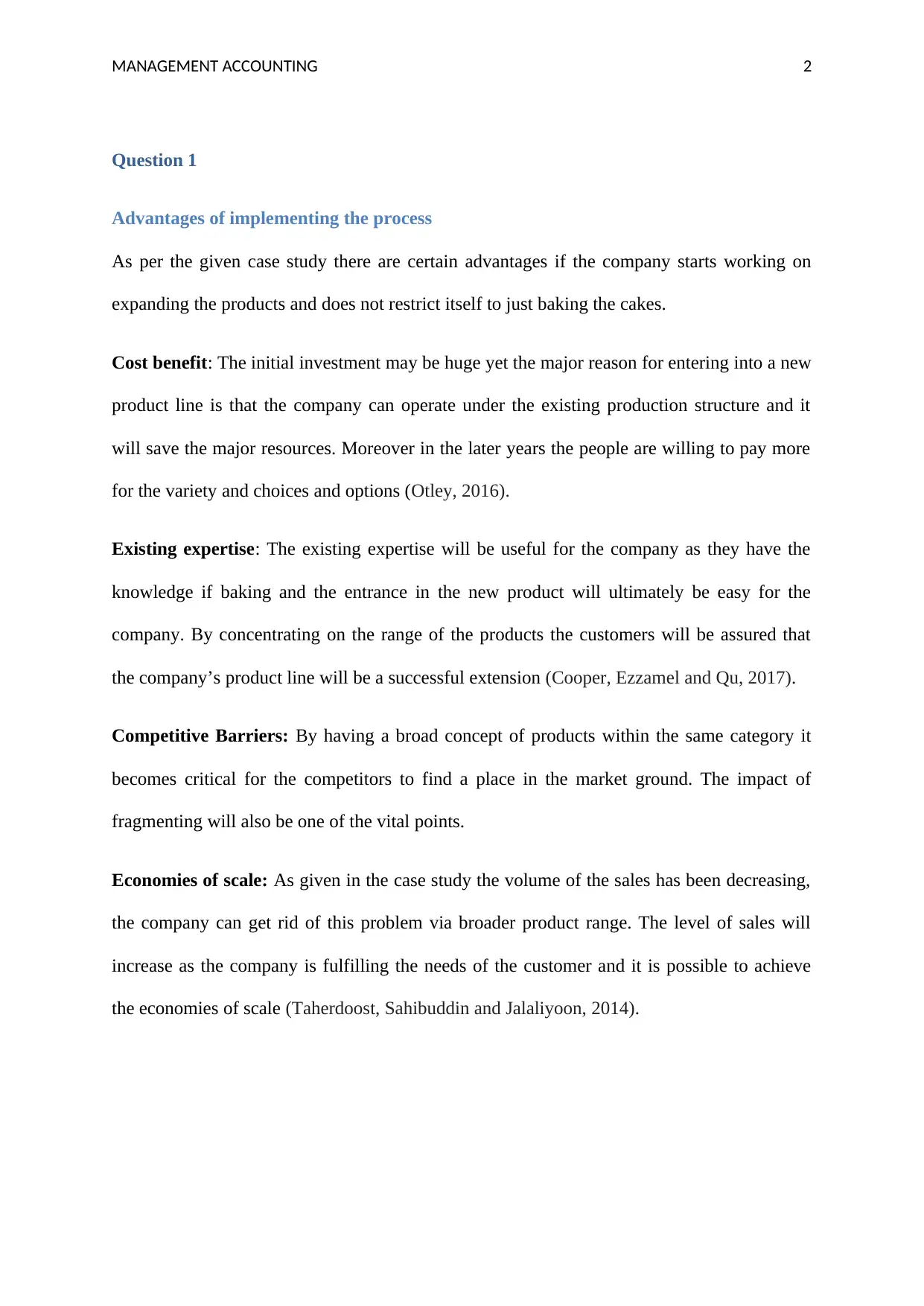
As per the given case study there are certain advantages if the company starts working on
expanding the products and does not restrict itself to just baking the cakes.
Cost benefit: The initial investment may be huge yet the major reason for entering into a new
product line is that the company can operate under the existing production structure and it
will save the major resources. Moreover in the later years the people are willing to pay more
for the variety and choices and options (Otley, 2016).
Existing expertise: The existing expertise will be useful for the company as they have the
knowledge if baking and the entrance in the new product will ultimately be easy for the
company. By concentrating on the range of the products the customers will be assured that
the company’s product line will be a successful extension (Cooper, Ezzamel and Qu, 2017).
Competitive Barriers: By having a broad concept of products within the same category it
becomes critical for the competitors to find a place in the market ground. The impact of
fragmenting will also be one of the vital points.
Economies of scale: As given in the case study the volume of the sales has been decreasing,
the company can get rid of this problem via broader product range. The level of sales will
increase as the company is fulfilling the needs of the customer and it is possible to achieve
the economies of scale (Taherdoost, Sahibuddin and Jalaliyoon, 2014).
Question 1
Advantages of implementing the process
As per the given case study there are certain advantages if the company starts working on
expanding the products and does not restrict itself to just baking the cakes.
Cost benefit: The initial investment may be huge yet the major reason for entering into a new
product line is that the company can operate under the existing production structure and it
will save the major resources. Moreover in the later years the people are willing to pay more
for the variety and choices and options (Otley, 2016).
Existing expertise: The existing expertise will be useful for the company as they have the
knowledge if baking and the entrance in the new product will ultimately be easy for the
company. By concentrating on the range of the products the customers will be assured that
the company’s product line will be a successful extension (Cooper, Ezzamel and Qu, 2017).
Competitive Barriers: By having a broad concept of products within the same category it
becomes critical for the competitors to find a place in the market ground. The impact of
fragmenting will also be one of the vital points.
Economies of scale: As given in the case study the volume of the sales has been decreasing,
the company can get rid of this problem via broader product range. The level of sales will
increase as the company is fulfilling the needs of the customer and it is possible to achieve
the economies of scale (Taherdoost, Sahibuddin and Jalaliyoon, 2014).
⊘ This is a preview!⊘
Do you want full access?
Subscribe today to unlock all pages.

Trusted by 1+ million students worldwide

MANAGEMENT ACCOUNTING 3
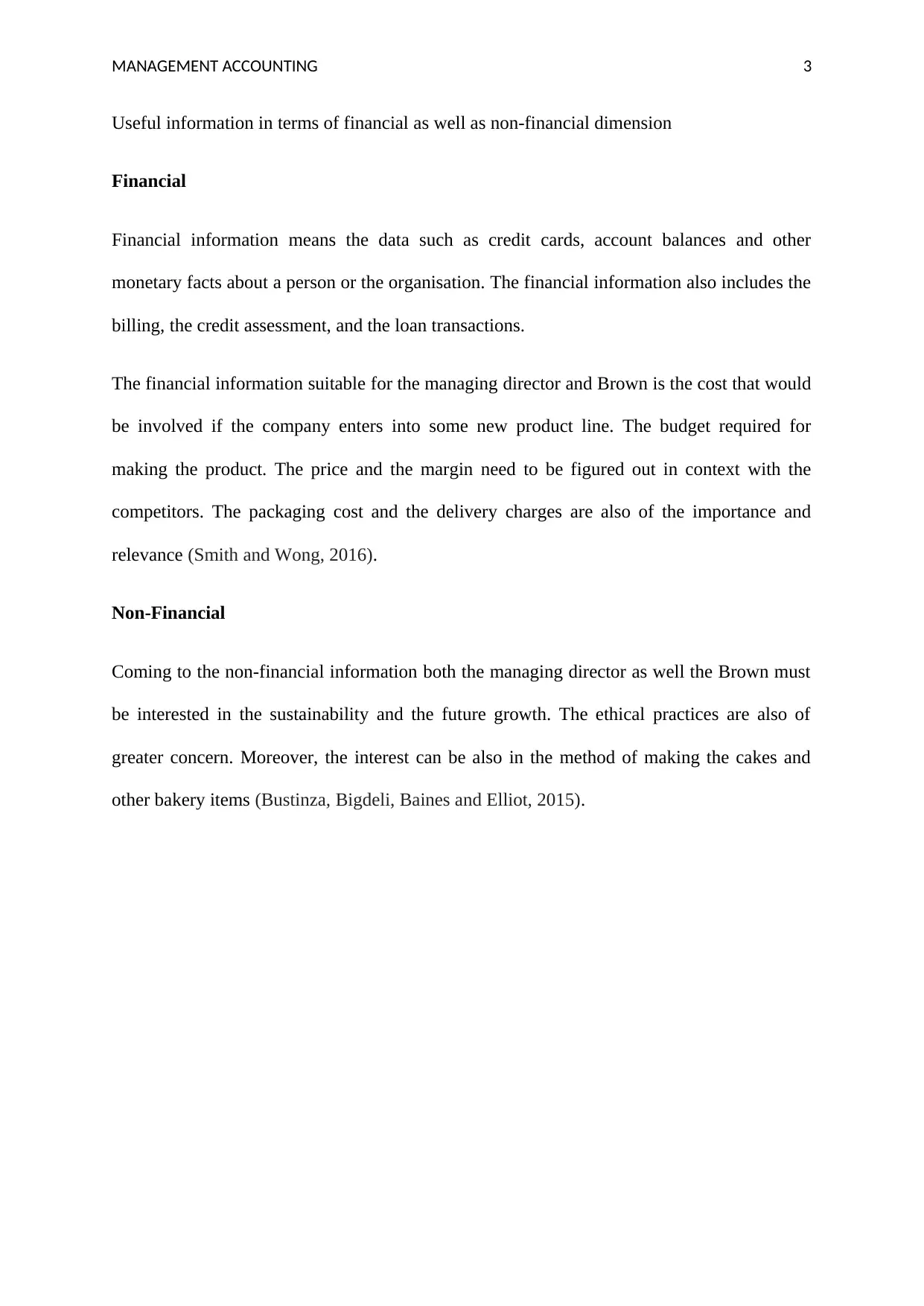
Useful information in terms of financial as well as non-financial dimension
Financial
Financial information means the data such as credit cards, account balances and other
monetary facts about a person or the organisation. The financial information also includes the
billing, the credit assessment, and the loan transactions.
The financial information suitable for the managing director and Brown is the cost that would
be involved if the company enters into some new product line. The budget required for
making the product. The price and the margin need to be figured out in context with the
competitors. The packaging cost and the delivery charges are also of the importance and
relevance (Smith and Wong, 2016).
Non-Financial
Coming to the non-financial information both the managing director as well the Brown must
be interested in the sustainability and the future growth. The ethical practices are also of
greater concern. Moreover, the interest can be also in the method of making the cakes and
other bakery items (Bustinza, Bigdeli, Baines and Elliot, 2015).
Useful information in terms of financial as well as non-financial dimension
Financial
Financial information means the data such as credit cards, account balances and other
monetary facts about a person or the organisation. The financial information also includes the
billing, the credit assessment, and the loan transactions.
The financial information suitable for the managing director and Brown is the cost that would
be involved if the company enters into some new product line. The budget required for
making the product. The price and the margin need to be figured out in context with the
competitors. The packaging cost and the delivery charges are also of the importance and
relevance (Smith and Wong, 2016).
Non-Financial
Coming to the non-financial information both the managing director as well the Brown must
be interested in the sustainability and the future growth. The ethical practices are also of
greater concern. Moreover, the interest can be also in the method of making the cakes and
other bakery items (Bustinza, Bigdeli, Baines and Elliot, 2015).
Paraphrase This Document
Need a fresh take? Get an instant paraphrase of this document with our AI Paraphraser

MANAGEMENT ACCOUNTING 4
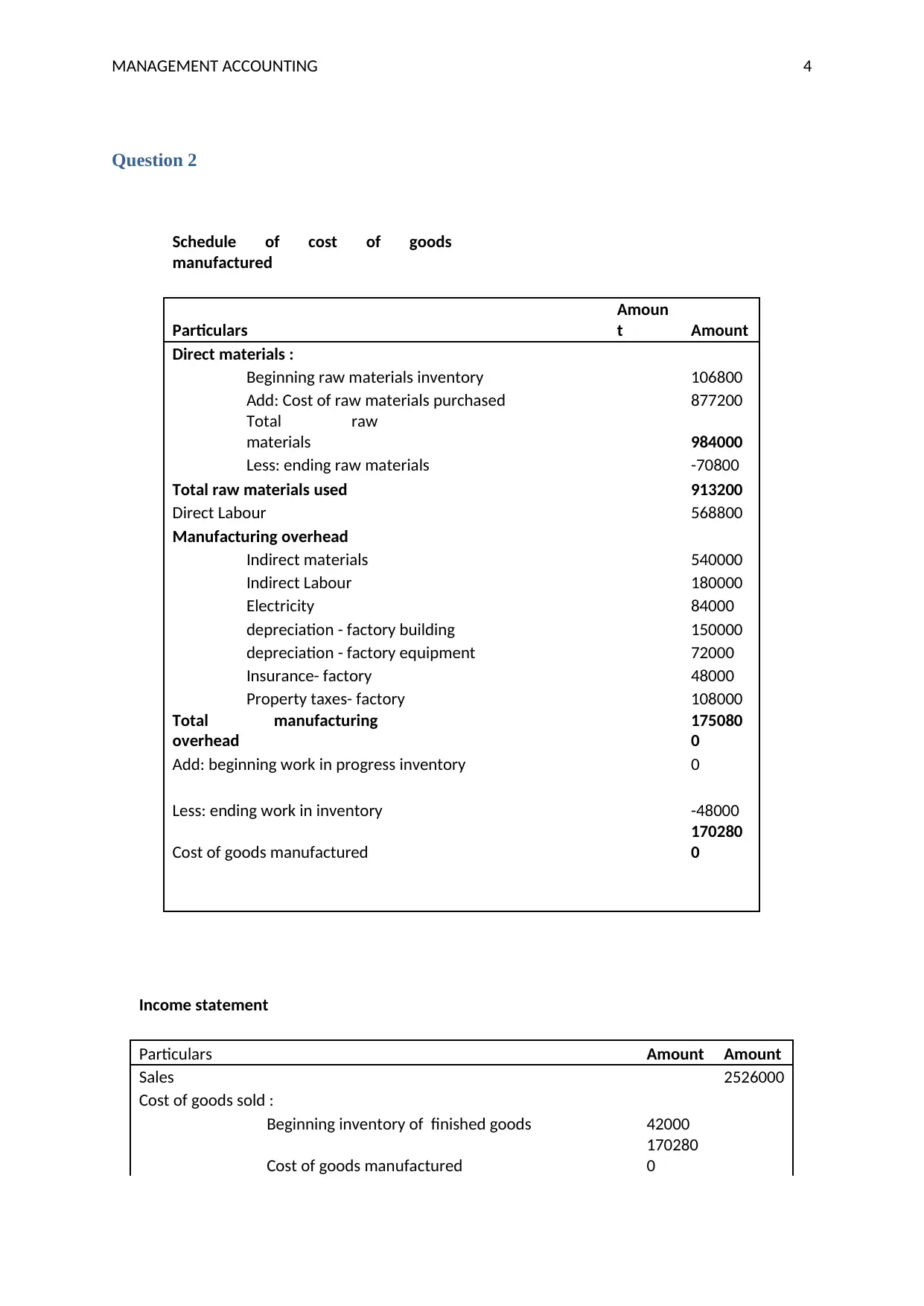
Question 2
Schedule of cost of goods
manufactured
Particulars
Amoun
t Amount
Direct materials :
Beginning raw materials inventory 106800
Add: Cost of raw materials purchased 877200
Total raw
materials 984000
Less: ending raw materials -70800
Total raw materials used 913200
Direct Labour 568800
Manufacturing overhead
Indirect materials 540000
Indirect Labour 180000
Electricity 84000
depreciation - factory building 150000
depreciation - factory equipment 72000
Insurance- factory 48000
Property taxes- factory 108000
Total manufacturing
overhead
175080
0
Add: beginning work in progress inventory 0
Less: ending work in inventory -48000
Cost of goods manufactured
170280
0
Income statement
Particulars Amount Amount
Sales 2526000
Cost of goods sold :
Beginning inventory of finished goods 42000
Cost of goods manufactured
170280
0
Question 2
Schedule of cost of goods
manufactured
Particulars
Amoun
t Amount
Direct materials :
Beginning raw materials inventory 106800
Add: Cost of raw materials purchased 877200
Total raw
materials 984000
Less: ending raw materials -70800
Total raw materials used 913200
Direct Labour 568800
Manufacturing overhead
Indirect materials 540000
Indirect Labour 180000
Electricity 84000
depreciation - factory building 150000
depreciation - factory equipment 72000
Insurance- factory 48000
Property taxes- factory 108000
Total manufacturing
overhead
175080
0
Add: beginning work in progress inventory 0
Less: ending work in inventory -48000
Cost of goods manufactured
170280
0
Income statement
Particulars Amount Amount
Sales 2526000
Cost of goods sold :
Beginning inventory of finished goods 42000
Cost of goods manufactured
170280
0

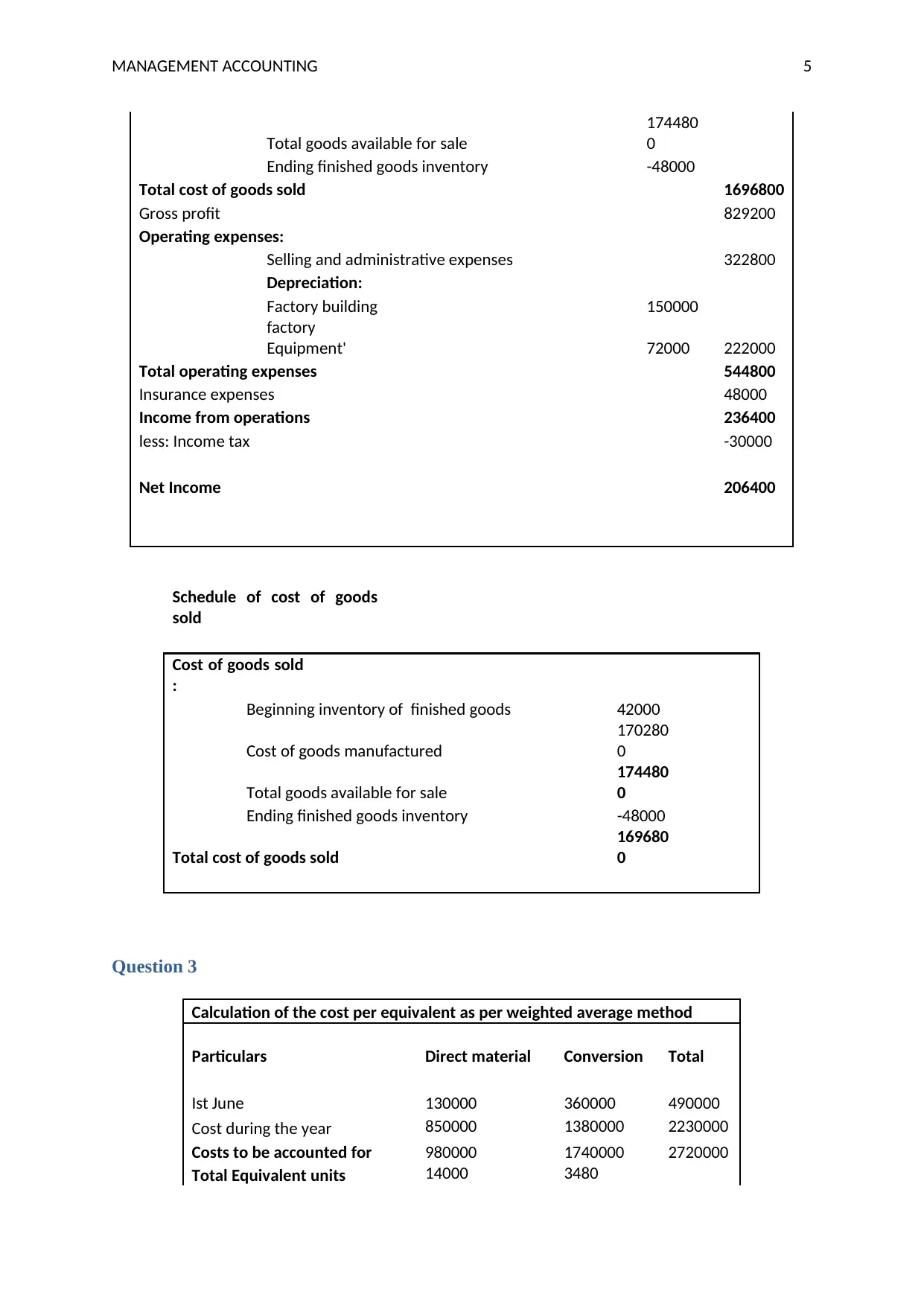
MANAGEMENT ACCOUNTING 5
Total goods available for sale
174480
0
Ending finished goods inventory -48000
Total cost of goods sold 1696800
Gross profit 829200
Operating expenses:
Selling and administrative expenses 322800
Depreciation:
Factory building 150000
factory
Equipment' 72000 222000
Total operating expenses 544800
Insurance expenses 48000
Income from operations 236400
less: Income tax -30000
Net Income 206400
Schedule of cost of goods
sold
Cost of goods sold
:
Beginning inventory of finished goods 42000
Cost of goods manufactured
170280
0
Total goods available for sale
174480
0
Ending finished goods inventory -48000
Total cost of goods sold
169680
0
Question 3
Calculation of the cost per equivalent as per weighted average method
Particulars Direct material Conversion Total
Ist June 130000 360000 490000
Cost during the year 850000 1380000 2230000
Costs to be accounted for 980000 1740000 2720000
Total Equivalent units 14000 3480
Total goods available for sale
174480
0
Ending finished goods inventory -48000
Total cost of goods sold 1696800
Gross profit 829200
Operating expenses:
Selling and administrative expenses 322800
Depreciation:
Factory building 150000
factory
Equipment' 72000 222000
Total operating expenses 544800
Insurance expenses 48000
Income from operations 236400
less: Income tax -30000
Net Income 206400
Schedule of cost of goods
sold
Cost of goods sold
:
Beginning inventory of finished goods 42000
Cost of goods manufactured
170280
0
Total goods available for sale
174480
0
Ending finished goods inventory -48000
Total cost of goods sold
169680
0
Question 3
Calculation of the cost per equivalent as per weighted average method
Particulars Direct material Conversion Total
Ist June 130000 360000 490000
Cost during the year 850000 1380000 2230000
Costs to be accounted for 980000 1740000 2720000
Total Equivalent units 14000 3480
⊘ This is a preview!⊘
Do you want full access?
Subscribe today to unlock all pages.

Trusted by 1+ million students worldwide

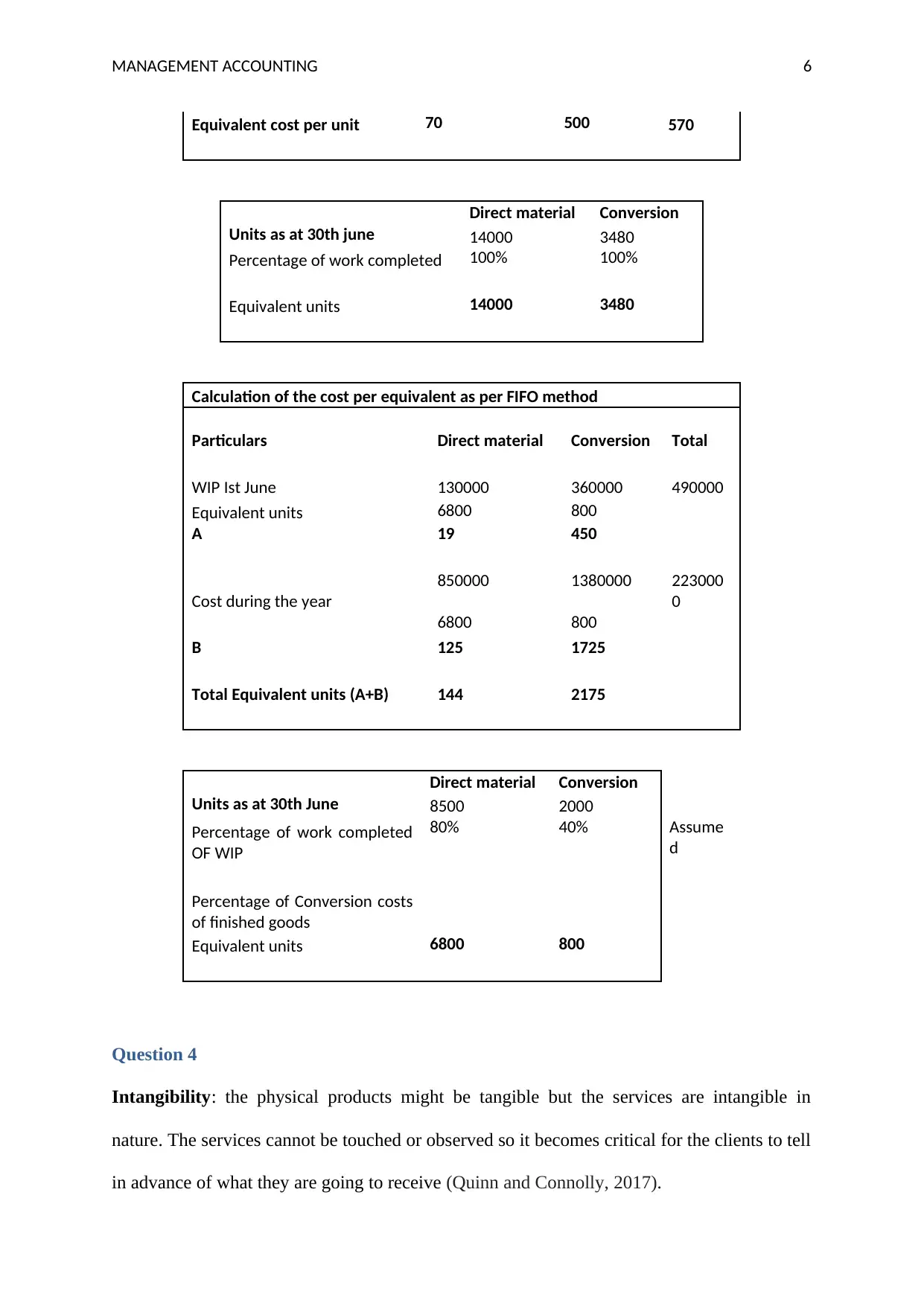
MANAGEMENT ACCOUNTING 6
Equivalent cost per unit 70 500 570
Direct material Conversion
Units as at 30th june 14000 3480
Percentage of work completed 100% 100%
Equivalent units 14000 3480
Calculation of the cost per equivalent as per FIFO method
Particulars Direct material Conversion Total
WIP Ist June 130000 360000 490000
Equivalent units 6800 800
A 19 450
Cost during the year
850000 1380000 223000
0
6800 800
B 125 1725
Total Equivalent units (A+B) 144 2175
Direct material Conversion
Units as at 30th June 8500 2000
Percentage of work completed
OF WIP
80% 40% Assume
d
Percentage of Conversion costs
of finished goods
Equivalent units 6800 800
Question 4
Intangibility: the physical products might be tangible but the services are intangible in
nature. The services cannot be touched or observed so it becomes critical for the clients to tell
in advance of what they are going to receive (Quinn and Connolly, 2017).
Equivalent cost per unit 70 500 570
Direct material Conversion
Units as at 30th june 14000 3480
Percentage of work completed 100% 100%
Equivalent units 14000 3480
Calculation of the cost per equivalent as per FIFO method
Particulars Direct material Conversion Total
WIP Ist June 130000 360000 490000
Equivalent units 6800 800
A 19 450
Cost during the year
850000 1380000 223000
0
6800 800
B 125 1725
Total Equivalent units (A+B) 144 2175
Direct material Conversion
Units as at 30th June 8500 2000
Percentage of work completed
OF WIP
80% 40% Assume
d
Percentage of Conversion costs
of finished goods
Equivalent units 6800 800
Question 4
Intangibility: the physical products might be tangible but the services are intangible in
nature. The services cannot be touched or observed so it becomes critical for the clients to tell
in advance of what they are going to receive (Quinn and Connolly, 2017).
Paraphrase This Document
Need a fresh take? Get an instant paraphrase of this document with our AI Paraphraser

MANAGEMENT ACCOUNTING 7
Inseparability: Personal services cannot be detached from the individual as the services are
created and consumed simultaneously.
Variability: the basic services involve the people from different culture and there is a
possibility that the same problem can be solved in more than two ways by different people.
Therefore, it becomes important to minimise the variances in the performances (Marshall and
Steinbart, 2017).
Perishability: Services generally possess the high degree of the perishability. The unused
capacity is not kept for the future use as it is not the product. If the services are not used
today it is lost forever. For example the empty seats in the aeroplane cannot be transferred to
the next flight if the person has not chosen it for (Theriou, 2015).
Change in demand and pricing of services: The demand for the services fluctuates and can
be seasonal and the prices of services are usually dependent on the basis of the demand and
the competition (Lovelock and Patterson, 2015).
To what extent these variables are present in the following areas is of core importance
Electricity gas and water supply: Generally the electricity gas and water supply mostly
affects the factor of the change in demand. As the demand increases the prices fluctuates
and tends to rise. The water supply and Electricity gas are necessity therefore it will be
utilised irrespective of the prices. They are also perishable in nature as once used, it gets
finished (Pucheta‐Martínez, Bel‐Oms and Olcina‐Sempere, 2016).
Information media and telecommunication: The dimension of the intangibility is present to
a high level of degree in case of the information and telecommunication medium. The
information cannot be felt or touched but its affect can be seen. Moreover, the information
media and telecommunication are inseparable of each other (Fuller, 2016). The information
Inseparability: Personal services cannot be detached from the individual as the services are
created and consumed simultaneously.
Variability: the basic services involve the people from different culture and there is a
possibility that the same problem can be solved in more than two ways by different people.
Therefore, it becomes important to minimise the variances in the performances (Marshall and
Steinbart, 2017).
Perishability: Services generally possess the high degree of the perishability. The unused
capacity is not kept for the future use as it is not the product. If the services are not used
today it is lost forever. For example the empty seats in the aeroplane cannot be transferred to
the next flight if the person has not chosen it for (Theriou, 2015).
Change in demand and pricing of services: The demand for the services fluctuates and can
be seasonal and the prices of services are usually dependent on the basis of the demand and
the competition (Lovelock and Patterson, 2015).
To what extent these variables are present in the following areas is of core importance
Electricity gas and water supply: Generally the electricity gas and water supply mostly
affects the factor of the change in demand. As the demand increases the prices fluctuates
and tends to rise. The water supply and Electricity gas are necessity therefore it will be
utilised irrespective of the prices. They are also perishable in nature as once used, it gets
finished (Pucheta‐Martínez, Bel‐Oms and Olcina‐Sempere, 2016).
Information media and telecommunication: The dimension of the intangibility is present to
a high level of degree in case of the information and telecommunication medium. The
information cannot be felt or touched but its affect can be seen. Moreover, the information
media and telecommunication are inseparable of each other (Fuller, 2016). The information

MANAGEMENT ACCOUNTING 8
cannot be communicated without a medium and the medium cannot run without the
information.
Education and training: The variability factors have a larger extent in case of the education
and training. For example different teachers will teach different students with their own
perspective. Apart from that the factor that most affects it is the perishability as thought the
knowledge gets retained but the services are detached from the environment (Gillespie and
Riddle, 2015).
cannot be communicated without a medium and the medium cannot run without the
information.
Education and training: The variability factors have a larger extent in case of the education
and training. For example different teachers will teach different students with their own
perspective. Apart from that the factor that most affects it is the perishability as thought the
knowledge gets retained but the services are detached from the environment (Gillespie and
Riddle, 2015).
⊘ This is a preview!⊘
Do you want full access?
Subscribe today to unlock all pages.

Trusted by 1+ million students worldwide

MANAGEMENT ACCOUNTING 9
References
Otley, D., (2016) The contingency theory of management accounting and control: 1980–
2014. Management accounting research, 31, pp.45-62.
Cooper, D.J., Ezzamel, M. and Qu, S.Q., (2017) Popularizing a management accounting idea:
The case of the balanced scorecard. Contemporary Accounting Research, 34(2), pp.991-1025.
Fuller, G.W., (2016) New food product development: from concept to marketplace. Costa
Rica: CRC Press.
Gillespie, K. and Riddle, L., (2015) Global marketing. California: Routledge.
Lovelock, C. and Patterson, P., (2015) Services marketing. Australia: Pearson Australia.
Taherdoost, H., Sahibuddin, S. and Jalaliyoon, N., (2014) Features’ Evaluation of Goods,
Services and E-Services; Electronic Service Characteristics Exploration. Procedia
Technology, 12, pp.204-211.
https://marketing-insider.eu/characteristics-of-services/
Smith, L.C. and Wong, M.A. eds., (2016) Reference and Information Services: An
Introduction: An Introduction. ABC-CLIO.
Bustinza, O.F., Bigdeli, A.Z., Baines, T. and Elliot, C., (2015) Servitization and competitive
advantage: the importance of organizational structure and value chain position. Research-
Technology Management, 58(5), pp.53-60.
Marshall, B.R. and Steinbart, P.J., (2017) ACCOUNTING INFORMATION SYSTEMS.
PEARSON EDUCATION LIMITED.
References
Otley, D., (2016) The contingency theory of management accounting and control: 1980–
2014. Management accounting research, 31, pp.45-62.
Cooper, D.J., Ezzamel, M. and Qu, S.Q., (2017) Popularizing a management accounting idea:
The case of the balanced scorecard. Contemporary Accounting Research, 34(2), pp.991-1025.
Fuller, G.W., (2016) New food product development: from concept to marketplace. Costa
Rica: CRC Press.
Gillespie, K. and Riddle, L., (2015) Global marketing. California: Routledge.
Lovelock, C. and Patterson, P., (2015) Services marketing. Australia: Pearson Australia.
Taherdoost, H., Sahibuddin, S. and Jalaliyoon, N., (2014) Features’ Evaluation of Goods,
Services and E-Services; Electronic Service Characteristics Exploration. Procedia
Technology, 12, pp.204-211.
https://marketing-insider.eu/characteristics-of-services/
Smith, L.C. and Wong, M.A. eds., (2016) Reference and Information Services: An
Introduction: An Introduction. ABC-CLIO.
Bustinza, O.F., Bigdeli, A.Z., Baines, T. and Elliot, C., (2015) Servitization and competitive
advantage: the importance of organizational structure and value chain position. Research-
Technology Management, 58(5), pp.53-60.
Marshall, B.R. and Steinbart, P.J., (2017) ACCOUNTING INFORMATION SYSTEMS.
PEARSON EDUCATION LIMITED.
Paraphrase This Document
Need a fresh take? Get an instant paraphrase of this document with our AI Paraphraser

MANAGEMENT ACCOUNTING 10
Theriou, N.G., (2015) Strategic Management Process and the Importance of Structured
Formality, Financial and Non-Financial Information. European Research Studies, 18(2), p.3.
Pucheta‐Martínez, M.C., Bel‐Oms, I. and Olcina‐Sempere, G., (2016) Corporate governance,
female directors and quality of financial information. Business Ethics: A European
Review, 25(4), pp.363-385.
Quinn, J. and Connolly, B., (2017) The Non-Financial Information Directive: an assessment
of its impact on corporate social responsibility. European Company Law, 14(1), pp.15-21.
Theriou, N.G., (2015) Strategic Management Process and the Importance of Structured
Formality, Financial and Non-Financial Information. European Research Studies, 18(2), p.3.
Pucheta‐Martínez, M.C., Bel‐Oms, I. and Olcina‐Sempere, G., (2016) Corporate governance,
female directors and quality of financial information. Business Ethics: A European
Review, 25(4), pp.363-385.
Quinn, J. and Connolly, B., (2017) The Non-Financial Information Directive: an assessment
of its impact on corporate social responsibility. European Company Law, 14(1), pp.15-21.
1 out of 11
Related Documents
Your All-in-One AI-Powered Toolkit for Academic Success.
+13062052269
info@desklib.com
Available 24*7 on WhatsApp / Email
Unlock your academic potential
Copyright © 2020–2025 A2Z Services. All Rights Reserved. Developed and managed by ZUCOL.