Financial Performance Analysis and Enhancement Report
VerifiedAdded on 2022/12/26
|9
|2602
|82
Report
AI Summary
This report provides an in-depth analysis of financial management, emphasizing its critical role in organizational success. It defines financial management and highlights its importance in planning, fund acquisition, efficient fund usage, financial decision-making, profitability enhancement, and firm value increase. The report then explores key financial statements such as the income statement, balance sheet, and cash flow statement, explaining their significance in assessing a company's financial health. Furthermore, it details the use of various financial ratios, including net profit margin, gross profit margin, current ratio, and quick ratio, to evaluate a company's liquidity and profitability. The analysis of these ratios enables a comprehensive understanding of the business's financial performance and provides insights for improvement. The report concludes by summarizing the findings and emphasizing the importance of sound financial practices for sustained business operations.

Finance

Paraphrase This Document
Need a fresh take? Get an instant paraphrase of this document with our AI Paraphraser
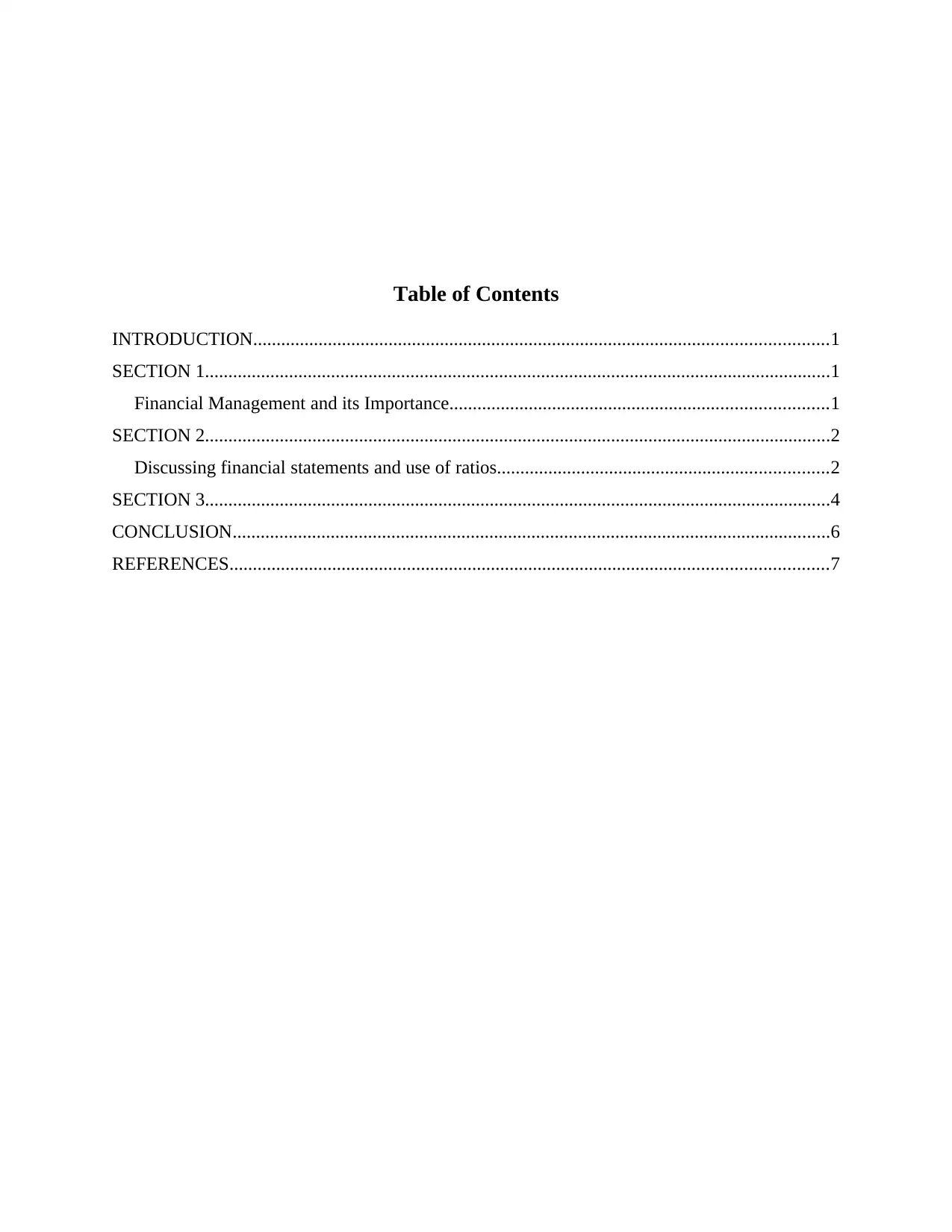
Table of Contents
INTRODUCTION...........................................................................................................................1
SECTION 1......................................................................................................................................1
Financial Management and its Importance.................................................................................1
SECTION 2......................................................................................................................................2
Discussing financial statements and use of ratios.......................................................................2
SECTION 3......................................................................................................................................4
CONCLUSION................................................................................................................................6
REFERENCES................................................................................................................................7
INTRODUCTION...........................................................................................................................1
SECTION 1......................................................................................................................................1
Financial Management and its Importance.................................................................................1
SECTION 2......................................................................................................................................2
Discussing financial statements and use of ratios.......................................................................2
SECTION 3......................................................................................................................................4
CONCLUSION................................................................................................................................6
REFERENCES................................................................................................................................7
INTRODUCTION
Finance corresponds to the administration of funds as well as the acquisition of funds.
Finance is a boarder concept that refers to operations involving financing, debt, lending, financial
markets, assets, including investments. The term "business finance" applies to the utilization of
funds and credits in an enterprise. This also facilitates management of funds/monies in order to
increase the profitability of a company by reviewing business’s financial statements (Ozili,
2020). This report based on the analysis of applied business finance. In this report consist of
definition of financial management with its importance. Along with discuss main financial
statement with key ratios to analysis the performance of business. Moreover, calculate all
missing amounts from different templates and interpret them. At the end of the report, define and
discuss the procedure to enhance their financial performance.
SECTION 1
Financial Management and its Importance
In every organisation, financial management is critical practice. It is the practice of
scheduling, coordinating, managing, and reporting financial capital in order to meet the aims and
targets of an entity. It is crucial practice for managing an entity 's fiscal operations, like fund
acquisition, fund allocation, billing, transfers, risk evaluation, and everything else involving
monies/funds. In other word, financial management implies to application of strategic
management concepts to an organization's financial assets. Quality gasoline and routine service
are provided by proper financial management in order for a company's processes to run
smoothly. If an enterprise's finances aren't handled appropriately, it can encounter obstacles that
could stifle its progression and advancement.
In this regard, following are several major importance of practices of Financial
management in effective performance of enterprise, as follows:
Financial Planning: Financial management facilitates in determining the financial
requirements of a corporation issue and subsequently contributes to fiscal planning
Financial planning is essential aspect of business that aids in effective growth of
business-entity (Bilan and et.al, 2019).
1
Finance corresponds to the administration of funds as well as the acquisition of funds.
Finance is a boarder concept that refers to operations involving financing, debt, lending, financial
markets, assets, including investments. The term "business finance" applies to the utilization of
funds and credits in an enterprise. This also facilitates management of funds/monies in order to
increase the profitability of a company by reviewing business’s financial statements (Ozili,
2020). This report based on the analysis of applied business finance. In this report consist of
definition of financial management with its importance. Along with discuss main financial
statement with key ratios to analysis the performance of business. Moreover, calculate all
missing amounts from different templates and interpret them. At the end of the report, define and
discuss the procedure to enhance their financial performance.
SECTION 1
Financial Management and its Importance
In every organisation, financial management is critical practice. It is the practice of
scheduling, coordinating, managing, and reporting financial capital in order to meet the aims and
targets of an entity. It is crucial practice for managing an entity 's fiscal operations, like fund
acquisition, fund allocation, billing, transfers, risk evaluation, and everything else involving
monies/funds. In other word, financial management implies to application of strategic
management concepts to an organization's financial assets. Quality gasoline and routine service
are provided by proper financial management in order for a company's processes to run
smoothly. If an enterprise's finances aren't handled appropriately, it can encounter obstacles that
could stifle its progression and advancement.
In this regard, following are several major importance of practices of Financial
management in effective performance of enterprise, as follows:
Financial Planning: Financial management facilitates in determining the financial
requirements of a corporation issue and subsequently contributes to fiscal planning
Financial planning is essential aspect of business that aids in effective growth of
business-entity (Bilan and et.al, 2019).
1
⊘ This is a preview!⊘
Do you want full access?
Subscribe today to unlock all pages.

Trusted by 1+ million students worldwide
Acquisition of Funds: Financial management encompasses obtaining the necessary funds
for a company concern. Obtaining required funds is an important aspect of financial
management, that includes finding the most cost-effective sources of funding.
Efficient Funds usage: The optimal utilization as well as utilisation of funding improves
the corporation concern's operating performance. When a financial executive utilizes
funds wisely, he or she will lower cost of funding and raise the company's value.
Financial Decision: Financial management aids in the making of rational financial
decisions in an enterprise. The concern's overall business activity would be affected by
the fiscal decision. Since there is a direct link between different department tasks
including advertising, manufacturing, and so forth (Fisch, 2019).
Improve Profitability: The efficiency and efficient usage of funding by business concern
are solely responsible for concerns productivity. With the aid of strong financial
monitoring devices like budgetary monitoring financial ratios, and cost volumes benefit
analysis, FM enables to increase the profitability level of the organization.
Increase the Value of the Firm: In area of rising the resources of investors including
market concerns, FM is critical. The overarching goal of any business organization is to
enhance profits and greater profitability contributes to increased wealth for investors.
Promoting Savings: Savings within business are only achievable when an organization
reaches a higher profitability margin and maximizes wealth. Person and organizational
savings can be promoted and mobilized with the aid of efficient financial management.
SECTION 2
Discussing financial statements and use of ratios
Financial Statements: Financial statement for organization refers to a structured
comprehensive report form document that shows the company's current financial status along
with all of its main financial operations (Frizzo-Barker and et.al, 2020). The most important
components of a company's financial statements are series of standardization records such
as balance sheet, profits and losses or income statements, cash-flow statements, and equity-
change statement.
Businesses may consider to generate financial statements on monthly, quarterly, or
annualized basis, with annual reports due at the ending fiscal period. Businesses are required to
2
for a company concern. Obtaining required funds is an important aspect of financial
management, that includes finding the most cost-effective sources of funding.
Efficient Funds usage: The optimal utilization as well as utilisation of funding improves
the corporation concern's operating performance. When a financial executive utilizes
funds wisely, he or she will lower cost of funding and raise the company's value.
Financial Decision: Financial management aids in the making of rational financial
decisions in an enterprise. The concern's overall business activity would be affected by
the fiscal decision. Since there is a direct link between different department tasks
including advertising, manufacturing, and so forth (Fisch, 2019).
Improve Profitability: The efficiency and efficient usage of funding by business concern
are solely responsible for concerns productivity. With the aid of strong financial
monitoring devices like budgetary monitoring financial ratios, and cost volumes benefit
analysis, FM enables to increase the profitability level of the organization.
Increase the Value of the Firm: In area of rising the resources of investors including
market concerns, FM is critical. The overarching goal of any business organization is to
enhance profits and greater profitability contributes to increased wealth for investors.
Promoting Savings: Savings within business are only achievable when an organization
reaches a higher profitability margin and maximizes wealth. Person and organizational
savings can be promoted and mobilized with the aid of efficient financial management.
SECTION 2
Discussing financial statements and use of ratios
Financial Statements: Financial statement for organization refers to a structured
comprehensive report form document that shows the company's current financial status along
with all of its main financial operations (Frizzo-Barker and et.al, 2020). The most important
components of a company's financial statements are series of standardization records such
as balance sheet, profits and losses or income statements, cash-flow statements, and equity-
change statement.
Businesses may consider to generate financial statements on monthly, quarterly, or
annualized basis, with annual reports due at the ending fiscal period. Businesses are required to
2
Paraphrase This Document
Need a fresh take? Get an instant paraphrase of this document with our AI Paraphraser
adhere to universally accepted accounting principles in order to maintain the consistency and
credibility of the formulation of business’s financial reports.
Financial statements within business are essential records for evaluating a business's outcomes
and finance situation. The following are some of the most relevant elements of financial
statements, as described here:
Income statements: A business’s Income statement clearly describes actual overall
profitability status of organisation during a particular period. It presents the P&L account
in which clarify the fiscal point of an entity that presents net profit and losses in certain
period of time. It is essential portion in which compare revenues as well as expenditure in
which consist of operating cost, research & technology cost that impact on the outcomes
on entity (Gulzar and et.al, 2019).
Balance sheet: This statement describes total fiscal status of organisation as on a specific
date. It is one one of key financial statement which is presenting financial modelling as
well as accounting. In this statement presents the total assets and how these are financed
as per the debt and equity. It can be also mention as a statement of net worth, financial
position. It is mainly depend on the fundamental equation which is Assets = Liabilities +
Equity. It is classified into two sides first assets and second liabilities.
Cash flow statements: Such kind of statement reflects how efficient an organisation is in
managing their overall cash or liquid funds. This statement defined that how much cash
come in business and how much go out. This statement has been categorised into three
parts such as, operational, financial and investment activities. Different cash transactions
are categorised into these activities that helps to analysis the actual cash position in
detailed manner. Such activities measure and determine organisational efficiency and
facilitates the investors as well as shareholders to determine the outcomes efficiently. It
supports business in taking informed decision in context of cash position and how
effectively a business pay their debts and conduct incurred operating expenditure
(Coleman and et.al, 2019).
Ratio are consisting of broad variety of calculations in which act as indicator and analysis
profitability as well as liquidity of business entity. The ratio analysis is quantitative method of
achieving insight into a organisational liquidity, profitability by researching its financial
3
credibility of the formulation of business’s financial reports.
Financial statements within business are essential records for evaluating a business's outcomes
and finance situation. The following are some of the most relevant elements of financial
statements, as described here:
Income statements: A business’s Income statement clearly describes actual overall
profitability status of organisation during a particular period. It presents the P&L account
in which clarify the fiscal point of an entity that presents net profit and losses in certain
period of time. It is essential portion in which compare revenues as well as expenditure in
which consist of operating cost, research & technology cost that impact on the outcomes
on entity (Gulzar and et.al, 2019).
Balance sheet: This statement describes total fiscal status of organisation as on a specific
date. It is one one of key financial statement which is presenting financial modelling as
well as accounting. In this statement presents the total assets and how these are financed
as per the debt and equity. It can be also mention as a statement of net worth, financial
position. It is mainly depend on the fundamental equation which is Assets = Liabilities +
Equity. It is classified into two sides first assets and second liabilities.
Cash flow statements: Such kind of statement reflects how efficient an organisation is in
managing their overall cash or liquid funds. This statement defined that how much cash
come in business and how much go out. This statement has been categorised into three
parts such as, operational, financial and investment activities. Different cash transactions
are categorised into these activities that helps to analysis the actual cash position in
detailed manner. Such activities measure and determine organisational efficiency and
facilitates the investors as well as shareholders to determine the outcomes efficiently. It
supports business in taking informed decision in context of cash position and how
effectively a business pay their debts and conduct incurred operating expenditure
(Coleman and et.al, 2019).
Ratio are consisting of broad variety of calculations in which act as indicator and analysis
profitability as well as liquidity of business entity. The ratio analysis is quantitative method of
achieving insight into a organisational liquidity, profitability by researching its financial
3
statements like profit & loss account and financial position. There are mentioning use of
financial ratios in financial management that are mentioned below:
Helps in comparison: Such ratios are meaningful in comparison outlook to business and
supports in effective actions are necessary to taken. It is critically analysis on basis of
shareholders, investors to compare actual performance of past years with current years
activities.
Supports in predicting and forecasting: On the basis of ratio organisation know actual
financial performance ans know the changes in current years on basis of past year
activities. Planning is looking ahead as well as ratios are computed for number of years
are working as guide for future activities. The meaningful conclusion carried out that
company take investment decision in the context of business and helps in forecasting as
well as in planning (Sugiyanto and Candra, 2019).
Useful in decision making: The financial statements are producing by an entity in
specified period of time at the end of year. In these statements are including all the
financial activities end in itself and no meaningful conclusion can be drawn as per the
statements. The ratio analysis supports business in decision making procedure and get
effective results from the different financial statements.
Helps in control: This analysis is supporting in making control different business
activities that conduct in particular financial year. These ratios are calculated by manager
on basis of income statement and financial statements. Thus these ratios are presenting
actual performance of business. When find any comparing the actual and budgeted
standards so take corrective action at the right time.
Supports in communication: The financial weakness and strength of business are
communicated easily and realize by ratio analysis. These analysis mainly use by the
business to present actual position of business and present in front of board of directors.
Thus, it use for proper communication and increase the value of financial statements
(Palacín-Sánchez, Canto-Cuevas and di-Pietro, 2019).
SECTION 3
Net profit ratio: It is a financial ratio that utilised to compute the percentage of profit of an
entity for produces on basis of its total revenues. This ratio analysis the amount of net profit of
an entity that acquire as per dollar to gain revenues. For the calculation of net profit require to
4
financial ratios in financial management that are mentioned below:
Helps in comparison: Such ratios are meaningful in comparison outlook to business and
supports in effective actions are necessary to taken. It is critically analysis on basis of
shareholders, investors to compare actual performance of past years with current years
activities.
Supports in predicting and forecasting: On the basis of ratio organisation know actual
financial performance ans know the changes in current years on basis of past year
activities. Planning is looking ahead as well as ratios are computed for number of years
are working as guide for future activities. The meaningful conclusion carried out that
company take investment decision in the context of business and helps in forecasting as
well as in planning (Sugiyanto and Candra, 2019).
Useful in decision making: The financial statements are producing by an entity in
specified period of time at the end of year. In these statements are including all the
financial activities end in itself and no meaningful conclusion can be drawn as per the
statements. The ratio analysis supports business in decision making procedure and get
effective results from the different financial statements.
Helps in control: This analysis is supporting in making control different business
activities that conduct in particular financial year. These ratios are calculated by manager
on basis of income statement and financial statements. Thus these ratios are presenting
actual performance of business. When find any comparing the actual and budgeted
standards so take corrective action at the right time.
Supports in communication: The financial weakness and strength of business are
communicated easily and realize by ratio analysis. These analysis mainly use by the
business to present actual position of business and present in front of board of directors.
Thus, it use for proper communication and increase the value of financial statements
(Palacín-Sánchez, Canto-Cuevas and di-Pietro, 2019).
SECTION 3
Net profit ratio: It is a financial ratio that utilised to compute the percentage of profit of an
entity for produces on basis of its total revenues. This ratio analysis the amount of net profit of
an entity that acquire as per dollar to gain revenues. For the calculation of net profit require to
4
⊘ This is a preview!⊘
Do you want full access?
Subscribe today to unlock all pages.
Trusted by 1+ million students worldwide
deduct all the expenditure of an entity from its total revenues. This ratio increase efficiency and
carry out new ways to enhance their finances. The high profitability ratio presents the current
business practices and sale out their items at higher prices (Attaran and Woods, 2019).
Net profit margin = 43057 / 189711 * 100
= 22.69%
Gross profit: It is part of profitability ratio that presents the relationship between gross
profit and total net sales revenues. Most of the organisations are using this ratio to analysis the
operational performance of an entity. For the calculation of this ratio requires gross profit
dividing by net sales and get amount in percentage manner.
Gross profit margin= 81125 / 189711 * 100
= 42.76%
Current ratio: This ratio use by business to measure the capability of an entity to meet
its short term activities that are due within a year. In this ratio focus on the weight of total current
assets as well as total current liabilities. It is presenting of actual financial health and liquidity
position. On the basis of this ratio company take right decision and make investment in further
activities. This ratio can be utilised to effectively measure a entity's liquidity.
Current ratio = Current assets / current liabilities
= 54349 / 37928
= 2.22:1
Quick ratio: This ratio measure the liquidity of an entity by analysis how well its current
assets could cover its current liabilities. Therefore, this ratio use for progressiveness measure of
liquidity due to it does not consist of all the activities that used in current ratio. For the
calculation of this ratio require to adding cash and cash equivalents, accounts receivables
(Hessian, 2019) (Van and et.al, 2021).
Quick ratio = (Current assets – inventory) / current liabilities
= (84349 – 28571) / 37928
= 1.47: 1
As per the ratio analysis it is determining that the efficiency level of entity is high that is
related with the profitability and with its core operations. It can be defined that evaluating margin
gross profit of an entity as organisation is earning greater gross profit margin. On the other side,
business entity require to enhance its net profit margin that can be done as per the reducing
5
carry out new ways to enhance their finances. The high profitability ratio presents the current
business practices and sale out their items at higher prices (Attaran and Woods, 2019).
Net profit margin = 43057 / 189711 * 100
= 22.69%
Gross profit: It is part of profitability ratio that presents the relationship between gross
profit and total net sales revenues. Most of the organisations are using this ratio to analysis the
operational performance of an entity. For the calculation of this ratio requires gross profit
dividing by net sales and get amount in percentage manner.
Gross profit margin= 81125 / 189711 * 100
= 42.76%
Current ratio: This ratio use by business to measure the capability of an entity to meet
its short term activities that are due within a year. In this ratio focus on the weight of total current
assets as well as total current liabilities. It is presenting of actual financial health and liquidity
position. On the basis of this ratio company take right decision and make investment in further
activities. This ratio can be utilised to effectively measure a entity's liquidity.
Current ratio = Current assets / current liabilities
= 54349 / 37928
= 2.22:1
Quick ratio: This ratio measure the liquidity of an entity by analysis how well its current
assets could cover its current liabilities. Therefore, this ratio use for progressiveness measure of
liquidity due to it does not consist of all the activities that used in current ratio. For the
calculation of this ratio require to adding cash and cash equivalents, accounts receivables
(Hessian, 2019) (Van and et.al, 2021).
Quick ratio = (Current assets – inventory) / current liabilities
= (84349 – 28571) / 37928
= 1.47: 1
As per the ratio analysis it is determining that the efficiency level of entity is high that is
related with the profitability and with its core operations. It can be defined that evaluating margin
gross profit of an entity as organisation is earning greater gross profit margin. On the other side,
business entity require to enhance its net profit margin that can be done as per the reducing
5
Paraphrase This Document
Need a fresh take? Get an instant paraphrase of this document with our AI Paraphraser
unplanned expenses and other activities. Moreover, the liquidity position of entity is defined
adequate manner. Apart from it, financial position of business is appropriate so it is necessary to
assuring about the proper consolidation of financial statement that enables to organisation in
improvising proficiency level of an entity.
CONCLUSION
As per the above report it has been concluded that finance is backbone of any business
that helps to operate various business activities. The term of financial management supports to
manage different financial resources and activities in proper manner. It enables to determine the
performance level of an entity in which different activities concerned with different approaches
like management of fixed assets and processing of payment. For the analysis financial
performance of business prepare various financial statements in order to calculate different ratios
and provide overview. As per the ratio analysis know the actual position of business in effective
manner and determine actual position of business.
6
adequate manner. Apart from it, financial position of business is appropriate so it is necessary to
assuring about the proper consolidation of financial statement that enables to organisation in
improvising proficiency level of an entity.
CONCLUSION
As per the above report it has been concluded that finance is backbone of any business
that helps to operate various business activities. The term of financial management supports to
manage different financial resources and activities in proper manner. It enables to determine the
performance level of an entity in which different activities concerned with different approaches
like management of fixed assets and processing of payment. For the analysis financial
performance of business prepare various financial statements in order to calculate different ratios
and provide overview. As per the ratio analysis know the actual position of business in effective
manner and determine actual position of business.
6
REFERENCES
Books and Journals
Ozili, P. K., 2020, January. Financial inclusion research around the world: A review. In Forum
for social economics (pp. 1-23). Routledge.
Bilan, Y. and et.al, 2019. The influence of industry 4.0 on financial services: Determinants of
alternative finance development. Polish Journal of Management Studies.
Fisch, C., 2019. Initial coin offerings (ICOs) to finance new ventures. Journal of Business
Venturing. 34(1). pp.1-22.
Frizzo-Barker, J. and et.al, 2020. Blockchain as a disruptive technology for business: A
systematic review. International Journal of Information Management. 51. p.102029.
Gulzar, S. and et.al, 2019. Financial cointegration and spillover effect of global financial crisis:
A study of emerging Asian financial markets. Economic research-Ekonomska
istraživanja. 32(1). pp.187-218.
Coleman, S. and et.al, 2019. Policy support for women entrepreneurs’ access to financial capital:
evidence from Canada, Germany, Ireland, Norway, and the United States. Journal of
Small Business Management. 57. pp.296-322.
Sugiyanto, S. and Candra, A., 2019. Good Corporate Governance, Conservatism Accounting,
Real Earnings Management, And Information Asymmetry On Share Return. Jiafe
(Jurnal Ilmiah Akuntansi Fakultas Ekonomi). 4(1). pp.9-18.
Palacín-Sánchez, M. J., Canto-Cuevas, F. J. and di-Pietro, F., 2019. Trade credit versus bank
credit: a simultaneous analysis in European SMEs. Small Business Economics. 53(4).
pp.1079-1096.
Attaran, M. and Woods, J., 2019. Cloud computing technology: improving small business
performance using the Internet. Journal of Small Business & Entrepreneurship. 31(6).
pp.495-519.
Hessian, M. I., 2019. The Impact of Managerial Ability on the Relation between Real Earnings
Management and Future Firm’s Performance: Applied Study. International Journal of
Business Ethics and Governance, pp.57-85.
Van, L. T. H. and et.al, 2021. Financial inclusion and economic growth: An international
evidence. Emerging Markets Finance and Trade. 57(1). pp.239-263.
7
Books and Journals
Ozili, P. K., 2020, January. Financial inclusion research around the world: A review. In Forum
for social economics (pp. 1-23). Routledge.
Bilan, Y. and et.al, 2019. The influence of industry 4.0 on financial services: Determinants of
alternative finance development. Polish Journal of Management Studies.
Fisch, C., 2019. Initial coin offerings (ICOs) to finance new ventures. Journal of Business
Venturing. 34(1). pp.1-22.
Frizzo-Barker, J. and et.al, 2020. Blockchain as a disruptive technology for business: A
systematic review. International Journal of Information Management. 51. p.102029.
Gulzar, S. and et.al, 2019. Financial cointegration and spillover effect of global financial crisis:
A study of emerging Asian financial markets. Economic research-Ekonomska
istraživanja. 32(1). pp.187-218.
Coleman, S. and et.al, 2019. Policy support for women entrepreneurs’ access to financial capital:
evidence from Canada, Germany, Ireland, Norway, and the United States. Journal of
Small Business Management. 57. pp.296-322.
Sugiyanto, S. and Candra, A., 2019. Good Corporate Governance, Conservatism Accounting,
Real Earnings Management, And Information Asymmetry On Share Return. Jiafe
(Jurnal Ilmiah Akuntansi Fakultas Ekonomi). 4(1). pp.9-18.
Palacín-Sánchez, M. J., Canto-Cuevas, F. J. and di-Pietro, F., 2019. Trade credit versus bank
credit: a simultaneous analysis in European SMEs. Small Business Economics. 53(4).
pp.1079-1096.
Attaran, M. and Woods, J., 2019. Cloud computing technology: improving small business
performance using the Internet. Journal of Small Business & Entrepreneurship. 31(6).
pp.495-519.
Hessian, M. I., 2019. The Impact of Managerial Ability on the Relation between Real Earnings
Management and Future Firm’s Performance: Applied Study. International Journal of
Business Ethics and Governance, pp.57-85.
Van, L. T. H. and et.al, 2021. Financial inclusion and economic growth: An international
evidence. Emerging Markets Finance and Trade. 57(1). pp.239-263.
7
⊘ This is a preview!⊘
Do you want full access?
Subscribe today to unlock all pages.
Trusted by 1+ million students worldwide

1 out of 9


Related Documents


Your All-in-One AI-Powered Toolkit for Academic Success.
+13062052269
info@desklib.com
Available 24*7 on WhatsApp / Email
![[object Object]](/_next/static/media/star-bottom.7253800d.svg)
Unlock your academic potential
Copyright © 2020–2026 A2Z Services. All Rights Reserved. Developed and managed by ZUCOL.