Applied Business Finance 1 Report: Financial Performance and Analysis
VerifiedAdded on 2022/12/16
|15
|2903
|68
Report
AI Summary
This report provides a detailed analysis of financial management concepts within a business context. It explores the importance of financial management, the roles and responsibilities of finance managers, and the components of financial statements, including the income statement, balance sheet, and cash flow statement. The report emphasizes the use of ratio analysis, covering profitability, liquidity, and efficiency ratios to assess business performance. It includes a business review template, income statement, and balance sheet to evaluate a company's financial health. The report reviews the company's performance, highlighting its profitability, liquidity, and efficiency based on provided financial data. It concludes by suggesting processes to improve financial performance, such as optimizing costs, managing working capital, and exploring expansion opportunities.

Applied Business Finance
1
1

Paraphrase This Document
Need a fresh take? Get an instant paraphrase of this document with our AI Paraphraser
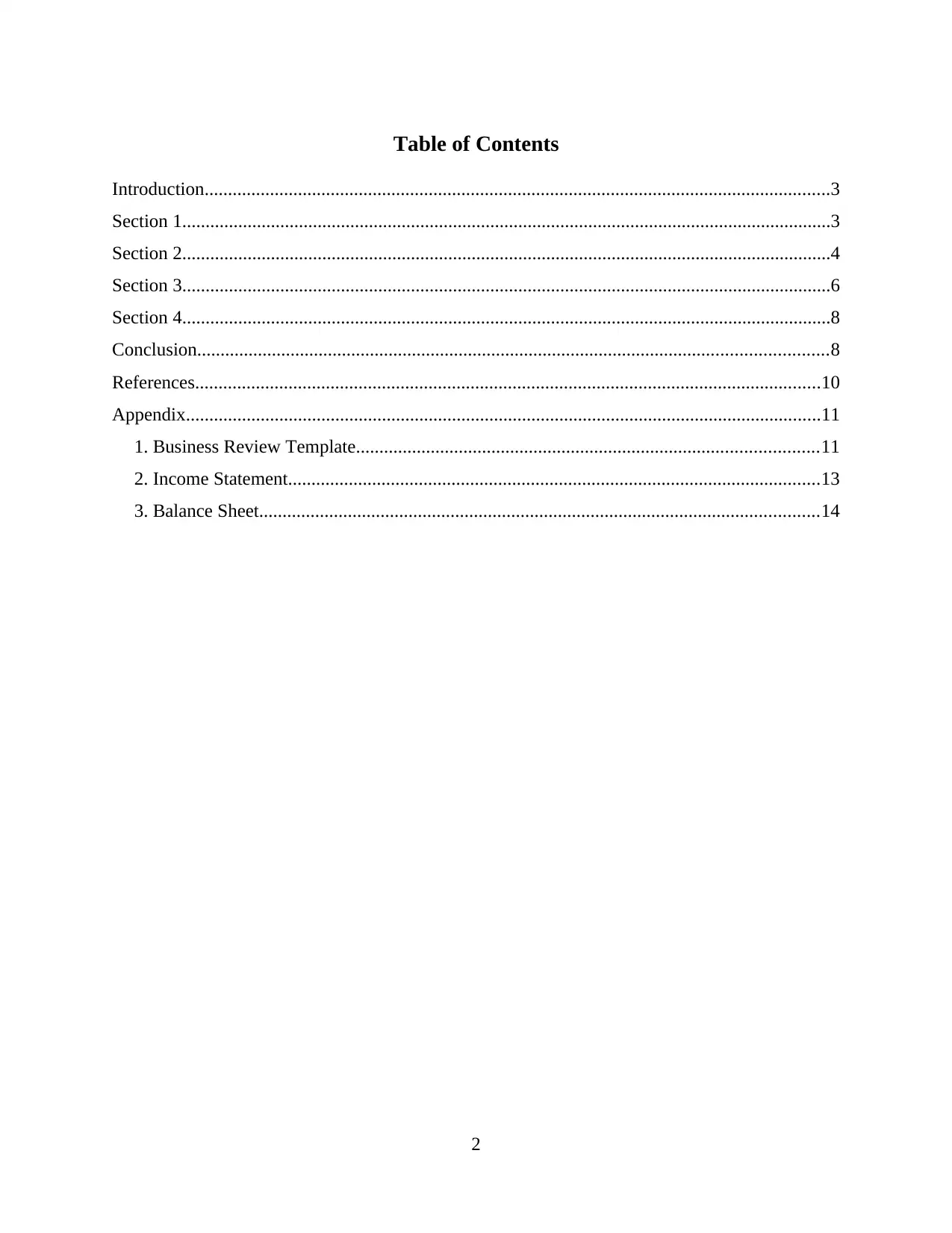
Table of Contents
Introduction......................................................................................................................................3
Section 1...........................................................................................................................................3
Section 2...........................................................................................................................................4
Section 3...........................................................................................................................................6
Section 4...........................................................................................................................................8
Conclusion.......................................................................................................................................8
References......................................................................................................................................10
Appendix........................................................................................................................................11
1. Business Review Template...................................................................................................11
2. Income Statement..................................................................................................................13
3. Balance Sheet........................................................................................................................14
2
Introduction......................................................................................................................................3
Section 1...........................................................................................................................................3
Section 2...........................................................................................................................................4
Section 3...........................................................................................................................................6
Section 4...........................................................................................................................................8
Conclusion.......................................................................................................................................8
References......................................................................................................................................10
Appendix........................................................................................................................................11
1. Business Review Template...................................................................................................11
2. Income Statement..................................................................................................................13
3. Balance Sheet........................................................................................................................14
2
Introduction
Financial management concept is concerned with organization's financial performance
and results. The main goal of this study is to explore the relevance of the framework of
the financial management within an organization (Dance and Imade, 2019). In conjunction,
financial statements including related aspects of the corporation used as a reference case are
formulated for more evaluation and review in report. The corporation's performance being
examined using ratio review as well as additional findings are made in order to enhance the
corporation's performance.
Section 1
Concept of financial management
Financial management corresponds to the method of a company's financial resources
being planned, procured, allocated, and used. It is part of the corporation's strategic planning
phase and its aim is to maximize the productivity of the capital resources in order to maximize
the corporation's values and shareholder’s wealth. Its aims are to ensuring that funding are
accessible to the corporation in a timely manner, and also that their acquisition and
distributions improve the company's financial structure and wealth management. Moreover,
objective is to build a resonant capital structure with the correct balance of debts and equity
(Herranz, Estévez, Oliva and Dé, 2017).
Importance of financial management
Below listed are certain key importance of business’s annual financial statements:
Scheduling and management - It analyses financial statements information to plan
budgets, investments opportunities including working capital and liquidity management
in order to help businesses develop efficiently and sustainably. This allows for the
possibility of unforeseen events in the organization.
Monitoring - This utilizes a variety of budgets/financial plan as well as other financial
statements compiled by financial managers as benchmarks against which company's
actual output is measured. Variations are established, and preventive steps are
formulated, scheduled, and carried out. This is done in order to improve the overall
position of the company.
Roles and responsibility of finance managers
3
Financial management concept is concerned with organization's financial performance
and results. The main goal of this study is to explore the relevance of the framework of
the financial management within an organization (Dance and Imade, 2019). In conjunction,
financial statements including related aspects of the corporation used as a reference case are
formulated for more evaluation and review in report. The corporation's performance being
examined using ratio review as well as additional findings are made in order to enhance the
corporation's performance.
Section 1
Concept of financial management
Financial management corresponds to the method of a company's financial resources
being planned, procured, allocated, and used. It is part of the corporation's strategic planning
phase and its aim is to maximize the productivity of the capital resources in order to maximize
the corporation's values and shareholder’s wealth. Its aims are to ensuring that funding are
accessible to the corporation in a timely manner, and also that their acquisition and
distributions improve the company's financial structure and wealth management. Moreover,
objective is to build a resonant capital structure with the correct balance of debts and equity
(Herranz, Estévez, Oliva and Dé, 2017).
Importance of financial management
Below listed are certain key importance of business’s annual financial statements:
Scheduling and management - It analyses financial statements information to plan
budgets, investments opportunities including working capital and liquidity management
in order to help businesses develop efficiently and sustainably. This allows for the
possibility of unforeseen events in the organization.
Monitoring - This utilizes a variety of budgets/financial plan as well as other financial
statements compiled by financial managers as benchmarks against which company's
actual output is measured. Variations are established, and preventive steps are
formulated, scheduled, and carried out. This is done in order to improve the overall
position of the company.
Roles and responsibility of finance managers
3
⊘ This is a preview!⊘
Do you want full access?
Subscribe today to unlock all pages.

Trusted by 1+ million students worldwide
Below mentioned are roles and responsibility of finance managers:
Capital structure management - They are in-charge of deciding the organization's optimal
capital structure, as well as raising and managing funds within the organization. They
carry out debt-equity rationing and also working capital flow management They will have
the power to make decisions for the corporation's growth diversification, innovation, and
dividend decisions (Valaskova, Kliestik and Kovacova, 2018).
Financial controls - They are in-charge of the corporation's financial reporting and use a
range of methods and approaches to conduct these tracking and monitoring measures,
including ratio evaluation, cost accounting and so forth. They must ensure that the
corporation's working capital flows and cash fund management run smoothly in order to
prevent over or under-liquidation.
Section 2
Financial statements
The corporation 's fiscal transactions are reported and outlined in accounting books. They
are then categorized and analyzed deeper in financial reports, that are formal statements. Which
are designed to help users comprehend the financial results and status of the organization in a
direct way. Internal stakeholders, such as corporation management and external stakeholders
such as investors, are also users of this information and facts. The following are an organization's
standard financial statements:
Income Statement - It's also described as profits and loss account, which is used to find
out a corporation's financial performance throughout a specific period. It is financial
statement compiled using accounting concepts like accruals accounting or matching
method. It considers expenditures incurred and revenue generated during accounting
cycle, which is normally one year. After that, the corporation's net profit is measured
through subtracting all costs from all streams of revenues. These net earnings are then
generally allocated to company's shareholders as dividends or preserved by the
corporation for future operations. In business's Balance Sheet, such retained profit sum is
passed to equity funds or shareholders' fund (Daryanto and Nurfadilah, 2018).
Balance Sheet - Statements of financial position is another name for it. This
shows position in time that determines the present state of an organization's overall assets
and liabilities. Apart from assets and liabilities, corporation 's equity fund is taken into
4
Capital structure management - They are in-charge of deciding the organization's optimal
capital structure, as well as raising and managing funds within the organization. They
carry out debt-equity rationing and also working capital flow management They will have
the power to make decisions for the corporation's growth diversification, innovation, and
dividend decisions (Valaskova, Kliestik and Kovacova, 2018).
Financial controls - They are in-charge of the corporation's financial reporting and use a
range of methods and approaches to conduct these tracking and monitoring measures,
including ratio evaluation, cost accounting and so forth. They must ensure that the
corporation's working capital flows and cash fund management run smoothly in order to
prevent over or under-liquidation.
Section 2
Financial statements
The corporation 's fiscal transactions are reported and outlined in accounting books. They
are then categorized and analyzed deeper in financial reports, that are formal statements. Which
are designed to help users comprehend the financial results and status of the organization in a
direct way. Internal stakeholders, such as corporation management and external stakeholders
such as investors, are also users of this information and facts. The following are an organization's
standard financial statements:
Income Statement - It's also described as profits and loss account, which is used to find
out a corporation's financial performance throughout a specific period. It is financial
statement compiled using accounting concepts like accruals accounting or matching
method. It considers expenditures incurred and revenue generated during accounting
cycle, which is normally one year. After that, the corporation's net profit is measured
through subtracting all costs from all streams of revenues. These net earnings are then
generally allocated to company's shareholders as dividends or preserved by the
corporation for future operations. In business's Balance Sheet, such retained profit sum is
passed to equity funds or shareholders' fund (Daryanto and Nurfadilah, 2018).
Balance Sheet - Statements of financial position is another name for it. This
shows position in time that determines the present state of an organization's overall assets
and liabilities. Apart from assets and liabilities, corporation 's equity fund is taken into
4
Paraphrase This Document
Need a fresh take? Get an instant paraphrase of this document with our AI Paraphraser
account, that can be expressed as Assets Equal to Liabilities Plus Capital. Current as well
as non-current assets as well as liabilities are different sorts of business's assets and
liabilities. Here, Current assets represent those that will be utilized by the corporation in
the next year, while current liabilities amount are those that must be repaid in the over the
next year. Non-current assets as well as liabilities of business are those that have a long
term purpose or life cycle or paying cycle.
Cash flow statement - The cash flows statement is the third element of financial
statement. It is known as period statement, as well as it’s used to measure the cash
inflows and outflow scenario over a set span of time. Cash flows generated through
operating activities, cash-flows through investment activities as well as cash
flows through financial activities are the three forms of activities which make up cash
flows statement. Its object is to assess cash flows over a set length of period as well as to
serve as a benchmark for decisions such as dividend payment, forecasting, and budgeting.
Its aim is to assist businesses in evaluating their liquidity status (Sari, Tjahjono and
Turino, 2018).
Use of ratios in financial management
Ratio analysis is mechanism of analyzing information contained in a corporation's
financial statements or reports in attempt to obtain data that can be exploited by managers and
stakeholders to make informed decisions. The following are some of the applications of ratio
analysis:
It can be used to make intra-firm as well as inter-firm comparative analysis. It assists a
company in contrasting its output and role to a market standard, helping it to determine
where it wants to strengthen.
It assists a company in recognizing patterns in its efficiency, that is beneficial in predicting
business processes, performance, including growth prospects (Nufus, Muchtar, Supratikta and
Sunarsi, 2020).
Ratios of business may be divided into distinct forms like profitability ratios, yield/return
ratios, efficiency-based ratios, market/risk ratios, liquidity ratios etc. In this regard following
certain key ratios are below described:
5
as non-current assets as well as liabilities are different sorts of business's assets and
liabilities. Here, Current assets represent those that will be utilized by the corporation in
the next year, while current liabilities amount are those that must be repaid in the over the
next year. Non-current assets as well as liabilities of business are those that have a long
term purpose or life cycle or paying cycle.
Cash flow statement - The cash flows statement is the third element of financial
statement. It is known as period statement, as well as it’s used to measure the cash
inflows and outflow scenario over a set span of time. Cash flows generated through
operating activities, cash-flows through investment activities as well as cash
flows through financial activities are the three forms of activities which make up cash
flows statement. Its object is to assess cash flows over a set length of period as well as to
serve as a benchmark for decisions such as dividend payment, forecasting, and budgeting.
Its aim is to assist businesses in evaluating their liquidity status (Sari, Tjahjono and
Turino, 2018).
Use of ratios in financial management
Ratio analysis is mechanism of analyzing information contained in a corporation's
financial statements or reports in attempt to obtain data that can be exploited by managers and
stakeholders to make informed decisions. The following are some of the applications of ratio
analysis:
It can be used to make intra-firm as well as inter-firm comparative analysis. It assists a
company in contrasting its output and role to a market standard, helping it to determine
where it wants to strengthen.
It assists a company in recognizing patterns in its efficiency, that is beneficial in predicting
business processes, performance, including growth prospects (Nufus, Muchtar, Supratikta and
Sunarsi, 2020).
Ratios of business may be divided into distinct forms like profitability ratios, yield/return
ratios, efficiency-based ratios, market/risk ratios, liquidity ratios etc. In this regard following
certain key ratios are below described:
5
Profitability ratios - Such ratios evaluate a company's potential to transition sales into
profits These ratios are is classified mainly as gross profitability margin, net profit
percentage and operating profits margin.
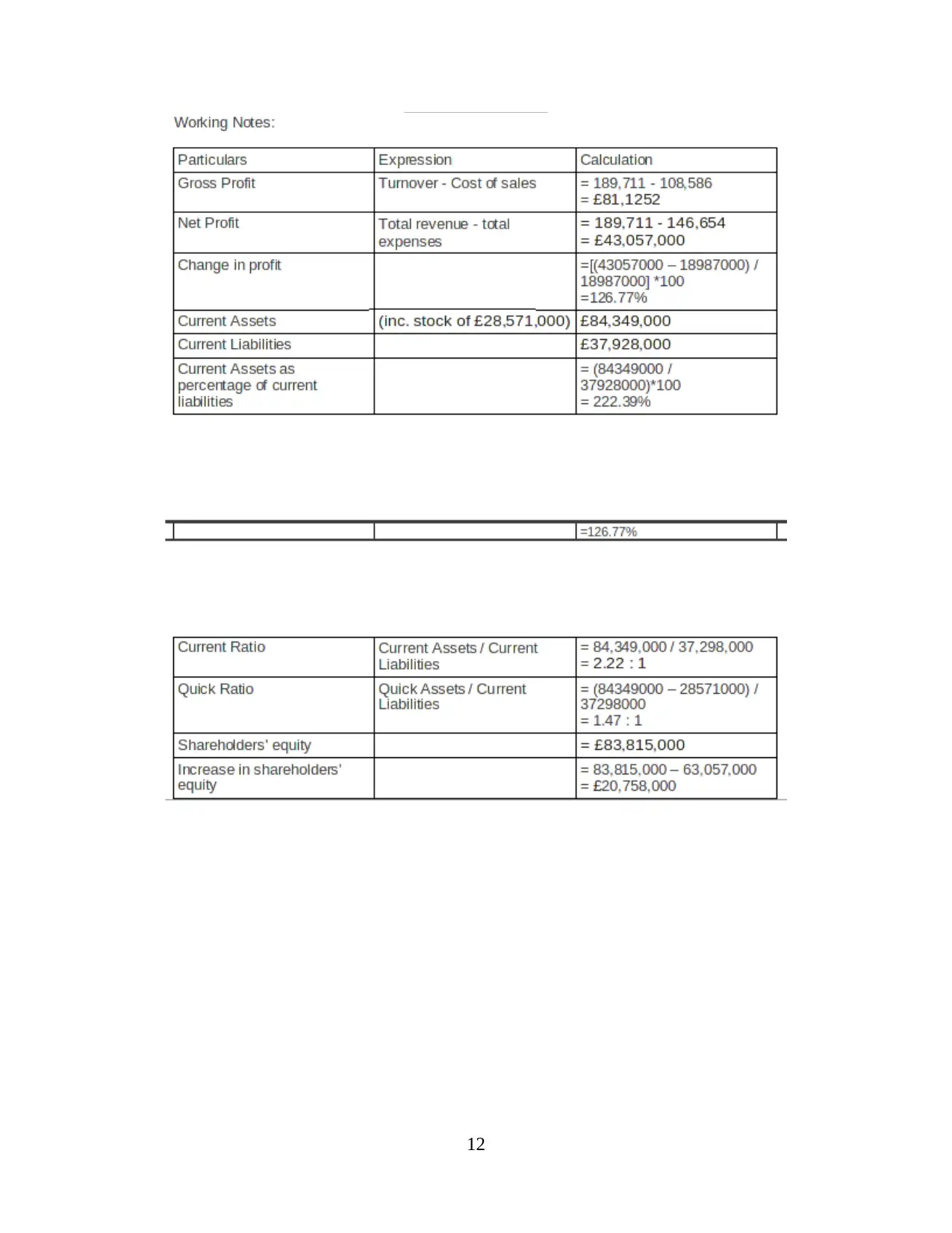
Gross profit margin/ratio = Gross profit Figure / total sales * 100 = 81,125,000 / 189,711 * 100 =
42.76%
Net profit margin/ratio = Net profit figure / total sales * 100 = 43,057,000 / 189,711 * 100 =
22.69%
Liquidity ratios - Liquidity ratios within business are a type of measure that is employed
to evaluate a company's ability to fund their working capital flows and liquidity. Such
ratios are used to calculate a company's shorter-term solvency. It considers those assets
that could be turned into cash or liquid quickly. As a result, it could be divided into two
categories: current ratios and quick ratio. The quick ratio considers quick assets, that are
assessed as business's current assets minus inventories and prepaid expenses.
Current Ratio = Current Assets / Current Liabilities = 84,349,000 / 37,298,000 = 2.22 : 1
Quick Ratio = Quick Assets / Current Liabilities = 55,778,000 / 37,298,000 = 1.47 : 1
Efficiency ratios - These metrics are intended to evaluate the effectiveness of a
company's capital in turning revenues into profits. Such measures are used to determine
how easily a company can repay its obligations or accept reimbursement from customers,
among other items (Setiawan and Amboningtyas, 2018).
Net Assets Turnover Ratio = Sales / Net Assets = 189,711,000 / 83,815,000 = 2.26
Stock Turnover = Stock / Cost of sales *365 = 28,571,000 / 98, 975 * 365 = 105.36 days
Other ratios = Several other ratios, like operating ratios, risk or investors' ratios, capital
gearing proportions, and so on, are also useful in determining a company’s fiscal
or financial status Employee turnover, customer satisfaction level and other non-financial
indicators are described by certain ratios.
Receivables days = Debtors / turnover * 365 = 26,367,000 / 179,587,000 * 365 = 53.58 days
Payable days = Creditors / cost of sales * 365 = 19,493,000 / 98,975,000 * 365 = 71.88 days
Section 3
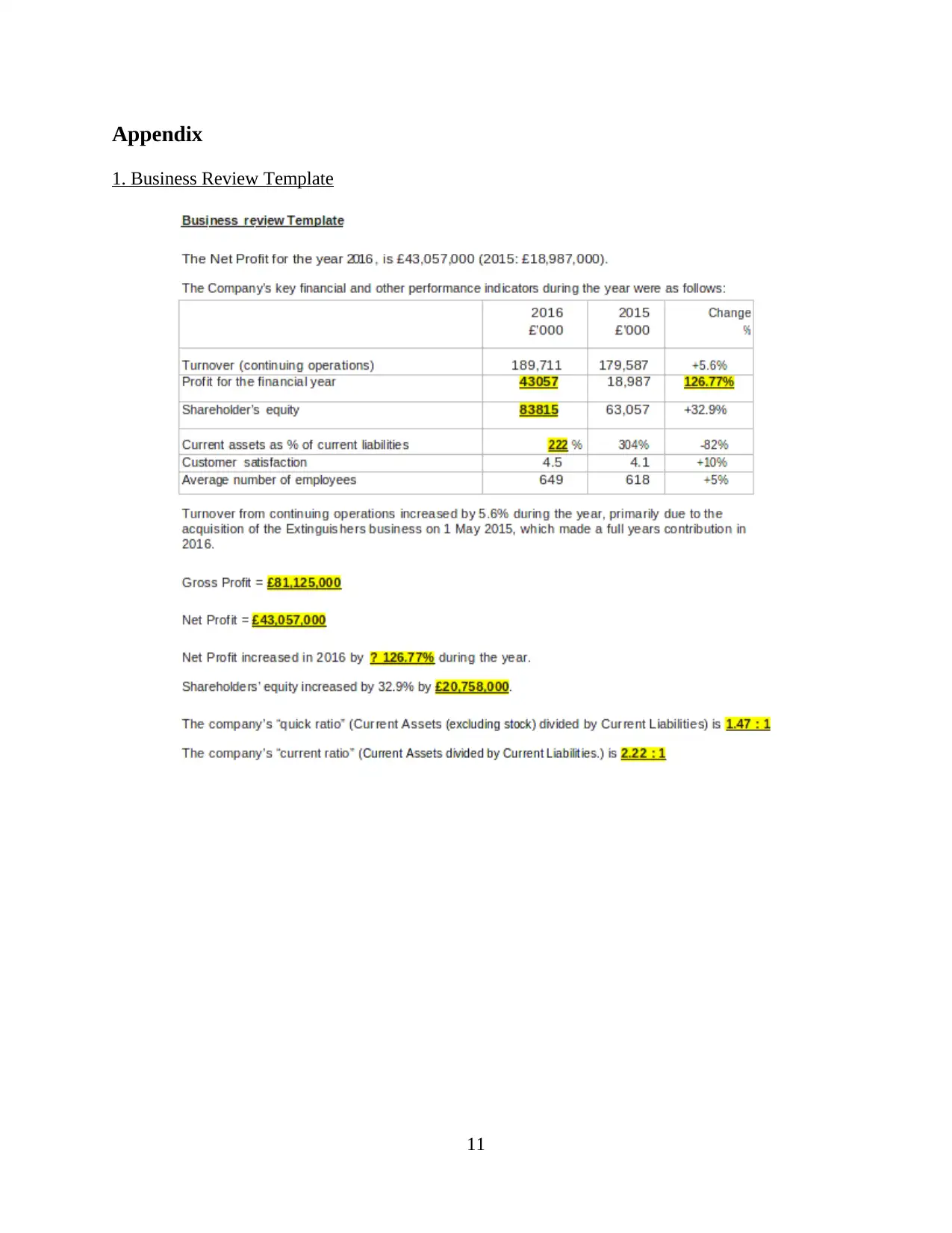
Business Review Template
(in appendices)
Income Statement
6
profits These ratios are is classified mainly as gross profitability margin, net profit
percentage and operating profits margin.
Gross profit margin/ratio = Gross profit Figure / total sales * 100 = 81,125,000 / 189,711 * 100 =
42.76%
Net profit margin/ratio = Net profit figure / total sales * 100 = 43,057,000 / 189,711 * 100 =
22.69%
Liquidity ratios - Liquidity ratios within business are a type of measure that is employed
to evaluate a company's ability to fund their working capital flows and liquidity. Such
ratios are used to calculate a company's shorter-term solvency. It considers those assets
that could be turned into cash or liquid quickly. As a result, it could be divided into two
categories: current ratios and quick ratio. The quick ratio considers quick assets, that are
assessed as business's current assets minus inventories and prepaid expenses.
Current Ratio = Current Assets / Current Liabilities = 84,349,000 / 37,298,000 = 2.22 : 1
Quick Ratio = Quick Assets / Current Liabilities = 55,778,000 / 37,298,000 = 1.47 : 1
Efficiency ratios - These metrics are intended to evaluate the effectiveness of a
company's capital in turning revenues into profits. Such measures are used to determine
how easily a company can repay its obligations or accept reimbursement from customers,
among other items (Setiawan and Amboningtyas, 2018).
Net Assets Turnover Ratio = Sales / Net Assets = 189,711,000 / 83,815,000 = 2.26
Stock Turnover = Stock / Cost of sales *365 = 28,571,000 / 98, 975 * 365 = 105.36 days
Other ratios = Several other ratios, like operating ratios, risk or investors' ratios, capital
gearing proportions, and so on, are also useful in determining a company’s fiscal
or financial status Employee turnover, customer satisfaction level and other non-financial
indicators are described by certain ratios.
Receivables days = Debtors / turnover * 365 = 26,367,000 / 179,587,000 * 365 = 53.58 days
Payable days = Creditors / cost of sales * 365 = 19,493,000 / 98,975,000 * 365 = 71.88 days
Section 3
Business Review Template
(in appendices)
Income Statement
6
⊘ This is a preview!⊘
Do you want full access?
Subscribe today to unlock all pages.
Trusted by 1+ million students worldwide
(in appendices)
Balance Sheet
(in appendices)
Review of performance of the business
Below mentioned is the review of the performance of the business on the basis of the
information obtained from business review template:
Business profitability - It could be noticed that in year 2015, the company made net profit
amounting £18,987,000, that enhanced to £43,057,000 during year 2016, reflecting 127
percent rise. This demonstrates that organization is functioning well here in terms
of profitability generation as company has gross profit percentage of 42.8 percent
while net profit ratio of 22.7 percent. These results cannot be contrasted because there is
no industry standard. A larger absolute figure of growing margins, on other hand, paints
a more positive or favorable performance of the company's operations.
Business liquidity - Current ratio as well as quick ratio of firm can be used to evaluate the
company's liquidity over a certain period. In the apparent lack of industry norm, the
conceptual standard level of current ratio is 2:1 while 1:1 for quick ratio is regarded. The
corporation's current ratio is 2.22:1 and its quick ratio is 1.47:1. In contrast, the business
appears to be doing well, with ample current assets to cover current liabilities.
Conversely, it can't be overlooked that the corporation 's working capital level has
been decreased by 82 percent, suggesting that liquidity situation isn't as healthy as the
results indicate (Kadim, Sunardi and Husain, 2020).
Business efficiency - The efficiency level of the corporation could be seen in fact that the
corporation's customer satisfaction rating increased by 10% during year 2015 to
year 2016. Additionally, the average no. of employees has grown by 5%, indicating that
either organization has expanded employees level or strengthened its staff retaining
capacity. Both of such scenarios are advantageous to the corporation as former implies
that more staff will be available to serve clients, while the latter implies that more skilled
individuals will ensure corporation 's productivity (Sadi’ah, 2018). Furthermore, there is
around 32.9 percent rise in shareholders' capital, which could be attributed to the
corporation's enhanced profits or retained earnings. Besides that, the corporation has 105-
day inventory turnover period. This takes around 72 days to pay its trade creditors as well
7
Balance Sheet
(in appendices)
Review of performance of the business
Below mentioned is the review of the performance of the business on the basis of the
information obtained from business review template:
Business profitability - It could be noticed that in year 2015, the company made net profit
amounting £18,987,000, that enhanced to £43,057,000 during year 2016, reflecting 127
percent rise. This demonstrates that organization is functioning well here in terms
of profitability generation as company has gross profit percentage of 42.8 percent
while net profit ratio of 22.7 percent. These results cannot be contrasted because there is
no industry standard. A larger absolute figure of growing margins, on other hand, paints
a more positive or favorable performance of the company's operations.
Business liquidity - Current ratio as well as quick ratio of firm can be used to evaluate the
company's liquidity over a certain period. In the apparent lack of industry norm, the
conceptual standard level of current ratio is 2:1 while 1:1 for quick ratio is regarded. The
corporation's current ratio is 2.22:1 and its quick ratio is 1.47:1. In contrast, the business
appears to be doing well, with ample current assets to cover current liabilities.
Conversely, it can't be overlooked that the corporation 's working capital level has
been decreased by 82 percent, suggesting that liquidity situation isn't as healthy as the
results indicate (Kadim, Sunardi and Husain, 2020).
Business efficiency - The efficiency level of the corporation could be seen in fact that the
corporation's customer satisfaction rating increased by 10% during year 2015 to
year 2016. Additionally, the average no. of employees has grown by 5%, indicating that
either organization has expanded employees level or strengthened its staff retaining
capacity. Both of such scenarios are advantageous to the corporation as former implies
that more staff will be available to serve clients, while the latter implies that more skilled
individuals will ensure corporation 's productivity (Sadi’ah, 2018). Furthermore, there is
around 32.9 percent rise in shareholders' capital, which could be attributed to the
corporation's enhanced profits or retained earnings. Besides that, the corporation has 105-
day inventory turnover period. This takes around 72 days to pay its trade creditors as well
7
Paraphrase This Document
Need a fresh take? Get an instant paraphrase of this document with our AI Paraphraser
as 54 days to recover money from trade debtors. It is complicated to determine a
company's organizational capabilities in lack of an industry standard.
Section 4
Processes helpful to business in improving financial performance
According to the aforementioned performance analysis, the organization is doing quite
well as well as is on appropriate track to improve and expand. Conversely, there are several
aspects where the corporation's efficiency may be enhanced, such as proportion of current assets
level over business's current liabilities (Garcia, 2017). The organization should aim to change its
operational procedures in attempt to enhance such parameters. To develop the best plan, the
company must first determine its long-term goals.
Business ought to concentrate on raising its profits efficiently and should concentrate on
raising its operating efficiency through optimize its costs structure which
involves reassessing costs including material costs, labour costs and other overhead
expenses. This would help business re-align and strengthen their working capital
management also.
This should sustain existing capital structure as well as may be able to re-align or re-
structure payments terms with debtors and trade creditors in order to increase working
capital. Furthermore, the organization has ample capital and should be on lookout for
development and expansion opportunities. This can re-evaluate their assets management
as well as dispose of or substitute assets that are underperforming. It may use techniques
such as hire-purchase or rented properties instead of repurchasing (Daryanto, Dzikro and
Fitri, 2019).
It should make an effort to enhance the efficiency of its activities, i.e. minimize waste.
This will assist in cost reduction and raise profit margins even further. This should
evaluate its marketing mix and re-evaluate its marketing campaigns. Instead of depending
on responsive ads, the organization should establish aggressive marketing initiatives.
Conclusion
The accompanying report focuses on the analytical dimensions of the financial
management within organization, as well as its realistic demonstration using case study. Annual
financial statements and key ratio review are produced in order to assess the quality and efficacy
8
company's organizational capabilities in lack of an industry standard.
Section 4
Processes helpful to business in improving financial performance
According to the aforementioned performance analysis, the organization is doing quite
well as well as is on appropriate track to improve and expand. Conversely, there are several
aspects where the corporation's efficiency may be enhanced, such as proportion of current assets
level over business's current liabilities (Garcia, 2017). The organization should aim to change its
operational procedures in attempt to enhance such parameters. To develop the best plan, the
company must first determine its long-term goals.
Business ought to concentrate on raising its profits efficiently and should concentrate on
raising its operating efficiency through optimize its costs structure which
involves reassessing costs including material costs, labour costs and other overhead
expenses. This would help business re-align and strengthen their working capital
management also.
This should sustain existing capital structure as well as may be able to re-align or re-
structure payments terms with debtors and trade creditors in order to increase working
capital. Furthermore, the organization has ample capital and should be on lookout for
development and expansion opportunities. This can re-evaluate their assets management
as well as dispose of or substitute assets that are underperforming. It may use techniques
such as hire-purchase or rented properties instead of repurchasing (Daryanto, Dzikro and
Fitri, 2019).
It should make an effort to enhance the efficiency of its activities, i.e. minimize waste.
This will assist in cost reduction and raise profit margins even further. This should
evaluate its marketing mix and re-evaluate its marketing campaigns. Instead of depending
on responsive ads, the organization should establish aggressive marketing initiatives.
Conclusion
The accompanying report focuses on the analytical dimensions of the financial
management within organization, as well as its realistic demonstration using case study. Annual
financial statements and key ratio review are produced in order to assess the quality and efficacy
8

of the corporation 's finance management. This can be inferred that a corporation's financial
manager serves a critical role in not only maintaining the corporation 's financial stability but
also securing its long-term growth and progress.
9
manager serves a critical role in not only maintaining the corporation 's financial stability but
also securing its long-term growth and progress.
9
⊘ This is a preview!⊘
Do you want full access?
Subscribe today to unlock all pages.
Trusted by 1+ million students worldwide
References
Books and Journals:
Dance, M. and Imade, S., 2019. Financial Ratio Analysis in Predicting Financial Conditions
Distress in Indonesia Stock Exchange. Russian Journal of Agricultural and Socio-
Economic Sciences, 86(2).
Herranz, R.E., Estévez, P.G., Oliva, M.A.D.V.Y. and Dé, R., 2017. Leveraging financial
management performance of the Spanish aerospace manufacturing value chain. Journal
of Business Economics and Management, 18(5), pp.1005-1022.
Valaskova, K., Kliestik, T. and Kovacova, M., 2018. Management of financial risks in Slovak
enterprises using regression analysis. Oeconomia Copernicana, 9(1), pp.105-121.
Daryanto, W.M. and Nurfadilah, D., 2018. Financial performance analysis before and after the
decline in oil production: Case study in Indonesian Oil and Gas Industry. International
Journal of Engineering & Technology, 7(3.21), pp.10-15.
Nufus, K., Muchtar, A., Supratikta, H. and Sunarsi, D., 2020. Analysis of Financial Performance:
Case Study of Pt. X Employee Cooperative/Analisis del desempeno financiero: Estudio
de caso de la cooperativa de empleados PT X. Utopía Y Praxis
Latinoamericana, 25(S10), pp.429-445.
Setiawan, H. and Amboningtyas, D., 2018. Financial Ratio Analysis for Predicting Financial
Distress Conditions (Study on Telecommunication Companies Listed In Indonesia
Stock Exchange Period 2010-2016). Journal of Management, 4(4).
Kadim, A., Sunardi, N. and Husain, T., 2020. The modeling firm's value based on financial
ratios, intellectual capital and dividend policy. Accounting, 6(5), pp.859-870.
Daryanto, W.M., Dzikro, S.I. and Fitri, D.N., 2019. Financial Performance Analysis of
Conventional Taxi in Indonesia: Before and After The Emergence of Ride-Hailing
Company. South East Asia Journal of Contemporary Business, Economics and
Law, 19(1), pp.13-21.
Garcia, R.C., 2017. Profitability and efficiency evaluation of the financial management of a
socio-economic intervention. Management & Marketing, 12(2).
Sari, R.P., Tjahjono, H. and Turino, T., 2018. Analysis of Financial Performance in Public
Sector. Journal of Accounting and Strategic Finance, 1(1), pp.82-90.
Sadi’ah, K., 2018. The Effect of Corporate Financial Ratio upon the Company Value. The
Accounting Journal of Binaniaga, 3(02), pp.75-88.
10
Books and Journals:
Dance, M. and Imade, S., 2019. Financial Ratio Analysis in Predicting Financial Conditions
Distress in Indonesia Stock Exchange. Russian Journal of Agricultural and Socio-
Economic Sciences, 86(2).
Herranz, R.E., Estévez, P.G., Oliva, M.A.D.V.Y. and Dé, R., 2017. Leveraging financial
management performance of the Spanish aerospace manufacturing value chain. Journal
of Business Economics and Management, 18(5), pp.1005-1022.
Valaskova, K., Kliestik, T. and Kovacova, M., 2018. Management of financial risks in Slovak
enterprises using regression analysis. Oeconomia Copernicana, 9(1), pp.105-121.
Daryanto, W.M. and Nurfadilah, D., 2018. Financial performance analysis before and after the
decline in oil production: Case study in Indonesian Oil and Gas Industry. International
Journal of Engineering & Technology, 7(3.21), pp.10-15.
Nufus, K., Muchtar, A., Supratikta, H. and Sunarsi, D., 2020. Analysis of Financial Performance:
Case Study of Pt. X Employee Cooperative/Analisis del desempeno financiero: Estudio
de caso de la cooperativa de empleados PT X. Utopía Y Praxis
Latinoamericana, 25(S10), pp.429-445.
Setiawan, H. and Amboningtyas, D., 2018. Financial Ratio Analysis for Predicting Financial
Distress Conditions (Study on Telecommunication Companies Listed In Indonesia
Stock Exchange Period 2010-2016). Journal of Management, 4(4).
Kadim, A., Sunardi, N. and Husain, T., 2020. The modeling firm's value based on financial
ratios, intellectual capital and dividend policy. Accounting, 6(5), pp.859-870.
Daryanto, W.M., Dzikro, S.I. and Fitri, D.N., 2019. Financial Performance Analysis of
Conventional Taxi in Indonesia: Before and After The Emergence of Ride-Hailing
Company. South East Asia Journal of Contemporary Business, Economics and
Law, 19(1), pp.13-21.
Garcia, R.C., 2017. Profitability and efficiency evaluation of the financial management of a
socio-economic intervention. Management & Marketing, 12(2).
Sari, R.P., Tjahjono, H. and Turino, T., 2018. Analysis of Financial Performance in Public
Sector. Journal of Accounting and Strategic Finance, 1(1), pp.82-90.
Sadi’ah, K., 2018. The Effect of Corporate Financial Ratio upon the Company Value. The
Accounting Journal of Binaniaga, 3(02), pp.75-88.
10
Paraphrase This Document
Need a fresh take? Get an instant paraphrase of this document with our AI Paraphraser
Appendix
1. Business Review Template
11
1. Business Review Template
11
12
⊘ This is a preview!⊘
Do you want full access?
Subscribe today to unlock all pages.
Trusted by 1+ million students worldwide

1 out of 15


Related Documents


Your All-in-One AI-Powered Toolkit for Academic Success.
+13062052269
info@desklib.com
Available 24*7 on WhatsApp / Email
![[object Object]](/_next/static/media/star-bottom.7253800d.svg)
Unlock your academic potential
Copyright © 2020–2026 A2Z Services. All Rights Reserved. Developed and managed by ZUCOL.