BSc Business Management: Financial Analysis and Performance Report
VerifiedAdded on 2023/06/15
|12
|2550
|279
Report
AI Summary
This report provides an in-depth analysis of financial management principles, emphasizing the significance of financial ratios in decision-making. It includes the construction of an income statement and balance sheet, followed by a detailed calculation and interpretation of liquidity, efficiency, and profitability ratios to assess a company's financial health. The report further explores strategies for enhancing financial performance, leveraging insights from the case study to identify areas for improvement and long-term viability. The conclusion highlights the importance of accurate financial statements for effective fund allocation and strategic financial planning, essential for sustaining business growth and competitiveness.
BSc (Hons) Business Management with Foundation
BMP3005
Applied Business Finance
BMP3005
Applied Business Finance

Paraphrase This Document
Need a fresh take? Get an instant paraphrase of this document with our AI Paraphraser

INTRODUCTION
Finance is basically the process of managing the fund within the business which not only
help the firm in carrying out their different daily operations but also help them when they need
the capital(Bulturbayevich and et. al., 2020). All the objectives of the company can be effectively
achieved by with the procurement of the financial activities. The following report is going to
give information in the significance and the concept of the financial management by utilizing the
fiscal ratios which help the company in decision making. This report also cover the completion
of the income statement with the use of balance sheet. Afterword’s, various various ratios like
productivity, efficiency and liquidity ratios were calculated that help in analysing the financial
performance of the company in the competitive market. Furthermore an analysis has been done
which develops the performance of the company.
TASK
Section 1: Definition and discussion of the concept and
importance of financial management
The financial management maybe defined as the process of managing the capital and
funds of the company in a very effective manner. In simple terms it is the process of managing
the asset and liabilities of the company. With the help of effective and proper financial
management not only the stability of the company has been improved but also the revenues of
the company has been increases(Yuniningsih,Pertiwi and Purwanto, 2019). The main motive of
the firm behind managing the finance of the company is to control the cost and expenses of the
company which ultimately improves the earning of the firm. Due to this they are able to operate
their different business functions in very smooth and long term manner.
Significance of the Financial Management has been discussed below :-
Long – term Stability :- if the organisation effectively manage their funds then they can enjoy
the long term stability in the market. As with the help of financial management profit of the firm
can be monitor and the allocation of the cost can be done in a very effective manner. By doing
all these things the expenses can be minimize (Okeze and Ngwakwe, 2018)
Finance is basically the process of managing the fund within the business which not only
help the firm in carrying out their different daily operations but also help them when they need
the capital(Bulturbayevich and et. al., 2020). All the objectives of the company can be effectively
achieved by with the procurement of the financial activities. The following report is going to
give information in the significance and the concept of the financial management by utilizing the
fiscal ratios which help the company in decision making. This report also cover the completion
of the income statement with the use of balance sheet. Afterword’s, various various ratios like
productivity, efficiency and liquidity ratios were calculated that help in analysing the financial
performance of the company in the competitive market. Furthermore an analysis has been done
which develops the performance of the company.
TASK
Section 1: Definition and discussion of the concept and
importance of financial management
The financial management maybe defined as the process of managing the capital and
funds of the company in a very effective manner. In simple terms it is the process of managing
the asset and liabilities of the company. With the help of effective and proper financial
management not only the stability of the company has been improved but also the revenues of
the company has been increases(Yuniningsih,Pertiwi and Purwanto, 2019). The main motive of
the firm behind managing the finance of the company is to control the cost and expenses of the
company which ultimately improves the earning of the firm. Due to this they are able to operate
their different business functions in very smooth and long term manner.
Significance of the Financial Management has been discussed below :-
Long – term Stability :- if the organisation effectively manage their funds then they can enjoy
the long term stability in the market. As with the help of financial management profit of the firm
can be monitor and the allocation of the cost can be done in a very effective manner. By doing
all these things the expenses can be minimize (Okeze and Ngwakwe, 2018)
⊘ This is a preview!⊘
Do you want full access?
Subscribe today to unlock all pages.

Trusted by 1+ million students worldwide
. Along with this, it also guarantee that the daily activities cab be carried out in a very
proper manner and with in the set time limit. Therefore this give business the longevity
and its effective development in the competitive market.
Estimation of the required funds :- the financial manager of the company is responsible for
managing the funds of the company. They need to develop the different sources of raising the
fund to fulfil the capital requirement of the company when needed. The financial policies of the
company influence the fund requirement of the company(Young and Legiste 2018). The overall
assessment or the capital structure of the company is made in such a manner which help them in
increasing their earning capacity.
Decision – making :- the preparing of the financial budget help in estimating the cost
due to which the decision relates to the status of the company has been taken in a very
effective manner. Decision making related to the finance is being considered as one of
the crucial element of any type of business. As these decisions has a huge impact on the
performance and productivity of the company in a very positive manner.
Profitability :-the employees of the finance department is responsible for managing all
the activities or the financial transactions of the company. The manager of the finance
depart' ensures that whether all the accounts of the company are managed in a suitable
and accurate manner or not. By doing all these things the organisation is able to grab the
opportunities from the market which improves their productivity and performance.
Section 2: Description and discussion of the main financial
statements and explain the use of ratios in financial management
The financial statement is basically a written document in which all the transaction of the
company has been recorded and along with this these statements also help in conveying the
financial position and performance of the company(Oleghe, 2019). These statements can be
audited by the government agencies, accountant, firms etc. It is very important for all the
organisation to keep all these statements in a very specific manner. With the help of these
statements the summary of the company financial situations and the current status of the
company has been clearly describe. The most important financial statements which is being
mandatory to made has been discussed below :-
proper manner and with in the set time limit. Therefore this give business the longevity
and its effective development in the competitive market.
Estimation of the required funds :- the financial manager of the company is responsible for
managing the funds of the company. They need to develop the different sources of raising the
fund to fulfil the capital requirement of the company when needed. The financial policies of the
company influence the fund requirement of the company(Young and Legiste 2018). The overall
assessment or the capital structure of the company is made in such a manner which help them in
increasing their earning capacity.
Decision – making :- the preparing of the financial budget help in estimating the cost
due to which the decision relates to the status of the company has been taken in a very
effective manner. Decision making related to the finance is being considered as one of
the crucial element of any type of business. As these decisions has a huge impact on the
performance and productivity of the company in a very positive manner.
Profitability :-the employees of the finance department is responsible for managing all
the activities or the financial transactions of the company. The manager of the finance
depart' ensures that whether all the accounts of the company are managed in a suitable
and accurate manner or not. By doing all these things the organisation is able to grab the
opportunities from the market which improves their productivity and performance.
Section 2: Description and discussion of the main financial
statements and explain the use of ratios in financial management
The financial statement is basically a written document in which all the transaction of the
company has been recorded and along with this these statements also help in conveying the
financial position and performance of the company(Oleghe, 2019). These statements can be
audited by the government agencies, accountant, firms etc. It is very important for all the
organisation to keep all these statements in a very specific manner. With the help of these
statements the summary of the company financial situations and the current status of the
company has been clearly describe. The most important financial statements which is being
mandatory to made has been discussed below :-
Paraphrase This Document
Need a fresh take? Get an instant paraphrase of this document with our AI Paraphraser
Balance Sheet :- the balance sheet of the company is being considered the most
important financial statement. This statement is also known as company balance sheet.
This statement has been divided into two parts i.e. asset and liabilities. The asset are on
the right side of this statements and liabilities are on the left side of this statement. These
statements have been made on the yearly basis which describe the financial health of the
company. Current asset, fixed asset, non current asset and many more are some of the
head which comprises in this statements machinery, inventory, investment, and
intangible assets and many more came under this head. The creditors are the non current
liabilities of the company which came on the liability side. With the help of this
statement the position of the cash and company is able to invest in the new project is
being effectively determined.
Profit and loss statement: - this statements is also being considered as the most important
statements. With the help of this statements different types of financial statements has been
prepared. The main motive behind preparing this statement is to concluded the net profit which
have been earned by the company. In addition to this different type of operating and non
operating expenses has been effectively determined. These statements also being prepared on the
annual basis and the net profit has been calculated by subtracting all the expenses form the
revenues. It also help in calculating the ratios(Sugeng and Suryani, 2020).
Usage of financial ratios: -
Ratio analysis helps the company in evaluating the financial position, profitability and
liquidity in a very effective manner. Following are the usage of financial ratio which has
been discussed below: -
Communication Source: -sometimes it’s become difficult for the company to present
their financial statement in front of their stakeholder’s and along with this it’s become
difficult for them to understand the big and complex figures. Investors of the company
feels difficulty in comparing the financial data. At that time ratio analysis plays a very
important role as with the help of these ratios the current status of the company has been
effectively determined. Due to which continue investment has been done within the
company operations.
Solvency: - the ability of the company for paying their current debts has been determined
with the help of acid test ratio, quick ratio and many more. With the help of these ratios it
important financial statement. This statement is also known as company balance sheet.
This statement has been divided into two parts i.e. asset and liabilities. The asset are on
the right side of this statements and liabilities are on the left side of this statement. These
statements have been made on the yearly basis which describe the financial health of the
company. Current asset, fixed asset, non current asset and many more are some of the
head which comprises in this statements machinery, inventory, investment, and
intangible assets and many more came under this head. The creditors are the non current
liabilities of the company which came on the liability side. With the help of this
statement the position of the cash and company is able to invest in the new project is
being effectively determined.
Profit and loss statement: - this statements is also being considered as the most important
statements. With the help of this statements different types of financial statements has been
prepared. The main motive behind preparing this statement is to concluded the net profit which
have been earned by the company. In addition to this different type of operating and non
operating expenses has been effectively determined. These statements also being prepared on the
annual basis and the net profit has been calculated by subtracting all the expenses form the
revenues. It also help in calculating the ratios(Sugeng and Suryani, 2020).
Usage of financial ratios: -
Ratio analysis helps the company in evaluating the financial position, profitability and
liquidity in a very effective manner. Following are the usage of financial ratio which has
been discussed below: -
Communication Source: -sometimes it’s become difficult for the company to present
their financial statement in front of their stakeholder’s and along with this it’s become
difficult for them to understand the big and complex figures. Investors of the company
feels difficulty in comparing the financial data. At that time ratio analysis plays a very
important role as with the help of these ratios the current status of the company has been
effectively determined. Due to which continue investment has been done within the
company operations.
Solvency: - the ability of the company for paying their current debts has been determined
with the help of acid test ratio, quick ratio and many more. With the help of these ratios it
has been analyse that whether the company is prepared for paying the debts in an
accounting year or not. Along with this the payment cycle of the company has also been
analysed due to which the credit worthiness has been improved.
Risk evaluation and timely appropriate measures: - different types of busines functions has
been performed by the company in different business segments and market and most of them are
risky. With the use of ratios not only the risk but also its factor has been analysed in a very
effective manner. Along with this, effective actions have been taken by the company which limit
the risk(Sugeng and Suryani, 2020). Ratios like debt equity ratio or debt coverage ratio shows
the reliance of the company on the external sources of funding and their capacity to repay the
debt.
Section 3: Using the template provided: -
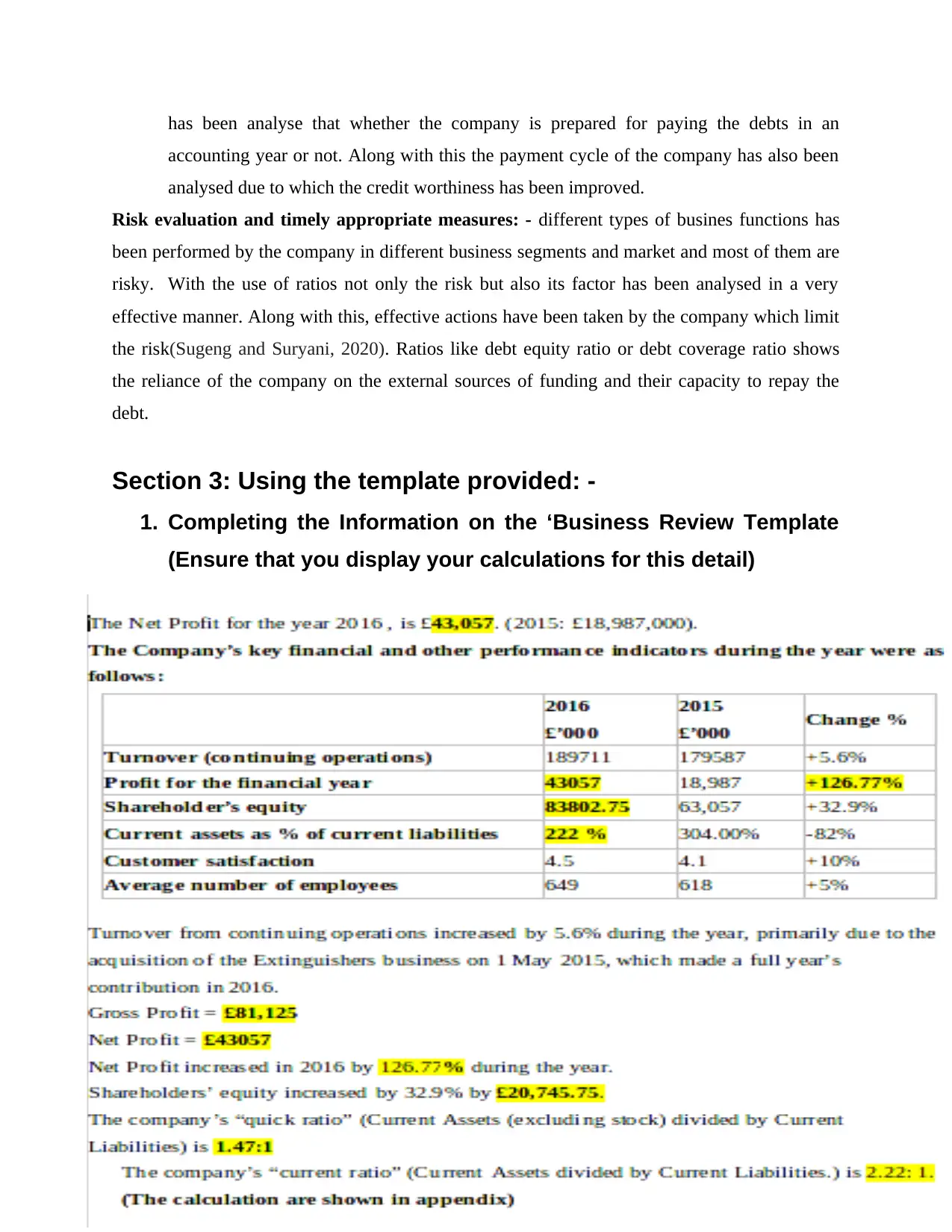
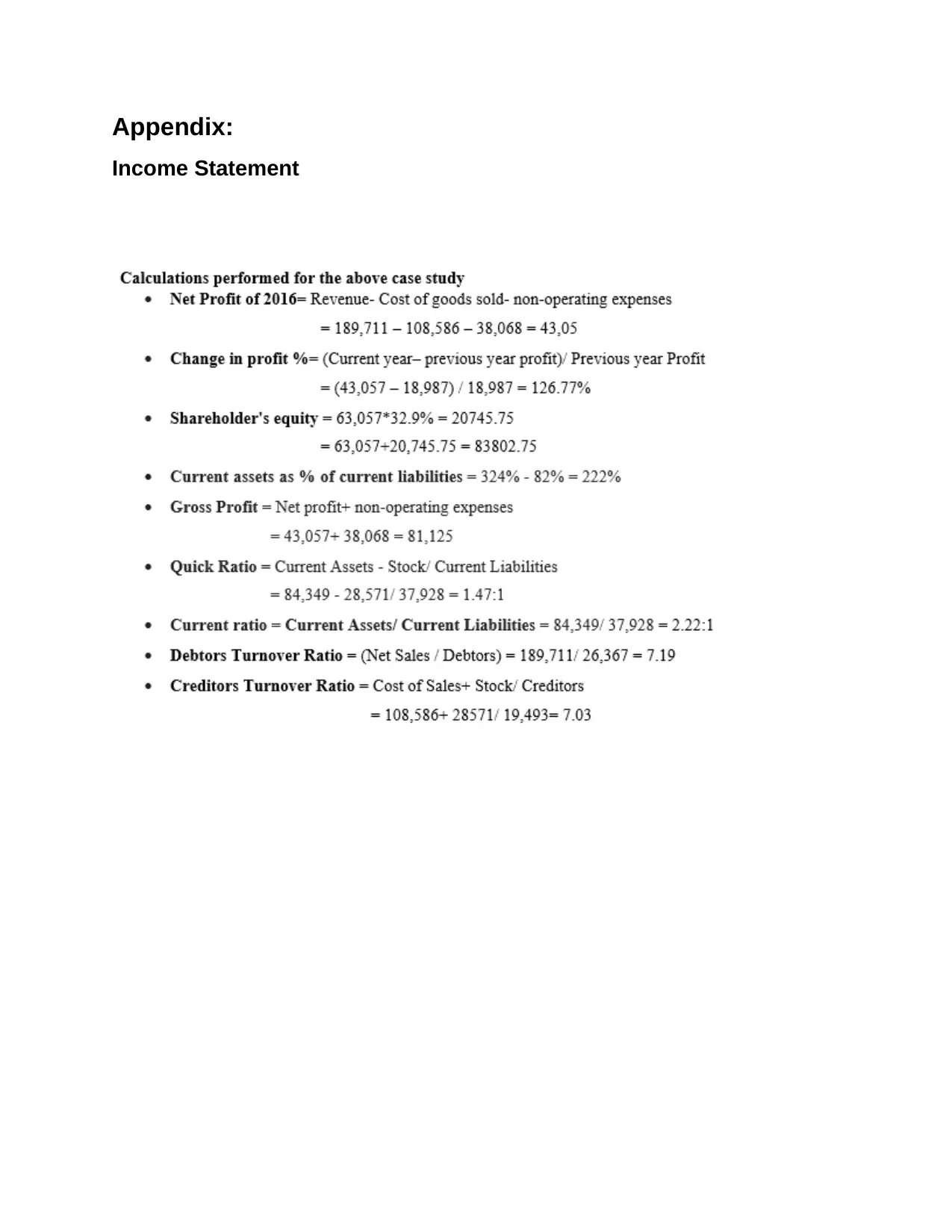
1. Completing the Information on the ‘Business Review Template
(Ensure that you display your calculations for this detail)
accounting year or not. Along with this the payment cycle of the company has also been
analysed due to which the credit worthiness has been improved.
Risk evaluation and timely appropriate measures: - different types of busines functions has
been performed by the company in different business segments and market and most of them are
risky. With the use of ratios not only the risk but also its factor has been analysed in a very
effective manner. Along with this, effective actions have been taken by the company which limit
the risk(Sugeng and Suryani, 2020). Ratios like debt equity ratio or debt coverage ratio shows
the reliance of the company on the external sources of funding and their capacity to repay the
debt.
Section 3: Using the template provided: -
1. Completing the Information on the ‘Business Review Template
(Ensure that you display your calculations for this detail)
⊘ This is a preview!⊘
Do you want full access?
Subscribe today to unlock all pages.
Trusted by 1+ million students worldwide
2. Using Excel producing an Income Statement for the Sample
Organisation (see Case Study)
This is included within appendix
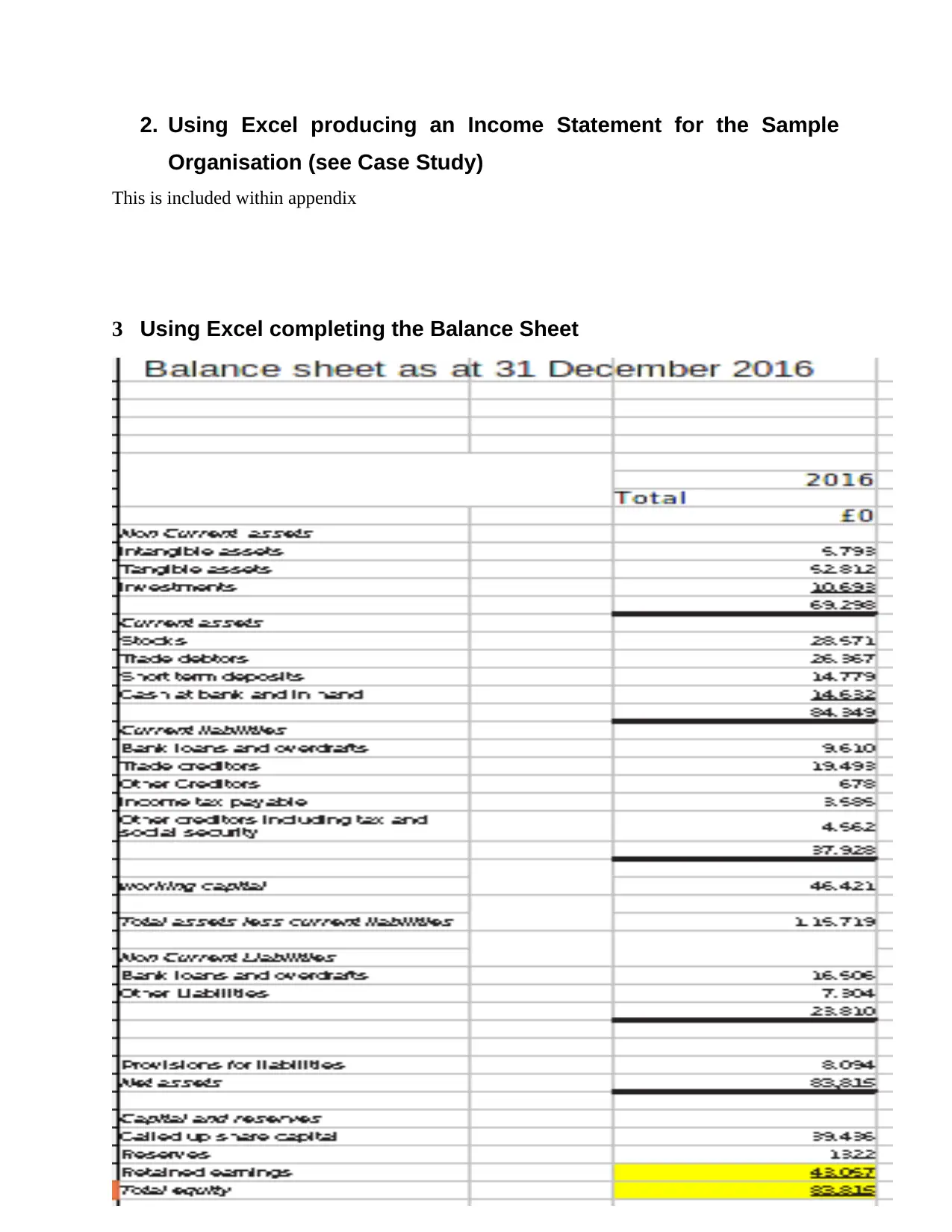
3 Using Excel completing the Balance Sheet
Organisation (see Case Study)
This is included within appendix
3 Using Excel completing the Balance Sheet
Paraphrase This Document
Need a fresh take? Get an instant paraphrase of this document with our AI Paraphraser
4 Using the Case study information describing the profitability,
liquidity and efficiency of the company based on the results of ratio
analysis
Monetary ratio analysis helps the company in analyse the monetary data of the firm in a very
effective manner. These ratios can be carried out by proper analysing the financial statements of
the company which are made on annual basis and along with this relationship between at least
two variables can also be determined. For determining the economic position of the company
different types of ratios can be utilized by company. In relation to the case study, information
related to the calculation of liquidity, profitability and efficiency has been discussed below: -
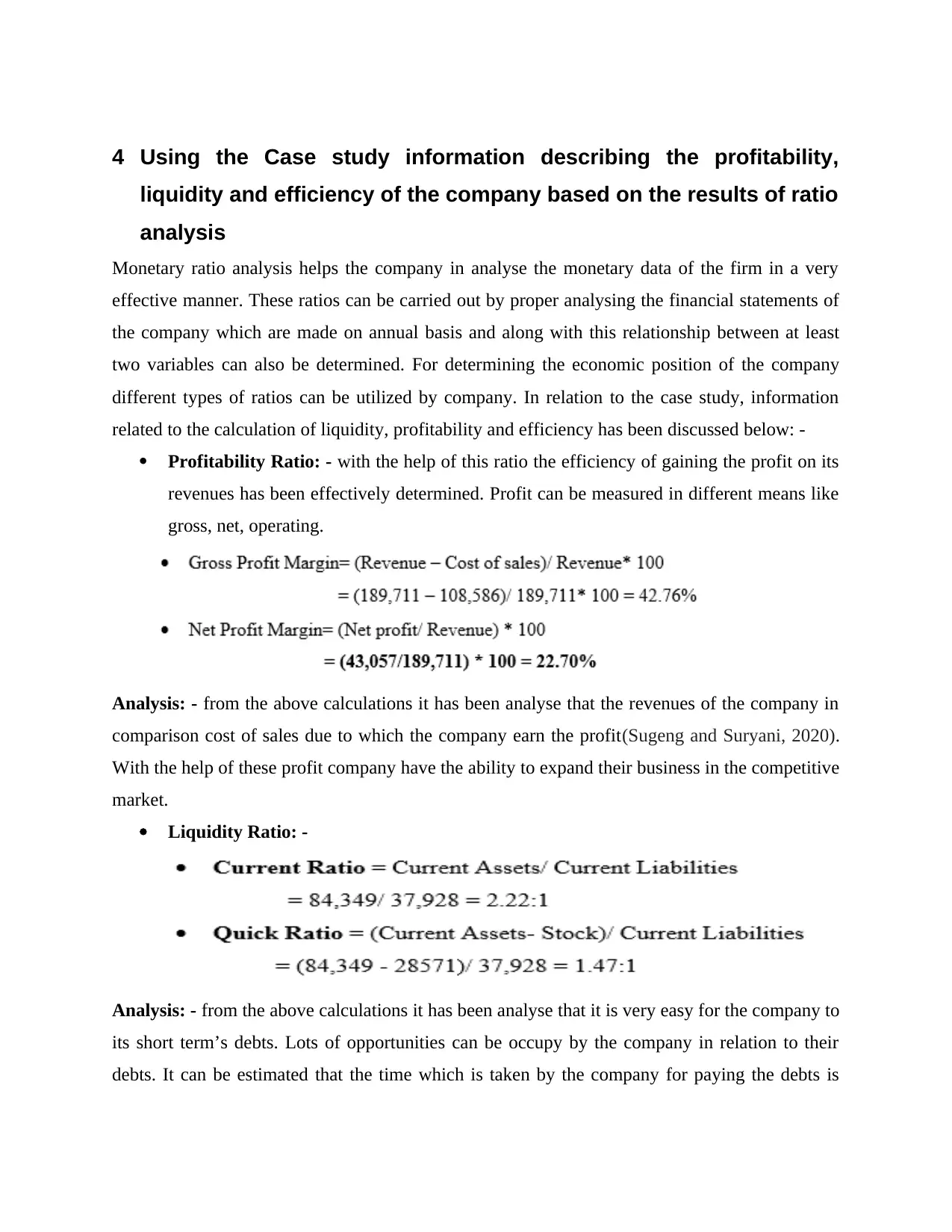
Profitability Ratio: - with the help of this ratio the efficiency of gaining the profit on its
revenues has been effectively determined. Profit can be measured in different means like
gross, net, operating.
Analysis: - from the above calculations it has been analyse that the revenues of the company in
comparison cost of sales due to which the company earn the profit(Sugeng and Suryani, 2020).
With the help of these profit company have the ability to expand their business in the competitive
market.
Liquidity Ratio: -
Analysis: - from the above calculations it has been analyse that it is very easy for the company to
its short term’s debts. Lots of opportunities can be occupy by the company in relation to their
debts. It can be estimated that the time which is taken by the company for paying the debts is
liquidity and efficiency of the company based on the results of ratio
analysis
Monetary ratio analysis helps the company in analyse the monetary data of the firm in a very
effective manner. These ratios can be carried out by proper analysing the financial statements of
the company which are made on annual basis and along with this relationship between at least
two variables can also be determined. For determining the economic position of the company
different types of ratios can be utilized by company. In relation to the case study, information
related to the calculation of liquidity, profitability and efficiency has been discussed below: -
Profitability Ratio: - with the help of this ratio the efficiency of gaining the profit on its
revenues has been effectively determined. Profit can be measured in different means like
gross, net, operating.
Analysis: - from the above calculations it has been analyse that the revenues of the company in
comparison cost of sales due to which the company earn the profit(Sugeng and Suryani, 2020).
With the help of these profit company have the ability to expand their business in the competitive
market.
Liquidity Ratio: -
Analysis: - from the above calculations it has been analyse that it is very easy for the company to
its short term’s debts. Lots of opportunities can be occupy by the company in relation to their
debts. It can be estimated that the time which is taken by the company for paying the debts is
practically the same. As the turnover proportion of the business is 1.23 which support the
spending’s of the business.
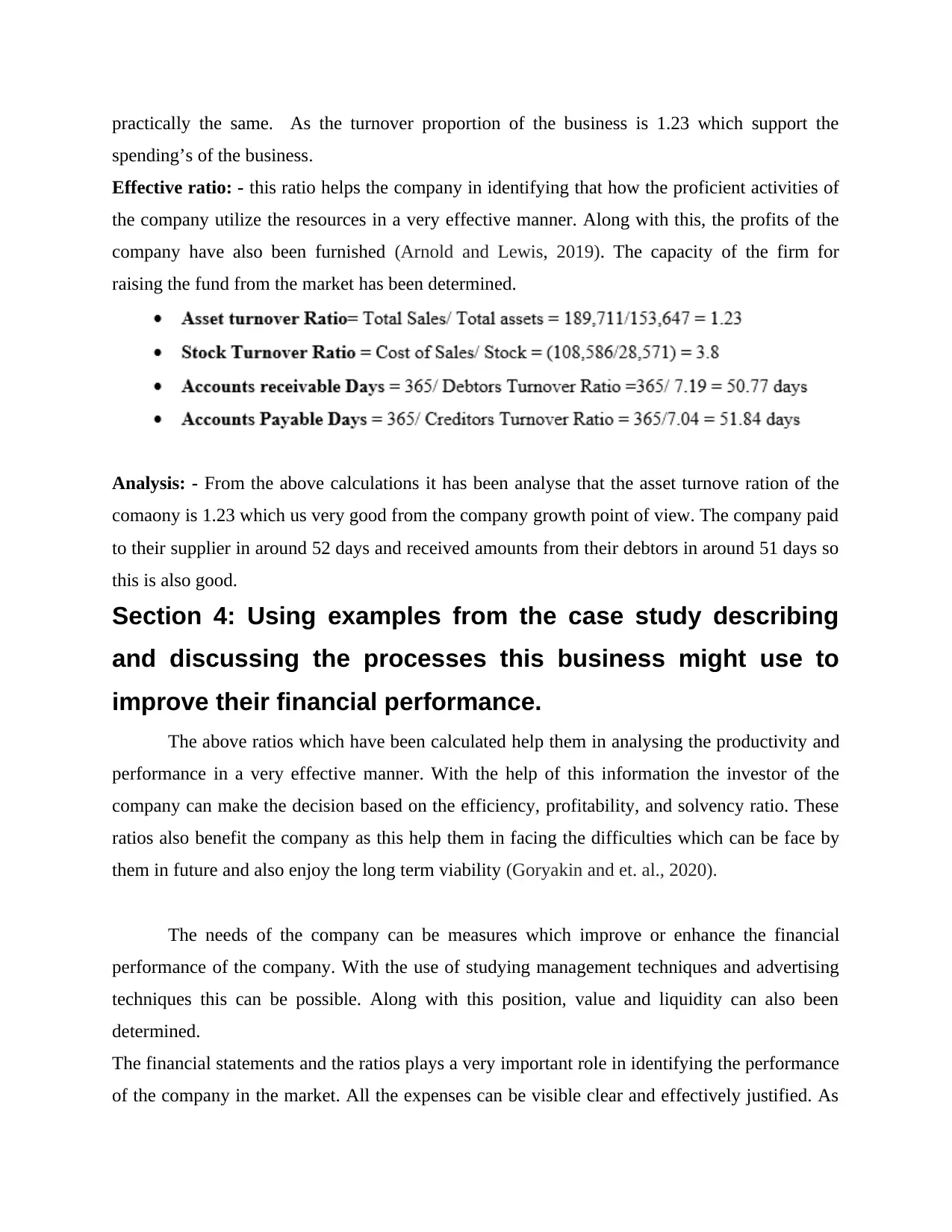
Effective ratio: - this ratio helps the company in identifying that how the proficient activities of
the company utilize the resources in a very effective manner. Along with this, the profits of the
company have also been furnished (Arnold and Lewis, 2019). The capacity of the firm for
raising the fund from the market has been determined.
Analysis: - From the above calculations it has been analyse that the asset turnove ration of the
comaony is 1.23 which us very good from the company growth point of view. The company paid
to their supplier in around 52 days and received amounts from their debtors in around 51 days so
this is also good.
Section 4: Using examples from the case study describing
and discussing the processes this business might use to
improve their financial performance.
The above ratios which have been calculated help them in analysing the productivity and
performance in a very effective manner. With the help of this information the investor of the
company can make the decision based on the efficiency, profitability, and solvency ratio. These
ratios also benefit the company as this help them in facing the difficulties which can be face by
them in future and also enjoy the long term viability (Goryakin and et. al., 2020).
The needs of the company can be measures which improve or enhance the financial
performance of the company. With the use of studying management techniques and advertising
techniques this can be possible. Along with this position, value and liquidity can also been
determined.
The financial statements and the ratios plays a very important role in identifying the performance
of the company in the market. All the expenses can be visible clear and effectively justified. As
spending’s of the business.
Effective ratio: - this ratio helps the company in identifying that how the proficient activities of
the company utilize the resources in a very effective manner. Along with this, the profits of the
company have also been furnished (Arnold and Lewis, 2019). The capacity of the firm for
raising the fund from the market has been determined.
Analysis: - From the above calculations it has been analyse that the asset turnove ration of the
comaony is 1.23 which us very good from the company growth point of view. The company paid
to their supplier in around 52 days and received amounts from their debtors in around 51 days so
this is also good.
Section 4: Using examples from the case study describing
and discussing the processes this business might use to
improve their financial performance.
The above ratios which have been calculated help them in analysing the productivity and
performance in a very effective manner. With the help of this information the investor of the
company can make the decision based on the efficiency, profitability, and solvency ratio. These
ratios also benefit the company as this help them in facing the difficulties which can be face by
them in future and also enjoy the long term viability (Goryakin and et. al., 2020).
The needs of the company can be measures which improve or enhance the financial
performance of the company. With the use of studying management techniques and advertising
techniques this can be possible. Along with this position, value and liquidity can also been
determined.
The financial statements and the ratios plays a very important role in identifying the performance
of the company in the market. All the expenses can be visible clear and effectively justified. As
⊘ This is a preview!⊘
Do you want full access?
Subscribe today to unlock all pages.
Trusted by 1+ million students worldwide
the assets of the company cannot be utilized in a long term or in future(Khan and Hussanie,
2018). The depreciation which have been made on the property result in reducing the last
advantage.
CONCLUSION
From the above report it has been concluded that it is very important for the firm to make
all the financial statement in a very effective manner. With the help of these financial accounting
the available fund can be allocated in very correct manner. Along with this the financial ideas
within the management has been generated which help in making all the financial decisions of
the company. It also help the firm in projection the business conditions which assist them in
preparing from the different crises. This report also concluded the different financial ratios which
help the firms in identifying their financial position in the market.
REFERENCES
Books and Journals
Bulturbayevich, M.B and et. al., 2020. Modern features of financial management in small
businesses. International Engineering Journal For Research & Development, 5(4), pp.5-5.
Yuniningsih, Y., Pertiwi, T. and Purwanto, E., 2019. Fundamental factor of financial
management in determining company values. Management Science Letters, 9(2), pp.205-216.
Young, J.H. and Legister, A.P., 2018. Project-based learning in international financial
management. Journal of Teaching in International Business, 29(1), pp.76-87.
Oleghe, O., 2019. System dynamics analysis of supply chain financial management during
capacity expansion. Journal of Modelling in Management.
Sugeng, B. and Suryani, A.W., 2020. Enhancing the learning performance of passive learners in
a financial management class using problem-based learning. Journal of University Teaching &
Learning Practice, 17(1), p.5.
Arnold, G. and Lewis, D.S., 2019. Corporate financial management. Pearson UK.
2018). The depreciation which have been made on the property result in reducing the last
advantage.
CONCLUSION
From the above report it has been concluded that it is very important for the firm to make
all the financial statement in a very effective manner. With the help of these financial accounting
the available fund can be allocated in very correct manner. Along with this the financial ideas
within the management has been generated which help in making all the financial decisions of
the company. It also help the firm in projection the business conditions which assist them in
preparing from the different crises. This report also concluded the different financial ratios which
help the firms in identifying their financial position in the market.
REFERENCES
Books and Journals
Bulturbayevich, M.B and et. al., 2020. Modern features of financial management in small
businesses. International Engineering Journal For Research & Development, 5(4), pp.5-5.
Yuniningsih, Y., Pertiwi, T. and Purwanto, E., 2019. Fundamental factor of financial
management in determining company values. Management Science Letters, 9(2), pp.205-216.
Young, J.H. and Legister, A.P., 2018. Project-based learning in international financial
management. Journal of Teaching in International Business, 29(1), pp.76-87.
Oleghe, O., 2019. System dynamics analysis of supply chain financial management during
capacity expansion. Journal of Modelling in Management.
Sugeng, B. and Suryani, A.W., 2020. Enhancing the learning performance of passive learners in
a financial management class using problem-based learning. Journal of University Teaching &
Learning Practice, 17(1), p.5.
Arnold, G. and Lewis, D.S., 2019. Corporate financial management. Pearson UK.
Paraphrase This Document
Need a fresh take? Get an instant paraphrase of this document with our AI Paraphraser
Goryakin, Y and et. al., 2020. Public financial management and health service delivery: a
literature review. Global Health Economics: Shaping Health Policy in Low-and Middle-Income
Countries, pp.191-215.
Khan, Z.A. and Hussanie, I., 2018. Shareholders wealth maximization: Objective of financial
management revisited. International Journal of Enhanced Research in Management & Computer
Applications, 7(3), pp.739-741.
Okeze, W.O. and Ngwakwe, E.J., 2018. Assessment of financial management practices of
secondary schools in Abia State. Environmental Education, 3(1).
literature review. Global Health Economics: Shaping Health Policy in Low-and Middle-Income
Countries, pp.191-215.
Khan, Z.A. and Hussanie, I., 2018. Shareholders wealth maximization: Objective of financial
management revisited. International Journal of Enhanced Research in Management & Computer
Applications, 7(3), pp.739-741.
Okeze, W.O. and Ngwakwe, E.J., 2018. Assessment of financial management practices of
secondary schools in Abia State. Environmental Education, 3(1).
Appendix:
Income Statement
Income Statement
⊘ This is a preview!⊘
Do you want full access?
Subscribe today to unlock all pages.
Trusted by 1+ million students worldwide

1 out of 12


Related Documents


Your All-in-One AI-Powered Toolkit for Academic Success.
+13062052269
info@desklib.com
Available 24*7 on WhatsApp / Email
![[object Object]](/_next/static/media/star-bottom.7253800d.svg)
Unlock your academic potential
Copyright © 2020–2026 A2Z Services. All Rights Reserved. Developed and managed by ZUCOL.