Financial Performance Analysis: BAE Systems Balance Scorecard Report
VerifiedAdded on 2022/09/08
|17
|3597
|26
Report
AI Summary
This report provides a comprehensive analysis of BAE Systems, a UK-listed FTSE 100 company, through the lens of the balanced scorecard (BSC). It begins by critically discussing the BSC as a performance measurement tool, drawing on relevant academic theory and references. The report then examines how BAE Systems' annual report provides information for external stakeholders to assess each aspect of the BSC, including financial, customer, internal processes, and learning and growth perspectives. The analysis explores the limitations of traditional performance measures and the advantages of the BSC in aligning activities with strategic objectives. It also delves into the theory of stakeholders, emphasizing the importance of considering all stakeholders, including employees, suppliers, customers, and the community. The report discusses BAE Systems' implementation of the BSC, its evolution in performance management, and its efforts to integrate financial and non-financial measures. Overall, the report assesses the extent to which BAE Systems' reporting practices enable stakeholders to evaluate its performance effectively using the BSC framework.
Running Head: Balance Scorecard Analysis of BAE Systems
Balance Scorecard Analysis of BAE Systems
Name of the Student
Name of the University
Author Note
Balance Scorecard Analysis of BAE Systems
Name of the Student
Name of the University
Author Note

Paraphrase This Document
Need a fresh take? Get an instant paraphrase of this document with our AI Paraphraser
1Balance Scorecard Analysis of BAE Systems
Table of Contents
Response to question 1-.............................................................................................................2
Literature Review.......................................................................................................................6
The theory of Stakeholder- R. Edward Freeman...................................................................6
Response to question 2...............................................................................................................7
References-...............................................................................................................................14
Table of Contents
Response to question 1-.............................................................................................................2
Literature Review.......................................................................................................................6
The theory of Stakeholder- R. Edward Freeman...................................................................6
Response to question 2...............................................................................................................7
References-...............................................................................................................................14
2Balance Scorecard Analysis of BAE Systems
Response to question 1-
The traditional approach of measuring the performance is based on the techniques and
information which are available in the cost accounting, financial accounting and management
accounting. The financial measures which are primarily measured by the traditional
techniques include the revenue, profitability, cash flows, return on investments, return on
assets, earning per share. These measures are backward looking and are therefore known as
lag indicators since they only show the past data and focus on representing the historical
performance (Rezaei, et al. 2016). However, these quantitative performance measures help in
controlling and improving the performance of the organization but at the same time it results
in providing incorrect decision making in the long run. There are certain characteristics of
this traditional approach which helps in the measurement of the performance of the
organization (Cameron 2015). Such as-
It only concentrates on measuring the key and crucial variables other than
concentrating on the petty issues.
These measures focus on the key business drivers which are mainly responsible for
the success of the business.
These measures are a mixture of the present, past and the future hence they make sure
that the business is concerned with all the three perspectives.
These measures are based on the needs of the stakeholders of the organization which
include the customers, shareholders and other key stakeholders.
These measures are flexible in nature so that it can be adjusted as per the changes in
the strategy and environment.
These measures are needed to have goals and targets and these targets and goals are
based on research instead of arbitrary numbers.
Response to question 1-
The traditional approach of measuring the performance is based on the techniques and
information which are available in the cost accounting, financial accounting and management
accounting. The financial measures which are primarily measured by the traditional
techniques include the revenue, profitability, cash flows, return on investments, return on
assets, earning per share. These measures are backward looking and are therefore known as
lag indicators since they only show the past data and focus on representing the historical
performance (Rezaei, et al. 2016). However, these quantitative performance measures help in
controlling and improving the performance of the organization but at the same time it results
in providing incorrect decision making in the long run. There are certain characteristics of
this traditional approach which helps in the measurement of the performance of the
organization (Cameron 2015). Such as-
It only concentrates on measuring the key and crucial variables other than
concentrating on the petty issues.
These measures focus on the key business drivers which are mainly responsible for
the success of the business.
These measures are a mixture of the present, past and the future hence they make sure
that the business is concerned with all the three perspectives.
These measures are based on the needs of the stakeholders of the organization which
include the customers, shareholders and other key stakeholders.
These measures are flexible in nature so that it can be adjusted as per the changes in
the strategy and environment.
These measures are needed to have goals and targets and these targets and goals are
based on research instead of arbitrary numbers.
⊘ This is a preview!⊘
Do you want full access?
Subscribe today to unlock all pages.

Trusted by 1+ million students worldwide
3Balance Scorecard Analysis of BAE Systems
Contrary to this, such traditional approach of performance measurement is subject to
certain drawbacks. These drawbacks can be explained in the following manner (Vij and Bedi
2016)-
The traditional performance measures are mainly short term focused and it helps in
collection of information which are financial and operational and do not focus on
profit, income, overhead expenses and other figures included in the accounting
system. Therefore, this is the reason for the organization to wind up in the long run. In
order to have a smooth running of the business the organizations should also focus on
longer term measures which are customer and employee satisfaction, quality of the
products and services and other public responsibility measures.
Most of the traditional measures lack relevance with the demands related to the
modern business environment and are basically based on irrelevant and outdated
principles.
These performance measures mainly focus on the cost data and the revenue data
instead of the process and sometimes the measures provide misleading and irrelevant
information. The performance measures which contain financial results of bottom line
are unable to take steps for useful corrective actions.
These performance measures do not contain any activity and process. The activity and
process is necessary for deciding the value added and non-value added activities and
processes. At the same time, it is crucial for the business organisations to analyse the
type of the processes for fulfilling the requirements of the customers from time to
time.
In order to understand the correct and effective implementation of the strategies the
organizations find it difficult to make a proper assessment for the same. However, the
performances are measured based on certain specific areas only and they do not
Contrary to this, such traditional approach of performance measurement is subject to
certain drawbacks. These drawbacks can be explained in the following manner (Vij and Bedi
2016)-
The traditional performance measures are mainly short term focused and it helps in
collection of information which are financial and operational and do not focus on
profit, income, overhead expenses and other figures included in the accounting
system. Therefore, this is the reason for the organization to wind up in the long run. In
order to have a smooth running of the business the organizations should also focus on
longer term measures which are customer and employee satisfaction, quality of the
products and services and other public responsibility measures.
Most of the traditional measures lack relevance with the demands related to the
modern business environment and are basically based on irrelevant and outdated
principles.
These performance measures mainly focus on the cost data and the revenue data
instead of the process and sometimes the measures provide misleading and irrelevant
information. The performance measures which contain financial results of bottom line
are unable to take steps for useful corrective actions.
These performance measures do not contain any activity and process. The activity and
process is necessary for deciding the value added and non-value added activities and
processes. At the same time, it is crucial for the business organisations to analyse the
type of the processes for fulfilling the requirements of the customers from time to
time.
In order to understand the correct and effective implementation of the strategies the
organizations find it difficult to make a proper assessment for the same. However, the
performances are measured based on certain specific areas only and they do not
Paraphrase This Document
Need a fresh take? Get an instant paraphrase of this document with our AI Paraphraser
4Balance Scorecard Analysis of BAE Systems
provide any integrated viewpoint of the performances since the performance measures
are based on single tracking dimensions of the performance.
The traditional performance measures do not encourage teamwork and only
encourage competition by making comparison between the performances of one
business organization with another instead of making comparison within the
organizations itself and as a result of which the teamwork is discouraged.
In order to address the problems and limitations of traditional performance measurement
system the balanced scorecard (BSC) performance measurement system has been
introduced. The balanced scorecard measurement system is an integrated strategic
management system which helps in the alignment of activities of a business with the
strategic objectives of an organization. It helps to provide a framework for the objectives
of translating the strategy of an organization into a quantitative performance objective so
that it can be measured with the help of the four inter-connected perspectives (Zizlavsky
2014). These four perspectives are customer perspectives, financial perspectives, learning
and growth perspectives and internal business processes perspective. These perspectives
can be explained in the following ways (Ivanov and Avasilcăi 2014)-
Customer Perspective- This perspective mainly concentrates on the satisfaction
of the customers and deals with the view point of the customers towards the
organization. In order to accomplish the long term planning of a business
organization this perspective is important and it helps in the measurement of the
value like the customer retention rate, customer satisfaction rate, delivery
performance, quality performance which has been delivered to the customers
meeting the customer needs and demands.
provide any integrated viewpoint of the performances since the performance measures
are based on single tracking dimensions of the performance.
The traditional performance measures do not encourage teamwork and only
encourage competition by making comparison between the performances of one
business organization with another instead of making comparison within the
organizations itself and as a result of which the teamwork is discouraged.
In order to address the problems and limitations of traditional performance measurement
system the balanced scorecard (BSC) performance measurement system has been
introduced. The balanced scorecard measurement system is an integrated strategic
management system which helps in the alignment of activities of a business with the
strategic objectives of an organization. It helps to provide a framework for the objectives
of translating the strategy of an organization into a quantitative performance objective so
that it can be measured with the help of the four inter-connected perspectives (Zizlavsky
2014). These four perspectives are customer perspectives, financial perspectives, learning
and growth perspectives and internal business processes perspective. These perspectives
can be explained in the following ways (Ivanov and Avasilcăi 2014)-
Customer Perspective- This perspective mainly concentrates on the satisfaction
of the customers and deals with the view point of the customers towards the
organization. In order to accomplish the long term planning of a business
organization this perspective is important and it helps in the measurement of the
value like the customer retention rate, customer satisfaction rate, delivery
performance, quality performance which has been delivered to the customers
meeting the customer needs and demands.
5Balance Scorecard Analysis of BAE Systems
Financial Perspective- The financial objectives of an organization are mainly
focused by the financial perspective of BSC. This financial measure helps in the
assessment of the revenue, profitability, cash flows, return on investments, return
on assets after properly monitoring and tracking of the financial objectives and the
success of the company and the viewpoint of the organization towards its
shareholders.
Learning and Growth perspective- The human capital and the operational
capital are the intangible drivers responsible for the growth of the business of a
business organization. The learning and growth perspective of BSC mainly
focuses on these intangible drivers of the business and the objectives like the
capability of a business organization to flourish, improvement and creation of
value. The learning and growth perspective includes the measures like job
satisfaction, turnover and training as well as the development of the employees,
rate of innovation.
Internal Business Processes Perspective- The internal business processes
perspective gives an understanding of the internal operational objectives of an
organization which are needed to be achieved for the purpose of survival. This
performance measure helps in the determination process of the organization to
have an idea about the customer satisfaction level by producing value added
products and services and improving the internal resources and asset utilization.
Therefore, the performance of a company is evaluated and measured with the help of
these four perspectives of the balanced scorecard performance measurement systems after
designing, collecting and analysing each of these four perspectives. However, all these four
perspectives are inter connected with each other (Tjader, et al. 2014). The learning and
growth perspective is interlinked with internal business processes since it helps in developing
Financial Perspective- The financial objectives of an organization are mainly
focused by the financial perspective of BSC. This financial measure helps in the
assessment of the revenue, profitability, cash flows, return on investments, return
on assets after properly monitoring and tracking of the financial objectives and the
success of the company and the viewpoint of the organization towards its
shareholders.
Learning and Growth perspective- The human capital and the operational
capital are the intangible drivers responsible for the growth of the business of a
business organization. The learning and growth perspective of BSC mainly
focuses on these intangible drivers of the business and the objectives like the
capability of a business organization to flourish, improvement and creation of
value. The learning and growth perspective includes the measures like job
satisfaction, turnover and training as well as the development of the employees,
rate of innovation.
Internal Business Processes Perspective- The internal business processes
perspective gives an understanding of the internal operational objectives of an
organization which are needed to be achieved for the purpose of survival. This
performance measure helps in the determination process of the organization to
have an idea about the customer satisfaction level by producing value added
products and services and improving the internal resources and asset utilization.
Therefore, the performance of a company is evaluated and measured with the help of
these four perspectives of the balanced scorecard performance measurement systems after
designing, collecting and analysing each of these four perspectives. However, all these four
perspectives are inter connected with each other (Tjader, et al. 2014). The learning and
growth perspective is interlinked with internal business processes since it helps in developing
⊘ This is a preview!⊘
Do you want full access?
Subscribe today to unlock all pages.
Trusted by 1+ million students worldwide
6Balance Scorecard Analysis of BAE Systems
right competencies for the employees and a good internal business process helps to meet the
demands and needs of the customers. The higher satisfaction level of the customers lead in
improving the financial performance of an organization. Thus, it can be highlighted that there
is an inter connection between all the four perspectives of the balanced scoreboard (Perkins,
Grey and Remmers 2014).
It can be concluded from the above discussion that the balanced scoreboard helps in
the measurement of the performance of an organization by maintaining a balance in the
financial and the non-financial measures. The progress of an organization is measured with
the help of traditional financial measures like profit and loss and the contemporary non-
financial measures the satisfaction of the customers, retention of the employees, brand equity
and market shares. The balanced scorecard includes both the lag indicators as well as the lead
indicators in the above mentioned four perspectives and links the strategic objectives of an
organization with the daily activities of the managers. Hence, it is important to link
measurement of the performance with the strategic decisions at all the levels of activities of
management (Valmohammadi and Ahmadi 2015).
Literature Review
The theory of Stakeholder- R. Edward Freeman
The theory of stakeholder and the business ethics has been coined by R. Edward
Freeman who is an American philosopher and a professor at a school named Darden School
of University of Virginia (Jones, Wicks and Freeman 2017). The theory focuses on the
different stakeholders of an organization which include the employees, suppliers, customers,
banks and financial institutions and the communities. All these stakeholders play a crucial
role for the success of the business and creating of the business value. The professor has also
mentioned that it is not possible for any business organization to overlook the interests of any
right competencies for the employees and a good internal business process helps to meet the
demands and needs of the customers. The higher satisfaction level of the customers lead in
improving the financial performance of an organization. Thus, it can be highlighted that there
is an inter connection between all the four perspectives of the balanced scoreboard (Perkins,
Grey and Remmers 2014).
It can be concluded from the above discussion that the balanced scoreboard helps in
the measurement of the performance of an organization by maintaining a balance in the
financial and the non-financial measures. The progress of an organization is measured with
the help of traditional financial measures like profit and loss and the contemporary non-
financial measures the satisfaction of the customers, retention of the employees, brand equity
and market shares. The balanced scorecard includes both the lag indicators as well as the lead
indicators in the above mentioned four perspectives and links the strategic objectives of an
organization with the daily activities of the managers. Hence, it is important to link
measurement of the performance with the strategic decisions at all the levels of activities of
management (Valmohammadi and Ahmadi 2015).
Literature Review
The theory of Stakeholder- R. Edward Freeman
The theory of stakeholder and the business ethics has been coined by R. Edward
Freeman who is an American philosopher and a professor at a school named Darden School
of University of Virginia (Jones, Wicks and Freeman 2017). The theory focuses on the
different stakeholders of an organization which include the employees, suppliers, customers,
banks and financial institutions and the communities. All these stakeholders play a crucial
role for the success of the business and creating of the business value. The professor has also
mentioned that it is not possible for any business organization to overlook the interests of any
Paraphrase This Document
Need a fresh take? Get an instant paraphrase of this document with our AI Paraphraser
7Balance Scorecard Analysis of BAE Systems
of the mentioned stakeholders. If focus is given to only one stakeholder then it will put the
business in a dangerous situation (Harrison, Freeman & Abreu 2015). Hence it can be said
that the theory of stakeholder put emphasis on the management of a business organisation and
the ethics of business which will help in the creation of the values and the morals of the
organization.
Figure 1: Theory of Stakeholder
Source: Harrison, Freeman & Abreu, 2015
Response to question 2
The BAE systems or the British Aerospace Systems is a public limited company
headquartered at London in UK. It is a British multinational company with its operations in
aerospace, defence and security and it is listed in the London Stock Exchange and it is a
constituent of FTSE 100 Index. This company was formed after the merge between two
British companies- Marconi Electronic Systems (MEC) and General Electronic Company plc
of the mentioned stakeholders. If focus is given to only one stakeholder then it will put the
business in a dangerous situation (Harrison, Freeman & Abreu 2015). Hence it can be said
that the theory of stakeholder put emphasis on the management of a business organisation and
the ethics of business which will help in the creation of the values and the morals of the
organization.
Figure 1: Theory of Stakeholder
Source: Harrison, Freeman & Abreu, 2015
Response to question 2
The BAE systems or the British Aerospace Systems is a public limited company
headquartered at London in UK. It is a British multinational company with its operations in
aerospace, defence and security and it is listed in the London Stock Exchange and it is a
constituent of FTSE 100 Index. This company was formed after the merge between two
British companies- Marconi Electronic Systems (MEC) and General Electronic Company plc
8Balance Scorecard Analysis of BAE Systems
(GEC) in the year 1999 and currently having operations worldwide (BAE Systems
International. 2019).
There are several factors responsible for choosing BAE Systems which are
(Annualreports.com. 2019)-
It is the largest defence contractor in Europe
It is the biggest manufacturer in Britain
It has been ranked as the third largest company in the world based on its revenue for
F.Y 2017.
It has its largest operation hub in United States and in United Kingdom
It has its operations in the markets of India, Saudi Arabia and Australia
It is involved in major defence projects like the Eurofighter Typhoon, The Lockheed
martin F-35 Lightning, Queen Elizabeth-class aircraft carriers and the Austute-class
submarine.
There has been evolution in the performance management system of BAE Systems which
is an aerospace company of UK. During the year 1997, BAE Systems introduced the system
of business value scorecard (BVS) in order to put strategy into action and it is an alternative
approach introduced by BAE Systems. This business value scoreboard gives both financial
and the non-financial information to managers which includes the five key values of the
company’s culture change project (Cameron 2015).
The main concern of BAE Systems for implementing balanced scorecard is to orient
the vision and mission of the organization focusing on the four different perspectives which
are customer, financial, learning & growth and internal operations. The implementation of the
balanced scorecard in BAE Systems has initiated a changed programme in the which actually
helped in breaking of the conglomerate and replaced it with a completely new structure of the
(GEC) in the year 1999 and currently having operations worldwide (BAE Systems
International. 2019).
There are several factors responsible for choosing BAE Systems which are
(Annualreports.com. 2019)-
It is the largest defence contractor in Europe
It is the biggest manufacturer in Britain
It has been ranked as the third largest company in the world based on its revenue for
F.Y 2017.
It has its largest operation hub in United States and in United Kingdom
It has its operations in the markets of India, Saudi Arabia and Australia
It is involved in major defence projects like the Eurofighter Typhoon, The Lockheed
martin F-35 Lightning, Queen Elizabeth-class aircraft carriers and the Austute-class
submarine.
There has been evolution in the performance management system of BAE Systems which
is an aerospace company of UK. During the year 1997, BAE Systems introduced the system
of business value scorecard (BVS) in order to put strategy into action and it is an alternative
approach introduced by BAE Systems. This business value scoreboard gives both financial
and the non-financial information to managers which includes the five key values of the
company’s culture change project (Cameron 2015).
The main concern of BAE Systems for implementing balanced scorecard is to orient
the vision and mission of the organization focusing on the four different perspectives which
are customer, financial, learning & growth and internal operations. The implementation of the
balanced scorecard in BAE Systems has initiated a changed programme in the which actually
helped in breaking of the conglomerate and replaced it with a completely new structure of the
⊘ This is a preview!⊘
Do you want full access?
Subscribe today to unlock all pages.
Trusted by 1+ million students worldwide
9Balance Scorecard Analysis of BAE Systems
business which would help in supporting the business in a better and new way (Lueg and Vu
2015).
The implementation process of the balanced scorecard was done involving several
steps. The first step includes the involvement of the senior management and this step has
been considered as the essential and necessary step as it initiates in overhauling of the
corporate culture and structuring the approach of balanced scorecard. The second step
includes the creation of shared vision and it is also another critical step. The managers and
leaders of the organization are needed to be agreed on the vision and at the same time they
are also required to have a vision of coherence in order to develop a better communication.
The third step includes that the vision should have a relationship with the objectives of the
organization and the fourth step includes the communication of this vision which is necessary
for the natural progress of the successful process of changes (Baynal and Ozkan 2014).
In this present scenario, the balanced scorecard has become one of the most popular
and global driver for the business organisations in order to link the strategic goals of the
shareholders with the individuals within the organization. The balanced scorecard was
originally developed for the purpose of measuring the performance and lately it has
developed as the strategy implementation tool for both public as well as private sectors (Mills
2017).
A study has been initiated for understanding the recent developments made in the
balanced scorecard applications specially is its primary role of strategy mapping. This study
has been undertaken since there are continuous changes and modifications in the operations
and as a result it made the balanced scorecard subject to appropriate modifications
(Akkermans and Van Oorschot 2018). This study gives importance to the Kaplan and
Norton’s five principles of guiding along with the alternative and complimentary strategies of
business which would help in supporting the business in a better and new way (Lueg and Vu
2015).
The implementation process of the balanced scorecard was done involving several
steps. The first step includes the involvement of the senior management and this step has
been considered as the essential and necessary step as it initiates in overhauling of the
corporate culture and structuring the approach of balanced scorecard. The second step
includes the creation of shared vision and it is also another critical step. The managers and
leaders of the organization are needed to be agreed on the vision and at the same time they
are also required to have a vision of coherence in order to develop a better communication.
The third step includes that the vision should have a relationship with the objectives of the
organization and the fourth step includes the communication of this vision which is necessary
for the natural progress of the successful process of changes (Baynal and Ozkan 2014).
In this present scenario, the balanced scorecard has become one of the most popular
and global driver for the business organisations in order to link the strategic goals of the
shareholders with the individuals within the organization. The balanced scorecard was
originally developed for the purpose of measuring the performance and lately it has
developed as the strategy implementation tool for both public as well as private sectors (Mills
2017).
A study has been initiated for understanding the recent developments made in the
balanced scorecard applications specially is its primary role of strategy mapping. This study
has been undertaken since there are continuous changes and modifications in the operations
and as a result it made the balanced scorecard subject to appropriate modifications
(Akkermans and Van Oorschot 2018). This study gives importance to the Kaplan and
Norton’s five principles of guiding along with the alternative and complimentary strategies of
Paraphrase This Document
Need a fresh take? Get an instant paraphrase of this document with our AI Paraphraser
10Balance Scorecard Analysis of BAE Systems
the strategy mapping considering the intangible assets as the main feature and supporting the
guiding principles with the use of the approach of Business Modelling (Zizlavsky 2014).
The BAE Systems has implemented the balanced scorecard for the purpose of driving
its strategies and operations. Initially the balanced scorecard was constructed for the
measurement of the performance and gradually it has been upgraded for helping in terms of
implementation and formulation of the business strategies. After the inception of Kaplan and
Norton during the early 1990s the management framework of balanced scorecard has been
adopted by many organizations. The balance scorecard contains four quadrants and it
translates the vision and strategies of the organizations into these four quadrants. The four
quadrants follow the original strategies used by Kaplan and Norton for reflecting the
following perspectives and implementation of the strategy. These four perspectives are-
1. Financial
2. Customer
3. Internal Business Processes
4. Organizational Learning and Growth
the strategy mapping considering the intangible assets as the main feature and supporting the
guiding principles with the use of the approach of Business Modelling (Zizlavsky 2014).
The BAE Systems has implemented the balanced scorecard for the purpose of driving
its strategies and operations. Initially the balanced scorecard was constructed for the
measurement of the performance and gradually it has been upgraded for helping in terms of
implementation and formulation of the business strategies. After the inception of Kaplan and
Norton during the early 1990s the management framework of balanced scorecard has been
adopted by many organizations. The balance scorecard contains four quadrants and it
translates the vision and strategies of the organizations into these four quadrants. The four
quadrants follow the original strategies used by Kaplan and Norton for reflecting the
following perspectives and implementation of the strategy. These four perspectives are-
1. Financial
2. Customer
3. Internal Business Processes
4. Organizational Learning and Growth
11Balance Scorecard Analysis of BAE Systems
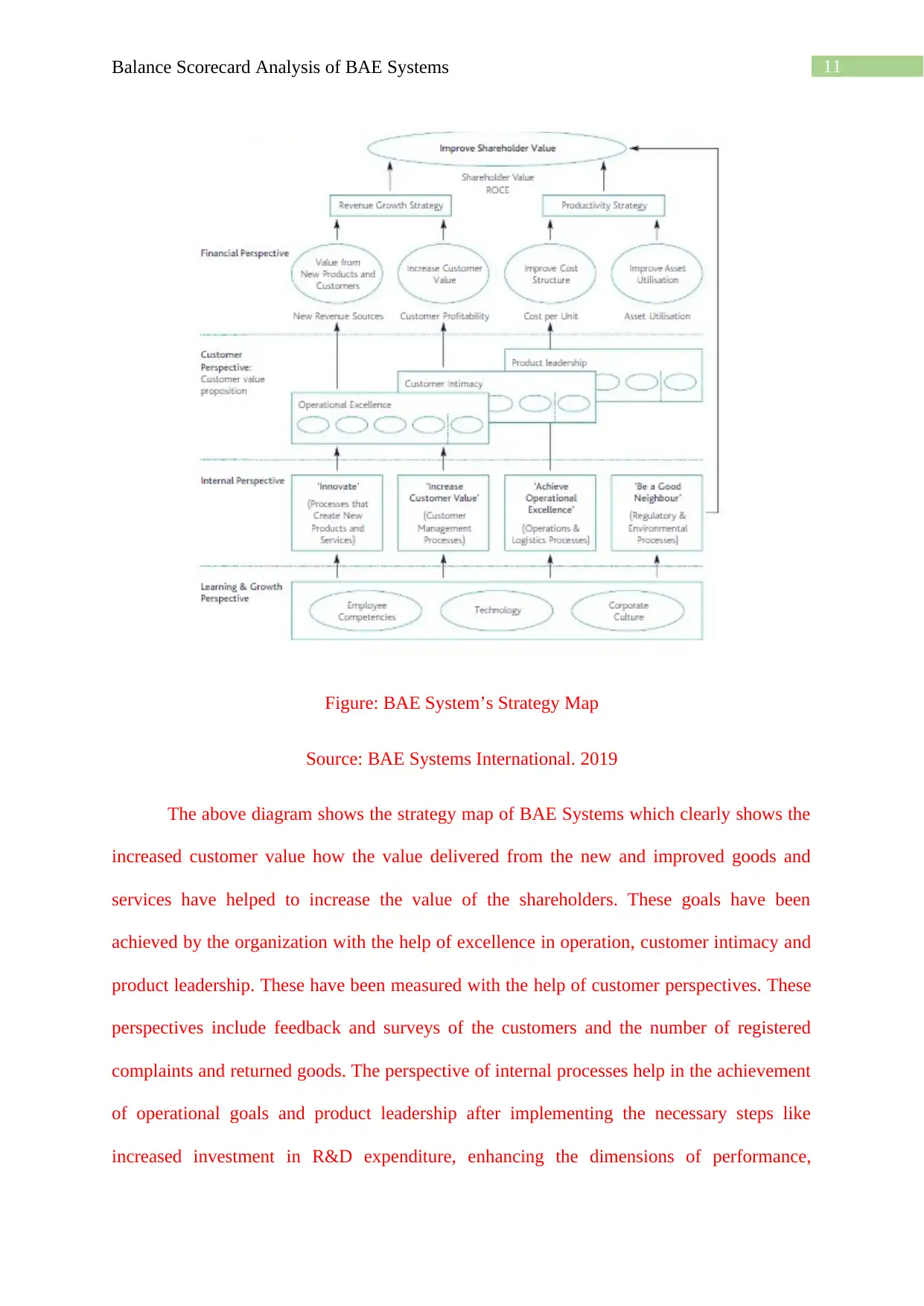
Figure: BAE System’s Strategy Map
Source: BAE Systems International. 2019
The above diagram shows the strategy map of BAE Systems which clearly shows the
increased customer value how the value delivered from the new and improved goods and
services have helped to increase the value of the shareholders. These goals have been
achieved by the organization with the help of excellence in operation, customer intimacy and
product leadership. These have been measured with the help of customer perspectives. These
perspectives include feedback and surveys of the customers and the number of registered
complaints and returned goods. The perspective of internal processes help in the achievement
of operational goals and product leadership after implementing the necessary steps like
increased investment in R&D expenditure, enhancing the dimensions of performance,
Figure: BAE System’s Strategy Map
Source: BAE Systems International. 2019
The above diagram shows the strategy map of BAE Systems which clearly shows the
increased customer value how the value delivered from the new and improved goods and
services have helped to increase the value of the shareholders. These goals have been
achieved by the organization with the help of excellence in operation, customer intimacy and
product leadership. These have been measured with the help of customer perspectives. These
perspectives include feedback and surveys of the customers and the number of registered
complaints and returned goods. The perspective of internal processes help in the achievement
of operational goals and product leadership after implementing the necessary steps like
increased investment in R&D expenditure, enhancing the dimensions of performance,
⊘ This is a preview!⊘
Do you want full access?
Subscribe today to unlock all pages.
Trusted by 1+ million students worldwide

1 out of 17


Related Documents


Your All-in-One AI-Powered Toolkit for Academic Success.
+13062052269
info@desklib.com
Available 24*7 on WhatsApp / Email
![[object Object]](/_next/static/media/star-bottom.7253800d.svg)
Unlock your academic potential
Copyright © 2020–2026 A2Z Services. All Rights Reserved. Developed and managed by ZUCOL.